548 résultats
200012973Cos Cob CT: Alexander Autographs. New. 2000. Paperback. FREE UPGRADE to Courier/Priority Shipping Upon Request - IN STOCK AND IMMEDIATELY AVAILABLE FOR SHIPMENT - Flawless. Features an image of an original signed painting by U. S. Grant on the back cover. Includes autographed items of historical interest including from a number of public figures in politics and the arts. -- with a bonus offer-- . Alexander Autographs paperback
199727871Greenwich CT: Alexander Autographs. New. 1997. Paperback. FREE UPGRADE to Courier/Priority Shipping Upon Request - IN STOCK AND IMMEDIATELY AVAILABLE FOR SHIPMENT - FLAWLESS COPY BRAND NEW PRISTINE -- with a bonus offer-- . Alexander Autographs paperback
199727870Greenwich CT: Alexander Autographs. New. 1997. Paperback. FREE UPGRADE to Courier/Priority Shipping Upon Request - IN STOCK AND IMMEDIATELY AVAILABLE FOR SHIPMENT - FLAWLESS COPY BRAND NEW PRISTINE -- with a bonus offer-- . Alexander Autographs paperback
199928069Greenwich CT: Alexander Autographs. New. 1999. Paperback. FREE UPGRADE to Courier/Priority Shipping Upon Request - IN STOCK AND IMMEDIATELY AVAILABLE FOR SHIPMENT - FLAWLESS COPY BRAND NEW PRISTINE NEVER OPENED -- with a bonus offer-- . Alexander Autographs paperback
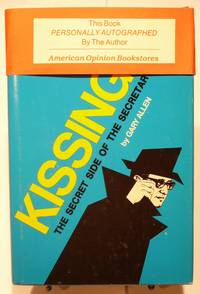
1976004421Devin-Adair 1976. 1st Edition. Hardcover. Near Fine/Very Good. Signed by Authors. 1st Printing SIGNED on front end paper "Best Regards" Gary Allen. First Printing stated. Has private library envelope on front end paper No other marks or writings pages bright and clean binding sound. Dust jacket unclipped light wear to spine ends and corners light shelf wear. Has slip enclosed around book "This book Personally Autographed by the Author. American Opinion Bookstores." Devin-Adair hardcover
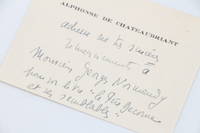
194184462s. l.: S. n. 1941. Fine. S. n. s. l. s. d. 1941 9.50 x 7.50 cm une feuille Autograph signed carte de visite by Alphonse de Chateaubriant 5 lines written in blue ink addressed to Georges Normandy thanking him for having sent him his work ""Le père Decorne et ses semblables"" recently published. A small black ink stain in the upper right margin of the card thin adhesive strips in the right and left margins of the verso of the card. S. n. unknown
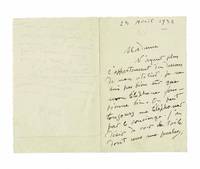
193376130s. l. 1933. Fine. s. l. 1933 10.40 x 16.20 cm 2 pages sur un double feuillet Autograph letter signed by Edmond Aman-Jean; two pages written in black ink on a double sheet with the painter's monogram. Fold inherent to mailing. ""No longer having the apartment below my studio I am not quite sure that my telephone is working properly. One can always call me through the concierge. I have the desire to see the canvas you mention to me."" unknown
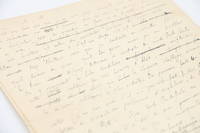
191388289Londres 1913. Fine. It is no longer a question of conquering the world; but of pacifying it. Work let us work together for world peace. Londres 12 décembre 1913 20 x 25.50 cm en feuillets Complete autograph manuscript in French by Anatole France 7 pages in black ink on 7 leaves and a signed autograph note on a bifolium. Complete and extensively corrected speech by Anatole France on the occasion of a banquet given in his honor in London. The future Nobel Prize winner for Literature delivers a passionate appeal for peace between nations and an ode to England - its philosophy literature and politics - less than a year before WW1. The writer offered this manuscript with a signed note: Keep dear colleague and friend keep these leaves of paper if they are of any value to you. Anatole France London December 12 1913. Anatole France's English biographer witnessed this speech which foreshadowed the absolute necessity of a close relationship between France and England based on their long and rich relationship: ""In December 1913 the Master paid a brief but memorable visit to this country. The central event of his sojourn in London was the banquet given in his honour at the Savoy Hotel. On this occasion it was apparently decided in those remote and exalted circles where such decisions are made that the socialist should be ignored his turn was to come later with the Fabians but that honour could and should be paid to the man of genius the foremost man of letters of the day. The feast was therefore presided over by a peer the late Lord Redesdale himself a gifted writer. The company was numerous and distinguished. . Monsieur France though an inimitable talker is not a speaker and on this occasion he read his discourse. All that I now remember of it was the rich deliberate music of the voice that uttered it and the words which he repeated with strange insistency: 'Travaillons de concert a la paix du monde''Let us work together for the peace of the world.' This was in December 1913. The exhortation thus reiterated seemed even then to be fraught with ominous significance and now looking back over the years of horror that were so soon to follow one wonders whether this old man with his strange inscrutable eyes and musical melancholy voice had somehow seen the shadow of the coming catastrophe."" J. Lewis May Anatole France the man and his work: an essay in critical biography p. 98-99. The manuscript contains numerous crossed-out and rewritten passages and shows the genesis of the writing of this beautiful speech: M.M. I am not sure that I am not dreaming. Welcomed with this splendid cordiality by so many men whose names works and thoughts represent so much greatness strength and beauty. . Your compatriots have authored masterpieces of this kind for two centuries. Need I remind you of Richardson and Fielding Swift and Daniel Defoe Walter Scott Dickens and Thackeray George Elliott . the novel is in England in its favorite soil like the apple in Normandy and the orange in Valencia. Why It takes a large volume or a single word to explain it. Well let's say it in a word. This word Lord Redesdale gave us a foretaste of it. It is that the novel is intimate cordial and familiar by nature and that the English has a familiar intimate and cordial spirit. Gentlemen I am not dreaming: it is a banquet I see the shining cups and the benevolent faces of the guests. And I can understand why you invited me. I am a symbol an allegory for you. I represent at this table the French literati just as at the festivals of the French Revolution the citizen Momoro represented the goddess Reason. Without being a goddess or particularly reasonable this idea puts me at ease and I won't quibble too much with you about the choice of your symbol. I tell myself that perhaps you didn't mind having a Frenchman at your table who having the weakness to write at least had the merit which you greatly value of never d unknown
1975047198Kyoto Japan: Senshoku to Seikatsusha Publishing Co 1975. 1st Edition . Hardcover. Very Good/No Jacket. Folio - over 12 - 15" tall. Folio. 76 pages indexed 104 colour plates. Hardcover in green cloth. Binding has scuffs on front and rear covers. SIGNED by the author on the half title. Text is clean. Text is in English with Japanese translation on the facing page. <br/> <br/> Senshoku to Seikatsusha Publishing Co hardcover
1940059287New York: The Macmillan Company 1940. First Edition 1st Printing. Hardcover. Near Fine/Good. Light Blue Boards Spine Stamped In Black. First Edition Dated 1940 On Title Page "Published October 1940" On Copyright Page . A Bright Clean Solid Copy No Fraying Or Stains Or Marks. Dust Jacket First Issue Price Clipped But Rear Panel Refers To His Only "Earlier Book" Black Bay And Chestnut. Dust Jacket With Short Tears And Loses Small Tape Repairs At Bottom Edge Of Front Panel; Vertical Crease On Front And Rear Panels As Dust Jacket Was Stored Folded Inside The Book. <br/> <br/> The Macmillan Company hardcover
1923008436Philadelphia: J B Lippincott Co. Second Edition Revised. Hard cover in original cloth. Published Philadelphia: J B Lippincott Co. 1923 sixth printing. 8vo. 312pp. with 25 illustrations and 35 diagrams frontis. Gold cloth with blue titles and cover design. Inscribed by author on flyleaf: "Best wishes for success on 'the downward path!' Paul L. Anderson January 21 1933." Gentle foxing along edges of page block light soil to cloth sweating line along top edge of frontis and its tissue guard. Else very good plus pages clean unmarked binding tight. . Very Good Plus. Hard. 1923. J B Lippincott Co unknown
1969010291Paris: EURIMPRIM IMPRIMEURS EUROPEENS REUNIS. 2nd Edition. Hard cover in red letherette boards. Published Paris: EURIMPRIM IMPRIMEURS EUROPEENS REUNIS 1969. Folio 9 3/4" x 13" 413pp. illustrated with full page plates of insignia in color and b/w. Text in French. Pebbled red letherette with gilt titles. Russian born Serge Andolenko served admirably as French military officer rising to the rank of brigade général of the French Army. "A passionate historian he was renowned for several publications on the French Army and the Imperial Russian Army." Work covers all infantry regiments including infantry of the foot hunters the Zouaves the foreign legion the Moroccan riflemen the African light infantry and the Moroccan Goums. Mild dust foxing on top edge of page block gilt bit dull else fine clean bright unmarked. A beautiful copy. . Near Fine. Hard. 1st. 1969. EURIMPRIM (IMPRIMEURS EUROPEENS REUNIS) unknown
1949010290Paris: Imprimerie Nationale. Signed numbered first edition. Number 30. Hard cover in cloth and limp boards. Published Paris: Imprimerie nationale 1949. 4to. 8 3/4" x 12" 317pp. Text in French. Pale green cloth with gilt titles. Signed by Andolenko on fly leaf. Russian born Serge Andolenko served admirably as French military officer rising to the rank of brigade général of the French Army. "A passionate historian he was renowned for several publications on the French Army and the Imperial Russian Army." Work covers all infantry regiments including infantry of the foot hunters the Zouaves the foreign legion the Moroccan riflemen the African light infantry and the Moroccan Goums. Some uniform sun fade to the spine dust foxing on top edge of page block else near fine clean bright unmarked. A beautiful copy. . Very Good Plus. Hard. 1st. 1949. Imprimerie Nationale unknown
1923003175New York 1923: Harcourt Brace & Co. 1923. First American Edition . Blue Cloth. Very Good. 314 Pp. First Printing. This Is Andrade's First Book Originally Published In England In 1923 Intended As An Introduction To Atomic Structure For The "Serious Student". Andrade Was Quain Professor Of Physics At The University Of London 1928-1950 And A Highly Honored Historian Of The Physical Sciences. This Copy Signed By Robert F. Bacher And Dated In April 1925 While Bacher Was A Student. Bacher Later Followed Hans Bethe To Cornell In 1935 Where He Started Doing Experimental Work In Nuclear Physics With Bethe And Left Theoretical Work Behind. He Was Quickly Promoted To Full Professor And Director Of The Laboratory Of Nuclear Studies. Early On He Had Felt That The United States Needed To Start Doing War Work And When Lee Dubridge Head Of The Radiation Lab Working On Radar At Mit Summoned Him There In 1941 He Went. Then Late In 1942 Oppenheimer Who Had Been One Of Bacher's Instructors Earlier At Caltech Approached Bacher About A New Lab For Nuclear Weapons Work That Was Just Starting Up And The Following Spring Asked Him To Join The Manhattan Project. Bacher Declined Initially Telling Oppenheimer That What He Needed Was Engineers. Ultimately When Oppenheimer Made A Commitment To Hiring More Engineers And Made Him Head Of The Experimental Physics Division Bacher Signed On. From The Beginning Bacher Was Firmly Opposed To Making Los Alamos A Military Lab And Persuaded Oppenheimer Who Had Agreed To Take A Commission As Lieutenant Colonel And Had Already Ordered His Uniforms To Keep It Under Civilian Control At Least Until They Had Enough Fissionable Material For A Bomb. When The Project Was Reorganized In July 1944 To Speed Work On Implosion Bacher'S Experimental Physics Division Was Split And He Was Put In Charge Of The G For "Gadget" The Code Name For The Bomb Division. Bacher Personally Escorted The First Bomb To The Test Site In July Of 1945. In 1946 He Was Awarded The President'S Medal For Merit For His Work On The Manhattan Project. Bacher Returned To Cornell Hoping To Get Back To High-Energy Physics But The Bomb'S Aftermath Continued To Involve Him. He Felt Strongly That There Should Be Some Sort Of International Control Of Atomic Weapons And Worked Hard On Negotiations With The Soviet Union. He Admitted In His Oral History That This Was Perhaps Idealistic But Thought That Getting This Technology Out In The Open Might Have Avoided The Subsequent Cold War. When The Atomic Energy Commission Was Established Bacher Served As The Only Scientist Among Its Members; He Had Tried To Decline The Post But Took It On When He Learned That There Would Be No Scientist At All If He Didn'T Accept. While A Member Of The Aec He Pushed For The Development Of Nuclear Submarines And Breeder Reactors For Commercial Power. In The Meantime Lee Dubridge Now President Of Caltech Offered Him A Position As Chairman Of The Division Of Physics Mathematics And Astronomy Or As Just A Professor Whichever He Preferred. "The Decision I Came To Was A Fateful One And Probably Illustrates A Major Failing In My Makeup" Bacher Said In The Oral History. What He Saw As A Major Failing In His Makeup Was In Fact A Superb Talent For Envisioning The Future And Leading The Institute Into It. After Getting A Commitment That The Institute Would Support A Program In High-Energy Physics Both Theoretical And Experimental Bacher Arrived In 1949. One Of His First Hires In High-Energy Physics Was Robert Walker Whom He Had Known At Los Alamos And Cornell. Another Of Bacher'S Early Recruits Was Richard Feynman Who Was Reportedly Feeling "Unsettled" At Cornell; Bacher Persuaded Him To Sign On At Caltech With A Sabbatical Year In Brazil In Between. Feynman Then Settled In Pasadena In 1951 For The Rest Of His Career. Now With Feynman And Robert Christy Who Had Come In 1946 Bacher Felt He Had The Two Most Outstanding Theorists From Los Alamos. Then In 1955 He Also Hired Murray Gell-Mann. <br/> <br/> Harcourt Brace & Co. hardcover
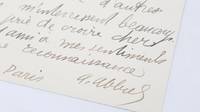
194186762Paris 1941. Fine. Paris s. d. ca 1941 14 x 15.50 cm une page sur un double feuillet Autograph letter signed by sculptor André Abbal 13 lines in black ink on a double sheet. Traces of folding inherent to postal dispatch. The sculptor discusses his various productions: ""I am now certain that my Tarn et Garonne will not return to the workshop. With peace of mind on this front I will work hard on other things that interest me greatly."" André Abbal student of Alexandre Falguière is renowned for his direct-carved stone sculptures. unknown
1961627341961. Fine. 23 juin 1961 13.50 x 21 cm 1 page sur une feuille Signed autograph letter of André Billy written in green ink. Date at the top of the letter and signature at the bottom of the letter. Folding caused by mailing. André Billy writes in this letter that ""Franco-Maurras friendship"" is not new. unknown
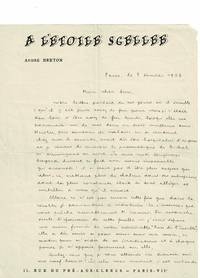
195375729Paris 1953. Fine. Paris 8 janvier 1953 21 x 27 cm 1 pages et quelques lignes sur un feuillet Unpublished handwritten signed letter from André Breton addressed to critic Charles Estienne; one page and a few lines in black ink on a paper from the à l'étoile scellée gallery. Two transverse folds from having been sent a small corner missing in the upper right margin. Very beautiful letter giving an account of the death of one of André Breton's dearest friends and of his quarrel with Albert Camus. Breton tells his friend about the death of the Surrealist Czech artist Jindich Heisler: Your letter spoke of those days where it seemed that there was only just enough fire to live: on Monday there was far from enough fire when it reached me: one of my two or three best friends Heisler taken suddenly unwell on his way to mine on Saturday had to be hospitalised urgently and I had just received the pneumatic from Bichat telling me of his death. The event no less inconceivable than accomplished left me distraught for a long time: there was no-one more exquisite than he putting more warmth into everything he did the most constant of which was to lighten and embellish those whom he loved. The two poets were indeed very close: Heisler participated alongside Breton in the launch of Néon in 1948 and supported him during a period of depression accompanying him with other friends to the Île de Sein. The beginning of 1953 was overshadowed by the death of Jindich Heisler 4 January. Loyal among the faithful he lived entirely for Surrealism according to Breton who pays tribute to his activity as a leader: This is how he was between 1948 and 1950 the soul of Néon and until his last moments the greatest bearer of projects that as if by magic his talent gave him the means to achieve. Henri Béhar André Breton In this letter laden with pain Breton suddenly makes reference to L'Homme révolté by Albert Camus published two years earlier: Come on it is not yet the time in the rebellion that I will succeed in introducing the measure that M. Camus kindly preaches to us. The two writers met in New York at the end of March 1946 when Camus was invited to the United States for a conference tour as a representative of Combat. The two agree on the best way to preserve the testimony of certain men free from ideological distortions. They dream of a kind of pact by which people of their calibre would commit to not join any political party to fight against the death penalty to never claim any credit whatsoever. ibid. With other intellectuals they founded the Rassemblement démocratique révolutionnaire RDR in 1948; but the idyll ended a couple of years later in the autumn of 1951 when Camus published Lautréamont et la banalité an extract from his Homme révolté which was published later. Breton was extremely hurt and responded to him in an article entitled Sucre jaune in Arts: This article . testifies to the part of Camus for the first time for an indefensible moral and intellectual position. . He only wants to see a guilty adolescent in Lautréamont whom he - in his capacity as an adult - must discipline. He goes as far as to find him in the second part of his work: Poésies a deserved punishment. According to Camus Poésies would be but a mass of laborious banalities . It could still be worse if the destitution of these views did not intend to promote the most suspect thesis in the world which is that absolute revolt can generate only the taste for intellectual enslavement. This is a completely gratuitous ultra-defeatist statement which must incur even more contempt than its false demonstration. Thus two years later Breton still holds out against Camus' crime of lese-majesty towards that which Breton constructed as the father of surrealism but even more this allusion to Camus' pacifist philosophy bearing witness to the incompatibility between a thought of moderation and a poetry of revol unknown
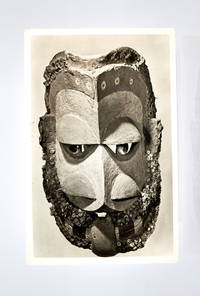
195875712Amsterdam 1958. Fine. Amsterdam 1958 13.90 x 8.90 cm une carte postale Autograph signed postcard addressed to Jean Schuster Amsterdam 1958 13.9 x 8.9 cm a postcard Handwritten postcard signed by André Breton addressed to Jean Schuster written in blue ballpoint pen on the back of a postcard reproducing a black and white photography of a Melanesian mask preserved at the Tropenmuseum in Amsterdam and which André Breton designates under the highly significant qualifier friend responsible for showing his affection to Jean Schuster. This grid pattern of canals and the tulip tiling leaves us in great indecision. . This country is decidedly very beautiful. His wife Elisa Breton added a few lines of a Surrealist tone following the main text: Elisa in Amsterdam comes from a gingerbread tin and a potential twisting from antiquarians. Jean Schuster 1929-1995 joined the Surrealist group in 1947. Close to Benjamin Péret and André Breton he will become Breton's executor. unknown
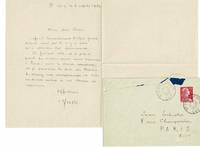
195676379Saint-Cirq-Lapopie 1956. Fine. Saint-Cirq-Lapopie 9 octobre 1956 13.50 x 18 cm 1 page sur un double feuillet et une enveloppe Autograph letter signed by André Breton addressed to Jean Schuster; one page written in black ink on a double sheet of white paper. Envelope included. The writing of this letter coincides with the publication date of the very first issue of the journal Le Surréalisme même: ""At last! Considering the closed object let us say that there is nothing left but to await events."" Breton then at his house in Saint-Cirq-Lapopie plans to return to Paris for this occasion: ""This was necessary - and the great cold of the morning - to bring us back to Paris: we will be there Friday and I will stop by the Musset in the evening."" Jean Schuster 1929-1995 joined the Surrealist group in 1947. Close to Benjamin Péret and André Breton he would become the latter's literary executor. unknown
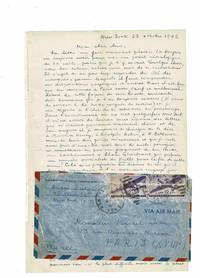
194576388New York 1945. Fine. New York 23 octobre 1945 17.10 x 25.40 cm 2 pages sur un feuillet et une enveloppe Unpublished autograph letter signed by André Breton addressed to Marcel Jean two pages written in blue ink on a sheet. ""Air mail"" envelope enclosed. Creases inherent to mailing. This letter is mentioned and very briefly quoted in Marcel Jean's autobiography Au galop dans le vent. Important and lengthy letter sent from New York when Breton in exile since 1943 as he was considered a ""dangerous anarchist"" by the Pétainist government was forced - like many intellectuals - to leave France in order to continue working. He shares with his friend the ""overwhelming despair"" ""l'accablement"" that the city brings him and one still senses his eagerness to return to his homeland. Painter draftsman and decorator Marcel Jean joined the Surrealist group in 1933 and became one of the movement's first chroniclers. One can sense all his emotion upon receiving this letter which he discusses at length in his autobiography: ""October 1945 I write to André Breton in New York. In response two densely written pages of fine calligraphy. My letter whose tone must have pleased him gave him ""real pleasure"" ""vraiment plaisir"". He finds me ""healthy safe and by no means lacking in that lucid smiling very human way of seeing"" ""sain sauf et nullement dénué de cette façon de voir lucide souriante très humaine"" that he has always known in me ""I just thought ""Je viens de penser"" he says of your firm handshake ""à ta rude poignée de main""."". I had mentioned to him the study on Lautréamont whose elements I am gathering he encourages me to give extracts of it for a Surrealist issue being prepared for the magazine Vrille ""this without prejudice to a drawing by you that Vrille should reproduce"" ""cela sans préjudice de dessin de toi que Vrille devrait reproduire"" and for the same magazine to submit ""a certain number of recent works to an in-depth analytical and critical commentary"" ""un certain nombre d'ouvrages récents à un commentaire analytique et critique approfondi"". This is followed by advice and encouragement regarding a work of literary criticism he would like to see me undertake. Then some news from America and our friends: Max Ernst Tanguy Péret who is bored in Mexico Matta who ""paints large panels in a new genre sadistic figurative much remarked upon."" ""peint de grands panneaux dans un nouveau genre figuratif sadique très remarqués."". And the vigorous signature. Breton's letters their contrast between the text with extremely regular handwriting and the flourish hurried and in both scripts something controlled have always given me the impression that in writing to me he was doing me the favor of an autograph. His message outlined for me a program as chronicler in view of his return to Paris in the spring but I had in mind something other than commenting on the commentaries of critics whose interest he pointed out to me - Maurice Blanchot or Léon-Pierre Quint. My projects concerned the study of Lautréamont and then - or at the same time: to paint and to draw."" unknown
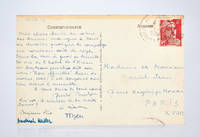
194975342Île-de-Sein 1949. Fine. Île-de-Sein Août 1949 13.60 x 9 cm une carte postale Handwritten postcard from André Breton signed by himself his wife Elisa Benjamin Péret Toyen and Jindich Heisler addressed to Marcel Jean and his wife and written on the back of a black and white photograph view of the Chaise-du-Curé rocks on the Île de Sein Finistère. Charming poetic postcard written during a stay in Brittany: ""la corne de brume manque à tous ses devoirs quoique le coupage au couteau soit de règle. Dans la vase à quoi se limite la vue de l'hôtel de l'Océan un bateau penché dit son nom : ""Rose effeuillée"". Rien de moins. Mais c'est toujours très bien dans l'ensemble."" Returning to more professional discussions Breton asks for news of the American gallery owner Sidney Janis: What was the result of the Janis' visit unknown
194774239Paris 1947. Fine. Paris mercredi 12 mars 1947 20.80 x 27 cm 1 page sur un feuillet enveloppe jointe Unpublished autograph letter signed addressed to Sarane Alexandrian one page written in blue ink on a sheet with the letterhead of the 1947 International Exhibition of Surrealism. Envelope enclosed. This letter is a response to a letter sent the day before by Sarane Alexandrian partially accessible on the Breton Archives website. Born in Baghdad and engaged in the Resistance in the Limousin it was during this period that Sarane Alexandrian discovered Dadaism. At twenty years old he became André Breton's right-hand man and was entrusted by the latter with directing the secretariat of Cause in order to respond to applications from numerous young artists from around the world wishing to join the Surrealist movement. In October 1948 he broke with the pope of Surrealism while maintaining his esteem and admiration for him: ""Near him one learned the savoir-vivre of poets whose essential article is a savoir-aimer. We admired him for the dignity of his behavior as a writer thinking neither of prizes nor decorations nor academies"" Alexandrian André Breton par lui-même 1971. The letter we offer marks the beginnings of this ephemeral but important relationship between the two writers. André Breton twenty years Sarane Alexandrian's senior seems to place great hopes in this young theorist who takes interest in his writings: ""Max-Pol Fouchet has not yet had me read 'Poetry and Objectivity' but your letter tells me enough for me to believe in a profound accord between us an accord based less on the reception you give to what my message has been able to be until now than on the very nature of your personal project which largely coincides with mine."" As for ""Poetry and Objectivity"" he adds: ""I would see the greatest interest in publishing in the catalog of the Surrealist exhibition some pages by you in which the principal ideas expressed in your letter would need to be barely transposed and especially those which touch upon the creation of an 'erotic mystique'."" This publication taking the form of a manifesto would indeed see the light of day and appear in the review Fontaine produced for the occasion of the 1947 International Exhibition of Surrealism at the Galerie Maeght. The text would earn great success for young Alexandrian who would henceforth be considered by his peers as the number two theorist of Surrealism. A very fine letter marking the beginning of the important but ephemeral relationship between the two master thinkers of Surrealism. unknown
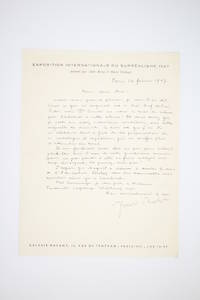
194776435Paris 1947. Fine. Paris 16 février 1947 20.80 x 27 cm une page sur un feuillet enveloppe jointe Unpublished autograph letter signed by André Breton addressed to Michel Fardoulis-Lagrange written in black ink on a sheet with letterhead of the International Surrealist Exhibition 1947. Envelope included. Transverse folds inherent to mailing. Interesting letter evoking the review Troisième Convoi founded by Jean Maquet and Michel Fardoulis-Lagrange written shortly before the second surrealist exhibition at the Maeght gallery: ""Dites-moi : IIIe Convoi ne nous a tout de même pas habitués à cette allure ! "" ""Tell me: IIIe Convoi has not exactly accustomed us to this pace!"". The review whose title was inspired by Vases communicants ""Nous voyageurs du second convoi."" ""We travelers of the second convoy"" had five issues between 1945 and 1951. We have found no trace of Breton's collaboration with this review but the letter we offer demonstrates that it may have been discussed: ""Et vous savez que je reste en assez mauvaise condition avec cette séquelle de sinusite. . Il me faudrait aussi être un peu plus éclairé peut-être sur l'axe de votre quatrième numéro pour ne pas partir à côté ou faire malgré moi trop divergent. Ne pensez-vous pas "" ""And you know that I remain in rather poor condition with this sequel of sinusitis. . I would also need to be perhaps a little more enlightened about the direction of your fourth issue so as not to go off track or despite myself be too divergent. Don't you think"" unknown
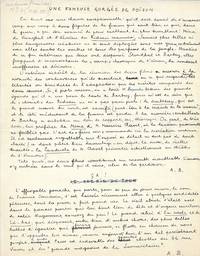
1953751681953. Fine. mai 1953 21 x 27 cm une feuille et un petit papillon André Breton autograph manuscript signed ""A.B."" of two chronicles entitled ""Une fameuse gorgée de poison"" and ""ça !"" written for issue no. 7 of May 1953 of the review Médium. One long page written in black ink in careful handwriting on a white sheet some corrections and additions sometimes in blue ink. Included is a small slip in Breton's hand concerning an article by René Alleau containing a small printed text annotated by him in red and blue ballpoint pens and bearing an explanatory note at the top. Two transverse folds of no significance. This is the final version of these two texts; an intermediate version of these articles more crossed out than ours can be seen on the Breton Archives website. ""Une fameuse gorgée de poison"" ""A famous gulp of poison"" is a critical text on two films: Le Rideau cramoisi by Alexandre Astruc drawn from a story by Barbey d'Aurevilly and La Canduela by Maurice Clavel drawn from a novel by Stendhal: ""As they stand these two films constitute an unforgettable ensemble. Love is kindled there in the wind it loves that of perdition."" ""ça !"" ""that!"" whose title we can clearly see was previously chosen by Breton ""Le gredin du jour"" ""The scoundrel of the day"" is a diatribe against ""The frightful fool who bears for so few days more the name of Francis Jourdain"" and who ""recently allowed himself some sordid senile drivel which the press made much of. The old idiot had got it into the rotten parsnip that serves him as head and excretory organ to soil Huysmans if you please!"" unknown
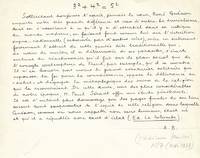
1953751691953. Fine. mai 1953 21 x 27 cm une feuille André Breton autograph manuscript signed ""A.B."" entitled ""3² 4² = 5²"" written for issue no. 7 of May 1953 of the review Médium. 18 lines written in black ink in careful handwriting on a white sheet. Two transverse folds of no significance. This is the final version of the text; an intermediate version of this article can be seen on the Breton Archives website. An interesting chronicle on Paul Sérant's work devoted to René Guénon and his work published by éditions La Colombe: ""Of this work one of the most considerable of our time M. Paul Sérant offers a penetrating study."" unknown