Biblio.com

184 résultats
1893039619San Francisco 1893. Original Signed Photograph . No Binding. Fine. 7" x 5. Original Photograph Image 4 1/2" X 3 7/8" Mounted On Plain Card With Rounded Corners. Inscribed By Irving To "Sweet Charlotte" And Dated 1893. Note On Verso Explaining That It Was Obtained Backstage When She Was Taken To San Francisco By Rosa Bradbury And Her Sister. <br/> <br/> unknown
1857409672New York: Barker & Godwin 1857. From the Bart Auerbach Collection. Slight split at ends of spine a few small stains on front cover. 8vo. 16 pages. Original buff printed wrappers. An early and rare autograph catalogue. Includes items from the collection of Aaron Burr relating to the Revolutionary War principally by officer and others encamped on the Hudson. Barker & Godwin unknown
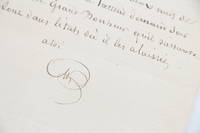
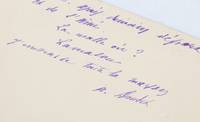
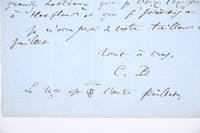
1866866021866. Fine. lundi soir 1866 13.30 x 20.90 cm une page sur un bifeuillet Autograph letter signed by Alexandre Dumas to his mistress Marie Richon. 6 lines on one page of a bifolium of laid paper with the writer's crowned initials. « Chère amoi sic Ton ami arrivé moulu brisé de deux nuits de voitures et de chemins de fer. Il t'attend demain soir mardi. Oh ce sera avec grand bonheur qu'il s'assurera que toutes choses sont dans l'état où il les a laissées a toi » Nothing is known of this affair with Marie Richon addressed to this mistress evidently sensitive to literature ""Fais-moi de bons vers pour mon retour"" he requests of her in another note. Actress society woman or woman of learning the mystery remains complete around this character who inspires in the insatiable Dumas a torrid correspondence. He notably arranged meetings with his mysterious conquest at his residence on Boulevard Haussmann where he had settled from 1865 onwards. A sentence from Dumas in another note tells us that she even met Dumas's daughter who lived with her father and endured the visits of his mistresses ""elle t'adore - ou plutôt nous t'adorons"" he would write to her. This missive can probably be situated during 1866 when the writer was preparing the theatrical adaptation of his novel Gabriel Lambert and mentions in a letter a reading of the play created at the Ambigu-Comique on March 16 1866. The last years of his life did not belie his immeasurable love of women; during this period rich in adventures he also shared his nights with the feminist and gerontophile Olympe Audouard as well as the famous Adah Isaacs Menken whose portraits alongside the writer were divulged by their indiscreet photographer. Handsome letter filled with anticipation from the hand of the great writer and addressed to a mysterious mistress still unknown to biographers. unknown
1860640961860. Fine. s. d. circa 1860 20.60 x 27.60 cm un feuillet remplié DUMAS Alexandre Naïs et Chloé. Unpublished handwritten sapphic poem signed by Alexandre Dumas N. d. c. 1860 206 x 276 cm one folded leaf Autograph manuscript poem signed by Alexandre Dumas bearing the title Naïs et Chloé 84 verses in black ink on a blue folded leaf of paper. A few tiny tears without damage to the text invariably produced when a leaf of paper is folded. A very rare manuscript of a long unpublished poem depicting the love of Naïs and Chloé the writing of which is motivated by the admiration and tribute paid by Alexandre Dumas to one of the greatest figures of ancient poetry Sappho. A prolific novelist Dumas rarely tried his hand at poetry; Naïs et Chloé by its length constitutes a hapax in the literary production of this writer. The text remains unpublished to this day and is here enhanced by the elegant calligraphy of its author. The poem is made up of 21 quatrains among which stands a remarkable insertion of the most famous verse by Sappho to the beloved woman the title of which is preserved in the very body of the text. This embedding is part of the verve with which Dumas defends the poetic and evocative force of the writing of Sappho whom he elevates to the rank of the star of the world of Poetry: Il est au sein des mers s'appuyant à l'Asie Entre l'heureuse Smyrne et la sombre Lemnos Une île aux bois fleuris chers à la Poésie A qui Venus donna le doux nom de Lesbos. Quand du chantre divin la voix fut étouffée Que du nom d'Euridice elle eut frappé l'écho Le flot roula tête et la lyre d'Orphée Sur la rive où plus tard devait naître Sapho Sapho naquit la lyre en ses mains fut remise Les sons qu'elle en tira jusqu'à nous sont venus. Translated with conscientious care by the author the poem borrowed from Sappho in which that most famous verse emerges this one I say is equal to the gods is found in several places in Dumas' work particularly in the chapter entitled les vers saphiques of San Felice and in a collection of articles dedicated to the great female figures where she sits alongside Joan of Arc and Margaret of Anjou. For Dumas it is a matter of remaining faithful to the written verses and rendering their sensuality often blurred by previous translators: The translations of these two poets often appear to lack not only ancient color but are inadequate in their lesbian ardor Les étoiles du monde Galerie historique des femmes les plus célèbres de tous les temps et de tous les pays. Above and beyond this translation Dumas is imbued with the lyricism of Sappho without losing his own romantic vein and he paints the sapphic love of Naïs and Chloé in an erotic light: Oh seule palpitante échevelée et nue Une main sur ma gorge et l'autre. Oh ma Naïs Serre moi dans tes bras et sois la bien venue Car à force d'amour. tiens. tiens je te trahis Et l'on n'entendit plus alors dans la nuit sombre Que le bruit des baisers répétés par l'écho Car Nais et Cloé se taisaient et dans l'ombre Clinias s'enfuyait en maudissant Sapho. The poem testifies to the continuous interest that the authors of the late 19th century showed toward sapphism and to the personage of the reader-voyeur here embodied by Cleinias whose most famous occurrence remains Zola's Nana. Exceptional and long autograph sapphic poem by Alexandre Dumas. $ 10 000 unknown
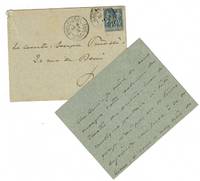
189475854Marly-le-Roi 1894. Fine. Marly-le-Roi 1894 11.30 x 8.90 cm une carte recto-verso Autograph letter signed by Alexandre Dumas Fils addressed to Count Joseph Primoli. Envelope included. A charming letter in which Dumas Fils thanks his friend for lending him a volume and invites him to visit during the week. It was at Princess Mathilde's salon mentioned in this letter: ""Tendresses respectueuses à la Princesse"" ""Respectful affection to the Princess"" that Dumas Fils and Joseph Primoli first met. unknown
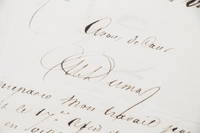
184187125s. l. 1841. Fine. s. l. août 1841 13.40 x 20.50 cm une page sur un feuillet Autograph letter signed by Alexandre Dumas to the private secretary of the Royal Princess. A page written in black ink autograph address written on verso postal stamps dated 30 August 1841. ""Dearest Enclosed under your care are two letters: one which I beg you to send to Colonel Brahant by Joseph asking him to wait for the reply. The other is for M. Pascal whom you will be good enough to send to your home and who will also give you the answer as soon as possible. These two replies dearest you will send to me. Yours sincerely Dumas I had prepared my work for the 2nd and 17th so that Mr. Pascal would have them both in October. Send me the proofs if you have them printed before I get to Paris. Aesthetically written later dating from Dumas' exile in Florence. unknown
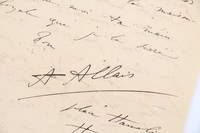
189588099Honfleur: s. n. 1895. Fine. s. n. Honfleur s.d. ca 1895 14 x 22 cm une page recto verso Autograph letter signed addressed to a journalist friend at Figaro illustré 28 lines in black ink. Fold mark inherent to envelope insertion a lack to upper corner of the letter without any damage to the text. Alphonse Allais must do a favor for his friend: ""Un peu de patience mon cher Abel un peu de patience. Sitôt rentré à Paris ma première démarche sera pour ton parapluie que je choisirai en soir gorge-pigeon et manche d'argent."" A little patience my dear Abel a little patience. As soon as I return to Paris my first errand will be for your umbrella which I will choose in pigeon-throat evening silk with a silver handle.; he therefore also allows himself to solicit the kindness of his correspondent: ""Et bien envoie-moi le n° du Figaro illustré d'il y a un mois ou deux où il y avait des choses de Toulouse-Lautrec."" Well then send me the issue of Figaro illustré from a month or two ago where there were things by Toulouse-Lautrec. He concludes his letter with a sententious: ""Donne-moi ta main loyale que je la serre. Ton Alphonse Allais. Bonjour aux amis."" Give me your loyal hand so I may shake it. Your Alphonse Allais. Greetings to friends. s. n. unknown
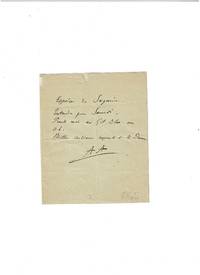
1880756851880. Fine. s. d. circa 1880 11.60 x 14.20 cm un billet Autograph letter signed by Alphonse Allais mounted on fine cardboard. Traces of transverse folds small lacks and marginal tears. ""Espèce de sagouin. / Entendu pour samedi. / Prends moi au Gil Blas vers 6h / Mille cordiaux respects à ta dame. A.A."" ""You rascal. / Agreed for Saturday. / Pick me up at Gil Blas around 6pm / A thousand cordial respects to your lady. A.A."" unknown
188984470s. l.: S. n. 1889. Fine. S. n. s. l. 5 Mai 1889 10.50 x 6 cm une feuille une enveloppe Autograph signed carte de visite from Alphonse Daudet 13 lines written in blue ink addressed to journalist and librettist Philippe Gille sending his thanks and congratulations for a recent performance. Envelope included. S. n. unknown
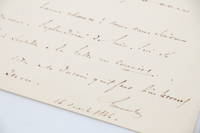
184684820Mâcon 1846. Fine. Mâcon 26 Décembre 1846 13.50 x 20.50 cm une page sur un feuillet Autograph letter dated and signed by Alphonse de Lamartine; one page with his monogram blind-stamped in the upper left corner and written in black ink on one leaf 15 lines. Folds inherent to mailing. In this letter Lamartine shows his happiness to collaborate with their mutual friend's journal and confirms a financial agreement. unknown
189064360s. l. 1890. Fine. s. l. s. d. 10 x 6 cm une carte Signed autograph card of Alphonse Daudet 7 lines in black ink erasure of the hand of the author. Letter of praise addressed to Jean Jullien playwright precursor of the theatrical revolutions of the twentieth century about one of his pieces which Daudet emphasizes the naturalistic aesthetic: "" what admirable acts of a moving and wide poetry of observation "" . unknown
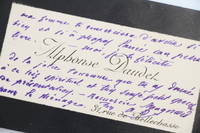
188986970Paris 1889. Fine. Paris 10 Avril 1889 10 x 6 cm une carte de visite une enveloppe Printed visiting card of Alphonse Daudet on which he added these few words for his friend the journalist Philippe Gille regarding his benevolent publicity that he devoted to his wife Julia's recently published work: ""Ma femme te remercie d'avoir si bien et si à propos lancé son petit livre. Moi je te félicite de la jolie tournure que tu as donné à ce très spirituel et bien sensé petit spectacle de présentation. Remercie Magnard pour le ménage. Ton A.D."" My wife thanks you for having so well and so aptly launched her little book. As for me I congratulate you on the nice turn you gave to this very witty and sensible little presentation show. Thank Magnard for the household. Yours A.D. Envelope enclosed with a tear due to the opening of the postal fold a date inscribed in margin on verso of the card probably that of the card's reception. unknown
1880634971880. Fine. s. d. circa 1880 - une feuille Letter written in ink on Vergé paper without date or address. An old handwriting indicates the letter was addressed to Zola information that can not be verified. Daudet relates the impression that the publisher Georges Charpentier left him during a dinner. The importance of the friendly group formed by the writers of the time is here particularly pregnant: "" I want to write him a word to propose to come with us five "". Presumably written after the death of Jules Goncourt probably in the 1880s as suggested by the use of the only surname Goncourt the letter evokes a cold between Goncourt and Charpentier: "" Goncourt may not be delighted; but he is too well brought up to let him see . "" unknown
188486671s. l. 1884. Fine. s. l. Mai 1884 12.50 x 9 cm une page une enveloppe Autograph signed visiting card by Alphonse Karr on which he has added recto verso a few words for the attention of journalist and librettist Philippe Gille 36 lines in purple ink. Envelope included. Alphonse Karr solicits his friend the journalist Philippe Gille to allow him to deliver a few articles in order to remedy his pecuniary problems and to come to the aid of his family. unknown
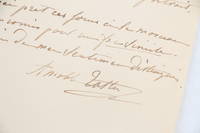
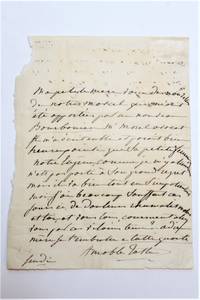
1840866121840. Fine. s. d. circa 1840 9.80 x 13.80 cm une page sur un feuillet Autograph letter signed by Amable Tastu monogram stamped in blind in upper left corner 11 lines written in black ink. Fold mark inherent to mailing. The author sends various works to his correspondent and also informs him that he has at his disposal: ""le morceau que je vous ai promis pour un fac-simile."" ""the piece I promised you for a facsimile."" unknown
1840734331840. Fine. s. d. circa 1840 9.80 x 13.80 cm une page sur un feuillet Autograph letter signed by Amable Tastu addressed to her mother-in-law Élise Voïart and written in black ink. A small tear in left margin not touching text. unknown
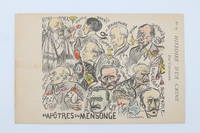
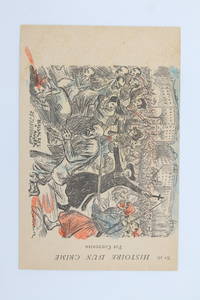
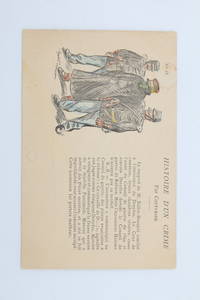
189980782s. l. Paris: Edouard Couturier 1899. Fine. Edouard Couturier s. l. Paris s. d. 1899 13.90 x 9 cm une carte postale First edition of this postcard from the series entitled ""Histoire d'un crime"" n°15; it was created by Edouard Couturier and heightened in colors. Handsome copy. Edouard Couturier unknown
189980783s. l. Paris: Edouard Couturier 1899. Fine. Edouard Couturier s. l. Paris s. d. 1899 13.90 x 9 cm une carte postale First edition of this postcard belonging to the series entitled ""Histoire d'un crime"" n°16; it was created by Edouard Couturier and heightened in colors. Handsome copy of this postcard denouncing the anti-Semitic massacres in Algiers in January 1899. Edouard Couturier unknown
189980784s. l. Paris: Edouard Couturier 1899. Fine. Edouard Couturier s. l. Paris s. d. 1899 13.90 x 9 cm une carte postale First edition of this postcard belonging to the series entitled ""Histoire d'un crime"" n°18; it was created by Edouard Couturier and heightened in colors. Handsome copy. Edouard Couturier unknown
1826774711826. Fine. 1826 18.50 x 24 cm une feuille rempliée Autograph letter signed addressed to the painter Jean-Pierre Granger and dated April 24 1826 one page written in black ink with the correspondent's address on the verso. 15 lines in a beautiful slanted handwriting on a folded sheet. The celebrated Empire painter recommends to his colleague: ""a young man who seems very interesting to me and too young to enter my studio. Dear Grand Diable please do me the favor of taking good care of him in yours and when he has spent some time copying if it does not inconvenience you I will take him back with pleasure and well on his way."" Jean-Pierre Granger was first a pupil of Jean-Baptiste Regnault before joining Antoine-Jean Gros in Jacques-Louis David's studio. In 1800 he became laureate of the first Rome Prize for history painting with Antiochus renvoie son fils à Scipion Paris École nationale supérieure des beaux-arts while his fellow student Jean-Dominique Ingres received the second prize. unknown
1863WA6793New York: Leavitt & Allen 1863. Hardcover. Fine. 12mo multi-color papers quarter morocco wood-patterned paper extra-gilt stamping aeg <br/><br/>Presentation inscription from Sylvester M. King to E. B. King at Charlestown Jany 1st 1864. Illustrated with 4 black-and-white engravings 1 floral chromolithograph and 1 pasted in scenic view. The autographs range in date from 1864 to circa 1880. Leavitt & Allen hardcover
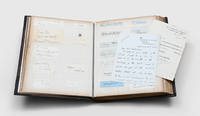
18831767411883-1916. Autograph hunting among British high society A fine assemblage of around 250 signatures of the luminaries of the Victorian and Edwardian age including a signed portrait of Ernest Shackleton the signatures of Prime Ministers Arthur Balfour and H. H. Asquith and the writers George Trevelyan John Morley and George Augustus Sala. Most of the signatures are clipped and mounted alongside their letterhead. The rest are tipped-in letters many of which are made out to Samuel Holliday 1846-1912 who worked as a superintendent for the North Eastern Railway for 48 years and consequently encountered many notable travellers - some are letters of thanks for his service. His obituary noted "he was one of the best known figures in railway circles at York and Newcastle and was held in the highest esteem by all who knew him either in his official or private capacity" North Mail Newcastle Daily Chronicle 20 August 1912. Other letters are addressed to different people and acquired elsewhere. Where dated the letters range from 1883 to 1916. Also included are loose signed photographic portraits of William Booth Liza Lehmann and Harry Lauder and a signed sketch of Harry Furniss. Provenance: Anon. Sale: Sotheby Parke Bernet & Co. London May 9 1983 Lot 356; sold to Steve Forbes chairman of Forbes Magazine and presidential candidate in the 1996 and 2000 US elections; his book label is loosely inserted. Contemporary half morocco album 283 x 229 mm brown cloth sides silk moiré endpapers cloth inner hinge supports. Together with five loose portraits of which four signed see note. Album rubbed some signatures loose contents a little toned. In very good condition. hardcover
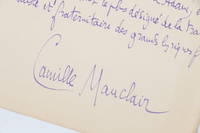
189983424s. l.: S. n. 1899. Fine. S. n. s. l. s. d. 1899 15 x 19.50 cm 8 feuillets Autograph manuscript signed entitled ""La force et la destruction"" about Paul Adam's novel La Force which has just been published 8 leaves in blue ink with some corrections. The article was certainly published in the Revue Blanche. In this laudatory critique of the novel La Force published by Paul Ollendorff: "". c'est un très grand poème épique."" "". it is a very great epic poem."" as well as of Paul Adam's already prolific work: ""Un écrivain qui à trente-cinq ans avant ce livre en a signé vingt-trois autres dont aucun n'est médiocre et dont dix sont de premier ordre."" "". un inépuisable agitateur d'idées d'aperçus de rêves et de beautés."" ""A writer who at thirty-five before this book had signed twenty-three others none of which is mediocre and ten of which are first-rate."" "". an inexhaustible agitator of ideas insights dreams and beauties."" Camille Mauclair demonstrates to the readers of the Revue Blanche of socialist and anarchist allegiance that Paul Adam is one of them: ""Mais le peuple ne sait peut-être pas combien ce romancier cet artiste de style est près de lui dévoué à sa cause véritablement son apôtre en face de la bourgeoisie. c'est en luttant de front contre les iniquités les laideurs et les égoïsmes de la classe possédante que M. Adam a imposé son nom."" ""But the people perhaps do not know how close this novelist this artist of style is to them devoted to their cause truly their apostle in the face of the bourgeoisie. it is by fighting head-on against the iniquities ugliness and selfishness of the possessing class that Mr. Adam has established his name."" Despite success and unlike many of his fellow poets and novelists Paul Adam has not gone astray: "". un mandarin des lettres refugié dans des rêves compliqués et indifférents à l'époque aux souffrances et aux injustices."" "". les autres décadents égotistes ou symbolistes. se réfugiaient prudemment dans la tour d'ivoire ou dans les honteux culte du moi en attendant l'académisme ou le suffrage des snobs."" "". a literary mandarin taking refuge in complicated dreams and indifferent to the times to suffering and injustices."" "". the other decadents egoists or symbolists. prudently took refuge in the ivory tower or in the shameful cult of the self awaiting academicism or the approval of snobs."" and is animated by an acute political and social consciousness: "". sa voix fut une des plus éloquentes parmi celles qui saluèrent dans l'anarchisme les beaux côtés de sa morale civique l'idéal internationaliste la haine des castes le relèvement de l'individu considéré comme unité et commune mesure de la société."" "". Au moment où la panique multipliait autant les dénonciateurs que les poltrons M. Paul Adam signa résolument un magnifique éloge de Ravachol.""' "". his voice was one of the most eloquent among those who greeted in anarchism the beautiful aspects of its civic morality the internationalist ideal the hatred of castes the elevation of the individual considered as unit and common measure of society."" "". At the moment when panic multiplied denouncers as much as cowards Mr. Paul Adam resolutely signed a magnificent eulogy of Ravachol.""' Finally Camille Mauclair precisely analyzes the significance of ""La force"": Avec une frappante justesse Paul Adam oppose la force véritable la hauteur d'esprit à la suprématie de l'épée."" ""M. Paul Adam nous montre l'éternel symbole de Prométhée de l'intelligence créatrice enchaîné entre la Force et la Violence."" "". étant adversaire du chauvinisme et du militarisme. de mettre en lumière tous leurs motifs de gloire pour mieux en montrer l'écoeurant non-sens la nullité la débilité devant la vie pensante et l'action féconde."" ""With striking accuracy Paul Adam opposes true force elevation of spirit to the supremacy of the sword."" ""Mr. Paul Adam shows us the eternal symbol of S. n. unknown
1865767951865. Fine. 30 mai 1865 13.70 x 21.10 cm une page sur un feuillet Autograph letter signed by Charles Baudelaire to Narcisse Ancelle written in black ink on a sheet of blue paper. Folds from mailing three minute pinholes not affecting the text. This letter was transcribed in the Complete Works volume 11 published in 1949 by L. Conard. A moving letter from Brussels addressed to the celebrated family notary who became in 1844 Charles's legal guardian charged with managing his annuity and his exponential debts. A complex relationship developed between the poet and his guardian mingling necessity and mistrust yet nonetheless bearing witness to genuine mutual respect between the two men. This correspondence devoid of the emotional quality of his letters to his mother or the circumlocutions in his exchanges with creditors constitutes one of the most precious biographical sources on the poet. Indeed Baudelaire's financial dependence constrained him to great transparency with his guardian and each of his letters to Ancelle admirably summarizes his wanderings. Thus this letter evokes the terrible mire in which the poet found himself in Belgium and his constantly postponed return to Paris. When he writes Baudelaire is still in Brussels at the Hôtel du Grand Miroir ""28 rue de la Montagne"" but one must not write the hotel's name otherwise letters do not reach him directly where he is dying of boredom illness and resentment toward a country in which he innocently believed he would find glory. This announcement of imminent departure for Paris ""Two or three days after your reply I will leave"" echoes all the similar promises the poet has made for nearly a year to his correspondents. This one will be aborted like all the others for as he confesses to Ancelle a few months earlier Paris fills him with ""a dog's fear."" It is only in August 1865 that he will make a final and brief stay in France before his fatal stroke. His return ""I am eagerly awaited in Paris and in Honfleur"" was nevertheless motivated by a compelling reason: to negotiate with a publisher through Manet's intervention the publication of his collection of reflections on his contemporaries which he had already titled My Heart Laid Bare Mon cur mis à nu and whose manuscript is partly at his mother's house in Honfleur. Another failurethe work would not appear until 1897 thirty years after Baudelaire's death. But it is undoubtedly the reference to the ""two large paintings he wishes to send to Honfleur"" that gives this letter all its significance. Baudelaire evokes his wish to repatriate paintings from his collection that he left with various lenders or restorers of which he had already sent a list to Ancelle a few months earlier. Among these which ones did he want to bring back to his mother His father's portrait the Boilly the Manet a Constantin Guys There is no mention in other letters of this art shipment and of the ""remainder"" to which the paintings were to be joined. This desire to ""send to Honfleur"" his precious belongings nonetheless testifies to the weakened poet's wish to settle permanently in his mother's ""jewel-house"" in Honfleur an island of serenity where Baudelaire dreamed of a peaceful retreat where all would once again be ""order and beauty luxury calm and voluptuousness."" He would indeed return there paralyzed and mute but for a final year of agony after his syphilitic crisis. The Hôtel du Grand Miroir would remain his last true dwelling as noted on Tuesday April 3 1866 in the register of admissions at the Saint-Jean Clinic: ""Name and first names: Baudelaire Charles. Address: France and 28 rue de la Montagne. Profession: man of letters. Illness: apoplexy."" A fine letter to the man who was both Baudelaire's persecutor and protector. He accompanied the poet until his death before becoming executor of the family estate. unknown
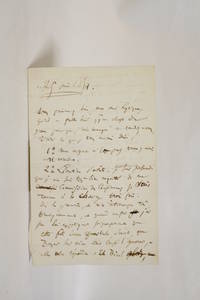
185468690Paris 1854. Fine. Paris 25 Juin 1854 11.50 x 18.50 cm une page recto-verso Handwritten letter dated and signed by Charles Baudelaire to Philoxène Boyer concerning the intriguing Léontine B. Paris 25 Juin 1854 11.5 x 18.5 cm one page recto-verso Handwritten two-page letter dated 25 June 1854 and signed by Charles Baudelaire to Philoxène Boyer whom he calls «my dear Lyrique» in which he apologises for having missed a meeting with him he confesses his impecuniosity to him and reports to him on the efforts made by Léontine B. an intriguing person who will end up compromising Philoxène Boyer because of his debts to attend a party to which she is not invited and which holds a certain jealousy: «You surely assume my dear Lyrique that yesterday something serious happened for me to have missed this meeting. Here is what I would have told you: 1 my money has not come; but it will come. / 2 Léontine is obstinate. I am convinced that I have fulfilled my confidence mission very well. I came back three times. When I finally could explain to her carefully that this party was for family secret that Boyer himself was supposed to ignore it she replied: Well it's no longer a secret since I know.» Finally while recognising Léontine as «a very original turn of mind» and although the attitude of this troublesome scheme: «causes you worry and I understand.» Charles Baudelaire pleads for indulgence and leniency: «since she persists so proudly I would urge you to let the event run. It is after all only the homage of a dizzy mind.» unknown