Louise MICHELBiblio.com
184 résultats
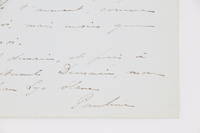
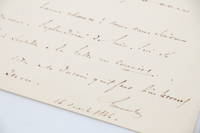
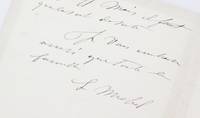
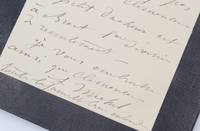
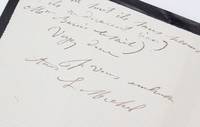
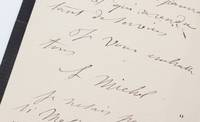
188583957s. l. Paris 1885. Fine. s. l. Paris 12 juin 1885 11 x 16.90 cm 2 pages 1/2 sur un bifeuillet Autograph letter signed by Louise Michel addressed to Lucien Barrois; two and a half pages written in black ink on a white paper bifolium with black border. Transverse folds inherent to postal delivery. Louise Michel requests help for one of her acquaintances: ""Madame Maron à qui Lafont ou Clémenceau avait fait avoir promesse à la mairie d'un terme de son loyer elle en doit trois n'a plus entendu parler de rien et il faut qu'elle déménage pour aller en face où elle paiera moins. Sa propriétaire l'aurait attendue avec un terme payé sur les trois. Il faut enfin que ce soit vous qui rappeliez cette pauvre femme qui a rendu tant de services."" ""Madam Maron for whom Lafont or Clémenceau had secured a promise from the town hall for one term of her rent she owes three has heard nothing more and must move across the street where she will pay less. Her landlady would have waited for her with one term paid out of the three. You must finally be the one to remind them of this poor woman who has rendered so many services."" Moving letter testimony to the unwavering devotion of the former Communard. unknown
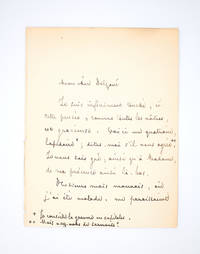
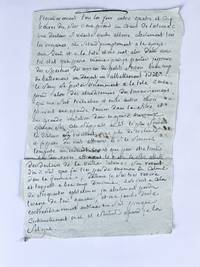
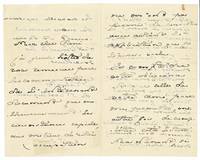
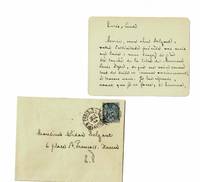
1892759251892. Fine. s. d. 15 avril 1892 12.60 x 16.40 cm 2 pages sur un double feuillet une carte et un calque Autograph letter signed by Stéphane Mallarmé to Alidor Delzant. Two pages written in black ink on a bifolium. Envelope enclosed. Also included is a signed autograph quatrain by Mallarmé on a card the one later inscribed on the mantelpiece: « Ici le feu pour renaître Tantôt durable ou charmant Comme l'amitié du maître Mêle du chêne au sarment. » Alidor Delzant was a lawyer collector and bibliophile. A friend of the Goncourt brothers he devoted a work to them and served as Edmonds secretary and executor. A fine letter in which Mallarmé evokes the composition of a quatrain to adorn Delzants mantelpiece: « Je suis infiniment touché et cette pensée comme toutes les vôtres est gracieuse. Voici un quatrain lapidaire je conseille la gravure en capitales; dites-moi s'il vous agrée. Mais usez-vous de sarments » Also included is the original tracing probably made by Mallarmé himself of the quatrain intended to decorate the lintel of Alidor Delzants library fireplace in his house at Paraÿs. Delzants reply to this letter is known: « Mon cher ami / Ces vers sont très beaux juste ce qui convenait pour glorifier la Cheminée de Paraÿs où les sarments pétillent autour des bûches des chênes. / Je demeure touché et reconnaissant. / Alidor Delzant. » unknown
180185841Charenton 1801. Fine. ""I experience spasms a sort of shivering a lot of yawning disgust total despondency the blood rushes violently to my head then I feel dizzy spinning which makes me stumble and a thousand other things proving a great tension in the body and a great irritation in the nervous system."" Charenton 1801 15 x 22.80 cm un feuillet composé deux papiers encollés Original autograph letter by the Marquis de Sade consists of 27 lines of relatively tight handwriting. Most likely written to his wife as evidenced by the letter's origin from Sade's family. The letter is physically composed of two glued pieces of paper. On the verso the Marquis wrote 19 lines and scrupulously crossed them out - a few words and letters are still quite visible. Cited in Maurice Lever's biography 'Donatien Alphonse François marquis de Sade' Paris Fayard 1991 p. 631. On March 7 1801 Armand de Sade the Marquis's son received a letter from the Minister of Police Joseph Fouché notifying him that his father had been arrested yesterday and that handwritten pages from the novel 'La nouvelle Justine' Justine or the Misfortunes of Virtue had been found on his person: Nevertheless sensitive to your request for leniency and concerned to preserve the honor of your name I have decided to have your father transferred to the Charenton nursing home.. It should be noted that for Fouché Charenton an insane asylum was nothing more than a nursing home a prison. It should not be forgotten that a large proportion of the population of these asylums did not fit into the social and moral field and psychiatry has long had no other aim than to normalize to make them fit for social life. Contrary to what has been said Sade fits in perfectly. However as soon as he entered Charenton Sade's attitude led to his expulsion to Bicêtre the Bastille of scoundrels but his family succeeded in getting him back into the Charenton asylum. Charenton was not only the Marquis de Sade's last incarceration but also the last place he lived in where he died in 1814. The 19 lines scrupulously crossed out on the back of the leaf reveal a few words or letters; in this respect we can conjecture that it's a coded message which Sade was quite fond of for if censorship had been behind these erasures absolutely everything would have been yet the message clearly shows that almost everything has been conscientiously crossed out apart from a few words or letters. We can still make out a few of them: 'Nécessaire' 'à tous' 'ger' 'ue' 'quel' 'je trouve' 'de'. As for the letter itself it is remarkable for the homogeneity of its message. It is a lengthy complaint describing the physical ailments Sade has suffered. It is an account of the sum total of the symptoms that overwhelm the writer. In a hyperbolic style using among other figures of speech adverbs of intensity si tel très. Sade methodically spells out the violent pains his body is suffering with the whole of this violence constituting a system a structure in which all the parts are linked. In the writer's correspondence it can be said that each time he found himself incarcerated his letters mention uncontrollable physical attacks although we know of no other letter so uniform and systematic.The pain originates in the pit of the stomach radiating out to the periphery: head eyes legs all converging on vertigo loss of balance. .because that's what it's all about: Sade isn't suffering from any illness he's besieged by anguish whose ultimate meaning is vertigo the wavering of a reality from which his freedom to live as he pleases his freedom of movement and his name have been taken away. The loss of these fundamental elements of his existence sends Sade in turmoil. In addition and as regards the formation of these particular symtoms if we consider that the fulfillment of a certain sexual sadism is necessary to him the deprivation of this satisfaction turns this sadistic driv unknown
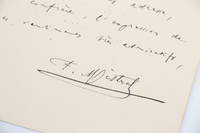
189886539Maillane Bouches du Rhône Maillane 1898. Fine. Maillane Bouches du Rhône Maillane 28 Février 1898 11.50 x 17.50 cm trois pages sur un double feuillet Autograph letter dated and signed by Frédéric Mistral addressed to Anatole France 44 lines in black ink regarding the publication of his work ""Les mannequins d'osier"" which he has just sent him with a dedication. Fold marks inherent to postal delivery a vertical shadow on the first leaf. Frédéric Mistral has just received ""Les mannequins d'osier"" and gives a glowing portrait of his correspondent's style: "". ce livre qui m'a donné tous les plaisirs de la lecture. Je suis de ceux que le roman n'intéresse guère lorsqu'ils ne sont que prétentieux tableaux de la vie contemporaine. . mais il y a dans les vôtres une si fine quintessence d'érudition et d'observation agréablement mêlées et une si joyeuse fleur d'optimisme tolérant qu'on s'y retrouve sans rechercher dans la façon gauloise omnisciente et libre de Maître Rabelais."" this book which has given me all the pleasures of reading. I am one of those whom novels hardly interest when they are merely pretentious tableaux of contemporary life. . but there is in yours such a fine quintessence of erudition and observation agreeably mixed and such a joyful flower of tolerant optimism that one finds oneself in it without seeking in the Gallic omniscient and free manner of Master Rabelais. The félibrige loves equally the characters created by his illustrious and charming master ""Tous vos personnages sont si naturels si bien en situation si logiques que ma foi on les aime tous et quoique tout cela provienne d'un aimable et indulgent scepticisme on y a là l'explication de ce phénomène étrange que si loin si injuste si douloureux que soit le monde chacun pourtant y pousse volontiers sa brouette avec la conviction en le réconfort d'avoir raison."" All your characters are so natural so well placed in their situations so logical that my faith one loves them all and although all this comes from an amiable and indulgent skepticism there one has the explanation of this strange phenomenon that however distant unjust painful the world may be each person nevertheless willingly pushes his wheelbarrow with the conviction and comfort of being right. as the spirit that breathes and animates his books: "". la sympathie du reste vraiment universelle qui accueille tous vos écrits doit vous prouver combien vous êtes humain et sage dans l'antique sens de ces mots."" the truly universal sympathy that welcomes all your writings must prove to you how human and wise you are in the ancient sense of these words. unknown
188984470s. l.: S. n. 1889. Fine. S. n. s. l. 5 Mai 1889 10.50 x 6 cm une feuille une enveloppe Autograph signed carte de visite from Alphonse Daudet 13 lines written in blue ink addressed to journalist and librettist Philippe Gille sending his thanks and congratulations for a recent performance. Envelope included. S. n. unknown
189574355s. l.: S. n. 1895. Fine. S. n. s. l. s. d. circa 1895 12.50 x 20 cm quatre pages sur une feuille rempliée Autograph letter signed by the dandy count four pages 43 lines written in black ink thanking his friend Henry Lapauze and one of his acquaintances for having procured for him: ""l'intéressant document"" ""the interesting document"" which his overwhelming activity has not yet allowed him to read: "". avec autant d'application que je l'aurais voulu."" "". with as much attention as I would have wished."" Robert de Montesquiou therefore relies on his friend's indulgence also transmitting his apologies and gratitude to the unknown person who helped him through Henri Lapauze: "". je compte sur votre obligeance et celle de votre ami pour me permettre une autre fois de compléter cette lecture. veuillez bien lui transmettre ma gratitude en même temps que le surplus de mon désir."" "". I count on your kindness and that of your friend to allow me another time to complete this reading. please convey to him my gratitude along with the remainder of my desire."" A small brown stain at the top of one page a light crease at the foot of another without significance. Henry Lapauze 1867-1925 was a journalist and art critic who became in 1905 curator of the Petit Palais converted four years earlier into a museum and whose collections he considerably enriched by acquiring notably the Courbet Henner and Falguière collections with at the twilight of his life a marked preference for the Decorative Arts of which he was an ardent promoter. S. n. unknown
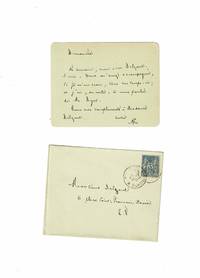
189476276Paris 1894. Fine. Paris 11 mars 1894 11.40 x 8.80 cm une carte recto et une enveloppe Autograph card signed by Stéphane Mallarmé addressed to Alidor Delzant written on the recto in black ink. Envelope attached. Alidor Delzant was a lawyer collector and bibliophile. Friend of the Goncourts he devoted a work to them and was the secretary and testamentary legatee of Edmond. Card written upon return from a trip to Oxford during which Mallarmé gave a lecture on aesthetics: "".j'ai du reste à vous parler de M. Dyer."" "".I have moreover to speak to you about M. Dyer."" Louis Dyer friend of Delzant is an Oxford alumnus and was then professor of Greek at Harvard. Through Delzant's intermediary he had offered hospitality to Mallarmé who did not know him before his lecture but this card attests that the two men finally met. unknown
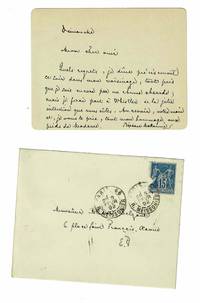
189276345Paris 1892. Fine. Paris 7 février 1892 11.40 x 8.80 cm une carte et une enveloppe Autograph letter signed by Stéphane Mallarmé addressed to Alidor Delzant written on the recto in black ink. Envelope included. Alidor Delzant was a lawyer collector and bibliophile. Friend of the Goncourts he devoted a work to them and was Edmond's secretary and testamentary legatee. ""Quels regrets je dîne précisément ce soir dans mon voisinage tout pris que je sois encore par un rhume absurde ; mais je ferai part à Whistler de la jolie intention que vous eûtes."" ""What regrets I am dining precisely this evening in my neighborhood taken as I still am by an absurd cold; but I will inform Whistler of the lovely intention you had."" unknown
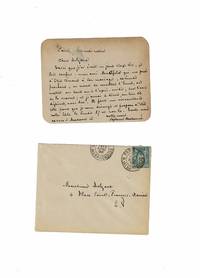
189676279Paris 1896. Fine. Paris 15 avril 1896 11.40 x 8.80 cm une carte recto et une enveloppe Signed autograph card from Stéphane Mallarmé addressed to Alidor Delzant written on the recto in black ink. Envelope included. A small water stain affecting the beginning of the card without hindering readability. Alidor Delzant was a lawyer collector and bibliophile. Friend of the Goncourts he devoted a work to them and was Edmond's secretary and testamentary legatee. ""Voici que j'écris un jour trop tôt je suis confus : mon ami Muhlfeld qui me prie d'être témoin à son mariage ce lundi prochain."" ""Here I am writing a day too early I am confused: my friend Muhlfeld who asks me to be witness at his wedding this coming Monday."" ""On the 20th of this month also spring-like he signs the municipal register as witness at the wedding of Lucien Muhlfeld one of the leading figures of La Revue blanche and all this fine company dines in evening dress at La Tour d'Argent enlivened by the laughter of Misia and the Natanson brothers."" Jean-Luc Steinmetz unknown
1826774711826. Fine. 1826 18.50 x 24 cm une feuille rempliée Autograph letter signed addressed to the painter Jean-Pierre Granger and dated April 24 1826 one page written in black ink with the correspondent's address on the verso. 15 lines in a beautiful slanted handwriting on a folded sheet. The celebrated Empire painter recommends to his colleague: ""a young man who seems very interesting to me and too young to enter my studio. Dear Grand Diable please do me the favor of taking good care of him in yours and when he has spent some time copying if it does not inconvenience you I will take him back with pleasure and well on his way."" Jean-Pierre Granger was first a pupil of Jean-Baptiste Regnault before joining Antoine-Jean Gros in Jacques-Louis David's studio. In 1800 he became laureate of the first Rome Prize for history painting with Antiochus renvoie son fils à Scipion Paris École nationale supérieure des beaux-arts while his fellow student Jean-Dominique Ingres received the second prize. unknown
189476272Paris 1894. Fine. Paris 12 février 1894 11.40 x 8.80 cm une carte recto-verso et une enveloppe Autograph letter signed by Stéphane Mallarmé addressed to Alidor Delzant written on both sides in black ink. With envelope. Alidor Delzant was a lawyer collector and bibliophile. A friend of the Goncourts he devoted a work to them and served as secretary and testamentary legatee to Edmond. Mallarmé mentions a future stay in Oxford and thanks Delzant for having recommended him to a friend: "".vous songez si j'ai été touché de la lettre de Monsieur Louis Dyer de qui me voici connu tout de suite et comme anciennement à travers vous. Je lui réponds avant que je ne fasse si heureux sa connaissance. Hôte je ne pourrai l'être M. Powell qui a eu l'initiative de ma conférence m'ayant de longue date offert son toit pendant mon bref séjour à Oxford."" "".you can imagine how touched I was by the letter from Monsieur Louis Dyer through whom I find myself known immediately and as if from long ago through you. I am writing back to him before I have the pleasure of making his acquaintance. I will not be able to be a host as M. Powell who initiated my lecture has long since offered me his roof during my brief stay in Oxford."" Mallarmé would indeed give a lecture on aesthetics on March 1st 1894 at Oxford the text of which was published in 1895 under the title Oxford Cambridge. La musique et les lettres. unknown
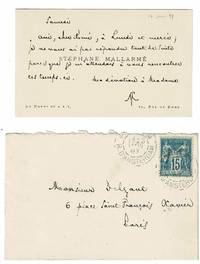
189776333Paris: S. n. 1897. Fine. S. n. Paris 23 janvier 1897 10.20 x 6.30 cm une carte de visite et son enveloppe Signed autograph visiting card from Stéphane Mallarmé addressed to Alidor Delzant. Envelope included. Alidor Delzant was a lawyer collector and bibliophile. Friend of the Goncourts he devoted a work to them and was Edmond's secretary and testamentary legatee. ""Ami cher ami à lundi et merci ; je ne vous ai pas répondu tout de suite parce que je m'attendais à vous rencontrer ces temps-ci."" ""Friend dear friend until Monday and thank you; I did not answer you right away because I expected to meet you these days."" S. n. unknown
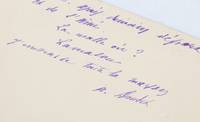
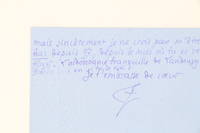
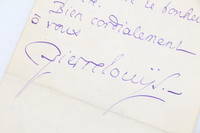
189778160Paris 1897. Fine. Paris s. d. après 1897 13.80 x 9 cm une carte autographe recto et verso Autograph card by Pierre Louÿs signed with his initial addressed to Georges Louis and written in violet ink on both sides. Note addressed to his brother Georges Louis with whom Pierre Louÿs maintained a very intimate relationship and whom he considered as his own father. The question of Pierre Louÿs's real paternal identity still fascinates biographers today: ""His father Pierre Philippe Louis . had married in 1842 Jeanne Constance Blanchin who died ten years later after giving him two children Lucie and Georges. In 1855 he remarried Claire Céline Maldan and from this union was born in 1857 a son Paul; then in 1870 our writer who received the given names Pierre Félix. This late birth the differences in character between father and son the former's disaffection toward the latter the profound intimacy that always reigned between Louÿs and his brother Georges all this has led certain biographers and critics to suspect that the latter was in reality the writer's father. The exceptionally intimate and constant relationship that Pierre and Georges maintained between themselves throughout their lives could be an argument in this direction. Of course no irrefutable proof has been discovered and probably never will be. Nevertheless certain letters . are quite troubling. In 1895 for example Louÿs writes seriously to his brother that he knows the answer to 'the most poignant question' he could ask him a question he has had 'on his lips for ten years.' The following year in the full triumph of Aphrodite he thanks Georges effusively and ends his letter with this sentence: 'Not one of my friends has a FATHER who is for him what you are for me.' Arguing from the close intimacy of Georges and Claire Céline during the year 1870 and the jealousy that the father never ceased to show toward his younger son Claude Farrère did not hesitate to conclude in favor of Georges Louis. And what to think of this dedication by Louÿs to his brother on a Japan paper copy of the first edition of Pausole: To Georges his eldest son / Pierre."" Jean-Paul Goujon Pierre Louÿs Pierre Louÿs revolutionizes his living conditions: ""I am taking serious care of myself. For two days now I have been going to bed at half past midnight to wake up between 9 and 10. Today after a day that has already lasted 11 hours I have only smoked half a pack of cigarettes. That's a quarter of my usual consumption during the same time. Moreover I walked more than a league on foot I took the air as much as I could.Well with all that I feel quite unwell or rather as if I were the day after a long and serious illness. Neither strength nor nerves. I have trouble listening speaking following an idea. Should this be attributed to my cigarette rationing It's possible. But honestly I don't think I have felt so low since '97 since the month when you came to see me in Algiers."" Amusing note from the most tobacco-addicted of writers nearly 60 cigarettes per day.! who wrote in Une volupté nouvelle: ""One night as I found myself there in silent conversation with two blue porcelain cats crouched on a white table I hesitated to choose between two pastimes of solitude: write a regular sonnet while smoking cigarettes or smoke cigarettes while looking at the ceiling carpet. The important thing is to always have a cigarette in hand; one must envelop objects in a celestial and fine cloud that bathes lights and shadows erases material angles and by a perfumed spell imposes on the agitated mind a variable balance from which it can fall into reverie."" unknown
190078919s. l. Paris 1900. Fine. s. l. Paris s. d. ca. 1900 12.30 x 16.50 cm 4 pages sur un double feuillet Autograph letter signed ""Pauline"" by Renée Vivien addressed to Natalie Clifford Barney and written in black ink on a double sheet with the poetess's silver monogram letterhead. Very beautiful and poetic love letter from the Muse of violets languishing for her ""dear white Lily"": ""Je n'ai pas pu te demander cet après-midi si je te verrais demain mon doux Avril mais tu as bien compris n'est-ce pas qu'il me serait aussi impossible de vivre un jour sans toi que de me priver des lumières du soleil ou des fleurs. . Avril mon doux petit Avril chaque fois que tu t'en vas tu emportes un peu de mon cur qui ne peut se détacher de toi et te suit tristement. Tu es pour moi la poésie la consolation et le rêve. Tu mets de la beauté dans ma vie et dans mon âme - quand je me réveille chaque jour et je pense à toi c'est la perpétuelle éclosion de quelque miraculeuse amour. Je vis dans un conte de fées un pays où tout est bleu et d'où la tristesse a disparu. Pense à moi ce soir avant d'aller rêver dans l'au-delà et le lointain du sommeil."" ""I could not ask you this afternoon if I would see you tomorrow my sweet April but you understood didn't you that it would be as impossible for me to live a day without you as to deprive myself of light sun or flowers. . April my sweet little April each time you leave you take with you a piece of my heart which cannot detach itself from you and follows you sadly. You are for me poetry consolation and dream. You bring beauty into my life and into my soul - when I wake each day and think of you it is the perpetual blossoming of some miraculous love. I live in a fairy tale a country where everything is blue and from which sadness has disappeared. Think of me tonight before going to dream in the beyond and the distance of sleep."" The letter then takes on a more sensual tone: ""J'aime tes cheveux blonds. Je leur envoie un long baiser. Les lys que j'ai dans ma chambre sont tristes parce que tu n'es plus là. Ils t'envoient leur âme dans un parfum. Ils t'aiment comme moi ; mais moins que moi."" ""I love your blonde hair. I send them a long kiss. The lilies I have in my room are sad because you are no longer there. They send you their soul in a fragrance. They love you like me; but less than me."" During their first night of love Renée had filled her room with lilies transforming it into a ""chapelle ardente"" N.Clifford Barney Je me souviens. Jean-Paul Goujon notes: ""The choice of lilies was very much in the taste of the period: let us remember Mucha's posters Schwabe's paintings Lorrain's poems. But Vivien who certainly remembered certain pages filled with flowers and perfumes from Zola's La Faute de l'abbé Mouret seems to have wanted to celebrate mystical nuptials coupled with a sort of perfumed death."" It was at the end of 1899 and through Violette Shillito that Renée Vivien - then Pauline Tarn - made the acquaintance of Natalie Clifford Barney ""cette Américaine plus souple qu'une écharpe dont l'étincelant visage brille de cheveux d'or de prunelles bleu de mer de dents implacables"" ""this American more supple than a scarf whose sparkling face shines with golden hair sea-blue eyes implacable teeth"" Colette Claudine à Paris. Natalie who had just lived through a summer idyll with the scandalous Liane de Pougy who initiated her into Sapphism paid only discreet attention to this new acquaintance. Renée however was totally captivated by the young American and would relate this coup de foudre in her autobiographical novel Une Femme m'apparut: ""J'évoquai l'heure déjà lointaine où je la vis pour la première fois et le frisson qui me parcourut lorsque mes yeux rencontrèrent ses yeux d'acier mortel ses yeux aigus et bleus comme une lame. J'eus l'obscur prescience que cette femme m'intimait l'ordre du destin que son visage était le visage redouté de mon avenir. Je sentis p unknown
184684820Mâcon 1846. Fine. Mâcon 26 Décembre 1846 13.50 x 20.50 cm une page sur un feuillet Autograph letter dated and signed by Alphonse de Lamartine; one page with his monogram blind-stamped in the upper left corner and written in black ink on one leaf 15 lines. Folds inherent to mailing. In this letter Lamartine shows his happiness to collaborate with their mutual friend's journal and confirms a financial agreement. unknown
189686610Paris 1896. Fine. Paris 1896 13 x 20.50 cm 3 pages sur un double feuillet Autograph letter signed by Pierre Louÿs addressed to his publisher Alfred Vallette 50 lines written in purple ink on a double sheet. Pierre Louÿs responds to his friend and publisher Alfred Vallette after a controversy launched by a journalist from Comoedia a controversy that could damage their friendship: ""Je ne suis pour rien dans l'écho publié par Comoedia. Mais ce que vous en citez suffit à me montrer que le rédacteur s'est mal informé."" ""I had nothing to do with the piece published by Comoedia. But what you quote from it is enough to show me that the writer was misinformed."" and he intends to remind him that they had not been able to agree on the publishing terms for Aphrodite and that he envisioned only a confidential distribution for his latest book: ""L'histoire de notre édition est très simple. Vous m'avez proposé un traité que je n'ai pas trouvé bon ; j'ai préféré le ""compte d'auteur"" et je ne peux pas vous accuser d'avoir mal prévu le succès du livre puisque moi-même j'avais écrit mon roman pour vingt amis et quelques inconnus."" ""The story of our edition is very simple. You offered me a contract that I did not find good; I preferred the 'author's account' and I cannot accuse you of having poorly predicted the book's success since I myself had written my novel for twenty friends and a few strangers."" This is why the father of Aphrodite is astonished by the triumph achieved by the work: ""Si une diseuse de bonne aventure nous avait prédit alors qu'Aphrodite dépasserait un jour le 300e mille nous l'aurions traitée comme une pauvre folle."" ""If a fortune teller had predicted then that Aphrodite would one day exceed 300000 copies we would have treated her as a poor madwoman.""; the latter consecrating his fame and wealth in the literary world: ""J'ai en outre une seconde raison pour ne pas vous en vouloir du traité que j'ai signé avec vous : c'est qu'en préservant mes droits d'autuer sur ce roman j'ai fait sans le savoir ma fortune. C'est à cela seul que je dois mon indépendance littéraire et cette inestimable liberté du silence qui n'est pas l'idéal de tous mais qui me paraît être le bonheur du poëte."" ""I have furthermore a second reason for not resenting the contract I signed with you: it is that by preserving my author's rights on this novel I made my fortune without knowing it. It is to this alone that I owe my literary independence and this invaluable freedom of silence which is not everyone's ideal but which seems to me to be the poet's happiness."" Very fine autograph on Pierre Louÿs's literary triumph. unknown
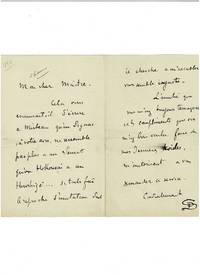
1894755111894. Fine. s. d. 23 janvier 1894 22.60 x 17.50 cm 2 pages sur un double feuillet déplié Autograph letter signed by Paul Signac addressed to Camille Pissarro written in black ink over two pages and signed with the artists monogram. This letter was transcribed in the article by Pierre Michel and Christian Limousin entitled ""Octave Mirbeau et Paul Signac - Une lettre inédite de Signac à Mirbeau"" in Cahiers Octave Mirbeau no. 16 March 2009 pp. 202-210. ""Mon cher Maître Cela vous ennuirait-il sic d'écrire à Mirbeau qu'un Signac à votre avis ne ressemble pas plus à un Seurat qu'un Hokousai à un Hiroshigé. si toutes fois sic le reproche d'imitation dont il cherche à m'accabler vous semble injuste. L'amitié que vous m'avez toujours témoignée et les compliments que vous avez bien voulu faire de mes toiles m'autorisent à vous demander ce service. Cordialement. PS"" A fine letter in which Paul Signac seeks the support of his master Camille Pissarro after a scathing critique published by Octave Mirbeau in L'Echo de Paris. In this article featured on the front page of L'Echo de Paris of 23 January 1894 Octave Mirbeau spares Signac no harshness: « M. Signac a voulu continuer Seurat. Je ne puis me faire à sa peinture. Je ne méconnais pas ses qualités mais elles disparaissent sous l'amoncellement de ses défauts. Ce qu'on admettait de Georges Seurat . on le comprend moins chez M. Signac qui n'en est que l'adepte trop complaisant et trop littéral. Et puis cette continuelle sécheresse me choque. M. Signac fait la nature immobile et figée. Jamais le vent n'a secoué la surface inerte de ses mers ni tordu les branches de ses pins ni animé l'éternelle fixité de ses nuages la raideur cartonnée de ses ciels. Il ignore le mouvement la vie l'âme qui est dans les choses. . Il serait peut-être temps pour notre joie que M. Signac voulût bien nous donner du Signac. Je crois qu'il le peut.» Why this obsession with Seurat « At the beginning of 1894 the position of Mirbeau Geffroy Pissarro and a few others was to consider that Neo-Impressionism had in fact died in 1891 with the passing of Seurat. Their retrospective view of this artistic venture led them to think that it was not a continuation of Impressionism by new scientific means but a reaction against it even a liquidation of the movement.» Cahiers Octave Mirbeau. Pissarros reply to Signac also transcribed by Michel and Limousin was not long in coming: it « l'ennuirait d'écrire ce que vous me demandez à Mirbeau et cela pour plusieurs raisons. . Premièrement parce que je suis en froid avec lui vous le savez bien. Deuxièmement parce que pour vous-même il ne sied pas de discuter l'opinion d'un critique même étant persuadé d'être dans le vrai et si vous voulez franchement ma façon de penser et que je suis heureux d'avoir l'occasion de vous exprimer je trouve que la méthode même est mauvaise. Au lieu de servir l'artiste l'ankylose et le glace. Si je vous ai fait des compliments cette année c'est parce que j'ai trouvé vos dernières toiles mieux que celles que vous aviez exposées aux Indépendants mais je suis loin de trouver que vous êtes dans la voie qui convient à votre tempérament essentiellement peintre et si jusqu'à présent je ne vous ai rien dit à ce sujet c'est parce que j'étais sûr de vous être désagréable et somme toute mes convictions peuvent ne pas être partagées par vous. Réfléchissez mûrement et voyez si le moment n'est pas venu de faire votre évolution vers un art plus de sensation plus libre et qui serait plus conforme à votre nature.» « Disheartened and deprived of the authority of a master revered by the critic Signac was left to devise himself without delay the reply to address to Mirbeau . » ibid. This response took the form of a long letter written the same day as the one offered here and now preserved at the Harry Ransom Center at the University of Austin Texas: « Je reconnais hautement que c'est Seurat qui a insta unknown
188783960s. l. Paris 1887. Fine. s. l. Paris 19 novembre 1887 11.30 x 17.70 cm 1 pages 1/2 sur un bifeuillet Autograph letter signed by Louise Michel addressed to Lucien Barrois; one and a half pages written in black ink on a bifolium of white paper with black border. Transverse folds inherent to mailing. ""Chauvière et d'autres amis communs vous prient bien de tâcher que Clemenceau recommande au professeur qui a la chaire de Russe au Collège de France et à la Sorbonne notre ami Gregorieff comme aide. Il paraît qu'avec un mot de Rochefort et de Clemenceau il serait immédiatement accepté ."" ""Chauvière and other mutual friends earnestly ask you to try to have Clemenceau recommend our friend Gregorieff as assistant to the professor who holds the Russian chair at the Collège de France and at the Sorbonne. It appears that with a word from Rochefort and Clemenceau he would be immediately accepted ."" The novelist P. Gregorieff had given some Russian lessons to Louise Michel. Moving letter testimony to the unfailing devotion of the former Communard. unknown
188583964s. l. Paris 1885. Fine. s. l. Paris 6 février 1885 11.10 x 17.60 cm 1 page 1/2 sur un bifeuillet Autograph letter signed by Louise Michel addressed to Lucien Barrois; one and a half pages written in black ink on a bifolium of white paper with black border. Transverse folds inherent to mailing. A trace of glue on the second sheet where Louise Michel had probably pasted a letter from her cousin. News of Louise Michel's little cousin Lucien Dacheux: ""Je reçois une lettre de mon petit cousin Dacheux qui me demande de remercier encore pour lui Clemenceau et lui. Je le fais moi-même de tout coeur. N'oubliez pas de le dire à Clemenceau. Le petit Dacheux est à Brest 1ère division de recrutement. . Clemenceau serait en droit de dire que je suis bien ennuyeuse mais montrez lui la lettre du petit si on pouvait obtenir qu'il ait un peu d'instruction. Je ne sais pas s'ils peuvent avoir des leçons. Y a-t-il une école je ne sais rien de tout cela dans la division où il est."" ""I receive a letter from my little cousin Dacheux who asks me to thank Clemenceau and him again on his behalf. I do so myself wholeheartedly. Don't forget to tell Clemenceau. Little Dacheux is in Brest 1st recruitment division. . Clemenceau would have the right to say that I am quite bothersome but show him the little one's letter if we could obtain that he have a little education. I don't know if they can have lessons. Is there a school I know nothing of all that in the division where he is."" Moving letter testimony to the unfailing devotion of the former communard. unknown
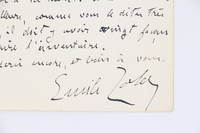
188279111Médan 1882. Fine. Médan 1er décembre 1882 13.60 x 21.40 cm 2 pages sur un double feuillet - enveloppe jointe Autograph letter signed by Emile Zola - apparently unpublished - written in black ink on a double sheet and addressed to Léon Carbonnaux department head at Bon Marché. Folds inherent to mailing. Envelope included. Only two letters from Léon Carbonnaux to Emile Zola are known: they can be consulted in the digitized preparatory file for Au bonheur des dames made available online by the Bibliothèque nationale de France. However we know from this same file which contains a long section entitled ""Notes Carbonnaux"" that this department head at Bon Marché provided Zola with a significant amount of information particularly about employee customs their remuneration and especially inventory techniques. The two men probably met when Emile Zola eager for information about the workings of department stores conducted field research in February and March 1882. Very important unpublished letter shedding new light on the pre-original publication of Au bonheur des dames. In his biography of Emile Zola Henri Mitterrand writes: ""Even before the novel was completed Zola gave an extract to Panurge in November; and on November 23 1882 Gil Blas announced its imminent publication in its columns."" Our letter discussing precisely this alleged pre-publication in Panurge attests that it was simply a joke and thus contradicts Henri Mitterrand: ""But your letter surprises and saddens me somewhat. How could you have been taken in by Panurge's stupid joke Did you not notice that the entire issue is a 'farce' Not one of the articles is authentic they are parodies and very poorly done ones at that."" Indeed reading the said extract cannot fool the assiduous reader of Zola despite the introduction that the journalists wrote: ""After Nana and Pot-Bouille those epics of elegant vice and bourgeois vice M. Emile Zola wanted to create one of honesty: Au bonheur des Dames which will appear shortly is a reassuring painting of innocence and virtue; the greatest success is assured for this new work whose characters move in the setting of a large novelty store; Parisian high commerce will not long await its observer and painter. We thank Emile Zola for having kindly cut out especially for Panurge a few pages from his still unpublished work and we are proud to give the public first an extract from this work of such high morality and such powerful interest."" Panurge no. 4 of October 22 1882 The sentences of this false Zolian text are exaggeratedly long and Panurge took the liberty of endowing the novel with a male main character Denis Mouret an amalgam of Denise the true heroine of the book to appear and Octave Mouret. One can think that it is a text composed from elements of Pot-Bouille the previous volume of Rougon Macquart where Octave - future owner of Bonheur des Dames - exercised the function of clerk before his meteoric social rise: ""For already more than two months he had been attached to the 'silks and furs' department; he arrived in the morning at seven o'clock to return home his day finished only at nine o'clock in the evening when all of Paris buzzed strangely with a feverish animation of pleasure and enjoyment and on his way back he followed gawking the great crowded boulevards where blazed the cafés full of girls and where on the asphalt at theater doors the crowd jostled with here and there in the vague rumor of trampling and pressing the roguish intonation of the cries of program vendors and ticket sellers."" Panurge In his letter of November 30 1882 Léon Carbonnaux - reading the extract from Panurge - had reproached Zola for his errors: ""Nowhere except at the Fabriques de France near Les Halles does one arrive at 7 a.m. It's at the earliest 7:30 but more often 8 a.m. and even then. There is no silk and fur counter at the Louvre. . It is so easy for you to be accurate that errors of this kind especially if t unknown
188583963s. l. Paris 1885. Fine. s. l. Paris 16 juillet s. d. ca 1885 13.40 x 21.10 cm 1 page 1/2 sur un bifeuillet Autograph letter signed by Louise Michel addressed to Lucien Barrois; one and a half pages written in black ink on a bifolium of white paper with black border. Transverse folds inherent to posting. Mrs. Vernier will be released from prison thanks to Louise Michel's assistance: ""elle sort le mois prochain et elle le mérite bien elle vous est bien reconnaissante. Remerciez Clémenceau Lafont et Clovis Hugues avec Laguerre peut-être tous les quatre qui ont apostillé la demande."" ""she is released next month and she well deserves it she is very grateful to you. Thank Clémenceau Lafont and Clovis Hugues with Laguerre perhaps all four who endorsed the request."" A moving letter testimony to the unwavering devotion of the former Communard. unknown
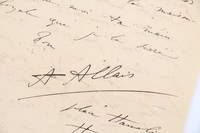
189588099Honfleur: s. n. 1895. Fine. s. n. Honfleur s.d. ca 1895 14 x 22 cm une page recto verso Autograph letter signed addressed to a journalist friend at Figaro illustré 28 lines in black ink. Fold mark inherent to envelope insertion a lack to upper corner of the letter without any damage to the text. Alphonse Allais must do a favor for his friend: ""Un peu de patience mon cher Abel un peu de patience. Sitôt rentré à Paris ma première démarche sera pour ton parapluie que je choisirai en soir gorge-pigeon et manche d'argent."" A little patience my dear Abel a little patience. As soon as I return to Paris my first errand will be for your umbrella which I will choose in pigeon-throat evening silk with a silver handle.; he therefore also allows himself to solicit the kindness of his correspondent: ""Et bien envoie-moi le n° du Figaro illustré d'il y a un mois ou deux où il y avait des choses de Toulouse-Lautrec."" Well then send me the issue of Figaro illustré from a month or two ago where there were things by Toulouse-Lautrec. He concludes his letter with a sententious: ""Donne-moi ta main loyale que je la serre. Ton Alphonse Allais. Bonjour aux amis."" Give me your loyal hand so I may shake it. Your Alphonse Allais. Greetings to friends. s. n. unknown
189985096Brest 1899. Fine. Brest 3 Octobre 1899 11 x 17 cm 1 page et demi sur un feuillet double Autograph letter dated and signed by Victor Segalen addressed to Emile Mignard one and a half pages 24 lines written in black ink on a double sheet. Traces of transverse folds inherent to postal delivery. Trace of white paper tab. Emile Mignard 1878-1966 also a doctor from Brest was one of Segalen's closest childhood friends whom he met at the Jesuit college Notre-Dame-de-Bon-Secours in Brest. The writer maintained with this companion an abundant and regular correspondence in which he described with humor and intimacy his daily life in the four corners of the globe. It was at Mignard's wedding on February 15 1905 that Segalen met his wife Yvonne Hébert. It was in 1899 that Victor Segalen's first nervous disorders manifested themselves which would only worsen as he advanced in age. Worried about his already failing health his friends and relatives wanted to hear news of him which sometimes exasperated him: ""Faire comprendre à Mlle D. qu'il me serait extrêmement pénible de répondre à ses lettres qui ne pourraient être que de condoléances.autant celles d'amis comme toi me seraient apaisantes autant des consolations féminines même bien intentionnées je n'en doute pas me seraient insupportables."" Make Miss D. understand that it would be extremely painful for me to respond to her letters which could only be of condolence.while those from friends like you would be soothing to me feminine consolations even well-intentioned I have no doubt would be unbearable to me. Victor Segalen thus declares his profound intimacy with Emile Mignard with whom he had undertaken that same year a cycling tour in Brittany and to whom he confided fully. Fleeing certain relationships he desired to maintain despite his illness his privileged friendship with the latter: "". ne reviendrai qu'après un détour dont je ne prévois pas la durée. Mais j'ai le temps et le désir d'avoir de tes nouvelles."" .will only return after a detour whose duration I cannot foresee. But I have the time and desire to hear from you. Knowing his friend to be understanding and respectful of his reserve the convalescent Victor Segalen did not wish to elaborate further on the illness that was already consuming him: ""Tu sens que je ne puis en écrire plus long n'ayant en ce moment pas le choix des sujets mais tu ne m'en voudras j'en suis sûr pas."" You feel that I cannot write at greater length not having at this moment a choice of subjects but you will not hold it against me I am sure. Autograph letters by Victor Segalen are extremely rare. unknown
189577509Paris 1895. Fine. Paris 12 novembre 1895 12.50 x 20 cm 4 page sur un double feuillet Autograph letter signed by Pierre Louÿs signed with his initial addressed to Georges Louis. Four pages written in blue ink on a double sheet. Envelope enclosed bearing on the verso the intact wax seal with the writer's cipher. Transverse fold inherent to the mailing. Important letter addressed to his brother Georges Louis with whom Pierre Louÿs maintained a very intimate relationship and whom he considered as his own father. The question of the real identity of Pierre Louÿs' father still fascinates biographers today: ""His father Pierre Philippe Louis . had married in 1842 Jeanne Constance Blanchin who died ten years later after giving him two children Lucie and Georges. In 1855 he remarried Claire Céline Maldan and from this union was born in 1857 a son Paul; then in 1870 our writer who received the first names Pierre Félix. This late birth the differences in character between father and son the former's disaffection towards the latter the profound intimacy that always reigned between Louÿs and his brother Georges all this has led certain biographers and critics to suspect that the latter was in reality the father of the writer. The exceptionally intimate and constant relationship that Pierre and Georges maintained between them all their lives could be an argument in this sense. Of course no irrefutable proof has been discovered and probably never will be. Nevertheless certain letters . are quite troubling. In 1895 for example Louÿs writes seriously to his brother that he knows the answer to 'the most poignant question' he could ask him a question he has had 'on his lips for ten years.' The following year in the midst of Aphrodite's triumph he thanks Georges effusively and ends his letter with this sentence: 'Not one of my friends has a FATHER who is for him what you are for me.' Arguing from the close intimacy of Georges and Claire Céline during 1870 and the jealousy that the father never ceased to show towards his younger son Claude Farrère did not hesitate to conclude in favor of Georges Louis. And what to make of this dedication by Louÿs to his brother on a Japan paper copy of the first edition of Pausole: To Georges his eldest son / Pierre."" Jean-Paul Goujon Pierre Louÿs As attested by the enclosed envelope Pierre Louÿs sends this letter to his brother while the latter is exercising the function of France's delegate to the International Commission of Egyptian Debt and is in Cairo. Like a good socialite Pierre tells his brother about his new encounters: ""I met yesterday at a friend's house one of the sons of your minister Marcellin Berthelot. I have known all four of them for a long time but I see little of them. One of them André is a friend of Henri Mougeot with whom he has rented along with two or three other young men a house in Chevreuse and a mistress in Paris. . The other Daniel is a professor at the School of Pharmacy. A remarkable chemist they say. Philippe does nothing special . Finally René the youngest is Blum's oldest friend and his great rival of former times in the general competition. . It is Philippe who formed five or six years ago with Léon Daudet and Georges Hugo such a famous trinity. He is also known for having written a sonnet containing six rhymes in omphe which stupefied Heredia."" But these worldly matters do not distance Pierre Louÿs from literature. Indeed his first novel entitled Aphrodite is about to appear and he wonders to whom he could dedicate it. He first thought of José Maria de Heredia but. ""H. refuses . the dedication of Aphr. because he still has two daughters to marry. I myself had put a thousand reservations in my offer and his response after all is not unobliging. I know on the other hand that he repeats before strangers and indifferent persons everything he told me about the book and in the same hyperbolic terms. Finally he gave me unknown
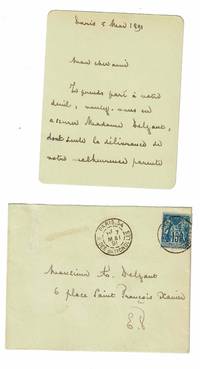
189176346Paris 1891. Fine. Paris 5 mai 1891 11.40 x 8.80 cm une carte recto-verso et une enveloppe Signed autograph card from Stéphane Mallarmé addressed to Alidor Delzant written on both sides in black ink. Envelope included. Alidor Delzant was a lawyer collector and bibliophile. Friend of the Goncourts he devoted a work to them and was Edmond's secretary and testamentary legatee. ""Je prends part à votre deuil voulez-vous en assurer Madame Delzant dont seule la délivrance de votre malheureuse parente par elle entourée de soins peut adoucir le chagrin. . Heureusement vous êtes un de ceux avec qui l'on se sent partout et même loin."" ""I share in your grief would you please assure Madame Delzant of this for whom only the deliverance of your unfortunate relative surrounded by her care can soften the sorrow. . Fortunately you are one of those with whom one feels comfortable everywhere and even from afar."" unknown