[MEIJI PERIOD BOARD GAME].Biblio.com
46 résultats
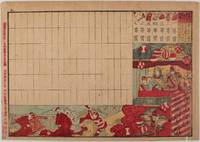
1892215726大野栄吉. Ōno Eikichi. Meiji 25 1892. Colour woodblock print 22.8 x 32.5cm evenly browned few chips in margins but overall very good. This colourful woodblock print serves as a point sheet for a horse racing board game. While the game rules are unclear the print vividly captures an exciting race scene featuring three horses and their jockeys. The race unfolds in a festive atmosphere complete with blossoms and lanterns while the spectators appear to include the Meiji Emperor and Empress along with their entourage. The Emperor is depicted in full military uniform and the Empress is shown in a traditional kimono. The print also displays the prizes for first through seventh place which include a silver cup a trophy a riding cap a scarf a shoe and a whip. Western-style horse racing began in Japan in the mid-19th century following the arrival of Westerners and became a high-class social event during the Meiji period. . 大野栄吉. [Ōno Eikichi]. unknown
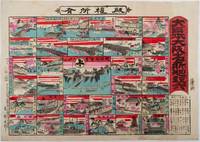
1898218612大阪. Osaka.: 東新太郎. Azuma Shintarō. Meiji 31 1898. Colour woodblock sugoroku 37.8 x 53cm a little light staining and soiling in margins very good. This vividly printed colour woodblock sugoroku game was published in 1898 and features major sites in Osaka. The game highlights entertainment districts such as Dōtonbori Shinsaibashi and the city’s red-light areas. It also includes the headquarters of Osaka Shōsen Kaisha OSK.<br><br>Known as the city of rivers canals and bridges Osaka is well represented in the game through depictions of several famous bridges. The goal of the game is the Osaka Army Headquarters located near Osaka Castle. Distances from Kōrai Bridge to various destinations are listed in the lower right corner. . 東新太郎. [Azuma Shintarō]. unknown
1898NF0052WHERE TO HUNT AMERICAN GAME United States Cartridge Co.1898 first edition a bright vg copy in gold-gilt stamped pictorial with over 125 illustrations. United States Cartridge Co. 1898 unknown
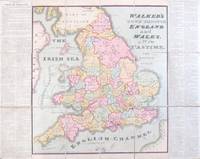
180950306London: Publisher for the Author. by W. & T. Darton 1809. Folding game 54 x 66 cm the map portion 49 x 43 cm not including margins dissected and backed on linen. Attractive contemporary hand colouring panels either side mostly in double column containing the instructions and a list of the places featuring in the game with brief descriptions. Some minor creasing to the edge of a few sections some soiling to the reverse. Original marbled case with a printed label a little rubbed overall a well preserved example. Whitehouse p.13. London: Publisher for the Author... by W. & T. Darton unknown
1802207728Lond. W. & T.Darton. 1802. Large folding hand-coloured map of England & Wales. 550x530cm when unfolded. Has 118 place markers on which counters can move when a totum is thrown. The counters can be purchased separately. The players commence in Maidstone no.1. and end in London No.118. Contained in a rubbed card case. Good copy. Scarce. The directions for playing s printed on the sides of the map. Lond. W. & T.Darton. unknown
189764124New York: Longmans Green & Co. 1897. Tall 8vo. 8 195 1 pp. Six plates. Pictorial green publisher’s cloth cover art of moose by Decorative Designers gilt lettering front cover & spine slight rubbing & scuffing to lower right fore-edge very minor dustsoiling still VG bright copy. First American edition of this excellent work incorporating big game hunting accounts of Lions in South Africa Hippopotamus Giraffe & Zebra hunting as well as Grizzlies in the Rocky Mountains and Moose. Longmans, Green & Co., hardcover
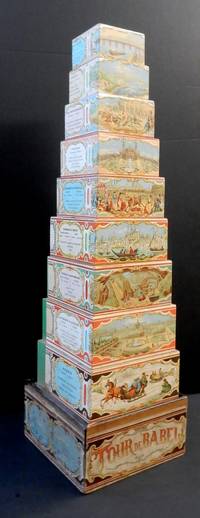
18823220299<i>A nest of nine wooden blocks ranging in size from 78 x78 x 46 mm to 182 x 182 x 60 mm each with a chromolithograph wrap-around illustration depicting European countries with statistical information; contained in the original box with a wrap around title label including four cartouche scenes printed in blue; with a sliding lid replaced.</i><br /><br />Each of the blocks is illustrated with a typical scene from European countries Russia the largest block showing a number of troikas in a winter landscape Germany & Austria with a view of Vienna Sweden and Denmark with mining for iron Turkey & Greece with a view of Istanbul etc. Also included are cartouches with basic information on the population and chief products of each country. <br /><br />The now ubiquitous graduated nested set of blocks for children was quite a late development in toy design with the earliest known patent being applied for in the US in 1881. Watilliaux's Tour of Babel was first marketed as interlocking jigsaw like pieces that could be joined together as hexagons and then stacked to form a tower that was issued at the time of the 1878 Paris Exposition here depicted as the illustration representing France. However when first American nested blocks began to appear Watilliaux evidently adapted the printed design and applied it to his own set of graduated blocks. Unfortunately this reworking did not quite fit the increased surface area of the blocks and a blank section has perforce had to be filled by a section of green glazed paper. It also necessitated the dropping the country of Switzerland and in that case the original pattern was too large to be adapted without their being some lose to the design.<br /><br />No doubt the original design had some educational value although this is somewhat lessened as there is no dexterity needed to correctly interlock the jigsaw pieces and instead only to stack and knock down the Tour de Babel.<br /><br />In 1874 Charles Watelliaux took over the publisher and manufacturer of many board games and toys Bernard Coudert and became a major producer until its sale in 1908 to Revenaz & Tabernat. Watilliaux, Editeur, Lith. J. Marie, Faub St Denis, 61.
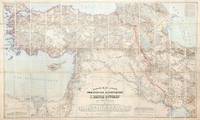
1899155664Dehra Dún India & Berlin: Photozincographed at the Office of the Trigonometrical Branch Survey of India & Dietrich Reimer 1899-1904. Remarkable assemblage of three important and superbly detailed maps A rare opportunity to acquire three exceptionally impressive and uncommon maps together forming the finest contemporary cartographic overview of the Great Game's central theatre. Spanning from the Mediterranean to Afghanistan and from the Caspian to Sir Baniyas Island they present a striking synoptic view of the region at a moment of intense strategic interest. All three share the same provenance each bearing the distinguished bookplate of the officers' mess library of the 85th Foot later part of The King's Light Infantry. Likely acquired as a group by an officer attuned to imperial affairs in the run-up to or immediate aftermath of the 1907 Anglo-Russian Convention they reflect the period's effort as Hopkirk notes to resolve regional rivalries and curb Germany's eastward ambitions. The Persia map is a landmark Survey of India production and the most comprehensive rendering of the region then available incorporating the latest British and Russian surveys and reconnoitres. Only 300 copies of this August 1904 issue were printed and institutional locations are limited to the British Library Deutsche Nationalbibliothek and Sächsische Landesbibliothek. The impressive wall map of Afghanistan June 1901 produced under Strahan and Gore and executed at the Frontier Drawing Office under Colonel R. A. Wahab is equally rare with copies recorded only at the British Library Wisconsin and the Bayerische Staatsbibliothek. Its authority rests on extensive British and Russian sources including work by Robertson Trotter Sykes Ney Elias and the Afghan Boundary Commission. These maps exemplify the Survey of India's exacting standards during the era of photozincographic production when officers were required to vet every detail under magnification. Kiepert's map of the Ottoman Empire complements the two Survey of India sheets representing the best contemporary mapping of a region Britain could not itself survey. Kiepert one of the foremost scholarly cartographers of the 19th century travelled widely in Ottoman territories producing clear and remarkably accurate maps that remain valuable records of the period. This map is comparatively well represented institutionally with around 17 holdings recorded in Europe the US and the UK. Persia: scale 1:1013760 six-sheet coloured map divided into four linen-backed quadrants each measuring approx. 976 x 963 mm when assembled measuring 1952 x 1926 mm North West North East South West South East each backed with Nonpareil pattern marbled paper each section dissected into 20; Afghanistan: scale 1:1013760 coloured map dissected into 45 sections linen backed measuring approx. 1035 x 1640 mm; Turkey: scale 1:1500000 coloured map dissected into 65 sections linen backed measuring approx. 1016 x 1700 mm; together with the "Apercu general" measuring 412 x 570 mm showing the administrative division of the same area intended to accompany the map; dissected into 10 sections linen backed. Each map housed in the original dull purple morocco-grain cloth case Stanford's printed label to front. Cases a little worn with some loss of fabric light toning to maps otherwise in excellent condition. Cases a little worn with some loss of fabric occasional light toning to maps otherwise in excellent condition. Kourosh Ahmadi Islands and International Politics in the Persian Gulf: Abu Musa and the Tunbs in Strategic Perspective 2008; Kyle J. Gardner The Frontier Complex: Geopolitics and the Making of the Indo-China Border 1846-1962 2021; Peter Hopkirk The Great Game: On Secret Service in High Asia 1992. hardcover
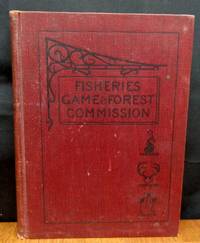
1898050957Wynkoop Hallenbeck Crawford Co. Good with no dust jacket. 1898. Hardcover. Hardcover. The front free endpaper has been SIGNED 'Compliments of Edward Thompson' who was one of the commissioners and authors. Red cloth boards show edge wear and soil. Sun darkened spine ends frayed. Text pages lightly tanned occasional finger soil rough edges. Includes 9 Denton color chromolithographic fish plates and 5 Ridgeway animal plates 1 Catchment Basins map which has a few closed tears plus many black and white photos and illustrations. Always carefully wrapped and shipped in cardboard boxes to protect your purchase. ; 4to 11" - 13" tall . Wynkoop Hallenbeck Crawford Co. hardcover
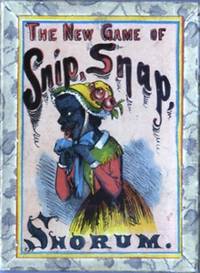
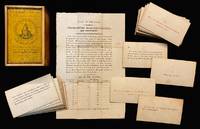
1890510171890. Deck of 20 illustrated playing cards 3 5/8 x 2 9/16 inches hand-colored with 2 card with printed game instructions. All housed in the original box with color printed label on the lid. A few cards have light soiling or foxing as does the blank paper of the box. Near fine. The game or Snip Snap Snorum has its roots in the late 18th century and was popular throughout the 19th century. It is basically a stops game in which cards are played in ascending sequence in suit. This version has five suits each containing four cards. Of these two suits depict stereotyped images of blacks with ridiculous racist names. unknown
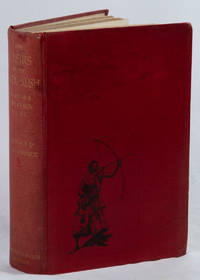
1896223413London.: Lawrence & Bullen Ltd. New Edition. 1896. Coloured folding map tipped in at rear 79 full page and text illustrations by A. D. McCormick xx 658pp original decorated polished red cloth spine gilt-lettered 24 x 15.5 cms front free endpaper browned neat inscription of a previous owner to the front pastedown manuscript short index tipped in by a previous owner at rear boards bumped and stained and spine a little sunned but a good complete copy. A distinguished soldier diplomat and Anglo-Indian administrator Sir George Scott Robertson 1852–1916 journeyed in Kafiristan in 1890-91 living for a year among the "wild" hillmen. <br>The Kafirs’ polytheistic religion and customs were rapidly disappearing by the time Robertson visited and his work served as one of the most important eyewitness accounts of the pre-Islamic cultures of the Hindu Kush and as valuable historical record of a culture that was quickly being assimilated into the broader Afghan Islamic state. It is one of the last detailed accounts of the Kafir people before they were forced into Islam or eradicated by Afghan forces. <br>Robertson’s book also provides important historical context for understanding the political dynamics of the Great Game. His observations of the Kafirs’ resistance to the Afghan Amir and his concerns about the potential spread of Islam in the region highlight the intersection of politics culture and religion in Central Asia during the 19th century. <br>The profuse illustrations are after sketches and watercolours by Arthur David McCormick who was artist on Sir Martin Conway's expedition to the Karakoram subrange of the Himalayas and in 1895 on Clinton T. Dent's expedition to the Caucasus Mountains. . Lawrence & Bullen Ltd. hardcover
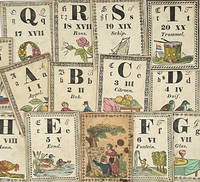
1820103149<p>No place no date but Leiden P.J. Trap c. 1820. Size: c. 6 x 8 cm. 27 cards the first one with two children reading and the other 26 contain the alphabet in various lettering types and the Roman and Arabic numbers. Each card also shows a word beginning with the letter on it and a handcoloured picture of the word. Each card with a decorative typographical border various types. card with publisher's name not present; the first card with browning and staining but all in all a lovely clean set held in a homemade green open box.</p><p>Rare Dutch alphabet cards. The first card was used for the cover of 'Kinderen lazen kinderen lezen'. c.f. Van Veen Kinderen lazen kinderen lezen #17; Buijnsters Papertoys p. 142/143.</p> P.J. Trap
18343220027<i>24 printed cards 9.5 x 5.4 cm including 12 question cards printed in red and 12 Answer cards printed in black; a folding printed sheet of instructions; contained in the original wooden box two sides very skilfully replaced; sliding lid with printed title label depicting a seated Moses reading from the Tablets. </i><br /><br /><br />The game is intended for six players who are each provided with a piece of scrap paper called 'Contracts'. The Answer cards are dealt to the players and the Question cards retained by the dealer. The players each examine their aAswer card they have been given after which the dealer selects a question card and lays it down in front of the players and then asks each in turn until the Answer card is produced. If no answer is forthcoming then the dealer refers to a 'key' which matches questions to the correct answers. Whoever reads the wrong answer or fails to recognise they have the correct card in their hand forfeits a Contract. The player who has parted with the fewest Contracts is the winner. <br /><br />Questions include 2 'What time did God employ in forming the Creation' the Answer 'Six days: and rested on the seventh day. We are not to suppose by this expression that God was weary and required rest but that he rested from or left off creating.' 16 'Who is supposed to have arranged and published the Old Testament' Answer 'Ezra a priest of the Jews.<br /><br />Some of the answers stray into the New Testament and are also fearsomely long for children to remember:- 15 'How did the Jews forfeit the favour of God; and will they ever regain it' Answer 'They forfeited the divine favour but their obstinate rejection of the Son of God whose pure doctrine of humility and love was in direct opposition to the worldly pomp and glory which they had falsely led themselves to expect at the coming of Christ. It is predict that they will one day acknowledge Christ as the Messiah and be restored to their former privileges' One has to admit there is quite a lot of anti Jewish feeling in many of the Answer cards reinforcing contemporary prejudices - 22 'In reading the Bible what part may be passed over in order to connect the historical records' - Answer 'You may be allowed to pass over the book of Leviticus and the eight first chapters of the book of Numbers. The books of Chronicles may be read as a repetition of the book of Kings both bring you to the Babylonish Captivity; you then pursue the History of the Jews and read to the end of Esther. The writings of the Prophets as connected with the History of the Bible should be read next. The book of Job the Psalms &. are beautiful compositions and may be read as such at any time.'<br /><br />Produced by the short lived partnership of William Mason Wood a typefounder and shareholder in the Austin Letter Foundry in Aldergate and Kilelm Chandler a printer from Tewkesbury who had recently moved to London and married in 1834. The partnership in Beech street was a few hundred yards from the Austin Letter foundry and as far as we can tell lasted as a business for only a few months before it was dissolved in October 1834. Chandler was successively a printer Station Master Compositor and latterly a Fruitier. We have found no other item issued from their partnership and one feels as a product of their business the cards were a commercial failure.<br /> Wood and Chandler, Printers, 41, Beech Street, Barbican.
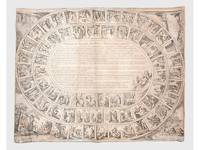
1821141642Paris: chez Basset 1821. Rare printed board game retracing the history of Genesis in 63 squares arranged in a spiral. The game begins from the Garden of Eden and ends with the death of Joseph. Each box in the game is illustrated with an engraved biblical scene. The corner illustrations depict the creation of the world the ark of Noah and Lot and his daughters. The rules are in the centre of the image. Large single sheet 455 x 575 mm. Printed to one side only. The printer's details have been trimmed off this example. Central vertical and horizontal creases from prior folding. Paper age toned some wear repair and damp staining - minimal damage still a good copy. unknown
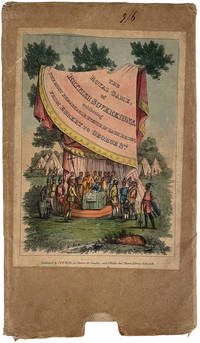
182021196041820. Published by J. & E. Wallis 42 Skinner Street London and J. Wallis Junr. Marine Library Sidmouth. 1820. Original engraved sheet game circa 61 x 46cm mounted in sections on original linen folded and housed in the original buff card slipcase with publisher's onlaid engraved and handcoloured pictorial label to one side; a striking and decorative Georgian table or chase game which is composed of 53 pictorial compartments surrounding the elaborately engraved title and printed rules of the game; both game and slipcase in uncommonly fresh condition with some slight toning dusting and a few marks and some light staining to the reverse side the slipcase in unusually fresh condition; scarce in this condition; without the additional explanatory rules booklet which is frequently the case.Third edition with No 53 described in the rules as ""1820. Buonaparte on board the Bellerophon"". Later editions of the book of rules have 3 spaces added: 54. George IV. Plans of London Improvements submitted to the King; 55 William IV. Negro Slavery abolished throughout the British Dominions; 56 Victoria l. May her reign be long and happy. The game would have required a teetotum and counters but these were not supplied by the publisher Whitehouse 25. unknown
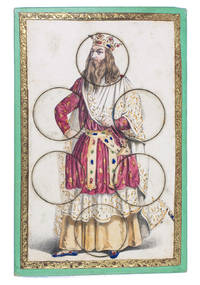
184017799Paris 1840. 19.5 x 13 cm. R. Lacouchin With 3 finely lithographed plates mounted on 3 thick green paperboard cards. The lithographs are framed with a gold-coloured ornamental border. The images on the cards are all beautifully hand coloured and the 3 cards depict respectively a crowned king in ornate robes a beautiful young lady in a green dress and a young man or possibly a court jester in an extravagant yellow and green outfit. Each card has 6 large circular movable pieces to be removed or inserted as the game demands in various circumstances. 3 puzzles. Three beautiful and complete puzzle cards with round movable pieces for example for a game of metamorphosis or lotto. While no rules are present or other specific indications given the cards with their beautiful coloured illustrations are quite intriguing by themselves.The illustration of the young man in the yellow and green outfit is signed "R. Lacouchin". Slightly foxed otherwise in very good condition. unknown
189922877BUlletin Publ NY 1899. HB NODJ Stated Second edition 1899 Original Beige cloth titled in black at top Cover light Rub Wear SUN extremties spine Interior nice condition light Wear FoX PENCIL NOTES or Marks here & There & some inner Hinge tape Reinforcement VG-/VG NODJ 277 pgs Table Contents Back. Hard Cover. BUlletin Publ, NY hardcover
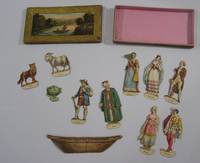
182518320French: n.p. 1825. Very good. 11 engraved cut-out figures or objects including ferryman three couples wolf goat cabbage and boat to be slotted into boat original box with engraved pictorial label colored by hand A rare children's game possibly printed by the Parisian publisher Nepveau. Contained in the box measuring 14cm x 7cm x 1cm is a complete set of figures for the two river crossing puzzles known as the 'Jealous Husbands Problem' and 'Goat Wolf and Cabbage'. The earliest account of these puzzles is in the 9th century manuscript "Propositionnes ad Acuendos Juvenes" Problems to Sharpen the Young attributed to Alcuin. In both puzzles there are only two places in the boat. In the Jealous Husbands Problem no woman can be with another man unless also accompanied by her husband. In Goat Wolf and Cabbage the wolf will eat the goat and the goat will eat the cabbage unless they are guarded by the boatman. <br /> Originally accompanied by counters and an instruction sheet now lost. The box is lightly worn else in very good condition; the figures are in fine condition except the boat which has been repaired and the cabbage which lacks the lower part of its insertion tab and one female figure lacks a hand. Rare. n.p. unknown
189578554August 1895 - 1978. original padded leather. The album's spine is perished with light wear at edges; contents sound and fine. 8vo. Illustrated throughout. The first page is an amusing original hand-colored cartoon of a Victorian couple cowering in front of a pig initialled "A.T." Following are 175 pig drawings all signed and most dated and many with a location. Dozens are neatly filled in in black and one is flesh-colored. 117 drawings were made between 1895-1900; 26 from 1900-1910 . hardcover
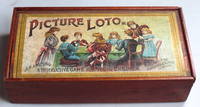
188040199London: J. Jaques & Son c.1880. Twelve cards showing 18 pictures each - a total of 216 pictures plus 207 tiles with the names of the pictures in both English and French - so lacking 9 and with some handwritten replacements included. Original wooden box with a pictorial sliding lid not fitting well but otherwise sound. Scarce. The price includes VAT in the UK. Please contact us if you are elsewhere. London: J. Jaques & Son unknown
1874246686London: Chapman and Hall 1874. First edition secondary binding. vi 337. 1 vols. 8vo. Green cloth spine titled in gilt. Very good minor rubbing. First edition secondary binding. vi 337. 1 vols. 8vo. Tiger hunting in Central India with notes on leopard. The author "also relates numerous stories from other sportsmen focusing on hunting bear rogue elephant and the like" Czech. Czech Asia p. 2 Chapman and Hall unknown
189941810Wynkoop Hallenback Crawford Co. State Printers 1899. First edition. Cloth with gilt titles stamped in blind string tied. Maps very good with small splits at corner folds colors bright in very good portfolio with small soiled spot on front and some sunning to spine. 1 colored map on 2 joined sheets 102 x 121 cm. Each map is 32 3/4 x 25 1/2 inches. Issued in portfolio 9 1/4 x 5 3/4 inches with cover title: Map of the Catskill Preserve. Engraved by J.Y. McClintock and W.L. Lawton. Over four feet if joined scale is 1 inch to 2 miles. Shows patents lots names of landowners and town boundaries subdivided into tracts. Shows street names and railroads. Compiled from "Official Maps and Field Notes on file in the State Departments at Albany N.Y. by Authority of the Fisheries Game and Forest Commission." The first meeting of the Forest Preserve Commission was held on September 23 1885 and a tabulation of the state ownership did not exist yet; in 1892 the State provided $250 the Forest Commission "for completing the public path leading to the summit of Slide mountain Ulster County included within the preserve." and in a 1893 budget bill Chapter 726 the State provided $1000 "For the expenses of examination of title and survey of lands owned by the state on Slide Mountain in Ulster County and other parts of the Catskills." which lead to the creation of this first map of the Catskill Forest Preserve. Quite detailed and in remarkably good condition. Wynkoop Hallenback Crawford Co. State Printers hardcover
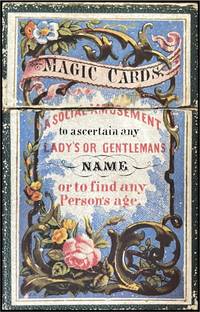
185019999England 1850. 18 cards 89 x 54 mm 9 printed on pink cardstock and 9 on yellow. Housed in original slipcover made of pebbled green paper over boards with chromolithographed label affixed to the front open at top and bottom. Light wear to edges of slipcover otherwise in excellent condition. A charming and unusual magic card game based on mathematical principles that purports to reveal anyone’s name and age. Using the pink cards for women and yellow for men the questioner holds onto the instruction and key cards and gives the player the rest of them which have lists of names and numbers and the letters A E I O U W and Y at the top. The player tells the questioner the letters corresponding to which cards have their name on them and using the key the questioner adds their corresponding numbers to get the player’s name provided it is one of the 127 names listed. The game is played the same way to determine players’ ages. The game actually works! unknown
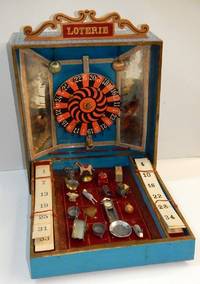
19002210013<p><i>Wooden box 32 x 26 x 8 cm with light blue patterned paper covering; the lid with a label lettered 'Loterie' and a hinged pierced wooden sign with the words 'Loterie' lettered in gilt paper on red; the lined paper interior with a central mounted wheel between mirrored sides and two hanging silk balls; the fall front where the prizes are held with two spaces left and right containing six lottery cards one from another set together with 16 toy prizes as listed below.</i></p><p>Lottery or carnival wheels games became popular at the end of the nineteenth century. Their construction was more complicated than heretofore with the addition of a rotating wheel with pins with a 'clack' mechanism sounding as the wheel is spun. The numbers on the wheel are randomly arranged from 0 through to 25 in white on alternating in black and red ground - clearly based on the 'single zero' form of roulette wheel that became the norm in Europe from the middle of the nineteenth century. The design has a second purpose as the box is hinged so that open it is given the form of a fairground entertainment with an assortment of prizes laid out in a display on squares below the wheel that each have a number too. </p><p>The idea of the game is twofold firstly as the wheel is spun and numbers called out the player who first completes a card of numbers is the winner. In the second game when the numbers 1 to 16 are called out and a player has the number on one of the cards they can then claim one of the small toy prizes. The sixteen twenty assorted of toy prizes include: a handcart wall clock bracelet scales pram wooden top bracelet fairground horse two rabbits a chicken a dish a parcel a metal top metal puzzle pair antimony jardinieres and a heart broach.</p><p>There is no makers name and the design although of a solid construction is nevertheless probably a bespoke production possibly made in order to be sold through fairgrounds and market stalls rather than the more salubrious emporia for children. The interior is lined in turquoise paper with bevelled mirrored silvered card sides and although simple the idea was glittery enough to catch any passing child's attention.</p>
1891335233eme. Ed. revue et corrigée.- Paris: Octave Doin Ed. 1891.- XXXII-398 p. en numeración continua: Ilustraciones; 8º 189 x 125 cm.; Texto en francés; Fina encuadernación a la alemana en Tela Nueva tejuelo. La portadilla con una falta de papel pequeña en su base. El papel algo grisáceo. Por lo demás en buen estado. ESOTERIA TEOSOFÃA PARAPSICOLOGÃA ALQUIMIA CARTOMANCIA SECTAS Y CIENCIAS OCULTAS EN GENERAL Livre en français Octave Doin hardcover