1 913 résultats
19672110502150415339Mainichishinbunsha 1967. Soft Cover. Fine. Volume: 1 Mainichishinbunsha paperback
19652110502150410768elementary school 1965. Soft Cover. Fine. Volume: 1 elementary school paperback
19822092902137403253Kodansha 1982. Soft Cover. Fine. Volume: 1 Kodansha paperback
19762110502150414827Heibonshuppan 1976. Soft Cover. Fine. Volume: 1 Heibonshuppan paperback
19792110502150413583Chikushobo 1979. Soft Cover. Fine. Volume: 1 Chikushobo paperback
19632110502150402515Kodansha 1963. Soft Cover. Fine. Volume: 1 Kodansha paperback
19812110502150413580Kisotengaisha 1981. Soft Cover. Fine. Volume: 1 Kisotengaisha paperback
19812110502150414062Kisotengaisha 1981. Soft Cover. Fine. Volume: 1 Kisotengaisha paperback
19862110502150413584Byakuyashobo 1986. Soft Cover. Fine. Volume: 1 Byakuyashobo paperback
19752110502150413208Dandi-sha 1975. Soft Cover. Fine. Volume: 1 Dandi-sha paperback
19702110502150406760Naniwashobo 1970. Soft Cover. Fine. Volume: 1 Naniwashobo paperback
19712110502150412117Mushi Pro Trading Co. Ltd. 1971. Soft Cover. Fine. Volume: 1 Mushi Pro Trading Co., Ltd. paperback
19712110502150414457Kodansha 1971. Soft Cover. Fine. Volume: 1 Kodansha paperback
19402110502150401967music club office 1940. Soft Cover. Fine. Volume: 1 music club office paperback
19722110502150415392Jitsugyo no Nihonsha 1972. Soft Cover. Fine. Volume: 1 Jitsugyo no Nihonsha paperback
19522110502150412670modern movie company 1952. Soft Cover. Fine. Volume: 1 modern movie company paperback
19562110502150411841Kodansha 1956. Soft Cover. Fine. Volume: 1 Kodansha paperback
19632110502150414043Kodansha 1963. Soft Cover. Fine. Volume: 1 Kodansha paperback
19822111902156002145Ethnological Society of Japan 1982. Soft Cover. Fine. The book is in fine condition. Ethnological Society of Japan paperback
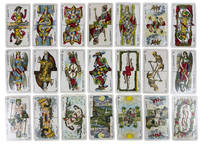
1943135<p>COMPLETE DIVINATION DECK OF ITALIAN TAROT<br />"MODERN PIEMONTESE PATTERN" PRINTED IN GENOA AND USED DURING THE SECOND WORLD WAR IN THE AREA OF THE "ITALIAN SOCIAL REPUBLIC"</p><p>Tarocchi Piemontesi<em> </em>Genoa Italy Faustino Solesio 1944-1945.</p><p>78 Tarot cards 10.5 x 5.5 cm featuring chromolithographic images; backs of the cards adorned with a green diagonal pattern; rounded corners.</p><p>A complete deck of the "<em>Tarocchi</em>" characterized by Italian suits: <em>Spade</em> Swords <em>Bastoni</em> Batons <em>Coppe</em> Cups and <em>Denari</em> Coins with <em>Spade</em> and <em>Bastoni</em> interlaced in a manner typical of these decks. The deck features double-headed court cards comprising four face cards—King Queen Knight and "Valet"—and ten numeral cards in each suit totaling 56 cards. It includes 21 double-ended "atouts" trump cards <em>atutti</em> in Italian numbered one to twenty-one and an extra card called "Il Matto" The Fool numbered 0. The trumps are captioned in Italian; the trumps and the suits are numbered with Arabic numerals inside or above a small image representing the suit.<br />On the Ace of Coins is the name of the maker: "Faustino Solesio Genova – Casa Fondata nel 1774" House Founded in 1774 and the tax stamp.</p><p>The Italian Social Republic RSI also known as the Republic of Salò was a puppet state created in the northern part of Italy during the Second World War from September 1943 to April 1945. Formally led by Benito Mussolini it was under the political and military control of Nazi Germany. The RSI represented the fascist regime's last attempt to maintain power in Italy with a precarious state structure and a context marked by partisan resistance and the Italian civil war.</p><p>Faustino Solesio was an important printer of playing cards and tarot decks active in Genoa during the 19th and early 20th centuries. He was known for printing various types of cards including <em>Tarocchi Piemontesi</em> produced using woodblock printing techniques and colored with <em>pochoir</em>; <em>Minchiate Fiorentine</em> of which he was the last known producer around 1930. The <em>Minchiate Fiorentine</em> were created based on designs by the Modenese artist Pipein Gamba probably intended mainly for collectors since players had by then disappeared. He also produced playing cards with Italian suits.</p><p>Conditions: Unused perfectly preserved.</p><p>Provenance: On the Ace of Coins there is a tax stamp with the inscription "IX – Lire tre". This rare stamp was used during the period 1944-1945 when northern Italy was under the control of the Italian Social Republic RSI which used specific fiscal stamps. The Roman numeral did not represent the year according to the Fascist calendar as is often erroneously believed but indicated the city to which the deck belonged. The number XII represented the city of Milan XIII was Trento and IX present on this deck probably represented Genoa.</p><p>Reference: Stuart Kaplan <em>The Encyclopedia of Tarot</em> Volume II U.S. Games Systems 1986. Peter Endebrock's Playing-card Pages.</p> Faustino Solesio
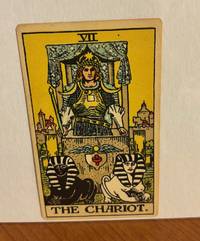
192016446London:: William Rider & Son c1920-1940. 70 x 118 mm. 2.75 x 4.75 inches. Single card. Original Rider Waite Tarot deck card. The Chariot. Card VII. from the Major Arcana. From the original early editions of William Rider & Sons printing of A.E. Waites tarot deck. Excellent condition. Full color. Brown crackle backed design. A rare and beautiful card from the most famous tarot deck ever printed. At time of description we locate no other comparable singles for sale. We find only one complete deck of Pam C printing for sale at five thousand dollars. 70 x 118 mm. 2.75 x 4.75 inches. The Rider-Waite tarot is likely the most popular and famous tarot card reading deck ever printed. It was first printed and published by William Rider & Son in 1909 printed 1910 after the instruction of well known occultist and academic mystic A. E. Arthur Edward Waite. It was illustrated by Pamela Colman Smith. It is estimated that over 100 million copies of the Rider-Waite deck have circulated over the last century. The symbols and imagery were influenced by the 19th-century magician and occultist Eliphas Levi as well as teachings of the Hermetic Order of the Golden Dawn. The first printing was extremely limited. The Pam A deck was published from 1910-1920. Pam C was published 1920-1928. Pam B published 1931-1940. The deck was not printed again until much later in the 1970s. The difference between the early editions are distinct by outline artwork colors and lettering. The letters A B. C. and D were given at random and do not always refer to the order of publication. The easiest way to clarify which edition is by the ÒThe SunÓ card in each deck it is a bit more distinct in each edition. However because our deck was incomplete in the first place and missing ÒThe SunÓ card we could only match by color and design. Our strong belief backed by experience and reference is that our cards for sale are from the PAM C 1920-2928 or PAM B 1931-1940 decks. The colors designs and brown crackled backs support this. Please see The World of Playing Cards Rider Waite Tarot Early Editions for reference. William Rider & Son, unknown
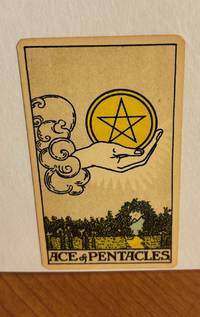
192016449London:: William Rider & Son c1920-1940. 70 x 118 mm. 2.75 x 4.75 inches. Single card. Original Rider Waite Tarot deck card. Ace of Pentacles. from the Minor Arcana. From the original early editions of William Rider & Sons printing of A.E. Waites tarot deck. Excellent condition. Full color. Brown crackle backed design. A rare and beautiful card from the most famous tarot deck ever printed. At time of description we locate no other comparable singles for sale. We find only one complete deck of Pam C printing for sale at five thousand dollars. 70 x 118 mm. 2.75 x 4.75 inches. The Rider-Waite tarot is likely the most popular and famous tarot card reading deck ever printed. It was first printed and published by William Rider & Son in 1909 printed 1910 after the instruction of well known occultist and academic mystic A. E. Arthur Edward Waite. It was illustrated by Pamela Colman Smith. It is estimated that over 100 million copies of the Rider-Waite deck have circulated over the last century. The symbols and imagery were influenced by the 19th-century magician and occultist Eliphas Levi as well as teachings of the Hermetic Order of the Golden Dawn. The first printing was extremely limited. The Pam A deck was published from 1910-1920. Pam C was published 1920-1928. Pam B published 1931-1940. The deck was not printed again until much later in the 1970s. The difference between the early editions are distinct by outline artwork colors and lettering. The letters A B. C. and D were given at random and do not always refer to the order of publication. The easiest way to clarify which edition is by the ÒThe SunÓ card in each deck it is a bit more distinct in each edition. However because our deck was incomplete in the first place and missing ÒThe SunÓ card we could only match by color and design. Our strong belief backed by experience and reference is that our cards for sale are from the PAM C 1920-2928 or PAM B 1931-1940 decks. The colors designs and brown crackled backs support this. Please see The World of Playing Cards Rider Waite Tarot Early Editions for reference. William Rider & Son, unknown
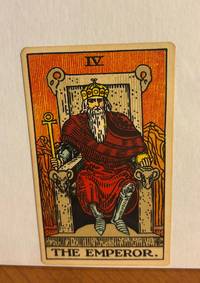
192016447London:: William Rider & Son c1920-1940. 70 x 118 mm. 2.75 x 4.75 inches. Single card. Original Rider Waite Tarot deck card. The Emperor. Card IV. from the Major Arcana. From the original early editions of William Rider & Sons printing of A.E. Waites tarot deck. Excellent condition. Full color. Brown crackle backed design. A rare and beautiful card from the most famous tarot deck ever printed. At time of description we locate no other comparable singles for sale. We find only one complete deck of Pam C printing for sale at five thousand dollars. 70 x 118 mm. 2.75 x 4.75 inches. The Rider-Waite tarot is likely the most popular and famous tarot card reading deck ever printed. It was first printed and published by William Rider & Son in 1909 printed 1910 after the instruction of well known occultist and academic mystic A. E. Arthur Edward Waite. It was illustrated by Pamela Colman Smith. It is estimated that over 100 million copies of the Rider-Waite deck have circulated over the last century. The symbols and imagery were influenced by the 19th-century magician and occultist Eliphas Levi as well as teachings of the Hermetic Order of the Golden Dawn. The first printing was extremely limited. The Pam A deck was published from 1910-1920. Pam C was published 1920-1928. Pam B published 1931-1940. The deck was not printed again until much later in the 1970s. The difference between the early editions are distinct by outline artwork colors and lettering. The letters A B. C. and D were given at random and do not always refer to the order of publication. The easiest way to clarify which edition is by the ÒThe SunÓ card in each deck it is a bit more distinct in each edition. However because our deck was incomplete in the first place and missing ÒThe SunÓ card we could only match by color and design. Our strong belief backed by experience and reference is that our cards for sale are from the PAM C 1920-2928 or PAM B 1931-1940 decks. The colors designs and brown crackled backs support this. Please see The World of Playing Cards Rider Waite Tarot Early Editions for reference. William Rider & Son, unknown
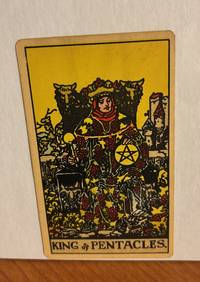
192016451London:: William Rider & Son c1920-1940. 70 x 118 mm. 2.75 x 4.75 inches. Single card. Original Rider Waite Tarot deck card. King of Pentacles. from the Minor Arcana. From the original early editions of William Rider & Sons printing of A.E. Waites tarot deck. Excellent condition. Full color. Brown crackle backed design. A rare and beautiful card from the most famous tarot deck ever printed. At time of description we locate no other comparable singles for sale. We find only one complete deck of Pam C printing for sale at five thousand dollars. 70 x 118 mm. 2.75 x 4.75 inches. The Rider-Waite tarot is likely the most popular and famous tarot card reading deck ever printed. It was first printed and published by William Rider & Son in 1909 printed 1910 after the instruction of well known occultist and academic mystic A. E. Arthur Edward Waite. It was illustrated by Pamela Colman Smith. It is estimated that over 100 million copies of the Rider-Waite deck have circulated over the last century. The symbols and imagery were influenced by the 19th-century magician and occultist Eliphas Levi as well as teachings of the Hermetic Order of the Golden Dawn. The first printing was extremely limited. The Pam A deck was published from 1910-1920. Pam C was published 1920-1928. Pam B published 1931-1940. The deck was not printed again until much later in the 1970s. The difference between the early editions are distinct by outline artwork colors and lettering. The letters A B. C. and D were given at random and do not always refer to the order of publication. The easiest way to clarify which edition is by the ÒThe SunÓ card in each deck it is a bit more distinct in each edition. However because our deck was incomplete in the first place and missing ÒThe SunÓ card we could only match by color and design. Our strong belief backed by experience and reference is that our cards for sale are from the PAM C 1920-2928 or PAM B 1931-1940 decks. The colors designs and brown crackled backs support this. Please see The World of Playing Cards Rider Waite Tarot Early Editions for reference. William Rider & Son, unknown
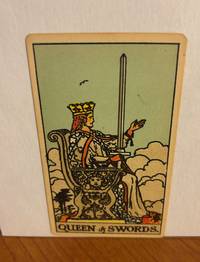
192016462London:: William Rider & Son c1920-1940. 70 x 118 mm. 2.75 x 4.75 inches. Single card. Original Rider Waite Tarot deck card. Queen of Swords. from the Minor Arcana. From the original early editions of William Rider & Sons printing of A.E. Waites tarot deck. Excellent condition. Full color. Brown crackle backed design. A rare and beautiful card from the most famous tarot deck ever printed. At time of description we locate no other comparable singles for sale. We find only one complete deck of Pam C printing for sale at five thousand dollars. 70 x 118 mm. 2.75 x 4.75 inches. The Rider-Waite tarot is likely the most popular and famous tarot card reading deck ever printed. It was first printed and published by William Rider & Son in 1909 printed 1910 after the instruction of well known occultist and academic mystic A. E. Arthur Edward Waite. It was illustrated by Pamela Colman Smith. It is estimated that over 100 million copies of the Rider-Waite deck have circulated over the last century. The symbols and imagery were influenced by the 19th-century magician and occultist Eliphas Levi as well as teachings of the Hermetic Order of the Golden Dawn. The first printing was extremely limited. The Pam A deck was published from 1910-1920. Pam C was published 1920-1928. Pam B published 1931-1940. The deck was not printed again until much later in the 1970s. The difference between the early editions are distinct by outline artwork colors and lettering. The letters A B. C. and D were given at random and do not always refer to the order of publication. The easiest way to clarify which edition is by the ÒThe SunÓ card in each deck it is a bit more distinct in each edition. However because our deck was incomplete in the first place and missing ÒThe SunÓ card we could only match by color and design. Our strong belief backed by experience and reference is that our cards for sale are from the PAM C 1920-2928 or PAM B 1931-1940 decks. The colors designs and brown crackled backs support this. Please see The World of Playing Cards Rider Waite Tarot Early Editions for reference. William Rider & Son, unknown