31 résultats
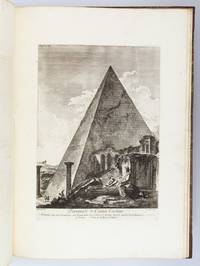
1787ST17496-043Rome: Bouchard et Gravier 1787. 525 x 375 mm. 20 3/4 x 14 3/4". <br/> Near contemporary half calf over marbled boards smooth spine divided by gilt rules into panels with blind-stamped centerpiece red morocco label hinges reinforced with buckram marbled endpapers and edges. Engraved vignette on title page and 99 COPPER-ENGRAVINGS ON 60 PLATES. A 1911 letter from the editor of "Hobbies" magazine in response to a previous owner's questions about the contents of this volume laid in at front. The plate numbered 92 with an 18th century cemetery scene pasted to the verso; rear flyleaf with two engravings pasted on. Cicognara 3595; Brunet I 646. Spine label partly missing front joint cracked from tail edge to midpoint head and tail of spine chipped boards a bit chafed and with a drizzle of white paint to front cover but the binding still solid. Occasional mild marginal foxing or finger smudges but an excellent copy internally fresh and clean throughout and with pleasing impressions of engravings. Not an external beauty as is often the case with architectural tomes but quite attractive inside.<br/> <br/> This is a collection of beautifully engraved plates drawn from the work of a painter and engraver who made engravings for Piranesi's 1748 "Varie vedute di Roma antica e moderna" and collaborated with him on the majestic "Le antichità Romane" 1756. Inspired by his work with the master Barbault drew and engraved his own series of Roman views issued in "Les plus beau monumens de Rome ancienne" 1761 and "Recueil de divers monumens anciens" 1770. The plates in the present volume are drawn from those works. Barbault's picturesque scenes are characterized by a sense of romantic decay: in some the landscape is open and generally free from human intrusion the once-grand ruins rising proudly from the encroaching vegetation. One has the sense of being among the first to stumble across these hidden wonders. In others the artist juxtaposes temple remains with the shed of a contemporary farmer a humbling contrast between past grandeur and present poverty. Jean Barbault 1718-62 had studied painting in Paris with John Restout II before receiving a scholarship from the Académie des Beaux-Arts for travel to Rome in 1721. Once there he stayed building a career as engraver and establishing himself with Piranesi and his circle. Bouchard et Gravier unknown
17423993Frankfurt am Main: Johann David Jung 1742. First Edition. Hardcover. Very Good. 18 double-page or folding plates comprising 6 of processions and 12 of interior and exterior views; 19 portraits; 2 double-page floor plans of coronation events. 100 306 80 2 38 4 96 8 2 28; 20 128 52 2 26 2 34 2 30; 4 20 8 2 10 2 26 48 pages including half-titles in first 2 volumes. Together 3 volumes in one. Frankfurt am Main: Johann David Jung 1742-43. First edition of an account of festivities and events surrounding the coronation of Charles VII 1697-1745. Lipperheide 1963 2517. Folio contemporary vellum; 19th-century institutional stamp on Volume 1 half-title large folding procession plate in Volume 2 lightly dampstained and backed with sheets from 19th-century literary journal. Very rare complete copy of this wonderfully illustrated book in handsome comdition. <br/><br/> Johann David Jung hardcover
178728145London:: T. Cadell 1787. Third Edition. All four volumes rebound in Very Good brown leather with fading to the spines. William Coxe was an English historian and priest who served as a travelling companion and tutor to nobility from 1771 to 1786. He wrote numerous historical works and travel and was a comparatist in method and incorporated new material gleaned during his many tours into the various editions of his published writings. T. Cadell, hardcover
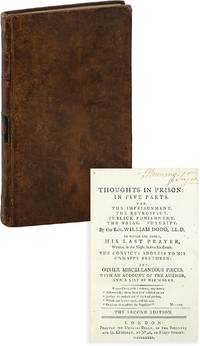
178189519London: For Charles Dilley and G. Kearsley 1781. Second edition first published 1777. 12mo. Full 18th-c. tree calf with contrasting title label and ornament to spine; iixxxvi192pp; frontispiece portrait; wanting half-title. A pretty copy joints and boards firm and free of notable wear; internally fresh and free of foxing; Very Good indeed. Early presentation to front endpaper "N.S. Nancy Henning from her Affectionate Father;" further signed on verso of frontispiece "Henning / illegible / 1789;" and to title-page "Henning-Smyth." <br /> <br /> Second edition of this much-reprinted work of prison literature a verse apologia composed by William Dodd an Anglican minister in the weeks following his imprisonment for forging the name of his former student the Earl of Chesterfield on a £4000 bank note. Chesterfield was not in a forgiving mood and the work culminates with Dodds' prayer composed the night before his execution for the crime. Includes "The Convict's Address to His Unhappy Brethren" which appears on pp.157-78 and is generally atrributed to Samuel Johnson. Indeed Johnson publicly petitioned for clemency in Dodd's case despite his own misgivings regarding the convict's character which were succinctly expressed in a letter to Boswell written the day following the execution: "His character is very bad; I hope all is not true that is charged upon him." A desirable copy very well-preserved with a contemporary woman reader's provenance. ESTC T133880. COURTNEY-NICHOL SMITH pp. 128-129. For Charles Dilley and G. Kearsley unknown
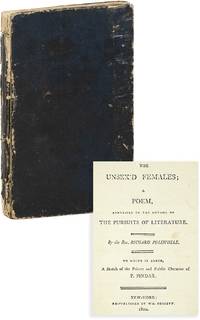
180087844New York: Wm. Cobbett 1800. First American Edition. 18mo 155mm x 100mm. Contemporary paper-covered boards; vi1-68pp. Boards worn with losses to paper at spine ends; slight darkening to text with faint tide-mark visible on rear endpapers; text complete and fresh. A Good sound copy. <br /> <br /> A virulent anti-Jacobin antifeminist tract that first appeared anonymously in London in 1798. It is the best-known or at least most-cited work by Richard Polwhele 1768-1838 an Anglican minister of Cornish birth who became a leading voice of reactionary moral conservatism during the Industrial Revolution. He was a frequent contributor to John Gifford's Anti-Jacobin Review the leading Tory journal of the period and not surprisingly a close associate of William Cobbett under whose auspices the present volume was published in America.<br /> <br /> The poem is a vicious heavy-handed attack upon a cadre of progressive British women authors that included Charlotte Turner Smith Anna Laetitia Barbauld Ann Yearsley and others all of whom Polwhele accuses of having been infected with foreign i.e. French revolutionary ideas and with trying to spread them among a susceptible British working-class. But the primary target for Polwhele's animus is Mary Wollstonecraft whose Vindication of the Rights of Women had been published in 1792 to the general consternation of Anglican conservatives. Given existing attitudes towards Wollstonecraft among Tory commentators it is no surprise that her death in childbirth in 1797 followed by the appearance of an intentionally scandalous biography by her husband the philosopher William Godwin a year later spurred a cottage industry of anti-Wollstonecraft character assassination. The Unsex'd Females published the same year as Godwin's Memoirs fits precisely into this context and does so in the most scurrilous ways imaginable painting its subject as not only irreligious but as practically sub-human a creature driven by animal instincts without regard for law whether human or divine: ".Nature is the grand basis of all laws human and divine: and the woman who has no regard to nature either in the decoration of her person or the culture of her mind will soon 'walk after the flesh in the lust of uncleanness and despise government." In what is perhaps the most alarming passage in the work Polwhele implies that Wollstonecraft's death was a just reward for ".A woman who has broken through all religious restraints will commonly be found ripe for every species of licentiousness.I cannot but think that the Hand of Providence is visible in her life her death and in Godwin's Memoirs themselves. As she was given up to her "heart's lusts" and let "to follow her own imaginations" that the fallacy of her doctrines and the effects of an irreligious conduct might be manifested to the world; and as she died a death that strongly marked the distinction of the sexes." <br /> <br /> That Polwhele's work would find its way to an American audience through the agency of the pugnacious pamphleteer and rabble-rouser William Cobbett is hardly a surprise. Cobbett had fled England for Philadelphia in 1792 and quickly established his reputation in America as a political pamphleteer of great skill and prolificity his American writings published under the pseudonym Peter Porcupine were collected in twelve volumes in 1801. During this period Cobbett's and Polwhele's political instincts were closely aligned though Cobbett would make an about-turn to populist reform later in life and there is some evidence that the two were directly acquainted see Polwhele's Reminiscences 1836 for examples of correspondence between Cobbett and himself. Cobbett's edition of The Unsex'd Females appeared in 1800 shortly before his return to England and includes an essay by Polwhele - "A Sketch of the Private and Public Character of P. Pindar" - that is not present in the British editiion. All editions are uncommon in commerce with no examples at auction in this century and only two since 1966. WING W8134. EVANS 38293. Wm. Cobbett unknown
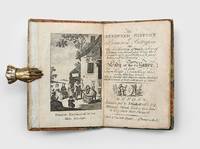
1789178870London: Printed and sold by J. Marshall & Co. 1789. A tale that promotes studying Third and most extensively illustrated edition of this rags-to-riches moral tale for young readers well-preserved in the original publisher's binding. It is decorated throughout with characterful woodcuts. The tale follows a familiar Cinderella-style narrative. The protagonist is born to humble but honest circumstances proves her virtues during tribulations and is rewarded for her efforts with marriage to a wealthy nobleman. However aspects of this seemingly timeless story situate it in the world of the late 18th century. As rationalism had become a widespread philosophy the heroine is not aided by magical intervention but owes her successes to consistent diligent attention to her lessons. This trait is shared by the protagonists of the several inset stories. Primrose Prettyface also functions as promotional material for the publishers as books are shown to be essential material for the virtue of studiousness. John Marshall and Co. were an enterprising firm who built a reputation for themselves as the dominant children's book producers of their day. In 1789 they opened a "retail bookshop specialising in children's publications" Stoker p. 86 at 17 Queen Street where Primrose Prettyface was sold. We have traced just 12 copies in institutional libraries worldwide. Duodecimo 122 x 84 mm pp. 88 4. Engraved title page and frontispiece woodcut illustrations throughout two leaves of publisher's advertisements at end rear pastedown of advertisments for The Juvenile Magazine. Original Dutch gilt paper over boards rebacked with original spine laid down. Housed in custom grey cloth solander box. Ownership inscriptions in childish hands to front pastedown: "H Hannah" in ink "Harris his book" in pencil and pencil markings from former booksellers. Extremities a little worn short split to foot of front board joint some rubbing to covers with a closed tear across back: a well-preserved bright copy of this fragile publication. ESTC T120222 Grub Street 432483. David Stoker "John Marshall John Evans and the Cheap Repository Tracts 17931800" The Papers of the Bibliographical Society of America vol. 107 No. 1 March 2013. hardcover
1780076375London: J. P. Coghlan. 2xv1458pp 8th edition hardback full brown contemporary calf with ten engraved plates including frontispiece vignette to title page front board detached many ownership signatures with family details to end-papers concerning: Joseph Laws Winifrid Law Thomas Law William Mintridge John Latchford Elizabeth Mintridge Joseph Bowyer &c p 125 closed tears edge tear to one plate losses to spine and corners rubbed soiling to leaves through use text complete ESTCT180971 a roman catholic recusant work binding copy . Fair. Hardcover. 5th or later Edition. 1780. J. P. Coghlan hardcover
176312399no place but Sheffield UK: no imprint 1763. Hardcover. Very good. 12mo ccciv 304pp. plus Index. A very good copy in contemporary full calf with wear to the spine ends otherwise crisp clean and sound quite well-preserved. Errata slip neatly tipped onto the verso of the title page. Volume III only of this mid-18th century English guide to prayers in English and Latin for the use of English Catholics. OCLC attributes authorship to Charles Cordell an influential English Catholic priest academic and bibliophile. Scarce in the trade with few auction records; presumably much scarcer than Anglican volumes from the period given the much smaller population of English Catholics during the period as compared with Anglicans. OCLC records just over a dozen holdings of the whole set. Though an odd volume rather than a whole set a rich text which documents the daily and liturgical prayers and traditions of English Catholics during this period. [no imprint] hardcover
179955420Philadelphia: Re-Printed by William Conover 1799. Second American Edition. 12mo 18.5cm. Contemporary tree calf; 320pp. Small perforation at leaf E6 costing a few characters but no loss of sense. Leaf L4 is bound out of order before L3 with marginal loss but no loss of text. Else a complete sound and Good copy in a contemporary binding worn with front joint cracked through held by threads. Ownership signature of a Henry Rogers dated 1801 to front pastedown. <br /> <br /> A popular 18th-century utopia described in the Encyclopedia of Science Fiction on-line as "one of the first Lost World novels in the literature" and "probably the first to suggest that the lost race in question may be Ancient Egyptians." Often attributed to Bishop Berkeley but in fact the work of another Catholic divine Simon Berington; in any case not a translation of any Italian work and "Gaudentio di Lucca" a synonym. Gaudentio which describes an imaginary African kingdom of Mezzorania where "Nature is the source of all that is good for mankind" originally appeared in London in 1737 and proved immediately popular going through a succession of French and German translations prior to the death of the author in 1755. The first American edition appeared in Norwich Connecticut in 1796; ours is the second American edition printed in Philadelphia three years later. Both editions are institutionally plentiful but rather uncommon in commerce. SARGENT p.11 the 1st ed. LEWIS p.18. NEGLEY 93. LCP AFRO-AMERICANA 1125 citing only this edition. EVANS 35183. Re-Printed by William Conover unknown
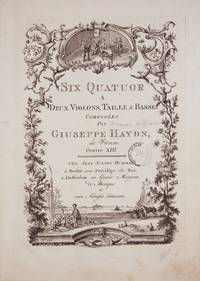
177540401à Berlin avec Privilége du Roi à Amsterdam: Jean Julien Hummel PN 356 1775. 4 volumes. Folio. Quarter dark tan mottled calf with marbled boards decorative cut paper label to uppers with titling in contemporary manuscript. <br /> <br /> Violino primo: 1f. recto title verso blank 3-15 pp.<br /> Violino secondo: 1f. recto title verso blank 3-14 pp. <br /> Viola: 1f. recto title verso blank i blank 4-15 pp.<br /> Basso: 1f. recto title verso blank i blank 4-15 pp.<br /> <br /> With a fine illustrated title to each part depicting two groups musicians within an elaborate border incorporating vegetation and animals. Engraved throughout.<br /> <br /> Small circular handstamp of the "Musik=Schule des Cantons" of Solothurn Switzerland to to each title.<br /> <br /> Binding slightly worn rubbed and bumped; upper hinges slightly split; "Oberlin 1812" in contemporary manuscript to front pastedown of each part. Minor signs of wear soiling and staining; some annotations in pencil.<br /> <br /> A very good crisp and attractive copy overall. Rare. RISM H 6244 three holdings all incomplete. <br /> <br /> These quartets were formerly thought to be by Haydn. <br /> <br /> "Hoffstetter's musical ideas are memorable easily accessible and popular in style but his working out of material does not attain Haydn's concentration. Apart from three viola concertos which might suggest that he was himself a viola player he composed various pieces of church music. His masses show some uncertainty in tonal structure. Writing to F.S. Silverstolpe on 11 January 1802 he confessed as much and acknowledged that 'everything that flows from Haydn's pen seems to me so beautiful and remains so deeply imprinted on my memory that I cannot prevent myself now and again from imitating something as well as I can'. Appropriately several of his works became known under Haydn's name." Hubert Unverricht in Grove Music Online. Jean Julien Hummel [PN 356] unknown
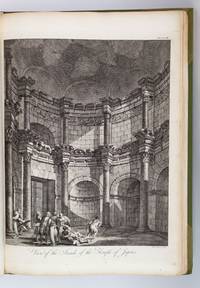
1764ST17496-042London: Printed for the Author 1764. FIRST EDITION. 520 x 365 mm. 20 3/4 x 14 1/4". iv 8 subscribers list 33 pp. <br/> Attractive modern light green half morocco gilt by J. F. Newman of Dublin his ticket on front pastedown raised bands spine panels with central patera ornament two darker green morocco labels reinforced hinges edges untrimmed. WITH 61 SPLENDID ENGRAVINGS 14 plans and elevations 47 views ON 54 PLATES eight double-page six folding by Bartolozzi and others. Front flyleaf with ink signature of Francis D. Bedford dated October 1886. Cicognara 3567; Fowler 2. Spine sunned to a light olive shade one corner bumped one plate with a little browning along the fold occasional mild marginal foxing or trivial smudges but A FINE COPY--fresh bright and clean internally with deep impressions of the type rich impressions of the plates and generous margins in a binding with few signs of wear.<br/> <br/> This is an extremely appealing copy of one of the great architectural books of the 18th century described by Cicognara as a "magnificent and grandiose work." Scottish architect Robert Adam 1728-92 was a product of the Scottish Enlightenment and moved in intellectual circles that included historian William Robertson who wrote the introduction here David Hume and Adam Smith. His interest in architectural drawing was stimulated by books in his father's extensive library which DNB tells us contained "a working collection of illustrated architectural books in English French and Italian and a series of manuals on architectural draughtsmanship." This curiosity developed into a passion during his 1755-57 tour of Italy which "was in every way a period of intense professional training during which the skills learned in Scotland were tested and given an international gloss by the Roman circle in which he now moved." DNB At the center of this circle was French architect antiquarian and artist Charles-Louis Clérisseau 1721-1820 the leading authority on Roman antiquities and architecture who introduced Adams to among others the great Piranesi. With Clérisseau as guide and tutor he explored and sketched various sites before arriving at the un-surveyed fortress palace built by the former emperor Diocletian at Spalatro the modern-day Croatian city of Split. Adam undertook a survey of the building and drew the architectural plans and elevations for this work while Clérisseau sketched views of the ruins. Adam planned this book as a way of promoting his career as an architect and worked with Clérisseau to have engravings made for it. According to Thom "while the traditional plans elevations and sections--what Robert Adam called the 'Geometricals'--were generally supplied by English engravers like Rooker Patton and Walker the all-important picturesque views and perspectives which Adam thought were essential to convey the emotional impact of the remains of Diocletian's Palace were engraved in Italy mostly by Bartolozzi Paolo Santini and Zucchi." Adams also wrote the architectural commentary. The publication was a success praised by the "Critical Review" in October 1864 as possessing "a taste and execution that has never been equalled in England." As DNB observes "during these two Roman years Adam succeeded in transforming himself from a provincial and rather green Scottish architect into a cosmopolitan figure ready indeed to put into effect 'the Antique the Noble & Stupendous.'" Now based in London he embarked on a distinguished career specializing in country houses and townhomes that reflected the deep influence classical architecture and his Italian sojourn had on his work. Our copy was once owned by another artist Francis Donkin Bedford 1864-1954 who exhibited landscapes at the Royal Academy and illustrated books during the Golden Age of children's book illustration in the late 19th and early 20th century. Printed for the Author unknown
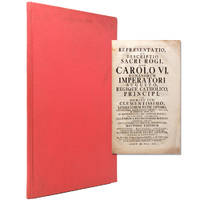
1741339750Vindobonae : Universitas 1741. 8 45pp. Folio. Later red cloth. 8 45pp. Folio. unknown
173459334Leyden: apud Conradum & Georgum Wishoff 1734. First combined edition. Engraved general title by Bleyswyck additional printed title in red and black. 26 344 14 pp.; separate title page Dd4 for second title misbound at rear along with Contents leaf. Two parts with continuous pagination. 1 vols. 4to. Contemporary full mottled Dutch calf gilt spine red leather title label. Small rectangular excision from lower margin of half-title leaf. some slight darkening at edges. First combined edition. Engraved general title by Bleyswyck additional printed title in red and black. 26 344 14 pp.; separate title page Dd4 for second title misbound at rear along with Contents leaf. Two parts with continuous pagination. 1 vols. 4to. Collects two works by the prolific Dutch scholar and Roman historian Pieter Burmann. The first deals with a Roman tax called the "vectigal" which was applied to revenue "derived from public land mines salt-works. etc. and in general to rents derived from State property." - Oxford Classical Dictionary 1949. apud Conradum & Georgum Wishoff unknown
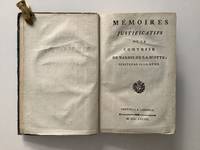
178916956AB1789. Londres 1789. 20 : 13 cm. 204 pages. Contemporary boards. 'Exemplaire tres correct'. Die 'Pieces justificatives' nach Seite 173. Verteidigungsschrfit der Gräfin de La Motte welche zwei Jahre zuvor aus dem Gefä#ngnis ausbrach in das sie wegen ihrer Rolle in der 'Halbandaffäre' gebracht wurde. Sie erhebt darin schwere Vorwürfe gegen die Königin von Frankreich Maria Antoniette. Ab Seite 173 sind angebliche Briefe Maria Antoniette und Kardinal Louis de Rohans welche die Schuld der Königin und ihre eigene Unschuld beweisen sollen. Diese und andere Veräffentlichung Valois de Saint-Rémys trugen viel zur steigenden Unbeliebheit der Königin beim französischen Volk bei. - Einband teils stärker berieben. hardcover
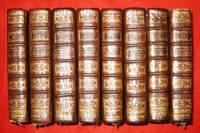
1779284Paris: De Imprimerie de Lottin l'aine 1779. Leather Bound. Very Good . 8 vols. 4 ¼ x 7 inches. Each volume bound in matching contemporary full speckled calf with four green ribbon markers all of which are present. The spines are matching with six compartments and five raised bands. In one compartment of each volume is the name of the season the four "secular" seasons rather than the seasons of the Christian Kalendar and in a second compartment is the title "Missel de Paris" in gilt lettering. The remaining compartments have extensive gilt decoration. Gilt decoration along the edges of the boards. Each volume has contemporary hand-marbled endpapers. All page edges are gilt. Each volume has occasional and unobtrusive library stamps of Bibliotheca Pusieana Oxon. and library markings on the front endpapers and there is the expected shelf wear to the edges and corners with a few small losses. The interior of the volumes is otherwise bright and clean and free of significant marking soiling or staining. The descriptions of each volume are as follows: Hyver Winter 1 partie: 2 ffep 3 unnumbered leaves Kalendar 324 numbered pages Missal cclviii numbered pages Commun des Saints 1 iv numbered leaves Supplement 2 rfep with slight loss to tail. Hyver Winter 2 partie: 2 ffep 4 unnumbered leaves Kalendar 368 numbered pages Missal cclix Commun des Saints viii iv numbered pages Supplement 2 rfep. Printems Spring 1 partie: 2 ffep 4 unnumbered leaves Kalendar 440 numbered pages Missal ccxi numbered pages Commun des Saints xi numbered pages Supplement 1 rfep. Printems Spring 2 partie: 2 ffep 4 unnumbered leaves Kalendar 428 numbered pages Missal ccxxv numbered pages Commun des Saints xi numbered pages Supplement 2 rfep. Été Summer 1 partie: 2 ffep 4 unnumbered leaves Kalendar 416 numbered pages Missal cclv numbered pages Commun des Saints viiii numbered pages Supplement 2 rfep. Été Summer 2 partie: 2 ffep 4 unnumbered leaves Kalendar 330 numbered pages Missal cclv numbered pages Commun des Saints viiii numbered pages Supplement 2 rfep. Automnie Autumn 1 partie: 2 ffep 4 unnumbered leaves Kalendar 404 numbered pages Missal cclv numbered pages Commun des Saints viiii numbered pages Supplement 2 rfep; slight loss to head of spine. Automnie Autumn 2 partie: 2 ffep 4 unnumbered leaves Kalendar 368 numbered pages Missal cclv numbered pages Commun des Saints viiii numbered pages Supplement 2 rfep Pusey House is a center of Anglo-Catholic worship and Study at the University of Oxford named after the prominent Tractarian Edward Bouverie Pusey. The Oxford or Tractarian Movement was a movement of High Church Anglicans eventually developing into Anglo-Catholicism. The movement the members of which were often associated with the University of Oxford argued for the recovery of traditional aspects of the Christian faith subsequently lost and their inclusion into Anglican liturgy and theology and conceived of the Anglican Church as one of three branches of the Catholic Church. A nice copy of this scarce dual language missal according to the Use of Paris with a unique provenance. De Imprimerie de Lottin l'aine unknown
1792252168Edinburgh: Printed by J. Robertson South Bridge-Street 1792. Second edition revised and enlarged. The first edition 1791 was of 240 pages. Pp. 335 1 on a proposed translation of Buchanan. 1 vols. 8vo. Contemporary sheep red spine label. Spine defective ends worn cracked but holding internally clean. Second edition revised and enlarged. The first edition 1791 was of 240 pages. Pp. 335 1 on a proposed translation of Buchanan. 1 vols. 8vo. Assembly of literary essays and poems by Francis Garden Lord Gardenstone 1721-1793 judge and landowner in Kincardineshire.<br /> <br /> "He was a man of many peculiarities one of which was an extreme fondness for pigs. It is related that a visitor called on him early one morning before he was up and being shown into the bedroom in the dark stumbled against something which gave a terrible grunt. At this Gardenstone said 'It is just a bit sow poor beast and I laid my breeches on it to keep it warm all night'" ODNB citing an anecdote in Kay A Series of Original Portraits and Caricature Etchings. Printed by J. Robertson, South Bridge-Street unknown
17922807London: F. Dodsley 1792. Early Edition. Leather bound. Very Good. 4 1/4 X 7 1/8 Inches. Early fine leather binding with gilt decoration to covers and spines. Four raised hubs. Stated "Tenth Edition" in each of the four volumes. Missing frontis illustrations else complete. A bit of scuffing to covers and spines but a tight set overall. Light foxing throughout. F. Dodsley unknown
172314638AB1723. 3 parts in 1 volume. Paris d'Antoine-Urbain-Coustellier 1723. 165 : 105 cm. 7 leaves 112; 64; 56 pages. Contemporary full calf spine richly gilt red title.label on spine. First critical edition of Villon edited by Eusebe de Lauriere and P. du Cerceau. Based on the collection of Coustelier where this is the most thought after. The first seven leaves contain: title-page aux lecteurs tables privilege du roy. The three parts are: Le petit testament de F. Villon 112 pages. - Les repues franches. Le franc archier de Baignollet. Le dialogue de messieurs de Mallepaye et de Baillevant 64 pages. - Lettre a Monsieur de en lui envoyant la nouvelle edition des Ouevres de Francois Villon 56 pages. The letter is by P. de Cerceau. 'La seule edition ancienne que l'on puisse recontrer apres celle de 1542'. - Nice copy in contemporary binding. - Joints a bit rubbed right joint a bit damaged otherwise fine. - Rare. - Brunet II 544; Tchemerzine V 980. unknown
174514082AB1745. 3 parts in 1 volume. Nürnberg and Leipzig Geyer 1745. 175 : 105 cm. Title 734 pages. Contemporary full calf spine richly gilt back label. BOUND WITH: Grammont Philibert Comte de. Die vergnügten Abwechslungen der Geschäfte auf dem Lande oder egebenheiten des Grafen von Grammont aus dem Französischen des Grafen Anton Hamilton übersetzet. Stockholm and Leipzig Kiesewetter 1745. 390 pages. - Booth works in first edition and extremely rare. - Title-pages with small collectors-stamp Exlibris last fly-leaf with some annotations by the previous owner. unknown
1757396Pragae Prague: Typis Universitatis Carolo-Ferdinandeae in Collegio Societatis Jesu Ad. S. Clementem 1757. Leather Bound. Near Fine. 2 vols. 8 1/2 x 12 1/4 inches. Vol. 1: 1 ffep half title title 1 - 260 7 unnumbered pages 261 - 644 lacks numbering for 645-46 but collates 647-696 4 unnumbered pages 697 - 790 1 rfep. Vol. 2: Ownership inscription "Collegia Soc. Jesu Confluentia" to front pastedown 1 ffep half title title 473 numbered pages 169 unnumbered pages. Both volumes with numerous decorative capitals and printer's devices of styles and methods ranging from post-incunabula to baroque engraving. All page edges rouged. Bound in contemporary white blindstamped goatskin with 2 of 4 engraved fore-edge clasps. Spines with four raised bands and red spine label with gilt "Institut Societ Jes Tom number. A fine and unusual tour de force of Jesuit and printing history includes excellent example of St. Ignatius of Loyola's Spiritual Exercises and mentions of missions in Canada Brazil and Japan among others. A rare imprint. Typis Universitatis Carolo-Ferdinandeae in Collegio Societatis Jesu Ad. S. Clementem unknown
173031900En Sevilla Impressor Mayor de dicha ciudad Seville: Por Juan Francisco Blas de Quesada 1730. Fine. Por Juan Francisco Blas de Quesada En Sevilla Impressor Mayor de dicha ciudad Seville 1730 15 x 20 cm relié First edition. Large arms of Utrera on second leaf. Title in red and black with a floral frame. Contemporary vellum spine titled in ink smudged. One tie in good condition spine partly detached. Traces of glue to final endpaper. A good copy without significant faults generally fresh. A monograph on the town of Utrera in the south-west of Spain not far from Seville in the province of Andalusia. The town has a rich history recorded events from which stretch back to the 13th century when Alfonso X conquered Seville. Archeological digs have shown that the town was inhabited even before the Roman period. 20th century ex libris with an image of a 16th century hand press. Por Juan Francisco Blas de Quesada hardcover
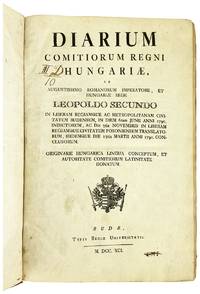
179131131Budae Buda: Typis Regiae Universitatis 1791. Very Good. Budae Buda Hungary: Typis Regiae Universitets 1791. First Edition. Folio 35.5cm.; full contemporary roan spine in six compartments with printed paper spine label all edges stained red; xxiv3933pp.; woodcut illus. as well as initials head- and tail-pieces. Leather rather scuffed and worn along spine ends and corners old paper shelf label to upper cover textblock unevenly toned and lightly foxed very occasional contemporary marginalia to earlier leaves else a Very Good sound copy overall. <br /> <br /> Detailed account of the first year in the reign of Leopold II who became Holy Roman Emperor in 1790. He died suddenly just eighteen months later in March 1792 at the age of forty-four. Typis Regiae Universitatis unknown
1789057160Edinburgh: Mundell & Son 1789. New Edition . Hardcover. Very Good Plus. EDINBURGH : 1789. It is not known when and where the first edition appeared; the second a duodecimo is dated 1672. Text complete. Old calf-leather; all corners reinforced with leather at some point; spine grey paper with simple lettered label; grey end-papers. All edges gilt. Cover stamped in gold with Name; 'B. Bolger'. Internally VERY GOOD INDEED. Ideal to have rebound. vii 555 pages. All editions are scarce and often incomplete. Only one copy of this edition is recorded in the British Library. JOHN AUSTIN or Austen born 1613 at Walpole Suffolk England; died London 1669 was an English lawyer controversial writer and one of the founding Fellows of the Royal Society. He was a student of St. John's College Cambridge and of Lincoln's Inn and about 1640 became a Catholic. He was well regarded in his profession and was looked on as a master of English style. His time was entirely devoted to books and literary pursuits. He enjoyed the friendship of such scholars as the antiquary Thomas Blount Christopher Davenport Franciscus a Santa Clara John Sergeant and others. Will be well-packed for posting/shipping. 8vo. Rosley Books for Antiquarian books Cumberland Everyman Inklings Keswick Literature Rarities Theology and History. . Published by Mundell & Son SCARCE. <br/> <br/> Mundell & Son hardcover
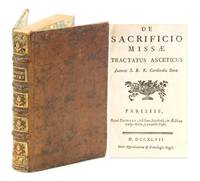
1747511396Despilly 1747. Leather. NEAR FINE. Devotional / Ascetical treatise on the Mass by the Italian Cistercian Cardinal Giovanni Bona 1609-1674. xiii 184pp. 24mo in 'cat's paw' mottled calf with 4 raised bands ornate floral stamped spine panels and burgundy morroco spine label red edges marbled endpapers bookseller's ticket to front pastedown and flyleaf verso -- Guimar Libraire in Nantes. Just a trifle rubbed at the extremities leather splitting at the ends of both joints but hinges very strong light and shallow tidemark to top edge; a very clean and attractive copy. Despilly unknown