11 résultats
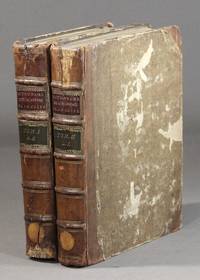
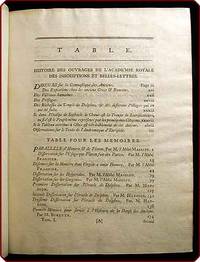
1742SS13441London:: Printed for John and Paul Knapton. . . 1742-53. 1742. 5 volumes. 8vo. Vol.1: 4 x 11-456 16; Vol.2: 2 407 15 10; Vol.3: 2 422 16; Vol.4: 2 410 14 11-26; Vol.5: 2 426 14 pp. The first 10 pages of the "Addenda" are bound at the end of vol.2 pp.11-26 are bound at the end of vol.4. 44 of 45 engraved plates mostly folding I: 17; II: 6; III: 6; IV: 6; V: 9 of 10 plates pl. 10 supplied in facs. see p. 422 TOTAL: 44 2 folding tables vol. I tables some folding addenda indexes; 2nd wasp plate vol. V with small scrape effecting some of the image. Original speckled calf; rebacked and with later endleaves vols. I III & V with joints gently mended with kozo. PROVENANCE: Bookplates of Henry and Carol Faul mounted on top of the following engraved bookplate for the American Academy of Arts & Sciences: "Sub libertate Florent" dated 1780 "The Gift of . . ." -- also with their gilt-stamp applied to the foot of the later spines "American Academy"; Rubber stamps discarded of the Linda Hall Library Kansas City MO. Very good. HENRY FAUL'S COPY -- WORKED FOR ENRICO FERMI & BIKINI ATOLL TEST. A collection of early scientific papers from leading figures all belonging to the Royal Academy of Sciences at Paris the French equivalent to the Royal Society of London. The abridged papers all appeared between 1699 and 1720 and include diverse topics such as anatomy apiculture astronomy incl. Moon chemistry electricity entomology gases geography geology herpetology invertebrates magnetism medicine meteorology mineralogy monsters music mollusks natural history optics physics scientific instruments including the barometer microscope zoology and more. / AMONG THE NUMEROUS CONTRIBUTORS OR NOTABLES MENTIONED: Agricola Amontons Baert Juan de Barros Bernoulli Bignon Borelli Bouvet Robert Boyle Carre Cassini Chazelles Chevalier Coronelli Dampier Descartes Dodart Fermat Fontenay Fontenelle Galileo Gandolphe Gassendi Gesner Gouye Halley Van Helmont de la Hire du Hamel Huygens Jeaugeon Kepler Kircher Leibnitz Lemery Leuwenhoek Malpighi de Marca Mariotte Mollard Gregory Nazianzen Isaac Newton de Nointel Ortelius Parent Picard Renau Riccioli Sanctorius Strabo Tournefort Varignon etc. PROVENANCE: 1 American Academy of Arts & Sciences bookplate: The Academy seal features Minerva the goddess of wisdom science and trade and the arts. Her temple on the Aventine Hill was a meeting place for skilled craftsman writers and actors. She is also depicted as a warrior a symbol appropriate for an organization created in the midst of the American Revolution. Around Minerva are representations of the new country—on her right a field of Indian corn a stand of oaks and the outline of a town; at her feet a hoe a plow and a sickle; on her left a quadrant and a telescope a ship heading for shore and the sun completely risen above the cloud. Over the whole is the motto SUB LIBERTATE FLORENT which suggests that arts and sciences flourish best in. -- 2 Rubber stamps discarded of the Linda Hall Library Kansas City MO. -- 3 Henry and Carol Faul. Henry Faul was a geologist working on Enrico Fermi's team at the University of Chicago. He was responsible for prospecting uranium ore in Colorado and Utah. He also travelled to Manhattan Project sites at Los Alamos and in Washington DC. Following the war Faul continued to work on nuclear projects and participated in the Bikini Atoll test. He received his M.S. from the University of Chicago during the war and went on to get his Ph.D. from the Massachusetts Institute of Technology. ESTC T131275. Printed for John and Paul Knapton. . . , 1742-53. unknown books
177344548Sevilla: Por D. Joseph Padrino y Solis 1773. First edition. Full calf. Boards rubbed extremities worn hinges starting but strong initials inked on fore edge front and rear endpapers toned early owner's signature on free front end paper older sigantures covered with small labels on first two leaves title page provided in facsimile scattered foxing & soiling contents otherwise clean; otherwise good. 16 cxii 321 pp. Illus. with b/w plates portraits facsimiles some folded and folded map. 4to. A second volume was published seventy years later in 1843. Contents: Discurso sobre la utilidad del estudio de las buenas letras / Por D.D. Sebastian Antonio de Cortes en la Academia Publica de 30 de Octubre de 1753 p. 1-66 ; Extracto de la disertacion escrita con motivo de una inscripcion antigua descubierta en Sevilla / Por Don Francisco Laso de la Vega en la Academia de 10 de Noviembre de 1752 p. 67-95 ; Traducion y explicacion del epitafio hebreo del sepulcro del Santo Rey Don Fernando III / Por Don Thomas Antonio Sanchez en la Academia de 12 de Enero de 1753 p. 96-104 ; Disertacion sobre el monacato del Rey Wamba / Por Don Miguel Sanchez Lopez en la Academia de 30 de Marzo de 1754 p. 105-152 ; Disertacion en que se prueba haverse celebrado en Sevilla un concilio nacional en el año 1478 de el qual ningun historiador ha hecho memoria / Por Diego Alexandro de Galvez en la Academia de 20 de Marzo de 1756 p. 152-170 ; Noticia de dos inscripciones anecdotas en que se hace memoria de un municipio antiguo llamado muniguense descubiertas / Por D. Sebastian Antonio de Cortes y D. Joseph de las Quentas Zayas en la academia de 26 de Marzo de 1757 p. 171-207 ; Apendice I p. 208-210 ; Apendice II p. 211-227 ; Noticias pertenecientes a la historia antigua y moderna de la Villa de Lora del Ria en Andalucia / Por D. Thomas Andres de Guseme en la Academia de 2 de Junio de 1758 p. 228-263 ; Explicacion de una inscripcion romana existente en Carmona atribuida por el celebre Muratori a Sevilla / Por Don Candido Maria Trigueros en la Academia de 28 de Septiembre de 1758 p. 264-282; Explicacion de una inscripcion hebrea que esta en la puerta que llaman de la campanilla de la Santa Patriarcal Iglesia de Sevilla / Por Don Candido Maria Trigueros en la academia de 12 de Junio de 1772 p. 283-305; Noticia y explicacion de un monumentoantiguo romano descubierto en la Villa de las Cabezas de San Juan del arzobispado de Sevillas / Por Don Francisco de Bruna en la Academia de 16 de Octubre de 1727 p. 306-314; Memoria de varias inscripciones sellos y monedas ineditas pertenecientes a la Betica cuyas copias y dibujos con la noticia de su descubrimiento y actual existencia han sido presentados à la Academia à consequencia de su particular encargo y comisión / Por D. Candido Maria Trigueros p. 315-321. Palau 162485. Por D. Joseph Padrino y Solis hardcover books
1785876331785. American Academy of Arts and Sciences. MEMOIRS OF THE AMERICAN ACADEMY OF ARTS AND SCIENCES: TO THE END OF THE YEAR MDCCLXXXIII. Vol. 1: Boston: Adams and Nourse 1785. i-iii - xxxii 568pp. 1 f.errata. 4to 10 1/2" x 8 1/2". Six folding plates. Contemporary calf binding. Front and rear hinges cracked but attached. Vol. 2: pt.1 Isaiah Thomas & Ebenezer T. Andrews 1793. i-v- 200. pt.2 Charlestown: Samuel Etheridge 1804. i-iii - 24. 1- -168. Bound as one in contemporary calf. Contains 3 plates including one folding plate of a reproduction of James Winthrop's sketch of the Deighton Rock petroglyphs.Front board detached; rear hinge cracked. Ex-library copy previously owned by noted Boston physician Buckminster Brown. Text is mostly clean with some mild foxing and ink staining . First two volumes of the series published by one of the oldest and most prestigious honorary societies in the country. Created during the Revolution it included John Adams Thomas Jefferson and John Hancock among other luminaries. Volume 2 which includes an obituary of George Washington published in 1804 is quite scarce. $3250.00. unknown books
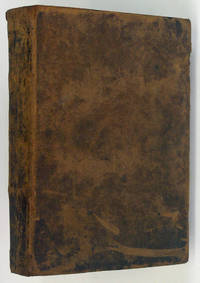
17854672Boston: Printed by Adams and Nourse in Court-Street 1785. Hardcover. Very Good. Rare complete copy with the six folding plates. Later 3/4 leather and marbled boards; boards loose. The Academy's members included George Washington John Adams John Hancock and Benjamin Franklin. <br/><br/> Printed by Adams and Nourse, in Court-Street hardcover books
178518342Boston: Adams & Nourse 1785. Vol. I. 4to. xxxii 20 568 pp. lacking 6 plts. <br><br>The first volume in the series including scholarly papers on mathematics botany geology and medicine among other topics. <br>Â Â Â Â <br>Â Â Â Â Evans 18900; Sabin 1034; ESTC W15739; Rink 8. Lacking covers; leather partially lost from spine. Title-page and several others rubber-stamped by a now-defunct institution; pages with mild to moderate waterstaining offsetting and foxing. No plates are present. Adams & Nourse hardcover books
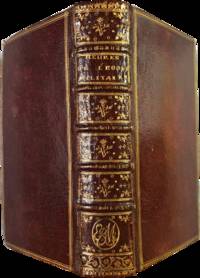
17744067Paris: Imprimerie Royale 1774. 8vo 163 x 91 mm. 18 3 3 528 30 3 3 pages. Partly double column. Woodcut and type-ornament head- and tailpieces. Faint marginal discoloration. Contemporary red morocco sides with triple thick and thin ruled border spine in six gold-tooled compartments title lettered in second compartment gilt medallion with monogram of the Ecole Royale Militaire in lower compartment gilt edges Brokatpapier endleaves with semis of gold stars and dots corners bumped. Provenance: modern etched bookplate with initials AK. Only Edition of a complete course of religious instruction for the pupils of the Ecole Royale Militaire founded in 1751 by Louis XV as a military academy for the sons of noble families including those who had sunk into poverty. The book of which only one other copy is recorded was printed and bound for the school. At first two hundred and eventually five hundred teenagers from all over France were admitted on the basis of an exam taken at the end of primary school. The huge expenses entailed by the construction of a magnificent palace to house the school designed by the architext Ange-Jacques Gabriel were covered by a national lottery and by taxes on playing cards. A single cohort graduated before the project ran out of money and although the buildings had been completed in 1787 the academy closed its doors. Pillaged during the Revolution it would not open again for the same purpose for another century. The first part of the book which was approved by and possibly written by Christophe de Beaumont the Archbishop of Paris consists of a primer of the Christian religion. It opens with the Archbishop's rules for the administration of religion in the school. From 6 am masses to near-daily catechisms and energetic prayer sessions to prepare for confession the young future officers were reminded regularly that their duties to God were as important as those to the King. The meticulous scheduling of each day and other casual details testify to the complete control of their lives by the authorities of the academy whose premises they seem never to have left not even on Christmas. An allusion to visits by the religious Directors to students in prison and in the infirmary are further reminders to the modern reader of the harsh conditions of young people's lives when children were viewed as small-sized adults. Including a table of moveable feasts from 1775 to 1793 and a calendar of Saints' days this section provides the basics of religion from the Ten Commandments to instructions on communion on how to conduct oneself at Mass and the ritual itself on examining one's conscience and preparing for confession and so on. While most could apply equally to any student including the repeated exhortations to contemplate one's sins clearly a central concern to these teachers of adolescents a few paragraphs address the special circumstances of soldiers. These include prayers to be recited before battle or after victory instructions on providing absolution to the dying in the absence of an available priest requiring memorization of a rather long passage and finally a prayer for a good death. The second and longer part printed in two columns contains the Offices for Sundays and feast days throughout the year partly in Latin. OCLC locates a single copy at the BnF. Imprimerie Royale unknown books
177742973Nismes: chez Gaude Pere Fils & Compagnie 1777. 2 volumes 4to pp. 6 iii-vii 1 644; 4 633 1; text in triple column; contemporary quarter calf over speckled paper-covered boards gilt-paneled spines in 6 compartmentsl red and green morocco labels in 2; top spine panel of both volumes cracked that on volume II with loss bottom 2 panels on volume I cracked and with old neat repair; boards rubbed extremities rubbed and worn; good and sound. The Academy was formed in 1635 at the request of Cardinal Richelieu "after the pattern of the Italian academies of the Renaissance. The Cardinal's purposes were to create something very serious a piece of governmental machinery to legislate for language as other bodies legislated on matters economic or judicial. In 1638 the work on the dictionary was begun. There was little practical organization of the task and hardly any efficiency. The result was an exasperating slowness which invited numerous lampoons. One wag suggested that the dictionary then being at the letter F he would be delighted to live until they reached G. There was one time papers were seized by creditors and the work was practically paralyzed. Finally in 1694 that is to say fifty-eight years after its inception the book was off the press and was presented to the king with ceremony. As was to be expected it was ultra-conservative and based essentially on the canons of Malherbe with even more restrictions on the admission of popular terms" Holmes & Schutz Hist. of the French Lang. pp. 86-87. Not a common edition: 6 in OCLC only UCLA in the U.S.; this eition not in Vancil. <br/><br/> chez Gaude Pere, Fils & Compagnie hardcover books
177713107Londres: T. Becket & P. Elmsly 1777. 4to 27 cm 10.6". 3 vols. I: 2 iii 1 lx 656 pp. pagination skips 1732 text uninterrupted. II: 2 iii 1 ccviii 495 1 blank pp. III: 2 iii lxviii 1 696 pp.; 1 fold. plt. 2 plts. <br><br>Sole edition thus: Three-volume set of selected pieces from the Histoire et mémoires de l'Académie a massive collection of French-language commentary and criticism on Greek and Latin classics. The printing of the Histoire et mémoires commenced in 1717 and ran through 1809 with the total number of volumes coming to 51; the present compilation offers especially noteworthy treatises from the beginning of the series through 1763.<br>Â Â Â Â The third volume includes two plates and one oversized folding plate reproducing two inscriptions and a frieze engraved by E. Malpas.<br>Â Â Â Â ~> Uncommon outside of Great Britain's libraries. <br>Â Â Â Â <br>Â Â Â Â ESTC T113913; Brunet I 26; Lowndes I 5. Contemporary treed calf spines gilt extra with gilt-stamped leather title and volume labels; leather worn at edges and moderately rubbed with joints cracking. Front pastedowns with private bookplates and signs that a plate was removed on front free endpaper one vol. endpaper holed; impressions of old pencilled shelf numbers on title-pages and one lightly inked old date. First two leaves of vol. III with upper margins stained and final leaf browned; some pages with a few spots of faint foxing most clean and crisp. T. Becket & P. Elmsly hardcover books
1780266788Petropoli Saint Petersburg: Typis Academiae scientiarum 1780. 18 folding engraved plates at end one folding table in text. viii LACKING 84 pages of introductory matter pp. 1-395 pp. Articles in Latin and in French. 1 vols. 4to. Modern quarter brown morocco and marbled boardsnew endpapers. Ex-library with discard stamp on original endpaper. 18 folding engraved plates at end one folding table in text. viii LACKING 84 pages of introductory matter pp. 1-395 pp. Articles in Latin and in French. 1 vols. 4to. Part two of the report on the year 1777 by the St. Petersburg Imperial Academy of Sciences. Articles include<br/><br/>Peter Simon PALLAS article on the giant anteater Observationes circa Myrmecophagam Africanam at pp. 223-231; Description du Bufle i.e. Buffalo à Queue de Cheval.pp. 232-257; Observations sur l'Asne dans son état sauvage ou sur le veritable onagre des anciens pp. 258-277.<br/><br/>An article by Daniel BERNOULLI at pp. 109-129 on the mesurement of time; and several articles by the great Swiss mathematician Leonhard EULER: De integratione formulae; De valore formulae integralis; Novae demonstrationes circa resolutionem numerorum in quadrata; Considerationes circa brachystochronas; Sur l'effet de la refraction dans les observations terrestres; De motu oscillatorio penduli cuiuscunque dum arcus datae amplitudinis absolvit; De theoria lunae ad maiorem perfectionis gradum evehenda. Typis Academiae scientiarum unknown books
1763LLV2074Amsterdam:: n.p. 1763. 1763. Two volumes. Sm. 8vo. 176 x129 mm. Collation: -2 A-Y8 Z4 Z4 blank; -1 A-R8 S2. Pagination: 4 358 2 blank; 2 276 pp. Title is an insert. Illustrated woodcut as chapter-title heading 1 typographic ornament vol. II chapter-title heading; paper flaws in margin vol. I pp.115-118 light spotting occasional worming at gutter one signature loose. Original plain paper wrappers completely untrimmed. Very good. This enormously popular collection of games was first published in 1717 and went through numerous editions well into the 19th century. Gaming in the eighteenth century mostly card games such as "Quadrille" card game popular during the 1700s played by four people with a deck of 40 cards "Hombre" a predecessor to whist and bridge "Piquet" "Comet" "Reversis" "Papillon" "l’Ambigu" Tontine Lottery Triumph Poque Sizette billiards Paume "palm game" – an indoor predecessor to tennis Trictrac similar to backgammon Toc and Chess. STCN 176308 1 copy. Thierry Depaulis Les loix du jeu: bibliographie de la litterature technique de jeux de cartes en francais avant 1800 1994 91; Catherine Perry Hargrave A History of Playing Cards and a Bibliography of Cards and Gaming p. 411; F.A. Jackson & G.B. Keen Catalogue of the Chess Collection of the Late George Allen 1878 p.1. n.p., 1763. unknown books
175311459Paris: Delaguette & Le Prieur 1753. 1st edition. 3 vols. 4to. Frontispieces in each volume engraved by Le Bas after Francois Boucher 1703-70. c.1900pp. 258 x 192mm.Contemporary half calf gilt a little rubbed. Occasional very light foxing or browning faint dampstain on a few leaves in vol. 1 but a fine set still. Bookplate & signatures in vol. 1.</p> <p> FIRST EDITION complete 4to. run later volumes appeared in 12mo. only Collects the prize competition papers of the Royal Academy of Surgery from the 1730's to the 1750's and features a frontispiece repeated in each volume by Francois Boucher considered the greatest French master of the first half of the 18th centuryand probably the most productive and versatile painter of the century. As royal painter Boucher could probably be called on to grace the prize publication of the recently created Royal Academy of Surgery; nevertheless a medical work illustrated by an artist of his rank was no less an exception then as now and should be valued on that basis. Blake 2.</p> . Delaguette & Le Prieur unknown books