Nicolas BOILEAU DESPREAUXBiblio.com

59 résultats
174746934à Paris: Chez DavidChez Durand 1747. Fine. Chez David Chez Durand à Paris 1747 11.20 x 18 cm reliés New edition and first given by Saint-Marc with his remarks and commentaries. It is illustrated with a portrait by Rigaud engraved by Daullé 5 fleurons on the titles by Eisen and engraved by Boucher 39 vignettes by Eisen and engraved by Avéline by La Fosse unsigned 25 unsigned tailpieces and 6 figures by Cochin for Le lutrin. Contemporary full marbled and glazed calf bindings. Spine with raised bands decorated. Red morocco title label and beige morocco volume labels. Joints of volume I cracked at head. Lower joint of volume III cracked at foot. Joints of volume V cracked. Restorations to headcaps and joints of the 5 volumes. Paper uniformly yellowed. Saint-Marc's first edition is one of the best critical editions of Boileau's work. Saint-Marc did not purely abrogate the contribution of different editions but used them judiciously to create his own. He restored Brossette's commentaries and gathered the various notes from previous editions. Saint-Marc's notes and commentaries constitute a large part of the work and accompany the text very intelligently without vain erudition. 19th century armorial bookplate of A. Aubaret. Chez DavidChez Durand hardcover
1701345508Amsterdam: Chez Francois Vander Plaats 1701. First edition in French. xvi 319 320-330 Table pp. Title in red and black. Error in pagination omitting page numbers 50-59. 1 vols. 12mo. Contemporary calf spine gilt. Lightly rubbed else very good. First edition in French. xvi 319 320-330 Table pp. Title in red and black. Error in pagination omitting page numbers 50-59. 1 vols. 12mo. A historical resumé of and an attack on the practice of self-flagellation written by Abbé Jacques Boileau 1635-1716 translated from his own Historia Flagellantium which appeared in the preceding year. An abridged version appeared in Cologne the same year as this Amsterdam possibly fictitious imprint. Boileau was the brother of the poet Nicolas Boileau. Chez Francois Vander Plaats unknown
177255442à Paris: Chez Les libraires associés 1772. Fine. Chez Les libraires associés à Paris 1772 12.50 x 21.50 cm 5 volumes reliés New edition printed on laid paper and illustrated with a frontispiece drawn by Bernard Picart dit le Romain and engraved by Vinkeles. Also includes two allegorical figures by van der Meer as frontispiece to l'Epitre and l'Art poétique 6 figures after Picart re-engraved by Vinkeles for Le Lutrin and four title vignettes by van der Meer and one by F. de Bakker. Contemporary bindings in full speckled blonde calf smooth spines decorated with red straight-grained morocco title and volume labels fleurons and triple gilt fillets gilt striations on headcaps gilt fillets on leading edges marbled endpapers and pastedowns all edges speckled blue. Gilt initials at foot of spines. Headcap of volume 1 slightly rubbed discreet worming on tailcap of volume 1 and on title label as well as at foot of joint of second board of volumes 3 and 5 traces of rubbing on boards slight lack to first board of volumes 1 and 3 small dark stains on spine and second board of volume 1 corners somewhat rubbed. Very small wormhole to upper margin of leaves of volume 2. Fresh copy free from foxing. Chez Les libraires associés hardcover
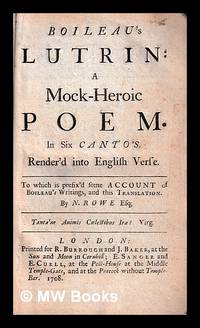
1708442173London : Printed for E. Sanger and E. Curll 1708. First Edition. Disbound. Very good paperback copy disbound as issued; edges slightly dust-dulled and nicked. Remains particularly well-preserved overall. Physical description; 22 122 pages plate. Subjects; Rowe Nicholas 1674-1718. Ozell John -1743. Boileau Despreaux Nicolas 1636-1711. Ozell Mr. John d. 1743. French poetry Translations into English ; Early works to 1800. French poetry Translations into English. London : Printed for E. Sanger and E. Curll unknown
1716FILuvBOI13<p>Geneva: Fabri & Barrillot 1716. 1716. 2 Vols. 4to. pp. 2 p.l. xxviii 506 1 leaferrata; 3 p.l. 427 34errata & index. with half-titles. titles in red & black. engraved frontis. portrait by Fr.Chereau after H.Rigaud engraved portrait of Philippe d'Orléans by Fr.Chereau after J.B.Santerre. 6 engraved plates by Chereau for Le Lutrin. engraved title vignettes dedication headpiece & initial by Ant.Chopy. woodcut ornaments & initials. contemporary sprinkled calf gilt backs rubbed joints repaired some light foxing portraits closely trimmed at lower margin. ownership entry of Thomas Jefferson Hogg 1792-1862 friend & biographer of Shelley. One of the most important editions of Boileau's works edited by Claude Brossette 1671-1743 and incorporating explanatory and historical notes and commentary based on information provided by Boileau himself. This is also the first edition to contain the Satire XII sur l'Équivoque. Brunet I 1058. Cioranescu 12732. Cohen-De Ricci 165. Magne 568. Tchemerzine II 291-92. F. Hardcover.</p> Geneva: Fabri & Barrillot, 1716. hardcover
177245004à Paris: Chez Les libraires associés 1772. Fine. Chez Les libraires associés à Paris 1772 12 x 21 cm 5 volumes reliés New edition illustrated with a frontispiece by Picart engraved by Winkeles 2 allegorical figures by van der Meer the Epistle and the Poetic Art and 6 figures after Picart re-engraved by Vinkeles for Le lutrin 4 title vignettes by van der Meer and one by F. de Bakker. This edition also appeared in Amsterdam published by Changuion. Picart's figures were taken from the 1718 edition they are printed on thick paper. Contemporary full scaled calf binding. Richly decorated spine with raised bands head and tail rolls. Green morocco title and volume labels. Triple fillet frame on covers. Green painted edges. One tear with lack at head of volume I; headcap of volume II worn down; lack at head of volume III. Several corners bumped. Lower right corner worn. Despite the noted defects handsome binding with very decorative appearance. Fresh copy with wide margins. After the great edition of Boileau's works published in 1718 in folio format and given the success fine editions of this author followed one after another in 1722 1729 1745 with variants. This last edition well printed whose subtle typographical variations suggest the reduction of a folio has been revised and the spelling has been modernized; the pamphlet Boileau aux prises avec les jésuites has been restored and a life of the author has been added. Finally one cannot emphasize enough the critical quality of this edition which takes up the abundant and judicious remarks and commentaries of Saint-Marc from the 1745 edition. Chez Les libraires associés hardcover
17182177Amsterdam 1718. Folio. David Mortier Late 18th or early 19th-century gold-tooled straight-grain dark blue morocco with the title and imprint lettered in gold on the spine a single fillet and two ornamental borders on both boards gold-tooled board edges and turn-ins gilt and gauffered edges orange end papers. With a richly engraved allegorical frontispiece incorporating a portrait of the author an engraved vignette with portrait of Erasmus on the title page of both volumes both titles are printed in red and black all text pages are set within a fine typographical woodcut border an engraved part-title 6 full-page engraved plates 2 engraved headpieces 2 engraved initials and 27 engraved tailpieces by Bernard Picart. 2 volumes. 4 XVIII 4 450; 4 VII 1 370 20 pp. First deluxe edition of the collected works of Nicolas Boileau Despréaux 1636-1711 printed on high quality laid paper with every text page set within an ornamental border. "Elle se recommande et par sa belle execution typogr. et par d'assez bonnes estampes ou vignettes" Brunet. David Mortier published several editions of the work from 1714 onwards but the present is the first annotated edition as well as the first illustrated one and has been richly adorned with beautiful engraved illustrations and tailpieces by Bernard Picart 1673-1733. The present copy comes from the library of John Charles Bigham 1840-1929 first Viscount of Mersey.Boileau Despréaux was one of the most famous French poets of the 17th century as he reformed the prevailing form of French poetry. The present collection includes his satires and letters several songs the six-part Le Lutrin with numerous poems odes sonnets and epigrams as well as his important French translation of On the sublime by Longinus which made Longinus' ideas on literary criticism available to a wider audience for the first time.Picart was famous French draughtsman and engraver a pupil of Sébastien le Clerc who came to live in the Netherlands in 1710 and gave new impetus to Dutch book illustration. He illustrated the present deluxe 1718 edition of Boileau Despréaux' work as well as a second deluxe edition from 1729. Although Mortier published several other editions and issues of the work these two deluxe editions are the only ones that have been illustrated.With the bookplate of John Charles Bigham 1840-1929 Viscount of Mersey and the label of Viscount Mersey Bignor Park mounted on the front pastedown of both volumes a bookseller's description mounted on the opposing page in the first volume. The boards are somewhat scratched the edges are somewhat scuffed. Lacking the folding portrait of the dedicatee Charlotte princess of Wales and the final blank of volume 1 occasional minor foxing. Otherwise in good condition.l Brunet I col. 1058-1059; Cohen-De Ricci 165-166; STCN 191962147 4 copies; cf. E. de la Fontaine Verwey Illustr. Letterk.18e eeuw p. 30 ff. hardcover
177227309Paris.: Libraires Associes. 1772. Finely bound in uniform full brown polished calf banded spines in six compartments with gilt floriated decoration red and brown leather title labels in second and third compartments. Triple gilt fillets to edges of boards gilt turn-ins. Marbled endpapers. 5vols. 4to. Illustrated with engraved title vignettes culs-de-lampe engraved frontispiece and hors-texte engraved plates. Engravings by Picart le Romain. PROVENANCE: With the gilt stamp with the 'tughra' of the Ecole Imperiale Ottomane in centre of each front board. A.e.g. Ex-libris pastedowns of the Esmerian library and the Bibliotheque du Vte. Calvet-Rogniat. A fine large copy with each page mounted on larger sheets in a uniform binding with the gilt Imperial Ottoman stamp on each volume.Nicolas Boileau 1636-1711 was a renowned 17th century French poet and critic. He was educated at the college of Beauvais and was at first destined to enter the Church but soon abandoned the study of theology and to please his father prepared himself for the Bar. Though admitted as counsellor-at-law December 1656 he never practised and his father having died leaving him enough to satisfy his wants he devoted himself entirely to poetry. He was then twenty-one years old. Four years later he published his first satirical poem: "Adieux d'un poète à la ville de Paris"; immediately after this he published six others: "Les embarrass de Paris" "La satire à Molière" "Le repas ridicule" "La noblesse" and two others of minor importance. In these satires not only did Boileau parody and attack such writers as Cotin Chapelain and Le Voyer but he also developed the practical capabilities of the French language.Above all these satires inaugurate in France a systematic literary criticism for art's sake where previously criticism had been nothing but the expression of envy or anger. In 1660 Boileau published the "Epistles" more serious in tone and also more polished in style. In 1674 appeared 'Le lutrin" which was lighter in tone. Boileau's masterpiece however and that of the didactic school in French was without doubt "L'art poétique". This was also the first code of French versification. It comprises four books the first and the last containing general precepts; the second treating of the pastoral the elegy the ode the epigram and the satire; and the third of tragic and epic poetry. His later publications were chiefly poems which he composed to defend himself against the numerous enemies his satires had raised up against him.These five volumes are one of the most beautiful of Boileau's complete editions an exquisite printing of his entire oeuvre. Libraires Associes. hardcover
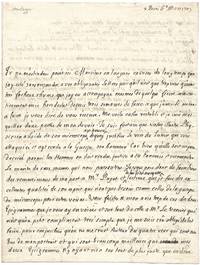
1705Boileau1<p><strong>BOILEAU DESPRÉAUX Nicolas 1636-1711</strong></p><p>Autograph letter signed " Despreaux " to Claude Brossette<br />Paris 6 March 1705 3 p. small in-4° in black ink on laid paper<br />Reinforced central fold small tears on margins without gravity<br />Several words crossed out by Boileau</p><p><strong>A long spiritual letter from the poet enriched with an epigram and a verse from <em>Le Cid</em> – Boileau elaborates in detail on his <em>Odes</em> and <em>Epigrams</em> the quintessence of the spirit of the Grand Siècle</strong></p><p><strong><em>" You say nothing about the four verses I wrote for the other infamous engraving I mentioned to you. Do you think they are bad Yet they have pleased everyone to whom I recited them "</em></strong></p><p><strong><u>Remarkable rediscovery of one of the rare letters to Brossette still in private hands believed to have been 'lost since 1858' Pléiade</u></strong></p><p><em>" Je ne m'estendrai point ici Monsieur en longues excuses du long temps que j'ay esté sans respondre a vos obligeantes Lettres puis qu'il n'est que trop vrai qu'un très facheux rhume que j'ay eu accompagné mesme de quelques fievre m'a entièrement mis hors d'estat depuis trois semaines de faire ce que j'aime le mieux a faire</em><em> je veux dire de vous réscrire. Me voila enfin restabli et je vais macquitter d'une partie de mon devoir. <strong>Je suis fort aise que votre illustre Physicien a l'aide de son microscope ayt trouvé de quoy justifier le vers du Lutrin que vous attaquiés et ayt rendu a la Guespe son honneur</strong></em>. <em>Car bien qu'elle soit un peu decriée parmi les Hommes on doit rendre justice a ses Ennemis et reconnoistre Le merite de ceux mesmes qui nous persecutent.</em> <em>Je vous prie donc de faire bien des remercimens de ma part a Mr Puget et de lui bien marquer lestime que je fais des excellentes qualités de son esprit qui n'ont pas besoin comm</em>e<em> celles de la guespe de microscope poue estre veües</em>¹.<strong><em>Vous faictes a mon avis trop de cas des deux Epigrammes que je vous ay envoiées et sur tout de celle a Mr Le Verrier qui n'est qu'un petit compliment très simple que je me suis crû obligé de lui faire pour empescher qu'on ne me crûst Auteur</em></strong>² <strong><em>des quatre vers qui sont au bas de mon portrait et qui sont beaucoup meilleurs que mes deux Epigrammes n'y ayant rien sur tout de plus juste que ces deux vers</em></strong><br /><em>J'ay sceu dans mes Escrits docte enjoués sublimes </em><br /><em>Rassembler en moi Perse Horace et Juvenal</em><br /><em>Supposé que cela fust vrai Docte respondant admirablement a Perse</em> <em>enjoué a Horace et sublime a Juvenal. Il les avoit faicts d'abord indirects et de la maniere dont vous me faictes voir que vous avés pretendu les rajuster mais cela les rendoit froids et c'est par le conseil de gens tres habiles qu'il les mit en stile directe</em> <em>la prosopopée ayant une grace qui les anime et une fanfaronnade mesme pour ainsi dire qui a son agrement. <strong>Vous ne me dites rien des quatre vers que j'ay faicts pour Lautre infame gravûre dont je vous ay parlé. Est-ce que vous les trouvés mauvais</strong></em>³ <strong><em>Ils ont pourtant réjoui tous ceux a qui je les ay dits</em></strong><em>. Mais pour vous satisfaire sur l'histoire que vous me demandez de l'Epigramme de Lubin</em> <em>Je vous dirai que Lubin est un de mes parens qui est mort il y a plus de vingt ans et qui avoit la folie que j'y attaque. Il estoit Secretaire du Roy et s'appelloit Mr Targas.</em>ⴠ<em>Javois dit lui vivant le mot dont j'ay composé le sel de mon Epigramme qui ma esté faicte quenviron depuis deux mois chés moi a Auteuil ou couchoit l'Abbé de Chasteauneuf.</em>ⵠ<em>Je m'estois ressouvenu le soir en conversant avec lui du mot dont il est question. Il l'avoit trouvé fort plaisant et sur cela <strong>nous estions convenus l'un et lautre qu'avant tout pour faire une bonne Epigramme il falloit dire en conversation le mot quon y vouloit mettre a la fin et voir s'il frapperoit</strong>. Celui ci donc l'ayant frappé je le lui rapportai le lendemain au matin construit en Epigramme telle que je vous lay envoiée. Voilà l'histoire. Le monument antique que vous m'avés faict tenir est fort beau et fort vrai</em>.ⶠ<em>Mon dessein estoit de le porter moi mesme a l'Academie des inscriptions mai j'ay sceu qu'il y avoit deja longtemps qu'il y estoit et que les Academiciens mesme sestoient deja fort exercés sur cette excellente relique de l'Antiquité. Je ne scay pas pourquoi vous me faictes une querelle d'Allemand sur la preeminence qu'a eu autrefois Lyon au dessus de Paris</em>.ⷠ<strong><em>Est ce que Paris a jamais nié que du temps de Cesar non seulement Lyon mais Marseille Sens Melun ne fussent beaucoup plus considérables que Paris et qu'est ce que de cela Lyon scauroit conclure contre Paris sinon ce vers du Cid</em></strong>⸠<strong><em><u>Vous estes aujourd'hui ce qu'autrefois je fus</u>.</em></strong><em> Je vous conjure de bien marquer Mr de Mezzabarba</em>⹠<em>dans les lettres que vous lui escrivés le cas que je fais de sa personne et de son merite. Je ne scay si vous avés veû la traduction qu'il a faite de mon Ode sur Namur. Je ne vous dirai pas qu'il y est plus moi mesme que moi mesme mais je vous dirai hardiment que bien de j'aye sur tout songé a y prendre l'esprit de Pindare</em>. <em>Mr de Mezzabarba y est beaucoup plus Pindare que moi. Si vous n'avés point encore receû de lettre de Mr Le Verrier cela ne vient que de ma faute et du peu de soin que j'ay eu de le faire ressouvenir comme je devois de vous rescrire mais je vais disner aujourd'hui ches lui et je reparerai ma negligence</em>. <em>Vous pouvés vous asseurer d'avoir au premier jour un compliment de sa facon. Adieu mon illustre Monsieur croiés que c'est tres sincerement que je suis</em><br /><em>Vostre très humble et tres obeissant serviteur</em><br /><em>Despreaux</em></p><p><em>Monsieur</em><br /><em>Soufrés que je fasse ici en particulier et hors d'œuvre mon compliment a Mr Perichon "</em></p><p>1 – The said "Wasp" makes its appearance in <em>Le Lutrin</em> Boileau's mock-epic which he published between 1672 and 1674. The passage to which the poet alludes is:<br /><em>" Tel qu'on voit un Taureau qu'une Guespe en furie </em><br /><em>A piqué dans les flancs au dépens de sa vie " </em>Pléiade p. 193 v. 7 & 8<br />Boileau had already responded two years earlier to his correspondent's criticism of this very passage in a letter he sent on May 26 1703: <em>"I well remember however that you strongly attacked what I say in my Lutrin about the Wasp which dies from the very sting with which it wounds its enemy."</em></p><p>2- <em>"</em> <em>Au joug de la Raison asservissant la Rime</em><br /><em>Et mesme en imitant toujours original</em><br /><em>J'ay sceu dans mes Escrits docte enjoués sublimes </em><br /><em>Rassembler en moi Perse Horace et Juvenal</em> <em>"</em> Pléiade p. 272<br />Brossette recounts that an engraver wishing to place a few verses beneath a portrait of Boileau asked the poet to compose them himself. To this Boileau replied: <em>"I am neither vain enough to speak well of myself nor foolish enough to speak ill of myself."</em> Even if he tries in vain to deny it Boileau is indeed the author of the epigram pretending to find himself too highly praised. He even complains about it in Poem no. XII <em>Pléiade</em> p. 245.</p><p>3- <em>"The other infamous engraving"</em> is a portrait of Boileau by an artist whose name he did not know. Plainly very displeased the poet lashes out in his earlier letter of January 12 1705 in these terms: <em>"</em>it<em> resembles me less than the Great Mogul."</em> The four lines to which he here alludes are found in that same letter:<br /><em>" Du celebre Boileau tu vois ici l'image.</em><br /><em>Quoi c'est là diras tu ce Critique achevé </em><br /><em>D'où vient le noir chagrin qu'on lit sur son visage </em><br /><em>C'est de ce voir si mal gravé. "</em></p><p>4- Pierre Targas married a cousin of Boileau Élisabeth Colin in 1647. Boileau made him the dedicatee of his Epigram LXVII <em>"The Lover of Clocks"</em> which he composed in December 1704.</p><p>5- François de Castagner Abbé de Chateauneuf 1645–1709 was Voltaire's godfather.</p><p>6- In his letter of February 12 Brossette enclosed an inscription "engraved on an ancient altar in the form of a pedestal which had been discovered in recent days in Lyon on the hill of Fourvière by peasants digging in the ground.</p><p>7- Boileau's reaction to the latest letter sent by Brossette who writes to him: <em>"You see Sir that in those times our Lyon was already a considerable city adorned with the title of colony and municipium and admitted to the honors and privileges of the Roman people whereas your Lutetia perhaps did not yet even dare aspire to the name of city."</em></p><p>8- <em>The Cid</em> Act I Scene 2 Don Diègue to the Count:<br /><em>" Je le sais vous servez bien le roi :</em><br /><em>Je vous ai vu combattre et commander sous moi.</em><br /><em>Quand l'âge dans mes nerfs a fait couler sa glace</em><br /><em>Votre rare valeur a bien rempli ma place ;</em><br /><em>Enfin pour épargner les discours superflus</em><br /><em>Vous êtes aujourd'hui ce qu'autrefois je fus. "</em></p><p>9- This is the translation of Boileau's ode <em>On the Capture of Namur</em>.</p><p>A lawyer from Lyon Claude Brossette 1671–1743 met the poet during a stay in Paris in 1698. Admirer of Boileau's poetry he was authorized by the poet to consider publishing his works with commentary. The edition rich in notes did not appear until 1716 five years after the poet's death. Brossette also left a <em>Journal</em> published by Laverdet in 1858 in which his relationship with Boileau is recounted.<br />Of the seventy-five letters from Boileau to Brossette that have been catalogued more than half are now held in the collections of the Historical Library of the City of Paris.</p><p><strong><u>Boileau's letters to Brossette considered among the finest in the poet's correspondence are exceedingly rare on the open market</u></strong></p><p><u>Provenance:</u><br />Private collection</p><p><u>Bibliography:</u><br /><em>Correspondance entre Boileau Despréaux et Brossette</em> éd. Auguste Laverdet J. Techener 1858 n°CVIII / <em>Œuvres poétiques</em> t<em>. </em>2 Imprimerie générale Paris 1872 p. 178 /<em> Bibliographie générale </em>éd. Émile Magne Giraud-Badin Paris 1929 p. 11 <em>/ Œuvres complètes</em> éd. Françoise Escal Pléiade pp. 694-696 – n°XLVIII / <em>Littérature classiques Juvénal en France au XVI</em><em>ᵉ</em><em> et au XVII</em><em>ᵉ</em><em> siècle</em> Pascal Debailly printemps 1995 p. 45<br />The transcription in the <em>Pléiade</em> based on Laverdet's edition contains errors in several places. Here we restore Boileau's original spelling as it stands.</p>