604 résultats
193030584Paris.: La Societe Nouvelle des Editions d'Art Devambez. 1930. Original wrappers with vellum chemise and slipcase. 4to. With 26 original etchings by Chahine many full-page. Edition limited to 226 copies with this one of 10 copies printed entirely on japon nacre a la forme originally reserved for the artist and friends. It has all the etchings in three states including one state with remarques as well as four supplementary plates not published in the book also in three states. Also included is an original signed drawing by Chahine executed in blue pencil. La Societe Nouvelle des Editions d'Art Devambez. hardcover
193239127Paris: Chez l'Artiste 1932. André Dunoyer de Segonzac. ANDRE DUNOYER DE SEGONZAC'S UNIQUE PROOF SET OF THE ELEVEN "PLANCHES REFUSEES" FOR COLETTE'S "LA TREILLE MUSCATE" WITH EACH ETCHING PRINTED ON FINE JAPANESE PAPER AND SIGNED AND TITLED BY THE ARTIST. Cailler 632-642 obviously didn't know about this set and thus does not give the titles of these etchings except "La cure de soleil" which is titled in the plate WHICH UNTIL NOW HAVE BEEN COMPLETELY UNKNOWN. The 20 first copies of "La treille muscate" include unsigned and untitled sets of these planches refusées. Cailler 642 annotated "épreuve d'essai sur Japon nacré sic--it is in fact on antique Japanese laid paper / suite de Colette / éditée". IN PERFECT CONDITION WITH NO DEFECTS. UNIQUE AND IMPORTANT. <br/><br/> Chez l'Artiste unknown
1959140944276Beirut: Al-Kutub 1959. First edition. First edition. Signed by Colette Khoury on the front free endpaper in green ink inscribed to previous owner. Bound in publisher's illustrated wraps. In Arabic. Very Good with cocked and creased spine light wear a few dog-eared pages. Scarce signed. <p>A pioneering feminist novel that caused a major scandal in the Arabic literary world for its taboo depictions of female sexuality and agency. Khoury is from a very prominent family the granddaughter of a former Syrian prime minister and this autobiographical novel was about her love affair with famous Syrian poet Nizar Quabbani. Al-Kutub unknown
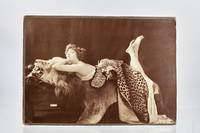
190777332s. l. Paris 1907. Fine. Colette the ""nude dancer"" in her stage costume s. l. Paris s. d. 1907 28.70 x 20.40 cm une photographie contrecollée sur carton Rare and superb original contemporary mounted albumen print showing Colette languidly stretched out on a lion skin and covered with a leopard skin. Photographer's penciled number and studio stamp on the back of the mount. A substantially cropped print bearing the same penciled number on the back of our photograph 11214 is in the Reutlinger archives at the Bibliothèque nationale de France Album Reutlinger de portraits divers vol. 53 p.3. We have been unable to find any other examples of this photograph in other public collections. A similar photograph belatedly dedicated to Maurice Chevalier went on sale in 2008. A beautiful sultry shot of Colette probably taken the year of her banned dance show ""Rêve d'Egypte"" at the Moulin Rouge where she shared the bill and a scandalous kiss with her cross-dressing aristocrat lover Missy. ""Colette was a nude dancer which at the time meant that she . draped herself in vaporous veils concealing part of her anatomy under animal skins"" Paula Dumont. Colette had already used animal skins hugging her figure in this picture as a sensual costume in Charles Van Lerberghe's Pan accompanied on stage by Lugné-Poe and Georges Wague. This was the first time anyone had dared to go without a flesh-colored body suit. Justifying her choice she went on to say: ""I want to dance naked if the body suit bothers me and humiliates my plasticity"". At the time of this photograph in 1907 Colette was performing in countless shows following her debut two years earlier in Nathalie Clifford Barney's Sapphic Salon where Mata Hari also danced. For Colette dance was synonymous with emancipation in more ways than one - as a means of sustenance and liberation of her body which finally belonged to her after her separation from her abusive husband Willy in 1906. Her undulating almost gestureless dance was linked by contemporary critics to that of Loïe Fuller and Isadora Duncan; her greatest success remained ""La Chair"" a risqué mime show she performed two hundred times in Paris and was subsequently produced with a new cast in New York's Manhattan Opera House. It was also in the halls of Parisian dance venues that Colette flaunted herself freely on the arm of her lovers. Her scandalous union with Missy the virile Marquise de Morny who accompanied her on stage in male costumes contributed to the fame of her performances. This is probably the rarest photograph of Colette taken by Reutlinger who also photographed her draped in Grecian style or wearing her costume from ""Le Rêve d'Egypte"". A rare visual testimony to a revolution in dance costume brought about by Colette a key figure in twentieth-century artistic and literary Paris. unknown