MisselBiblio.com
7 résultats
172218639AB1722. Paris Quillau et Desaint 1722. 16 : 105 cm. XLVIII 356 off 3 leaves pages IX-XLIV 290 pages CCXV pages. Contemporary calf with two claps. On the front fly-leaf dedication with the initials E.M.E. With exlibirs Marie-Francoise Comtesse d'Esterhazy née Marquise de Roissin. unknown
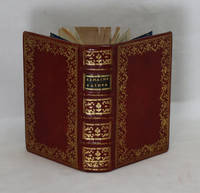
1772HW40 /6B<p>Maroon calf binding with black title plate gilt decoration and title on the spine. Gilt decoration on the boards.</p><ul><li><strong>We provide an in-depth photographic presentation of this item to stimulate your feeling and touch. More traditional book descriptions are immediately available</strong></li></ul><p>As the photographs depict this is a lovely and well preserved book both to its binding and contents. Just fantastic.</p><p><strong>Holy Week</strong> is for Christians the week before Easter and the last part of Lent . It is intended to commemorate the Passion of Christ. The Easter Triduum of the Passion and Resurrection of Christ begins on Thursday evening of this week and ends on the evening of Easter Sunday. These three days are the high point of the liturgical year because it was by his death that Christ destroyed death and it was by rising again that he restored life. Orthodox Christians call it <strong>Great Week . </strong>Romanian Orthodox Christians most often call it the <strong>Week of Sufferings</strong> . The services of Holy Week have the particularity of beginning with Compline and Matins and ending with Vespers whereas it is normally the Vespers service that begins the liturgical day. Holy Week consists of liturgical ceremonies that take place only once a year. The first of these is Palm Sunday .</p> Chez J Felix Faulcon. hardcover
176584155Antverpiae: Ex Architypographia Plantiniana 1765. 36 x 24.5 cm contemporary leather binding over boards with raised bands on spine ruled border blind-stamped on covers marbled endpapers title page in red and black 66 624 cxxviii 4 8 2 1 pages printed in red and black throughout engraved frontispiece and full-page engraved illustrations text in Latin. Binding lightly worn with rubbing and scuffing to covers and corners interior pages age-toned browned but clean and complete overall still in very good condition see picture. Issued by the famous Plantin-Moretus press in Antwerp one of the most celebrated printing houses in European history. This edition of the Roman Missal conforms to the Tridentine rite as mandated by the Council of Trent and subsequently revised under Popes Pius V Clement VIII and Urban VIII. Includes Proper of the Time Proper of Saints Common of Saints and chant notation; notable for its fine 9 engraved illustrations. Ex Architypographia Plantiniana hardcover
1784AQ14409Olispone i.e. Lisbon: Typographia regia et privilegio 1784. 30 672pp cxlvi 10 58. Several engraved devotional images within pagination. Contemporary red morocco richly gilt marbled endpapers and gilt gauffered edges yellow metal clasps. Rubbed small incision to lower joint paper label to upper board. Tears to FFEP occasional marginal loss/tearing some occasional marking. A handsomely bound Portuguese-printed Roman missal which despite later confusion in an inscription to a blank fly-leaf earlier manuscript letters inserted suggest that this was seized from the flagship of the usurper Dom Miguel the 80-gun Don Juan during the 1833 Battle of Cape St. Vincent passing through the hands of several clergymen before being presented to Grayfriar's Oxford. . Folio. Typographia regia, et privilegio unknown
1726311716Venice 1726. Printed in red & black; Engravings including initial letters & title page vignette depicting St Peters and a papal crown by Sister Isabella Piccini. Short thick folio red velvet worn over boards With silver escutcheons & corner pieces on back & front covers. Venetiis: Typographia Balleoniana 1726<br/> <br/> unknown
1737ABC_50448Antwerp: ex architypographia Plantiniana = Joannes Jacobus Moretus 1737. Contemporary elaborately gold-tooled red morocco with remnants of brass catch and anchorplates along the fore edge gilt and gauffered edges with intricately made tabs along the fore edge gold-tooled board edges marbled endpapers. Folio. With 20 full-page engraved plates by Cornelius Galle 10 engraved frames surrounding the text and vocal music printed on pp. 153-155 196-197 199-207 220-233 235-237 240-272 286-288 290-292 and xvii. The text is printed in red and black with historiated initials hand-coloured in red an engraved vignette on the title page of each work and several woodcut tailpieces throughout of which 3 printed in red. 2 works in 1 volume. With: 2 SPANISH MISSAL. Missae propriae sanctorum Hispanorum qui generaliter in Hispania celebrantur. ex apostolica concessione & auctoritate S. Pii V. Gregorii XIII. Sixti. V. Clementis VIII. & Urbani. VIII. aliorumque summorum pontificum. Antwerp ex architypographia Plantiniana = Joannes Jacobus Moretus 1737. Plantin edition of the revised Roman Missal produced in line with the Council of Trents directives. This imposing folio exemplifies the Tridentine tradition established after the council 1545-1563 when the Roman Church responding to the Reformation sought to standardise the liturgy. In 1570 Pope Pius V 1504-1572 promulgated the reformed Missale Romanum establishing the text and ceremonial form of the Mass that would govern the Latin Church for centuries. Subsequent revisions under Clemens VIII 1536-1605 and Urban VIII 1568-1644 refined but did not alter its essential structure.From 1571 until the mid-18th century the press founded by Christophe Plantin 1520-1589 held a significant monopoly on the production and sale of authorised liturgical work for the Spanish Netherlands and effectively much of the Spanish Empire. The present Missale Romanum has been bound together with the Missae propriae sanctorum Hispanorum 1737 a collection of masses for Spanish saints. It contains the specific texts and music intended for the celebration of these saints reflecting its use in Iberian or Spanish-influenced territories. The beautiful red morocco binding richly gilt in the rococo manner was also most likely bound in Spain or Portugal.The front joint is slightly weakened but the structural integrity of the work is still intact a hole at the head and foot of the spine the edges and corners of the boards are slightly scuffed the boards are somewhat stained lacking the clasps. The leaves are somewhat browned with occasional foxing a few pages retaining traces of yellow wax. Otherwise in good condition.l Imhof Plantins 1574 Missale Romanum in octavo in: De Gulden Passer 73 1995 pp. 67-82; STCV 12923535; Ad 2; WorldCat 804759478 0 copies; not in STCV. ex architypographia Plantiniana [= Joannes Jacobus Moretus], unknown
1770047085Angelopoli Puebla: Typis Seminarii Palafoxiani 1770. First Edition. Hardcover Full Leather. Very Good Condition. José de Nava. Contemporary full calf wear at edges surface scrapes to leather old paper spine label and private library label to spine paste paper endpapers stamp from library of Rev. L. Kenzel and a printed in Germany stamp to verso of title. SLight browning to page edges some offsetting and acidification from the ink used in the musical notation and engravings; generally a bright fresh copy internally. 8 1-137; Frontispiece 1-198 pages 133-135 incorrectly numbered 233-235 pp. Sabin 49459 Palau V195.<br /> <br /> A high point of Mexican printing. Finely printed in Puebla with 3 very fine engravings by de Nava. The Mozarabic rites were used by the Visigothic and Mozarabic Christians of medieval Spain until replaced in the the 11th century. They were reauthorized for use in Toledo in the 15th century where they continue in some form to be used. Size: Folio. Illustrator: José de Nava. Quantity Available: 1. Shipped Weight: 1-2 kilos. Category: Religion & Theology; Antiquarian & Rare. Inventory No: 047085. Typis Seminarii Palafoxiani hardcover