5 résultats
161771548Venetia: appresso Gio. Battista Ciotti 1617. pergamino. Folio. appresso Gio. Battista Ciotti unknown
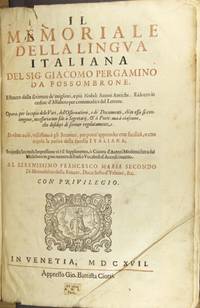
161743152Venetia: Apresso Gio. Battista Ciotti 1617. Seconda impressione two parts in one folio pp. 12 609 1 8 236; a6 A-2N8 2O-2p6 †4 A-O8 P6; V4 of the first section missigned R4 with manuscript cancellation; woodcut printer's device initials and head- and tail-pieces; title page printed in red and black; text in double columns; full contemporary vellum soiling calf bands manuscript spine title and ornamentation; vertical hatch marks to upper cover edges quite rubbed and worn; endpapers supplied title page edges rather ragged minor worming to preliminaries else textblock mostly very good. Small period manuscript paper label "Ad usum A.M.L. Parm." mounted to bottom of title page. Zaunmüller p. 209. OCLC does not locate any copies in the United States. Apresso Gio. Battista Ciotti unknown
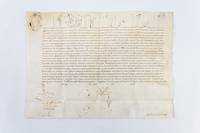
1622ST12778-0281Rome 1622. 295 x 410 mm. 11 5/8 x 16 1/8". Single column 23 lines in a papal chancery hand. <br/> Elaborate lettering across top line of text. Lower margin with several signatures in ink; verso with brief notes in ink; lacking the original hemp tie and lead seal. Two tears at bottom of the document where ties were removed not affecting text vellum lightly soiled but in excellent condition overall.<br/> <br/> Addressed to the Archbishop of Naples this Papal Bull grants a marriage dispensation between Fabritio Virgopia and Judith Cuono. An online search finds nothing about the couple named here but the document reveals that they were petitioning for a dispensation because they fell into the second and third degrees of consanguinity meaning that they shared at least one common ancestor. Although marrying within four degrees of consanguinity was prohibited by the church it was not uncommon for the Holy See to issue dispensations as here allowing such marriages to take place—particularly for the privileged classes. The Papal Bull takes its name from the lead seals called "bullae" lacking in the present example that were issued with official documents of the papacy as a way of ensuring their authenticity. Apart from the very rare Solemn Privilege like Innocent III's famous granting of England in 1214 to his involuntary vassal King John there are three categories of Papal Bulls: Simple Privileges also called Solemn Letters Letters of Grace which confirm privileges and rights but are somewhat smaller and Mandates which are differentiated by their use of hemp ties as opposed to silk as would have been the case here. Pope Gregory XV born Alessandro Ludovisi 1554-1623 ruled for just over two years from 1621-23. His brief papacy was marked by efforts to support the Catholic Counter-Reformation including the establishment of the Congregation for the Propagation of the Faith to oversee missionary work. He also played a key role in the election of Holy Roman Emperor Ferdinand II canonized notable saints such as Ignatius of Loyola and Francis Xavier and issued the last papal mandate concerning witchcraft. Documents issued by Gregory XV are unsurprisingly rare given the shortness of his rein: we could trace just one sold at auction since 1995. unknown
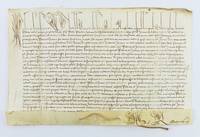
1614ST12778-0352Rome 1614. 203 x 319 mm. 8 x 12 5/8". Single column 25 lines in a papal chancery hand. <br/> With braided cloth tie for appended seal now gone. Elaborate lettering all across top line of text especially the first 8-line initial and at lower right corner. Lower margin with several signatures in ink behind the fold; verso with brief notes in ink; remains of hemp tie for appended seal which has been cut away. Three vertical and one horizontal fold creases faint overall yellowing to verso possible erasure correction in second line of text otherwise the page bright and the hand clear.<br/> <br/> Addressed to the Archbishop of Naples this Papal Bull grants a marriage dispensation between Pietro Palladino and Giovanna Cabalone. An online search finds nothing about the couple named in the present document but they were apparently high-ranking Neapolitan citizens who had the means to procure a Papal intercession. Likewise the particular impediment prohibiting the marriage is not apparent here. This type of document takes its name from the lead seals called "bullae" that were issued with official documents of the papacy as a way of ensuring their authenticity. Apart from the very rare Solemn Privilege like Innocent III's famous granting of England in 1214 to his involuntary vassal King John there are three categories of Papal Bulls: Simple Privileges also called Solemn Letters Letters of Grace which confirm privileges and rights but are somewhat smaller and Mandates which are differentiated by their use of hemp ties as opposed to silk as here. A member of the influential Borghese family Pope Paul V born Camillo Borghese 1550-1621 reigned as head of the Catholic Church for 16 years from 1605 until his death. As a staunch defender of the rights and privileges of the church he often came into conflict with secular leaders. He is perhaps best remembered for financing the completion of St. Peter's Basilica and for his involvement in the Galileo controversy in which he warned the scientist against advocating heliocentrism. unknown
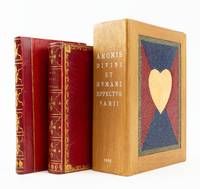
1626ST19298Antwerp: M. Snyders 1626. FIRST EDITION. 135 x 82 mm. 5 1/4 x 3 1/4". 39 of 40 leaves lacking C4. Two volumes one as issued the other a companion volume containing related plates without any title page. <br/> Very pretty late 18th or early 19th century red morocco covers bordered by delicate cresting roll with leaf cornerpieces smooth spine gilt in compartments with leafy centerpieces gilt lettering turn-in with gilt floral roll pale blue watered silk endleaves all edges gilt. Supplemental volume in late 19th century red half morocco over red paper boards similarly tooled spine. Housed together in a custom-made modern wooden box with sliding panel closure a heart mosaic in multi-colored hard-grain leather on its sides. Amoris Divini WITH engraved title page and 38 of 39; lacking plate XXXIV ENGRAVED PLATES 35 OF THEM ON VELLUM ALL DELICATELY COLORED AND HEIGHTENED IN GOLD plates 19 29 30 31 and 36 bound after text pages for plates 31 36 29 30 and 34 respectively; second volume with 45 plates on paper though without any text including many of these same emblems apparently from a later edition of this work ALL DAINTILY HIGHLIGHTED WITH GILT. Front pastedown of first volume with monogram book label in colors and gilt verso of front free endpaper with oval armorial bookplate "Ex Museo Van Der Helle" see below. De Vries "De Nederlandsche Emblemata" 121; Landwehr "Low Countries" 33; Praz p. 254; Brunet I 240 this copy; Delbergue-Cormont "Bibliothèque de M. Van der Helle" Paris 10 Février 1868 lot 69 this copy. Amoris spine very slightly dulled occasional hints of marginal thumbing but A LOVELY COPY clean and fresh internally with rich colors and glistening gold in a well-preserved binding; supplemental plates with faint marginal browning but excellent internally the engravings gently shimmering with gold and the binding with few signs of wear.<br/> <br/> The main volume here comprises a collection of emblems illustrating concepts of human and divine love; it is made all the more special by being printed on vellum beautifully hand colored and then delicately highlighted with gold. The emblems depict Divine Love as a beardless young man with nimbus who always represents love in its purest form. Human love or worldly love is variously embodied in a winged Cupid sometimes blindfolded who represents erotic love and who is accompanied by symbols of treasure or power that represent worldly desires. Landwehr Praz and De Vries make no mention of a vellum edition but Brunet describes one copy on vellum painted in colors and gold which he says sold at the Duriez auction. That book appeared as lot 3216 in "Catalogue des livres imprimés et manuscrits composant la bibliothèque de feu M. L.-M.-J. Duriez de Lille membre de la Société des Bibliophiles français" Paris J.-S. Merlin 1827 where its binding description matches our copy. Having uncovered no other hand-colored copies on vellum in auction records or in OCLC we think it quite likely that the present volume is in fact the Duriez copy. Louis Duriez 1753-1825 was a Lille lawyer of sufficient skill and cleverness to move without incident from serving as lieutenant provost for his district under King Louis XVI to becoming receiver of the district of Lille after the revolution 1791 and purchasing the estate of an aristocrat which had been seized by the state. He rose to successively more important and remunerative governmental positions and was named Knight of the Royal Order of the Legion of Honor in 1814. In 1820 he was one of the founding members of the Société des Bibliophiles français an elite group limited to 24 scholarly collectors. After his death his collection of more than 5000 carefully chosen works was dispersed at 59 auctions held between 22 January and 1 April 1828 at Maison Silvestre in Paris. A perusal of the lots on offer finds a strong emphasis on fine bindings works on vellum and illustrated books many noting hand coloring. The emblems in the second thinner book here on paper without coloring--but with gold highlighting allow the reader to experience the pleasure to be found in comparing the degrees of decoration and opulence of the two volumes. These illustrations likely come from one of the later printings of this title each of which added new emblems to the original 39 called for in Landwehr and Praz. It is not clear when or by whom this second volume was wedded to the first. After its presumed residence in the Duriez collection our copy of the 1626 edition and perhaps its sidecar volume moved to another distinguished library--that formed by the scholarly and erudite French collector M. Van Der Helle of Lille who amassed a collection particularly rich in illustrated books and works on vellum. In the catalogue for the sale of his library in 1868 Paris auction house Delbergue-Cormont described him as a bibliophile "of the school of Renouard . . . who only liked irreproachable copies." We bought this item without being warned that it is slightly defective but given its distinguished provenance and the many other features it has going for it we did not ask the seller to take it back. M. Snyders unknown