Eugene DELACROIXBiblio.com
33 résultats
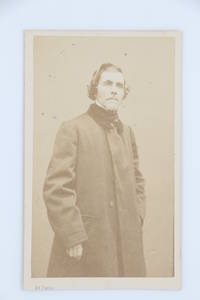
186078831Paris: Carjat et Cie 1860. Fine. Carjat et Cie Paris s. d. circa 1860 6 x 10.30 cm une photographie Photographic portrait of Eugène Delacroix Carjat et Cie Paris ca 1860 6 x 103 cm one photograph Original photograph on albumen paper in carte de visite format mounted on a board. Some small foxing. Rare copy of this photograph only found at Carnavalet Louvre and Orsay museums. Carjat et Cie unknown
185414648Paris: La Revue des deux mondes 1854. Fine. La Revue des deux mondes Paris 15 juillet 1854 15.50 x 25 cm broché First edition. Eugène Delacroix's articles would only be collected after his death in 1865 and printed in only 300 copies. In original wrappers. La Revue des deux mondes unknown
185414647Paris: La Revue des deux mondes 1854. Fine. La Revue des deux mondes Paris 15 juillet 1854 15.50 x 25 cm broché Published before the first edition. Softcover as issued. La Revue des deux mondes paperback
1842Sand29<p><strong>DELACROIX SAND George 1804-1876</strong></p><p><u>Two autograph letters</u> signed " GS " to Eugène Delacroix<br />Nohant 6 & 7 July 1842 3 p. in-8° in total in black ink<br />Autograph addresses on verso<br />Stamp marks previous trace of mounting</p><p><strong>Saddened by the departure of her "good little" Delacroix after the latter's stay in Nohant in the company of Chopin and the rest of the Sand family the writer found herself immersed in her reading of <em>Les Mystères de Paris</em></strong></p><p><strong><u>From the Marc Loliée library</u></strong></p><p><em>" <strong>Cher bon petit</strong> J'espère que vous êtes arrivé à bon port sans trop souffrir de la chaleur qui a été modérée le jour de votre départ. Vous avez oublié ici quelques effets dont Maurice a fait une caisse laquelle part aujourd'hui. Comme le port en est payé accusez-en réception afin qu'elle ne s'égare pas sans que nous la fassions réclamer. J'ai encore retrouvé dans mes mouchoirs un mouchoir à vous. Je vous le mets à part ainsi que ceux qui pourraient se retrouver au prochain blanchissage. <strong>Que Jenny</strong></em> la gouvernante de Delacroix <strong><em>ne nous accuse donc pas de vous avoir grinché vos zardes</em></strong>¹<em>. – <strong>Je lis le Chourineur et je vous assure que malgré l'horreur du sujet et des détails</strong></em>²<strong><em> c'est jusqu'à présent fort intéressant et fabriqué avec beaucoup de talent</em></strong><em>. – <strong>Nous sommes restés tout tristes et tout déconfits de votre départ</strong>. Nous tâchons de jouer au billard mais je crois que vous avez emporté le carambouillage</em>³<em> dans votre poche et que vous ne nous avez laissé que le manque de touche. J'attends avec impatience un petit mot de vous. <strong>Nous sommes encore trop chagrins pour vous en dire long aujourd'hui</strong>. Et puis l'heure me presse. À présent cher soyez bien portant. Si vous nous regrettez autant que nous vous regrettons faites un effort pour nous oublier jusqu'à notre retour </em>Sand et Chopin rentreront à Paris le 31 juillet<em> alors vous nous raimerez de nouveau. <strong>Adieu moi et tous vous embrassons et vous aimons</strong>.<br />GS. "</em></p><p><em>" Cher ami mon dadet </em>sic <em>de Thomas </em>peut-être Thomas Aucante autrefois vacher<em> a commencé le cours de bêtises auxquelles je dois m'attendre en ne payant pas le port de la caisse que je vous ai envoyée hier. Si bien qu'il faut que vous le sachiez afin de n'avoir pas de contestation avec l'administration. Accusez-moi réception car tout ceci a été fort mal fait malgré mes précautions.<br />Nous nous portons bien. <strong>Nous vous aimons. J'ai rêvé de vous toute la nuit</strong> ; j'espère que c'est bon signe et que vous êtes bien portant.<br />À vous<br />GS. "</em></p><p>In response to his friend's repeated invitations Delacroix spent nearly two weeks in Nohant in June 1842. He wanted above all to rest "vegetate" as he put it and enjoy the pleasures of the countryside. Back in Paris he replied on the 8th stating that he had received the crate and calling the person who had brought it to him a cheat and an imposter demanding postage. He asked his friend for a small purse left in Nohant a purse that Solange had given him and a small cord from Algiers. He concluded: "The weather is awful for the nerves. When you dreamed that you saw me did you dream that you were the Duchess of Berry I send you all my sincere embraces but I am very sad" Corr. gén. de Delacroix t. II p. 116.</p><p>Using the slang present in Eugène Sue's work we understand that Sand is here in the middle of reading The Mysteries of Paris. The serial novel published in the Journal des débats from June 19 1842 to October 15 1843 inaugurated mass literature in the 19th century and earned its author immense fame in all social classes.</p><p><u>Provenance:<br /></u>Bibliothèque Marc Loliée<br /><u><br />Bibliography:<br /></u><em>Correspondance</em> t. V éd. G. Lubin Garnier n°2477 & 2478</p>
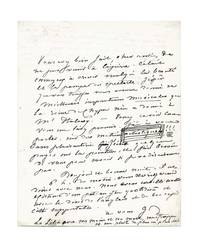
1841Sand14<p><strong>DELACROIX SAND George 1804-1876</strong></p><p>Autograph letter signed " G.S. " to Eugène Delacroix<br />Paris Postal mark 23rd December 1841 1 p. 1/2 in-8°<br />Autograph address on fourth folio wax seal : " Monsieur Delacroix rue des Marais Saint Germain 17 "</p><p><strong>Superb letter to her friend Delacroix about her desire to write "a few pages on painting" the <em>Femmes d'Alger</em> her contempt for the <em>Ingresque</em> school and other artistic news</strong></p><p><em>" Vous avez bien fait cher ami de ne pas venir à l'Opéra. <strong>C'était ennuyeux à crever malgré la beauté et la pompe du spectacle.</strong> J'espère que vos truffes vous auront donné de meilleures inspirations musicales que la reine de Chypre n'en a donné à Mr Halevy.1</em><br /><strong><em>Venez ce soir comme vous me l'avez promis. J'ai à vous parler sur des matières artistiques !!!</em></strong> le mot est entouré par Sand d'un triple trait de plume.<strong><em> Sans plaisanterie j'écris quelques pages sur la peinture et j'ai besoin de vous pour savoir si je ne déraisonne pas. </em></strong><em>2</em><br /><em>Bonjour et bonne nuit. Il est 6h du matin. Vous devriez venir dîner avec nous. Nous avons embelli notre existence d'un pot-au-feu quotidien et avec le dîner de l'anglais3 et du bon café c'est supportable.</em><br /><em>G.S.</em><br /><strong><em>La Lélia</em></strong><em>4<strong>avec son moine et son mort me frappe et me plaît de plus en plus c'est ce qui m'a mise en veine d'écrire sur la couleur et ce qu'il faut entendre par la forme. Avec ça j'ai vu vos femmes d'Alger</strong>5 ce matin. Si vous m'encouragez je suis capable de faire le prochain salon dans notre revue</em> La Revue indépendante<em> et <strong>vous savez que je ne caponnerai pas</strong></em> ne se montrera pas lâche <strong><em>avec tout cette école silhouettiste</em></strong><em>6<strong> qui se dit en possession du dessin</strong> ".</em></p><p>1 <em>La Reine de Chypre</em> an opera in five acts by Halévy to a libretto by St. George took place the day before December 22 1841. Unlike George Sand Richard Wagner who was also present at the premiere considered the music "noble moved and even new and exhilarating" although he criticized Halévy's failings in simple orchestration.<br />2 In Horace which George Sand was then writing she staged a rapin a pupil of Delacroix but there were no "few pages on painting". Is this an article intended for the Independent Review – which it has just created – but which it has renounced The word written in postscript confirms that it is an aesthetic reflection that focuses on "color" and "form".<br />3 Possible reference to an English restaurateur or caterer frequented by George Sand.<br />4 <em>Lélia avec son moine et son mort</em> is the third work offered by Delacroix to George Sand for the gifts of 1842. It is a pastel depicting Lélia kneeling near Stenio's corpse while the monk Magnus "in the shadows leaning stiffly against the wall of the cave darted on her his sparkling eyes". The subject was treated several times by Delacroix.<br />5 This is the <em>Femmes d'Alger dans leur appartement</em> a painting presented at the Salon of 1834 where it caused a sensation. A synthesis of orientalism and romanticism this painting expresses a deep "melancholy" for the poet and art critic Baudelaire.<br />6 George Sand refers to the school of Ingres as a "Silhouettist school". We know the adversity between the two painters that animated the artistic scene of the nineteenth century. The writer had resolutely taken Delacroix's side that of "form" and "color".</p><p><u>Bibliography:</u><br /><em>George Sand</em> – Correspondance t. V Lubin Garnier p. 529-531 lettre n°2369<br /><em>Correspondance</em> éd. Françoise Alexandre Les éditions de l'Amateur p. 117-118 n°50</p><p><u>Provenance:</u><br />Achille Piron Delacroix's universal legatee<br />Bibliothèque Marc Loliée</p>
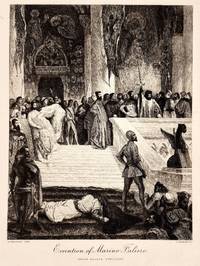
18642167London: George Barrie 1864. Etching with engraving on buff cream laid paper 12 x 6 inches 305 x 152 mm; sheet 16 1/2 x 10 3/4 inches 420 x 273 mm full margins. Scattered areas of discoloration and toning notation in pencil in the lower right sheet area beneath the platemark. Marino Faliero the 55th Doge of Venice was beheaded for treason on April 17 1355 at the top of the "del Piombo" staircase in the Doge's Palace. After his plot to overthrow the government was discovered he was sentenced to death executed and his portrait was replaced with a black veil. Here Faliero's body lies at the bottom of the steps while the executioner holds the sword used in the beheading high above his shoulder in one hand and Faliero's head mostly obscured by the balustrade in the other. George Barrie unknown
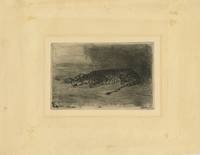
18301301830. Etching drypoint and roulette on watermarked Hallines cream laid paper 3 3/4 x 5 7/8 inches 95 x 148 mm full margins. A very good impression of this charming image with all of the fine lines printing clearly. Plate is inky and well-wiped. Scattered light surface soiling age tone and mat tone. Several scattered spots of foxing all outside of image area. Issued 1908 as the frontispiece in Le Peintre-Graveur Illustre third volume: Ingres and Delacriox. Sixth state of 6. <br /> <br /> Delteil 12. unknown
183025217Leipzig: Kohler 1830. hardcover. very good-. Nach der dreizehnten Auflage aus dem Franzosischen bearbeitet und mit Anmerkungen begleitet von einem Arzte. 204pp. 12mo contemporary calf-backed boards rebacked with cloth tips worn front hinge reinforced. Leipzig: Karl Franz Kohler 1830. Good.<br/> <br/> Translation of De la connaissance du temperament.Paris 1830 a handbook on diagnosing all diseases. Extremely rare; not in NUC or Wellcome.<br/> <br/> Kohler unknown