33 résultats
18431167<p>1843. Lithograph. L. Delteil 107 after the third state with letters in face. From the series of 16 illustrations for Hamlet. Image: 9 x 8. Margins: 21¾ x 14.</p> Villain
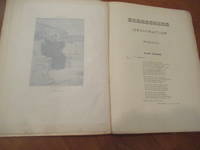
182848710Paris.: Ch. Motte & Sautelet. 1828. Black morocco-backed marbled boards and endpapers gilt spine original printed wrappers by Devéria bound in. Folio. Frontispiece portrait of Goethe half-title additional lithograph wrapper by Devéria title and 17 lithographs by Delacroix. A large paper copy of the first edition of Delacroix’s masterful interpretation of ‘Faust’ a pioneering meeting of word and image and a monument of nineteenth-century illustration.All of the plates printed on chine and mounted to larger sheets conform to first or first published state with the address of ‘Ch. Motte’. The wrapper is present in two states one of the front cover on white paper and the other including both the front and rear covers and the backstrip on blue paper.One of the monuments of nineteenth-century illustration.'Ouvrage remarquable et typique de l'époque romantique illustration magistrale du grand Delacroix qui est heureusement de plus en plus estimé des bibliophiles de gout.' Carteret. Ch. Motte & Sautelet. hardcover
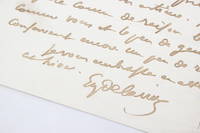
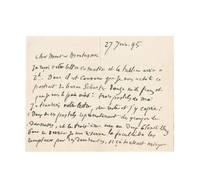
1895Degas4<p><strong>DELACROIX DEGAS Edgar 1834-1917</strong></p><p>Autograph letter signed <em>"Degas"</em> to collector Montagnac<br />Np 27 June 1895 2 pages in-8 oblong on laid paper in bespoke leather sleeve.<br />Fold marks previous and discreet tape repair on verso</p><p><strong>Degas collector acquires a painting by Delacroix in exchange for three of his pastels of dancers as currency</strong></p><p><em>" Cher Monsieur Montagnac<br />Je reçois votre lettre ce matin et le tableau </em>de Delacroix <em>arrive à 2h. Donc il est convenu que je vous achète ce portrait du baron Schwiter douze mille francs et que <strong>je vous paie ainsi : trois pastels de moi.</strong> Je transcris votre lettre du reste j'y copie : <strong>Deux de ces pastels représenteront des groupes de danseuses et le troisième une ou deux blanchisseuses. Pour ce dernier je me réserve la faculté de les remplacer par des danseuses si ça m'allait mieux</strong>.<br />Si vous pouvez me dites-vous me livrer un de ces pastels d'ici un ou deux mois vous me feriez le plus grand plaisir. Vous ajoutez : Il est entendu que les 3 pastels seront terminés pour l'hiver prochain. Tout cela est bien et j'y souscris.<br />Au revoir cher Monsieur et recevez mes remercîments.<br />Degas "</em></p><p>A shrewd collector Degas had assembled a remarkable collection of paintings from the Renaissance to Romanticism including Greco Ingres Courbet Delacroix etc. Of the latter of which he owned thirteen paintings it is the portrait of Baron Schwiter that is here the object of his lusts.<br />This full-length portrait of Baron Louis de Schwiter 1805-1889 an important collector and familiar of Delacroix was painted in 1827. Refused by the jury of the Salon the same year it is now kept at the National Gallery in London which had acquired it during the dispersal of Degas' property after his passing in 1917.</p><p><u>Provenance:</u><br />Bibliothèque Bernard Loliée</p>
1893052165Paris: Paul Chevallier Georges Petit 1893. First Edition . Stiff Wrappers. Very Good/Good Dustjacket. 36.7 Cm / 14.5" Tall. Plain Stiff Cardboard Wrappers Printed Dust Jacket. Descriptions Of 75 Works Of Art With Full-Page Rotogravures Of 21 Each Description Accompanied By The Price In Pencil. Spine Cracked Very Worn Chipped With Some Loss Of Paper Cover Along Spine. Dampstain To Front Cover At Bottom Not Affecting Interior. <br/> <br/> Paul Chevallier, Georges Petit unknown
18333615Paris : Gaume Fréres Libraires Rue du Pot-de-fer No 5 ; se trouve aussi à Paris Chez A. Jeanthon Libraire Place Saint-André-des-Arts No. 11; imprimerie de Decourchant 1833. 1833. Hardcover. Good. Volume 1 only of 2 ; 180 pp. ; 14 cm. ; text in French ; richly bound in motled leather with gold lettering and designs fore-edge decorations and olive green and ecru marbled endpapers with silk ribbon ; a tiny worm hole on front cover ; chip to leather spine label ; an overview of the general history of religious orders and the benefits derived therefrom ; the author also revised the Dictionnaire Historique d'Education of Fillassier the friend of Rousseau ; a poem by Chênedollé is reprinted from his Etudes Poétiques "La neige au loin accumulée" concerning the Péres du Saint-Bernard ; this volume similar to OCLC: 65870631 ; only one set of the latter available at the University of Utrecht ; scarce ; G <br/> <br/> Paris : Gaume Fréres, Libraires, Rue du Pot-de-fer, No 5 ; [se trouve aussi à Paris, Chez A. Jeanthon, Libraire, Place Saint-A hardcover
18281163<p>1828. Lithograph. L. Delteil 57 i or ii of iv. Image: 10 x 6½. Margins: 18½ x 12. Marginal flaws. From the set of 17 illustrations to Goethe's Faust published 1828.</p>
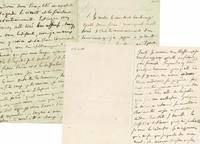
1823759401823. Fine. s. d. ca 1823 12 x 18.20 cm Six pages sur deux feuillets rempliés Almost entirely unpublished handwritten letter from the painter Eugène Delacroix to the love of his youth the mysterious Julie now identified as being Madame de Pron by her maiden name Louise du Bois des Cours de La Maisonfort wife of Louis-Jules Baron Rossignol de Pron and daughter of the Marquis de La Maisonfort Minister of France in Tuscany patron of Lamartine and friend of Chateaubriand. 90 lines 6 pages on two folded leaves. A few deletions and two bibliographical annotations in pencil on the upper part of the first page no114. This letter is one of the last to his lover in private ownership all of Delacroix's correspondence to Madame de Pron being kept at the Getty Research Institute Los Angeles. Only nine of the ninety lines of this unpublished letter were transcribed in the Burlington Magazine in September 2009 alongside the long article by Michèle Hanoosh Bertrand and Lorraine Servois whose research finally revealed the identity of the famous recipient. Sublime love letter from twenty-four-year-old Eugène Delacroix addressed to his lover Madame de Pron twelve years his senior who unleashed the liveliest passion in him. This episode of the painter's youth then considered the rising star of Romanticism for a long time remained a mystery in the biography of Delacroix who was careful to preserve the anonymity of his lover thanks to various pseudonyms: Cara the Lady of the Italians and even Julie as in this letter in reference to the famous epistolary novel Julie ou la Nouvelle Héloïse by Rousseau. For obvious reasons Delacroix did not sign his name on any of the letters in correspondence with the lady. A great figure of the legitimate aristocracy the recipient of this feverish letter is Madame de Pron daughter of the Marquis de La Maisonfort Minister of France in Tuscany patron of Lamartine friend of Chateaubriand. Her beauty was immortalized in 1818 by Élisabeth Vigée-Lebrun who painted her portrait in pastel with an oriental hairstyle. Delacroix and Madame de Pron met in April 1822 when the portrait of the latter's son Adrien was commissioned a pupil at the Lycée Impérial now Lycée Louis-le-Grand. Delacroix had been commissioned for the portrait by his close friend Charles Soulier Madame de Pron's lover who despite himself served as an intermediary for Delacroix. In the absence of Soulier who had gone to Italy the painter and the young women established an intense romantic relationship. The portrait commission became a pretext for their tender meetings in his studio on rue de Grès while no trace of the child's painting has been found to this day. Their adventure lasted a little over a year but it was one of the most intense passions of the artist's life. Our letter undoubtedly corresponds to the last throes of their relationship in the month of November 1823. After one of their visits at the end of a hiatus of several months Delacroix writes to her again under the influence of emotion: I come home with a shaken heart what a wonderful evening! . Sometimes I say to myself: why did I see her again In the calm sanctuary where I lived even in the middle of the invisible places that I had formed . I managed to silence my heart. Madame de Pron had indeed decided to bring an end to their intimate relationship see her letter from 10 November 1823: I want sweet friendship . I do not want to torment you Getty Research Institute. Losing all discernment and with blind devotion Delacroix attempts to revive their affair: Make me lie prove to me that your soul is indeed that of the Julie that I once knew since mine has regained its charming emotions and its worries. But the painter runs into Soulier and General de Coëtlosquet also lovers of Madame de Pron. Delacroix had narrowly avoided a final disagreement with Soulier who had almost seen a letter from Madame de Pron in h unknown
185086760Champrosay 1850. Fine. I am madly in love with these innocent and beautiful trees while human nature on the other hand falls every day in my esteem. Champrosay s. d. 1840-1860 13.50 x 20.10 cm une page sur un feuillet remplié Autograph letter signed by the painter Eugène Delacroix to his friend Baron Félix Feuillet de Conches master of protocol at the Ministry of Foreign Affairs under Charles X and Louis-Philippe. One page in black ink on a folded sheet with the autograph address on the verso. Traces of seal and postal stamps dated October 7. The painter writes to his friend Feuillet de Conches a distinguished man of letters whose works were well received and who also amassed an elegant collection of art and autographs in his apartment on the rue Neuve-des-Mathurins the address of this very letter. A charming and witty missive in which Delacroix expresses his enchantment with country life far removed from the bustle of Paris. ""From the summer of 1844 Eugène Delacroix settled at Champrosay on the edge of the Sénart forest near Paris. There he recorded in his journal the impressions inspired by his regular walks through the countryside. He produced numerous sketches later reworked into his large compositions as well as more ambitious landscapes that reveal how in his mature and later years the observation of nature now contemplated for its own sake had become central to his art."" MuMa ""I reply to you late dear Feuillet but you will forgive me: I promise you a Gros very happy to add it to the collection. I pity you for living far from the fields. If we were still in the time of Ovids Metamorphoses I might believe myself in danger of one day being turned into a tree. I am mad about these innocent and beautiful trees while human nature on the other hand loses each day in my esteem. I except of course friends like you and the few who retain a little reason.I embrace you while awaiting this winterEug. Delacroix."" unknown