75 résultats
18832080502106914921Not Available 1883. Soft Cover. Fine. The book is in fine condition. Not Available paperback
18422091502135402464Ishikawa-ya 1842. Soft Cover. Fine. Number of books: 1 Ishikawa-ya paperback
18072110502150902526Not Available 1807. Soft Cover. Fine. Volume: 1 Not Available paperback
18632110502150903444Not Available 1863. Soft Cover. Fine. Number of books: 4 Not Available paperback
1898mon0000060159Philadelphia : John D. Wattles 1898-01-01. Paperback. Acceptable. in x in x in. Hardcover. Philadelphia : John D. Wattles paperback
180950198Paris Mad. Ve Barnard 1809. Contemp. hcalf. Spine gilt. Wear to top of spine. A few scratches to binding. Small stamps on verso of titlepage.In: "Annales de Chimie ou Recueil de Mémoires concernant la Chemie" Tome 70. 336 pp. Entire volume offered. Davy's paper: pp. 189-254. <br/><br/><em>First edition in French the first English 1808 of this importent historical paper in chemistry in which Davy shows that electricity is capable of decomposing some alkalies isolating two new substances and discovering potassium and sodium. Neville in his Historical Chemical Library vol. I p.340 writes about this paper "ONE OF THE GREAT CLASSIC RESEARCHES IN CHEMISTRY in which Davy announced in this his second Bakterian lecture the isloation of metallic potassium and sodium by the electrolytic decomposition of their fused oxides.""He Davy began his own electrical experiments.The results were spectacular. On October 6 1807 the current passing through molten potash liberated a metal which Davy called potassium. The little globules of shining metal tore the water molecule apart as it eagerly recombined with oxygen and the liberated hydrogen burst into lavender flame. Davy danced about in a delirium of joy. A week later he isolated sodium from soda."Asimow. The paper offered here describes these discoveries."Humphry Davy was one of the most brilliant chemists of the early nineteenth century. His early study of nitrous oxide brought him his first reputation but his later and most importent investigations were devoted to electrochemistry. Following Galvani's experiments and the discovery of the voltaic pile interest in galvanic electricity had become widespread. The first electrolysis by means of the pile was carried out in 1800 by Nicholson and Carisle who obtained oxygen and hydrogen from water. Davy began to examine the chemical effects of electricity in 1800 and his numerous discoveries were presented in his Bakerian lecture to the Royal Society on November 20 1806. A Source Book in Chemistry p. 243. </em> unknown
183449065Leipzig Barth 1834. Contemp. hcalf. raised bands spine gilt. Spine with light wear. in. "Annalen der Physik und Chemie. J.C. Poggendorff" Zweite reine 3. bd.VIII5584 pp. and 5 plates. Entire volume offerd. Faradays papers: pp. 149-189 Sixth series pp. 301-331 a. 481-520 Seventh series. Internally clean and fine printed on good paper. <br/><br/><em>First appearance in German - prepared by Faraday himself for publication in Annalen - of 2 historical papers in chemistry and physiscs in which Faraday in the first detects a new recombination-effect in electrolysis and in the second we have the MILESTONE PAPER in which Faraday announces the discoveries of further laws of electrochemistry stating the general relations of electricity to chemistry and introducing new terms with precise meanings. The first part of the paper introduces his new terminology giving the words a limited and precise meaning. These words devised with the assistance of William Whewell are now familiar to all chemists electrode anode cathode ion anion and cation. He also introduces the "Volta-electrometer" and arrives at the "Law of electro-chemical equivalents". The paper offered is one of Farday's most famous papers."Another section of the paper is devoted to a closer examination of the law of constant electrochemical action with respect to water and to the development of a gas electrometer to measure quantities of electricity. Faraday's "Volta-electrometer" provided the first practical means for the quantitative measurement of electricity." Source Book in Chemistry p. 280-81.The Sixth series: "In the course of his experimental investigations of a general and importent law of electro-chemical action which required the accurate measurement of thegases evolved during the decomposition of water and other substances the author was lead to the detection of a curious effect which had never been previously noticed and of which the knowledge had he before possessed it would have prevented many of the errors and inconsistencies occurring in the conclusions he at first deduced from his earlier experiments. The phenomena observed was the gradual recombination of elements which had been previously separated from each other by voltaic action. This happened when after water had been decomposed by voltaic electricity the mixed gases resulting from such decomposition were left in contact with the platina wires or plates which had acted as poles; for under these circumstances they gradually diminished in vo.umes water was reprioduced and at lust the whole of the gases disappeared."Abstract - Faraday explains the causes of this recombination. </em> hardcover
19002092902141000194Geisha-do 1900. Soft Cover. Fine. Size: B4 Geisha-do paperback
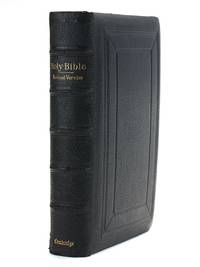
1885505253Cambridge at the University Press 1885. First Edition. Leather. VERY GOOD. First Edition First Printing of the complete one-volume Revised Version of the Bible preceded only by the 5 volume 'Presentation Edition' of the American Committee with matching fine binding published simultaneously with two larger formats. x 696 xv 204 pp; 8 15 engraved color maps Indexed Atlas to the Holy Bible. 8vo 20.5 x 13.5 cm bound in a fine-grained leather over boards with 5 raised bands both covers and spine ruled in blind with gilt stamped spine lettering gilt ruled turn-ins 'Sewn with Silk' with reinforced inges; all edges art gilt marbled endpapers purple place ribbon; printed with Minion font in dual colums with marginal references. Some trivial wear to the extremities family tree in pen to flyleaf;some notes on prophecy related to WWII in a neat miniscule hand to FFEP verso and some erasable pencil notes to rear flyleaf; otherwise a sound and handsome binding with clean fresh text. A copublication between the two royal-privileged printers Oxford and Cambridge though printed solely by C.J. Clay at Cambridge. The Revised Version was the product of over a decade of British and American collaborative work co-financed by Oxford and Cambridge in exchange for exclusive co-copyright on the text. Received with great acclaim and criticism it shot Oxford's number of Bibles printed per-annum over 2 million for the first time. The RV committee was a spectacular assembly of scholarly prowess who made enthusiastic use of the most recent scholarship including the new critical Greek text of Westcott and Hort. Conspicuously absent from the committee were the more literary voices of King James's translators and the somewhat wooden style of the RV suffers for it though exegetes have prized it for exactly the same reason. A surprising inclusion in this royally-convened committe was a large team of Americans: 'In every instance the suggestions from America were treated with the same consideration as those proceeding from members of the English Company and were adopted or rejected on their merits. It was a part of the terms of agreement with the American Company that all points of ultimate difference between them and the English Revisers should be placed on record found in the appendix . Many of them will be found to be changes of language which are involved in the essentially different circumstances of American and English readers; others express a preference for the marginal rendering; others again involve a real difference of opinion; but all shew that they have been dictated by the same leading principle the sincere desire to give to modern readers a faithful representation of the meaning of the original documents.' from the Preface Darlow & Moule 2041; Simon Eliot The History of Oxford University Press Vol. II. Cambridge at the University Press unknown
18632110502150901905Not Available 1863. Soft Cover. Fine. Number of books: 5 Not Available paperback
1823AQ19315Oxford: Printed at the Clarendon Press by Samuel Collingwood and Co. 1823. Unpaginated. With additional engraved title pages for both the O.T. and N.T. and a further 27 engraved plates. Handsomely bound in contemporary blind-stamped black straight-grain morocco lettered in gilt A.E.G. Slightest of rubbing to extremities. Manuscript records of births deaths marriages etc. of the Trueman family to front blank fly-leaves very occasional light spotting. . Quarto. Printed at the Clarendon Press by Samuel Collingwood and Co. unknown
18242110502150908263Not Available 1824. Soft Cover. Fine. Number of books: 4 Not Available paperback
181143628Halle Rengerschen Buchhandlung 1811 1811 1812. Without wrappers as published in "Annalen der Physik. Herausgegeben von Ludwig Wilhelm Gilbert" Bd. 37 Drittes u. Viertes Stück Bd. 38 Sechtes Stück Bd. 40 Zweites u. Drittes Stück. The entire issues offered 5 issues. With titlepage to vol. 37 38 a. 40. Pp. 233-480 a. 3 engraved plates. pp. 121-236 a. 2 engraved plates. pp. 117-348 a. 1 engraved plate. Berzelius's papers: pp. 249-337 a. 415-472.- Pp. 161-226. - Pp. 162-208 a. 235-330. <br/><br/><em>The papers represents one of the first announcements of Berzelius' discovery of the fixed chemical proportions determining the weights and valencies of the various constituent elements in inorganic compounds. The papers were published at the same time in German both here in Annalen and in Schweiger's Journal and in French. By running many hundreds of analysis of chemical compounds he gave so many examples of the law of definite proportions that the world of chemistry could no longer doubt its validity and in so doing he gave experimental evidence to the atomic theory. He hereby laid a solid fundation for the further development of chemistry.According to Söderbaum Jac. Berzelius 2 p.12 "It was a giant work one of the most importent in the history of chemistry which was here presented. One is even more impressed when one remembers that it was a pioneer undertaking in every sense of the term. Analytic and synthetic methods existed before Berzelius' time to be sure but there were no precise methods of the sort which he required. They all had to be elaborated at the cost of time and labour."J. Erik Jorpes "Jac. Berzelius" p.45."In general Berzelius's efforts were directed toward the consolidation and extension of the atomic theory. He improved chemical analysis and determined the composition of a large number of compounds thus verifying the laws of constant and multiple proportions and furnishing the most accurate equivalent weights then available. By ingenious methods he arrived at the correct atomic composition of most common substances and thus was enabled to draw up in 1826 a table of atomic weights very nearly identical with the modern one."Leicester & Klicktein "A Source Book in Chemistry" p. 258.Parkinson "Breakthroughs" 1810-20 C. </em> unknown
183248987Paris Crochard 1832. Contemp. hcloth gilt lettering to spine. In: "Annales de Chimie et de Physique Par MM. Gay-Lussac et Arago." tome 50 Series 2. Entire volume offered. 448 pp. 2 folded engraved plates. Faraday's papers: pp. 5-67 a. pp. 113-162. Some scattered brownspots. <br/><br/><em>First French editions of the 2 first memoirs of Faradays groundbreaking researches on electricity constituting the first 2 papers of his "Experimental Researches in Electricity" and containing his fundamental discovery of electromagnetic induction THE FOUNDATION OF NEARLY ALL THE ELECTRICITY IN USE TODAY. In 1820 Oersted had generated magnetism from electricity Faraday here finds the opposite effect generating electricity by magnetism. He also described the first electrical generator second paper. THESE PAPERS ARE SOME OF THE GREAT CLASSICS OF CHEMISTRY AND PHYSICS."Faraday demonstrated this theory involving the lines of force.by inserting a magnet into a coil of wire attached to a galvanometer. While the magnet was being inserted or removd current flowed through the wire. If the magnet was held stationary and the coil moved over it one way or the other there was current in the wire. In either case the magnetic lines of force about the magnet were cut by the wire.If the magnet and coil were both held motionless whether the magnet was within the coil or not there was no current.Faraday hd thus discovered electricalinduction.It was to lead to great things but this was not apparent."Asimov."Although his discovery of the electric motor and the dynamo was almost entirely identical to his theoretical discoveries it laid the foundation of the modern electrical industry - electric light and power teælephony wireless telegraphy televison etc. - by providing for the production of continous mechanical motion from an electrical source and vice versa." PMM 308.Horblit 29 - Milestones 62. - Dibner 64. - PMM 308.The volume contains further notable papers. Elie de Beaumont "Zweiter geologischer Brief.an A.v. Humboldt über die relative Alter der Gebirgszüge" pp. 1-58 a. 2 plates one handcoloured papers by Döbereiner E. Lenz Moser Mitscherlich de Saussure J. Dumas F.E. Neumann Gay-Lussac Johannes Müller "Beobachtungen zur Analyse der Lymphe des Bluts und des Chylus" pp. 513-590. </em> hardcover
18512111902160201050Santoshorin 1851. Soft Cover. Fine. Number of books: 4 Santoshorin paperback
18392110502150903265Not Available 1839. Soft Cover. Fine. Number of books: 2 Not Available paperback
183244146Leipzig Johann Ambrosius Barth 1832. Contemp. hcalf. raised bands gilt spine. Light wear along edges. In "Annalen der Physik und Chemie. Hrsg. von J.C. Poggendorff" Band 25. Entire volume offered. VIII648 pp. and 6 folded engraved plates. Small stamps on verso of titlepage and plates. Faraday's papers: pp. 91-142 a. pp. 142-186. with 3 folded engraved plates. Clean and fine. <br/><br/><em>First German editions of the 2 first memoirs of Faradays groundbreaking researches on electricity constituting the first 2 papers of his "Experimental Researches in Electricity" and containing his fundamental discovery of electromagnetic induction THE FOUNDATION OF NEARLY ALL THE ELECTRICITY IN USE TODAY. In 1820 Oersted had generated magnetism from electricity Faraday here finds the opposite effect generating electricity by magnetism. He also described the first electrical generator second paper. THESE PAPERS ARE SOME OF THE GREAT CLASSICS OF CHEMISTRY AND PHYSICS."Faraday demonstrated this theory involving the lines of force.by inserting a magnet into a coil of wire attached to a galvanometer. While the magnet was being inserted or removd current flowed through the wire. If the magnet was held stationary and the coil moved over it one way or the other there was current in the wire. In either case the magnetic lines of force about the magnet were cut by the wire.If the magnet and coil were both held motionless whether the magnet was within the coil or not there was no current.Faraday hd thus discovered electricalinduction.It was to lead to great things but this was not apparent."Asimov."Although his discovery of the electric motor and the dynamo was almost entirely identical to his theoretical discoveries it laid the foundation of the modern electrical industry - electric light and power teælephony wireless telegraphy televison etc. - by providing for the production of continous mechanical motion from an electrical source and vice versa." PMM 308.Horblit 29 - Milestones 62. - Dibner 64. - PMM 308.The volume contains further notable papers. Elie de Beaumont "Zweiter geologischer Brief.an A.v. Humboldt über die relative Alter der Gebirgszüge" pp. 1-58 a. 2 plates one handcoloured papers by Döbereiner E. Lenz Moser Mitscherlich de Saussure J. Dumas F.E. Neumann Gay-Lussac Johannes Müller "Beobachtungen zur Analyse der Lymphe des Bluts und des Chylus" pp. 513-590. </em> hardcover
183244145Paris Crochard 1832. Contemp. hcalf. gilt spine light wear along edges. In: "Annales de Chimie et de Physique Par MM. Gay-Lussac et Arago." tome 50 Series 2. Entire volume offered. 448 pp. 2 folded engraved plates. Faraday's papers: pp. 5-67 a. pp. 113-162. <br/><br/><em>First French editions of the 2 first memoirs of Faradays groundbreaking researches on electricity constituting the first 2 papers of his "Experimental Researches in Electricity" and containing his fundamental discovery of electromagnetic induction THE FOUNDATION OF NEARLY ALL THE ELECTRICITY IN USE TODAY. In 1820 Oersted had generated magnetism from electricity Faraday here finds the opposite effect generating electricity by magnetism. He also described the first electrical generator second paper. THESE PAPERS ARE SOME OF THE GREAT CLASSICS OF CHEMISTRY AND PHYSICS."Faraday demonstrated this theory involving the lines of force.by inserting a magnet into a coil of wire attached to a galvanometer. While the magnet was being inserted or removd current flowed through the wire. If the magnet was held stationary and the coil moved over it one way or the other there was current in the wire. In either case the magnetic lines of force about the magnet were cut by the wire.If the magnet and coil were both held motionless whether the magnet was within the coil or not there was no current.Faraday hd thus discovered electricalinduction.It was to lead to great things but this was not apparent."Asimov."Although his discovery of the electric motor and the dynamo was almost entirely identical to his theoretical discoveries it laid the foundation of the modern electrical industry - electric light and power teælephony wireless telegraphy televison etc. - by providing for the production of continous mechanical motion from an electrical source and vice versa." PMM 308.Horblit 29 - Milestones 62. - Dibner 64. - PMM 308. </em> unknown
186344144Paris Victor Masson et Fils 1863 a. 1864. Boundin 2 contemp. hcalf. Gilt spines raised bands light wear along edges. In: "Annales de Chimie et de Physique" 3e Series - Tome 68 a. 4e Series tome 1. 512 pp. a. 5 large folded engraved plates. 512 pp. a. 3 large folded engraved plates. Kirchhoff's papers: pp. 5-45 a. pp. 396-411. 5 plates belongs to K's papers 4 showing spectra and 1 plate double page depicts the famous spectroscope invented by K. and used by K. and Bunsen in their importent analysis of the spectra of the elements. <br/><br/><em>First edition in French of Kirchhoff's milestone papers on the interpretation of the dark D lines - noticed by Fraunhofer in 1814 - in the spectrum of the sun the papers that inspired Max Planck to his theory of quanta 1900. The papers are the French translations of his papers published in Abhandl. d. königl. Akad. d. Wissenscchaften in Berlin in 1861 and 1862.In the course of his preparatory work in the autumn of 1859 Kirchhoff made an unexpected observation. It had long been known that the dark D lines noticed in the solar spectrum by Fraunhofer 1814 coincided with the yellow lines emitted by flames containing sodium.Kirchhoff's unexpected discovery was that if the intensity of the solar spectrum increased above a certain limit the dark D lines were made much darker by the interrposition of the sodium flame. He instantly felt that he had got hold of "something fundamental" even though he was at a loss to suggest an explanation. On the day following the surprising observation Kirchhoff found the the correct interpretation which wass soon confirmed by new experiments: a substance capable of emittiing a certain spectral line has a strong absorptive power for the same line.The dark D lines in the solar spectrum could accordingly be ascribed to absorption by a solar atmosphere containing sodium. Immense prospects thus opened up of ascertaining the chemical composition of the sun and other stars from the study of their optical spectra. A few more weeks sufficed for Kirchhoff to elaborate a quantitative theory of the relationship between emissive and absorptive poweer."DSB VII pp. 381-82.PMM 278 b. - Barchas 1169-70 - Sparrow 117 - Horbli 59 - Dibner 153 the note. </em> hardcover
181146030Paris Chez J. Klostermann fils 1811-12. Bound in 6 contemp. hcalf. Gilt spines slightly rubbed. Wear to top of spines. In: "Annales de Chimie ou Recueil de Mémoires concernant la Chemie" Tome 78 79 80 81 82 and 83. Entire volumes offered. The 14 parts: Tome 78: pp. 5-37 105-132 217-242. - Tome 79: pp. 113-142 233-264. - Tome 80: pp. 5-37 225-258. - Tome 81: pp. 5-36 278-303. - Tome 82: pp. 5-33 113-125 225-72. Tome 83: pp. 5-35 a. pp. 117-127. With in all 3 engraved plates. Some scattered brownspots. <br/><br/><em>The papers represents one of the first announcements of Berzelius' discovery of the fixed chemical proportions determining the weights and valencies of the various constituent elements in inorganic compounds. The papers were published at the same time in Swedish German both here in Annalen and in Schweiger's Journal and in French. By running many hundreds of analysis of chemical compounds he gave so many examples of the law of definite proportions that the world of chemistry could no longer doubt its validity and in so doing he gave experimental evidence to the atomic theory. He hereby laid a solid fundation for the further development of chemistry. A reprint is found in Ostwald's Klassiker der exakten Wissenschaften No. 35.According to Söderbaum Jac. Berzelius 2 p.12 "It was a giant work one of the most importent in the history of chemistry which was here presented. One is even more impressed when one remembers that it was a pioneer undertaking in every sense of the term. Analytic and synthetic methods existed before Berzelius' time to be sure but there were no precise methods of the sort which he required. They all had to be elaborated at the cost of time and labour."J. Erik Jorpes "Jac. Berzelius" p.45."In general Berzelius's efforts were directed toward the consolidation and extension of the atomic theory. He improved chemical analysis and determined the composition of a large number of compounds thus verifying the laws of constant and multiple proportions and furnishing the most accurate equivalent weights then available. By ingenious methods he arrived at the correct atomic composition of most common substances and thus was enabled to draw up in 1826 a table of atomic weights very nearly identical with the modern one."Leicester & Klicktein "A Source Book in Chemistry" p. 258.Parkinson "Breakthroughs" 1810-20 C. </em> unknown
19002090502130301419Hanshichi Yoshikawa 1900. Soft Cover. Fine. Number of books: 1 Hanshichi Yoshikawa paperback
18562111902160200585Not Available 1856. Soft Cover. Fine. Number of books: 4 volumes of 8 volumes Not Available paperback
18502080302106802665Not Available 1850. Soft Cover. Fine. Number of books: 1 Not Available paperback
19002090502130301032Hanshichi Yoshikawa Yoshikawa Kobunkan 1900. Soft Cover. Fine. Number of books: 1 Hanshichi Yoshikawa (Yoshikawa Kobunkan) paperback
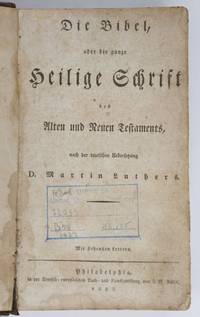
182754126Philadelphia: J. G. Ritter 1827. Hardcover. Good. Two parts thick octavo. VIII 1096; 328. Old Testament and Apocrypha paginated continuously; collective title page; New Testament with separate full title page. Text in two columns. Contemporary calf rubbed; spine with raised bands gilt title. Wear at spine cap some loss 3/4 inch at spine tail. Light dampstain at bottom margin; mild foxing throughout somewhat heavier at final 50 leaves. A good complete copy.<br /> <br /> Rare early nineteenth-century edition of the Bible in Luther's German translation published in Pennsylvania. Apart from the 1828 New Testament very few copies of any of the Luther Bible editions published by Johann Georg Ritter 1772-1840 at Philadelphia between 1826 and 1829 survive. In his 1893 pioneering work The First Century of German Printing in America Oswald Seidensticker locates no complete Luther Bibles and only two editions of the New Testament which were published by Ritter in 1826 304 pages and 1828 541 pages. These were of course often bound with the Old Testament along with their full title-page. The 1828 New Testament is the only portion of Ritter's biblical editions that is widely held in institutional libraries. Expanding upon the work of Seidensticker the editors of The first Century of German Language Printing in the United States of America 1989 assign only four Luther Bible editions Old and New Testaments bound together to Ritter one in 1827 and three in 1829. OCLC however locates Luther Bible editions published by Ritter in all four years between 1826 and 1829. A careful comparison of the paginations reveals that Ritter's Luther Bibles appeared in several variants. The 1827 edition was re-issued in 1829 as a "Zweyte Auflage" with 20 additional pages of preparatory material immediately preceding the Old Testament. Variants of the present edition also appeared in which the Apocrypha 160 pages was separately paginated. Some surviving copies lack the Apocrypha and only contain the 936 pages of the Old Testament. Our careful review of OCLC locates only sixteen surviving copies of Ritter's Luther Bibles containing both the Old and New Testaments published between 1826 and 1829. Twenty-four copies of the separately bound 1828 New Testament have survived as well. The only two copies of our 1827 edition have been located: the University of Waterloo and the Wurttembergische Landesbibliothek. The results of our census are appended below.<br /> <br /> Johann Georg Ritter appears to have begun his career in Reading Pennsylvania where he printed two German-language works for the firm of William M'Carty and Davis in Philadelphia: Geschichte des americanischen Kriegs von 1812 1817; Hoch-Deutsches reformirtes A B C-und Namen-Büchlein für Kinder welche anfangen zu lernen 1818. He later moved to Philadelphia and set up his own shop Der Deutsche-europäischen Buch- und Kunsthandlung. Sammlung religiöser deutscher Gesaenge which he edited along with J. G. Schmauk was published in 1824 and has been tentatively attributed to Ritter after his move to Philadelphia; Karl Rudolph Demme's Letzte ehre des Christlichen Predigers in einer Christlichen Gemeine Philadelphia 1825 is the earliest work to appear under his imprint. He catered chiefly to the German-speaking Reformed community with religious works sermons and elementary school texts. He briefly published in 1825 a periodical edited by Johann Carl Gossler Philadelphier Magazin für Freunde der deutschen Literatur in Amerika.<br /> <br /> Provenance: Stamp of Library of United Theological Seminary at title. Full title and imprint: Die Bibel oder die ganze Heilige Schrift des Alten und Neuen Testaments auch der deutschen Uebersetzung D. Martin Luthers. Mit stehenden Lettern. Philadelphia in der Deutsch-europäischen Buch- und Kunsthandlung von J. G. Ritter 1827. New Testament title: Das Neue Testament unsers Herrn und Heilandes Jesu Christi verteutscht von Dr. Martin Luther. Mit stehender Schrift. Philadelphia in der Deutsche-europäischen Buch- und Kunsthandlung von J. G. Ritter 1827.<br /> <br /> Refences: O. Seidensticker The First Century of German printing in America 1728-1830 Philadelphia 1893; Bötte & Tannhof The First Century of German Language printing in the United States of America vol. 2 1808 - 1830 cf. nos. 2878; 3044; 3045; 3046. Not in Darlow & Moule.<br /> <br /> INVENTORY<br /> <br /> •Die Bibel oder Die ganze Heilige Schrift des Alten und Neuen Testaments New Testament with separate title page<br /> <br /> 1826 - xii 868 304 pages 18 cm - Southern Methodist University Bridwell Library<br /> "New Testament has special t.p.: Das Neue Testament Unsers Herrn und Heilandes Jesu Christi verteutscht von D. Martin Luther."<br /> <br /> 1826 - 2 volumes in 1 19 cm - Pennsylvania State Univ; Brigham Young Univ UT<br /> "New Testament has special t.p. and separate paging."<br /> <br /> 1827 - viii 1096; 328 pages - Wurttembergische Landesbibliothek - OUR EDITION<br /> <br /> 1827 - viii 1096; 328 pages 22 cm - Univ of Waterloo Libr CA ON - OUR EDITION<br /> <br /> 1827 2 Aufl. - viii 936; 328 pages 22 cm - Baker Univ KS; American Bible Soc Libr PA <br /> "Zweyte Auflage. Mit stehenden Lettern."/ Spine title: Biblia./ The Holy Bible in German./ The New Testament has special title page and pagination: Das Neue Testament unsers Herrn und Heilandes Jesu Christi./ Bound in brown leather tan end papers sprinkled red edge brass clasps missing title in gold on spine./ Text printed in verse form double column single rule down center of page. Chapter summaries in smaller type references between verses." N.B.: Our researches indicate this copy lacks Aprocrypha = 160 pages probably separately paginated as Hillsdale 1829 edition below.<br /> <br /> 1827 - viii 1557 3 462 p. - Bethel Coll Libr N Newton KS; American Antiquarian Soc Libr MA; United Theog Seminary Libr OH; Library of Virginia<br /> "The New Testament 462 p. has separate title page./ Printed in two columns./ "Die Propheten nebst den Büchern so man Apocrypha nennet verdeutscht durch D. Martin Luther."-- Page 965-1557. Shoemaker 28112; Bötte & Tannhof German printing 2878."<br /> <br /> 1828 20. Aufl. - viii 936; 328 pages 22 cm - Univ. of Virginia<br /> N.B.: Our researches indicate this copy lacks Aprocrypha = 160 pages probably separately paginated as Hillsdale copy 1829 edition below.<br /> <br /> 1828 - 1324 462 pages 23 cm - Buffalo & Erie Cnty Pub Libr Rare Books NY; Calvin Col and Theol Seminary MI<br /> "New Testament has special t.p. and separate paging."<br /> <br /> 1829 2 Aufl. - 2 20 1096 x 328 pages 23 cm 2 Aufl. - Univ of Waterloo Libr CA ON<br /> <br /> 1829 Zweyte Aufl. mit stehenden Lettern. 23 cm - viii 336 i.e. 936 160 328 pages ; 23 cm - Hillsdale Coll. Mossey Libr MI<br /> "Apocrypha and New Testament each have special t.p./ Apocrypha has publication date 1829; New Testament has publication date 1828."<br /> <br /> <br /> •Das Neue Testament unsers Herrn und Heilandes Jesu Christi <br /> <br /> 1826 - 304 pages 18 cm - Kansas City Pub Libr MO; Webster Eden Libr MO; Franklin & Marshall Col PA; German Soc of Pennsylvania Horner Libr<br /> <br /> 1827 - 462 pages 23 cm - New York Pub Libr<br /> <br /> 1828 Neue Aufl. - 542 pages 8vo - Universiteit Goettingen<br /> longer title page text: . Mit kurzem Inhalt eines jeden Capitels und vollständiger Anweisung gleicher Schriftquellen ; Wie auch aller Sonn- und Festtägigen Evangelien und Episteln.<br /> <br /> 1828 Neue Auflage - 542 p. 18 cm - American Antiquarian Soc Libr MA<br /> Shoemaker 32318; Bötte & Tannhof German Printing 2970<br /> <br /> 1828 New ed. - 542 pages - Univ of Ontario Group; Univ of Toronto Thomas Fischer Rare Book <br /> "mit kurzem Inhalt eines jeden Capitels und vollständige Anweisunggleicher Schriftstellen wie auch aller Sohn- und Festtägigen Evangelien und Episteln."<br /> <br /> 1828 - 542 pages 19 cm - 20 Libraries 19 US; 1 CA<br /> "Text printed in double column verse form single rule down center of page title centered across top of both pages. Chapter summaries in matching type references after verses. mit kurzem Inhalt eines jeden Capitels und vollständiger Anweisung gleicher Schriftstellen wie auch aller Sonn- und Festtägigen Evangelien und Episteln. J. G. Ritter hardcover