[WAR OF THE SPANISH SUCCESSION]Biblio.com
68 résultats
1711AQ26623London: Printed for S. Popping 1711. 8 88pp. Modern half-calf marbled paper boards contrasting red morocco lettering-piece. Minor shelf-wear. Half-title browned. The sole edition of a pamphlet variously attributed to Bishop of Chichester Francis Hare 1671-1740 and physician and satirist William Wagstaff 1683/4-1725 demonstrating 'the Danger of leaving the House of Bourbon in possession of the whole Spanish Monarchy or of any considerable part of it' occasioned by the peace negotiations March-July 1710 held at Geertruidenberg in the United Provinces between representatives of Louis XIV and the Dutch in an attempt to conclude the War of the Spanish Succession and written partly in response to three contemporary pamphlets; The ballance of Europe: or an enquiry into the respective dangers of giving the Spanish monarchy to the Emperour as well as to King Philip; Reasons why this nation ought to put a speedy end to this expensive war; and An essay at a plain exposition of that difficult phrase a good peace - all commonly ascribed to Daniel Defoe 1660-1731. ESTC T56742. First edition. 8vo. Printed for S. Popping hardcover
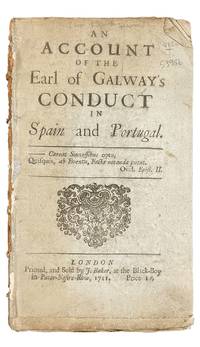
171134984London 1711. 888pp. Some toning. Very good. Disbound.<br/> <br/> An interesting work relating to the actions of French Huguenot soldier and diplomat Henri de Massue Earl of Galway during the War of the Spanish Succession. Galway's failure at the Battle of Almanza led to the defeat of the British and his eventual censure by Parliament.<br/> <br/> ESTC T18844. Goldsmith 4973. unknown
1711WRCAM53956London 1711. 888pp. Dbd. Some toning. Very good. An interesting work relating to the actions of French Huguenot soldier and diplomat Henri de Massue Earl of Galway during the War of the Spanish Succession. Galway's failure at the Battle of Almanza led to the defeat of the British and his eventual censure by Parliament. ESTC T18844. GOLDSMITH 4973. unknown books
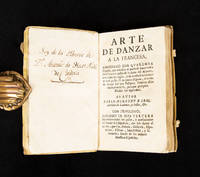
175834566Madrid: The Author 1758. 16mo. ca. 150 x 103 cm. Full contemporary vellum with manuscript titling to spine leather ties. 1f. recto title verso blank 1f. "Al Lector i privileges dated July 2 9 and 10 1737 iii "Advertencia" 72 pp. text 20 engraved plates of choreographic notation of dances including those by Feuillet and Pecour with music with alternate rectos and versos blank as issued. With one folding plate of engraved music between pp. 35 and 37.<br/><br/>With charming woodcut depictions of both male and female dancers one with an accompanying musician illustrating positions of the arms and feet and dance etiquette including bowing and managing one's hat. Diagrams and choreographic notation within text. <br/><br/>The final textual section "Explicacion del Danzar a la Española" offers detailed definitions of 46 steps used in Spanish dance followed by descriptions of "Danzas a la Española ." including the pabana the gallarda the españoleta the villano the impossibles and the hermosa. <br/><br/>Plates include:<br/>- Explicn. de la Chorographia<br/>- Movimentos de los Brazos Codos etc.<br/>- Demonstracion de la Bretaña<br/>- Rigodon ô Allegro de la Bretaña<br/>- El Amable con otra Chorographia<br/>- La Pastoril demonstda. redonda y larga<br/>- La Diligenta delinda. â lo largo ô larga<br/>- La Cortesana Cont. quadrada ô en quadro<br/><br/>Free front endpaper with elaborate contemporary paraph verso with contemporary inscription: "Soy de la Libreria de Dn. AntonÃo de Hozes Ferñz de Cordova."<br/><br/>Binding slightly worn; ties partially lacking; endpapers slightly worn; free front endpaper slightly stained. Minor internal wear and soiling; some leaves browned; occasional foxing; several small virtually invisible professional archival repairs. Rare third edition of the work demonstrating the foundations of dancing in the French style considered of greater elegance than the Spanish first published in 1737. Derra de Moroda 1856 edition of 1758. Malkin 79 edition of 1737. Niles & Leslie pp. 360-361 edition of 1758. Waterloo p. 144 RISM Écrits p. 587 editions of 1758 and 1768. All with variant titles no recorded copies with this title. <br/><br/>Minguet's manual incorporates material from two other important early 18th century dance treatises Feuillet's Chorégraphie Paris 1700 and Rameau's Le Maître de danser Paris 1726.<br/><br/>"A compilation of Feuillet Rameau and De la Cuisse. His engravings however are superior to the originals of the fore-mentioned and make his Arte de Danzar perhaps the most important treatise in 18th century Dance literature in Spanish." Niles & Leslie<br/><br/>"Spain was one of the first countries to record its social dances in a system of dance notation and notation was to be an important element in dance manuals of the eighteenth century. The first Spanish book devoted entirely to dance was Discursos sobre el arte de danzado 1642 by Juan de Esquivel Navarro dancing master to Philip IV. The next dance book by Bartolemé Ferriol y Boxeraus did not appear until a century later in 1745. Pablo Minguet e Irol a famous engraver as well as an author and translator published works on a wide range of subjects; his dance books included several important works which incorporated the French dance notation of Raoul-Auger Feuillet." International Encyclopedia of Dance 5 p. 670. <br/><br/>"A particularly lovely set of illuminations can be found in Pablo Minguet e Yrol's Arte de danzar à l a francesca." op. cit. 6 p. 124. <br/><br/>Antonio de Hoces Fernández de Córdoba 1722-1782 was a "Master of Seville" and served as mayor of Cordoba. [The Author] unknown books
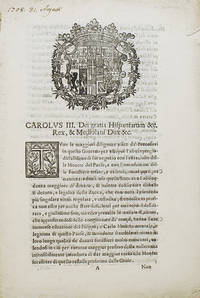
1708217289Milan: M.A.P. Malatesta 1708. 6 2 blank pp. 1 vols. Samll folio. Old stab-marks visible. Very good. 6 2 blank pp. 1 vols. Samll folio. The Austrians Rule Milan. Issued during the Wars of Spanish Succession when Archduke Charles the future Emperor 1711-40 claimed the Spanish throne as Charles III. In 1706 the Austrians invaded Northern Italy and entered Milan ending he Spanish rule there. This edict of 31 August 1708 is an attempt to regulate the currency eliminate the flight of Milanese gold and silver coins through black market foreign exchange and set the rate of the new Milanese money against seventeen other foreign currencies. M.A.P. Malatesta unknown books
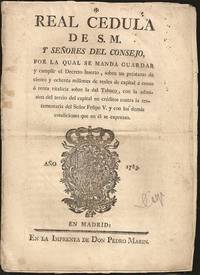
1783CA114212 pages with crest to title page. Quarto 11 1/4" x 8" single folded sheet housed in a custom made enclosure. First edition.<br /><br />Cedula Latin means in general an order or authorization; in earlier times such a document on the authority of the king or a royal decree which for Spain and Spanish America was a decree issued directly by the monarch.<br /><br />During the second half of the eighteenth century the Spanish Crown monopolized the tobacco industry in its American colonies creating vertically integrated organisations which included factories for the production of cigars and cigarettes. Few economic activities were more vital to the development of the Spanish American economies that the cultivation manufacture and commercialization of tobacco. Tobacco was the second most important export industry in Spanish America at the time. The decision of the Bourbon monarchs to monopolize the industry was a critical component of their plan to increase government revenues through a renewed contract with the colonists. This Spanish royal decree issued at the end of the War of American Independence to take effect January 1 1784 alters the basis for the tobacco trade set up as a monopoly under Phillip V and establishing new regulations for the business. This decree mainly affected the American colonies including Louisiana.<br /><br /><b>Condition:</b><br /><br />Some soiling on front and back; last page has columns of numbers and damp-stain along edge one inner page heavily soiled near head else a very good copy in a fine enclosure. En la Imprenta de Don Pedro Marinan
1787135132Madrid: En la Imprenta Real 1787. First nationwide Spanish census First edition of Spain's first nationwide census the census of 1787. The first census in Spain was undertaken in Castile as early as 1594 and there was a census of the Spanish Empire in 1776 but this was the first which embraced the whole country. It is sometimes known as the Census of Floridablanca after the reformist prime minister Count Floridablanca under whom it was undertaken from 1785 to 1787. The 43 tables list the regions of Spain alphabetically from Andalucia to Valencia but also include the Balearic and Canary Islands. The data accounts for the number of persons their ages religious affiliation and social status. The final population count is 10409879. Although the census did display modern demographic techniques the attempts to classify the population on class and occupation proved too rudimentary - servants were not classified in any consistent way and the scope of the hidalgo class varied considerably from region to region. Even so the census was a considerable demographic achievement and remains studied in modern Spanish demography; it is considered more accurate than the subsequent Spanish census of 1797. Quarto 301 x 225 mm. With 43 printed tables and large printed folding table at rear. Contemporary quarter sheep smooth spine ruled in gilt with green calf label marbled paper sides edges speckled red. Inked number "153" to title page. Scuffing and wear around extremities contents clean leaf a4 creased minor paper faults to tables XVIII and XXVIII 6 cm closed tear to map. A nice unrestored example. Goldsmiths' 13352; Palgrave I 242. unknown
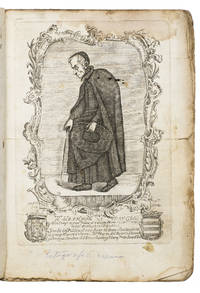
1770ABC_47902Córdoba 1770. 8vo. Contemporary limp parchment. With a large engraving of Juan de Santiago on the second leaf and a pen drawing on page 102. 4 "159" = 162 pp. Manuscript version of the only contemporary source on the life and death of the Córdoban Jesuit Juan de Santiago 1689-1762. It follows a work by the same name by Vincent Morales 1708-1765 which was probably published for the first time in 1763 in Córdoba. The copper engraving in the present manuscript likely comes from this edition. Judging from the ownership annotation the present manuscript was also made in Córdoba probably for a local university or convent. It contains an extra paragraph at the end about a feast held in honour of Juan de Santiago including six epigrams written for him. This part is not present in the printed versions of this work.Juan de Santiago was born in Écija. He became known as the "niño de la razón" because of his love for studying. He entered the Jesuit College at Sevilla at a young age. After he was ordained he moved to Córdoba College where he stayed for 40 years. He was seen as a model of holiness and many miracles were attributed to him. One of these occurred when he put out his hand to a blind woman who tried to enter the church and said to her: "Come in and take a good look." Upon which the woman cried "I see it I have recovered my sight." Throughout his life he was much loved in Córdoba because he helped and advised a great number of inhabitants. When he died there was an enormous grieving crowd in town and the City Council ordered that one of the three keys of his coffin should be kept in the city archive. The work by Morales was written at the request of the grieving Córdobans.With a crossed out ownership annotation on the verso of the title page. The parchment is stained and wrinkled with a few small holes and is somewhat smaller than the paper leaves. The borders of the first two leaves are frayed the manuscript is somewhat stained throughout. Otherwise in good condition.l Cf. De Backer-Sommervogel 1894 V 1284 printed ed. unknown
1739606731739. Relates to Events in the Americas Anglo-Spanish War. Cotejo de la Conducta de S.M. Con la de el Rey Britanico Assi en la Acaecido Antes de la Convencion de 14. de Enero de Este Anno de 1739 Como en lo Obrado Despues Hasta la Publicacion de Represalias y Declaracion de Guerra: Con Licencia en Madrid. His Catholick Majesty's Conduct Compared With That of His Britannick Majesty As Well With Regard To What Happened Before the Convention of the 14th of January of This Year 1739 As to What Has Been Done Since Untill the Publication of Reprisals and Declaration of War: Printed by Authority at Madrid by Antonio Marin. London: Printed for T. Cooper 1739. 63 pp. Spanish text with English translation on facing leaves. Octavo 8" x 5". Later quarter morocco over textured paper boards gilt title to spine. Some rubbing to joints corners lightly bumped hinges just starting at ends. Discoloration to free endpapers light toning to text somewhat heavier in a few places. Early owner signature Eyre to head of title page interior otherwise clean. $1250. Only edition. A legalistic analysis of Spanish claims advanced during the Anglo-Spanish War 1739-1748. Also known as the War of Jenkins' Ear after the conflict's flashpoint it related to Great Britain's exclusive right granted by the Treaty of Utrecht at the end of the War of the Spanish Succession 1713 to ply the slave trade and sell other goods in Spain's American colonies. This war was eventually subsumed into the War of the Austrian Succession 1742-1748. The signature in this copy may be that of Sir James Eyre 1734-1799 the notable judge later chief justice of the Court of Common Pleas. Sabin A Dictionary of Books Relating to America 17026. unknown books
1719WRCAM35378Seville: Francisco Garay 1719. 4pp. Small quarto. Modern three-quarter morocco over linen boards spine gilt. Occasional stains holes at bottom of both leaves not effecting text last page of text closely trimmed. A good copy. A four-page ballad describing the enormous storm experienced by the Spanish fleet in 1719 and of the miraculous preservation of the ships which eventually arrived safely in Cadiz. It was this same great fleet which Spain had gathered at Cadiz and Corunna for the invasion of the west of England directed by James Butler the attainted Duke of Ormonde. A rare possibly unique piece of early 18th-century Spanish verse. Not recorded in Palau NUC or on OCLC. Francisco Garay hardcover books
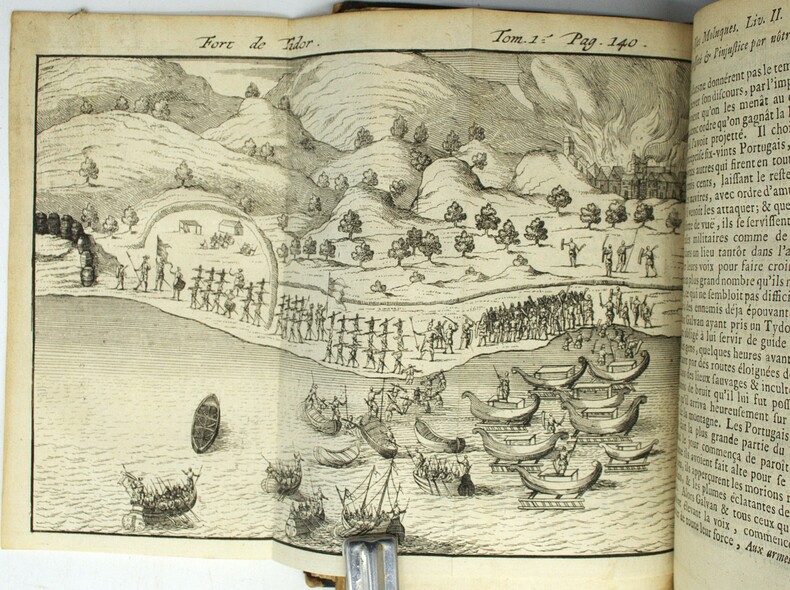
1706PHO-1901Amsterdam, Jacques Desbordes, 1706. 3 volumes in-12° (sur 3), 10ff-405pp-3pp (catalogue); 2ff-402pp-14ff( table) ; 4ff.-388pp.-10ff., illustré de 3 frontispices, 1 portrait et 30 (32) cartes et planches dépliantes dont une belle carte (25x36cm), manque la page de titre tome 1. Relié plein veau époque, dos à nerfs ornés avec pièce de titre et tomaison, tranches rouges, charnières frottées, début de fente (tome 1), coiffes usées, petit manque de cuir au dos, mouillure au tome 3, traces de restauration, manque la grande carte mais la carte de Ceylan est bien présente.
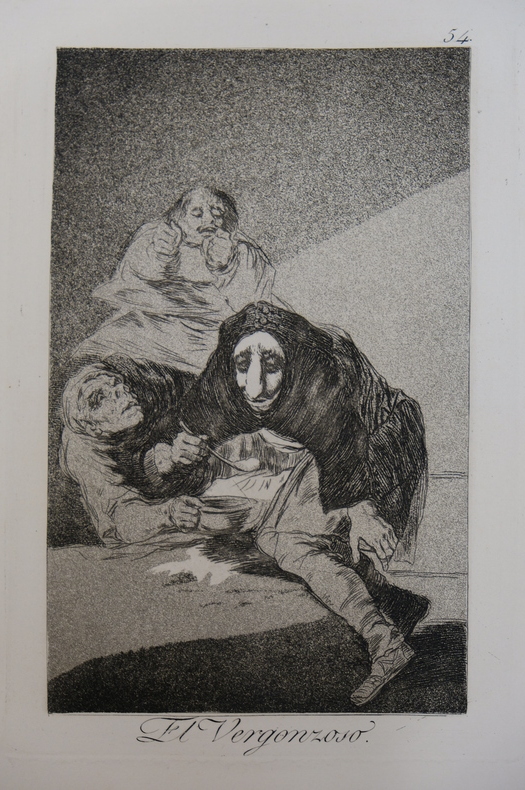
1799est152b2Dimension extérieur 34,5 x 26 cm, cuvette 21,5 x 16,5 cm. Magnifique eau-forte réalisée par le très célèbre Francisco de Goya en 1799. Elle est en parfait état. Dimensión externa 34,5 x 26 cm, cuenco 21,5 x 16,5 cm. Hermoso grabado del famosísimo Francisco de Goya en 1799. Está en perfecto estado.
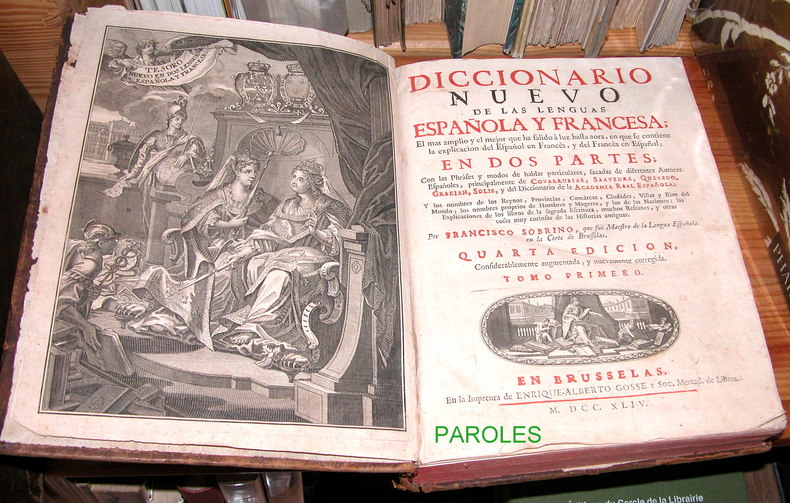
174416243Bruxelles, Henri-Albert Gosse & Comp., 1744 2 volumes In-4° (19,5 x 25,2cm) Reliure d'époque pleine basane; dos à 5 nerfs et 5 caissons ornés de motifs dorés, pièce d'auteur-titre de maroquin rouge en encadrement doré; tranches rouges. Vol.1: 1frontispice, 1titre imprimé en noir et rouge orné d'une vignette, 1feuillet, 601p.; Vol.2: 1titre imprimé en noir et rouge orné d'une vignette, 1feuillet, 604p.; bandeaux et lettrines. Epidermures aux dos et manques aux coiffes; petits travaux de vers aux charnières et 2nd plat du 1er volume; épidermures au 2nd plat du 1er volume; généralement propres à l'intérieur (quelques petites rousseurs et quelques feuilles fumées).
17724365Valencia Por Benito Monfort 1772. Hardcover. . ~ ~ NOTE: THE PRICE OF THIS BOOK IS CURRENTLY REDUCED! ~ ~ . Two volumes. Duodecimo. Pp. xxviii 335; 344. Half-titles present. HARDCOVER uniformly bound in contemporary full mottled calf spines richly decorated in gilt morocco lettering-piece to each spine marbled endpapers all edges red calf bit affected by the mottling few worm holes on endpapers paste-down of one volume partly adhered to board. In a very good condition rather fine interiors. A-2 <br/> <br/> Valencia, Por Benito Monfort hardcover
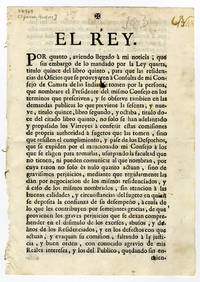
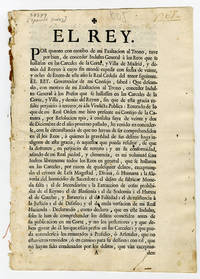
1758WRCAM37969Madrid 1758. 3pp. Folio. Dbd. Maltese cross at head of title. Contemporary and later manuscript annotations in ink and later pencil annotation on first page. Accomplished in manuscript with additional manuscript annotations. Manuscript inscription on blank verso of final printed page. Extremely light dampstaining in margins occasional minor soiling and ink stains the latter touching a few letters. Very good. A rare proclamation by Ferdinand VI King of Spain demanding that earlier laws regarding the appointment of judges in the Spanish Indies be observed. The decree states that disregard of these laws and guidelines in the past has been a great injustice causing injury to royal interests and to the general population. This proclamation was to be sent to the viceroys and audiencias throughout the Spanish Indies. This copy accomplished in manuscript at Aranjuez Spain on August 20 1758 is signed by Juan Emanuel Crespo with the inscription "Yo El Rey" and the annotation "Por mandado del Reyno exo. señor." A manuscript inscription on the blank verso of the final printed page dated December 4 1759 confirms that the decree had been reviewed by the President the fiscal and other high-ranking officials in Santiago de Chile. Not in OCLC Medina BHA or Palau. unknown books
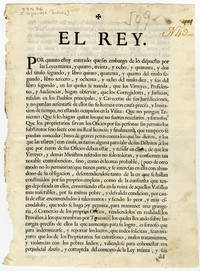
1760WRCAM37579Madrid 1760. 5pp. plus integral blank leaf inscribed. Folio. Dbd. Maltese cross at head of titlepage. Contemporary manuscript inscription and later pencil inscription at top of first page. Accomplished in manuscript at Buen Retiro Spain on Dec. 28 1770. Signed by Juan Manuel Crespo with additional annotation on last page of printed text and additional inscription on verso of last page of text. Integral blank leaf with manuscript note related to the cedula on recto and verso. Very good. A rare detailed royal cedula issued by Charles III King of Spain ordering a general pardon of accused individuals to be enacted throughout the Spanish Indies. Citing earlier royal proclamations issued previously by Charles III concerning clemency for prisoners this cedula reprints texts of decrees from January and February 1760. While most prisoners were to receive pardons a long list of exceptions based on the Jan. 28 cedula is provided. These included those accused of secular and religious treason killing a priest counterfeiting money arson blasphemy sodomy robbery falsehoods and duelling. Numerous other details regarding the earlier clemencies are also provided. The present royal amnesty was to be distributed to the viceroys presidents audiencias governors and other judges throughout the Indies in order that this resolution by properly executed. <br> <br> This copy accomplished in manuscript at Buen Retiro on Dec. 28 1770 is signed by Juan Manuel Crespo with the additional annotation: "Yo El Rey. Por mandado del Rey Nuestro Señor." A manuscript inscription on the blank verso of the final printed page dated Feb. 27 1762 confirms that the decree had been reviewed two days earlier by the President and other high officials in Santiago de Chile. A manuscript note in a separate hand on the recto and verso of the integral blank leaf provides additional information about the receipt of the document in Santiago in 1762. <br> <br> A rare and highly informative proclamation regarding royal pardons to be enacted throughout the Spanish New World and in Spain. Not in OCLC Medina BHA or Palau. unknown books
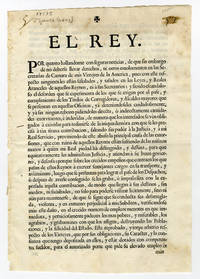
1758WRCAM37576Madrid 1758. 3pp. Folio. Dbd. Maltese cross at head of title. Contemporary manuscript inscription in ink and later pencil inscription at top of first page. Accomplished in manuscript see below with additional inscription on p.3. Additional manuscript inscription on blank verso of final printed page. Extremely light dampstaining in margins occasional light soiling. Very good. A rare royal cedula issued by Ferdinand VI King of Spain confirming earlier published laws stating that viceroys presidents and audiencias are to ensure that corregidores and justices reside in the principle towns and headquarters of their jurisdictions. The decree also states that the judges are not to be absent from their principle residences except under special circumstances when a license is issued indicating the precise cause for the absence and the length of time the judge will be away. In addition the judges can not name their own "lieutenants" or assistants nor can the viceroys presidents and audiencias name judges' assistants without royal approval. This copy accomplished in manuscript at Villaviciosa Spain on Sept. 7 1758 is signed by Juan Manuel Crespo with the additional inscription "Yo El Rey" and the annotation "Por mandado del Reyno exo. señor." A manuscript inscription on the blank verso of the final printed page dated Dec. 4 1759 confirms that the decree has been reviewed by the President and other high- ranking officials in Santiago de Chile. <br> <br> A rare proclamation regarding colonial judges in Spanish dominions throughout the New World. Not in OCLC Medina BHA or Palau. unknown books
1759WRCAM37578Madrid 1759. 3pp. Folio. Dbd. Maltese cross at head of title. Contemporary manuscript inscriptions in ink at top of first page. Accomplished in manuscript at Villaviciosa Spain on Feb. 18 1759 signed by Juan Manuel Crespo with additional inscription on p.3. Light dampstaining in margins occasional light soiling. Very good. A rare royal cedula issued by Ferdinand VI King of Spain confirming that the Secretaries of vice-royal chambers throughout the Americas do not have the rights privileges and emoluments held by governors corregidores and alcalde mayores. The decree refers to past abuses of power and finance by secretaries which were harmful to the realm and directs viceroys presidents and governors to ensure that secretaries officials and other dependents do not assume privileges which are not appropriate to their position. This copy accomplished in manuscript at Villaviciosa Spain on Feb. 18 1759 is signed by Juan Manuel Crespo with the inscription: "Yo el Rey. Por mandado del Rey Nuestro Señor." In addition the inscription notes that this printed text is a copy of the royal cedula located in the books of the Secretary of Peru located in Madrid as of March 31 1759. <br> <br> A rare proclamation regarding the limits of compensation for particular royal officials in Spanish dominions throughout the New World. Not in OCLC Medina BHA or Palau. unknown books
1799est149b2Dimension extérieur 35 x 25,9 cm, cuvette 21,5 x 15 cm. Magnifique eau-forte réalisée par le très célèbre Francisco de Goya en 1799. Elle est en parfait état. Dimensión externa 35, x 25,9 cm, cuenco 21,5 x 15 cm. Hermoso grabado del famosísimo Francisco de Goya en 1799. Está en perfecto estado.
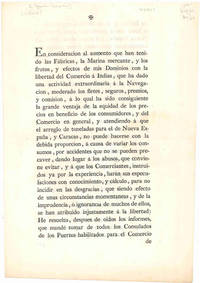
1789WRCAM47977Madrid 1789. 3pp. Folded folio sheet. Two worm holes very minor soiling else fine. This royal decree liberalized the tightly controlled trade between Spain New Spain and the Captaincy of Caracas. The Crown hoped to spur navigation and commerce and lessen the incentive for smuggling. Export duties on goods traveling to the Indies were to be slashed by ten percent but penalties against contraband would still be enforced. unknown books
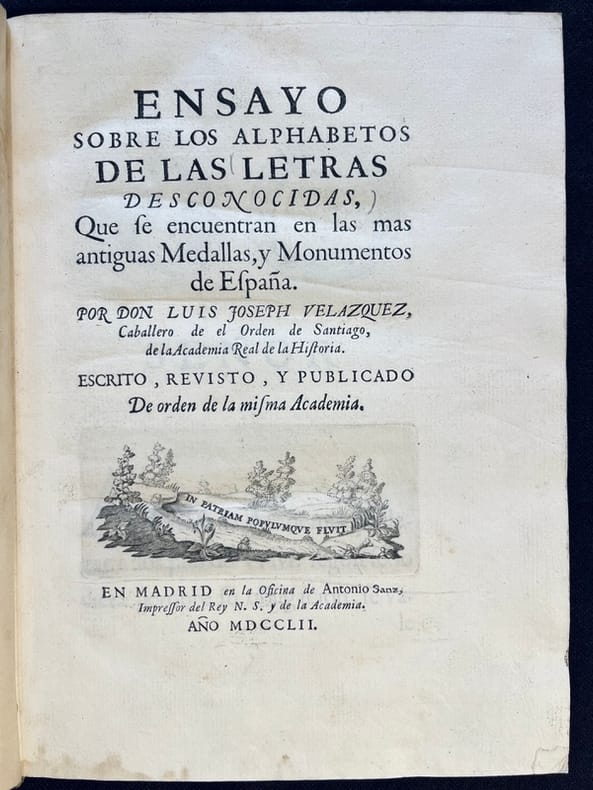
17526133Madrid, En Madrid en la Oficina de Antonio Sanz, Impressor del Rey N. S y de la Academia, 1752. In-4 de [16]-163-[5]p. demi-veau glacé bleu, dos rond orné de filets dorés, cartouche de titre carrée, tranches jaspées.
1703139168London: Printed and sold by John Nutt 1703. Planting colonies in the Spanish Americas First edition preceding the second edition of that year with an added postscript. Published in the third year of the War of the Spanish Succession 1701-1714 the anonymous author proposes that in return for the support of Britain and the Netherlands for the claim of the Emperor of Austria to the Spanish crown Spain's territories in America should be ceded to the two mercantile powers. They propose a confederation which will share the treasure from the Spanish mines keeping it out of the hands of a single monarch and in so doing preserve the balance of power in Europe. They moreover support extending the war to the Spanish West-Indies at that stage untouched by the conflict and offer proposals to plant colonies there. They respond to critics who would argue that such attempts at joint control of the American mines and territories would engender war between Britain and the Netherlands as trade brings peace and also reject the arguments that American wealth flowing into the mercantile nations would weaken the nation as was believed to be the case in Spain. The polemic nonetheless offers a stark realpolitik view of world politics and of the war treating as irrelevant the moral questions of stripping the territories of their nominal ally Habsburg Spain rather than the official war aims of taking French territories and stemming the growth of Bourbon power. A scarce treatise with ESTC locating six copies for this issue and a further two copies of the second edition Library Hub and Worldcat adding several more yet still absent from many prominent institutional collections and untraced in auction records. Small quarto 205 x 162 mm. Disbound pamphlet with remnants of original spine the pages numbered in an 18th-century hand 589-654 from its original place in the sammelband vol. Lightly browned and foxed top two cords mostly gone but bottom two holding light worming at foot not affecting text tiny hole affecting one letter to pp. 25/26. A very good copy without chipping or repairs. Alden 703153; European Americana 703/53; ESTC T193661; Kress S2261. Not in Sabin. unknown
1713WRCAM53351Minorca Spain 1713. 690pp. Thick quarto. Later three-quarter calf and marbled boards. Moderate wear to edges and spine extremities boards rubbed corners bumped. Small later ownership inscription on front pastedown. Light foxing and tanning marginal dust soiling. Composed in a neat legible hand. Very good. Untrimmed. A lengthy and highly detailed manuscript volume containing documents related to the British takeover of Minorca after its capture from Spain during the War of Spanish Succession and an investigation into the governance of the island. In September 1708 British forces occupied the Mediterranean island with little opposition the inhabitants and nobles having mostly supported the Anglo-Dutch designs for the Spanish throne. The inherent importance of the island as a military outpost and trading way point in the Mediterranean led the British to occupy it for the rest of the war and to receive it as a possession in the Treaty of Utrecht which ended the conflict in 1713. <br> <br> The documents collected here relate to the English Brigadier Lewis Petit who served as Lieutenant Governor and Chief Engineer of the island during its occupation. As Chief Engineer Petit was in charge of improving the fortifications and defenses of Minorca and although a Spanish ally was named as titular Governor Petit exercised the true authority over the island. Although his improvement plans may have been sound his management of the island's public moneys was suspect. <br> <br> "Petit somehow found time to enter into commercial speculations on his own account. In partnership with two Spaniards and Stanhope's secretary Arent Furley Petit purchased a French prize at Mahón for 7800 dollars with which to trade between Minorca Majorca Sardinia and the Spanish and Barbary coasts. He advised Furley that he had found it necessary to use funds supplied for the fortifications to complete the purchase and urgently requested capital from his partners to repay this misappropriation. Petit's participation was valuable to the enterprise owing to his ability to land cargoes at Mahón without paying duty an activity much objected to by the local town government. <br> <br> "Petit was soon to find himself under the scrutiny of the inspectors sent from London to investigate irregularities in the expenditure of the army in Spain as an attempt to disgrace the previous ministry.The accusations against him concerned imperfections in his accounts including allegations of missing vouchers irregularities and overcharging in the numbers of workmen and mules and alleged differences between prices contracted and prices paid among other charges" - DNB. <br> <br> The documents compiled here therefore relate principally to the investigation of those actions by a specially convened Board of Commissioners and contain Petit's written responses to specific inquiries about his expenditures. In transmitting these answers the reports provide a detailed perspective regarding the management of Minorca's finances defenses and engineering improvements under Petit's charge. Moreover in order to buttress or to undermine those claims voluminous correspondence financial figures construction reports testimonies affidavits and other material are reproduced that span the length of the British occupation of the island before it officially became a possession. As a result the manuscript documents contained here provide a thorough encapsulation of the economic and military situation on Minorca and the growth of its importance as a British outpost in the Mediterranean. <br> <br> A highly valuable set of manuscript documents that meticulously details the development and management of a British possession gained through the War of Spanish Succession worthy of much deeper research. Paul Latcham "Petit Lewis 1665-1720" in OXFORD DICTIONARY OF NATIONAL BIOGRAPHY Oxford University Press 2004 http://www.oxforddnb.com/view/article/22038. hardcover books
17901110042194xbvkNo place (Madrid?), Ruiz, 1790. 284 pages. - Original marbled full leather binding with gentle gilt spine-decoration and goldstamped title on gilt-decorated red spinelabel, marbled endpapers; sm.-8vo.(ca. 15 x 8 cm).
1793000703Paris Defer de Maisonneuve 1793