30 résultats
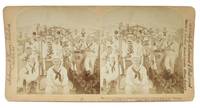
189947205New York: Underwood & Underwood Publishers 1899. Now housed in an archival mylar sleeve. Some wear & soiling to card. A bit of yellowing to image. A VG example. Caption printed to verso in 6 languages. Stereo image separate domed mounted to stiff-stock concave card. Oblong format: 3-1/2" x 7". Rounded corners. <br/><br/> Underwood & Underwood, Publishers unknown books
18206451Mexico City: Alejandro Valdes 1820. First printing. Quarto 11pp. Spirited defence of freedom of the press critical of infringements that were being made by the restored crown of Ferdinand VII of laws that had been passed by the Spanish Cortes parliament during the liberal period during and right after the Napoleonic invasion. One of these infringements was the restriction of the press. Though it is anonymous the author signs himself "El Espanol imparcial" and a close reading indicates that he was probably living in Mexico. From an argument for a free press he ends up proposing independence for the American possessions. Not in Medina; Palau 19237: OCLC list 5 libraries with holdings. Fine. <br/><br/> Alejandro Valdes unknown books
1898WRCAM54953Puerto Principe Cuba 1898. Broadside 16 1/4 x 12 1/4 inches. Toned old folds and creases minor edge chipping short closed tear slight fold separations. Very good. A very rare possibly unique surviving example of a Cuban broadside dating from the month after the conclusion of the Spanish- American War. The war ceased with a truce between the United States and Spain on August 12 1898; the official end of the war came a few months later on December 10 when the two parties signed the historic Treaty of Paris. Here on September 10 in the interim between truce and treaty the outgoing Spanish colonial governor of the south- central Cuban city of Puerto Principe present-day Camagüey Emilio March y Garcia calls for reinforcement of the truce agreement that would ensure free and open commercial trade in the region in the face of continuing interference by Cuban insurgents. March y Garcia claims that the Cuban revolutionaries are illegally detaining people interrupting the cattle trade trampling property rights carrying arms in flagrant disregard for the law and more. The ARIZONA REPUBLICAN published an English translation of this proclamation in its September 26 1898 issue. The translation reads: <br> <br> "I hereby inform the commanders of insurgent bands who are pillaging in the neighborhood of this city; who not observing the agreement between the Spanish and American governments with regard to the freedom of commercial relations are illegally detaining the country people; who are obliging the land owners to procure special passes and permits in order to put in order their plantations and will not allow them either to sell their cattle under the absurd pretext that the estates are the property of the nominal Cuban state and that its government alone can distribute and sell them and turn their products to what uses it sees fit thus trampling under foot the rights of property whereas on the part of this government the most absolute liberty in making contracts has been allowed and will be allowed in the future thus demonstrating the respect it has for the rights of all persons within its jurisdiction. I must call to notice with real sorrow that if these towns are suffering almost the horrors of starvation it is the result of the measures adopted by the chiefs of the insurgent bands who are impeding free traffic by forbidding the entry of all kinds of provisions especially cattle into the towns. In view of what I have already explained I consider it necessary to publish the following warnings: Article 1. I repeat my order of August 23 last permitting free entry and exit to all towns of this province subject to my authority and the most absolute freedom of trade between all the inhabitants of the province. Article 2. The prohibition to enter towns with arms remains in force and whoever is found with arms in his possession will be punished in accordance with the laws." <br> <br> Don Emilio Augusto March y Garcia Mesa was a career Spanish military commander who spent at least three stretches of time in Cuba the last as military governor of Puerto Principe during the Spanish defeat in the Spanish- American War. He also served as the colonial governor of Puerto Rico and general captain of Arago the Balearic Islands and the Canary Islands. <br> <br> The present broadside is exceedingly rare and quite possibly unique with no copies listed in OCLC and no records at auction. unknown books
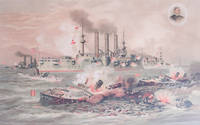
189840301Philadelphia: J. Hoover & Sons 1898. Image 27 x 17 1/2 inches. Framed and glazed. Image 27 x 17 1/2 inches. Schley was selected "at the opening of the Spanish-American War to command the Flying Squadron at Hampton Roads.when Cevera's ships reached Martinique the Flying Squadron.at 9:35 July3 1898 the Spanish ships emerged from the harbor of Santiago and turned westward Schley's flagship the Brooklyn westernmost of the blockading line."<br/><br/>Xanthus Russell Smith 1839-1929 comes from a Family of Philadelphia Artists. He was the som of Russell Smith. J. Hoover & Sons unknown books
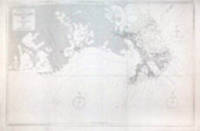
188015998Madrid: Published by the Spanish Admiralty 1880. Engraving. Printed on wove paper. In excellent condition. Image size: 24 x 37 1/4 inches. A wonderful sea chart of the Mississippi Delta produced by the Spanish Admiralty at the close of the nineteenth century.<br/> <br/>This is an impressive sea chart of the Mississippi Delta produced by the Spanish Admiralty in 1880. The coast line is clearly mapped out with little detailing except for the soundings around the Delta. There are two compasses and a number of lighthouses identified along the shoreline. The chart uses the surveys conducted by the U. S. Coast Survey which were carried out between 1853 and 1877. It is a wonderful chart of this important area and superb collector's piece for anyone interested in early maps of the Americas. Published by the Spanish Admiralty unknown books
1813869Cadiz: Imprenta Nacional 1813. 1/4 Leather. Good. 4to 21 cm 8.3 in. 4 694 pp. lacks frontis. <br/><br/>First edition: The Spanish Inquisition was established in the 13th-century. The power of the Spanish Inquisition wavered over the centuries and was limited to the censorship of books and free speech by the early 1800s; this censorship was abolished in 1812. Here is a discussion regarding its potential reinstatement by the Spanish Cortes 1810-1813 and their decision against it in 1813. <br/><br/>Palau 74471. Encyclopaedia Britannica. Columbia Encyclopedia. Contemporary quarter speckled leather with gilt tooling on the spine and marbled paper over boards on sides the binding shows age and handling plus wear to joints and fore-edge corners. Red-speckled edges with top edge dusty. As usual lacks the frontispiece. Scattered light foxing. Well-preserved tight and square. Imprenta Nacional unknown books
1879WRCLIT82812Madrid: Libreria de Cuesta 1879. 775pp. Large octavo. Printed wrappers extracted from pamphlet volume. Tables and illustrations. French bookseller's ticket on front wrapper spine covering absent but a very good copy. First edition published in the series "MonografÃas Industriales." OCLC/Worldcat locates two copies in North America: Sutro Library and Yale. OCLC: 42946953. Libreria de Cuesta unknown books
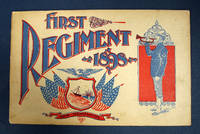
189840039Mexico Mo: Head Bros 1898. 1st printing. White paper wrappers printed in red & blue stapled. Age toning to paper. Staples a bit rusted. A VG copy. Unpaginated though 40 pp. Roster last 4 pages. Profusely illustrated with 65 b&w captioned photographic images. Oblong format: 5-7/8" x 9-1/4" <br/><br/>From the rear cover: "To the Officers and Members of this Regiment. . this book is presented to you as a souvenir of your camp life in the Spanish-American War. The idea is to show by photographs a practical army life ." Head Bros unknown books
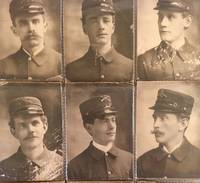
1898List319Massachusetts 1898. The 2nd Massachusetts Volunteers mustered into service in May 1898 and within a month saw significant action in Cuba at the Battle of El Caney. They were one of three volunteer units from Massachusetts to see action on the Santiago Campaign. The regiment was inexperienced - 55% were untrained recruits. The lack of experience combined with their rifles giving off a very visible black smoke led to a heavy casualties in the Battle of El Caney. After an encampment near Santiago de Cuba in which a large number of the soldiers became ill with disease - estimates are as high as 65% - the regiment returned home in August. Historians have noted that soldier demographics changed considerably from the Civil War to the Spanish American war as the smaller number of troops and the lack of a draft led to a more enthusiastic army with higher morale. <br /> <br /> The photographs in this group are interesting as a typological grouping of images of untrained soldiers and also for their historical value as most contain identifications to versos. The highlight of the group is forty-four uniformly mounted portraits of soldiers nearly all identified measuring 3 ¾ x 2 ½ inches each. Other photographs include a large portrait of Captain Frederick E. Pierce with the blindstamp of Goldsmith Studio Springfield Massachusetts and a 3 ¼ x 3 ¼ inch square card of Capt. Pierce in Camp Turner. Also included are two slightly larger photographs on similar mounts. <br /> <br /> Overall an interesting group. Good condition overall with assorted chips and wear. unknown books
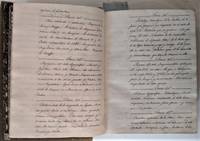
18504251850. 8vo. 215 x 160 mm. 8 ½ x 6 ¼ inches. 306 leaves chapters separated by blanks. 19th century leather backed marbled paper boards; inner hinge cracked edges bumped some abrasion to the head of the spine; sound. Beautifully written manuscript volume containing an extensive discussion of library management and practices written by an anonymous Spanish author in the middle of the 19th century. This dissertation organized in 70 chapters begins with a discussion of the library profession and its importance to civil society. His first chapters describe the "Archive" with reference to Spanish monastic governmental and diplomatic collections that have been preserved. He focuses his attention on Aragon Mallorca Navarra and Santiago. He turns to France to furnish some interested information on the archives in Paris before getting into the chapters on classification of materials and the creation of inventories. After nearly 200 leaves of text on the subject of archives the authors turns his attention to libraries. From the beginning he takes a historical approach focusing his attention on both books and manuscripts mentioning the collections at Cambridge University. Paleography is a subject he spends some time describing and then he moves into the history of printing typography Gutenberg and the spread of printing to Spain. The final dozen chapters are devoted to the rules for managing a library lessons in classification and inventory control. He quotes from both DeBure and Brunet in his lessons on cataloguing. A rather remarkable piece of work thought to be unpublished. An examination of both United States and Spanish national collections turned up no reference to this anonymous piece of library scholarship. unknown books
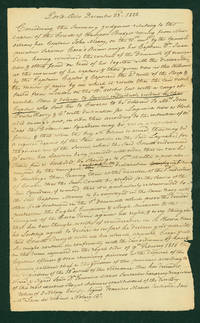
182121602<p>This fascinating archive consists of 27 manuscript documents in English and one in Spanish from litigation between the Baltimore owners of the merchant ship <i>Budget</i> and insurance companies that underwrote its voyage from England to South America. This conflict occurred against a backdrop of the collapse of Spain's American empire as various areas in Central and South America asserted their independence many under the leadership of Simón BolÃvar. The ship carrying weapons and supplies destined for Simón BolÃvar's rebels was captured by a Spanish privateer and condemned in Puerto Rico. The insurance companies refused to pay on their policies leading to two important cases on maritime law neutral rights and the responsibilities of insurance companies.</p> <b>INSURANCE NEUTRALITY SHIPPING SPANISH EMPIRE.</b>Archive of Evidence in <i>Thompson and Bathurst v. Maryland Insurance Company and Thompson and Bathurst v. Phoenix Fire Insurance Company</i> cases 1821-1824. 28 documents 41 pp. most 7¾ x 9¾ in.<p><b>Historical Background</b></p><p>In October 1822 Baltimore merchants Hugh Thompson and Matthew Bathurst insured their ship <i>Budget</i>and its cargo for $5000 with the Maryland Insurance Company and another $5000 with the Phoenix Fire Insurance Company for a voyage from London England to two ports on the "Spanish Main" Spanish colonies in Central America and on the northern coast of South America then back to the United States. The <i>Budget</i> was transporting "munitions of war" from London to the blockaded port of La Guaira Venezuela on the coast ten miles north of Caracas for Simón BolÃvar's rebels in Spanish America.</p><p>On December 1 1822 the Spanish privateer <i>Cora</i> under the command of Captain Don Juan Esiga captured the <i>Budget</i> and had it condemned as a prize of war at a court in Puerto Rico. <i>The Budget's</i>captain John Meany purchased the ship back billing Thompson and Bathurst for doing so. The merchants applied for payment from their insurers in March 1823. By May Thompson and Bathurst had turned over the <i>Budget</i> and its cargo to the Maryland Insurance Company and demanded payment. The insurers demanded more documentation especially of the condemnation proceedings in Puerto Rico. In August the insurance companies returned the copies of the proceedings in Puerto Rico to the ship's owners "to be translated into English." In March 1824 the insurers denied the claims.</p><p>On March 17 1824 the merchants sued the insurance companies in the Baltimore County Court for having "broken their covenant." Chief Judge Stevenson Archer ruled in favor of Thompson and Bathurst. However both the plaintiffs and the defendant's objected to parts of the decisions and filed cross-appeals to the Court of Appeals of Maryland.</p><p>In December 1832 Judge Thomas Beale Dorsey of Maryland's Court of Appeals concurred with the county court's refusing exceptions presented by the insurance companies and dissented on the exceptions offered by merchants. The Court of Appeals therefore ruled in favor of the ship's owners and entered judgment for "a total loss."</p><p><b>Excerpts:</b></p><p>Insurance Policy No. 8881 with the Maryland Insurance Company October 10 1822:</p><p>"<i>Touching the adventures and perils which we the assurers are contented to bear and take upon us in this voyage; they are of the Seas Men of War Fires Enemies Pirates Rovers Thieves Jettisons Letters of Mart and Counter Mart Surprisals Takings at Sea Arrests Restraints and Detainments of all Kings Princes or People of what Nation Condition or Quality soever Barratry of the Master and Mariners and all other Perils Losses and Misfortunes that have or shall come to the hurt detriment or damage of the said vessel or any part thereof.</i>"</p><p>Translation of Order of Francisco Marcos Santaella December 23 1822:</p><p>"<i>Having seen this summary judgment relating to the capture of the transport corvette called the Budget going from New Orleans under the orders & command of her Capt. & supercargo Mr. John Meany the first of the present month by the Spanish Privateer schooner called the Cora or Good Friends armed in this place and under command of her captain Don Juan Esija; taking into consideration the contents of the ships papers & from others found on board together with the declarations taken or made at the time of capture and those which have been made before this tribunal by the captains captor & captured second mate of the corvette and the prize master all tending to show that that vessel sailed from London on the 11th day of October last with a cargo of munitions of War belonging to particular individuals residing in that capitol who destined it for Caracas to be delivered to Messrs. Jones Pawly Harry and C<u>o</u> in Laguira at that time a port blockaded by the enemy in order that pursuant to the particular intention of M<u>r</u> Zeas the Columbian Squadron sh<u>d</u>be placed upon a respectable footing; and for this purpose was to be fitted out the Brigantine New Orleans & to make a regular deposit of said articles at the s<u>d</u> Laguira for the general use of the service where the s<u>d</u>corvette made efforts to enter the said captain bearing orders in case he found the place actually blockaded to carry her into S<u>t</u> Martha a port also occupied by the Insurgents and comprehended in the same declaration of blockade where she sh<u>d</u> be discharged and the cargo left to the judgment of the said individuals of Caracas; that the same Corvette sh<u>d</u> be offered for the service of s<u>d</u> Squadron whenever it shd be found needful that it shd be particularly recommended for the said Capt Meany to be employed in the marine service; with various other particulars which the said document contained and showing the decided protection which the European English and Anglo Americans afford to the insurgents of the continent contrary to all right and how much more worthy would it have been to have refrained out of respect for a short time.</i>"</p><p>Also the original order in Spanish December 23 1822 with a certification by Judah Lord "<i>Commercial Agent of the United States of America for Port Rico</i>" January 2 1823.</p><p>Thompson and Bathurst to President and Directors of Maryland Insurance Company March 12 1823:</p><p>"<i>Having received advise from Captain Maney that he had purchased the Ship Budget after her having been condemned and drawn on us for amount of Cost & Disbursements; we wish to know if we may calculate on receiving from you the amount insured in your Office at the stipulated time expressed in your Policy; say 90 days from proof of loss</i>"</p><p>Thompson and Bathurst to President and Directors of Maryland Insurance Company May 7 1823:</p><p>"<i>We abandoned to you on the 6<u>th</u> February last the Ship & Freight of Ship Budget insured in your Office by Policy N<u>o</u>8881 and at same time handed you a Certified Copy of the Condemnation of said Ship at Porto Rico. The Period of time required by your Policy for payment of Loss after proof thereof having now expired we beg leave to call upon you for the amount thereof.</i>"</p><p>President John Hollins of Maryland Insurance Company to Thompson and Bathurst May 24 1823:</p><p>"<i>Your letter of the 21st Inst has had the attention of a full board of Directors who have instructed me to inform you that they will advance to you $4498.75 on receipt of your & R. Oliver Esqrs joint note at six months bearing interest at the expiration of which time or sooner if convenient you are required to produce to this Company the following documents relative to the Ship Budget Viz The proceedings of the Court at Porto Rico The Log book or authenticated copy thereof The Charter Party or copy authenticated upon receipt of which & their proving satisfactory an adjustm<u>t</u> of the loss shall take place.</i>"</p><p>President John Hollins of Maryland Insurance Company to Thompson and Bathurst March 4 1824:</p><p>"<i>The board of Directors have instructed me to inform you that they do not consider the Company answerable for the claim you make for the ship Budget & freight insured by policy No 8881 this opinion they have formed from advice given by Mr Wirt & Mr Purviance who have had the case under their consideration.</i></p><p>"<i>I am also instructed to say to you that if your note in favor of Messs Rob. & Jno Oliver & by them endorsed for $4498.75 with interest & cost of protest be not taken up & paid at the Bank of Baltimore where it now lays on or before the 10th Inst it will be handed to Mr Purviance to be put in suit against you & those Gentlemen we hope you will prevent this unpleasant business but if not you will know the blame will not be chargeable to this Company.</i>"</p><p>Thompson and Bathurst to President and Directors of Maryland Insurance Company March 9 1824:</p><p>"<i>we are sorry to learn you still seem determined not to admit your liability for the Loss on the Ship Budget condemned at Porto Rico.</i>"</p><p>"<i>We had hoped that the very clear and decided opinions handed you of Mess<u>rs</u>Ogden & Binney Lawyers considered as the best informed in this Country on Marine Insurance would have removed all doubts & have been conclusive on that subject.</i>"</p><p>"<i>It is extremely unpleasant to us being under the necessity of resisting the payment of our Note which our Counsel have advised us to do; at same time we feel confident the result will prove we are in the right & justifiable in doing so.</i>"</p><p><b>Matthew Bathurst</b> 1778-1847 and <b>Hugh Thompson</b> 1760-1826 were partners in a general mercantile business in Baltimore Maryland.</p><p><b>John Meany</b> 1770-1841 was a sea captain in the merchant service and then a merchant and ship-owner in Philadelphia. For many years Hugh Thompson employed him.</p><p><b>John Hollins</b> 1760-1827 was a banker in Liverpool before immigrating to Baltimore where he became a successful merchant. He was president of the Maryland Insurance Company from 1802 to 1827 and he held a variety of local offices.</p><p><b>Simón BolÃvar</b> 1783-1830 was born in Caracas and educated in Spain and France. He joined the group of patriots that seized Caracas in 1810 and proclaimed independence from Spain. He went to Great Britain in search of aid but could get only a promise of British neutrality. When he returned to Venezuela and took command of a patriot army he recaptured Caracas in 1813 from the Spaniards. The Spaniards forced BolÃvar to retreat from Venezuela to New Granada now Colombia also at war with Spain. He took command of a Colombian force and captured Bogota in 1814. The patriots however lacked men and supplies and new defeats led BolÃvar to flee to Jamaica. In Haiti he gathered a force that landed in Venezuela in 1816 and took Angostura now Ciudad BolÃvar. He also became dictator there. BolÃvar marched into New Granada in 1819. His forces decisively defeated the Spaniards at Boyacá in 1819 liberating the territory of Colombia. He then returned to Angostura and led the congress that organized the original republic of Colombia now Ecuador Colombia Panama and Venezuela. BolÃvar became its first president on December 17 1819. BolÃvar crushed the Spanish army at Carabobo in Venezuela on June 24 1821. Next he marched into Ecuador and added that territory to the new Colombian republic. After meeting with another great liberator José de San Martin in 1822 BolÃvar became dictator of Peru in February 1824. His army won a victory over the Spaniards at Ayacucho in December 1824. Upper Peru became a separate state named Bolivia in BolÃvar's honor in 1825. He stepped down as president of Gran Colombia in January 1830 and died of tuberculosis eleven months later.</p> books
1820WRCAM21881Washington 1820. 8; 4pp. plus twenty-seven folding tables. Modern half morocco and marbled boards. Some occasional foxing. Overall crisp and very good. Untrimmed. The first report includes communications of the Spanish minister General Vives regarding the revolting Spanish American colonies possible Spanish session of Florida and other subjects. The second work consists of twenty-seven folding plates listing the names of American-owned vessels and other property claimed as Spanish spoliations. SERVIES 1048. hardcover books
1898WRCAM5606Washington 1898. 293pp. plus photos and two folding charts. Printed wrappers. Slightly dampstained. Good. The full testimony heard before the court of inquiry is included with nineteen photos of the wreckage and two charts of the keel of the Maine. The court found that the damage "could have been produced only by the explosion of a mine situated under the bottom of the ship" and that no officers or crew members were negligent in their duties. unknown books
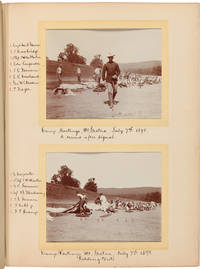
1898WRCAM54683Various places including Pennsylvania Virginia at sea New Jersey and Puerto Rico 1898. 171pp. with 342 photographs. Four large quarto photograph albums. Matching contemporary three-quarter crimson morocco and cloth front covers gilt. Minor shelf wear and some rubbing. Images in overall very good condition. An amazing assemblage of photographs documenting the Spanish-American War experiences of the First Troop Philadelphia City Cavalry which was at that time the oldest volunteer military unit in continuous service to the United States. The photographs are arranged chronologically in four contemporary photo albums with the images occasionally annotated in a contemporary hand and including the identification of numerous members of the Troop. <br> <br> The first volume opens with images of Mt. Gretna Pennsylvania "where troops were sworn into U.S. service May 7th 1898 by Maj. Thompson U.S.A." The photographs record field exercises camp building and tent organization at Camp Hastings cavalry drills an image of "Capt. Groome reading the Articles of War to Troop June 1898" a "first arrival of government horses" several shots of men training and "throwing" their horses shooting practice "Capt. Groome assigning Government horses to Troopers" and various shots of the men at work and even some play. Over the course of the album the names of numerous soldiers are recorded below several of the photographs. <br> <br> The second album opens with several photographs of the Troop striking their tents in preparation for leaving Camp Hastings at Mt. Gretna headed for Camp Alger at Dunn Loring Virginia. Here the Troop was ordered to increase their enlistment numbers. At Camp Alger the Troop was also fitted out with federal supplies and assigned to the Second Army Corps commanded by Maj. Gen. William Graham who is pictured here. Other photographs capture the camp scene at Alger "the First Troop picket line" the Troop receiving their federal-issue khaki uniforms the Troop at roll call and some shots featuring African-American helpers. <br> <br> In late July the Troop was sent to Newport News and several photographs record their brief time there with about a dozen shots of their temporary camp. On July 28 1898 the Troop left Virginia on the transport ship MASSACHUSETTS bound for Puerto Rico. Several images here capture the frenetic loading of the troops and their horses onto the ship with the remaining half dozen or so shots recording the Troop's time on board. <br> <br> The third album picks up where the second left off with the First City Troop embarked on the transport ship MASSACHUSETTS headed for Guanica Puerto Rico. Shipboard activities captured here include a few shots of groups of men being showered with water hoses. Several shots record the arrival of the men in the port of Guanica where they encounter the hospital ship NUECES which reports of the news of the "surrender of Ponce." After the men disembark they pitch their camp around Cathedral Virgin del Carmen on August 5. The next day several photographs record the unloading of horses and stores in the harbor at Ponce. The remaining thirty-eight photographs in this volume record scenes in the interior of Puerto Rico and are the most heavily annotated of the four albums. The images record scenes from the "road from Port of Ponce to Ponce" several scenes capturing a market day in Ponce and recording numerous native islanders the Troop's "temporary camp about 2 miles beyond Ponce" the "Troop wagon leaving camp beyond Ponce to join wagon train for Guayama" on August 8 a shot of the Troop's wagon "on road to Guayama in a Porto Rico mudhole" images of the wagon train to Guayama with the H Troop 6th U.S. Cavalry the "Point of Advance Guard entering Guayama within the lines" the Troop itself "entering Guayama passing General Brooke's Headquarters" a "View of First Troop Phila. City Cavalry U.S.V. Camp at Arroyo August 10th to 6A.M. Aug. 13th 1898" with the last ten images recording the camp or the streets at Arroyo. <br> <br> The fourth album documents the Troop's voyage home to Philadelphia. This time they take passage on the transport ship MISSISSIPPI and about half of the images record their voyage on board. On Sept. 10 1898 they reach Jersey City in New York harbor where they camp for a short time before returning to camp in Pennsylvania where the album ends. A couple of months later all three officers and the ninety- eight enlisted men of the First City Troop were mustered out of federal service for the Spanish-American War. <br> <br> Originally founded in 1774 by twenty-eight Philadelphia patriots as the "Light Horse of the City of Philadelphia" the First Troop of Philadelphia Cavalry is the oldest mounted military unit operating in continuous service to the American republic being the first volunteer cavalry troop organized in defense of the colonies. Among the Troop's original founders was John Dunlap printer to Congress from 1778 to 1789 publisher of the first American daily newspaper and the first printer of the Declaration of Independence. Most of the earliest members were similarly notable professional men of Philadelphia. The Troop served with valor in the American Revolution the War of 1812 the Mexican- American War the Civil War the Spanish- American War and every major American war through the Korean War. <br> <br> The present albums present a unique and important visual record of the First City Troop's activities before during and on the way home from the Spanish-American War. hardcover books
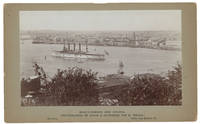
1890LIST110Havana: R. Testar 1890. Albumen photograph on cardstock mount image measuring 7 1/4 x 4 1/2 inches on 8 3/4 x 5 1/2 inch mount. A view of an American warship in Havana harbor likely taken prior to the outbreak of hostilities between the United States and Spain in early 1898. The photographers Leach and Patterson of Calle San Rafael published several views of Cuba at this time mostly of bucolic scenes around Havana and its environs. The American cruiser is similar in design to the U.S.S. Maine with slight differences - two smokestacks instead of three. An excellent example with minor wear to mount and fine image. R. Testar unknown books
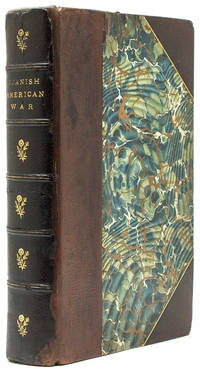
1900300814Albany: Lyon 1900. hardcover. very good. 3 volumes 994 993 969 pages. Thick tall 8vos pale orange cloth with black type; a bit dust-soiled and spines rubbed. Albany: James B. Lyon 1900. First edition.<br/><br/> Lyon unknown books
190020112Washington: Government Printing Office 1900. Folding maps. 8vo. Half burgundy morocco with original maroon spine laid down. Tightly bound else a very good copy. Folding maps. 8vo. Contains among the various reports "Government reports on the Battles and Capitulation of Santiago de Cuba" "Comments of Rear-Admiral Plüddemann on the Main features of the War with Spain" and "Sketches from the Spanish American War."¶ Senate Document 388 with the yellow slip preceeding title regarding the contents. Government Printing Office unknown books
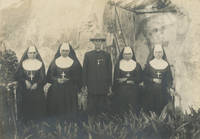
1900List518Most Cuba or Jacksonville 1900. Silver gelatin or albumen photographs various sizes ranging from 3 x 3 to 6 x 8 most captioned to verso. With handwritten manuscript four leaves discussing various diseases. The Spanish-American War was the first war in which nurses formed their own dedicated units as well as the first war in which they were accepted within military hospitals. While no nurses died in battle 153 died during the war from disease. Nurses were responsible for both treating soldiers as well as maintaining sanitary conditions within the camps. Conditions were often poor leading some to work until they were too sick to continue. <br /><br /> The current collection of photographs documents the experiences of a Mrs. Waters who was originally from Groton Massachusetts. The collection begins with a couple early photographs including a portrait as a young woman and a cyanotype of one of Waters' leprosy patients at Johns Hopkins Hospital in Baltimore. The next section shows Waters' training in Jacksonville Florida with either the Fourth or Seventh Army Corps at what was called Camp Cuba Libre both Corps trained there in 1898. The photographs of Jacksonville show life around the military camp and environs with some notable photographs of African-American inhabitants of the region. Three photographs quite notably show the Congregation of American Sisters a small group of American Indian nuns led by Reverend Francis Craft. The photographs taken in Cuba are notable for their portrayal of local life. Several photographs of military installations are taken around the "trocha" or line established by General Valeriana Weyler from Mariel to Majana. Another notable photograph is a cabinet card of a large group of nurses taken by the Havana photographer R. Testar. <br /><br /> The group overall shows very early photographic records of military nurses in training as well as a scarce photographic record from a woman in a combat situation. The photographs are generally well preserved in very good to excellent condition with some light fading. Accompanying the photographs is a four page manuscript essay presumably by Waters discussing leprosy as well as the booklet Spanish Phrase Book for American Soldiers and Sailors published by the National Relief Commission of Philadelphia. <br /><br /> Offered in partnership with Daniel / Oliver Gallery. books
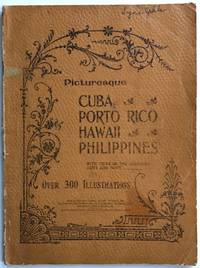
1898535Springfield Oh: Mast Crowell & Kirkpatrick 1898. Good. 121pp. Folio. Original orange printed wrappers. Light wear and soiling spine chipped with some glue repair. Ink ownership inscription at top of front cover. Minor internal soiling several leaves with tape repairs at edges. Extensively illustrated souvenir publication of the Spanish-American War. Images include local street scenes and landmarks photos of the native populations and the American military occupation. "Depicting the natives their costumes habitations and occupations; prominent buildings street scenes mountain and river scenery etc. Also life in the American Army and Navy with portraits of the chief actors in the Spanish-American War. Over three hundred illustrations. Mast, Crowell & Kirkpatrick unknown books
1899613371899. SPANISH AMERICAN WAR. PROCLAMATIONS AND DECREES DURING THE WAR WITH SPAIN. Dept. of State Unites States of America. Washington: Government Printing Office 1899. 8vo. original wrappered pamphlet bound in black cloth-backed marbled paper-covered boards paper labels to spine; 99 pp. Ex-library. Very good. unknown books
1897262561London: Published for the Spanish Atrocities Committee by J. Perry 1897. 23p. stapled wraps 5x7.25 inches wraps lightly foxed bottom edge of front wrap browned staple rusted pp8-17 evenly browned rear wrap lightly silverfished along two edges. Reprinted from "Freedom." On the mistreatment of anarchist political prisoners. Published for the Spanish Atrocities Committee by J. Perry unknown books
1897262648London: Published for the Spanish Atrocities Committee by J. Perry 1897. 23p. stapled wraps 5x7.25 inches wraps lightly foxed staple rusted else good condition. Reprinted from "Freedom." On the mistreatment of anarchist political prisoners. Published for the Spanish Atrocities Committee by J. Perry unknown books
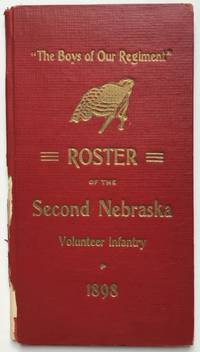
18981081Chattanooga: Times Print 1898. Very good. 29pp. Narrow 12mo. Original red cloth cover gilt. Spine heavily chipped corners worn. Contemporary ownership inscription on front pastedown contemporary notations to several leaves. Regimental roster for the Second Nebraska Volunteers mustered into service for the Spanish American War at Lincoln in May 1898. The regiment consisted of forty-six officers and 975 enlisted men each detailed herein by company. The regiment never saw active duty spending time training at Chickamauga before being transferred to Omaha and then mustered out in October of the same year. This copy with the ownership inscription of Irene G. Courtnay dated September 2 1898. Irene has made notations about several of the men -- presumably friends or acquaintances -- in the Remarks section of some pages. On the page for Company B she has written "Ernest G. Briggs drowned in Chickamauga Creek. 1st death in 2nd Neb. Regiment." Rare and likely produced in limited numbers for friends and family. Only a single photocopy reproduction located in OCLC. An interesting piece of Western Americana from this mostly-forgotten episode in American history. Times Print unknown books
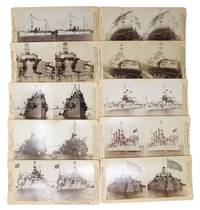
189947820New York / Washington DC: Strohmeyer & Wyman Publishers / J. F. Jarvis Publisher 1899. Peach-colored mounts concave. Versos blank. Images generally clear & sharp with mounts showing just minor wear & soiling. Two Jarvis views with 5 language captions to verso. Old prices penciled to verso upper corner. Withal a Very Good set. Individual domed b/w albumen images mounted side by side. Captioned underneath with publisher & distributer imprints to the view sides. 3-3/8" x 7" <br/><br/>A nice cache of views depicting 8 different vessels from the last turn-of-the-century conflicts: Cruiser Minneapolis Battleship Texas Cruiser New York Massachusetts Battleship Iowa Cruiser Brooklyn Oregon 3 & the Raleigh. Strohmeyer & Wyman, Publishers / J. F. Jarvis, Publisher unknown books
189947201New York: Underwood & Underwood Publishers 1899. Now housed in an archival mylar sleeve. Modest wear & soiling to card. A bit of yellowing to image. A VG example. Stereo image separate domed mounted to stiff-stock concave card. Oblong format: 3-7/16" x 7". Rounded corners. <br/><br/> Underwood & Underwood, Publishers unknown books