Hebrew BibleBiblio.com
26 résultats
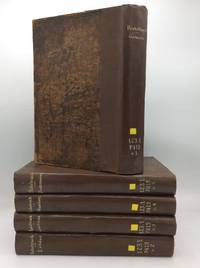
1882317950Vilnius 1882. Leather. Fair. 5 vols. Ex-library; REBOUND. A set of five hardcover books that have been rebound with brown cloth spines retaining the original leather boards and marbled endpapers. Titles and call numbers handwritten on spines; corners visibly rubbed. Boards warped on volumes 4 and 5. Each volume contains the bookplate of the Chicago Theological Seminary plus a card pocket in the back. Pages are deeply tanned and brittle with some edges chipped; title page of volume 1 is detached but present. Bindings are also brittle but remain tight enough for reading purposes. FAIR condition OFFERED AS-IS. The first five books of the Old Testament with all text in Hebrew. Publication information is is Russian. unknown
1825ZB1313772Sulzbach: S. Arnstein & Sohne 1825. Price HAS BEEN REDUCED by 10% until Monday June 29 SALE item approx. 350 pp. contemporary full leather hardcover book plate to the front paste down old ownership markings to the endpapers text age-toned and lightly foxed else good; entirely in Hebrew. - If you are reading this this item is actually physically in our stock and ready for shipment once ordered. We are not bookjackers. Buyer is responsible for any additional duties taxes or fees required by recipient's country. Sulzbach: S. Arnstein & Sohne hardcover
1832131642Imprenta de D. Miguel de Burgos 1832. Leatherbound . Good. Spanish; 728 p. clean and unmarked on strong paper of finest quality only faintly agetoned although with a little foxing on edge blocks; stamp on t.p. of Religiosas Dominicas de Ceinfuegos; marbled end pages; binding firm;though front gutter is cracked; leather boards scuffed and bumped at corners gilt lettering on spine is bright but portions are missing because some of leather has peeled off. Because volume is so fine within rebinding is recommended. Extra postage. Imprenta de D. Miguel de Burgos hardcover
18260731BA. Macintosh et. al. London: . 1826 186p. 24 mo. 120mm. Original straight grained black leather binding broken at rear joint. All edges gold gilt. Small printed label for D. Appleton & Co. New York. Early ms. Ownerships of Jas. Dodd and Joel Parker. Bought by Edwin Wolf II from William Salloch in 1984. The small size of this Hebrew Psalter meant that it could easily fit into a coat or vest pocket and would be always available for consultation. HEBREW BASEMENT. Hardcover. A. Macintosh (et. al.), London: . hardcover
189417549Cincinnati: Robert Clarke & Co 1894. Hardcover. g. 8vo. xxii413pp. Brown cloth with title-plate. Minor chipping to edges and slight abrasion on title-plate. Head and tail of spine slightly chipped. Wear to corners. Slight staining to boards. Decorated endpapers. Small handwritten plate pasted inside front board. Stamp and name of previous owners on blank page following front endpaper. Hinges starting. "Judaism at the World's Parliament of Religions comprising the papers on Judaism read at the Parliament at the Jewish Denominational Congress and at the Jewish Presentation." Binding in good- interior in very good condition. Robert Clarke & Co hardcover
1859220069London ; Edinburgh : Williams and Norgate 1859. First Edition. Hardback. Finely bound in modern leather-backed marbled boards. Gilt-blocked titles to spine with raised bands. Remains particularly well-preserved overall; tight bright clean and strong. Further scans images etc. and additional bibliographical material available on request. ; 8vo 8"" - 9"" tall; 152 pages; Physical description: xxxii 152 114p ; 24cm. Subjects: Bible.O.T. Genesis. -- Criticism interpretation etc. -- Criticism Textual. Old Testament -- Hebrew Language. ""The commentators whose works have been used throughout"": p. ix-x. Language: Hebrew and English. London ; Edinburgh : Williams and Norgate hardcover
184720246Berlin: Friedländersche Buchdruckerei 1847. First edition thus with German commentary. Hardcover. g. 8vo. 6 10pp. 40pp. xiv. 1/4 blue cloth over black paper covered boards. Printed on high quality cotton rag/ Famous work by renowned Medieval Jewish Rabbi Physician and Philosopher Moses Maimonides a.k.a. Ramba"m 1135-1204. Translated from Judeo-Arabic into Hebrew by Rabbi Isaac ben Nathan. This is the first edition with a German commentary: Renowned Orientalist and bibliographer Moritz Steinschneider see below added a summary a linguistic analysis and a thematic analysis in his preface. Age wear to binding with minor browning and foxing throughout. Overall clean and tight. In Hebrew with German preface. Good condition. R. Moses Maimonides Rambam was a 12th century Jewish philosopher and halachic legal scholar. A highly controversial figure both during his lifetime and after his death but generally acknowledged as the preeminent Jewish thinker of the Middle Ages. He was born in Córdoba Spain but fled as a child from the Almohad persecution. He eventually settled in Egypt where he served as a rabbi physician and philosopher. His fourteen-volume Mishneh Torah his only work not in Arabic still carries canonical authority particularly within the Yemenite Jewish community as the codification of Talmudic law. His other work includes a commentary on the Mishnah entitled Kitab al-Siraj Kitab al-Fara'I a book on precepts and the philosophical work Dalalat al-Ha'irin known in Hebrew as the Moreh Nevukhim The Guide to the Perplexed. The major premise is an attempted philosophical/theological reconciliation of the Hebrew Bible and Greek knowledge. This work came to play a central role in all subsequent major controversies over philosophy within the Jewish community during the Middle Ages. On the editor: Moritz Steinschneider 1816 – 1907 was a Bohemian Orientalist and bibliographer. He received his early instruction in Hebrew from Jacob Steinschneider 1782 - 1856 his father who was not well versed in both Talmud and secular science. In order to show the part that Jews had taken in the general history of civilization Kulturgeschichte Steinschneider chose fields unrelated to Jewish religion and theology like mathematics medicine natural history and philology. He was the first scholar to give a systematic survey of Jewish literature till the end of the eighteenth century and to publish catalogues of the Hebrew manuscripts and books which are found in the public libraries of Europe. The Bodleian catalogue was the foundation of his reputation as the greatest Jewish bibliographer. On the author Source: Public Domain: Moritz Steinschneider 1816 – 1907 was a Bohemian Orientalist and bibliographer. He received his early instruction in Hebrew from Jacob Steinschneider 1782 - 1856 his father who was not well versed in both Talmud and secular science. In order to show the part that Jews had taken in the general history of civilization Kulturgeschichte Steinschneider chose fields unrelated to Jewish religion and theology like mathematics medicine natural history and philology. He was the first scholar to give a systematic survey of Jewish literature till the end of the eighteenth century and to publish catalogues of the Hebrew manuscripts and books which are found in the public libraries of Europe. The Bodleian catalogue was the foundation of his reputation as the greatest Jewish bibliographer. Source: Public Domain. Friedländersche Buchdruckerei hardcover
1872AQ21592London: Elliot Stock 1872. iv 204pp. Original publisher's maroon cloth stamped in gilt and blind. Extremities sunned and lightly rubbed. Very occasional light spotting. A complete run of the first 12 issues of a short-lived monthly periodical dedicated to contemporary English members of the Hebrew Christian movement comprised of Jews who had converted to Christianity but worshipped in congregations separate from denominational churches. . Quarto. Elliot Stock hardcover
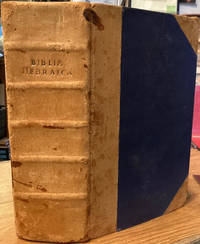
183977139London: James Duncan 1839. Large 8vo. 634 pp. Half light tan leather over navy cloth boards gilt lettering and raised bands to spine; all edges marbled. A little staining and flaking to the leather. Pencil note ink previous owner's name and a few marks to title and prelims otherwise clean with only a few pencil highlights to the text. This edition based as with most others in the 18th and 19th centuries on Van der Hooght's celebrated edition of 1705. . Very Good. Half Leather. 1839. James Duncan 1839 hardcover
1871060590Edinburgh: Edmondson & Douglas 1871. Hardcover. Very Good Plus. 8vo. EDINBURGH : 1871. First published the previous year. Hardback. Red cloth; printed paper-label to spine. Untrimmed edges as issued. Yellow end-papers. No owner name or internal markings. Tight bright and clean. VERY GOOD INDEED. xxxi 156 pages. Index. Will be well-packed for posting/shipping. 8vo. Edinburgh: Edmondson & Douglas. V. SCARCE. <br/> <br/> Edmondson & Douglas hardcover
1860198302London : Walton and Maberly 1860. 2nd edition revised. Hardback. Very good copies bound in contemporary gilt-blocked sand-grained leather. Slight suggestion only of dust-dulling to the spine bands and panel edges. Minor library marks. Remains particularly well-preserved overall; tight bright clean and strong. ; 8vo 8"" - 9"" tall; 1682 pages; Physical description: 2 v. 1682 78p. ; 25 cm. Subjects: Bible. O. T. - Concordances Hebrew. Bible. O. T. - Concordances Chaldee. Notes: Based on the work of William Burgh / edited by George V. Wigram. Lacks introduction xvi pages. Text in double columns. Includes 78-page appendix and index. London : Walton and Maberly hardcover
1831HEBREWBI014067Samuel Bagster London. 1831. Reprint of the 1823 Bagster edition. 12mo. 585 pages. Period binding of full dark green leather with raised bands and gilt decoration to spine gilt rules and blind decoration to covers marbled endpapers all edges gilt. Double-column Hebrew text.Some light spotting to prelims. Very good indeed. A bright copy. Samuel Bagster, London. hardcover
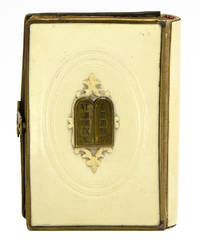
1857311893Vienna: Jos. Schlesinger Library 1857. Text in Hebrew and English. 875 3pp. Thick 12mo. Near contemporary binding of celluloid over cloth with bone and metal decorations and metal clasp. Light surface rubbing to covers text toned. Text in Hebrew and English. 875 3pp. Thick 12mo. Jos. Schlesinger Library unknown
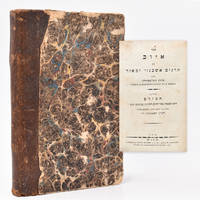
1817353306Vienna: Anton Schmidt 1817. Portrait frontispiece engraved additional title. 8vo. Contemporary quarter calf and marbled boards the calf tooled in blind worn rear hinge cracked lacks rear pastedown frontispiece detached. Portrait frontispiece engraved additional title. 8vo. Includes commentary by Rashi and Beur. Anton Schmidt unknown
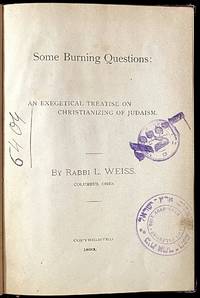
189342957Columbus Ohio: No Publisher The Author 1893. 1st edition. 8vo 87 pages 22 cm. Henry Marcus Leipziger's copy inscribed to him by the author. Singerman 4615. Errata slip tipped in. <br> Henry Marcus Leipziger 1854-1917 was an adult-education pioneer who "traveled to Europe and throughout the western United States examining educational systems. Upon his return to New York City Leipziger established the Hebrew Technical Institute. The Institute's objective was to educate Jewish boys in both intellectual and manual skills. Leipziger acted as director of the school from 1884 to 1891.<br> His papers are held in the NYPL archives. <br> From 1891-2896 he worked for the New York City Board of Education as Supervisor of Lecturers from 1890-1917. As such he organized an extremely popular series of free public lectures. Other positions he held were Assistant Superintendent of New York City Public Schools 1891-1896 Chairman of the Library Committee of Aguilar Free Library now part of the New York Public Library and vice president of the American Scenic and Historical Society.The National Institute of Social Science awarded Leipziger a gold medal for service to the community 1916" NYPL.<br> "Louis Weiss rabbi and scholar was born on February 17 1848 in Kotay Hungary. He received his rabbinical diploma from a school in Grosswardein Hungary. Weiss immigrated to the United States and in Chicago in 1876 he became a naturalized U.S. citizen. He served as rabbi for several congregations in the South and in Columbus Ohio 1894; Hamilton Ontario; Palestine Texas 1903-1905 and Braddock Pennsylvania 1905-1909" americanjewisharchives.org. <br> SUBJECTS: Judaism. <br> OCLC: 2082891. <br> Some wear to cover and spine some notes on second leaf and title page ex library with usual marks. Clean pages. Good condition. SBK AMR-68-4-B-'d. Columbus, Ohio: No Publisher [The Author] unknown
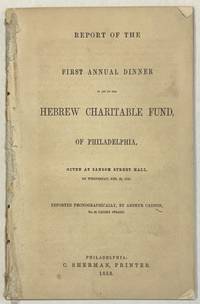
185340496Philadelphia: C. Sherman Printer 1853. 39 1 blank pp. Disbound tiny corner chip at head of title page. Good. Housed in a modern slipcase old bookplate on its front pastedown.<br /> <br /> Philadelphia's Jewish elite supported this organization. Abraham S. Wolf Isaac Leeser Solomon Solis H. Polack and others were the Committee of Arrangements. Funds are desperately required to meet "the many demands caused by the vast number of emigrants who annually land on our shores." The list of donors is 6-1/2 pages.<br /> Non-Jewish participation was substantial. For example former Vice President George Dallas was a conspicuous presence. Toasts patriotic addresses music and overall good cheer characterize the gathering.<br /> Singerman 1302. OCLC 78367144 3- LCP Princeton AJHS 57761577 1- Yeshiva as of October 2024. C. Sherman, Printer unknown
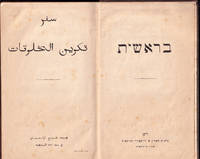
1872056106Vienna Wien: A.Riechert = A. Rikhard ve-Shutafot Beç 1872. 1st Edition . Hardcover. Very Good. 8vo - over 7¾ - 9¾" tall. Original cloth binding with a bilingual title in Hebrew and Ottoman Turkish in Arabic script on the front board and blind-tooled decorations on both boards. Demy 8vo 22 x 14 cm. Text in Ottoman Turkish and Hebrew. 4 176 pp. Cloth slightly faded; foxing to the first and last blank leaves and pastedowns as well as to some margins; hinges slightly split. Overall a good copy. Extremely rare early Viennese edition of this bilingual "Genesis" in Hebrew and Ottoman Turkish one of only three produced by the Adolf Holzhausen Printing House in Vienna a major centre for Hebrew book production in its time. According to the Özege catalogue it represents one of the few bilingual Holzhausen editions. Adolf Holzhausen 1868-1931 was an influential Austrian-Jewish publisher and bookseller notable for his contributions to the world of printing and publishing in Vienna. He was the son of Adolf Holzhausen the Elder 1827-1892 who led the Viennese court and the university's book printing company. Growing up in a family deeply rooted in the book trade Holzhausen received thorough training in the family business; his father had owned the prestigious Manzsche Buchdruckerei Manzsche Book Printing Company since 1858. Holzhausen developed specialized expertise in typesetting and printing of oriental scripts and he supplied his company with carefully crafted oriental typefaces which were highly valued in scholarly and literary circles. Building on this expertise he eventually established his own university book printing company as well as a private publishing house focusing primarily on art books historical works and scholarly publications. Following the upheavals of the First World War Holzhausen was appointed head of the Austrian Military Geography Institute reflecting both his organizational abilities and his intellectual reputation. Beyond his publishing and military contributions he was a strong advocate for collaboration among Austrian educational book publishers promoting greater unity and standards in the production of educational materials. Through his dual roles as a printer and publisher Holzhausen left a lasting impact on Viennese cultural and academic life bridging traditional craftsmanship with modern publishing practices and fostering scholarship in art and history. TBTK 12907. For later edition see Özege 19925. As of March 2026 OCLC lists no copies in a Western library see 236007780 but for the earlier edition 1860 it can be traced only in the Stanford University Cecil H. Green Library see 71019424. <br/> <br/> A.Riechert = A. Rikhard ve-Shutafot, Beç hardcover
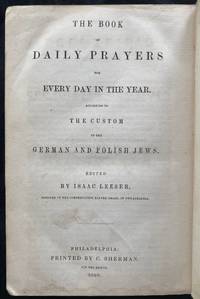
184842797Philadelphia: Printed by C. Sherman 1848. 1st edition original cloth boards 8vo viii pages 243 242 2 leaves; 24 cm. In Hebrew and English. Hebrew and English on facing pages with duplicate foliation. Singerman 1024. Rosenbach 636 Deinard 959 Goldman-Kinsberg 37. Vinograd Philadelphia 18. <br> The first English translation of the Ashkenazi prayer book published in America. “To unite Ashkenazic Jews in America using different prayer books and to provide them with an error-free text Leeser issued this work the first Ashkenazic prayer book published in America"--Goldman 37. <br> During the mid-19th century IsaacLeeser was the most prominent leader of American Orthodox Judaism and his writings show a defense of traditional Judaism against the changes in doctrine proposed by the growing Reform movement. Starting with Jewish publications in the 1830s Leeser is considered to have laid the foundation for a consistent Jewish printing industry in America. “Practically every form of Jewish activity which supports American Jewish life today was either established or envisaged by this one man†Bertram W. Korn “Isaac Leeser: Centennial Reflections†in American Jewish Archives Vol. XIX 1967 page 136.<br> Hebrew text is chiefly after Rabbi Wolf Heidenheim's celebrated Sapha Berurah. The most recent copy offered at major auction sold for $1250 in 2023. SUBJECTS: Siddurim -- Texts. Judaism -- Liturgy. Prayers and devotions. Ashkenazim. Germany. Poland. OCLC: 13891018. Wear on spine and cover spine internally fixed some pencil marks. Good Condition. A nice solid copy in original binding. BK5 AMR-69-3-. Philadelphia: Printed by C. Sherman unknown
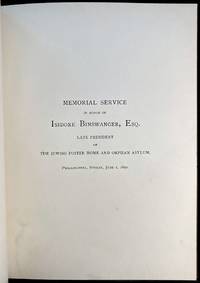
189042371New York: Press of Lehmaier & Bro 1890. paperback. 1st edition. Original publisher’s boards 8vo 39 unnumbered pages 1 photo plate portrait of Rabbi Binswanger. 22 cm. Prefatory poem signed in the print: F. B.i.e. Frances Binswanger. Singerman 4075. <br> Includes excerpts from obituaries that appeared in various periodicals. Isidore Binswanger 1820–1890 was a “U.S. businessman and communal leader. Binswanger was born in Wallerstein Bavaria. He immigrated to the United States in 1841 living first in Baltimore then in Philadelphia and finally in Richmond Virginia. In 1869 he became president of the Richmond Granite Company a position he held until shortly before his death. <br> Binswanger was chairman of the board and later president of the Hebrew Education Society in Philadelphia and president of the board of trustees of Maimonides College Hebrew Education Society. He was also active in various aid societies and helped organize relief measures in the early 1880s for Jewish immigrants from Russia. His three brothers Lewis Samuel and Harry S. settled in Richmond too where they also went into business and were active in local Jewish life†EJ.<br> SUBJECTS: Memorial service. Obituaries. Jews -- Pennsylvania -- Philadelphia -- Biography. Jewish businesspeople -- Service comme´moratif. Ne´crologies. Juifs -- Pennsylvanie -- Philadelphie -- Biographies. Gens d'affaires juifs -- Death and burial. <br> OCLC: 40128020. OCLC and Singerman together list 8 copies worldwide YU Wesleyan HUC HUC-LA Free Lib Phila Temple Penn AJHS only one at any Ivy League institution. <br> Jewish Institutional bookplate on front pastedown bookplate removed from rear pastedown edgewear to blank front endpaper no other marks inside some light wear to boards Very Good Condition B AMR-67-31-RBD!. New York: Press of Lehmaier & Bro unknown
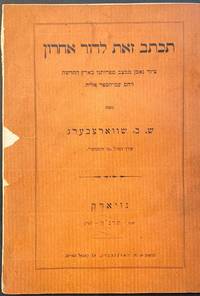
189842441Nuyork New York: Rozenberg 1898. paperback. 1st edition. Original orange printed wrappers 8vo 33 pages. 23 cm. In Hebrew. Title translates as: “Write This For The Last Generation: A Faithful Picture of the State of Our Literature in the New Land and the Attitude of the People of the Book To It.†<br> Extremely critical observations on the state of Hebrew literature and its readership in America by Schwarzberg 1865-1929 a Hebrew publisher and editor in Poland and the U.S. Singerman 5473. Goldman 1110. <br> "Schwartzberg published this pamphlet following the failure of Ner Hamerabi Goldman #908 a Hebrew periodical he edited." In it he “poured forth a bitter complaint against 'the people of the book' for their indifference to Hebrew and its literature . He draws a dark picture of the state of Hebrew culture and literature in this country" Waxman. Goldman notes that the work remains an important source on Ner Hamerabi. <br> “Schwarzberg who was born in Lipno Poland published Hebrew books at the close of the 19th century in Warsaw among them I. L. Peretz' Hebrew poems Ha-Ugav 1894. Arriving in the United States in 1897 he became editor of the Hebrew monthly Ner ha-Ma'aravi which appeared from 1895 to 1897. In 1898 he published a 33-page pamphlet Tikkatev Zot le-Dor Aharon "This Shall be Written for the Final Generation" a scathing attack on the attitude of the Jews toward the new Hebrew literature. <br> He fought Yiddishism and its standard-bearer Chaim Zhitlowsky. He also published a bibliography of the works of Senior Sachs†Eisig Silberschlag in EJ. Deinard 886; AJYB 1930-31 155; Not in Bibliography of the Hebrew Book 1470-1960. SUBJECTS: Hebrew literature Modern -- United States -- History and criticism. Litte´rature he´brai¨que moderne -- E´tats-Unis -- Histoire et critique. OCLC: 649820031. <br> OCLC: 649820031. OCLC lists 5 copies outside of Israel YIVO Am Jewish U Yale HUC YU. Spine rebacked touch of edgewear to orange wrapper which remains bright. About Very Good- Condition. Important. B AMR-67-38-DL-'b. Nuyork [New York]: Rozenberg unknown
18181286051818. HEBREW BIBLE. OTTENSOSSER David. SCHWABACHER Heimann. Kiryah ne'emanah sefer Ezra mit uebersetzung und be'ur von Heimann Schwabacher und David Ottenzosser. Fürth: Isaac ben David Zirndorfer 1818. Small octavo contemporary sheep boards rebacked. $1350.First edition of this Hebrew and German edition of the Book of Ezra prepared and printed by three eminent figures of 19th-century German Jewish scholarship.Uncommon Judeo-German edition of the Book of Ezra offering Hebrew text and a German translation transliterated in Hebrew characters on opposing pages with accompanying commentary. Heimann Schwabacher and David Ottensosser the editors were leading figures of the Haskalahan Enlightenment movement calling for rationality and secular educationin Fürth a major Jewish center with a long history of Hebrew printing. This work was printed by Isaac ben David Zirndorfer sometimes given as Zürndorfer or Zürndorf proprietor of a distinguished Jewish press in Fürth: ""Fuerth a center of Talmudic learning established its first Hebrew presses in 1691. In 1737 Hayyim ben Zvi Hirsch opened a print house in Fuerth issuing some 80-100 Hebrew titles in the next three and a half decades. When Hirsch died in 1772 his widow managed the shop for two years until her marriage in 1774 to Isaac ben David Zirndorfer. Zirndorfer and his family managed the press until 1868"" William Gross for the Center for Jewish Art. Vinograd Furth:726. Pages age-toned binding with expected age-wear edges expertly restored. Scarce. hardcover
1867N4568Vilna 1867. First Edition . Half Leather. Very Good. 8vo. 1867 for the first volume and 1876 for the other 3 volumes. First volume printed by S.I. Fin & a. Zvi Rosenkrantz. 3 other volumes at the printing house of the Widow and Brothers Rom. Some 1200pp for the 4 volumes. THE VOLUMES ARE: 1-LEHRE DER STATIK DYNAMIK MASCHINENKUNDE UND AKUSTIK. 2- BUCH DER CHEMIE 3-BUCH DER WÄRME UND DAMPFKRAFT. 4- BUCH DES MAGNETISMUS- ALL 4 BOOKS IN HEBREW WITH TITLE PAGES IN HEBREW RUSSIAN AND GERMAN. PROFUSELY ILLUSTRATED WITH MANY HUNDREDS OF ENGRAVINGS. ALL VOLUMES BOUND IN MODERN HALF LEATHER BINDINGS WITH MARBLED BOARDS. AN EXTREMELY RARE COMPLETE SET WITH MARVELOUS ILLUSTRATIONS. A VERY GOOD SET <br/> <br/> hardcover
1873140948037Vienna: L. C. Zamarski & C. Dittmarsch 1873. The Babylonian Talmud complete in 24 books bound in 12 volumes. The title page to the first volume is undated but typically dated 1864 in institutional catalogs; the second volume is dated 1866 the last volume is dated 1872 but the last page of the Taharot Vol. XXIV is dated 1873. Tall quarto each volume measuring 14" x 10". Bound in half cloth and paper-covered boards leather spine labels with gilt lettering. Title pages printed in red black yellow and gilt. Very Good overall lots of edge wear with exposed boards chipping toning and wear to spines. Cloth of volume 7 appears to have been inexpertly repaired; binding tape repair to rear hinge. Other than that the bindings are sturdy; contents have a little foxing with age. Occasional marginal notes presumably from either Ernest or Walter Jacob; a few pages of notes in Hebrew laid in as well. <p>This set has a very distinguished provenance: it came from the estate of Walter Jacob a significant leader in Reform Judaism in America author of 43 books and the chief rabbi at Rodef Shalom in Pittsburgh. His father Ernest Israel Jacob 1899-1974 was district rabbi of Augsburg and was deported to Dachau concentration camp for several months after Kristallnacht in 1938; he eventually emigrated to the US. Walter's grandfather Benno Jacob was considered one of the great biblical commentators of liberal Judaism. Ernest Jacob has written a note on the front pastedown of the first volume: "The textual corrections and marginal annotations in this Vienna edition of the Babylonian Talmud are by the late orientalist Samuel Landauer a great Aramaic scholar formally librarian of the University library at Strasbourg Alsace from whose estate I bought this work. Ernest I. Jacob." <p>A lovely 19th century Hebrew edition of the central text of Rabbinic Judaism and the source of Jewish law and theology compiled in the 3rd to 6th centuries in Mesopotamia. <p>International buyers please note: shipping this set outside the United States will require extra charges due to its weight and size. L. C. Zamarski & C. Dittmarsch unknown
183952150Philadelphia: Bagster & Marshall 1839. First American edition. Hardcover. Good . Octavo. 6 10 778pp. Pointed Hebrew text in two columns the New Testament with only vocal marks. Continuous pagination in Arabic numerals; but separate Hebrew pagination for the Old and New Testaments. Contemporary three-quarter calf over pebbled cloth boards; spine with raised bands ruled and lettered in gilt. Decorative endleaves. Covers rubbed with wear at spine caps and corners. Library pressure stamp at title bookplate and pocket at paste-downs. A good ex-library copy with very clean fresh text throughout.<br /> <br /> First American edition of this Hebrew Bible earlier published by Samuel Bagster at London in 1835; it contains the first printing of the New Testament in Hebrew translation to appear in the United States. That translation was prepared by the philologist William Greenfield 1799-1831 the editorial superintendent of the British and Foreign Bible Society and first published by Samuel Bagster at London in 1831 D&M no. 5186. In preparing his revised Hebrew version Greenfield was allowed to utilise the London Jews' Society Hebrew New Testament published at London between 1813 and 1817 D&M no. 5170. Among the earliest publications of the society founded in 1809 this version was itself based upon Elias Hutter's Hebrew translation of the New Testament published at Nuremberg in 1599 D&M no. 5111. Prepared by a group of scholars under the supervision of Thomas Fry and William Bengo Collyer this London Jews’ Society edition employed only biblical words and translated Old Testament quotations from the Greek not citing them directly from the Hebrew Scriptures.<br /> <br /> The editor of the New Testament version in the present work appears to have had a notable gift for languages. William Greenfield began his Hebrew studies as a young man while apprenticed to a bookbinder taking lessons from one of his co-workers a Jew with some learning who had been described as "a reader of the law in the synagogue" ODNB. Greenfield subsequently left the business in 1824 in order to devote himself to languages and biblical criticism. His defence of the Serampore Mahratta version of the New Testament in response to an 1829 article in the Asiatic Journal brought him to the attention of the British and Foreign Bible Society who then hired him to superintend their editiorial department. "During his nineteen months in the society's service Greenfield wrote on twelve European five Asiatic one African and three American languages and acquired considerable knowledge of Peruvian African-English Chippeway and Berber" ODNB. His revision of the Hebrew New Testament earlier published by the London Jews' Society was among the last works he undertook for the British and Foreign Bible Society along with the revision of the Modern Greek Psalter as it went through the press.<br /> <br /> Provenance: Bookplate and other markings including withdrawal stamp of the Library of the Garrett Theological Seminary Evanston Illinois. Full title in Hebrew: ספר הקדש ×•×”×•× ×ª×•×¨×” × ×‘×™××™× ×•×›×ª×•×‘×™× ×’× ×›×ª×‘×™ ברית החדשה × ×¢×ª×§ מלשון ×™×•× ×™×ª ×ל לשון עברית <br /> Philadelphiae: Sumptibus Bagster et Marshall in via vulgo dicta Chestnut Street ad Repositorium Bibliorum Sacrorum etc. quae in linguis antiquis et hodiernis edita sunt. Anno erae Judaicae I rev. C; rev. C DXCIX.<br /> <br /> References: Goldman Hebrew Printing in America no. 6: "This was the first New Testament published in Hebrew in America." ODNB: "Greenfield William" Gordon Goodwin revised by H. C. G. Matthew. J. R. Marcus "Jewish Americana a Supplement to A. S. W. Rosenbach An American Jewish Bibliography" in: Monographs of the American Jewish Archives 1954 no. 1 no. 164. Cf. Darlow & Moule nos. 5111; 5170; 5186. Bagster & Marshall hardcover
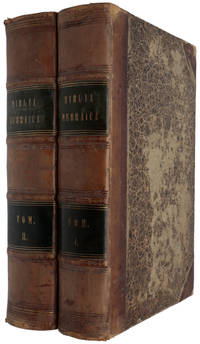
18146255Philadelphia: Printed by William Fry for Thomas Dobson 1814. First edition. <p>First edition of the first Hebrew Bible printed in America - this copy with the extremely rare inserted publisher's notice of February 1814 explaining the genesis of the edition a leaf that Goldman's bibliography of American Hebrew printing records in the Jewish Theological Seminary copy alone. Proposed in 1812 by Jonathan Horwitz an émigré newly arrived from Amsterdam with a font of Hebrew type the project passed early in 1813 to the publisher Thomas Dobson - already famous for the first American encyclopaedia - and the printer William Fry. The text reprints the great Amsterdam tradition of Athias Leusden and Van der Hooght whose 1705 edition was the received Hebrew text of the age printed here without vowel points and aimed at the Christian Hebraists of Harvard and Andover; American Jews continued to import pointed Bibles. It remained the only Hebrew Bible printed in America until Leeser's pointed edition of 1848. Bookseller's ticket of Talbot Watts New York dated March 1847.</p>. The Hebrew Bible Comes to America. <p>First edition of the first Hebrew Bible printed in America - the editio prima Americana of the sacred tongue of major importance in the field of American Judaica - this copy preserving the publisher's inserted notice of February 1814 recounting the genesis of the edition a leaf so rarely retained that Goldman's standard bibliography of American Hebrew printing records it in the Jewish Theological Seminary copy alone and omits it from the collation of the edition. Until these two octavo volumes left William Fry's Philadelphia press no complete biblical text in Hebrew had ever issued from an American press: congregations and colleges alike read from Bibles carried or ordered across the Atlantic. Their publication was the most ambitious Hebrew typesetting yet attempted in the United States and a measure of the standing Hebrew learning held in the early republic - a symbolic weight out of all proportion to the number of its readers. Abraham Karp surveying the Judaic treasures of the Library of Congress singled out the inserted notice as the key document of the edition's history found 'in some of the first copies of the first volume off the press'; the present set is one of the very few in which that first-state leaf escaped the binder's discard. Only one other copy described with the notice has been traced in auction records Philadelphia 2024.</p> <br /> <p>The notice itself dated February 1814 and printed on a single inserted leaf compresses the whole story of the enterprise into four paragraphs. In 1812 Jonathan Horwitz had proposed an edition of the Hebrew Bible 'the first proposal of the kind ever offered in the United States'; clergymen of standing endorsed the undertaking and subscriptions were gathered. Early in 1813 Horwitz transferred his rights and his subscriber list to Thomas Dobson who now reported the first volume published and the second well advanced. The publisher then turned his readers into proof-correctors: gentlemen of learning into whose hands the volume might come were entreated to note typographical errors and transmit their lists to Dobson in Philadelphia so that an accurate table of errata might be printed at the close of the work - a table which the collations of recorded copies suggest was never executed. A final line explains both the leaf's function and its disappearance: the title pages and preface would be furnished with the second volume. The earliest purchasers therefore received volume one as a bare text block this notice standing in for the missing preliminaries; when the second volume appeared with the title leaves and Van der Hooght's preface binders bound the proper preliminaries in and discarded the now-superfluous notice. The variable placement of those preliminaries among recorded copies - the four preface leaves stand at the front of the second volume in another documented set at the front of the first in the present one - is itself a fossil of this two-stage issue. The notice's survival here bound after the first title with the prefatory selections following marks the present set as one assembled from the first copies issued and fixes a terminus for its earliest American owner.</p> <br /> <p>Behind the notice lies a publishing race conducted in the newspapers of two cities. Jonathan Horwitz d. 1852 a Jewish émigré recently arrived from Amsterdam brought with him a font of Hebrew type and the conviction that the United States was ready for its own Hebrew Bible. He was nearly right and nearly first: the New York theological booksellers Whiting & Watson announced a rival Hebrew Bible under the patronage of the Theological Seminary at Andover; the missionary leaders John M. Mason and James McFarlane stood ready to enter the field; and in London Joseph Samuel C. F. Frey - the converted president of the London Society for Promoting Christianity Amongst the Jews - had in 1812 already published the first volume of a vocalized Hebrew Bible for the English-speaking world with rumours that he would cross the Atlantic to distribute it. Horwitz counter-attacked in the New York Evening Post of 16 January 1813 declaring that Harvard College and the Andover Theological Institution patronised his edition and had subscribed for forty copies each. Within weeks however he chose security over glory: he sold his Hebrew type to the printer William Fry made over his publication rights and subscriber list to Dobson and enrolled in the medical department of the University of Pennsylvania taking his M.D. in 1815. He practised medicine for the rest of his life marrying into the family of Haym Salomon the Jewish financier of the Revolution; his son Phineas rose to head the United States Navy's Bureau of Medicine. The Whiting & Watson Bible never appeared.</p> <br /> <p>The men who carried the project to completion were two of the most substantial figures in the Philadelphia book trade. Thomas Dobson 1751-1823 Scottish-born and Philadelphia-established from 1785 had already accomplished the most audacious publishing feat of the young republic: Dobson's Encyclopaedia 1789-1798 the first encyclopaedia published in the United States eighteen quarto volumes re-edited from the third Encyclopaedia Britannica with George Washington among the subscribers. His shop at 41 South Second Street was known simply as the Stone House and the Bible's title page Latinises the address into the imprint: edita ex aedibus lapideis. William Fry a printer praised for the accuracy of his presswork - his former partnership of Fry & Kammerer had printed the elegant 1809 specimen of Binny & Ronaldson the first permanent type foundry in the United States - executed the Hebrew text with the font acquired from Horwitz. Horwitz's prospectus had promised a new pica Hebrew to be cast for the purpose at the Binny & Ronaldson foundry but the type Fry actually employed appears to have been the Amsterdam font Horwitz had carried across the Atlantic: the foundry's surviving papers record only the freight on a parcel of Hebrew type shipped into Philadelphia in 1813 and every contemporary account of the project has Horwitz selling his own font to Fry. The Hebrew of the first American Bible was thus fittingly Dutch metal - cast in the same typographic culture that had produced the very editions the text reproduces. The choice of so compact a programme - the bare consonantal text without the apparatus of points and accents - kept the undertaking within the powers of a shop that had never before set a Hebrew book and the result is remarkably clean: the printer allowed himself a single flourish closing the first volume with the note Placuit Typographo has Deo agere gratias in fine hujus Tomi ex Jes. 40:29 - it pleased the typographer to give thanks to God at the end of the volume in the words of Isaiah.</p> <br /> <p>The text the Philadelphians chose was the most authoritative available anywhere: the Amsterdam tradition running from Joseph Athias through Everardus van der Hooght. Athias c. 1635-1700 the great Sephardic printer of Amsterdam produced in 1659-61 the first Hebrew Bible with numbered verses its proofs read by Johannes Leusden professor of Hebrew at Utrecht; on its completion Athias was admitted to the Amsterdam printers' guild an unprecedented honour for a Jew and the improved second edition of 1667 won him a gold chain and medal from the States General of the Dutch Republic. Long regarded as the most accurate Hebrew text in print the Athias-Leusden Bible became the foundation of virtually all subsequent editions. Everardus van der Hooght 1642-1716 a Dutch Reformed minister - the V.D.M. of the title page - corrected it once more for his Amsterdam and Utrecht edition of 1705 working not from manuscripts but from the printed tradition checked against the Masorah and prized above all for the exceptional clarity of its type. Van der Hooght's became the de facto received text of the Hebrew Bible for a century and a half: Houbigant Kennicott Hahn and Letteris all took it as their base as did the Bible Society editions of the nineteenth century. The 1814 Philadelphia edition declares this lineage on its title page and retains the essentials of Van der Hooght's apparatus in selection: four preliminary leaves headed Everardi van der Hooght ex praefatione selectae in hac editione retentae the Latin marginal annotations keyed to the text and the Masoretic verse-count summaries at the close of each biblical book with their mnemonic signs expounded in Latin notes.</p> <br /> <p>The two volumes carry the traditional tripartite Bible whole. The retained preface opens by expounding the division the volumes follow: the Torah or Law in its five books; the Prophets former and latter from Joshua to the Twelve; and the Hagiographa Psalms to Chronicles with the five scrolls read publicly at the festivals of the synagogue year. Divisional titles in Hebrew and Latin mark the great sections - Prophetae Posteriores announces Isaiah Jeremiah Ezekiel and the Twelve on a separate leaf - and each book runs under bilingual headlines the chapters numbered in roman and in Hebrew letters the text set in single column with Van der Hooght's Latin apparatus in the margins. At the end of each book the Masoretic colophons are reproduced and explicated: the close of Kings gives the count of 1534 verses with its mnemonic the close of Chronicles - and of the whole Bible - the count of 1656 each Hebrew letter-numeral resolved into figures in the Latin notes. These terminal apparatus pages easy to mistake for printer's ornament are in fact the working machinery of textual integrity that the Masoretes had built and Van der Hooght transmitted: a self-auditing text carried intact into the New World.</p> <br /> <p>One deliberate omission defined the edition's audience and its fate. As the title page announces the text is printed sine punctis Masorethicis - without the vowel points and cantillation marks of the Masoretic apparatus. Pointed Hebrew composition in which every consonant carries superimposed and subjacent sorts was beyond the capacity and the budget of the project; the unpointed text halved the difficulty of the typesetting at the cost of presupposing readers who could vocalise Hebrew for themselves - for the points are not ornament but the entire vocalisation tradition of the text fixed by the Masoretes of Tiberias and a bare consonantal page demands that the reader supply from memory what the apparatus would otherwise dictate. The practical consequence was that the first American Hebrew Bible was of limited use to American Jews: a text without points cannot serve the synagogue lectern or the elementary schoolroom and Jewish communities continued to import pointed Bibles from Europe. The book was aimed instead at the Gentile scholars ministers and seminarians whose institutions had subscribed for it - the constituency of the great religious revival then transforming American Protestantism which had made the recovery of the biblical languages an urgent devotional project. The edition thus occupies a curious position in Jewish book history: a Hebrew Bible produced in a land of Jewish refuge initiated by a Jewish immigrant and yet calculated for Christian use - a precise mirror of the state of Hebrew learning in the early republic.</p> <br /> <p>American Hebraism had deep roots but before 1814 almost no Hebrew press to show for it. Judah Monis's Grammar of the Hebrew Tongue Boston 1735 the first book printed in America with substantial Hebrew text had required type procured from London; Monis taught Hebrew at Harvard for nearly forty years and his grammar served as the College's required text. Hebrew figured in commencement exercises at Harvard Yale and Columbia; Ezra Stiles president of Yale made it a personal devotion. The founding of the Theological Seminary at Andover in 1808 institutionalised the revival of biblical philology and in 1813 the year Horwitz surrendered his project Andover's Moses Stuart published the first Hebrew grammar of the independent United States - finding no compositor equal to the task he set much of the Hebrew himself. A legend that the revolutionary generation had considered replacing English with Hebrew as the national language - traced by Shalom Goldman to a passing remark of the Marquis de Chastellux inflated by mocking British reviewers - has no documentary basis but its long circulation testifies to the symbolic standing the sacred tongue enjoyed in a republic that read itself as a new Israel. It was this climate - colleges teaching Hebrew seminaries multiplying a reading clergy hungry for the text in its original - that made a two-volume Hebrew Bible a plausible commercial venture in a country of perhaps three thousand Jews.</p> <br /> <p>Contemporary reception bore out both the promise and the irony. Karp observed that the appearance of a Hebrew work bearing the approbation of leading Christian clergymen and leading Jews alike marked the beginning of a friendlier intellectual discourse between the two communities - a discourse conducted warily since several of the divines most active in promoting Hebrew study were also active missionaries and Frey's conversionist society stood behind the rival London Bible. The standing of the edition among Jewish readers is caught a generation later in the letter of Rabbi Sabato Morais of Philadelphia printed by John Wright in Early Bibles of America: the edition was good the annotations helpful and copious. The endorsement carries its own quiet symmetry - Morais Leeser's successor at Mikveh Israel was a founder of the Jewish Theological Seminary the institution in whose library the one leaf-bearing copy recorded by Goldman now rests. The political setting sharpens the point: at the time of printing fewer than half of the original states extended full political equality to their Jewish citizens. The first Hebrew Bible printed in America thus appeared into a republic that honoured the language of Israel while still hedging the rights of Israelites - and the book itself passing between Jewish projector and Gentile publisher between seminary subscribers and synagogue importers embodies that unresolved moment.</p> <br /> <p>The edition kept its primacy for a generation. No second printing followed; Fry's Hebrew font surfaced only in smaller Philadelphia work; and the next complete Hebrew Bible printed in America - the first with vowel points - came only in 1848 when Isaac Leeser hazzan of Mikveh Israel in Philadelphia and the dominant figure of antebellum American Jewish letters produced his pointed Biblia Hebraica with the Episcopalian Hebraist Joseph Jaquett its Latin introduction dated September of that year. For thirty-four years the Dobson-Fry edition stood alone the only Hebrew Bible printed in America; every American who studied the Scriptures in their original from an American-printed book studied it from these sheets. Bibliographically the edition is anchored in every standard apparatus of the field - Rosenbach's pioneering American Jewish Bibliography Singerman's Judaica Americana Goldman's Hebrew Printing in America Darlow & Moule's catalogue of printed Scripture - and it is one of the few American books of its decade to have earned a separate bibliographical study Vaxer's account in the Journal of Jewish Bibliography for 1940.</p> <br /> <p>Sets of the Bible itself though held by the major Judaica collections - the Library of Congress and the Jewish Theological Seminary among them - appear on the market only at intervals: a recent cataloguer could count just five sets at auction in the preceding decade. The February 1814 notice is of another order of rarity altogether. The leaf was ephemeral by design superseded by the very preliminaries it promised and the bibliographers' collations treat it as a supernumerary survival rather than a constituent of the edition: Goldman's census-level note - locating the leaf in the Jewish Theological Seminary's Karp copy alone among the copies he recorded - remains the standard statement of its scarcity and the single auction copy described with the notice together with the present set brings the number of traceable examples to a small handful. For a collector of American Judaica the distinction is decisive: with the notice the set is not merely the first Hebrew Bible printed in America but a first-state copy carrying the edition's own birth certificate - the document from which every account of the book's genesis from Wright in 1894 to Karp in 1991 ultimately derives.</p> <br /> <p>An early trace of the set's American life survives on the front pastedown of the first volume: the printed ticket of Talbot Watts 'The Cheapest Store in the World' for books prints and oil paintings at 102 Nassau Street New York dated March 1847. Doggett's city directory for 1846-47 lists Watts as an agent for books and paintings at that address in the heart of the Nassau Street quarter that was already New York's second-hand book row; his ticket places the volumes in the New York trade barely a generation after publication circulating among the city's collectors and curiosity buyers while Leeser's pointed Bible was still in preparation.</p> <br /> <p>The two volumes close a circle in the history of the Hebrew book: a text perfected in seventeenth-century Amsterdam by Athias and Van der Hooght carried across the Atlantic in a font of type by an Amsterdam Jew and reborn in Philadelphia as the young republic's first Scripture printed in the original tongue. The line they opened runs forward through Leeser's pointed Biblia Hebraica of 1848 to the whole subsequent tradition of American Jewish Bible publishing and backward to Monis's lonely Harvard grammar of 1735 - the two poles between which this edition stands as the decisive event. Few books document so compactly the moment the Hebrew Bible came to America: the race of projectors fought out in the newspapers the immigrant's font of Dutch type the Stone House imprint rendered into Latin and in the copies issued first a printed leaf asking the learned gentlemen of a young republic to help perfect the word.</p> <br /> <br /> References:<br /> Goldman Hebrew Printing in America 4 - Rosenbach An American Jewish Bibliography 171 - Singerman Judaica Americana 236 - Darlow & Moule 5168a - Shaw & Shoemaker 30857 - O'Callaghan American Bibles 1814:8 - Wright Early Bibles of America 3rd ed. 1894 pp. 122-24 - Wolf & Whiteman The History of the Jews of Philadelphia p. 306 - M. Vaxer 'The First Hebrew Bible Printed in America' Journal of Jewish Bibliography II 1940 pp. 20-26 - A.J. Karp From the Ends of the Earth: Judaic Treasures of the Library of Congress Washington 1991 pp. 291-92 - S. Goldman God's Sacred Tongue: Hebrew and the American Imagination Chapel Hill 2004 - R.D. Arner Dobson's Encyclopaedia Philadelphia 1991.<br /> <br/> <br/> <p>Two vols. 8vo 221 × 139 mm ff. 6 296; 2 312 titles to both volumes dated 1814; the first volume with the inserted publisher's notice dated February 1814 and the four leaves of selections from Van der Hooght's Latin preface bound after the title. Contemporary American half calf over marbled boards smooth spines ruled in gilt with black lettering-pieces 'Biblia Hebraica' 'Tom. I'/'Tom. II'; binding moderately rubbed with loss of leather at the corners and some chipping at the spine ends; scattered foxing and some marginal staining the text generally clean. Printed ticket of Talbot Watts bookseller 102 Nassau Street New York dated March 1847 on the front pastedown of vol. I. Preserved in a custom cloth case with gilt-lettered morocco back.</p> . Printed by William Fry for Thomas Dobson unknown