(Bible New Testament Greek)Biblio.com
17 résultats
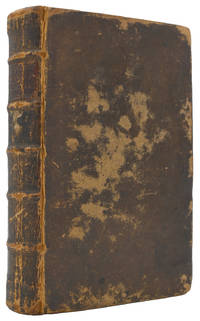
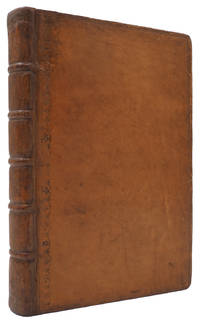
17997575Londini London: Apud G.G. & J. Robinson et al 1799. 12mo pp. 347 1. Half-title discarded. Contemporary sheep spine divided by gilt rules red morocco label edges sprinkled blue. Somewhat rubbed some areas of peeling and insect damage to rear board a little wear to extremities. Ownership inscriptions of Charles Kinloch to first few leaves dated 1802. A scarce London printing of the Greek New Testament: ESTC records just 5 copies. ESTC T176685. Apud G.G. & J. Robinson [et al] unknown
17517788Edinburgi Edinburgh: Apud Tho. & Wal. Ruddimannos 1751. 12mo pp. iv 402 frontispiece. Contemporary calf spine divided by raised bands between double gilt rules red morocco label. Somewhat rubbed joints starting some wear to extremities front flyleaf excised. Armorial bookplate of Sibbald to pastedown struck-through inscription of Charles Sibbald dated 1831 and of Donald Bruce to verso of frontispiece pencil notes to rear blanks. A pocket Greek New Testament printed by the Ruddimans. ESTC T94884; Darlow & Moule 4751. Apud Tho. & Wal. Ruddimannos hardcover
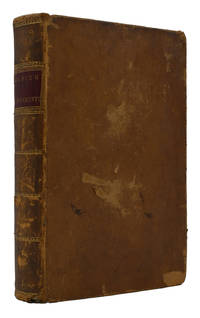
1791402279Etonæ : Excudit T. Pote 1791. Editio altera recognita. Hardcover. Poor copy in the original full aniline calf leather. Spine bands and panel edges rubbed and bumped as with age. Boards worn. Text remains clear and without blemish. Physical description; iv 321 1;249 1 pp. Notes; Greek text with Latin translation each part having separate pagination and register. Subjects; Greek literature. Philosophy. Latin. Translations. Etonæ : Excudit T. Pote hardcover
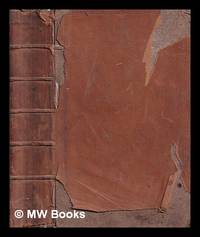
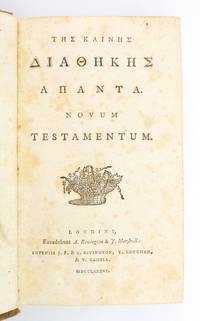
17867475Londini London: Excudebant A. Rivington & J. Marshall 1786. 12mo pp. 368 2 ads. Contemporary sheep spine divided by gilt rolls and rules red morocco label edges sprinkled red. A touch of spotting. Rubbed and a little marked some small sections of leather peeling. A scarce Greek New Testament recorded by ESTC in three North American institutions - Harvard Union Theological Seminary and Tennessee - and one private collection. ESTC N63834. Excudebant A. Rivington & J. Marshall hardcover
179580618AB1795. Vienna Trattnern 1795. 18cm x 12cm. 546 pages plus Appendix with " Lexicon Hermeneutico-Analyticum" 120 unnumbered pages. Original Hardcover in protective Collector's Mylar. Very good condition with only minor external signs of wear. Exemplar von Friedrich Georg Julius Heinrich Freiherr von Lasberg mit seinem Besitzvermerk auf dem Vorsatzblatt. Includes for example the following chapters: De elementis linguae graecae / De Etymologia / De Syntaxi / De Dialectis / De Prosodia / Chrestomathiae Graecae / Lexicon: Hermeneutica - Analyticum in Chrestomathiam Graecam. Provenance / Provenienz / From the library of: Friedrich Georg Julius Heinrich Freiherr von Lasberg 19. Juni 1766 in Braunschweig; 9. März 1839 in Düsseldorf war ein preußischer Offizier und Landrat. Der Protestant Friedrich von Lasberg war ein Sohn des Oberforstmeisters Moritz Franz Adolf Freiherr von Lasberg und dessen Ehefrau Sophia Dorothea geborene von Pestel. 1781 trat er als Fahnenjunker dem Regiment von Wunsch zu Prenzlow bei. Dort wurde er 1786 Fähnrich 1787 Sekondelieutenant 1797 Premierlieutenant und Inspektionsadjutant später Stabskapitän 1800 Wirklicher Kapitän und 1804 noch Major. Nachdem er 1808 aus preußischen Diensten verabschiedet worden war trat er als Bataillonschef in westfälische Dienste wo er 1809 Major sowie 1810 Oberst und Kommandeur wurde. Neben der 1813 erfolgten Beförderung zum Brigadegeneral wurde er zum Gouverneur der Pagen ernannt. Nach der Völkerschlacht bei Leipzig und dem Ende des Königreichs Westphalen trat Lasberg am 13. Dezember 1813 erneut in die preußische Armee ein wo er im Rang eines Obersts und Regimentskommandeurs eingestellt wurde. Mit Allerhöchster Kabinettsorder AKO vom 3. Oktober 1815 pensioniert wurde Lasberg zum 1. Mai 1816 zunächst kommissarisch zum Landrat des Kreises Düsseldorf ernannt seine definitive Ernennung folgte zu Beginn des Jahres 1817. Nach etwas mehr als 21 Dienstjahren wurde er mit AKO vom 27. September 1837 auf eigenen Antrag zum 31. Dezember 1837 in den Ruhestand versetzt den er bereits zum 1. Dezember 1837 antrat. Friedrich von Lasberg heiratete vor 1808 Charlotte Eichler von Auritz November 1772 in Ansbach; 24. Januar 1849 in Düsseldorf Tochter des ehemaligen markgräflich ansbachischen Hofmarschalls Carl Freiherr Eichler von Auritz und dessen Ehefrau Christine geborene Freiin von Remont. Wikipedia hardcover
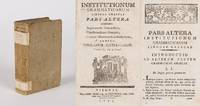
17324237Londini London: Typis Gul. Bowyer; Impensis autem Joh. Osborn & Tho. Longman 1732. 8vo pp. xvi 279 1 1 plate. Contemporary calf boards bordered in blind edges sprinkled red. A few leaves lightly toned one or two rust-marks. Joints expertly repaired boards lightly marked and corners a touch worn. The sole edition of this Greek grammar by George Thompson d. 1739 master of the grammar school at Tottenham High Cross. Thompson is reported to have had assistance from the classical scholar Samuel Patrick 1684-1748 and the antiquary John Ward 1678/9-1758 who had also produced a new edition of Lily's Latin grammar around the same time. Attractively printed by William Bowyer in an edition of 1500 copies with an engraved plate of Greek manuscript ligatures it is now scarce: ESTC locates just four copies in the UK plus two in Europe and three in North America. ESTC T148505. Typis Gul. Bowyer; Impensis autem Joh. Osborn, & Tho. Longman hardcover
1725AQ30436Trajecti ad Rhenum i.s. Utrecht: Apud Guilielmum vande Water et Jacobum van Poolsum 1725. In two volumes. 138 24 903 1; 2 928pp. Titles in red and black. Text printed in double columns. Contemporary gilt-tooled calf marbled edges. Extremities rubbed wear to head and foot of both spines Vol. I without lettering-piece lettering-piece of Vol. II chipped. Ink library stamps and recent bookplates of R. A. Levisson to both FFEPs scattered spotting. The Septuagint or the Koine Greek version of the Hebrew Bible is the earliest translation of the Hebrew Bible into Greek appearing between the first and third centuries before Christ in Alexandria. Embraced by the Catholic Church which includes many of the texts that Reformed churches ignore or consider Apocryphral the authorised Papal version of the Septuagint was first produced in Rome 1587 under the reign of Pope Sixtus V. A direct by-product of the Council of Trent the production of the Septuagint was the suggestion of Cardinal Pole who encouraged making available the Bible in Hebrew and Greek as well as the Latin vulgate in order to counter charges of the Reformers. This edition was compiled by German oriental philologist and reformed theologian David Mill 1692-1756 and was published simultaneously in Amsterdam. Darlow and Moule 4736. First Millius edition. 8vo. Apud Guilielmum vande Water et Jacobum van Poolsum unknown
1725L0823Amstelodami: Sumptibus Societatis David Millius. G : in Good condition without dust jacket. Covers rubbed. Loss to spine leather of volume 2. Occasional slight foxing. 1725. Seventh Edition. Brown hardback leather cover. 170mm x 100mm 7" x 4". 903pp; 928pp. Written in Greek. Bookplate of Montagu Burgoyne. Title page with small woodcut engraving. The second recognised edition from the Vatican in Rome. . Sumptibus Societatis [David Millius] hardcover
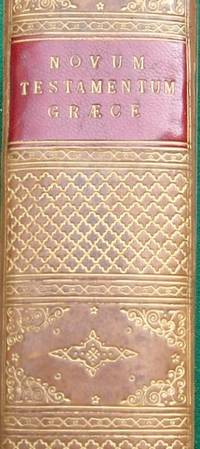
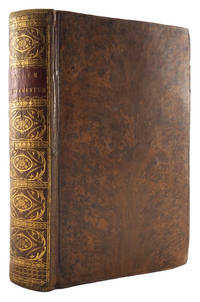
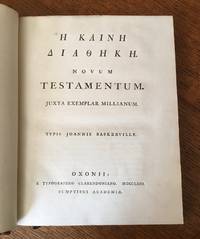
179312481BASKERVILLE'S GREEK TYPE <br />first edition thus in Baskerville type tall 8vo. in fours 676pp. printed on fine ie. thick paper attractive three-quarter sprinkled calf probably nineteenth century smooth spine very richly decorated in gilt in panels of contrasting and alternating design scarlet morocco label gilt marbled paper on sides and as endpapers half-title and last leaf a trifle dusty rear joint cracking else a fine fresh and bright copy. A particularly handsome copy. <br /><br />ESTC t94889 Darlow & Moule 4756<br />Only two books were printed in this type the octavo and quarto Testaments both in 1763. Edited by John Mill. 2000 copies printed. E Typographeo Clarendoniano hardcover
1763DC8_2013e typographeo Clarendoniano sumptibus academiae Oxonii. Clarendon Press Oxford: . 1763 pp. 4 415 1. Small age and damp stains to the first and last 40 leaves or so. Wide margined. Large 4to. 300mm. All edges gold gilt. Early plain full vellum binding. Marbled endpapers. Hand lettered ownership of: J.M Hicks Winton September 1910. Sole quarto printing of the Greek New Testament using Baskerville type i.e. Greek type that Baskerville designed and cut himself. The text follows the 1707 edition by John Mill 1645-1707 with seven variations. This quarto edition was limited to 500 copies and is much scarcer than the 8vo edition issued around the same time. Gaskell - Add. 1; Darlow & Moule 4755. John Baskerville 1706-1775 was the greatest printer of his era. Born in Wolverley Hereford - Worcester England he became a writing master in Birmingham. He also carried on a successful japanning varnishing business there. In about 1750 he began to make experiments in letter founding and produced the wonderful series of types now named after him. His first book the Virgil of 1757 was also the first to be printed upon wove paper manufactured by a process that he invented. In 1758 he became printer to Cambridge University. There he designed other fonts including his remarkable Greek type. All of his books bear the marks of fine craftsmanship and a refined sense of design.PRICE JUST REDUCED! All other examples of this edition are priced on-line at over $1000.00! I held this in my own bible collection since 1995. It is a great bargain. SAFE ADD 1. Hardcover. Very Good. e typographeo Clarendoniano, sumptibus academiae, Oxonii. (Clarendon Press, Oxford): . hardcover
17632548Oxonii Oxford: E Typographeo Clarendoniano 1763. 8vo pp. iv 676. Near-contemporary tree calf spine elaborately gilt in compartments red morocco label marbled endpapers edges yellow. Some light toning and spotting. Expertly rebacked by Bernard Middleton with old backstrip laid down hinges relined. An attractive copy. In 1758 Baskerville proposed the casting of a new set of Greek types to the Oxford University Press and they ordered 2000 copies of this octavo New Testament plus 500 in quarto to be printed with the resulting type - which ended up being its only use. Negative critical reception may have contributed to its abandonment but Baskerville’s Greek face has recently been reassessed by Gerry Leonidas as an important predecessor of more modern types if perhaps not quite as elegant as that used by the Foulis press that had fallen afoul of an arbitrary typographic orthodoxy. Gaskell Add. 2; ESTC T94889; D&M 4756. E Typographeo Clarendoniano unknown
1786ST20133London: Excudebant A. Rivington & J. Marshall: Impensis J. F. & C. Rivington T. Longman & T. Cadell 1786. 175 x 105 mm. 7 x 4 1/4". 368 pp. 1 leaf ads. <br/> Contemporary brown "school cloth" rough linen raised bands. Front flyleaf with owner inscription of John Cutler dated Sept 21 1789 four lines of Latin doggerel threatening anyone who steals the book with hanging and two large copperplate trials of Cutler's signature. ESTC N63834. Not in Darlow & Moule. A little fraying at top and bottom of joints light foxing and toning throughout due to paper quality a couple of small ink stains but a surprisingly appealing copy the text extremely clean and the unsophisticated makeshift binding--remarkably--with no significant wear.<br/> <br/> This is an almost startling survival: an 18th century New Testament in Greek in its original utilitarian binding preserved in condition far better than what could be anticipated given the audience of generally uncareful pupils for which it was intended. Considering the usual depredations of school children the rough school cloth should have been worn to shreds long ago but against the odds it has fortuitously escaped hard use and now gives us a glimpse of an important element of the English schoolroom very close to its original condition. One particularly delightful aspect of our copy is the flamboyant declaration of ownership by a pupil called John Cutter who inked his name no fewer than four times in different styles and with calligraphic flourishes across the flyleaf. Cutter's neatly penned book curse threating any would-be thieves with hanging may have helped to preserve the book as it now exists. In fact there are few signs of use by any owner rightful or unlawful. The leaves are free from any markings and the insubstantial binding appears to have rarely left the shelf. Excudebant A. Rivington & J. Marshall: Impensis J. F. & C. Rivington, T. Longman, & T. Cadell unknown
176310588<p>E Typographeo Clarendoniano. Sumptibus Academiae. Oxonii. 1763. FIRST BASKERVILLE EDITION. 4to in 2's. 12.2 x 9.7 inches. Half title Title page 415pp. One of 500 copies printed using the fine Baskerville Greek type. A clean and crisp copy in a very good contemporary leather binding of full diced dark brown calf boards with floral gilt roll borders. Professionally re-spined at a later date with a matching coloured Morocco spine ruled decorated and lettered in gilt. Board edges ruled in gilt. Marbled endpapers. Gilt inner dentelles. All edges marbled. A small patch of rubbing to the front free endpaper and some rubbing and bumping to the edges but overall a very good copy of this beautifully printed book in an attractive 18th century binding.</p> E Typographeo Clarendoniano. Sumptibus Academiae. Oxonii. 1763 hardcover
1798191868London: Printed for T. Cadell Junior and W. Davies 1798. The official publication of a scholarly pastiche First illustrated edition and the first authorized public one. These fictitious letters describing Athens during the Peloponnesian War were the work of a circle of Cambridge dons and students including the Bluestocking Catherine Talbot 1721-1770 who is named in the author key to this edition. Athenian Letters names more than one prominent female letter-writer from antiquity real and fictive. The work's instigators Philip Yorke second Earl of Hardwicke 1720-90 and his brother Charles 1722-70 are pictured in the frontispieces. The first edition of 1741 consisted of 12 copies followed by 100 in 1781 and a pirated edition. 2 vols quarto 274 x 212 mm pp. lxii 2 436; xv 1 466. Portrait frontispieces to each volume 12 engraved plates of busts folding map. Contemporary tree calf flat spines divided by gilt rolls blue and green labels central gilt tools to compartments green edges. Contemporary booklabels of Fasque the Gladstone family home. Head caps a little worn and split spines rubbed a few patches of stripping corners worn minimal foxing. A very good set. ESTC T84382. unknown
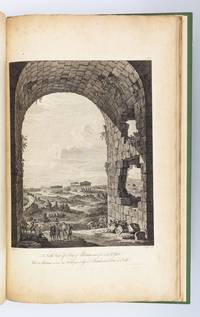
1768ST17496-011London: Chez l'auteur 1768. First Edition in French. 590 x 380 mm. 23 1/4 x 15". 52 2 pp. <br/> Modern brown quarter morocco over green linen boards brown morocco label with gilt lettering on smooth spine edges untrimmed. WITH 25 FULL-PAGE ENGRAVED PLATES OF GRECIAN RUINS and seven smaller engraved plates in text including one on dedication page. A Large Paper Copy. Fowler p. 157; Millard British 41; Blackmer 1065; Brunet III 1329. Head of spine partly torn but with no loss contents with not infrequent light marginal soiling though plates uniformly clean other minor imperfections but an excellent copy with greatly generous margins with deep impressions of the type and with strong impressions of the plates.<br/> <br/> This work is the first significant account of the ancient city of Paestum being in the words of Blackmer "larger and much more complete than any of the previous publications." Located in the Tyrrhenian Sea off the coast of southern Italy Paestum or Poseidonia in Greek was founded by Greek colonists in the sixth century B.C. and still contains beautifully preserved ruins from that period including temples an amphitheater and painted tombs. Abandoned in the Medieval period Paestum wasn't rediscovered by the West until the 18th century with the first modern publication of the site not appearing until 1764 when a suite of plans by G. P. M. Dumont appeared with no text based on the observations of Jacques-Germain Soufflot. As Millard indicates the genesis of the present publication has an extremely complex history we do not even know with certainty who wrote the text but we do know that engraver Thomas Major 1729-99 whom DNB calls "the first great English landscape engraver" was responsible for preparing the plates. Because he had no first-hand knowledge of the site Major relied on images by other artists including Antonio Joli Gaetano Magri Robert Mylne and Jacques-Germain Soufflot. The text was first published in English and then in French the same year. According to Fowler "this work . . . was an important eighteenth-century pioneer contribution to the knowledge of Greek architecture in England"; and Millard tells us that "the book was surprisingly well received by reviewers" in both England and France remaining "the standard reference to Paestum until 'Les Ruines de Paestum ou Posidonia' by C.-M. Delagardette was issued in 1798.". Chez l'auteur unknown
1758ST17496-017Paris: H. L. Guerin & L. F. Delatour Jean-Luc Nyon and Jean Neaulme 1758. FIRST EDITION. 608 x 445 mm. 24 x 17". xiv 56; 2 vi 28 pp. Two parts in one volume. <br/> Later early 20th century quarter sheep over marbled boards raised bands compartments gilt reddish-brown leather label with gilt lettering all edges untrimmed. With large woodcut vignette on title and 60 ENGRAVED PLATES by Le Bas Littret de Montigny Neufforge and Patte after Le Roy. Brunet III 103; Millard French 101. A little rubbing to corners and head and tail of spine leather a bit faded chafed and freckled in places but the binding entirely sound and still quite pleasing; very faint diagonal crease at lower corner of many leaves a handful of plates slightly browned one more noticeably so other minor issues but quite a fine copy internally--the vast majority of the contents clean and bright with deep impressions of the text with the engravings richly impressed and with vast margins.<br/> <br/> With engravings by the some of the most esteemed artists of the day this imposing work contains beautiful depictions of Greek ruins and monuments that proved extremely influential to the development of French Neoclassical architecture. The text is divided into two parts the first covering the history of various monuments and Le Roy's thoughts on the principles of architecture and the second primarily containing a discussion of the orders of columns--particularly the Doric order--as well as several reconstructions of ruined temples. According to Millard this work "breaks new ground in providing a synthesis of archaeological findings with a body of architectural theory developed and expanded from the important controversy of Claude Perrault and Francois Blondel i.e. quarrel of the Ancients and the Moderns. . . . Perhaps most important Le Roy's treatise provides the theoretical framework and many of the actual models for French neoclassical architecture." Although "Les Ruines" came under some criticism especially by British rivals James Stuart and Nicholas Revett it nevertheless "made a strong public impact" in the words of the Dictionary of Art Historians and "greatly influenced the architects of the day particularly Jacques-Denis Antoine Jean-Arnaud Raymond Alexandre-Théodore Brongniart and François-Joseph Bélanger." This was in no small part due to the exquisite plates that included many picturesque views engraved by talented artists such as Louis-Joseph Le Lorrain Pierre-Charles Le Mettay Claude-Antoine Littret de Montigny and Jacques Philippe Le Bas among others. The son of the horologer to Louis XV Julien-David Le Roy 1724-1803 was an architect art historian and archaeologist. He was a protégé of Jacques-François Blondel 1705-74 whom he later succeeded as professor at the Académie Royale d'Architecture. After winning the Prix de Rome in 1754 Le Roy spent time in Greece studying and measuring ancient architecture and developing many of the theories that he would eventually publish in the present work. H. L. Guerin & L. F. Delatour, Jean-Luc Nyon, and Jean Neaulme unknown
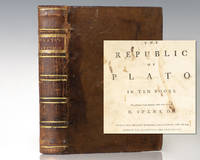
1763138322Glasgow: Printed by Robert and Andrew Foulis 1763. First edition in English of Plato's Republic marking the first appearance in the English language of Plato's profoundly influential dialogue concerning the nature of justice. Quarto bound in full polished calf with raised gilt bands to the spine morocco spine label lettered in gilt all edges speckled red. Harry Spens was a minister at the parish of Wemyss in Fife and respected classicist. In his introduction he professes his intent in his translation is: "To give the English Reader a view of Plato's sentiments and manner of writing and to stir up the youth to the study of the Ancients." Richard Garnett in his own introduction of the Everyman's Library reprint of this translation laments the relative lack of critical attention paid to it writing: "On the whole Spens's version should not be lightly esteemed. It is clearly the work of a scholar and a man of considerable literary ability." The brothers Robert and Andrew Foulis were renowned printers of classical works in their time sometimes referred to as 'the Elzevirs of Britain.' Their works mostly intended for scholars were "much sought after as admirable specimens of typography and are noticeable for their severely plain elegance" DNB 7: 514. In very good condition. Rare and desirable. "Its setting and its characters are full of political meaning. Its arguments are tantalizing and its fables fascinating… Plato's utopia is alarming and his metaphysics are intoxicating" Levi 348. The Republic "has reinforced dedication awakened vocations to leadership and strengthened the morale of those modest and competent souls who are always in reality the guardians of society" Rexroth 79. Printed by Robert and Andrew Foulis unknown