77 résultats
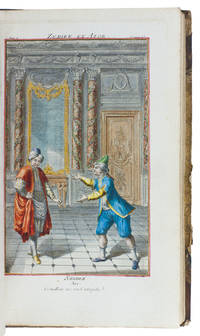
1783B63912PQHN58Amsterdam 1783. 8vo. Jan Helders Abraham Mars Contemporary half calf gold-tooled spine with one brown and a green morocco title label lettered in gold and fleurons in the remaining compartments sprinkled paper sides. With an engraved title page including a vignette by H.L. Meyling a letterpress title page with an emblematic engraved vignette by Reinier Vinkeles. Extra added in this copy are an additional letterpress title page also dated "1783" but with a portrait of Pieter Pijpers engraved by Theodorus Koning dated 1789 accompanied by the letterpress explanatory leaf with a poem "Op myne afbeelding door Theodorus Koning" dated 1789 signed by Pijpers in brown ink. Further with 3 extra added engraved plates 2 full-page and 1 half-page plus 1 repeated in an earlier state with no lettering depicting scenes from the play by various Dutch artists A. Fokke H.L. Myling W. Immink A. Hulk Jacobsz 1 dated 1784. And finally with 6 engraved plates by various French artists made for the original French edition. The engraved title is richly coloured and highlighted with gold incl. the lettering by a contemporary hand. The 6 French plates are splendidly coloured and highlighted with gold and gum arabic by a contemporary hand. 16 76 2 pp. Splendid copy luxuriously extra-illustrated 5 years after the original publication of the first edition of Pijpers's Dutch adaptation of Marmontel's 1771 Zémire et Azor a version of the fairytale Beauty and the beast. It is signed in brown ink by the author and on the last page by G. de Visscher one of the delegates of the Amsterdam theatre as a warrant of authenticity with the privilege to the printers Helders and Mars dated "Amsteldam den. 6 Augustus 1783". STCN notes that some copies like ours have 2 additional folia: an illustrated typographical title page with Pijpers's roundel portrait on a monument dated "1783" in letterpress but the engraving itself dated 1789 and a poem by Pieter Pijpers entitled "Op Myne afbeelding" dated 1789. Apart from these extra leaves our copy is embellished with 6 plates with scenes of the play from the original French edition of Marmontel's play published in Paris 1771 here all beautifully coloured and with 3 extra plates by Dutch artists probably made to illustrate a third edition; a second edition appeared in 1786.Zémire and Azor was a comic opera in 4 acts composed by the Belgian composer André Grétry with a French text by Jean François Marmontel 1723-1799 based on Jean Marie Prince de Beaumont's 1756 La belle et la bête and P.C. Nivelle de la Chaussé's 1742 Amour pour Amour. The opera was first performed on 9 November 1771 stayed in the French repertory until at least 1821 and enjoyed worldwide success. The story unfolds as follows:After being shipwrecked the "Persian" probably Armenian merchant Sander and his servant Ali find themselves in a strange palace. A banquet has been laid though there is no sign of the owner and the two help themselves to the feast. When Sander plucks a rose from the palace garden to give to his daughter Zémire the beast-like Azor appears. He is the owner of the palace and says Sander must pay with his life for stealing the rose unless he can persuade one of his daughters to take his place. When she hears what has happened Zémire agrees to sacrifice her life for her father and Ali leads her to the palace where she almost faints at the fearsome sight of Azor. However Azor proves to be a kind host showing Zémire her family in a magic mirror and even allowing her to visit home again so long as she promises to return. After a stay with her family Zémire decides to return to Azor and finds him in despair because he believes she has abandoned him. She protests that she cares about him and the magic spell on Azor is lifted now he has found love. He changes from a beast to a handsome prince and claims his kingdom with Zémire at his side.The Dutch poet and playwright Pieter Pijpers 1749-1805 from Amersfoort was a Roman Catholic in the Dutch Patriot party. He had to flee to Belgium after the Patriots' failed Democratic revolution of 1787 but was awarded many high positions after the Batavian revolution of 1795. He devoted himself to his literary work at his mansion Puntenburgh at Amersfoort.With the circular morocco bookplate of P. May with his interlaced monogram in gold and the blind stamp of a private Dutch collection on the endpapers.With generous margins and many deckles intact. In very good condition with only occasional very minor spotting and a water stain in one of the blank guard leaves protecting the coloured plates. Corners bumped and back board rubbed. Desirable extra-illustrated Dutch Beauty and the beast incorporating lavishly coloured Dutch and French plates.l Van Aken Cat. Ned. Toneel II p. 351 mentioning only a title vignette; Moderne Encyclopedie van de Wereldliteratuur vol. 7 p. 239; STCN 8 copies only 3 with engr. title. unknown
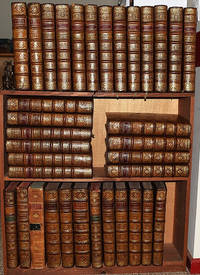
17512605210193Chez Briasson David Le Breton Durand A Paris; Amsterdam 1751 - 1777 1751. First Edition. Hardcover. Very Good. 0x0x0. The Organization of Enlightenment Thought: The Revolution in Ideas. A first edition of this foundational encyclopedia of 18th century knowledge. A massive thirty-five volume set. Large folios volumes 39.5 x 25 cm. Bound in 18th-century French calf. Spines gilt with raised bands. One volume non-uniformly bound in light calf. <br> The set includes: Encyclopedie Paris: 1751-57 & Neuchatel 1765. 17 volumes; Recueil de planches. Paris: 1762-72. 11 volumes 1 2 part I 2 Part II 3 5 6 7 8 9 10 11; Supplement a l'Encyclopedie. Paris & Amsterdam: 1776-77. 5 volumes including the Suite de recueil de planches; Table Analytique. Paris: 1780. <br> Profusely illustrated with engraved plates. <br> Diderot's famous Encyclopedie was initially a modest translation of Chambers's Cyclopaedia. It grew as a project into a massive project which attempted to collect human knowledge from a rationalistic perspective instead of by nature or theology. In organizing knowledge from a position where human reason was paramount the supremacy of the Church was imperiled. As a result the Encyclopedie was widely controversial and placed on the Index Librorum Prohibitorum by the Catholic Church. In discussing fundamental philosophical issues such as on political authority and natural rights articles in the Encyclopedie shifted the basis of governmental authority from the divine right of Kings to radical concepts popular consent was the basis of legitimacy and the ideals of a social contract. The work was banned by the King of France. It spread the foundational ideas of the French Revolution and enlightenment thinkers. "No encyclopaedia perhaps has been of such political importance or has occupied so conspicuous a place in the civil and literary history of its century. It sought not only to give information but to guide opinion." "It was a war machine; as it progressed its attacks on both the church and still more on despotic government as well as Christianity itself became bolder and more undistinguished and it was met with persecution and opposition unparalleled in the the history of encyclopedias." - Encyclopedia Britannica 11th ed p. 1483. "A monument in the history of European thought; the acme of the age of reason; a prime motive force in undermining the ancien regime and in heralding the French Revolution" Printing in the Mind of Man 200. Refs: Grolier/Horblit 25b; Norman 637; PMM 200. <br> Includes: 17 v. : ill. ; 41 cm. supplement 4 volumes plates 11 volumes plates supplement 1 volume. Table Analytique 1 volume. This is an oversized or heavy book which requires additional postage for international delivery outside the US. Chez Briasson, David, Le Breton, Durand, A Paris; Amsterdam (1751 - 1777) hardcover