Guy de MAUPASSANTBiblio.com
109 résultats
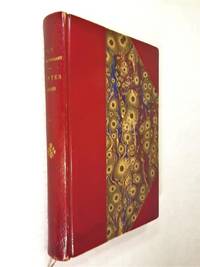
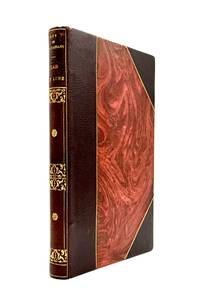
188487507Paris: Monnier 1884. Fine. Monnier Paris 1884 15.50 x 23.30 cm relié First illustrated edition published in the same year as the original duodecimo. The collection contains 12 short stories each illustrated with a wood engraving headpiece by a different artist: Gambard Jeanniot Merwart Le Natur Adrien Marie Myrbach J. Roy Grasset Arcos Renouard Tirado Rochegrosse in addition to a frontispiece and the illustration on the front cover. Contemporary burgundy half-shagreen binding with corners. Smooth spine decorated with 4 complex tools and 2 fleurons fillet lines on boards and corners. Top edge gilt. The covers have been preserved without the spine. Fresh throughout with occasional light foxing here and there. Spine sunned. Light traces of rubbing. Fine copy. Monnier hardcover
1886LS030520Librarie Illustree Paris 1886. Hardcover. Very Good. Librarie Illustree Paris no date ca. 1886. 8vo in 1/2 red straight grain goatskin on marbled boards. 278 pp. Nicely bound by renowned French Art Nouveau bookbinder Emile Carayon. This is number 9 of 25 copies printed on Japan paper. 118 illustrations by Pierre-Georges Jeanniot. Bound with original wraps; original spine bound in at rear. Edge wear to boards; corners worn; spine ends lightly worn. Faint stain along bottom edge of front board and spine. Binding is strong. Text block is tight. Light soiling to top of text block; other edges clean. Text and illustrations are pristine: no foxing; no writing or markings of any kind. Ships wrapped in bubble wrap and packed securely in a box. Librarie Illustree, Paris hardcover
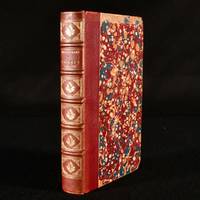
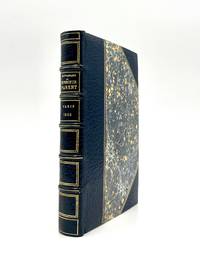
1900810J7Paris: Societe d'Editions Litteraires et Artistiques c1900. Fine Binding. Very Good Indeed. 7.5" by 5". Not Stated. A handsomely bound copy of this collection of short stories written by noted French author Guy de Maupassant the children's edition of this work. An engaging collection of tales from the acclaimed 'father of short stories' Guy de Maupassant. Comprising thirty-six short stories including 'Le Garde' 'Le Retour' 'Mon Oncle Jules' 'A Cheval' 'Aux Champs' and more. Guy de Maupassant was a French nineteenth-century short story writer who subscribed to the Naturalist school which depicts of humanity and destiny often employing a pessimistic tone.The children's edition of this work.In the original French.Including a preface by M. Marcel Prevost. Handsomely bound in quarter morocco with marbled boards and gilt detailing to the spine. Handsomely bound in quarter morocco with marbled boards and endpapers and gilt detailing to the spine. Externally very smart with some fading at the head of the boards and very light rubbing to the head and tail of the spine. Internally firmly bound. Pages are slightly age-toned to the extremities as is usual and a small handling mark to the title page otherwise pages are clean throughout. Very Good Indeed Societe d'Editions Litteraires et Artistiques unknown
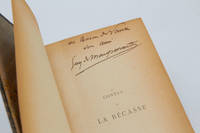
188387740Paris: ED. Rouveyre et G. Blond 1883. Fine. Guy to his Bel-Ami ED. Rouveyre et G. Blond Paris 1883 12 x 19 cm relié First edition no grands papiers deluxe copies printed. Half brown sheepskin spine with four raised bands framed in blind and decorated with gilt floral motifs some rubbing to the spine marbled paper boards marbled paper endpapers and flyleaves modest contemporary binding. Rare signed and inscribed copy by Guy de Maupassant to the Baron de Vaux who inspired the character of Bel-Ami: To Baron de Vaux / his friend / Guy de Maupassant. Maupassant and De Vaux knew each other from their time working at the newspaper Gil Blas where more than half of the short stories in Contes de la bécasse were published. The baron occupied the first office on the left as you entered. The main piece of furniture was the divan. When pretty visitors came to see him he would ostentatiously bolt the door Armand Lanoux Maupassant le Bel-Ami. This scandalous character and former cavalry officer wrote sports articles and front-page reports for Gil Blas which he signed Le Diable boiteux after Lesage's famous character. In the same year he gifted him this copy of Contes de la bécasse Maupassant dedicated to De Vaux the short story Un Sage published in a December issue of Gil Blas. The Baron de Vaux was one of the main inspirations for Georges Duroy the famous character from Bel-Ami: de Vaux had invented his title and had become an important man on the Boulevard. A specialist in horse riding shooting and hunting regular of the Café des Variétés he was the baron of blackmail' he knew all the scandals in Paris. He published a short study on weapons which Guy de Maupassant also prefaced. The baron described Maupassant himself as 'first-rate at cane and boxing tireless in this exercise for which his Herculean muscles are wonderfully suited' Armand Lanoux. A fine token of friendship from Maupassant to the baron of blackmail a member of the colorful and boastful crowd of Gil Blas and model for Bel-Ami. ED. Rouveyre et G. Blond hardcover
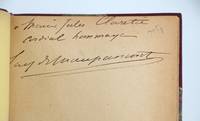
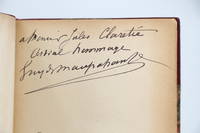
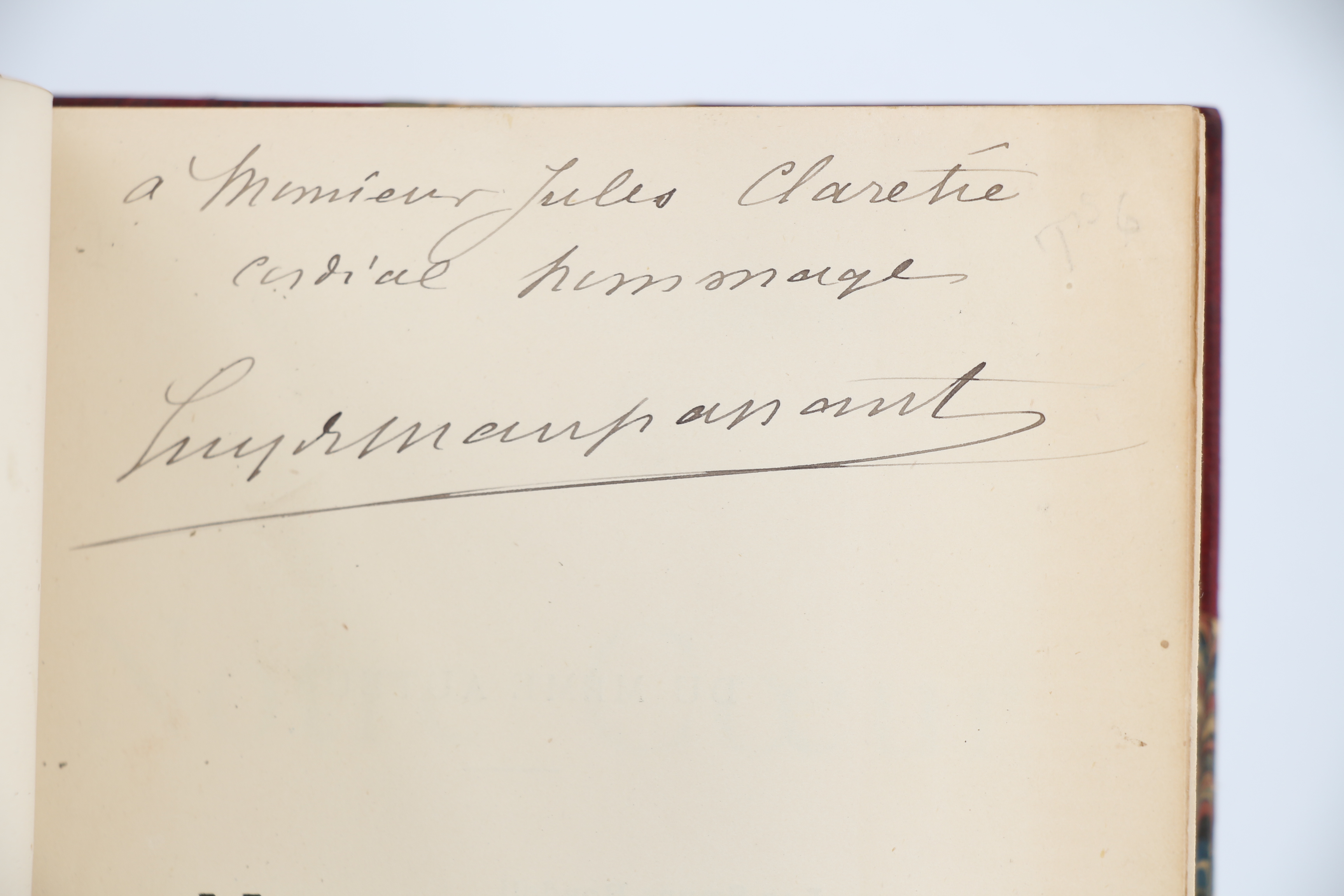
188987434Paris: Paul Ollendorff 1889. Fine. Paul Ollendorff Paris 1889 11.50 x 18.50 cm relié First edition on ordinary paper. Half red morocco binding with corners smooth spine spine in five compartments with black fillets gilt date at foot marbled paper boards combed paper endpapers and pastedowns original wrappers preserved one small stain and two tiny lacks at foot of first cover top edge gilt binding signed Gruel. Precious autograph inscription signed by Guy de Maupassant: « À monsieur Jules Claretie cordial hommage. Guy de Maupassant» To Monsieur Jules Claretie cordial tribute. Guy de Maupassant. Autograph inscriptions on the first edition of this text are rare especially in elegant contemporary signed bindings. A great admirer of his work the chronicler novelist and playwright Jules Claretie sponsored Maupassant's admission to the Société des Gens de Lettres on March 3 1884. Maupassant gave Claretie no fewer than nineteen copies of his works in first edition with autograph inscriptions Thierry Selva Maupassant par les textes. In his famous Parisian chronicles Claretie published these beautiful lines in tribute to his esteemed colleague: « J'aimais ce robuste au verbe clair. D'autres l'ont mieux connu : personne ne l'a plus admiré. C'était un classique » I loved this robust man with clear speech. Others knew him better: no one admired him more. He was a classic La Vie à Paris 1897. Paul Ollendorff hardcover
188987739Paris: Paul Ollendorff 1889. Fine. Paul Ollendorff Paris 1889 13.50 x 18 cm relié First edition one of 100 numbered copies on Holland paper the only deluxe copies after 5 Japan. Half-title and final endpaper pages entirely sunned handsome copy. Jansenist binding in full chocolate brown morocco spine with four raised bands set with black fillets and decorated with six black compartments septuple black fillet frame on covers tawny watered silk endpapers and pastedowns quadruple gilt fillet frame on pastedowns original wrappers preserved all edges gilt elegant binding signed Gruel. Handsome copy perfectly executed. Paul Ollendorff hardcover
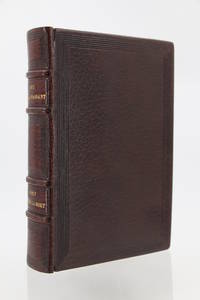
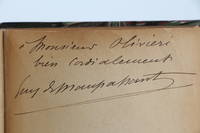
188980256Paris: Paul Ollendorff 1889. Fine. Paul Ollendorff Paris 1889 11.50 x 18.50 cm relié First edition printed on ordinary paper. Half green morocco-grained shagreen binding smooth spine decorated with a gilt cartouche adorned with cold arabesque set with dots and gilt fillets gilt friezes at head and foot marbled paper boards combed paper endpapers and pastedowns top edge gilt on deckled edges original wrappers preserved contemporary binding. Autograph inscription signed by Guy de Maupassant to Monsieur Olivieri. Provenance: from the library of the Count de Keller with his bookplate bearing the motto ""Vaillant et veillant"" pasted on the front pastedown. Paul Ollendorff hardcover
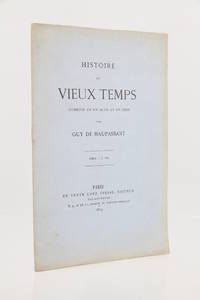
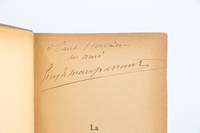
187986301Paris: Tresse 1879. Fine. Tresse Paris 1879 14.50 x 22 cm broché First edition of Guy de Maupassant's first work. Covers slightly and marginally lightened as usual two discoloration marks on the back cover. A handsome copy in its original wrappers. Tresse unknown
189039284Paris: Victor-Havard 1890. Fine. Victor-Havard Paris 1890 12 x 19 cm relié Original edition on the current paper. Binding bronze half calf smooth back guards and contreplats of handmade paper preserved cover elegant binding pastiche signed P. Goy & C. Vilaine. Signed autograph of the author Bookseller Achilles Heymann. This bookseller was ""one of the most picturesque types of Paris. . All birds . students sometimes even literate came to consult this man who knew all of the library the book he was reading or at least bought. "" G. Baume In the land of letters 1922. Maupassant did was not wrong as he says in the letter to Henry Kistemaeckers of 7 May 1882 ""I answer for sale at the Bookstore New You will see the 3 employees are called Achilles Heymann Ménard and. Reboul . It is essential . to provide a copy to each . - I'll go to the library to write a word for each of them - in this one house has sold 900 copies of La Maison Tellier. No newspaper is used as the three advertising. "" Victor-Havard unknown
188988827Paris: Paul Ollendorff 1889. Fine. Paul Ollendorff Paris 1889 12 x 19 cm relié First edition on ordinary paper with a mention of the fourth edition. Bradel binding in green almond half percaline smooth spine slightly faded and decorated gilt fillet at foot brown shagreen label marbled paper boards original wrappers preserved extremities very slightly rubbed contemporary binding. Inscribed and signed by Guy de Maupassant to Paul Hervieu.  Paul Ollendorff hardcover
189365535Paris: Paul Ollendorff 1893. Fine. Paul Ollendorff Paris 1893 12 x 19 cm relié First edition one of 10 numbered copies on Japon the tirage de tête after 5 Chine. Half morocco covers preserved binding signed by Thomas Boichot. A nice copy elegantly bound. Paul Ollendorff unknown
1895feb36535Paul Zsolnay 1895. Used. 1895; Romanian Edition of La vie errante; For more details please contact me Paul Zsolnay unknown
189030364Paris: Paul Ollendorff 1890. Fine. Paul Ollendorff Paris 1890 15 x 19 cm relié First edition one of 100 numbered copies on Hollande paper the only large paper copies along with 5 on Japon. Elegant brown morocco by G. Levitzsky spine in six compartments gilt roulettes to head- and tail-pieces date at foot of spine double gilt fillets to edges of covers pastedowns with a frame of dentelles and quintuple gilt fillets marbled pastedowns and endpapers covers and spine preserved top edge gilt. Cover illustrated by Riou. A very good copy in a handsome binding. Paul Ollendorff unknown
188787433Paris: Paul Ollendorff 1887. Fine. Paul Ollendorff Paris 1887 11.50 x 18.50 cm relié First edition on ordinary paper. Contemporary binding in half red morocco with corners spine with five raised bands framed with black fillets gilt date on tail marbled paper boards bouquet-patterned endpapers and pastedowns original wrappers and spine preserved small angular restoration to the foot of the first board gilt head. Binding signed by Léon Gruel one of the most renowned bookbinders of the late 19th century. Le Horla consists of thirteen short stories: Le Horla Amour Le Trou Sauvée Clochette Le Marquis de Fumerol Le Signe Le Diable Les Rois Au bois Une famille Joseph L'Auberge and Le Vagabond. Precious signed and inscribed copy by Guy de Maupassant: « À monsieur Jules Claretie cordial hommage. Guy de Maupassant ». To Mr Jules Claretie with my warmest regards. Guy de Maupassant' Autograph inscriptions on the first edition of Le Horla are particularly rare especially in signed contemporary half-marocco bindings. Only fourteen copies have been recorded by Thierry Selva Maupassant par les textes. A great admirer of Maupassant's work the critic novelist and playwright Jules Claretie sponsored his admission to the Société des Gens de Lettres on March 3 1884. Le Horla was published during the height of public interest in theories of hysteria and personality disorders. Both Maupassant and Claretie attended the lessons and hypnosis sessions of Doctor Charcot at the Salpêtrière hospital whose influence can be found in Le Horla and many of Maupassant's fantastic short stories. Claretie himself explored similar themes in his 1885 novel Jean Mornas depicting a crime committed under hypnotic suggestion and later in L'Obsession: Moi et l'Autre 1908 which tells the story of a painter suffering from a split personality. In 1892 as Maupassant succumbed to syphilitic madness under the care of Dr. Blanche Claretie immediately thought of Le Horla. He reopened his copy and examined the eerie connection between the writer and his work in an article for the North American Review: And while I am reading over this 'Horla"" to seek there for the trace to find there the premonitions of the misfortune that has overwhelmed M. de Maupassant I cannot keep from seeing him again revolver in hand in the room at Cannet trying to escape by suicide from that other Horla whose sinister approach he felt ; the mania of persecution. The Shudder in Literature' August 1892 English-speaking readers discovered Le Horla in 1890 Harpers & Brothers trans. Jonathan Stuges which would be H.P. Lovecaft's main inspiration for his famous Call of Cthulhu. On the writer's death Claretie once again dedicated some superb lines to him in his Parisian columns. One can easily imagine Claretie rereading the pages of this copy offered by the author contemplating the tragic fate of a genius whose illness eerily mirrored the hallucinations of Le Horla's narrator: ""I know of nothing more heartrending than this end at the height of his powers this sorrowful death in the prime of youth. One could have foreseen it perhaps guessed it this obsession with madness in such a poignant study as Le Horla - in such tales where the shudder of the unknown and the vertigo of fear run throughout. What a study of physiological literature for Arvède Barine who was already studying disease in Poe and Gérard de Nerval! Was it overwork or heredity that doomed the poor admirable Maupassant Was he the victim of his artificial life as a socialite or of his solitary reveries n this contrast of existences which part became the morbid one"" La Vie à Paris 1897. This masterpiece through its precious autograph dedication brings together two leading literary figures of the 19th centuryboth fascinated by the fantastic and the limits of human perception: ""I admired this man of robust clear prose. Others knew him better but no one admired him more. He was a classic."" Paul Ollendorff hardcover
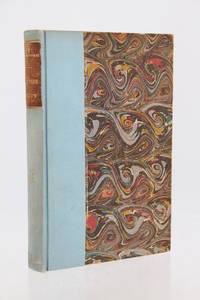
189985403Paris: Paul Ollendorff 1899. Fine. Paul Ollendorff Paris 1899 12 x 18.50 cm relié First edition on ordinary paper. Bradel binding in half sky-blue cloth smooth spine slightly faded decorated with gilt floral motif date and double gilt fillets at foot brown shagreen title-label with scratches marbled paper boards contemporary binding. Paul Ollendorff hardcover
188440652Paris: Paul Ollendorff 1884. Fine. Paul Ollendorff Paris 1884 12 x 19 cm broché First edition. Authorial presentation inscription signed by Guy de Maupassant to Monsieur Amaury Renoul manager of the Librairie Nouvelle located at 15 boulevard des Italiens. The back room of this celebrated Parisian bookshop served as a literary salon frequented by many of the capitals foremost artistic and intellectual figures. Spine slightly cocked joints rubbed otherwise a very good copy in its original condition. Amaury Renoul 1837-1898 was one of the most prominent men of letters in late nineteenth-century Paris. He was notably acquainted with Flaubert. Maupassant presented him with at least three inscribed works between 1884 and 1886. Paul Ollendorff unknown
188053303Paris: Charpentier 1880. Fine. Charpentier Paris 1880 12 x 19 cm relié First edition an ordinary paper copy. Contemporary green half shagreen marbled paper boards spine with five raised bands and gilt flowers speckled edges. With the autograph signatures of every author of the ""Médan group"" involved in the writing of this famous collection of short stories: Guy de Maupassant Emile Zola Joris-Karl Huysmans Léon Hennique Paul Alexis and Henri Céard on the first endpaper. A very good and rare copy in a strictly contemporary binding. This true manifesto of Naturalism that constitutes Les Soirées de Médan is composed of six short stories: ""L'Attaque du moulin"" by Émile Zola ""Sac au dos"" by J.-K. Huysmans ""La Saignée"" by Henry Céard ""L'Affaire du grand 7"" by Léon Hennique ""Après la bataille"" by Paul Alexis and of course ""Boule de Suif"" by Guy de Maupassant qualified as a masterpiece by Gustave Flaubert. Charpentier hardcover
188274155Bruxelles Brussels: Henry Kistemaeckers 1882. Fine. Henry Kistemaeckers Bruxelles Brussels 1882 10.50 x 16.50 cm relié First edition. Work illustrated with a frontispiece portrait of the author etched by Just. Bradel binding in half dark blue morocco with corners smooth spine date gilt at foot marbled paper boards pebbled paper endpapers and pastedowns covers and spine preserved top edge gilt bookplate pasted at head of one pastedown elegant unsigned binding. Handsome copy attractively bound. Henry Kistemaeckers hardcover
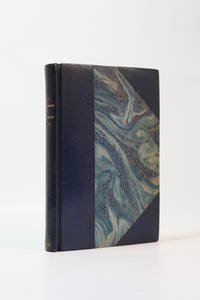
188686327Paris: Paul Ollendorff 1886. Fine. Paul Ollendorff Paris 1886 11.50 x 18.70 cm relié First edition on ordinary paper of this collection containing 17 short stories. Only 10 copies were printed on Holland paper separately. 20th century half navy morocco binding with corners. Spine with raised bands decorated in compartments. Double fillet on boards. Top edge gilt. Original covers and spine preserved. Contents: M. Parent La Bête à Mait' Belhomme A vendre L'Inconnue La Confidence Le Baptème Imprudence Un Fou Tribunaux rustiques L'Epingle Les Bécasses En Wagon Ca ira Découverte Solitude Au Bord du lit Petit soldat. Armorial bookplate: Pierre Latrobe. French writer who died in 1967. Handsome copy. Paul Ollendorff hardcover
188744878Paris: Victor-Havard 1887. Fine. Victor-Havard Paris 1887 11.50 x 18.50 cm relié First edition on ordinary paper. Contemporary half cloth adorned with arabesques over marbled paper boards spine with gilt fillets and olive-green shagreen title-piece repair to edges marbled pastedowns and endpapers one lower corner rubbed. Autograph inscription from Guy de Maupassant to monsieur Caron. Victor-Havard hardcover
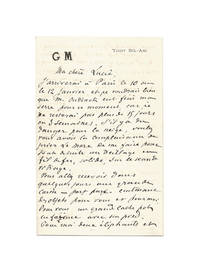
1886Maupassant4<p><strong>MAUPASSANT de Guy 1850-1893</strong></p><p>Autograph letter signed " Guy " to his cousin by marriage Lucie Le Poittevin<br />Antibes or Cannes late 1886 or early 1887 2 p. small in-8° in black ink<br />Letterhead " GM – Yacht Bel-Ami "<br />Tiny tear on central fold</p><p><strong>Nice unpublished letter from the writer enriched with an amusing signature</strong></p><p><em>" Ma chère Lucie</em><br /><em>J'arriverai à Paris le 10 ou 12 janvier et je voudrais bien que M. Oudinot</em>¹<em> eut fini ma serre</em>²<em> pour ce moment car je ne resterai pas plus de 15 jours ou 3 semaines. S'il y a du danger pour la neige voulez-vous avoir la complaisance de prier Le Mare de me faire pour tout de suite un treillage en fil de fer solide sur le second vitrage.</em><br /><em>Vous allez recevoir dans quelques jours une grande caisse – port payé – contenant des objets pour vous et pour moi. Pour vous un grand cache pot en faïence avec son pied. Pour moi deux éléphants</em>³<em> et quatre plaques de faïence.</em><br /><em>Nous avons ici un temps superbe le jardin plein de fleurs de roses d'anémones de narcisses ; et je préfère cela au grand froid et à la neige de Paris.</em><br /><strong><em>Je navigue beaucoup je fais de l'escrime avec rage je marche je me livre donc à tous les exercices sauf à …. l'affection. Mais je m'en passe.</em></strong><br /><em>À Bientôt ma chère cousine excusez moi si je vous écris si court et si peu mais vous savez que mes yeux ne me permettent guère ce genre de sport</em> one of the symptoms of his syphilis diagnosed in 1877 and which would continue to poison him.<br /><em>Je vous embrasse à la barbe de Louis dont je serre la main. </em><br /><em>Votre Cousin </em><br /><strong><em>Guy dit Capitaine Tellier</em></strong><br /><strong><em>Com</em></strong><strong><em>áµ—</em></strong><strong><em> le Bel-Ami</em></strong><br /><strong><em>Bateau Poisson</em></strong><br /><strong><em>B</em></strong><strong><em>ᵗᵉ</em></strong><strong><em> S.G.D.G</em></strong>â´<em> "</em></p><p>1 Camille Oudinot playwright and novelist was a close friend of Maupassant. The latter dedicated to him his short story <em>Le Parapluie</em> published in 1884.</p><p>2 It involves the construction of a greenhouse in La Neuville-Chant-d'Oisel. Jules de Maupassant Guy's paternal grandfather a storekeeper at the tobacco obtained a 130-hectare plot of land in the same town on which as if to ensure symmetry with the Château du Chant d'Oisel he had a residence erected in 1835. Several members of the Maupassant and Le Poittevin families are buried there.</p><p>3 The "two elephants" in question were possibly meant to decorate the entrance above the pillars of his residence "La Guillette" in Étretat.</p><p>4 While the surnames that Maupassant attributed to himself allude to two of his most famous works a contemporary letter to the Countess Potocka dated December 15 1886 sheds light on the double meanings of his signature:<br />" The <em>Bel-Ami</em> his boat is a sea fish as its name suggests: and it dances while embarking its owner a real cancan of a barrier ball. He and I are at this moment in the port of Cannes where a violent blow of the mistral southern wind of the French Riviera threw us the day before yesterday and where we remain blocked. I hope to get back on track tomorrow morning if the wind allows it. Since I have been in command of this symbolic boat I have taken the name of Captain Tellier an allusion to his short story <em>La Maison Tellier</em> ".<br />As for the acronym "Bté SGDG" Bréveté sans garantie du gouvernement the same occurrence is found in <em>Bel Ami</em> Romans ed. Forestier Pléiade p. 368.</p><p>A cousin by marriage of Maupassant Lucie Le Poittevin born Ernoult was the daughter of a rich banker from Rouen. She married the painter Louis Le Poittevin son of one of Flaubert's closest friends in Rouen. Maupassant's first cousin and confidant the latter dedicated his short story <em>L'Âne</em> published in 1883 to him.</p><p><u>Provenance:</u><br />Private collection</p>
189087435Paris: Paul Ollendorff 1890. Fine. Paul Ollendorff Paris 1890 11.50 x 18.50 cm relié First edition on ordinary paper. Half red morocco binding with corners smooth spine spine with five raised bands set with black fillets gilt date at foot marbled paper boards combed paper endpapers and pastedowns original wrappers preserved first cover restored and lined small corner lacks to second cover top edge gilt binding signed by Gruel. Precious autograph inscription signed by Guy de Maupassant: « À monsieur Jules Claretie cordial hommage. Guy de Maupassant» To Monsieur Jules Claretie cordial tribute. Guy de Maupassant. Autograph inscriptions on the first edition of this text are rare particularly in elegant contemporary signed bindings. A great admirer of his work the chronicler novelist and playwright Jules Claretie sponsored Maupassant's admission to the Société des Gens de Lettres on March 3 1884. Maupassant offered Claretie no fewer than nineteen copies of his works in first edition with autograph inscriptions Thierry Selva Maupassant par les textes. In his famous Parisian chronicles Claretie published these beautiful lines in tribute to his esteemed colleague: « J'aimais ce robuste au verbe clair. D'autres l'ont mieux connu : personne ne l'a plus admiré. C'était un classique » I loved this robust man with clear speech. Others knew him better: no one admired him more. He was a classic La Vie à Paris 1897. Paul Ollendorff hardcover
189056348Paris: Paul Ollendorff 1890. Fine. Paul Ollendorff Paris 1890 13 x 19 cm broché First edition one of 150 numbered copies on Hollande the only deluxe issue copies after 5 on Japon. A very fine copy as issued with an important manuscript document by Elme-Marie Caro 1 page in ink on a double leaf undated 1887 . Maupassant's last novel Notre Coeur is also one of his most autobiographical. The writer was strongly influenced in this piece by famous literary and artistic ""Salons"" held by high society women which he frequently attended. The novel confronts a man of letters with one of these strong-headed women of late 19th-century Paris. He describes the main character Michèle de Burne as ""a woman of refinement of indeterminate sensibility restless without fixed resolves her feelings in constant turmoil who seemed to have made it part of her experience to employ every narcotic that quiets the aching nerves: chloroform that stupefies ether and morphine that excite to abnormal reverie kill the senses and deaden the emotions"" Maupassant sketches the fictional portrait of Countess Potocka to whom he was one of the most fervent suitors called ""Macchabées"" or ""morts d'amour"" according to the rules of the literary game created in her famous Salon. He paints the picture of his unrequited love through this modern liberated although oppressive woman who only finds pleasure in the enslavement of her lover. Our copy exceptionally contains a precious ""Convocation extraordinaire du Club des Macchabées"" an amusing original document written by philosopher Elme-Marie Caro. Countess Potocka is referred to in the document as ""the Patroness Head of the Executive and Decorative Power of the Macchabees"" and the list of her suitors ""specially and ex officio summoned without procrastination or apology"" includes some of the Countess's Salon regulars: Clovis Bachelier Adrien de Montebello Olivier Taigny and Dubois were members of the administrative committee painters Jean Béraud and Henri Gervex represented the art world and writers Georges Legrand Elme-Marie Caro and Gustave Schlumberger the literary world. The ""President"" of this society is none other than famous actor Coquelin aîné member of the Comédie française. Although he does not appear on this invitation Maupassant played a major role in this infamous group as ""Perpetual Secretary of the Permanent Council of the Club des Macchabées"". A precious document bearing witness to the fascinating Countess who inspired Maupassant Marcel Proust for his Duchesse de Guermantes and Aimé Guerlain who created for her his Shore's Caprice perfume. Paul Ollendorff unknown
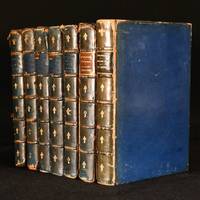
1900882T65Paris: Societe d'Editions Litteraires et Artistiques c1900. Leather. Good Only. 8.5" by 5.5". None. A collection of works from 19th-century French author Guy de Maupassant in the original French language. French language. Fourteen volumes in seven. Written by Henri René Albert Guy de Maupassant a 19th-century French author celebrated as a master of the short story as well as a representative of the naturalist school. A protégé of Gustave Flaubert his stories are characterized by economy of style and efficient seemingly effortless dénouements. This set includes: Mademoiselle Perle L'Heritage Le Vagabond Le Vorrou Boule de Suif Ce Cochon de Morin Hautot Pere et Fils Mouche La Femme de Paul Le Vieux Le Pere Amable Le Pere Mongilet L'Auberge Le Champ d'Oliviers Bound in full blue calf. Externally worn with rubbing resulting in light loss to the extremities. Fading to the spine and the odd mark to the boards. Loss of the spine labels to most volumes. Cracks to the joints with some boards held by cords only. Hinges starting to most volumes. Internally firmly bound. Pages are bright with light age toning to the extremities. Sympathetic repairs made with brown paper tape to the front endpaper and title page of Le Pere Amable. A tear across the half title of L'Auberge. Good Only Societe d'Editions Litteraires et Artistiques hardcover
189018273London: George Routledgeand Sons Ltd 1890. hardcover. Very Good. Ernest Duez & Albert Lynch. 12mo half-bound in leather with marbled boards and raised bands on spine top edge gilt corners and edges rubbed translated by Hugh Craig a novel 36 illustrations 339 pages George Routledgeand Sons Ltd hardcover