4 résultats
169771837xxx 1697. Piel epoca. Octavo. xxx unknown
1700314595Geneva: Vincent Miege 1700. hardcover. very good. 4 197 2 pages. Slim 12mo handsomely bound in older 3/4 calf over marbled boards. Engraved device on title and some engraved headpieces and initials. Geneve: Vincent Miege 1700. Nouvelle Edition. A very good copy with some light scattered foxing.<br/> <br/> Vincent Miege unknown
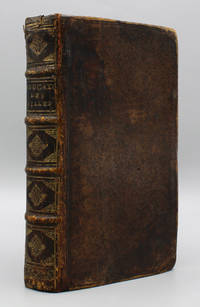
168712094<p>A Paris: Chez Pierre Aubouin Pierre Emery et Charles Clousier… 1687 First edition mixed issue of Fénelon's 1651-1715 most important book. This copy has no errata as is the case with first issue copies according to Tchermerzine. It follows Tchermerzine's description of the second issue with p. 167 line 20 having the reading "sans vivre de son esprit" . However it has the errors on p. 275 "manifiques" and "simplieté" as does the first issue. Both O4 pp. 167-8 and pp. 275-6 Z3 are on stubs. . Contemporary calf gilt-decorated spine. . Twelvemo. Spine ends corners lightly worn. Some light browning but generally a very good copy. Instructions for the Education of a Daughter was "…the first systematic attempt ever made to deal with that subject as a whole. Hence it was probably the most influential of all Fénelon's books and guided French ideas on the question all through the 18th century. It holds a most judicious balance between the two opposing parties of the time. On the one side were the précieuses enthusiasts for the 'higher' education of their sex; on the other were the heavy Philistines so often portrayed by Molière who thought that the less girls knew the better they were likely to be. Fénelon sums up in favour of the cultivated house-wife; his first object was to persuade the mothers to take charge of their girls themselves and fit them to become wives and mothers in their turn" Encyclopedia Britannica 13th edition. "Il faut considérer outre le bien que font les femmes quand elles sont bien élevées le mal qu'elles causent dans e monde quand elles manquent d'une education qui leur inspire la vertu. Il est constant que la mauvaise éducation des femmes fait plus de mal que celle des hommes puisque les désordres des hommes viennent souvent & de la mauvaise éducation qu'ils ont receüe de leurs mères & des passions que d'autres femmes leur ont inspirées dans un âge plus avancé. Quelles intrigues se presentent à nous dans les Histoires quel renversement des lois & des moeurs quelles guerres sanglantes quelles nouveautez contre la religion quelles révolutions d'Etat causées par le déreglement des femmes! Voilà ce qui prouve l'importance de bien élever les filles" pp. 7-8.</p> Chez Pierre Aubouin, Pierre Emery et Charles Clousier…
169930837Bruxelles Fr. Foppens 1699. Small 8vo 12mo. Bound in a beautiful later full calf ca. 1800 w. five raised bands on back. Gilt back and blindstamped ornamental borders on boards. All edges of boards gilt and gilt borders on inside of boards. Hinges cracked and boards loosening inner hinges crudely repaired. A bit of brownspotting but internally a very nice copy. <br/><br/><em>The very rare Bruxelles-edition published same year as the first edition Paris Barbin. Fénelon's main work written when he was a tutor to the Duke of Burgundy in order to hold up Ulysses as an example for the young prince. Fénelon was a leader of the Quetism heresy and in 1699 the year Télemaque appeared Pope Innocent XII condemned his writings. The true first edition of Fénélon's Télemaque appeared in one volume in 1699 under the title "Suite du quatrième livre de l'Odyssée d'Homère ou les Aventures de Télémaque fils d'Ulysse" and containing only half of what we consider Télémaque today. According to Brunet the first edition was suppressed and Moetjens printed a pirate-edition called the second edition in Haag with the same year and date June and a bit later the same year the second part appeared. Several editions appeared the same year and Brunet mentions one without printer or Place but Paris and the Liége- and Bruxelles-editions. "Dans les différentes éditions que nous venons de décrire dans lesquelles il le soit sont celles de LIÉGE 1699 et de BRUXELLES FR. FOPPENS même date l'une et l'autre impr. en France en 2 vol. in-12 et en dix livres." Brunet II:1212. Foppens also printed an edition in Bruxelles 1700 but that is divided into 16 books. All early editions of this work are scarce and the first edition is almost impossible to get a hold of. This main work of French literature has been printed numerous times after the author's death 1715 and editions printed before his death are a great rarity. The later editions were corrected and divided into numerous books not intended in the original manuscript."Une autre circonstance allait aggrever la situation de l'archevêque de Cambray. Peu de temps après sa condemnation parut le livre qui l'a rendu le plus populaire et qui après la "Bible" et l'"Imitation de Jésus-Christ" est un de ceux qui ont eu plus d'éditions: "Les Aventures de Télémaque". N.B.G. 17:328. The controversial but highly popular work was among other things accused of satirically portraying Louis XIV and thereby publicly humiliating him -this was probably not the intention but there is no doubt that the work was critical towards the reigning regime and put forth many ideas not previously heard of. In true utopian political manner Fénélon warns against overgrowth of the metropolis and preaches groundbreaking doctrines like free trade international arbitration etc. He actually foresees the French Revolution as a result of the flourishing despotism so visible in France at the time. Lamartine in his "Life of Fénélon" describes the saintly poet as the first Radical and the first communist of his century though not to his own knowledge and he directly traces the Utopias which produced the revolutions of 1793 and 1848 to his groundbreaking work "The Adventures of Telemachus". Especially the part "Voyage en Salente" is considered very important for the study of utopian literature but the entire work is characterized by the attempt to represent people as they might have behaved and might still be were they governed by sages and saints and according to the laws of God. The work represents a religious ideal where God is always higher than man; it is greatly political greatly influenced by the appreciation of ancient Greek life and is designed to evoke the feeling of honour responsibility and religion in the young prince. See Brunet II: 1210-1212. Graesse 2:563-64 Paris- and La Haye-editions. </em> hardcover