42 résultats
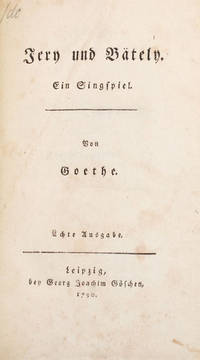
179029497Leipzig: Georg Joachim 1790. Hardcover. Very Good. Doedecimo under 6" - 7". 134pp A very good copy rebound in imitation tree calf. A very good copy in boards. <br/><br/> Georg Joachim hardcover
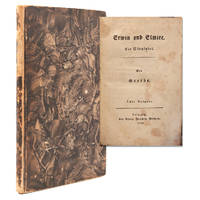
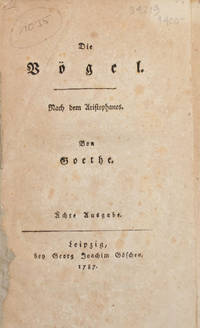
178724373Leipzig: Goschen 1787. First Edition. . Paperback. Good. 8vo. rough early modern paper covers 64pp edges roughly cut <br/> <br/> Goschen paperback
179000002809Leipzig: Georg Joachim Goschen 1790 134 pages paper backstrip worn missing pieces blue paper wrappers previous owner's signature on front cover some foxing stains on endpages. German. Georg Joachim Goschen paperback
18003371Berlin: Johann Friedrich Unger 1800. Book. Good. Papered Boards. 16mo - over 5¾" - 6¾" tall. 464 pages one illustration. Front cover detached 3 old church library stamps and old spine number. The illustration family tree of Cagliostro is printed on 2 leaves. Appears to be a second printing of this edition. Pagination jumps from page 258 to 359 which means that there are actually only 364 pages. Johann Friedrich Unger Hardcover
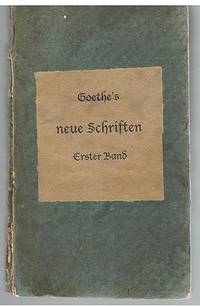
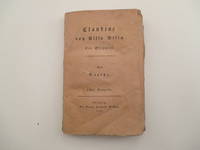
1790D4342Leipzig: Georg Joachim Goschen 1790. Achte Ausgabe. Paperback. Good. Wraps; pp. 1 56. Covers faintly water-stained; spine chipped with signatures exposed; text block a bit browned and brittle. <br/><br/> Georg Joachim Goschen paperback
1799mon0003597477Braunschweig: Friedrich Vieweg 1799. Hardcover. Good. . Plain boards with heavy wear and rubbing some loss at the corners and spine ends joints starting. Clipped ffep. With engraved frontispiece and 9 copperplate engravings. Pages with light foxing a small amount of underlining and marks in the margins. German language text. Braunschweig: Friedrich Vieweg hardcover
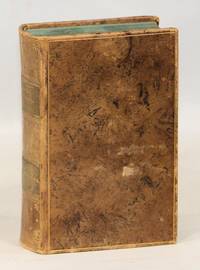
1794000016418Berlin: Johann Friedrich Unger 1794. Later edition. Hardcover. Very Good. Small 8vo. 7 6-491 3 pp. Later full sheep with a gold border on each board spine in five compartments with two brown leather labels lettered in gold gold tooling on the spine; all edges green. Marbled endpapers and pastedowns. The second book in what was a set of Goethe's literary works. The first set of Goethe's complete works was published during the latter half of the eighteenth century this edition followed a few years later. A bookplate on the front pastedown a small private stamp on the title page leaves lightly foxed. Johann Friedrich Unger hardcover
179817073AB1798. Berlin 1798. 165 : 105 cm. 176 pages. Contemporary boards with marbled paper. Reprint in the year of the first edition. -This epic was Goethe's biggest success in the book trade during his lifetime. - Some foxing. hardcover
1788D7155Leipzig: Georg Joachim 1788. First issue of this edition. Hardcover. Near Fine. Straight-grain brown morocco ornately ruled in gilt lettering and ornate details gilt-stamped in spine compartments 5 raised bands inside gilt dentelles a.e.g. moire endpapers; 16mo 90 x 150 mm; pp. 2 126. Spine just a little sunned and rubbed along joints; text block just a bit age-toned; previous owner's handsome bookplate on verso of FFEP. A lavish copy. <br/><br/> Georg Joachim hardcover
1788329870Leipzig: Goschen 1788. Achte Ausgabe. 64pp. 12mo. Decorated boards. Achte Ausgabe. 64pp. 12mo. <br/><br/> Goschen hardcover
17901599Leipzig: Goerg Joachim Göschen 1790. First separate edition. Marbled boards leather label uncut and partially unopened occasional light browning. First separate edition an offprint or extract from Goeschen's edition of Goethe's Schriften 1787-1790 newly paginated and with a separately printed title added. Goerg Joachim Göschen unknown
178738545Leipzig G.J. Göschen 1787. Contemp. marbled boards gilt back and titlelabel. Slightly rubbed. 2112 pp. Internally somewhat brownspotted. <br/><br/><em>Offprint from "Gesammelte Schriften" 1777. - Hagen 70 D4. </em> hardcover
178813973AB1788. Ächte Ausgabe. Leipzig Göschen 1788. 175 : 115 cm. Wrappers 126 pages Wrappers First single edition auf the second version in rhymes. Separete print from vol. 5 of "Goethes Schriften" 1787 - 1790. - Title browned and with small tear uncut front wrapper loose. - Goed. IV/3 135 115; Hagen 131 D/2; Kippenberg 361; Speck 1680. unknown
179099572BB1790 . Ächte Ausgabe. Leipzig: Georg Joachim Göschen 1790. 16°. 56 S. Zusätzlich auf S. 52 oben: "ein wenig zurücktretend". Pappband. Einband mit filigranem Muster. Rückentitel in Goldschrift auf rotem Grund. altersmässig gebräunt; hellen Stockflecken; Buchseiten durch Breitbahn-Laufrichtung leicht wellig; in gutem Zustand Text in Fraktur. Das Libretto zu diesem Singspiel entstand auf Goethes zweiter Schweizer Reise. Später vertont durch Ingeborg Bronsart 1840-1913. unknown
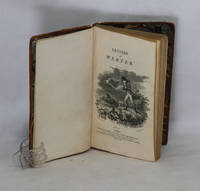
1799FB7279 /6B<p>Tan calf binding. Title worn off the spine. Gilt banding. Translated from the german of Goethe.</p><p><strong>We provide an in-depth photographic presentation of this item to stimulate your feeling and touch. More traditional book descriptions are immediately available.</strong></p><ul><li><p> THIS IS NOT A HAPPY TALE</p></li></ul><p>This is a very rare original publication. The book is in its original binding please view the photographs which visibly denotes the passage of two centuries. The contents and illustrations therein are in good readable condition and are fit to last a further two centuries.</p><p>George Nicholson was the publisher of Letters of Werter . He was born in Keighley in 1760. His father started the first printing business in Bradford in 1780 and by 1784 Nicholson and his brother had begun their own printing business also in Bradford Cooper 44. By 1790 Nicholson had begun commissioning illustrators and engravers to embellish his pieces with illustrations and one of these artists was the famed Thomas Bewick Cooper 47. At first the two did not get along well as Nicholson was upset that Bewick did not turn in his designs for the illustrations in a timely manner but the relationship between the two became more amiable as they continued their working relationship Cooper 48. In 1793 Nicholson moved his business to Manchester where he self-published his first written work related to vegetarianism in 1797. It was titled On the Conduct of Man to Inferior Animals: on the Primeval State of Man; Arguments from Scripture Reason Fact and Experience in Favour of a Vegetable Diet and this work received four editions the last published in Stourport in 1819 Cooper 45. This work and his other works on vegetarianism were popular enough to warrant him his own article in The Ethics of Diet: A Catena written by Howard Williams. M.A. and published in 1883 and even earned Nicholson a page on the International Vegetarian Union's website for his historic contributions to the cause of vegetarianism.</p><p>In 1799 Nicholson moved his business to Ludlow where it stayed until 1802 Cooper 44. By 1800 he was self-publishing his own periodical The Literary Miscellany: or Selections & Extracts Classical and Scientific; with Originals in Prose and Verse which included "eighty titles in twenty volumes" Cooper 44. These volumes were priced at 9d. to 1s./6d bound with colored boards and contained selections from poets popular religious and moral tracts some of Nicholson's own writing Cooper 44-46 and pieces about the art and practice of music just to list a few Cooper 55. Nicholson was said to be "the originator of cheap literature of the best class and of the most instructive sort" which can mostly be attributed to his production of The Literary Miscellany Williams. The text of Letters of Werter was originally published in the fifteenth volume of The Literary Miscellany July 1 1802 and was later republished as a novel by Nicholson in 1813 from Stourport according to the front cover of the actual book Forgotten Books. The book on its own was priced at 1s./6d.</p><p>Content of Book and Author</p><p>Now as for the content of the actual story contained within this little book. As previously stated the author of Letters of Werter is Johann von Goethe. He was a famous German author and poet and was involved in various kinds of scientific research such as research about plant and human morphology. He was born to a wealthy family in Frankfurt educated with private tutors and suffered from a ruptured blood vessel in his youth before finishing his education. He did end up finishing his education in Frankfurt though and then went on to live a life full of writing research and other intellectual pursuits "Johann von Goethe". Throughout his life however he suffered from feelings of "weariness of life" which in his autobiography he attributes to reading English poetry. He thought that English poems on average showed people the gloomy "weariness of life." He seemed to have a lot of sympathy for others who experienced feelings like his own and even admits in his autobiography that he himself had thoughts of suicide at a few points throughout his life. He also supposedly had an infatuation with a married woman Charlotte Buff "Johann von Goethe".</p><p>All of that information leads right into the plot of the book. According to "The Sorrows of Young Werther Summary" The Sorrows of Young Werther being an alternate English title for this text Letters of Werter tells the story of a man named Werther who falls madly in love with a woman named Lotte or Charlotte. Lotte however is engaged to be married to a man named Albert and has no intention of leaving her fiancé for Werther even though Werther feels she would be much happier with him than with Albert. Werther ends up leaving town completely taking an official position in another town. However this position doesn't work out and he feels he must return home. Ah but alas! When he returns home he finds himself even further in love with Lotte and feels increasingly hopeless because she refuses to be with him romantically and insists they remain as friends. Werther true to character refuses to accept this visits Lotte forces a kiss between them and is then forbidden from seeing Lotte ever again. Finding this dissatisfying he asks Lotte for Albert's hunting pistols in a letter receives them and then shoots himself in the head. Lotte Albert and Lotte's siblings all have to watch Werther slowly die and when the novel ends Lotte is in such a mournful state that she seems in danger of possibly ending her life as well.</p><p>It seems perfectly logical that Goethe's depression thoughts of suicide and feelings of unrequited love for a woman also named Charlotte informed the events of this novel. However something else of note is that this novel is written entirely through fictional letters that Werther writes to his friend Wilhelm. In Goethe's autobiography he mentions that he thinks these kinds of suicidal/depressed thoughts come from feelings of isolation so he chose to write the novel through letters. To Goethe letters allow for a person to express themselves and correspond with others but at the same time the letter writer is still withdrawn from society and isolated in their feelings of gloomy weariness.</p><p>Translation:To begin the original German title of Letters of Werter was Die Leiden des jungen Werthers. A direct translation of this title would be "The suffering of the young Werther" or perhaps "The young Werther's suffering." Generally however the book's English title is The Sorrows of Young Werther however whoever translated the text of this particular book chose to use a title that was more descriptive of the book's format rather than the book's plot content. The first English translation of this text was possibly made by David Malthus from the French translation of the text Long 174 however this is contested by another source which claims that the first English translation was actually made by Rev. Richard Graves Turner 367. Regardless the second English translation which was the first English translation to be made directly from the German was anonymously published in 1786 Long 177 and the third English translation was made by John Gifford published in 1789 Long 182.</p><p>This translation of Die Leiden des jungen Werther was published anonymously in Ludlow in 1799 was made directly from the original German and was the fourth English translation Long 186. The translator made a few changes to the original text which includes the omission of three letters Long 187 and the translator's own added preface Long 186. In this preface the translator defends Goethe against the accusation of him being "an apologist of suicide" and tells the reader that a few passages that "appeared to lower the general extraordinary merit of the work" have been omitted from the text. These "passages" were all letters in the novel. One of these letters was omitted by the two earlier English translations Long 187. Another of these letters was omitted by the translation published in 1786 Long 186 so it is possible that the translator of Letters of Werter was following earlier translators' examples. However Letters of Werter was the first English translation to omit "the whole of Werther's letter pertaining to religion" Long 187.</p><p>As previously mentioned this translation was republished by Nicholson in The Literary Miscellany. However according to Arthur E. Turner the version of the text published in The Literary Miscellany was altered from the original 1799 publication of the translation. There is a paragraph on the very last page of the story accompanied by an illustration titled "A Fragment from Charlotte." Turner claims that this paragraph was "appended to the translation" in Miscellany and was not present in the original translation 367.</p> T Knott. hardcover
17757053620Friedrich Nicolai Berlin 1775. This is an ex-library book and may have the usual library/used-book markings inside.This book has hardback covers. Clean from markings. In fair condition suitable as a study copy. Limited edition nr. 513 of 650. Rebound by library brown boards brown cloth spine with handwritten title. front hinge taped. Illustration on title page and a silhouette of Nicolai following the title page.60pp plus limited edition page. pages clean. Gothic script. Flyleaf page snapped - present but loose. Please note the Image in this listing is a stock photo and may not match the covers of the actual item200grams ISBN: Friedrich Nicolai, Berlin hardcover
17971808160033Printed by William A. Davis for E. Duyckinck & Co. T. Allen T. & J. Swords T. Greenleaf and J. Tiebout 1797-01-01. Hardcover. Good. First American Edition.Hardcover. 240 pp. lacking frontispiece. Modern red suede. Good binding and cover. Bookplate of Leigh Lawrence Minster. Toning scattered foxing. Evans 32313 Printed by William A. Davis, for E. Duyckinck & Co., T. Allen, T. & J. Swords, T. Greenleaf, and J. Tiebout hardcover
17741901150001Frankfurt am Mayn : Bey den Eichenbergischen Erben 1774. 2nd. Hardcover. Good. 2nd edition. Bound in 3/4 calf over marbled boards. 17 cm. Front boad detached. Gilt ruled gilt thistles on spien compartments. Marbled end pages. Printer's device on title. 192 pages. Schreiber 715. Second ed printed one year after the 1773 first ed. <br> Gotz von Berlichingen was a historical drama based on the life of the Franconian knight during the German Peasant's Revolt of 1524. In the drama Goethe made veiled criticism of contemporary tyranny using the gradual loss independence of German feudal lords. Rather amusingly includes the famous Swabian quote from Goethe "Mich ergeben! Auf Gnad und Ungnad! Mit wem redet Ihr! Bin ich ein Rauber! Sag deinem Hauptmann: Vor Ihro Kaiserliche Majestat hab ich wie immer schuldigen Respekt. Er aber sag's ihm er kann mich im Arsche lecken!" p. 122. Which roughly translates to: "Me surrender! At mercy! Whom do you speak with Am I a robber! Tell your captain that for His Imperial Majesty I have as always due respect. But he tell him that he can lick me in the arse!" Later translations took out the arsche lecken but this version holds true. <br> Provenance: Early ownership note on title page. Engraved book plates of Walter Konigsberger circa 1890s and Ronald P. Stanton 1960s. Konigsberger was a noted German Doctor in Berlin. Stanton was a German Jew who after fleeing Germany founded Transammonia Inc and became a multi-millionare. Frankfurt am Mayn : Bey den Eichenbergischen Erben hardcover
179034323Leipzig: Georg Joachim Göschen 1790. Ächte Ausgabe. 2 56 pp. 1 vols. Small 8vo. Modern marbled boards leather label gilt on upper board all edges uncut. Some wear to boards neat ink stamp on endpapers light foxing to title page else a fine bright copy. Ächte Ausgabe. 2 56 pp. 1 vols. Small 8vo. First separate edition of this work from Bd. 7 of Göschen's authorized edition of the Schriften with new title page and pagination. This copy has variant reading "zurücktretend" on p. 52. Speck Collection of Goetheana 1701 Georg Joachim Göschen unknown
178733175-3049Leipzig G. J. Göschen 1787. Titel 64 SS. 8vo. Mod. Ppbd. mit RSchild unbeschnitten. Leipzig G. J. Göschen 1787. Erste "ächte" Einzelausgabe aus dem 4. Band von "Goethe's Schriften" 8 Bde. Göschen 1787-90 nach Entfernung der Kupfer und der Bogennorm. Goethe macht aus der bei Aristophanes ursprünglich politisch ausgerichteten Satire eine köstliche indizienreiche Persiflage vermutlich auf den Weimarer Literatenkreis und sehr wahrscheinlich auch auf den Zürcher Dichter und Literaturkritiker Johann Jakob Bodmer 1698-1783 welcher als Schuhu "auf dem Gipfel eines überhohen Berges" thront und "mit nichts zufrieden ist und dem wir deswegen grosse Kenntnis zuschreiben. Sie nennen ihn im ganzen Lande den Criticus. Er sitzt den ganzen Tag über zu Hause und denkt alles durch was die Leute gestern getan haben und ist immer noch so einmal gescheut als einer der vom Rathaus kommt". Goethe hingegen schlüpft alternierend in die Rollen des Treufreund und Hoffegut zweier Literaten. Sehr humorvoll ist sein Urteil über Lexika "die grossen Krambuden der Litteratur wo jeder einzeln sein Bedürfnis pfennigweise nach dem Alphabet abhohlen kann!" - Schönes und breitrandiges Exemplar im Orig.- Zustand etw. bestaubt. - Goedeke IV/3 241 56a; Wilpert/Gühring 35; Kippenberg 359; Hagen 11 und 186; Brieger 723; Borst 544; Hirzel A 143; Meyer 305; Dorn 351. LITERATURE:GERMAN ; HELVETICA: ALLGEMEIN ; LITERATUR: DEUTSCHE ; Leipzig, G. J. Göschen unknown
178734219Leipzig: Georg Joachim Göschen 1787. Ächte Ausgabe. 2 64 pp. 1 vols. Small 8vo. Original grey wrappers all edges uncut lacking front cover title page and p. 64 somewhat browned else a bright unopened copy. Ächte Ausgabe. 2 64 pp. 1 vols. Small 8vo. First separate printing of this dramatic work from Bd. 4 of Göschen's authorized edition of Goethe with separate title page and new pagination. Georg Joachim Göschen unknown
178752465Lpz. Georg Joachim Göschen 1787 - 90. 8vo. Contemporary hcalf with gilt spine green volume-label and worn title-label. Some overall wear. Internally a bit brownspotted. Engraved title-vignette. <br/><br/><em>This volume six of Goethe's collected works contains the first printing of Goethe's famous play "Torquato Tasso". With the printing "Leipzig gedruckt bey Christian Friedrich Solbrig" on the bottom of the final page as stated in Hagen 116. </em> unknown
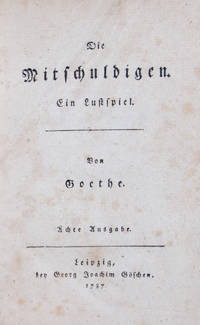
178737696Leipzig: Georg Joachim Göschen 1787. First edition. Hardcover. g to vg. Duodecimo. 128pp. Modern decorative paper-covered boards wit gilt ruling and lettering on black label of spine. The first draft of this one act comedy was written in 1768/69 the second draft in the summer of 1769. It premiered in 1777 with Goethe himself in the role of Alcest. Goethe kept revising the play until 1783. This if the first printing of the revised edition published by Georg Joachim Göschen in 1787. The presents presents an array of human weaknesses but also touches on "forbidden love" and expresses direct criticism of society. Hagen 169. Goed. IV/3 89 32 b. Text in German Fraktur. Binding with light wear along edges minor scuffing at hinges tail of spine and on cover. Some foxing in book block. Binding and interior in overall good to very good condition. Georg Joachim Göschen hardcover
1790203806Leipzig: Bey Georg Joachim Göschen 1790. First edition. Spine dried; neat modern booklabel on front pastedown; general rubbing. 12mo 96pp; three-quarter calf 19th century. Bey Georg Joachim Göschen unknown
178733172-411Leipzig G. J. Göschen 1787. Titel 64 SS. 8vo. Mod. marm. Ppbd. mit Rückenschild. Leipzig G. J. Göschen 1787. Erste "ächte" Einzelausgabe aus dem 4. Band von "Goethe's Schriften" 8 Bde. Göschen 1787-90 nach Entfernung der Kupfer und der Bogennorm. Eine köstliche indizienreiche Persiflage sehr wahrscheinlich auf den Zürcher Philosophen Dichter und Literaturkritiker Johann Jakob Bodmer 1698- 1783 der als Schuhu "auf dem Gipfel eines überhohen Berges" thront und "mit nichts zufrieden ist und dem wir deswegen grosse Kenntnis zuschreiben. Sie nennen ihn im ganzen Lande den Criticus. Er sitzt den ganzen Tag über zu Hause und denkt alles durch was die Leute gestern getan haben und ist immer noch so einmal gescheut als einer der vom Rathaus kommt". Goethe hingegen schlüpft alternierend in die Rollen des Treufreund und Hoffegut zweier Literaten. Sehr humorvoll ist sein Urteil über Lexika "die grossen Krambuden der Litteratur wo jeder einzeln sein Bedürfnis pfennigweise nach dem Alphabet abhohlen kann!".- Titelblatt geringfügig gebräunt sonst schönes Exemplar. - Goedeke IV/3 241 56a; Wilpert/Gühring 35; Kippenberg 359; Hagen 11 und 186; Brieger 723; Borst 544; Hirzel A 143; Meyer 305; Dorn 351. LITERATURE:GERMAN ; HELVETICA: ALLGEMEIN ; LITERATUR: DEUTSCHE ; Leipzig, G. J. Göschen unknown