4 résultats
1602045155Leiden i.e. Geneva: Jean Doreau 1602. Early Edition. Hardcover Full Leather. Very Good Condition. 18th century acid calf front hinge split and front board a little loose scrape to one board. Place of printing obscured on title and Leyden written above - a false imprint almost certainly Geneva. Old signature to title scattered annotations and underlinings to text neatly in an early hand mild browning small paper repair to the preface generally quite clean. lxxii 1031pp with the preface by his "fille d'alliance" Marie de Gournay and the analytical table which is sometimes lacking and the integral blank at d8. Bookplate of General J. Doreau and a letter laid in from a bookseller about the purchase of this book and other Jean Doreau editions. Graesse V4 579 PMM 95 1580 1st edition Brunet V3 434. First published in 1580 the third book was added in 1588 the last edition during Montaigne's lifetime. "Montaigne devised the essay form in which to express his personal convictions and private meditations a form in which he can hardly be said to have been anticipated." The table entitles "Les Pages du Sieur de Montaigne Où sont contenues les plus rare remarques de son liure." is not present in all of the printings and is according to Buchon the first such table to appear since 1595. Size: Octavo 8vo. Quantity Available: 1. Shipped Weight: Under 1 kilo. Category: Essays & Literary Criticism; Antiquarian & Rare. Inventory No: 045155. <br/><br/> Jean Doreau hardcover books
1652D8765Paris: Chez Augustin Courbé Estienne 1652. Hardcover. Very Good. Large folio 390 x 265mm. 840pp. Copper plate engraved printer’s device of Courbé a single palm tree surrounded by putti some trumpeting in frame with motto in allusion to his name Curvata Resurgo curved I straighten up signed by Daret. Title printed in red and black. Full-page copper engraved half title with author portrait of Michel de Montaigne the same as the 1635 edition. Near contemporary calf the spine tooled and lettered in gilt with raised bands; worming and small dampstain to margin of last 100 pages not affecting text other spotting and small stains binding slightly rubbed with losses to spine tips otherwise internally bright with clean wide margins. <br/><br/>Large Paris folio edition of Montaigne’s moralist and political ‘Essais.’ This 1652 edition contains beside the Essays the long preface and dedication of de Gournay the preface of Montaigne a summary of his life references to the authors in the margin and translations of the passages quoted. These citations often very lengthy make the Essays not only one of the great philosophical investigations in the Western tradition but a storehouse of the most beautiful and profound passages of classical literature. His citations from classical authors including Lucretius are especially remarkable. The whole is preceded by a notice of Estienne in which he details the improvements he has made in this edition most notably by placing the translations opposite the text – the first time this arrangement was introduced. Estienne also allowed Courbé the privilege to use his name and device on the title for this edition only although the work was printed on Estienne’s press. This same year Cousterout prints the work but uses the Estienne device. “I do not teach I tell” – Montaigne Montaigne’s Essays are central to the development of the early modern consciousness of the self; his skepticism and proto-empiricism were highly influential upon early modern scientific enquiry especially upon the works of Bacon. In the Essays Montaigne transcends his skepticism and transforms his stoicism to offer a positive and urgent message to his contemporaries. This message constitutes a new ethics one of goodness fellowship and trust all countering the model of heroic virtue which dominated his culture and his class by honor-bound aristocrats and religious zealots alike. Directed principally to the nobility of a nation torn apart by civil and religious conflict which forms the backdrop of the Essays Montaigne’s message shuns violence and urges for a new civilizing process. His moral argument depicts extreme humanist aspirations toward radical and divisive individualism in the name of a shared humanity. Canonical work in large format attractive and good with Courbé’s device found less often. Chez Augustin Courbé [Estienne] hardcover books
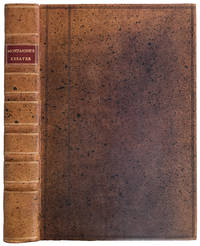
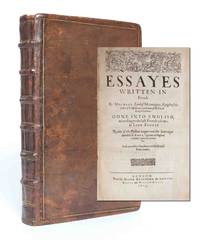
1613LLV2626London:: Printed by Melch. Bradwood for Edward Blount and William Barret 1613. 1613. Folio. 7 ¼ x 11 inches. x 630 pp. Frontispiece engraved portrait of Florio by William Hole bound facing the first text leaf containing general title page Main title with headpiece and vignette separate title-pages for the second and third books elaborate ornamental woodcut-engraved initials headpieces throughout occasional mispagination; title edges browned portrait the repaired tear strengthened with later backing. Antique-style full brown calf blind- and gilt-stamped sprinkled calf raised bands maroon label. Small manuscript notation at foot of title. Very good copy. Second edition in English of Montaigne’s seminal masterpiece with the key Elizabethan translation of John Florio used by Shakespeare as a source for The Tempest circa 1611 a splendid folio volume in contemporary calf boards. "Montaigne devised the essay form in which to express his personal convictions and private meditations a form in which he can hardly be said to have been anticipated. He finds a place in the present canon however chiefly for his consummate representation of the enlightened skepticism of the 16th century to which Bacon Descartes and Newton were to provide the answers in the next" - Printing and the Mind of Man 95. "Walt Whitman and Norman Mailer are indirect descendants of Montaigne even as Emerson and Nietzsche are his direct progeny" - Bloom Western Canon pp.147–151. "It is generally accepted that Shakespeare used Florio’s translation when writing the passage on the natural commonwealth in his Tempest" - Pforzheimer 378. Initially published in French in 1580 Montaigne’s Essayes were first published in English in 1603 with this translation. REFERENCES: STC 18042. Lowndes 1588. ESTC S111840. Printed by Melch. Bradwood for Edward Blount and William Barret, 1613. hardcover books
16131790London: Melch. Bradwood for Edward Blount and William Barret 1613. Second edition. Second edition of Florio's great translation which was first published in 1603. Small folio 11 3/8 x 7 1/4 inches; 290 x 185 mm collating: 12 630 2 blank pp. With engraved portrait of Florio on leaf A6v which was not included in the first English edition. With historiated initials and engraved head-and-tail pieces. The second and third books have separate dated title pages but pagination is continuous. This second edition replaces the original dedications of the three books to various Court ladies with a dedication and a new sonnet in Italian to the Queen Anne of Denmark who had appointed Florio as her reader in Italian and private secretary. Also for the first time in this edition is the anonymous sonnet Concerning the Honor of Bookes which was once attributed to Shakespeare but is more probably by Samuel Daniel. <br/><br/>Full contemporary polished calf. Boards and spine ruled in gilt. Board edges tooled in gilt. All edges speckled red. Remnants of green silk ties. Outer hinges professionally repaired. No front or rear pastedowns. Previous owner's bookplates. Contemporary ink notes on front free endpaper. Some minor toning to title-page and some occasional light dampstaining. Small hole to leaf Xx3 and light scrape to Ddd3 both with minor loss of text. Overall a very good copy. <br/><br/>This is considered the most important Elizabethan translation of any contemporary text. Its influence on English writers and philosophers of the time including Shakespeare Bacon Milton Hobbes and Locke can hardly be overestimated. "Montaigne startles the common reader at each fresh encounter if only because he is unlike any preconception we bring him. He can be interpreted as skeptic humanist Catholic Stoic even Epicurean" Bloom The Western Canon 147-151 <br/><br/>"Montaigne devised the essay form in which to express his personal convictions and private meditations a form in which he can hardly be said to have been anticipated.He finds a place in the present canon however chiefly for his consummate representation of the enlightened scepticism of the sixteenth century to which Bacon Descartes and Newton were to provide the answers in the next" Printing and the Mind of Man 95.<br/><br/> "The unfolding of a mind of genius in dialogue with itself and with the world a Renaissance humanist speaking to all humanity" Hollier A New History of French Literature 250. <br/><br/>Grolier Langland to Wither 102. Pforzheimer 378 Florio 1st edition. STC 18042. ESTC S111840. Melch. Bradwood for Edward Blount and William Barret unknown books