Montaigne, Michel deBiblio.com
14 résultats
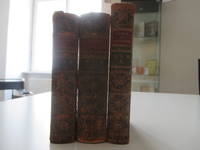
165913598AB1659. 3 volumes. Paris Tovrnel 1659. 155 : 9 cm. With three engraved title-pages; 33 leaves 556 pages 11 leaves; 1 leaf 817 pages 23 leaves; 1 leaf 610 pages 17 leaves. Contemporary full calf spine richly gilt two coloured back lables edgs gilt. With the celebrated portrait of Montaigne on the engraved title-pages. - Title-pages of vol. 1 and 2 narrow cut with 2 lines of text missing title of vol 1 browned reverse side and last page with rittings in ink; bindings partly rubbed vol. 3 a bit bigger in size. Contemporary full calf spine richly gilt two coloured back lables edgs gilt. unknown
16698618Paris Chez Laurent RondetChristophe Iournel et Robert Chevillyon. 1669. 1669 12mo. Three volumes. Engraved title pages. Contemporary French sprinkled calf bindings the spines gilt in panels between raised bands. The joints are cracking but the boards are strongly attached. No front endpaper in Vol. I and the engraved title page is trimmed close by the binder. There is a little shelf wear on edges and corners and a small patch of leather lost at the foot of the spine of Vol. I. The text blocks are all clean and tight. Paris, Chez Laurent Rondet,Christophe Iournel et Robert Chevillyon. hardcover
1669B6889Paris: Laurent Rondet Christophe Journel Robert Chevillion. 1669. Boards and spine rubbed; spine ends chipped small pieces lacking. Corners bumped. Interior lightly toned occasional marginal worming to bottom right corners of vol. II not affecting text. Interior else clean and crisp. Binding: Full original morocco boards. Spines with 5 raised bands title lettered in gilt in 2nd compartment remaining tooled in gilt design. Gilt fillet on board edges. In Mylar jackets. All edges speckled red. Notes: Text in French. First 2 volumes only. <br>Michel de Montaigne 1533 – 1592 also known as the Lord of Montaigne was one of the most significant philosophers of the French Renaissance. He is known for popularizing the essay as a literary genre. His work is noted for its merging of casual anecdotes and autobiography with intellectual insight. Montaigne had a direct influence on numerous Western writers; his Essais the present example contains some of the most influential essays ever written.<br><br> Size: 12mo. 145 x 85 mm Illustration: A very good example of Montaigne’s renown collection of essays who was the first to popularize the form as a literary genre. With engraved titles with portrait of Michel de Montaigne engraved by Matheus. 94 chapters 57 in vol 1 37 in vol 2. Vol I with period notation on front free endpaper “126. 307â€; vol 2 with period notation on lower pasted endpaper “liv. XII: p. 183-502.†Vol I mispag. 81 as 85; 248 as 148; 463 as 464. Vol II mispag. 290 as 280; 493 as 943; pagination jumps 503 to 506 but text continuous. Volume: 2 volumes. Pages: Livre Premier: title. Blank. Author’s note 2. Epistle for Cardinal Duc de Richlieu by Mademoiselle Gournay from the 1635 edition 4. Preface 46. Author’s biography 6. Contents 3. Pp. 1-556. Index 24. Livre Second: title. Blank. Contents 2. Pp. 1-827. Index 30. Printer’s note. Category: Book Literature; Book Social Sciences; Laurent Rondet, Christophe Journel, Robert Chevillion. hardcover
160814790Paris: Chez Michel Niuelle. Good. 1608. First Edition Thus. Hardcover. Half-leather and boards. Engraved title has been laid down and has only the 1608 date and just the single publisher. The original title is missing 3/8" along the right margin. The Table Des Matieres at the end is complete. This 1608 edition was the first to include "Sommaire discours sur la vie de Michel Seigneur de Montaigne" and sidenotes summarizing the text. This copy is missing the portrait of Montaigne which appeared for the first time in this edition. Covers are quite worn cracking along the leather spine. Much chipping to the upper spine end and a chip to the lower spine. Some splitting along the exterior spine hinges. Corners are bumped and worn. Boards rubbed. Leather label on the spine is quite chipped affecting lettering. Bookplate to the front pastedown. Quite a tight copy and but for the portrait otherwise complete. This edition of The Essays is quite scarce. ; 12mo 7" - 7½" tall; 1129 pages . Chez Michel Niuelle hardcover
166900518057Chez Lavrent Rondet. Christophe Iovrnel. et Robert Chevillion 1669. Leather Binding. Very Good/No Jacket. 16mo - over 5¾" - 6¾" 3 volumes complete as issued. Bound in 17th-century French speckled calf spines with raised bands and gilt tooling edges speckled red heavy rubbing with some chipping to spines; boards rubbed; some wear to text margins. PROVENANCE: Small ink stamps to title pages reading 'D. A. Lejay' spelling; bookplates in first two volumes bear the bookplate of celebrated collector Montgomery Evans II with his superb pictorial ex libris designed and illustrated by S.H. Sime illustrator of many works by Lord Dunsany volume I bears the pencilled note on front endpaper 'M.E. 1920' the bookplate in this volume has a long tear. Evans was also the author of 'Prodigal Sons; Or the Evolution of Caste'. Engraved Frontispieces in Each Volume. Chez Lavrent Rondet,... Christophe Iovrnel,... et Robert Chevillion unknown
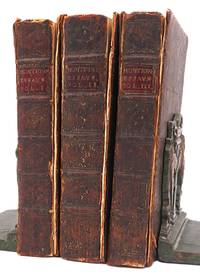
1685406London: T. Basset at the George in Fleet Street and M. Gilliflower and W. Hensman in Westminster-Hall 1685. Good. <p data-start="565" data-end="794">Three volumes.<br data-start="579" data-end="582" /> Volume I: London printed for T. Basset at the George in Fleet Street and M. Gilliflower and W. Hensman in Westminster-Hall 1685.<br data-start="713" data-end="716" /> Volume II: same printers dated 1686.<br data-start="753" data-end="756" /> Volume III: same printers dated 1685.<br /> <br /> Each volume in contemporary full calf now showing pronounced wear. Spines are cracked with losses along the joints and headcaps and boards are loose or detached in places as shown. Leather is dry with surface losses and darkening. Red spine labels “VOL. I†“VOL. II†“VOL. III†remain legible. The engraved portrait frontispiece of Montaigne appears in Volumes I and II. Text blocks appear complete with gatherings intact and no missing leaves visible in the provided openings. Pages show even toning and scattered foxing typical of the period. Early handwritten names appear at several title-page headers. One endpaper in Volume III shows old water staining limited to the edge. No modern repairs are visible. Custom modern clamshell cases—one for each volume—are included and appear unused.<br /> <br /> This is the celebrated first complete English translation of Montaigne by Charles Cotton a landmark in early modern philosophy and essay writing. Cotton’s translation shaped the English-speaking world’s understanding of Montaigne for more than two centuries and influenced later essayists from Addison and Johnson to Emerson. Complete 17th-century sets survive but are increasingly uncommon and sets retaining the engraved portraits are valued for their integrity. The accompanying custom clamshell cases enhance stability and long-term preservation particularly given the original bindings’ fragility.<br /> <br /> Early handwritten owner names on the title pages. No bookplates visible. The bindings suggest long private ownership. The modern custom cases indicate more recent stewardship by a collector attentive to conservation needs. Store case 2.</p> . T. Basset at the George in Fleet Street, and M. Gilliflower and W. Hensman in Westminster-Hall unknown
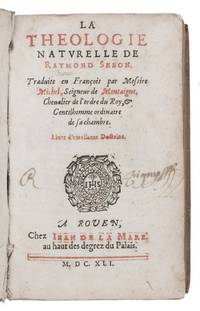
1641F7F92EA5LQQ2Rouen: Jean de la Mare 1641. Contemporary limp sheepskin parchment manuscript title and paper label on spine. 8vo. Sixth edition of Michel de Montaigne's 1533-1592 translation of the Book of creatures or Natural theology by the Catalan theologian Raymund of Sabunde ca. 1385-1436. Written round 1436 "the Book of creatures belongs to the tradition of medieval works that follow the imperative according to which faith must evolve into seeking understanding. It was given the name of Natural theology because as asserted in the prologue it sets out to offer every human being the means of reaching the truth of Christian dogma thanks to his own efforts just by reading into the book of God's creation". However although the book tries to guide the reader towards the fundamental truths of Christianity basing itself on the visible order of creatures it is halfway stated that since human nature is corrupt the scriptures are more important and "God's word is to be believed in itself" Habert.Although the translation was commissioned by the Paris booksellers and appeared without Montaigne's name it brought him his first fame as a man of letters. During his career he would return to Sabunde publishing an Apology for Raymund of Sabunde among his famous Essays en revising his translation in 1580. First published in 1569 Montaigne's translation was reprinted several times with the final edition appearing in 1641. After that the text would only reappear in 19th-century editions of Montaigne's complete works.Binding slightly soiled and lacking a small part at the lower back. Spotted throughout and and with several wormholes; the final 8 pages damaged leading to some text loss. Overall a good copy.l Caillet Manuel bibliographique des sciences psychiques ou occultes III 10074; Habert "Montaigne translator of Raymond Sebond" in: The Oxford handbook of Montaigne pp. 78-96. Jean de la Mare, unknown
1602045155Leiden i.e. Geneva: Jean Doreau 1602. Early Edition. Hardcover Full Leather. Very Good Condition. 18th century acid calf front hinge split and front board a little loose scrape to one board. Place of printing obscured on title and Leyden written above - a false imprint almost certainly Geneva. Old signature to title scattered annotations and underlinings to text neatly in an early hand mild browning small paper repair to the preface generally quite clean. lxxii 1031pp with the preface by his "fille d'alliance" Marie de Gournay and the analytical table which is sometimes lacking and the integral blank at d8. Graesse V4 579 PMM 95 1580 1st edition Brunet V3 434.<br /> <br /> First published in 1580 the third book was added in 1588 the last edition during Montaigne's lifetime. "Montaigne devised the essay form in which to express his personal convictions and private meditations a form in which he can hardly be said to have been anticipated." The table entitles "Les Pages du Sieur de Montaigne Où sont contenues les plus rare remarques de son liure." is not present in all of the printings and is according to Buchon the first such table to appear since 1595.<br /> <br /> Provenance: Bookplate of General J. Doreau and a letter laid in from a bookseller about the purchase of this book and other Jean Doreau editions Size: Octavo 8vo. Quantity Available: 1. Shipped Weight: Under 1 kilo. Category: Essays & Literary Criticism; Antiquarian & Rare. Inventory No: 045155. Jean Doreau hardcover
163238662London: M. Flesher for Rich. Good with no dust jacket. 1632. Third Edition. Hardcover. Later half vellum and marbled boards. Pp. 143-146 repaired. Lacking the engraved frontis. Some dampstains and small worm holes small tears. Modern ink notes to mounted page "to the beholder of this title" opposite title page and also to A2. Final page is in the index table letter R. Occasional old ink notes/ink stains. Shakespeare was infuenced by this work. ; Folio 13" - 23" tall . M. Flesher for Rich hardcover
1685492<p><strong>London: T. Basset… and M. Gilliflower and W. Hensman 1685-86. Three volumes. Octavo contemporary full speckled calf re-backed in calf-gilt to style with the original red morocco spine labels & raised bands. First edition of Cotton's highly regarded English translation of Montaigne's essays considered "among the masterpieces of translation" DNB with frontispiece portrait in each volume in contemporary calf boards. Volume 1 has contemporary ink marginalia at the bottom of the title page. It is very rare to have frontispieces in each of the 3 volumes. Half-titles are not called for. A beautiful very good set which has benefitted from some expert restoration to the board edges. "Montaigne devised the essay form in which to express his personal convictions and private meditations a form in which he can hardly be said to have been anticipated. The most elaborate essay the 'Apologie de Raimond Sebonde' is second to no other modern writing in attacking fanaticism and pleading for tolerance. He finds a place in the present canon however chiefly for his consummate representation of the enlightened skepticism of the 16th century to which Bacon Descartes and Newton were to provide the answers in the next" PMM 95. "Though regarded with suspicion by the Church and placed on the Index 1676 his work won the admiration of his own and succeeding generations… it was quoted by Shakespeare in The Tempest and… inspired the English essay as developed by Bacon Cowley Temple and Dryden" Reid 422. "How far his influence has extended is incalculable" Harris 105. "Cotton's Montaigne ranks among the masterpieces of translation" DNB. "The final work Cotton saw through the press was one of his most admired his translation of Montaigne's Essays three volumes 1685-6 which immediately supplanted that by John Florio 1603 and was still being reprinted well into the 20th century. In Montaigne Cotton found a congenial mind and character which he rendered in relaxed and conversational prose" ODNB. First translated into English in 1603.</strong></p> T. Basset… and M. Gilliflower and W. Hensman hardcover
1652D8765Paris: Chez Augustin Courbé Estienne 1652. Hardcover. Very Good. Large folio 390 x 265mm. 840pp. Copper plate engraved printers device of Courbé a single palm tree surrounded by putti some trumpeting in frame with motto in allusion to his name Curvata Resurgo curved I straighten up signed by Daret. Title printed in red and black. Full-page copper engraved half title with author portrait of Michel de Montaigne the same as the 1635 edition. Near contemporary calf the spine tooled and lettered in gilt with raised bands; worming and small dampstain to margin of last 100 pages not affecting text other spotting and small stains binding slightly rubbed with losses to spine tips otherwise internally bright with clean wide margins. <br/><br/>Large Paris folio edition of Montaignes moralist and political Essais. This 1652 edition contains beside the Essays the long preface and dedication of de Gournay the preface of Montaigne a summary of his life references to the authors in the margin and translations of the passages quoted. These citations often very lengthy make the Essays not only one of the great philosophical investigations in the Western tradition but a storehouse of the most beautiful and profound passages of classical literature. His citations from classical authors including Lucretius are especially remarkable. The whole is preceded by a notice of Estienne in which he details the improvements he has made in this edition most notably by placing the translations opposite the text the first time this arrangement was introduced. Estienne also allowed Courbé the privilege to use his name and device on the title for this edition only although the work was printed on Estiennes press. This same year Cousterout prints the work but uses the Estienne device. I do not teach I tell Montaigne Montaignes Essays are central to the development of the early modern consciousness of the self; his skepticism and proto-empiricism were highly influential upon early modern scientific enquiry especially upon the works of Bacon. In the Essays Montaigne transcends his skepticism and transforms his stoicism to offer a positive and urgent message to his contemporaries. This message constitutes a new ethics one of goodness fellowship and trust all countering the model of heroic virtue which dominated his culture and his class by honor-bound aristocrats and religious zealots alike. Directed principally to the nobility of a nation torn apart by civil and religious conflict which forms the backdrop of the Essays Montaignes message shuns violence and urges for a new civilizing process. His moral argument depicts extreme humanist aspirations toward radical and divisive individualism in the name of a shared humanity. Canonical work in large format attractive and good with Courbés device found less often. Chez Augustin Courbé [Estienne] hardcover
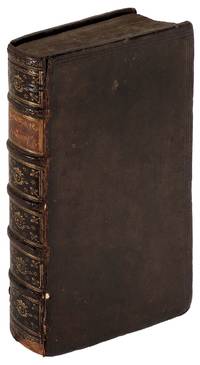
163238184London: Printed by M. Flesher for Rich: Royston in Ivie-lane next the exchequer Office London 1632. Hardcover. Very Good. Hardcover. This is the third edition of Montaigne's influential and famous essays and on the title page it says that whereunto this edition is now more newly added an index of the principal matters and personages mentioned in the book. The celebrated architectural illustration that is engraved on the title page is by Martin Droeshout responsible for the iconic portrait of Shakespeare in the First Folio also appeared in this edition for the first time Montaigne is credited with pioneering the modern essay form. His Essays are a collection of personal reflections exploring a wide range of topics from human nature to philosophy literature and personal experiences. Published in three books they were written and revised over several decades with the first edition appearing in 1580. The remarkable modernity of thought apparent in Montaigne's essays coupled with their sustained popularity made them arguably the most prominent work in French philosophy until the Enlightenment. Their influence over French education and culture is still strong. Wikipedia They were originally written in Middle French and published in the Kingdom of France. Montaigne's stated design in writing publishing and revising the Essays over the period from approximately 1570 to 1592 was to record "some traits of my character and of my humours." Montaigne's Essays went through several stages of publication evolving from a two-book work in 1580 to a final posthumous edition in 1595. The first English translation of Montaigne's Essays was published in 1603 by John Florio. This translation titled The Essayes or Morall politike and millitarie discourses was a significant event in English literature introducing the French philosopher's work to an English-speaking audience. <br /> <br /> Bound in full brown leather; the spine has raised bands with titling and ornaments in gilt. There are small chips on the right side of each band. A small piece of leather at the bottom of spine edge is torn away and their is a slight crack to the top of spine along the front cover. The covers have some bumping and rubbing and a few small spots. It appears that the formal endpapers are missing and there is just rough paper covering the inside covers. It is torn and revels glue remnants <br /> <br /> The front inside cover has a bookplate with a coronet and the Latin motto "Vernon Semper Viret" meaning in English "Vernon Always Flourishes". This appears to belong to George John Warren Venables-Vernon 5th Baron Vernon 1803-1866 who was a British politician and member of parliament. He was also a devotee of Dante and The Inferno.<br /> <br /> The text pages have bright white margins but the printed text sections are somewhat browned. There small brown spots along the margins of pages 55-60 with one having become a hole. There are three books of essays with the second and third books having title pages dated 1631. The first book: pages 1 - 177; the second book: pages 183-440; the third book: pages 443-631. It is followed by the "Index or Table of subjects that is unpaginated. Despite the noted condition issue this is still a very good copy of this important book. LIT/073125. Printed by M. Flesher, for Rich: Royston, in Ivie-lane next the exchequer Office, London hardcover
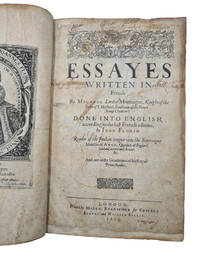
1613032513London : Printed by Melch. Bradwood for Edward Blount and Wliiam Barret 1613. Book. Very Good. Full Leather. 2nd Edition. 4to - over 9¾ - 12" tall. Second Edition in English. Full Leather. Quarto in 6's signatures A1 to Kkk3v 10 1/2 x 7 1/2 inches; 27 cm x 19 cm. Engraved frontis portrait of John Florio William Hole engraver. Pp. x 630 the second R1 and third books Rr5 have separate title pages: "The Essayes or Moral Politike and Militarie Discourses of Lo. Michael de Montaigne Knight of the noble Order of St. Michael and one of the Gentlemen in Ordinarie of the French King Henry the Third his Chamber. The Second Booke. 1613. The Third Booke. 1613" continuous pagination and register. Title pages have head-piece and decoration. Woodcut head and tail-pieces and initials; includes bibliographical references in Printed side-notes. Contemporary full calf 5 raised bands gilt stamped maroon spine label. Rebacked and re-cornered most likely a couple of hundred years ago. Covers rubbed and scuffed frontis portrait laminated to wide-margined stub; contemporary ink note to title page and signed "John Legard/Aug 79" possibly one of the Legard Baronets. Title page dust soiled and mildly browned paper repair to A5 done sometime ago margins appear trimmed but without loss; toning to pages with infrequent smudge or stain. Otherwise a good copy. Florio is one the individuals proposed as the real author of Shakespeare's works. His translation of the Essays was first published in 1603. Printed by Melch. Bradwood for Edward Blount and Wliiam Barret Hardcover
16135000740London: Melch. Bradwood for Edward Blount and William Barret 1613. Edges of the title-page ragged and 1/4 inch of lower margin made good with blank paper the following three leaves with some marginal wear well clear of text; portrait leaf normally at end of prelims placed here as frontispiece and slightly worn at outer margin; spine of the binding rubbed but good. Folio xii 630 pp. A-3I6 3K3 missing final blank leaf 3K4; leaf A6 pp.7/8 with portrait on verso bound as frontispiece; three parts published as one volume individual title-pages with woodcut decorations to second and third parts; old half calf and marbled boards. <p><p>Second edition in English of Montaigne's masterpiece in the important translation by John Florio one of the great prose works of the Elizabethan period used by Shakespeare as a source for several late works most importantly The Tempest. First published in French in 1580 Montaigne's Essays first appeared in English in Florio's translation in 1603. William Hole's portrait bound as frontispiece here celebrates the translator rather than the author of the Essays showing Florio as a handsome neatly bearded courtier.</p> <p>"Montaigne devised the essay form in which to express his personal convictions and private meditations a form in which he can hardly be said to have been anticipated. He finds a place in the present canon however chiefly for his consummate representation of the enlightened skepticism of the 16th century to which Bacon Descartes and Newton were to provide the answers in the next" Printing and the Mind of Man. </p> <p>The second edition contains the preliminary sonnet "Concerning the honor of bookes" which was at one time attributed to Shakespeare though is more likely to have been by Samuel Daniel who signs the poem before it in honour of Florio "Sam. Daniel". Oddly early ink annotations on this page claim "There are Six manuscripts and two Old Copys have it Sappy instead of Sam; which makes a great alteration in the Text" and "Sappy Daniel One of the greatest Poets in those Days: he writes in the Pindarick Stile: he read Homer in 5 days & translated Horace into Verse in 15 and became perfect Master of all ye Greek & Latin Classicks in 25. A Beautiful Progress".</p> </p> . Provenance: Early signatures on the title-page of Betty Gregson Yorkshire -1763 married Henry Chaytor in 1760 and Matthew Chaytor; later there seems to have been a family connection Sir Henry Heathcote Admiral 1777-1851 with his armorial bookplate as baronet. Melch. Bradwood for Edward Blount and William Barret unknown