21 résultats
15841316551584. hardcover. Libri I and II. Libri II Tradotti per Remigio Fiorentino. Title vignette 423 2 113 thick 12mo early calf gilt-decorated raised bands; spine ends worn partially missing corners bumped last page missing text of upper right corner. Venetia: Domenico Farri 1584.<br/> <br/> unknown
1565336295Venice: Beuilacqua 1565. hardcover. very good. 367 pages 13 page index text in Italian several copperplate engravings and initials a small bit of spotting and 1 page cancelled with early inking. Thick 32mo full mottled calf. no text on binding. Small book plate on inside front cover with a design and a crown. Venetia: Nicolo Beuilacqua 1565 a very good copy. Scarce.<br/> <br/> Beuilacqua unknown
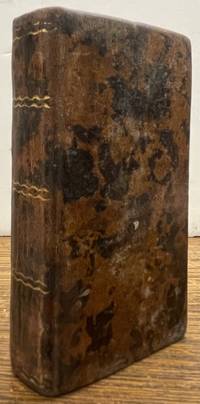
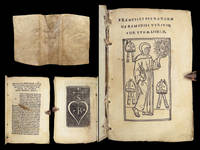
153628488<p><strong>1536 De Remediis by Petrarch Philosophy Humanism Dialogues Venice Latin</strong></p><p><em>"Books have led some to learning and others to madness." </em></p><p>― Francesco Petrarch</p><p>Petrarch was a 14th-century Italian humanist known for his discovery of the letters of Cicero and establishment of the study of humanism. He wrote sonnets and poems many of which were the model of poetry during the Dark Ages. At the end of Petrarch's life he completed a collection of wisdom and philosophical dialogues known as "<em>De Remediis</em>".</p><p>These dialogues were written to instruct readers on happiness humility and wealth. Other topics include Petrarch's views on Augustinian moral theology in conjunction with opposing God's love and self-love Lee Petrarch and Augustine p. 249. </p><p>This 1536 edition of Petrarch's "<em>De Remediis</em>" was published in Venice.</p><p>Item number: #28488</p><p>Price: $1250</p><p>PETRARCH Francesco</p><p><strong><em>Francisci Petrarchae De remediis utriusque fortunae libri II</em></strong></p><p>Venetiis: per dominum Bernardinum Stagninum de Tridino Montisferrati 1536.</p><p><u>Details</u>: </p><p><!-- if !supportLists-->· <!--endif-->Collation: complete with all pages</p><p><!-- if !supportLists-->o <!--endif-->422 i.e. 398 -24 leaves</p><p><!-- if !supportLists-->o <!--endif-->Pagination errors expected</p><p><!-- if !supportLists-->· <!--endif-->References: USTC 847819</p><p><!-- if !supportLists-->· <!--endif-->Language: Latin</p><p><!-- if !supportLists-->· <!--endif-->Binding: Vellum; secure</p><p><!-- if !supportLists-->· <!--endif-->Size: ~4.5in X 3in 11cm x 7cm</p><p><!-- if !supportLists-->· <!--endif-->VERY rare and desirable </p><p>Our Guarantee:</p><p>Very Fast. Very Safe. Free Shipping Worldwide.</p><p>Customer satisfaction is our priority! Notify us with 7 days of receiving and we will offer a full refund without reservation!</p><p><u>Photos available upon request. </u></p> per dominum Bernardinum Stagninum de Tridino Montisferrati hardcover
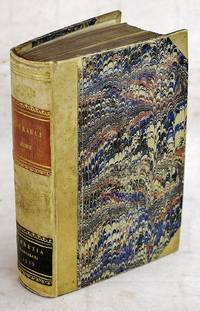
15392109100001Venetia : Stampato per Francesco Marcolino 1539. Hardcover. Very Good. Early Italian Emblem Book 2 volumes bound as one. Octavo 15 cm. Bound in later 1/2 vellum over marbled boards. Leather spine labels. Good binding and cover. 4 354 18 pages 180 leaves. Architectural title vignette with portrait of Petrarch. Engraved printer's device at end of first volume. Second volume has an engraved title with a portrait of Alunno. <br> Provenance: From Professor John MacQueen's library of Scotland. Includes related ephemera associated with Renaissance studies. "It is appropriate that Petrarch be printed in Italics a type invented in 1501 by the famous Venetian printer Aldus Manutius was said to have adopted Petrarch's own handwriting for . creating the new type." - Note inside front cover. <br> Refs: Fiske / Fowler 97; Ley 159-161; Brunet III 477. Venetia : Stampato per Francesco Marcolino hardcover
1545009633Vinegia: Gabriel Giolito de Ferrari 1545. Un volume in 8vo 15x22 cm di 8-197-7 carte- Bel frontespizio inciso con titolo incorniciato tra cariatidi e putti colonne floreali e colomba una piccola macchia. Capilettera incisi Ritratto di Petrarca e Laura alla carta aiii. Carta geografica incisa Descrittione del sito di Vauclusa a piena pagina. Sei graziose incisioni riquadrate di un terzo di pagina ad ogni inizio dei Trionfi. La numerazione dei fogli comincia con 3 uno sbaffo d'inchiostro al f.3 qualche brunitura e gore marginali da f.7 a 10 e 183-193; strappi ai margini bianchi di f. 222342 senza toccare il testo; piccolo foro a f. 91. Al foglio 137 da De l'empia Babilonia fino a che 'l sostiene versi biffati con inchiostro ma la lettura dello stampato resta possibile; piccola macchia al f. 138; al foglio 141 vecchio manoscritto incollato sopra le note con i versi da L'avara Babilonia ha colmo il sacco. fino a .e pien de l'opre antiche. Al retro del f. 170 tratti di penna nella parte bianca; al f. 177 piccolo strappo al margine bianco superiore. Legatura coeva in tutta pergamena rimontata modernamente con tassello al dorso. Tracce di antico ornamento dorato ai tagli. -Uno dei più interessanti Petrarca figurati del 500 in una copia che porta nelle sue pagine traccia delle polemiche che il testo ancora suscitava a metà del 500 con le sue accuse alla corruzione della corte pontificia le censure ai versi della empia Babilonia gli altri versi di accusa manoscritti. Bell'esemplare con le raffinate incisioni in ottima stampa. Gabriel Giolito de Ferrari unknown
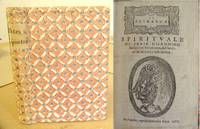
156736032Domenico Farri Venetia 1567. 3rd edition. Hardback. Later decorated paper boards VG. xxiv32218pp small 8° pagination runs 1-161 but only the rectos are numbered giving 322 pages to the main text - Signatures running a1-b4 A-I8 K-T8 V-V8 X2-X7 Y-Y4 rebound early 20th century in paper covered boards without any blanks sheet A yellowed affecting the first 8 leaves occasional light marginal water staining not affecting the text printers woodcut device of Roman goddess Spes upon a winged globe with sunburst an attractive copy. This copy complete with the initial dialogue & index. Malipiero's famous interpretation or re-write of part of the Il Canzoniere of Petrach in which Malipiero changes what he saw as bawdy rhymes to verse where the the emphasis is on Godly love & not insane lust. Malipiero considered Petrach full of 'gli sconci e molto disordinati affetti e l'angosciose passioni de' miseri innamorati'. He also removed references to the papacy at Avignon & had Germany depicted as a new Babylon due to the influence of Luther. First published in 1536 the work went through eight editions by 1587. Domenico Farri, Venetia hardcover
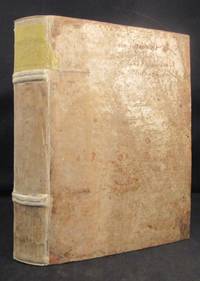
152832165Venegia: Maestro Bernardino de Vidali 1528. A very early Edition of the Vellutello Petrarca. With fine heraldic ownership label. Illustrated with the rare two page view of the Valchiusa. This copy with the Babylonian Sonnets 165 ff not censored and still included in the text. Rare thus. 4to mm. 190 x 140 handsomely bound in fine full vellum of the period. 11ff 185 ff 51 ff Del Triumpho pp. A contemporarily bound copy in a pleasing state of preservation generally crisp and clean throughout some interesting notes in very early hands to the pastedowns a few here and there in the margins of the text-block interesting notes concerning prohibition to the leaves that contain the Babylonian verses the back sometime strengthened the vellum binding strong and in good order. A FINE AND VERY EARLY PRINTING OF THE VELLUTELLO PETRARCA. The volume was dedicated to Carlo Grotta Chancellor to Cardinal Cristofor Madruzzo Principe Vescovo of Trent and organizer of the Council of Trent. This edition of Petrarca with the commentary of Vellutello is considered the most important. Especially important is the celebrated commentary on the Canzoniere out of the edition of 1525. Also important is the biography of the poet.<br> This copy contains the Babylonian Sonnets which were generally censored and seldom included in copies of Petrarca's writings. These Babylonian sonnets a group of three poems that criticized the Avignon Papacy were initially banned because they were included in a prohibited Protestant work. In 1557 Pier Paolo Vergerio wrote Alcuni importanti luochi an attack against the Church that emphasized those three sonnets from Petrarch. Many clerics denounced the greed and corruption of the Avignon papacy. In the 1340s Petrarch wrote “I am living in the Babylon of the West†comparing Avignon to the biblical city of vice and corruption. He went on to condemn the habits of prelates who feasted at “licentious banquets†and rode white horses “decked in gold fed on gold and soon to be shod in gold if the Lord does not check this slavish luxury†Petrarch in Tuchman p. 29. His disgust found fuller expression in several sonnets among them Sonnet 138 which he addressed to the papal court at Avignon: “O foundry of deceits cruel prison where good dies and evil is / created and nourished a hell for the living: it will be a great / miracle if Christ does not finally show his anger against you†<br> The Canzoniere poetic “songbook†is also known as the Rime Sparse “scattered rhymesâ€. The work is a series of erotic poems that Petrarch wrote in the Italian vernacular about his love for the mysterious beauty “Laura†whom he first encountered on April 6 1327 at the church of St. Clare. Apparently in 1348 Laura and Cardinal Colonna both succumbed to the Black Death the bubonic plague that was ravaging Europe. Petrarch himself escaped the plague though he recorded these devastating personal losses in the Canzoniere; Laura’s death in particular shaped the resolution of the sequence of poems. Tiring of Church politics Petrarch left Avignon in 1353 and spent his remaining years in various Italian provinces. He continued work on the Canzoniere sorting and arranging its poems until his death in 1374. Although Petrarch was best known among contemporaries for his Latin writings his vernacular works especially the Canzoniere are now regarded as his masterpieces. His exploration of the emotional states of love yearning and spiritual aspiration in this work would have a major influence on future generations of poets. Maestro Bernardino de Vidali hardcover
1573TNCC0066Domenico Nicolini 1573. Hardcover. Good. Italian text. Two Volumes in One also bound with "Tavola di Tutte"; Venice 1572. Marbled boards with leather spine and corners; edges worn with boards showing at corners; tiny chips in spine ends; 24mo just over 4 3/4" tall; pencil notation about book on free front endpaper; light foxing/discoloration to edges; interior is unmarked; 399 pages missing i Trionfi pages 400-544; followed by 'Tavola' 256 pages. Photos available upon request. Domenico Nicolini hardcover
1553048658Venice: Gabriel Giolito 1553. Third Edition. Hardcover Full Leather. Very Good Condition. 19th century full leather rubbing at edges and hinges binding quite sound endpapers refreshed. Slight scattered foxing; browning to bottom of title and first few leaves in the preliminaries and final leaf two small temoin at end of book; an attractive copy with 6 woodcuts in the Trionfi and a full page map of Valclusa. 52 667 1. Printer's mark on verso of final page. <br /> <br /> Giolito published similar editions of Petrarch with commentary by Gesualdo first was 1533 and Vellutell first was 1538 in the 1540s and 50s with the same map and engravings. Adams P820 Mortimer 375 for the 1543 Vellutello ed. Size: Quarto 4to. Quantity Available: 1. Shipped Weight: Under 1 kilo. Category: Poetry; Antiquarian & Rare. Inventory No: 048658. Gabriel Giolito hardcover
157452350Venedig Iacomo Vidali 1574. Small 4to. A little later full mottled calf richly gilt spine. Wear to top of spine. 28419 folios =56838 pp. Woodengraved initials throughout 1 full page map Sito di Valclusa Portraimedaillon of Petrarca and Laura 6 large woodcuts in the text 2 printers devices. Internally clean and fine. <br/><br/><em>Adams P 831. </em> unknown
1554242933Vinegia: Giovan. Griffio 1554. hardcover. very good. Griffin and putti woodcut device on title page griffin passant device at end 5 large woodcut illustrations and historiated letters. Italic and roman letter. 218 pages small 4to full vellum lacks title label on spine. Vinegia: Giovan. Griffio 1554. A beautiful copy of a scarce book.<br/> <br/> Not in Brunet; Cornell 104; not in Graesse; Haym 73 9; Hortis 55 99; Marsand 68.<br/> <br/> Giovan. Griffio unknown
1532324740Vinegia 1532. hardcover. very good. 303 pages with text in Italian. Thick 16mo old vellum-backed boards. Venegia: A san Moyse al segno dell'Angelo Raphael per Francsco di Alessandro Bindoni e Mapheo Pasini 1532. Some pages with old marginal repairs still a very good clean copy.<br/> <br/> unknown
1581289574Venitia.: Alessandro Griffio. 1581. 18th century full brown leather gilt floral borders raised bands gilt spine decorations speckled edges ribbon marker. Very good a few worm holes to cover old repair to top edge of title page scattered foxing. 8vo. 21x15 cm. Italian text. Set in a small attractive and very readable italic type. Leaf 415 erroneously numbered 413. Tightly bound in a handsome binding. weight: 2.1 lb. Engraved title page with decorated border and printer’s device historiated initials. Alessandro Griffio. hardcover
154144614Venegia Italy: Ioan. Antonio di Nicolini & i Fratelli da Sabbio 1541. 8vo 24 ccclxxxiiii 4 leaves; late 19th-century three quarter vellum over marbled boards maroon morocco gilt spine labels all edges red marbled endpapers; spine quite darkened lacking b3-6 from La Vita del Petrarcha quires G and V supplied; very good and sound. See Adams 807 and BM STC Italian p. 204 for the 4to edition. Ioan. Antonio di Nicolini & i Fratelli da Sabbio] unknown
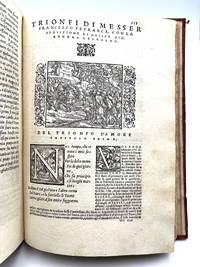
157325868<p><strong>1573 Petrarch Poetry Triumphs Italian Il Petrarca Venice BEMBO Ridolfi Tavola</strong></p><p>Petrarch was a 14th-century Italian humanist known for his discovery of the letters of Cicero and establishment of the study of humanism. He wrote sonnets and poems many of which were the model of poetry during the Dark Ages. This exceedingly rare 1573 edition of the works of Petrarch includes his '<em>Triumphs'</em> and includes commentary and notes by Pietro Bembo. Interestingly this work includes a printing of Luca Ridolfi's "Tavola" with a separate title page.</p><p>Item number: #25868</p><p>Price: $950</p><p>PETRARCH Francesco</p><p><strong><em>Il Petrarca</em></strong></p><p>In Venetia: Domenico Nicolini 1573.</p><p><u>Details</u>:</p><p><!-- if !supportLists-->· <!--endif-->Collation: Complete with all pages; 3 parts in 1 volume</p><p><!-- if !supportLists-->o <!--endif-->Il Petrarcha – 399 1</p><p><!-- if !supportLists-->o <!--endif-->Trionfi – 2 403-544</p><p> <!--endif-->6 vignette woodcut engravings</p><p><!-- if !supportLists-->o <!--endif-->Tavola di Tutte – 256</p><p><!-- if !supportLists-->· <!--endif-->References: USTC 847854</p><p><!-- if !supportLists-->· <!--endif-->Provenance:</p><p><!-- if !supportLists-->o <!--endif-->Armorial bookplate – Petri S.R.E. Cardinalis Ciriaci</p><p> <!--endif-->Pietro Ciriaci 1885–1966 was an Italian Cardinal of the Catholic Church who served as prefect of the Sacred Congregation of the Council in the Roman Curia from 1954 until his death and was elevated to the cardinalate in 1953 by Pope Pius XII. Motto: DOMINUS REGIT ME.</p><p><!-- if !supportLists-->o <!--endif-->Handwritten – <em>Manuel Maria Loper de Sampaio</em></p><p><!-- if !supportLists-->o <!--endif-->Handwritten – <em>Antonio Feliciano de Castilho</em></p><p> <!--endif-->António Feliciano de Castilho 1st Viscount of Castilho 1800–1875 was a Portuguese writer. He lost his sight at the age of six but the devotion of his brother Augusto and aided by a retentive memory succeeded in his studies and acquired an almost complete mastery of the Latin language and literature. Though Castilho's lack of strong individuality and his excessive respect for authority prevented him from achieving original work of real merit yet his translations of Anacreon Ovid and Virgil as well as his best-known <em>Letter to the Empress</em> reveal him as a master of form and a purist in language.</p><p><!-- if !supportLists-->· <!--endif-->Language: Italian</p><p><!-- if !supportLists-->· <!--endif-->Binding: Leather; tight and secure</p><p><!-- if !supportLists-->· <!--endif-->Size: ~4.75in X 3in 12cm x 7.5cm</p><p><!-- if !supportLists-->· <!--endif-->Rare and desirable</p><p>Our Guarantee:</p><p>Very Fast. Very Safe. Free Shipping Worldwide.</p><p>Customer satisfaction is our priority! Notify us with 7 days of receiving and we will offer a full refund without reservation!</p><p>25868</p><p>Photos available upon request.</p> Domenico Nicolini hardcover
155381681In Vinegia Venice: Apresso Gabriel Giolito de Ferrari 1553. Fine. Apresso Gabriel Giolito de Ferrari In Vinegia Venice 1553 15.30 x 22.50 cm relié Third edition of these works by Petrarch commented by Gesualdo the first of which appeared in Venice in 1533. They comprise the Canzoniere in italics prima parte and seconda parte with commentary distributed around it and the Trionfi also accompanied by commentary. 2 engraved title pages the first general one with portraits of Laura and Petrarch on either side of the portico and the second for the Trionfi. Numerous engraved and historiated initials and 6 title vignettes for the trionfi. A map of the Vaucluse site where Petrarch lived. Later Italian binding ca 1840 in half cherry red morocconized shagreen with red percale boards. Spine with 4 false flat raised bands decorated with 3 tools and blind frames roulettes on the bands and thick blind fillets. Initials in one of the compartments: CG. Traces of rubbing. Stains on boards and rubbing. Title-frontispiece cropped short with small lacks to corners and outer margin. Traces of pale yellow dampstains in margin of first 5 preliminary leaves then on Petrarch's life on 2 leaves dampstain trace at mid-page and in margin. Gathering 553 detached. On leaves 647 to 657 outer margin nibbled for 1cm then diminishing. Some scattered light foxing in margins but overall relatively fresh notably the text of the Canzoniere; more significant but still very light foxing at end of work. The preliminary pages include a stylistic analysis the lives of Petrarch and Laura. This edition of Gesualdo's commentary was revised in light of Vellutello's critical edition published later. Addressing very diverse and erudite questions Gesualdo's commentary is renowned for its great elegance. Apresso Gabriel Giolito de Ferrari hardcover
1527407565Venedig "Vineggia": Gregorio de Gregori 1527. hardcover. Gut. Titelei 5 Blatt 381 Blatt 1 Blatt. Ganzpergament der Zeit mit handschriftlichem Rückentitel Vorderdeckel mit dunklen Fleckchen mit kleinem Pergamentfrass leicht berieben und bestossen Paginierung teils irrig Seiten aber vollständig vorhanden Bezug der Spiegel angelöst Titelei im rechten weissen Rand angestückt ohne Text- und Bildverlust die ersten 30 Blatt wasserfleckig und teils braunfleckig sonst innen nur wenig gebräunt bzw. braunfleckig insgesamt recht frischer Druck auf meist weissem Papier schön und recht gut erhalten. - Schöner und seltener venezianischer Druck des italienischen Klassikers. Über KVK konnten wir weltweit nur 8 Exemplare nachweisen! Die "Huomini illustri" bringen Biographien aus der Antike u.a. von Romulus über Alexander den Großen Hannibal Cäsar Augustus bis Vespanian und Trajan. Petrarca war Mitbegründer des Humanismus und wollte die Antike wiederbeleben. Der Drucker Gregorio de Gregoriis da Forli ist in der Zeit von 1496 bis 1527 nachgewiesen. Teilweise zusammen mit seinem Bruder Giovanni druckte er in dieser Zeit die erstaunliche Menge von mehr als 100 Büchern meist Texte klassischer Autoren und Humanisten. - Nicht bei Adams; BL STC ital 506 teilt wie auf dem Titel: de glihuomini!; zu Gregori: Contemporaries of Erasmus II126. - Weitere Bilder auf Anfrage oder auf unserer Homepage. Wegen Urlaub kann Ihre Bestellung / Anfrage erst nach dem 21.06.2026 bearbeitet werden. - Because of holidays your order / question can be handled only after 06/21/2026. Gregorio de Gregori hardcover
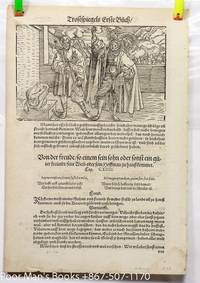
157232559Frankfurt: Bei Christian Egenolffs Erben. Very Good with no dust jacket. 1572. Paperback. Woodcuts; 8vo 8" - 9" tall; 2 pages; Headline of verso: "Trostspiegels Erste Buch/" Large woodcut illustration in upper portion of verso. Dampstain to lower margin very good. Laid paper. . Bei Christian Egenolffs Erben paperback
1562027459Venice: Lodovico Avanzo. Fair. 1562. Leather. 165 pages plus index front board missing 2 front endpapers with paper loss title page in good condition one woodcut and ititial letter pages trimmed and tinted red some dark staining to the bottom margins of the index.; 8vo . Lodovico Avanzo hardcover
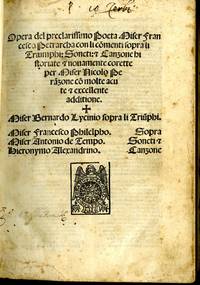
1512047500Venice: Angelo Scinzenzeler 1512. Early Edition. Hardcover Full Leather. Good Condition. Rebound in modern tooled leather. With the Opera bound before the Sonnets - with only 3 of the 6 engravings otherwise complete. Lacking the leaves at g5 i4 and q7 each with an engraving on the verso. 10 125 of 128; 116pp. With some mispagination and a switch to Arabic numerals from 89 but mispaginated 69 to 96. Modest foxing throughout lighter and heavier in spots first and lst pages worn. Old ink stains to Triumph of Time plate. and a few other stray old ink drops. Still very good or better overall save for the missing leaves. <br /> <br /> A rare edition a reimpression of Scinzenzeler's 1507 edition and with fine engravings by an unknown artist from the 1494 edition. Size: Folio. 2-volume set complete. Quantity Available: 1. Shipped Weight: Under 1 kilo. Category: Poetry; Inventory No: 047500. Angelo Scinzenzeler hardcover
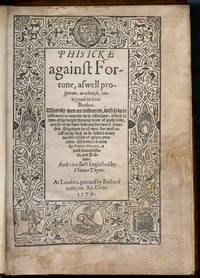
1579384London: Richard Watkyns 1579. First Edition. Very Good. Small 4to; 7 1/2 x 5 5/8 in. 190 x142 mm; pp. 4 xiv 1-152 First Booke Physicke for Fortune: 153-343 Second Booke Phisicke against Fortune vi table of contents 2. Each book with Epistolary preface by Franucis Petrarche. Translated into English from Latin by Thomas Twyne whose introduction dedicates the work to "Richard Bertie Esquier." Title within woodcut decorative border woodcut decorative initials set in gothic and latin type lacking sig.B and final blank lower corner of title torn and repaired with loss supplied first gathering lower corners repaired some dampstaining and toning throughout but sheets supple and intact. 19th century calf gilt panels from early English blind-stamped binding laid down on covers corners worn rubbed. Front pastedown with small engraved bookplate with initials "I N"<br /> <br /> Title page reads: «Physicke against Fortune as well prosperous as adverse contained in two Bookes<br /> Whereby men are instructed with lyke in differencie to remedie theyr affections aswell in tyme of the bright shyniyng sunne of prosperities as also of the foule lowiyng stonnes of adversities. Expedient for all men but most necessary for such as be subiect to any notable insult of eyther extremities. Written in Latine by Francis Petrarch a most famous Poet and Oratour. And now first Englished by Thomas Twyne.»<br /> <br /> STC 19809; ESTC S114602. This is the first edition in English of "De Remediis Utriusque Fortunae" "Remedies for Fortune Fair and Foul" written in Latin by the Humanist Francesco Petrarca 1304-1374 commonly known as Petrarch a collection of 254 dialogues mostly drawn from classical sources which seeks to instruct on moral philosophy and show how thought and deed can generate happiness on the one hand or sorrow and disillusionment on the other. It touches on a number of diverse subjects including dancing ball games gambling wrestling hunting and hawking alchemy libraries schoolmasters spectacles toothache lechery gout blindness and deafness. In a recurring theme throughout the dialogues Petrarch advises humility in prosperity and fortitude in adversity. It remained a popular book in Europe over the ages and was translated into English by the Elizabethan physician Thomas Twyne 1543-1613.<br /> <br /> "Latin work by Petrarch begun in 1354 but completed between 1360 and 1366 on how to deal with both good and bad fortune. The first of its two parts contains 122 dialogues between Ratio Gaudium and Spes and deals with how one should behave at times of good fortune; the second contains 131 dialogues between Ratio Dolor and Timor and deals with the behaviour appropriate to adverse fortune. It is a practical manual of moral philosophy and was widely read until the 17th c." Oxford Companion to Italian Literature. Richard Watkyns unknown