BOETHIUS, Anicius ManliusBiblio.com
2 résultats
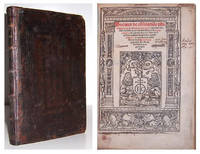
1515000220Lyon: Iohnnes Clein 1515. Hardcover. See Description. c.1515. 4to. pp. 280. p.280 blank. Colophon dated "nono kalendas Octobris" 23 Sept. Title page printed in red and black inside woodcut architectural border. Woodcut printer's device Sylvestre 132. Printed in Roman font with the surrounding commentaries printed in Gothic. Text contains decorative initials. Bound in contemporary blind stamped paneled calf boards; re-backed preserving original spine. Later antique endpapers with inscription on front-free endpaper dated "1925"; front and rear blank fly-leaves worn. Pages are generally clean with occasional marginalia in an old hand i.e. several small inscriptions written on the title page; minor spotting; lower corner of leaf c7 clipped in margin; The hinges and inner margins to the first gathering are neatly strengthened / repaired. The outer edges to this same gathering show some wear - i.e. a few marginal tears sealed and light soiling. The bottom margins on conjugate leaves a2 and a7 are trimmed about ½" 12 mm. Anicius Manlius Boethius 480-524 was a late Roman philosopher and statesman. He became embroiled in a plot against Theodoric the Ostrogothic ruler of Rome and was eventually executed. Boethius wrote his most famous work the "Consolation of Philosophy" while awaiting his fate in prison. The five sections discuss the capriciousness of fortune the influence of good and evil and the nature of God's control over the universe i.e. free will providence and fate. The work employs the Platonic notion of an ascent of the soul to the Godhead through a process of contemplation and reflection. The imagery is predominately pagan; however the author himself was strongly influenced by Christian thought. Boethius's work was immensely influential throughout the middle ages. Commentaries are provided by Josse Badius 1462-1535 and Thomas Wallensis the latter wrongly ascribed to Thomas Aquinas. The "Ascensio explanato" has separate signatures and divisional title page. Adams B-2290; BM STC French p. 73; Renouard Josse Badius II 213; Baudrier XII p. 268. <br/> <br/> Iohnnes Clein hardcover
153326505Basel: Hieronymus Froben e Nikolaus Episcopius 1533. The Editio Princeps the first printing of the work in the original Greek. Greek and roman type. Woodcut printer’s device of Johann Froben by Hans Holbein der Jünger The Younger on the title-page and on fol. CC4v Heitz-Bernoulli 50. Woodcut decorated headpieces decorated and animated initials on black ground from different alphabets designed by Holbein; on fol. a1r 8-line initial showing Heraclitus and Democritus from the capital Latin alphabet of May 1520 drawn by Holbein and by Jacob Faber cfr. Hollstein’s German xivB n. 119. 4to 210x146 mm. In a very rarely encountered contemporary binding of Dutch blind-tooled leather over wooden boards. The covers are framed by two borders of blind tooled fillets a floral tool at each corner; the central panel is divided into diamond designs with rosettes on the upper cover and fleur-de-lys on the rear. Turn–ins and cords fixed at the inner boards. Antique spine and clasps renewed at a somewhat later date and accomplished with the greatest skill. The guard leaves are composed of two bifolia from a 14th-century manuscript breviary. Collation: 1 2 3 4 a-z4 A-Z4 aa-zz4 AA-CC4 fols. 1v CC4r blank. 8 573 3 pp A beautiful and fine broad-margined copy in a wonderful contemporary binding faint water staining to the inner corner of the first quires a minor repair to the gutter of the first leaves two tiny wormholes in the last three quires. Provenance: John Alfred Spranger 1889-1968; book-plate on front pastedown and stamp on title-page. EXTREMELY RARE FIRST PRINTING OF THE EDITIO PRINCEPS OF THIS REMARKABLY IMPORTANT BOOK AND A COPY WHICH IS OF THE VERY FINEST STATE AND CONDITION. The editio princeps of Diogenes Laertius’ Lives of the Famous Philosophers is the most important source of our knowledge in the history of Greek philosophy from Thales to Pyrrho. <br> The text was known only in the Latin translation by Ambrogio Traversari 1386-1439 which made its first appearance in print in Rome around 1472 and which was widely reprinted during the fourteenth and the first decades of the sixteenth century. This is the first printing of the book in its original language.<br> The edition is dedicated by the typographers Froben and Episcopius to the scholars and in their epistle they declare their publishing plan: to print at least a work per year able to combine usefulness and pleasure. <br> The text follows a manuscript provided by the professor of Greek and Hebrew at the University of Wittenberg Matthaeus Goldhahn 1480-1553 called Aurigallus probably a copy of the codex Raudnitzianus Lobkowicensis vi.F.c.38 at the time preserved in Komotau Bohemie in the house of the politician Bohuslav Lobkowitz von Hassenstein c. 1460-1510 and presently in the Library Národní Knihovna of Prague. Hieronymus Froben e Nikolaus Episcopius hardcover
