139 résultats
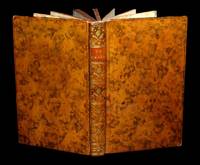
1754177171754. A Paris chez Orault & Fils 1754. Un vol. au format in-12 168 x 103 mm de 1 f. bl. lxxx pp. 1 f. n.fol. 239 pp. et 1 f. bl. Reliure de l'ÂŽpoque de pleine basane marbrÂŽe blonde filets ˆ froid encadrant les plats dos lisse ornÂŽ d'un double filet d'encadrement dorÂŽ doubles filets dorÂŽs larges fleurons dorÂŽs semis de points dorÂŽs piÂce de titre de maroquin chair titre dorÂŽ palette dorÂŽe en queue filet dorÂŽ sur les coupes toutes tranches rouges. Edition originale. L'exemplaire s'ouvre sur une Lettre de d'Alembert ''sur la personne et les ouvrages de Jean Terrasson''. ''La Philosophie dont il s'agit dans ce Recueil consiste ˆ prÂŽfÂŽrer dans les doctrines humaines l'examen ˆ la prÂŽvention et la raison ˆ l'autoritÂŽ''. Cioranescu III Bibliographie de la littÂŽrature franÂaise au XVIIIÂme 61551 - QuÂŽrard IV La France littÂŽraire p. 377. Coiffe supÂŽrieure lÂŽgÂrement arasÂŽe. Mors du premier plat fendillÂŽ ; sans toutefois nuire ˆ la soliditÂŽ de l'ensemble. Feuillets lÂŽgÂrement brunis. Rares rousseurs dans le texte. Nonobstant bonne condition. b42961 unknown
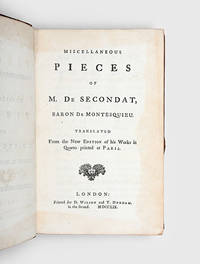
1759181611London: Printed for D. Wilson and T. Durham 1759. Building the Montesquieuvian legend in the English-speaking world First edition in English including the first English translations of the Defence of the Spirit of Laws - "the most brilliantly written of all his works" Ency. Brit - and of the final eight Persian Letters. The collection also includes a 52-page eulogy by d'Alembert who worked to bring Montesquieu into the group working on the Encyclopédie. The utilitarian approach to religious commandments in the Spirit of Laws provoked fierce criticisms of moral degradation blasphemy and atheism. The Defence was Montesquieu's reply reiterating his Christian credentials and receiving praise from no less a figure than Voltaire. For Carruthers it remains "the most revelatory of all Montesquieu's writings regarding his understanding of his method as a political philosopher" p. 22. The remaining pieces capture Montesquieu in a range of less familiar settings including historical fiction Lysimachus love poetry The Temple of Gnidus and a protean article for the Encyclopédie An Essay on Taste. Octavo 195 x 122 mm pp. vi 2 334. Woodcut title vignette. Contemporary mottled calf spine and covers ruled in gilt edges sprinkled red. With 1926 ink ownership signature to front pastedown. Light wear slight loss to spine ends and splitting to joints holding firm minor browning and foxing to contents: a very good copy. ESTC T89091. David W. Carruthers ed. Montesquieu: Discourses Dissertations and Dialogues on Politics Science and Religion 2020 unknown
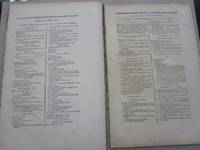
177259266France 1772. First edition. Disbound. This listing consists of several groupings of pages containing plates and descriptions of those plates which were removed from the first edition of Diderot's Encyclopedia. Pages measure 39 x 27 cm which are still bound together in signatures. Plates are either full page or two page plates. Description of each signature follows: <br /> <br /> Potier D'etain Tin consisting of a description of 9 plates of which 8 our present. Plate I is missing of this group. Bound with this: Potier D'etain Bimblotier consisting of a description of 6 plates all of which are present. <br /> <br /> Next grouping: Following this are 4 plates with no description page with titles like "Travail du Bas au Metier". Planche # III IV V VI.<br /> Next Grouping: "Forge des Ancres" anchor forging. Consisting of a description of 13 plates all of which are present.<br /> <br /> Next Grouping: "Potier de Terre". Consisting of a description of 19 plates all are present. Planche XVII is a fold-out plate titled "Potier de Terre Fours".<br /> <br /> Final Grouping: "Draperie". Consisting of a description of 11 plates all are present. <br /> <br /> In general the plates are in nice condition with no tearing. These are the plates with descriptions no binding and they are not a complete set. The original Encyclopédie was published in 17 volumes with 11 volumes of plates published by 1772. Later printings did not include plates to cut down the costs and allow a wider audience to read the work. This was the first encyclopedia to describe the mechanical arts and also the first to include contributions from many important named contributors. These include such famous enlightenment figures as Voltaire and Jean-Jacques Rousseau. unknown
1759h042.008GB: A. Millar 1759. Text commences at title page and then 4 and 314 pages extra leaf after p222 no leaf 255/6. Complete as issued. . Lacks rear endpaper. Bound in old full leather. Spine appears to have been replaced and is a darker brown with raised bands and leather title label. Joints and hinges appear repaired. Text is generally fairly clean and tight but early and late leaves are heavily browned in margins. Covers sound. This is just a good reading copy but not for the collector. Book is in good double plus condition with noticeable signs of wear and/or age. . 1st Edition. Hardback. G/No DW. A. Millar Hardcover
1751029352Paris 1751. 1st Edition . No Binding. Fine. Six Plates. Four Plates 23.7 X 39 Cm. On Growing And Manufacture Of Cotton Illustrating Aspects Of Cotton Processing. Fine. With A Copy Of The Two Pages Of Text Describing These Plates. <br/> <br/> unknown
17651378717Paris: Briasson David Le Breton 1765. Quarto 23 1 pages 64 plates. In Very Good minus condition. In later rough paper wraps. Front wrap detached but present. Some wear and rubbing to extremities of text block. Some foxing and toning throughout.<br /> <br /> <br /> PB consignment. Shelved in Room A Oversized. The 64 plates were engraved by Bernard after drawings by Goussier. They cover large format from pendulum clocks grandfather clocks and tower clocks to small carrying watches and pocket watches. Also depicted are star clocks calendar clocks and gear related mechanicals such as music boxes gear trains and extravagant dials.<br /> <br> <br /> <br> <br /> From the collection of Silvio Bedini. Bedini spent twenty five years at the Smithsonian Institution serving as curator in the Department of Mechanical and Civil Engineering in the new Museum of History and Technology now the National Museum of American History before serving as first Assistant Director then Deputy Director of the National Museum of History and Technology. He then served as Keeper of Rare Books at the Dibner Library of the History of Science and Technology a branch of the Smithsonian Institution Libraries before becoming a Historian Emeritus. He specialized in early scientific instruments. 1378717. Special Collections. [Briasson, David, Le Breton] unknown
176730163Paris 1767. The following plates come from a defective copy of Volume 5 and are generally in excellent condition with full margins: 32 plates divided into six suites showing engravers in ateliers equipment<br /> tools and several types of engraving: 8 plates containing attractive drawings of different steps in the art of engraving such as etching copper-plate engraving mezzotint engraving crayon engraving black engraving and including the tools needed. With their accompanying 9 text pages . Plates are numbered 1-8 and plate 1 is a double plate. unknown
176730162Paris 1767. The following plates come from a defective copy of Volume 5 and are generally in excellent condition with full margins: 3 plates and 1 text sheet. The plates display a vignette that represents the interior of the atelier where the furnace is seen in the chaudiere from which the lead is melted ; and where the mixture of the oprin is done plus the drawings of all the tools and equipments for the casting of bullets. unknown
176730159Paris 1767. The following plates come from a defective copy of Volume 5 and are generally in excellent condition with full margins. 17 text pages plus one folio and 25 plates . plates numbered 3 6 7 8 24 and 25 are all double plates.<br /> This 25 fascinating plates detail the art of casting cannons the machines the moulds for the casting of cannons bombs and bullets. In fact each plate from 1 to 25 is a fascinating journey through drawings of craftsmen working on different design of cannons specially on the double plates also on plates 1 2 3 display general plans of impressive furnaces foundations on minute detail. unknown
176730161Paris 1767. The following plates come from a defective copy of Volume 5 and are generally in excellent condition with full margins. 6 plates and 2 descriptive text sheets.<br /> The first plate represents the interior of an atelier in which several craftsmen of this profession are engaged in various operations and the planes of the double furnace. Plates 2- 6 are drawings of interesting tools plans and molds used in the sand foundry. unknown
176730160Paris 1767. The following plates come from a defective copy of Volume 5 and are generally in excellent condition with full margins. 8 plates followed by their 4 text sheets. Plates are numbered 1-8. <br /> Plate 1 is a double plate showing samples and tuning forks.<br /> Plates 2 3 4 5 are drawings of the fabrication the molds plan and elevation of the furnace and the operation. Plate 6 is a drawing of a factory where the operation of cooling the bells is in the process. Plates 7 8 are drawings of the towers and the suspension of the bells. unknown
176730191Paris 1767. The following plates come from a defective copy of Volume 5 and are generally in excellent condition with full margins: This suite of 71 plates comes in divided sections and each section is devoted to the explanation of a different branch of science thus each one of these 17 sections is numbered individually followed by 16 text pages. <br /> <br /> GÉOMÉTRIE <br /> 5 plates numbered 1-5 are an extensive work showing all the figures and instruments used in the practice of science of geometry.<br /> <br /> TRIGONOMÉTRIE <br /> 2 plates numbered 1-2 demonstrate the relationship involving lengths and angles of triangles and shows how this science emerged from applications of geometry to astronomical studies.<br /> <br /> ARPENTAGE<br /> 3 plates numbered 1-3 illustrate the science of surveying it's tools and the way are used in land and sea mapping . These science is known since human built the first large structures.<br /> <br /> ALGEBRE ET ARITHMÉTIQUE <br /> 2 plates numbered 1-2 demonstrat figures practiced in this science and on plate two we have the Machine of Arithmétique de Pascal figures in three dimensions.<br /> <br /> SECTIONS CONIQUES<br /> 3 plates numbered 1-3 contains figures practiced in conic section .<br /> <br /> ANALYSE <br /> 2 plates numbered 1-2 display figures used in this branch of science.<br /> <br /> <br /> MECHANIQUE<br /> 5 plates numbered 1 to 5 illustrate simple machines levers balances screws pulleys etc. and diagram their functions.<br /> <br /> <br /> <br /> HYDROSTATIQUE HYDRODYNAMIQUE et HYDRAULIQUE <br /> 3 plates numbered 1-3 display fountains instruments such as the Archimedan Screw <br /> <br /> MACHINES HYDRAULIQUES<br /> 2 plates numbered 1-2 show detail Marli’s impressive machine.<br /> 1 plate unnumbered contains different views of sewer reservoir pump.<br /> 1 plate unnumbered describes the fire pump and arm pump. This plate has 2 inches nicely repaired tear at top.<br /> 2 plates numbered 1-2 are drawings detailing the machine of scientist Dupuis.<br /> 1 plate unnumbered displays the windmill of Meudon. This mill is located in the park of the castle of Meudon near the farm of Vibon. We see all the internal mechanism in this plate and it is to show it the cage which contains it all around has to destroyed.<br /> 2 plates numbered 1-2 these plates show six figures detailing the harmonious work of the implements in the Machine of Nymphembourg. This machine is the invention of the Count de Whal. It is empowered to raise the water at sixty feet in height.<br /> 5 plates numbered 1-5 describe and display all the parts internal and external of the Water Mill.<br /> 4 plates numbered 1-4 are impressive views of the Noria water wheel. This is an ancient invention <br /> 1 plate unnumbered contains a scene of Canal et Écluses Canal and Locks.<br /> 6 plates numbered 1-6 are figures and plans of fire pompe. Thaïs machine has been employed in the Bois de Boffu near Saint-Guilain in the Province of Hainault. Plates 4 5 are internal views of the steam pompe while is it on pate 6 is profile of the Giant cylinder and other tools.<br /> 1 plate unnumbered showing four aspects of the filtering fountain.<br /> <br /> <br /> OPTIQUE <br /> 6 plates numbered 1-6 show attractive images of optics such relative to glasses lenses colors magnitude lanterns virtual focus and more.<br /> <br /> <br /> PERSPECTIVE<br /> 2 plates numbered 1-2 represent drawings of perspective distortion visual graphical aerial and geometry and the effect of visual perspective in graphic arts.<br /> <br /> <br /> ASTRONOMIE<br /> 26 plates numbered 1-26 are beautifully representing the instruction and the making of instruments used in this science and the way are used <br /> <br /> <br /> <br /> <br /> GEOGRAPHIE<br /> 3 plates numbered 1 1 2 represent construction and usage of maps and world map measurement of inaccessible distances. Plate tow is construction des globes.<br /> <br /> GNOMONIQUE<br /> 2 plates numbered 1-2 showing projections and equipment<br /> <br /> NAVIGATION<br /> 1 plate showing an astrolabe maps and other instuments.<br /> <br /> .<br /> <br /> INSTRUMENS DE MATHEMATIQUES<br /> 3 plates numbered 1-3. First plate opens with an attractive atelier displaying two craftsmen involved in the making of the instruments described on the rest of the plates.<br /> <br /> PHYSIQUE<br /> 5 plates numbered 1-5. Aurora borealis water spouts snowflakes scientific instruments<br /> <br /> PNEUMATIQUE<br /> <br /> 3 plates barometers thermometers an air-gun wind mills anenometer. unknown
176730190Paris 1767. The following plates come from a defective copy of Volume 5 and are generally in excellent condition with full margins: 14 plates including one double-page plus 1 page of descriptive text.<br /> 253 x 393mm. The folio represents all the buildings of all the royal manufacture of Langlee close to Montargis seen from the channel of Montargis and shows details of the giant mills.<br /> The drawings illustrate beautiful giant mills each one in it's own atelier & details of their mechanism plus the tools needed in the making of this art. unknown
176730185Paris 1767. The following plates come from a defective copy of Volume 5 and are generally in excellent condition with full margins: 3 plates of engraving on gemstones including equipment and tools. One descriptive text sheet. Plates are numbered 1-3. unknown
176730184Paris 1767. The following plates come from a defective copy of Volume 5 and are generally in excellent condition with full margins: 3 plates displaying an attractive atelier and engravers on wood and tools plate numbered 3 in this section is a display of the principles and 1 descriptive text sheet. Plates are numbered 1-3. unknown
176730186Paris 1767. The following plates come from a defective copy of Volume 5 and are generally in excellent condition with full margins: Three plate plus one descriptive sheet. unknown
176730182Paris 1767. The following plates come from a defective copy of Volume 5 and are generally in excellent condition with full margins: 2 plates displaying engraving of letters maps and music and the tools used to engrave letters sheet music maps. And two descriptive text sheets. Plates are numbered 1-2. unknown
176730183Paris 1767. The following plates come from a defective copy of Volume 5 and are generally in excellent condition with full margins: 3 plates describing an atelier and the smith engraving on lockets and all tools that are used in this art. Plates are numbered 1-3. 2 plates displaying two engravers in their attractive atelier and their tools. Plates are numbered 1-2. Included also one text sheet demonstrating the use of equipments and tools for engraving lockets and seals. unknown
176730189Paris 1767. The following plates come from a defective copy of Volume 5 and are generally in excellent condition with full margins: The 14 plates are breath taking drawings of different marble pavings for churches salons palaces . That still can be enjoyed in the Sorbonne Notre Dame de Paris des Invalides and more.<br /> 3 double plates numbered 910 & 11 are marvelous plans for works done on some historical buildings in Paris and more. Plates 12 13 & 14 contain drawings of tools needed in the making of this art. Including 1 text sheet. unknown
176730188Paris 1767. The following plates come from a defective copy of Volume 5 and are generally in excellent condition with full margins: The 37 plates includes two sections : first section numbered 1 -11 plates are drawings describing the Pipe Organ with minute details. Plate 11 is an index to a tuning scale. Second section plates numbered 1- 22 describes foreign ancients modern instruments & percussion plus different sorts of beautifully made instruments. Plate 10 on this section is doubled and on which described all tools needed in the making of the wind instruments.<br /> Plate 13 is damaged with a missing corner affecting text and border but not drawings. Plate 22 is double page. Four descriptive text sheets. unknown
17634606Paris:: Diderot & D'Alembert 1763. First printing. Fine. Folio. 10.25 x 16.5 inches. A fine original copperplate engraving printed on heavy handmade rag stock published as part of Denis Diderot and Jean le Rond d'Alembert's Encyclopédie ou Dictionnaire Raisonné des Sciences des Arts et des Métiers; the essential exploratory encyclopedia of arts science and industry produced during the Age of Enlightenment. This keynote work extolled the artistic virtues and labors of the common man during pre-Revolutionary France. Didactic in nature the plates were engraved and documented in meticulous detail and represented a fine visual record of French culture and achievement. After the French Revolution society could thus be recreated here inspired by the illustrations and descriptions of the daily toils and talents of the common folk. Today these refined engravings are prized for their diverse and elegant representations of the arts and craftsmanship as well as attention to detail of costume elements of travel architectural landscape and perspective. Matted in Rag Board Diderot & D'Alembert, unknown
17634592Paris:: Diderot & D'Alembert 1763. First printing. Fine. Folio. 9.25 x 14.25 inches. A fine original copperplate engraving printed on rag stock and published as part of Denis Diderot and Jean le Rond d'Alembert's Encyclopédie ou Dictionnaire Raisonné des Sciences des Arts et des Métiers; the essential exploratory encyclopedia of arts science and industry produced during the Age of Enlightenment. This keynote work extolled the artistic virtues and labors of the common man during pre-Revolutionary France. Didactic in nature the plates were engraved and documented in meticulous detail and represented a fine visual record of French culture and achievement. After the French Revolution society could thus be recreated here inspired by the illustrations and descriptions of the daily toils and talents of the common folk. Today these refined engravings are prized for their diverse and elegant representations of the arts and craftsmanship as well as attention to detail of costume elements of travel architectural landscape and perspective. Matted in Rag Board Diderot & D'Alembert, unknown
17634596Paris:: Diderot & D'Alembert 1763. First printing. Fine. Folio. 11.25 x 17.25 inches. A fine original copperplate engraving printed on heavy handmade deckle-edged rag stock uncut and published as part of Denis Diderot and Jean le Rond d'Alembert's Encyclopédie ou Dictionnaire Raisonné des Sciences des Arts et des Métiers; the essential exploratory encyclopedia of arts science and industry produced during the Age of Enlightenment. This keynote work extolled the artistic virtues and labors of the common man during pre-Revolutionary France. Didactic in nature the plates were engraved and documented in meticulous detail and represented a fine visual record of French culture and achievement. After the French Revolution society could thus be recreated here inspired by the illustrations and descriptions of the daily toils and talents of the common folk. Today these refined engravings are prized for their diverse and elegant representations of the arts and craftsmanship as well as attention to detail of costume elements of travel architectural landscape and perspective. Matted in Rag Board Diderot & D'Alembert, unknown
17634591Paris:: Diderot & D'Alembert 1763. First printing. Fine. Folio. 9.25 x 14.25 inches. A fine original copperplate engraving printed on rag stock and published as part of Denis Diderot and Jean le Rond d'Alembert's Encyclopédie ou Dictionnaire Raisonné des Sciences des Arts et des Métiers; the essential exploratory encyclopedia of arts science and industry produced during the Age of Enlightenment. This keynote work extolled the artistic virtues and labors of the common man during pre-Revolutionary France. Didactic in nature the plates were engraved and documented in meticulous detail and represented a fine visual record of French culture and achievement. After the French Revolution society could thus be recreated here inspired by the illustrations and descriptions of the daily toils and talents of the common folk. Today these refined engravings are prized for their diverse and elegant representations of the arts and craftsmanship as well as attention to detail of costume elements of travel architectural landscape and perspective. Matted in Rag Board Diderot & D'Alembert, unknown
17634597Paris:: Diderot & D'Alembert 1763. First printing. Fine. Folio. 11.25 x 17.25 inches. A fine original copperplate engraving printed on heavy handmade deckle-edged rag stock uncut and published as part of Denis Diderot and Jean le Rond d'Alembert's Encyclopédie ou Dictionnaire Raisonné des Sciences des Arts et des Métiers; the essential exploratory encyclopedia of arts science and industry produced during the Age of Enlightenment. This keynote work extolled the artistic virtues and labors of the common man during pre-Revolutionary France. Didactic in nature the plates were engraved and documented in meticulous detail and represented a fine visual record of French culture and achievement. After the French Revolution society could thus be recreated here inspired by the illustrations and descriptions of the daily toils and talents of the common folk. Today these refined engravings are prized for their diverse and elegant representations of the arts and craftsmanship as well as attention to detail of costume elements of travel architectural landscape and perspective. Matted in Rag Board Diderot & D'Alembert, unknown