32 résultats
159439275Coloniae 1594. ad varias quaestiones et Philosophiam naturalem cognescendas in primis utilia Einband unter Verwendung einer mittalterlichen Handschrift.Lederbändel als Schliessen.Rara Officina Birckmann Arnold Mylij 16°. Ldr. d. Zt. Philosophie unknown
1585012628Francofurdi: Apud heredes Andreae Wecheli 1585. Book. Good- condition. Hardcover. Early edition. Quarto 4to. iv 318 pages of text. Rebound in circa 1920 cloth which is slightly worn and soiled. The entirety of the text is damp-stained and the first and final few pages are heavily discolored. Minor worming to final few pages of index repaired. Previous owner's name on the front pastedown endpaper and the occasional notation mark in the text. Title page is in Greek and Latin; text in Greek; annotations in Latin. Title continues ".Latinum & Graecum." Edited by Friedrich Sylburg 1536-1596. Apud heredes Andreae Wecheli Hardcover
157627614Venezia 1576. Rhetoricorum Artisque Poeticae libri atque etiam Problematum Sectiones omnes Quibus Alexandri Aphrodisaei Omnia Problemata adiuncta suere. Pars sexta Einband beschädigt Gasparis Bindoni 16°. Pgt. Philosophie unknown
1557952227Paris: Hieronymus de Marnef 1557 und 1559. leather_bound. Gut. 141 3 weiße Blätter. - Lagenkollation: A-S8; 219 recte 221 2 1 weiße Seiten. A-O8. Halblederband des frühen 19. Jahrhunderts. Sedecimo. 111 x 67 mm. Vordergelenk angeplatzt leicht berieben innen nur wenig fleckig im Ganzen recht frisch. Halblederband des frühen 19. Jahrhunderts mit glattem Rücken aus hellbraunem Kalbleder vier durch blindprägung angezeichnete versetzte Bünde die von goldgeprägten Linien umschlossen sind auf zweitem Feld der Titel auf drittem ein ornamentaler Mittelstempel darunter die Bände unten und oben Filetenvergoldung. Deckel mit grün-schwarzem Marmorpapier bezogen handgestochene Kapitale Vorsätze aus Marmorpapier Schnitt marmoriert. Schöner Druck in zierlicher Kursiv. Marcus Antonius Zimara ein Philosoph und Arzt des frühen 16. Jh. aus Apulien lehrte zu Padua die Logik und zu Rom und Padua die Philosophie; cf. Jöcher IV1206. - Alexander Aphrodisiensis war ein peripatetischer Philosoph des 2.-3. nachchristlichen Jahrhunderts der Kommentare und kleinere Exegesen zu Aristoteles verfaßte; seine Interpretation ist antiplatonisch. Nineteenth-century calf backed boards spine gilt. Upper joint cracked but sound. A small stain to lower margin of some quires ruled in red. - Provenienz: Exlibris auf vorderem Spiegel: "Bibliothèque de Mr. le Vicomte de Vaufreland"; Exlibris auf vorderem fliegenden Vorsatz recto: "Ex libris Regis Bayle Consulde de S.M. la Roi des Belges" signiert R. Crozet. Vordergelenk geplatzt doch stabil Kanten stellenweise leicht berieben. Innen ein schwacher brauner Fleck im unteren weißen Rand einiger Lagen sonst recht frisch; durchgehend regliert. - I: Durling 287sqq. mit anderen Ausgg. I & II: nicht bei Adams BM STC. - RFM. Schriften zur aristotelischen Philosophie. - Weitere Bilder auf Anfrage oder auf unserer Homepage. Wegen Urlaub kann Ihre Bestellung / Anfrage erst nach dem 21.06.2026 bearbeitet werden. - Because of holidays your order / question can be handled only after 06/21/2026. Hieronymus de Marnef hardcover
1532120984Venetia Sebastiani Vincentinum impresse 1532 die XXVII Iunij. In 8° piena pergamena coeva rimontata risguardi sostituiti. Cc. XCIIII. Manca la cc 8 dell'indice e le ultime due carte bianche bel frontespizio con larga cornice figurata con angioletti putti e animali anche fantastici non recente leggero sottile capace rinforzo ai bordi. La numerazione della carte è tutta a cifre romane tranne le carte 9 11 13 e 15 che sono numerate in arabo variante B giusta la collazione. Volume con carta tutta un poco ingiallita ma volume ben sistemato e ben godibile riferibile come buono. Sebastiani fu tipografo attivo a Venezia forse un antenato di Giacomo Vincenzi ma Vincentinus potrebbe essere invece che un cognome un'indicazione di provenienza da Vicenza. Venetia, Sebastiani Vincentinum impresse unknown
1530047158Paris: Simonem Colineum 1530. Early Edition. Hardcover Full Leather. Good Condition. Rebound in modern calf in an antique style scattered minor foxing dampstains generally clean internally. Notes and underlining in a contemporary hand scattered through. Lacking the final 6 leaves but a nice example of Parisian scholastic printing - most early Paris printings of Aristotle were in folio but Paris was becoming a center of scholasticism and turning out 8vo and 12mo editions of important works. 175 of 181 leaves.<br /> <br /> George of Trebizond 1395-1486 was a Byzantine humanist who moved to Italy during the Renaissance there and edited and translated a number of works of philosophy and of the Church fathers. Size: Octavo 8vo. Quantity Available: 1. Shipped Weight: Under 1 kilo. Category: Philosophy; Inventory No: 047158. Simonem Colineum hardcover
1595V67175Venice: Haeredem Hieronymi Scotus 1595. Hardcover. Very Good. Large woodcut portrait Aristotle over 50 diagrams in the text historiated woodcut intial capitals . Folio modern cream linen with red leather label with gilt title tips rubbed 16pp 316pp Tideline from waterstaining at the front but becoming marginal & faint by text page 13. Some gatherings with more or less paper tanning but paper always supple and strong. Part of an 18 volume collected edition of Thomas Aquinas. It is printed in double columns with side-notes and deals with Aristotelian physics not in Adams or STC. Haeredem Hieronymi Scotus hardcover
1585D11004Frankfurt am Main: Apud heredes Andreae Wecheli heirs of Andreas Wechel MDLXXXV 1585. Hardcover. Very Good. 4to 210 x 149mm. 16 blank leaves at front and back 4 318 2 pages including final leaf with Wechel printers device. Title also with Wechels woodcut printers device a pegasus soaring over a caduceus pair of cornucopia and shaking hands AW monogram twice. Edited by Friedrich Sylburg. Dedicated to French scholar Joseph Justus Scaliger 1540-1609. Latin dedication notes and index. Greek text 18th-century calf marbled endpapers and red edges rebacked; light edgewear light marginal foxing title lightly browned. Likely remaining for several generations at the library of Balliol College Taylor Institution Oxford number B.181 deaccessioned sometime in the early 20th century two bookplates on front pastedown. Collection of Francis Howard Forbes 1881-1957 professor of Greek language and literature at Amherst College his round pictorial bookplate of Attic-style scribes on front pastedown. This particular copy was cared for by Oxford institutions for a good part of its history then crossed into a New England personal library of a classical scholar sometime in the early 20th century. <br/><br/>This is the self-contained volume from the 1584-1587 collected edition of the works of Aristotle in Greek and the Metaphysica of Theophrastus. Friedrich Sylburg 1536-1596 was a German classical scholar who made important contributions to several popular Greek texts of the later sixteenth century like Estiennes Greek Thesaurus. In 1583 Sylburg resigned from an educational post he held at Lich and moved to Frankfurt to work as leading active editor for the enterprising Wechel publishers. The humanist printers flourished in three distinct cities; Paris Frankfurt and Hanau. Andreas Wechel settled the firm in Frankfurt and distinguished it mainly by publishing neo-Latin literature classical philology and works by Ramus and his followers. The relationship between Sylburg and the Wechel printers was a seamless match; this 1585 edition of Aristotle was praised for its great critical power and finesse. It is widely regarded as the authoritative edition of its kind. Sound example of a sixteenth century published work on Aristotelian principles born from the inventive relationship between scholar and press.Fabricius-Harles III 444; Hoffmann I 275 and 289. Apud heredes Andreae Wecheli (heirs of Andreas Wechel) hardcover
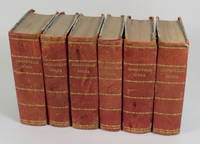
156122490Lugduni Lyon: Jacobi Juntae Jacobus Junta. Good with No dust jacket as issued. 1561. Hardcover. Early previous owner's name clipped from title leaf on each volume with unfortunate loss to some text on title leaf and to the printer's emblems on the title pages. One volume also with loss of text to corresponding portion of leaf following title leaf. Boards rubbed. Spines faded and rubbed. Corners of boards rubbed and worn. A couple of leather corners missing. Most other corners rubbed with abrasions to leather. Tomus quartus with some creasing to corners of leaves pages 705-760. ; 6 volumes of an 8 volume set. Volumes 1-4 6 Index volume. Printed date of 1561 in the Index volume only. Other volumes undated 1561. 19th century red half leather binding small leather corners with marbled papered boards. Page dimensions: 114 x 74mm 4 ½" x 2 7/8". Text in Latin. The titles of the six volumes are: 108.430 "Index Rerum Omnium Quae In Aristotelis Operibus Continentur Absolutissimus. In quem tota illius varia ac admirabilis doctrina quae sparsim ac diffuse suis in voluminibus tractatur contracta fuit ac ordine Alphabetico per locos communes digesta." Index volume to the first six volumes Tomus primus - Tomus sextus. 860 pages. Large piece cut from the title leaf and replaced with blank paper not recent with loss of the entire printer's emblem. This index volume contains page references to Volumes 1 - 6 but none to the eighth volume 108.430G.108.430A "Aristotelis Stagiritae Organum quod logicam appellant. Tomus Primus." 637 1 pages. Early owner's name cut away from title leaf with slight cropping to the top of the printer's emblem. Missing paper replaced not recent.108.430B "Aristotelis Stagiritae Physicorum Libri VIII. Quibus adiecimus omnia illius Opera quae ad Naturalem Philosophiam spectare videbantur. Quorum seriem versa pagella indicabit. Tomus secundus." 796 1 1 blank pages. Early owner's name cut away from title page with loss to "Tomus Secundus" and the upper part of the printer's emblem and also loss to 2 lines of the Contents on the verso of this leaf. Missing paper replaced with blank paper not recent.108.430C "Arisotelis Stagiritae Metaphysicorum Libri XIIII. Theophrasti Metaphysicorum Liber. Quorum omnium recognitionem et additamentum versa pagina ostendit. Tomus Tertius." 583 1 blank pages. Early owner's name cut away from title page with loss to "Tomus Tertius" and the upper part and left side of the printer's emblem and also loss to 2 lines of the Contents on the verso of this leaf. Missing paper replaced with blank paper not recent. 108.430D "Aristotelis Stagiritae Libri Omnes quibus Historia Partes Incessus Motus Generatioque Animalium atque etiam Plantarum naturae brevis description pertractantur. Quoniam seriem nominaque Interpretum versa pagina indicabit. Tomus Quartus." 842 1 1 blank pages. Owner's name cut away from title leaf with loss of "Tomus Quartus" and substantial part of printer's emblem and loss of 2 lines of the Contents on verso of this leaf. Also through carelessness there is loss of 3 lines of text on both recto and verso of the following leaf pages 3-4 In removing a piece from the title leaf the corresponding piece was also cut away from the following leaf. Missing paper on title leaf only replaced with blank paper not recent. This volume also with some creasing to corners of leaves pages 705-760. 108.430F "Aristotelis Stagiritae Rhetoricorum Artisque Poeticae libri atque etiam Problematum Sectiones omnes quibus Alexandri Aphrodisaei Omnia Problemaata adiuncta fuere. Quorum omnium seriem versa pagina commostrabit. Tomus sextus." 751 1 pages. Early owner's name cut away from title page with loss to left side of the printer's emblem and also loss to 6 lines of the Contents on the verso of this leaf. 15mm chip to lower blank corner of title leaf.Provenance: early-mid 20th century bookseller's ticket on front pastedown of each volume Newbold's Bookshop Dunedin New Zealand. Acquired from Scribes Bookshop Dunedin 2021.Lacking these two volumes:108.430E "Aristotelis libri omnes quibus tota moralis philosophis . . . Tomus quintus"; 104.430G "Aritotelis Stagiritae rhetoricorum artisque poeticae libri omnes". Reference: Cranz F. Edward "A Bibliography of Aristotle Editions 1501-1600" Second Edition with addenda and revisions by Charle B. Schmitt 1984: 108.430 p. 76 "Index rerum omnium"; 108.430A Addenda p. 146 "Tomus primus" - "This edition which includes 108.430B-104.430G accompanies the index volume 108.430 which is dated 1561"; 108.430B Addenda p. 146 "Tomus secundus"; 108.430C Addenda p. 146 "Tomus tertius"; 108.430D Addenda p. 146 Tomus quartus"; 108.430F Addenda p. 146 "Tomus sextus". . Jacobi Juntae [Jacobus Junta] hardcover
15551805240137Paris: Parisiis: Guil. Morelius apud Adrianum Turnebum typographicus Regium 1555. Hardcover. Good. Aristotle's Nicomachean Ethics in 10 books. Bound in 17th century morocco. 6 raised bands gilt ruled. Front hinge cracked. Gilt stamping to front board. All edges marbled. Marbled end pages. Small folio 29 cm. 4 253 1 pages. Text printed in parallel columns Greek and Latin. Pages generally unmarked. Minor toning. Some faded early marginalia. Adams A1810; BM STC French 1470-1600; p. 26. Colophon: Excudebat et cum graecis latina coniungebat Guil. Morelius M.D. LV. xii. Cal. Martias. <br> Book plate of Leon J Agourides "Knowledge is power." <br> Other titles: Aristotelis de moribvs ad Nicomachvm Lib. X. Aristotelis De moribus ad Nicomachum lib. XDe moribus ad Nicomachum lib. X Parisiis: Guil. Morelius, apud Adrianum Turnebum typographicus Regium hardcover
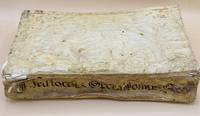
154866468Basileæ Basel: Ex Officina Joan. Oporini Joannes Oporinus 1548. Good. Second volume of a work in three volumes. 667pp. Quarto 33 cm Mid-17th-century vellum binding likely Spanish but possibly Italian. Bold manuscript title on the spine. Gauffered edges. With tanned skin sewing supports. Initial letters. Text block hanging on to wraps by a single leather cord. Missing title page and prefatory pages to Aristotle's work on auscultation. Text block cracked a couple of times at the rear. Light marginal tidemarks to the preliminary pages. Occasional manuscript notations. Pages exceptionally bright. Latin text.<br /> <br /> Contents:<br /> <br /> Aristotelis Stagiritae Physicae Auscultationis Io. Argyropylo Byzantio Interprete: Liber Primus; Liber Secundus; Liber Tertius; Liber IIII; Liber V; Liber VI; Liber VII; Liber VIII.<br /> <br /> Aristotelis Stagiritae De Coelo Io. Argyropylo Byzantio Interprete: Liber Primus; Liber Secundus; Liber Tertius; Liber Quartus.<br /> <br /> Epistola Nuncupatoria ad Leonem.<br /> <br /> Aristotelis Stagiritae Peripa Teticae Disciplinae Autoris: Liber De Generatione & Interitu Prior Latinus á Petro Alcyonio factus; Liber De Generatione et Interitu Posterior Latinus á Petro Alcyonio factus.<br /> <br /> Petrus Alcyonius Antonio Prato S. P. D.<br /> <br /> Aristotelis Stagiritae Meteoron Petro Alcyonio Interprete: Liber Primus; Liber Alter; Liber Tertius; Liber Quartus.<br /> <br /> Aristotelis Stagiritae De Anima Ioan Argyropylo Byzantio Interprete: Liber Primus; Liber Secundus; Liber Tertius.<br /> <br /> Petri Alcyonii In Libros Decem Aristotelis De Animalibus Se Autore Latinos Praefatio Ad Octavium Pregosium.<br /> <br /> Aristotelis Stagiritae De Sensu et Sensilibus Aut De Communibus Animae et Corporis Functionibus Liber Eodum Petro Alcyonio Interprete.<br /> <br /> Aristotelis Stagiritae De Memoria et Reminiscentia Liber Eodum Petro Alcyonio Interprete.<br /> <br /> Aristotelis Stagiritae De Somno Liber Eodum Petro Alcyonio Interprete.<br /> <br /> Aristotelis Stagiritae De Somniis et Imaginibus Liber Eodum Petro Alcyonio Interprete.<br /> <br /> Aristotelis Stagiritae De Communi Animalium Motione Liber Eodum Petro Alcyonio Interprete.<br /> <br /> Aristotelis Stagiritae De Communi Animalium Gressu Liber Eodum Petro Alcyonio Interprete.<br /> <br /> Aristotelis Stagiritae De Diuturnitate et Brevitate Vitae Liber Eodum Petro Alcyonio Interprete.<br /> <br /> Aristotelis Stagiritae De Spiratione Liber Eodum Petro Alcyonio Interprete.<br /> <br /> Theodori Gazae Thessalonicensis In Libros Aristotelis De Animalibus.<br /> <br /> Aristotelis Stagiritae De Historia Animalium Theodoro Gaza Interprete: Liber Primus; Liber Secundus; Liber Tertius; Liber Quartus; Liber Quintus; Liber Sextus; Liber Septimus; Liber Octavus; Liber Nonus.<br /> <br /> Aristotelis De Partibus Animalium et Earum Causis Theodoro Gaza Interprete: Liber Primus; Liber Secundus; Liber Tertius; Liber Quartus.<br /> <br /> Aristotelis Stagiritae De Generatione Animalium Theodoro Gaza Interprete: Liber Primus; Liber Secundus; Liber Tertius; Liber Quartus; Liber Quintus.<br /> <br /> Aristotelis Problematum Sectiones Duædequadraginta Theodoro Gaza Interprete. The second volume of Aristotle's works published by Joannes Oporinus containing the following works: On Auscultation; On the Heavens; On Coming-to Be and Passing Away; Meterology; On the Soul; On Sense and the Sensible; On Memory and Recollection; On Sleep; On Dreams and Images; On the Common Motion of Animals; On the Common Gait of Animals; On the Longness and Shortness of Life; On Breathing; On the History of Animals; On the Parts of Animals and Their Causes; On the Generation of Animals; Aristotle's Problems Section.<br /> <br /> Aristotle 384-322 B.C.E. was born in Stagira in northeastern Greece. He ranks among the greatest philosophers of all time. His works defined centuries of philosophy from Late Antiquity through the Renaissance and are still considered relevant today. A remarkable researcher and writer Aristotle produced nearly two-hundred treatises from which about thirty-one survive. His extant writings cover an extensive range of disciplines including logic metaphysics and philosophy of mind ethics political theory and aesthetics and rhetoric. In addition Aristotle's works explore non-philosophical realms as well such as empirical biology where he provided detailed animal and plant observation and description.<br /> <br /> A scholarly work in a striking vellum binding. Ex Officina Joan. Oporini (Joannes Oporinus) unknown
155567038Venice:: I. Gryphius 1555. contemporary limp vellum. Marginal worming to Biii - Diiiii; vellum soiled and a little worn; fragments of leather ties present. . Folio. Engraved vignette on title page and a few text illustrations. A few old marginal annotations associated with underlined text. I. Gryphius, hardcover
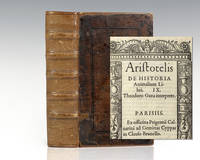
1542133014Parisiis: Ex officina Prigentii Caluarini ad Geminas Cyppas in Clauso Brunello 1542. Rare 16th century French printing of Aristotle's pioneering work on zoology which had a powerful influence on zoology for over two thousand years. Octavo bound in full polished calf engraved title pages. Rebacked. In very good condition. Written in the fourth century B.C.E. Aristotle's History of Animals had a powerful influence on zoology for some two thousand years. Generally seen as a pioneering work of zoology Aristotle frames his text by explaining that he is investigating the what the existing facts about animals prior to establishing the why the causes of these characteristics. The book is thus an attempt to apply philosophy to part of the natural world. Throughout the work Aristotle seeks to identify differences both between individuals and between groups. The work contains many accurate eye-witness observations in particular of the marine biology around the island of Lesbos such as that the octopus had color-changing abilities and a sperm-transferring tentacle that the young of a dogfish grow inside their mother's body and that the male river catfish guards the eggs after the female has left. Some of these were long considered fanciful before being rediscovered in the nineteenth century. It continued to be a primary source of knowledge until in the sixteenth century zoologists including Conrad Gessner all influenced by Aristotle wrote their own studies of the subject. Ex officina Prigentii Caluarini ad Geminas Cyppas in Clauso Brunello unknown
1545D11150Venice: Hieronymus Scotus 1545. Hardcover. Very Good. 8vo 157 x 106mm. 8 307pp. 13 leaves including final blank. Woodcut printers device of Scotus with personification of globe and motto FIAT PAX IN VIRTUTE Peace be with thee. Latin translation by Theodore Gaza. 12-line woodcut historiated initials at beginning of first chapter and at beginning of the Universalis generationis partitio. p. 224 of heraldry. Few woodcut initials throughout. Contemporary vellum; worn; spine and covers darkened; scattered stains worming affecting title next leaf and last 3 leaves; edges stained brown and gauffered to floral pattern. Sound copy enhanced by Latin marginalia in an contemporary hand. The Renaissance public as a part of their reading system frequently engaged Aristotles natural writings. Even at the height of this period at a time when Theodore Gaza had already produced his celebrated versions of Aristotles zoological corpus these works obtained wide recognition. <br/><br/>Aristotles zoological works edited by Theodore Gaza with Italian Renaissance commentary sparked on by the availability of Gazas text. Gazas version of the treatises were paraphrases of Aristotles zoological works but also included personal observations and information drawn from the other authors. Gaza in fact held a virtual monopoly on the biological works of Aristotle his translation completely overshadowing those before him and especially of his rival George of Trebizond. Gazas text had been used mainly as a source of quotations and only in philological and medical works such as Castigationes plinianae by Ermolao Barbaro or Benedettis Historia corporis humani. By 1521 starting with a course on the De Partibus animalium held in Bologna did the official Renaissance tradition of interpretation on Aristotles zoology take form. The Latin text which contributed to this renewed interest was none other than the elegant translation by Gaza. University Aristotelianism specifically that concerning the zoology was approached by the various interpreters in the context of systematic exploration of the encyclopedic work as a whole. The ample annotations of this volume showcase precisely this type of interaction with the evolving conversation. Gazas work throws light on Renaissance Aristotelianism carried out through the grid of scholastic commentary. Hieronymus Scotus hardcover
15541506230049Venice: Apud Hieronymum Scotum 1554-01-01. Hardcover. Good. Folio. Original vellum. Minor soiling to cover. Good binding and cover. Later leather binding straps. Later end pages. Printer's device on title page. Text generally clean a few lines of early marginal notation and underlining. Collated: A-L8 M-M6 N-N4 in 8's with the title as leaf A1. Faint stain on first few leaves. Edito princeps 1535. Refs: British Museum p. 44. STC Italy Vol I. p. 99; Not in Brunet. <br><br> Johannes Philoponus John the Grammarian or John of Alexandria was an important Aristotelian commentator and Christian theologian. John's commentaries on Aristotle were influential on medieval and early modern thinkers in Europe such as Gianfrancesco Pico della Mirandola and Galileo. Philoponus has been seen as an important precursor to the establishment of empirical philosophy. <BR> In this book Philoponus comments on Aristotle's De Anima On the Soul and substantially modifies Aristotle's ideas. His commentary deals specifically with Aristotle's theory of light "Philoponus contends that Aristotle' view fails to account both for the laws of optics. Philoponus modifies the theory so as to save the phenomena he proceeds to re-interpret the term Energeia not as a state of actuality but rather as an 'incorporeal activity' which besides constituting the transparency of the medium is also capable of warming bodies.Due to this novel interpretation of Aristotle's terminology light is now understood not statically but as something dynamical." - Stanford Philosophical Encyclopedia. <BR>It should also be noted that since Michael Hayduck's edition Berlin 1897 it is generally assumed by scholars that the third book of the commentary that had been ascribed to John Philoponus wasoriginally written by Stephanus of Alexandria as is attested in the manuscript Parisinus gr. 1914 11th/12th cent. An important early work in physics and natural philosophy. Venice: Apud Hieronymum Scotum hardcover
15421412010050Venetiis: Brandinus & Octavianus Scotus 1542-01-01. Hardcover. Good. 0x0x0. Folio. 2 85p 48p 1. Bound in modern leather. 4 raised bands. Gilt title to second compartment. Printers imprint to final leaf. Fine binding and cover. New FFEP. Marginal dampstain throughout. Otherwise clean unmarked pages. <br><br>John Philoponus also known as John the Grammarian or John of Alexandria was a Christian and Aristotelian commentator and the author of a considerable number of philosophical treatises and theological works. A rigorous sometimes polemical writer and an original thinker who was controversial in his own time John Philoponus broke from the Aristotelian-Neoplatonic tradition questioning methodology and eventually leading to empiricism in the natural sciences. He established his own independent thinking in his commentaries and critiques of Aristotle's On the Soul and Physics. In the latter work Philoponus became one of the earliest thinkers to reject Aristotle's dynamics and propose the 'theory of impetus': i.e. an object moves and continues to move because of an energy imparted in it by the mover and ceases movement when that energy is exhausted an early that was the first step towards the concept of inertia in modern physics. <br>His works were widely printed in Latin translations in Europe from the 15th century onwards. His critique of Aristotle in the Physics commentary was a major influence on Giovanni Pico della Mirandola and Galileo Galilei who cited Philoponus substantially in his works often citing him more than Plato. Philoponus' main significance in the history of science lies in his being at the close of antiquity the first thinker to undertake a comprehensive and massive attack on the principal tenets of Aristotle's physics and cosmology an attack unequaled in thoroughness until Galileo. <br><br> LC: Adams P1058 Venetiis: Brandinus & Octavianus Scotus hardcover
1531133411Parisiis: Petri Vidouei 1531. Rare 16th century French printing of Aristotle's third book of logic. Folio bound in full vellum elaborate woodcut vignette-border title-page illustrated with numerous in-text woodcut diagrams and woodcut initials. Ownership inscriptions including that of American philosopher Allan Gotthelf. Gotthelf received many honors for his work on Aristotle including in 2004 an international conference on "Aristotle on Being Nature and Life" held "in celebration of his contributions to the study of classical philosophy and science." In very good condition with some dampstaining and period marginalia throughout. Being one of the six extant Aristotelian writings on logic and scientific method The Prior Analytics was first composed around 350 BCE. The work represents the first formal study of logic where logic is understood as the study of arguments. In the Prior Analytics Aristotle identifies valid and invalid forms of arguments called syllogisms. A syllogism is an argument that consists of at least three sentences: at least two premises and a conclusion. Although Aristotle does not call them "categorical sentences" tradition does; he deals with them briefly in the Analytics and more extensively in On Interpretation. In the sixth century Boethius composed the first known Latin translation of the Prior Analytics. No Westerner between Boethius and Bernard of Utrecht is known to have read it. Petri Vidouei hardcover
1503D20057Venice: Octaviani Scoti per Bonetus de Locatellis 1503. Hardcover. Very Good. Small folio printed in gothic type in two columns woodcut initials & text diagrams; woodcut printer's device on final leaf. Bound in modern half parchment with printed paper boards. A copy with significant contemporary marginal notes in several sections the annotations run tight up against the outer margin. Title page cut down by one inch at the foot; some scattered spotting & worming but generally a nice copy of an early and uncommon to the market post-incunable edition worthy of future study. A recent edition was published in 2024 by the Aquinas Institute. Beth Mortensen summarizes the significance of the text: "All of us living in this Cartesian age grow accustomed to thinking of our bodies as animated machinesmachines that function better or worse subject to innumerable material factors. De Anima On the Soul reminds us that the human person is one whole and the soul is actively making the body what it is. This means that among other things the quality of the bodys functioning does not determine a human beings 'quality of life' and it is completely irrelevant to that persons worth or dignity." see: aquinas institute - commentary on de anima. <br/><br/> Octaviani Scoti per Bonetus de Locatellis hardcover
1549047<b>FIRST EDITION of this translation the FIRST ITALIAN TRANSLATION OF THE POETICS a little minor spotting in places tiny worm track to blank area of first two leaves early ownership inscription Jacobi Peruli Vabmatis' to title page pp. xii 355 25 4to eighteenth-century Italian vellum spine lettered in ink all edges blue a few tiny wormholes to backstrip a very good copy house in a maroon clamshell case with a black morocco label. A nice clean copy of the first edition of this translation of Aristotle's Rhetoric and poetics into Italian by Bernardo Segni 1504-1558 the first translation of the Poetics and the second of the Rhetoric to be printed. there was enough demand that a second edition was printed two years later.</b> Appresso Lorenzo Torrentino hardcover
1525133419Venetiis: Octaviani Scoticiuis 1525. Rare early 16th century Venetian printing of Aristotle's pioneering work on zoology which had a powerful influence on zoology for over two thousand years. Folio bound in full vellum illustrated with woodcut initials. In very good condition. Deaccessioned from the Harvard College Library with their stamps and bookplate. Written in the fourth century B.C.E. Aristotle's History of Animals had a powerful influence on zoology for some two thousand years. Generally seen as a pioneering work of zoology Aristotle frames his text by explaining that he is investigating the what the existing facts about animals prior to establishing the why the causes of these characteristics. The book is thus an attempt to apply philosophy to part of the natural world. Throughout the work Aristotle seeks to identify differences both between individuals and between groups. The work contains many accurate eye-witness observations in particular of the marine biology around the island of Lesbos such as that the octopus had color-changing abilities and a sperm-transferring tentacle that the young of a dogfish grow inside their mother's body and that the male river catfish guards the eggs after the female has left. Some of these were long considered fanciful before being rediscovered in the nineteenth century. It continued to be a primary source of knowledge until in the sixteenth century zoologists including Conrad Gessner all influenced by Aristotle wrote their own studies of the subject. Octaviani Scoticiuis hardcover
158450934Morgiis Guillelmus Laimarius 1584. Small folio. 18th century half vellum somewhat soiled and worn. Corners and edges bumped and worn. Handwritten title to spine. Fore-edge with 2-line title in neat contemporary hand and with the "Societas Jesu" i.e. the Jesuit Society symbol in white to the otherwise red fore-edge. Internally a very ni8ce copy with the occasional browning and spotting. A faint damp stain to top marging of some leaves. A small hole to top of title-page far from affecting print. Last leaves with neat strenthening of blank upper corners far from affecting text. Old presumably 18th century owner's name to title page: "Ioan. Bey A. Vest." Front free end-papers heavily annotated presumably by this same owner in Latin Greek and German. The annotations include and elaborate handwritten index information about the edition and references to the Greek sentences. Verso of last leaf and back end-papers also with notes. A few underlinings here and there. Woodcut ornamental title-border woodcut vignettes woodcut initials numerous woodcut illustrations and diagrams in the text. Greek-Latin parallel-text. 8 831 1 pp. <br/><br/><em>The very rare first edition of Julius Pace's seminal "Organon"-edition which was the standard-edition of the logical texts of Aristotle throughout more than a century running through at least 11 editions before 1624. Pace's version of the text in Greek-Latin parallels and with Pace's inspired commentaries and interpretations profoundly influenced Renaissance thought determining the course of the Organon-interpretation throughout this period and inspiring much original philosophical thought. Pace's interpretation of Aristotle's logical works - arguably the most influential collection of works in the history of Western thought - not only changed the face of Renaissance thought it has remained the authoritative reading of Aristotle's "Organon" to this day and is still considered the most important and authoritative reading of the texts. As Ross puts it in the Preface to his translation of the logical works the standard Oxford-edition: "My chief authority in matters of interpretation has been Pacius". "The Works of Aristotle Translated into English Under the Editorship of W.D. Ross. Volume I". Oxford University Press. To this day a proper study of Aristotle's "Organon" - and Porphyrios' "Isagoge" - is still unthinkable without references to Pace his rendering of the text and his interpretations of it. The famous "Porphyrian Tree" or "arbor porphyriana" which has gone down in history as a standard presentation of the basis of Aristotle's thought was presented by Porphyrios in his "Isagoge" which since Antiquity has accompanied Aristotle's "Ornanon" as an introduction thereof. The standard presentation of this tree is that of Pace in the present edition on p. 9. It is that rendering of it with occasional slight alterations which has remained standard ever since 1584. That which we ever since Antiquity have called the "Organon" comprises the logical works of Aristotle: 1. Categories 2. On Interpretation 3. Prior Analytics 4. Posterior Analytics 5. Topics 6. On Sophistical Refutations - which ever since late Antiquity/early Middle Ages have been accompanied by Porphyrios' 233/34-ca.310 "Isagoge" his introduction to Aristotle's "Categories". During the Renaissance all editions of Aristotle's "Organon" also comprised Porphyrios' "Isagoge" which was seen as necessary for the understanding of Aristotle's logic. Aristotle's logic has played a seminal role in the history of Western thought. No other collection of writings has had an impact on the history of philosophy that comes close to the "Organon" an impact that remains pivotal to this day. "Aristotle's logic especially his theory of the syllogism has had an unparalleled influence on the history of Western thought." SEP.From Antiquity the earlier middle ages had inherited Boethius' translation of the two first treatises of Aristotle's "Organon" along with Porphyrios' "Isagoge". These works formed the basis for logical study and teaching until the end of the 11th century. Only during the 12th and 13th centuries were Aristotle's writings - along with those of the Arabic and some of the Greek commentators - translated into Latin. When the medieval universities reached their full development during the thirteenth century Aristotle's works were adapted as the standard textbooks for all philosophical disciplines - thus modern terms for many philosophical and scientific disciplines correspond to the titles of Aristotle's works e.g. Ethics Physics Metaphysics. Through Aristotle's works the West thus acquired not only the specific problems and ideas that were being dealt with at the universities but also the terminology used to describe and discuss them and the systematic framework within which all relevant problems should and could be treated. But come the Renaissance we see a clear change in the use of Aristotle's works. We here witness something other than a mere continuation of the late medieval Aristotelianism. The Humanists began supplying new translations of Aristotle's works and translated all the Greek commentators of Aristotle many of them for the first time. And thus a tendency to emphasize the original Greek Aristotle developed a tendency that became pivotal for the development of modern thought - the development of modern science and modern philosophy is inextricably linked with the Renaissance Humanist editions of Aristotle's works in Greek with Latin parallel-text. The "Organon" Aristotle's seminal logical writings occupies a central position within the Aristotelian body of writing and thus within the development of Western thought. Certain Humanist versions of the Greek text and the Latin translations as well as the interpretations of them thus came to play a seminal role in the trajectory of Renaissance and modern though Pace's "Organon"-edition presumably being THE most important and influential edition ever to have appeared. "The medieval traditions of logical writing survived well into the sixteenth century particularly at Paris and at the Spanish universities though with considerable internal changes. Treatises on sophisms and on proofs of terms ceased to be written; whereas there was a sudden flurry of activity concerned with the various divisions of terms and with the opposition of propositions i.e. the logical relations between different kinds of categorical proposition. These internal changes were not however sufficient to keep the tradition alive and after about 1530 not only did new writing on the specifically medieval contributions to logic cease but the publication of medieval logicians virtually ceased. The main exceptions were the logical commentaries by or attributed to such authors as Thomas Aquinas and John Duns Scotus which found a place in their "Opera Omnia" and which benefited from a revived interest in the great medieval metaphysicians.The main changes in the teaching and writing of logic during the sixteenth century were due to the impact of humanism. First commentaries on Aristotle came to display a totally new style of writing. One reason for this was the influence of new translations of Aristotle and new attitudes to the Greek text. Another reason was the publication of the Greek commentators on Aristotle's logic Alexander Themistius Ammonius Philoponus and Simplicius. A third reason was the new emphasis on Averroes which expressed itself in the great Aristotle-Averroes edition of 1550-1552. The effects of these new factors can be seen in the commentaries on individual works of the "Organon" by such Italians as Agostino Nifo 1473-1546 and Jacopo Zabarella 1533-1589 the latter of whom offered a particularly influential account of scientific method. They can also be seen in the "Organon" edition of Giulio Pace 1550-1635 which was first published in 1584 and contained the Greek text side-by-side with a new translation which was designed not only to read well but also to capture the philosophical significance of Aristotle's words." Raul Corazzon "History of Renaissance and Modern Logic from 1400 to Stuart Mill"."No editor better understood the nature of this Treatise of Aristotle than Julius Pacius who was the preceptor of Casaubon and profoundedly skilled in all the arcane of the Peripatetic philosophy in both the Greek and Latin tongues." Dibdin I: 318Giulio Pace of Beriga or Julius Pace/Pacius 1550 - 1635 was a famous Italian Aristotelian scholar and jurist. He was born in Vicenza and studied law and philosophy in Padua. He was inspired by the Reformation and put on trial by the Inquisition. Therefore he had to flee Italy and escaped first to Geneva thereafter to Germany. While in Heidelberg he converted to Protestantism. He was highly respected as an academic and was widely known for his deep knowledge and understanding of Aristotle whom he became famous for translating. He was elected public professor in Geneva where he taught for ten years 1575-1585. The next ten years he spent teaching law at the University of Heidelberg where he got into different conflicts especially with the philosophical faculty for giving private tuition in the controversial Ramist logic. After Heidelberg he taught at different universities throughout Europe where he was especially well known for his 1584-edition of Aristotle's "Organon" which played a definitive role in Aristotle-scholarship and philosophy in general throughout all of Europe.Dibdin I:318; Adams A:1866. </em> hardcover
150565845Venetiis: 1505-1507. later old quarter vellum over marbled baords. Some old ink annotations and a neat repair to one corner of the first leaf; neat old marginal annotations in Latin to the Aristotle. Some inoffensive scattered marginal stains; contents very attractive. 4to. hardcover
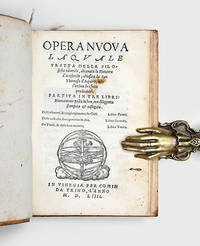
1554180648Venice: Comin da Trino 1554. Aristotleianism astrology and the development of Italian scientific prose First edition in Italian at the time the most complete translation of Aristotle's Meteorology in the vernacular together with extended commentary from two prominent medieval philosophers. This edition furthers the adaptation of Aristotle by medieval thinkers to support a range of contemporary interests most notably astrology. From its Latin translation in the 12th century until well into the 17th the Meteorology was "the unquestioned authority on weather theory" Frisinger p. 638. By 1554 Renaissance astrologers had long looked to it to support their conviction that the stars influence events on earth. Albertus Magnus c.1200-1280 among the most prominent medieval Aristotelians was one of the first to propose this astrological interpretation which characterizes the present edition. Following the great wave of scholarly Latin translations vernacular manuscripts of Aristotle's works began appearing from the 13th century onwards often commissioned by rising mercantile families. This edition is based on an anonymous translation made in 14th-century Florence. It pairs a revised and condensed version of the Meteorology with sections drawn from the commentaries of Albertus and to a lesser extent Thomas Aquinas. In several cases the editor has used their translation to bring Aristotle's text in line with Albertus's interpretation blurring the line between astronomy and astrology. Octavo 150 x 101 mm ff. iv 92. Woodcut printer's device to title page headpiece and historiated initial. Contemporary vellum spine lettered in manuscript ink remnants of morocco ties edges sprinkled red. Contemporary ink annotations between pp. 36-58 primarily focusing on explanations for atmospheric phenomena. Light rubbing and soiling infrequent minor browning and foxing: a very good copy. EDIT16 CNCE 2945; USTC 810943. H. Howard Frisinger "Aristotle and his 'Meteorologica'" Bulletin American Meteorological Society vol. 53 no. 7 July 1972; J. D. North "La 'Metaura' d'Aristotile: Volgarizzamento fiorentino anonimo del XIV secolo. Aristotle Rita Librandi" Speculum-A journal of medieval studies vol. 73 no. 2 1998. hardcover
1501300661501. Problemata Alexandri Aphrodisei. Problemata Plutarchi cum gratia. - Venetiis Per Bonetum Locatellum 1501 Folio 304 x 210 mm 22 296 fl. double colum gothic letters woodcut initials printer device fine full leather binding. A broad marginated clean and well preserved copy of this beautifully volume printed on strong paper. The greatest scientific name after Hippocrates is that of Aristotle 384-322 B.C. who gave the medicine the beginnings of botany zoology comparative anatomy embryology teratology and physiology and use of formal logic as an instrument of precision. Aristotle a pupil of Plato and at one time tutor to Alexander the Great had a profound influence in determining the direction of medical and biological thought; perhaps no other man has so dominated and advanced science as a whole.The Aristotelian Problemata enjoyed considerable popularity in the Middle Ages especially its book IV dealing with sexual intercourse and generation which adapted in such manner that it became a kind of pornographic publication. Petrus de Abano 1250-1315 was one of the most illustrious and influential men of his time and probably the most influential medical writer of the later middle age. A native of Apano near Padua from which he takes his name he took his degree in Paris and his cures were so remarkable that he was able to obtain the highest fees of any physicians of his time. He was called the Consiliator because of his remarkable book published during his residence in the Paris University. He was consulted by such man as Pope Honorius IV and was in great demand for lectures consultation and teaching. Dante was among his pupils. Abano believed that air has weight that brain is the source of the nervous system and the heart the source of the blood vessels- novel ideas that were not validated for centuries. He was the first to acquaint the West with the Problemata from Aritotle`s school to which he wrote the present commentary. For his heretical and outspoken views he was several times accused of heresy. Later he was suspected of magic and persecuted on that account during the Inquisition. Dying before his trial his body was taken out and burned in the public square. The medical science of the scholastic was a part of the universitas litterarum the scholastic physicians were philosophers. The methods of thought had been prescribed by Aristotle and the learned man of Arab. "Petrus spent some time in Constantinople probably before 1293; during his stay found a copy of the Problems of Aristotle.he translated them into Latin for the first time. He began a commentary on these problems while in Paris and completed it at Padua in 1310.His experience and activity represents a landmark in the history of scientific humanism." -Sarton III 439 "Prefatory note by Domenico Massaria. The translatio antiqua of Aristotle is that by Bartholomaeus de Messina which usually accompanies the commentary by Pietro d'Abano; not the ancient Latin version beginning Omnes hominess.- The Problemata of Alexander of Aphrodisias is in the translation of Giorgio Valla; the Problemata Quaestiones convivales of Plutarch in that by Giovanni Petri edited by Giovanni Calfurnio." -Durling NLM no. 286 p. 36; Thorndike II 874-947 921; Sarton III/1 pp.439-446; Sigerist Great doctors 75-79; Gordon Medial & Renaissance Medicine pp. 333-337; Brit. Museum Ital. Books Aristotle p.55. This edition not in Osler Wellcome Cushing Waller Adams etc. RILEY Aristotle texts and commentaries in the Univ. of Pennsylvania Library 1961 has only an edition of 1505 no. 209 hardcover
1514104082Venice: Gregorium de Gregorijs 1514. Rare 16th century printing of Aristotle's Posterior Analytics; bound together with Spanish Franciscan theologian Antonius Andreas's best known work Quaestiones super XII libros Metaphysicae Aristotelis. Quarto bound in contemporary parchment over handmade paper-covered boards woodcut initials text in two columns. In very good condition. A rare and desirable collection. The Posterior Analytics is a text from Aristotle's Organon that examines demonstration definition and scientific knowledge. In the work Aristotle distinguishes 'demonstration' as a syllogism productive of scientific knowledge and 'definition' as the statement of a thing's nature: the meaning of its name or of an equivalent nominal formula. In the Prior Analytics syllogistic logic is considered in its formal aspect; in the Posterior it is considered in respect of its matter. The "form" of a syllogism lies in the necessary connection between the premises and the conclusion. Aristotle concludes the book with the way the human mind comes to know the basic truths or first principles which are not innate because people may be ignorant of them for much of their lives. Of all types of thinking scientific knowing and intuition are considered as only universally true where the latter is the originative source of scientific knowledge. Gregorium de Gregorijs hardcover