ErasmusABAA

17 résultats
1549046607London: Edwarde Whitchurche 1549. Very Good Condition. Single leaf solio XXXIX light chipping at edges small dampstain in inner margin. ESTC S5153 Size: Folio. Quantity Available: 1. Shipped Weight: Under 1 kilo. Category: Religion & Theology; Antiquarian & Rare. Inventory No: 046607. Edwarde Whitchurche unknown books
15471328082Lugdunum: Ioannes Pul Ioannes Pullonus 1547. Other. Tibulli propertii ac Ovidii flores ab Ioanne Murmelio olim selecti nunc autem ab Augusto Botta Rouescallen. Iocupletissimè aucti ac recogniti. Edited by Ioannes Murmellius and Augustus Botta Rouescallen. Lugdunum: Ioannes Pullonus 1547. 117 pp. Text in Latin. Duodecimo in early vellum boards. A partial title has been written on the spine in faded ink. The initials F.R.G.F.C. appear in ink on the title page and the name Erasmus has been crossed out in two instances. A book stamp likely placing this volume in a library or collection in Bologna in the 19th century appears on the final page of text. Condition: Very Good. The boards are very thin and have become cockled. The vellum is somewhat darkened with age and light staining and shows minor insect damage. There is evidence of a closure device now absent on both boards. Both paste downs are partially detached but the binding is overall very solid. The pages are somewhat age-toned with occasional foxing. There are a handful of small ink marks to the textblock. Dimensions 4.25 x 6.375 x 0.625 inches<br /> <br><br /> <br><br /> shelved case 3. 1328082. Shelved Dupont Bookstore. Ioannes Pul [Ioannes Pullonus] unknown books
1571D10980Basel: Eusebius Episcopius & heirs of his brother Nicolaus 1571. Hardcover. Very Good. 8vo 165 x 104mm. 36 621 63 pages including final leaf with printers device of the word EPISCOP. Episcopus separated by stork surmounting bishops crozier on verso. Edited by Desiderius Erasmus; revised by Johann Jacob Grynaeus. Contemporary calf over wooden boards with blind-stamped arabesque centerpiece on covers brass catches lacking clasps rebacked spine gilt labeled IRENAEI HAERESES 1571; front joint cracked but cords intact; dark stain on opening leaves paper cracks and small holes in title not affecting text some light dampstaining in hinge toward end. 17th-century signature of Robert Baillie to title the famous Covenanter according to pencil note on front endpaper. 19th-century Chiesa Libera stamp on title; and pictorial bookplate of Douglas and Mildred Horton dated 1962 to front pastedown. Reverend Dr. Douglas Horton married Mildred née McAfee in 1945 who was a prominent female captain in the United States Naval Reserve and later the president of Wellesley College. <br/><br/>Irenaeus theological treatise written c. 180 attacked contemporary Christian heresies particularly Gnosticism and the system devised by Valentinus c. 100-c. 160. Irenaeus treatise also supported the idea that bishops maintained apostolic ties to the era of Christ and that a bishop was the best guide to understanding scripture. Given the very bishop-centric message of this work perhaps it is not curious at all that the Episcopius press expressed interest in printing it In Latin Episcopus is bishop. It was not until the 16th century that Irenaeus Opus eruditissimum was widely disseminated first published in Latin by Froben of Basel in 1526 and in the original Greek in 1570. Erasmus famously edited this Latin edition which appeared a year after the first Greek. In it he removed two annotations which referred to baptism and purgatory and also corrected a passage concerning the fault of Adam. The text itself is a new translation of the first book with an extensive dedication to the Basel Mayor Bernhard Brand and the founder of the Basel Reformed Orthodoxy Church Johann Jacob Grynaeus. Irenaeus Opus appears in 10 editions before this one published in both Basel 1528 1534 1548 1554 1560 and Paris 1541 1545 1563 1567 1570. This volume once belonged to Robert Baillie 1602-1662 a Glaswegian and Presbyterian minister and writer known for his Letters which faithfully recorded public events and his participation via correspondence. Baillie was a leader in the 17th century movement that rejected the Church of Englands Book of Common Prayer. From a reformative point of view Baillie would have found interest in Irenaeus work which recognized the canonical character of the gospels. For a work against the Gnostics it is said to contain valuable historical information and a great many New Testament quotations which are a witness to the New Testament text long prior to any extant manuscript; it is the first systematic exposition of Christian theology--Sarton I 294. Hoffmann II 466. Eusebius Episcopius & heirs of his brother Nicolaus hardcover books
1538046897Frankfurt: Christianum Egenolphum 1538. First Edition. Hardcover Full Leather. Very Good Condition. Contemporary rolled pigskin a bit stained lacking ties wear at edges page edges a little stained but quite sound and attractive overall. Scattered minor browning staining minor worm holes early marginalia. Tear to edges of leaf 142 with loss to some marginalia chipping to bottom right corner of following pages. Attractively printed with historiated initials. 349 leaves with the rear blank with the printer's device. Graesse L280 Adams L 1611 1543 reprint.<br/><br/>First edition of this Latin translation it was reprinted in 1543. Size: Folio. Quantity Available: 1. Shipped Weight: Under 1 kilo. Category: Literature & Literary; Antiquarian & Rare. Inventory No: 046897. Christianum Egenolphum hardcover books
1556LLV2641Lugduni Lyon:: Seb. Gryphium 1556. 1556. Small 8vo. Pagination: 473 23 pp. Signatures: a-z8 A-H8. Printer’s device on the title page woodcut initials printed marginalia; editor’s name on title and p. 2 are lined out in ink three small worm holes from title-page. Nineteenth century quarter gilt-ruled calf red paper board boards. Early ink name on title of "Carolus . . ." and occasional marginalia pp. 58 61 62 80-83 heavy notes - in the same hand. Very good. Beautifully printed early pocket edition printed by Sebastianus Gryphius 1493-1556 of Suetonius’ most famous work and one of the few of his texts that survive with excellent annotations by Desiderius Erasmus of Rotterdam. Commonly known as The Twelve Caesars the work contains a set of twelve biographies of Julius Caesar and the first eleven emperors of the Roman Empire Augustus Tiberius Caligula Claudius Nero Galba Otho Vitellius Vespasian Titus Domitian. It is a primary source for the study of Roman history. <br /><br /> The first edition of Suetonius with Erasmus’ annotation was issued in 1533. <br /><br /> Baudrier Henri L. Bibliographie lyonnaise VIII p. 284; Gultlingen V p. 215: I369; French Books III & IV: Books published in France before 1601 . . . edited by Andrew Pettegree Malcolm Walsby Leiden: Brill 2012 87100. <br /><br /> Locations: BYU lacks everything after p. 340 and title is damaged; NYPL. Seb. Gryphium, 1556. hardcover books
15708875Cologne: Apud Gualtherum Fabricum & JoannemGymnicum sub Monoccrote 1570. Pigskin. Very good . Sm. 8vo. 1675345pp. Woodcut device on title page. 2 woodcut historiated initials. Original roll tooled pigskin binding spine soiled. Covers with a large central stamp depicting a royal personage holding a sword and the scales of justice back cover image rather worn. Ownership signature of Andreas Drischel on verso of front free endpaper dated 1578. VD 16 E 2050. Apud Gualtherum Fabricum, & JoannemGymnicum sub Monoccrote unknown books
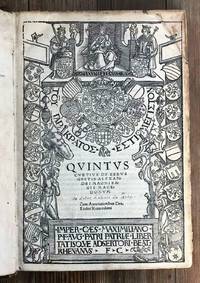
1518curtius<b>Erasmus Finds His Vacation Reading Deficient So He Prepares a New Critical Edition</b><b> <br /></b><br />Folio. 4 LXXXIX leaves; 10 124 pages. Late sixteenth century leather; light scuffing hinges cracked but cords holding tightly; insect damage to text block with loss of text throughout; margins in Orosius trimmed close affecting title image. First printing of Erasmus' critical edition of Quintus Curtius. This first century Roman biography of Alexander the Great was an early Renaissance bestseller with editions from at least a dozen printers throughout Europe by 1517. Erasmus brought it as reading material on a voyage to England in 1517 and finding the text incomplete and corrupt he prepared his own critical edition. This was first published by his friend Strasbourg printer Matthias Schürer in 1518. Erasmus' version proved so popular that five more printers had issued their own editions of his text by 1541; these in turn were reprinted a total of five more times by 1575. This first edition is scarce on the market with Rare Book Hub locating only one sale at auction since 1971 at PBA in 2008 for $2400. <br /><br /><b>Bound with</b>: Paulus Orosius <i>Adversvs paganos historiarvm libri septem</i>. Cologne: Eucharius Cervicornus 1526. An attractive copy of this first universal history by a Christian writer Paulus Orosius c 375-c 418 a Hispanic student of St Augustine who traveled widely throughout the Mediterranean. Elaborate title page border depicting the labors of Hercules signed "AW" Anton Woensam 1493-1541 a prolific painter and woodcut artist whose work was favored by the booming publishing industry in Cologne. Other page borders and initials are also by Woensam as described by Merlo 1864.<br /><br /><br /><br /> Schürer hardcover books
15421298970Basileæ: In officina Frobeniana 1542. Hardcover. Folio 8 816 pages 28 pages index; VG; bound in contemporary full vellum paneled spine with faded ink lettering to head of spine full tooling to boards partial beveling to edges; bound with two clasps majority of lower clasp missing upper clasp present; slight scraping to text block from clasp; woodcut printer's device on title page and verso of final leaf; woodcut initials; colophon on verso of final leaf; text in Latin with sections in Greek; wide margins; no bookplates or previous owners markings; index in rear; This edition is part 2 of "Nouum Testamentum iam quintum ac postremum accuratissima cura recognitum à Des. Erasmo Roterodamo cum annotationibus . Basileae 1541 1542 - cf. colophon.; consignment; shelved case 4. 1298970. Shelved Dupont Bookstore. In officina Frobeniana hardcover books
15256388Basel: Johannes Froben 1525. Very Good/Erasmus's edition of Pliny's Natural History conserving the notes from Ermolao Barbaro's edition of 1492 printed by Johannes Froben at the height of his powers. Froben's title page is effectively a billboard: "We give you the work of the Divine Pliny called History of the World more emaculate than any edition ever produced before starting with the annotations of erudite men first among them Ermolao Barbaro and then exemplary contributions by learned people which are still worth correcting with faith in the oldest codices from which we have restored many faults do difficult to find that no one no matter how learned could find them or had found them. We have nothing to envy. We have defeated all of our elders. And if someone now takes this prize from us we will not envy them but we will be grateful for the improvement of public education. Go reader and be fruitful. And by the way we added an index that lacks for nothing. Folio 37 cm; 18 leaves 671 143 pages. Woodcut printer's device the double-headed caduceus designed by Holbein on title page on verso of p. 671 on the title page of the index and on the final page. Holbein's detailed chiaroscuro woodcut initials throughout. Bound in vellum over boards titled in manuscript on spine. Old jottings in manuscript on upper board apparently an Italian and Latin vocabulary list including the names of foodstuffs. Portion of vellum near head of spine replaced. Erasmus's name on running head of dedicatory letter aggressively inked over! Occasional scattered very light foxing in a generally bright and unblemished text. References; Adams P-1560; van der Haeghen Biblioteca Erasmiana p. 45. For the initials among Holbein's largest see Schneeli and Heitz table V #II and table LXXXIII #XL. Johannes Froben hardcover books
15213319Mainz:: Johann Schöffer 1521. ONE OF 9 PRINTINGS all in 1521. Place and printer from VD16. Quarto:. 18.5 x 14 cm. 8 pp. Collation: AA4 Bound in modern wrappers. . A good copy with a light dampstain to the upper corner. Occ. light soiling. With a fine woodcut title page border. A German translation of Erasmus’ annotation on Mathew 11:29 taken from his “In Novum Testamentum annotationes†in which Erasmus differentiates between the divine order and human positive law. He laments that people ignore the commands of God and follow human law instead: ‘Christ’s law is inviting and easy but it becomes onerous and difficult through the addition of human prescriptions and dogmas.’ The verses were often used in Protestant propaganda in the early years of the Reformation hence the need for a vernacular version of Erasmus’ text. See Christine Christ von-Wedel Erasmus of Rotterdam: Advocate of a New Christianity Ch. 16 Bezzel 1228; VD16 E 3106 Johann Schöffer, unknown books
15291832Coloniae: Iohannem Gymnicum 1529. Rare edition a sound complete copy lacking only the final blank. Title within pictorial woodcut border. Octavo contemporary blind-tooled calf over wooden boards dated 1534 in blind brass clasps minor statins and soiling and some early penned marginalia. Also bound in are three additional works De Civilitate Morum Puerilium; Plutarch. De Liberis Educandis; and Horatius Flaccus. Iohannem Gymnicum hardcover books
15402712Cologne:: Ex officina Ioannis Gymnici 1540. RARE COLOGNE EDITION. Folio: . 31.2 x 20 cm. . 88 3-874 1 pp. A-d6 e8 f-g6 A-Z6 Aa-Zz6 Aaa-Zzz6 Aaaa-Dddd6 last leaf is blank. A very fine copy bound in contemporary pigskin over beveled wooden boards tooled in blind. The clasps lacking some scuffing and soiling to lower board otherwise a very nice binding. Internally a beautiful copy with the lightest of occasional soiling. Gyminus’ fine hippocamp device appears on the title. A very rare Cologne edition of Erasmus’ beloved and extraordinarily influential “Adages†first conceived as a collection of proverbial sayings drawn from the Latin authors of antiquity elucidated for the use of those who aspired to write an elegant Latin style. In its first incarnation the “Adagia†consisted of about eight hundred proverbs. The present version Erasmus' "Adagia Chiliades" “Thousands of Adages†is more than just a vastly expanded edition of that first enterprise: "A glance at its composition reveals that the ‘Adagia Chiliades’ was in fact -as well as in name- a new book and that Greek scholarship was largely responsible for the difference. Instead of 818 adages there were 3260. Of those about four-fifths were either new or substantially altered in form. And 2734 contained Greek passages of two to six lines or more in length.â€Renaissance Humanism vol. 2 pages 232-233. “In the dedication Erasmus pointed out the profit an author may derive both in ornamenting his style and in strengthening his argumentation from having at his disposal a good supply of sentences hallowed by their antiquity. He proposes to offer such a help to his readers. What he actually gave was much more. He familiarized a much wider circle than the earlier humanists had reached with the spirit of antiquity. “Prior to the ‘Adages’ the humanists had to some extent monopolized the treasures of classic culture in order to parade their knowledge of which the multitude remained destitute and so to become strange prodigies of learning and elegance. With his irresistible need of teaching and his sincere love for humanity and its general culture Erasmus introduced the classic spirit in so far as it could be reflected in the soul of a sixteenth-century Christian among the people. Erasmus made current the classic spirit. Humanism ceased to be the exclusive privilege of a few. According to Beatus Rhenanus he had been reproached by some humanists when about to publish the 'Adagia' for divulging the mysteries of their craft. But he desired that the book of antiquity should be open to all." Huizinga p. 39-40 Van der Haeghen I 4; Bezzel 83; VD16 E 1944 Ex officina Ioannis Gymnici, unknown books
1520253908Basel: Johann Froben 1520. First collected editions. Titles within ornamental woodcut border initials printer's device in colophon. 465 i.e. 495 1; 167 1; and 141 3 pp. 1 vols. 8vo. Contemporary blindstamped pigskin. Covers somewhat soiled one brass clasp missing lower joint just starting but quite firm; internally a SUPERB near flawless copy. Bookplate of scholar and author Nathan Comfort Starr. First collected editions. Titles within ornamental woodcut border initials printer's device in colophon. 465 i.e. 495 1; 167 1; and 141 3 pp. 1 vols. 8vo. First collected editions of these "Paraphrases" of the letters of Paul which were undertaken shortly after Erasmus's revolutionary edition of the Greek New Testament of 1516. As part of that monumental reconstruction of the New Testament Erasmus' intention was to "retell" the books of the New Testament in one uninterrupted voice without the clutter of textual commentary or critical interruption. It was a bold undertaking and in 1517 Erasmus began with the letters of Paul. They were first issued separately starting with Romans in 1517; and editions appeared in Louvain Thierry Martens Leipzig Valentin Schumann and Basel Johann Froben. The collected issues - such as the three which are bound together in this exquisite volume - began to be issued in Basel by Froben in 1519; and finally in 1521 Froben issued a collected edition of all of the Pauline letters. All of the lifetime editions both separate and collected are rare on the market: the last copy of any of the above collected Pauline paraphrases to appear at auction was in 1977. Adams E790; E792; E791 Johann Froben unknown books
15242455Paris:: Jodocus Badius Ascensius 1524. FIRST COMPLETE BADIUS EDITION. Quarto:. 19.8 x 14.5 cm. CXX leaves. Collation: a-p8 Bound in contemporary limp vellum lightly soiled. The contents are in very good condition with a few pencil annotations and light soiling to the title page. With Badius' device of his print shop the “Praelum Ascensianum†showing printers working a press on the title page. With large attractive crible initials and smaller charming historiated initials. Passages in Greek. A fine unsophisticated copy of this rare edition. From the personal library of Bob and Emily De Graaf. The rare 1524 Parisian “Praise of Folly†printed by Erasmus’ friend the scholar-printer Badius Ascensius who printed the first authorized edition in 1512. This edition contains all of the supplementary texts found in the Froben edition of 1516 including the dedicatory letter to Thomas More whose name Erasmus plays upon cleverly in the title of the work; and the letter to Martin Dorp in which Erasmus explains his motives for writing the “Moriaâ€: “My aim in the ‘Folly’ was exactly the same as in my other works. Only the presentation was different. In the ‘Enchiridion’ I simply outlined the pattern of a Christian life. In my little book the ‘Education of a Christian Prince’ I offered plain advice on how to instruct a prince. In my ‘Panegyric’ I did the same under the veil of eulogy as I had done elsewhere explicitly. And in the ‘Folly’ I expressed the same ideas as in the ‘Enchiridion’ but in the form of a joke.†“The ‘Praise of Folly’ is Erasmus’ most famous and controversial work… In Erasmus’ lifetime the ‘Moria’ was condemned in 1527 by the theologians of Paris for its attacks on faith and morality and again in 1533 by the Franciscans who found it full of heresies. The officials of the Sorbonne put it on the list of condemned books in 1542 and 1543 a list that was the basis of the Tridentine Index of 1564… “The ‘Moria’ may start as a learned joke to amuse a fellow humanist Thomas More but it moves into sharp criticism of contemporary mores and ends with a plea for a return to the Christianity of the Gospels… Erasmus writes in a Lucianic spirit of irreverent burlesque of the gods of classical mythology and light-hearted amusement at the irrationality of mankind. Folly argues that she is all that is natural youthful fecund and happy and that life would be intolerable if it were not ruled by civilized conventions which necessitate a degree of humbug and illusion. By contrast the Stoic ideal rational man is a ‘kind of marble statue of a man devoid of sense and any sort of human feeling.’ She then shifts her viewpoint and lists the people who enjoy her benefits in so far as they try to preserve their illusions or are happy in their ignorance self-deception or self-love. She even adds superstitious piety to alchemy gambling and the nobility’s obsession with hunting and extravagant building… “Next Erasmus starts to deliver a sharp and often bitter attack on all the victims of blind folly those who are deaf to the voice of true religion and lacking the gentler Christian virtues among whom are sycophants self-seekers money-makers pedants scholastics lawyers theologians superstitious worshippers of images and relics courtiers and kings worldly monks and irreligious pontiffs. This section culminates in a savage thrust at Pope Julius II the bellicose pope. The keen wit and ingenuity of the satire can be highly entertaining but there is no note of gaiety now. As Erasmus surveys the gulf between the Church and the ‘true philosophy of Christ’ he moves into the final section where the alternative offered to barren scholasticism is the vision of reality taken from Plato and folly in the sense used by Saint Paul that of receptivity to the Christian message by the ‘fool in Christ.’ All irony is dropped until the final short epilogue when Folly light-heartedly cuts short her ‘hotch-potch of words’; this is a direct and simply worded account of Erasmus’ personal belief moving into an exposition of the Neoplatonist concept that the soul’s ascent to beatitude ends in ecstasy a form of folly which is its supreme fulfillment.â€Betty Radice CWE Vol. 27 pp. 78 ff. Vander Haeghen I 123; Kossmann 979; Bibl. Belgica E 866; Not in Bezzel De Reuck or BM STC French; Renouard Badius II 424; Adams E 397. Inventaire chronologique des editions Parisiennes du XVIe siecle III no. 669; Renouard Imprimeurs Parisiens du XVIe siècle II no. 539 Jodocus Badius Ascensius, unknown books
1545314899Argentorati Strasbourg: Vuendelinus Rihelius Wendelin Rihel 1545. Fourth edition of the Calvin; second Froben folio edition of the Erasmus. Collation alpha-gamma6 delta4 A-Z6 a-s6 t-v4 v4 blank present. Pp. 431 505 3 blank. Errata at foot of index p. 43. 1 vols. Folio 11-3/4 x 8 inches. Contemporary blindstamped pigskin over wooden boards with metal clasps. With 8 pages of contemporary Latin notes loosely inserted; contemporary marginalia throughout second work. L2 in Calvin with old ink stains not affecting legibility; some wear along one bottom edge of binding. Manuscript prayer in Latin on lower pastedown. Small later paper label on upper cover "Bibliothèque de Spietz". A handsome copy. Fourth edition of the Calvin; second Froben folio edition of the Erasmus. Collation alpha-gamma6 delta4 A-Z6 a-s6 t-v4 v4 blank present. Pp. 431 505 3 blank. Errata at foot of index p. 43. 1 vols. Folio 11-3/4 x 8 inches. Calvin's 'Instutitio': Cornerstone of Liberty. "Calvin's 'Institution of the Christian Religion' was the first systematic statement of a Reformed Church. It is the most important doctrinal work of the Reformation as a whole and provided a comprehensive theological system rivaling those of the Middle Ages . Calvinism's most important role despite Calvin's authoritarian influences was to support the movement for liberty and independence in many parts of the world" Printing and the Mind of Man 65. First published in Basel in 1536 the "Institutio was much revised taking its final form in 1559" PMM. Calvin understood the importance of vernacular translations in the transmission of ideas made possible by the printing press and prepared a French edition in 1541. This fourth edition follows closely and corrects the third edition printed in 1543. All early editions are uncommon.<br/><br/>Calvin 1509-64 drew upon St. Augustine and Luther as well as upon classical sources including Plato and Seneca; his work addressed theological issues and also notably the relations between ecclesiastical and civil government. The contemporary annotations often callouts of classical authors and shoulder notes with a few pointing hands are most extensive in the first six chapters again in chapter sixteen on the Lord's Prayer where Melanchthon is cited but appear throughout. <br/><br/>The first work in this well preserved contemporary binding is the second Froben folio edition of Erasmus Ecclesiastes Basel: Froben 1539. OCLC 632887280 BSB Augsburg Univ. Basel. Collation a-z6A-M6N4O-Q6. Pp. 439 1 blank 18 index imprint date 1540 1 blank 1 Froben's device. This was first published in Basel in 1535. The manuscript notes refer to in the early passages of this work. The Bibliotheque de Spietz was dispersed at auction in 1874. The von Erlach family had been established at Bern since the early sixteenth century. Calvin: PMM 65; Adams C357; VD16 C 291; Peter & Gilmont Bib. Calviniana 45/5; En français dans le texte 59 for 1560 ed. Erasmus: Bezzel 823 Adams E632; VD16 E 2723 Vuendelinus Rihelius [Wendelin Rihel] unknown books
15132454Basel: and Strasbourg: and Paris:: Io. Froben and Excusum per Renatum Beck in aedibus zum Thiergarten and Jean Petit In vico Sancti Iacobi 1515 and 1515 and 1513. THIRD FROBEN EDITION of the "Praise of Folly". The two prior editions also appeared in 1515. Written in 1509 as a visitor's gift to Thomas More whose name -Morus- was so aptly similar to the Greek "moros" folly the "Moriae Encomium" was first printed by Gilles de Gourmont at Paris probably in 1511. The first of the Froben editions appeared in 1515. This copy is bound with the "Germania" of Aeneas Sylvius Piccolomini Pope Pius II together with the "Responsio" of Jakob Wimpfeling; and an edition of Lactantius edited by Gilles de Maizières and printed at Paris by Jean Petit. Large Quarto:. 20.2 x 15 cm. 3 works bound in one volume: I. Piccolomini: i-iv A-B4 C8 D-E4 F8 G-H4 I8 K-L4 M8 N-O4 P6. II. Lactantius: A6 B4 a-z8/4 A-D8/4 E6 F-N8/4 O6 P4. III. "Praise of Folly": a-h4 a-z4 A-B4 C6 Bound in contemporary quarter alum-tawed pigskin over wooden boards with working clasps and catches. The pigskin is tooled in blind with repeating vines and floral rolls. The text and binding are beautifully preserved. The contents are fresh and bright with wide margins and a number of deckled edges. Excellent. The "Germania" has a fine title page printed in red and black and surrounded by a fine woodcut border. The printer's beautiful device by Hans Baldung Grien appears on the final leaf. The Lactantius has Jean Petit's device on the title page. The text is adorned with fine floriated criblé initials. A contemporary reader has annotated the "De Opificio Dei" densely in Latin and added a long Latin poem to the final two leaves. The "Praise of Folly" has a fine Holbein border with the decapitation of John the Baptist in the lower register and affine woodcut border with a fool by Urs Graf on the contents leaf. This edition includes the original dedicatory letter to Thomas More whose name Erasmus plays upon cleverly in the title of the work; and the letter to Martin Dorp in which Erasmus explains his motives for writing the "Moria": "My aim in the 'Folly' was exactly the same as in my other works. Only the presentation was different. In the 'Enchiridion' I simply outlined the pattern of a Christian life. In my little book the 'Education of a Christian Prince' I offered plain advice on how to instruct a prince. In my 'Panegyric' I did the same under the veil of eulogy as I had done elsewhere explicitly. And in the 'Folly' I expressed the same ideas as in the 'Enchiridion' but in the form of a joke." The Froben edition is augmented with a number of other texts See the final paragraphs of this description.Praise of Folly:"The 'Praise of Folly' is Erasmus' most famous and controversial work… In Erasmus' lifetime the 'Moria' was condemned in 1527 by the theologians of Paris for its attacks on faith and morality and again in 1533 by the Franciscans who found it full of heresies. The officials of the Sorbonne put it on the list of condemned books in 1542 and 1543 a list that was the basis of the Tridentine Index of 1564…"The 'Moria' may start as a learned joke to amuse a fellow humanist Thomas More but it moves into sharp criticism of contemporary mores and ends with a plea for a return to the Christianity of the Gospels… Erasmus writes in a Lucianic spirit of irreverent burlesque of the gods of classical mythology and light-hearted amusement at the irrationality of mankind. Folly argues that she is all that is natural youthful fecund and happy and that life would be intolerable if it were not ruled by civilized conventions which necessitate a degree of humbug and illusion. By contrast the Stoic ideal rational man is a 'kind of marble statue of a man devoid of sense and any sort of human feeling.' She then shifts her viewpoint and lists the people who enjoy her benefits in so far as they try to preserve their illusions or are happy in their ignorance self-deception or self-love. She even adds superstitious piety to alchemy gambling and the nobility's obsession with hunting and extravagant building…"Next Erasmus starts to deliver a sharp and often bitter attack on all the victims of blind folly those who are deaf to the voice of true religion and lacking the gentler Christian virtues among whom are sycophants self-seekers money-makers pedants scholastics lawyers theologians superstitious worshippers of images and relics courtiers and kings worldly monks and irreligious pontiffs. This section culminates in a savage thrust at Pope Julius II the bellicose pope. The keen wit and ingenuity of the satire can be highly entertaining but there is no note of gaiety now. As Erasmus surveys the gulf between the Church and the 'true philosophy of Christ' he moves into the final section where the alternative offered to barren scholasticism is the vision of reality taken from Plato and folly in the sense used by Saint Paul that of receptivity to the Christian message by the 'fool in Christ.' All irony is dropped until the final short epilogue when Folly light-heartedly cuts short her 'hotch-potch of words'; this is a direct and simply worded account of Erasmus' personal belief moving into an exposition of the Neoplatonist concept that the soul's ascent to beatitude ends in ecstasy a form of folly which is its supreme fulfillment."Betty Radice CWE Vol. 27 pp. 78 ff.Piccolomini's "Germania":Shortly after 1455 Aeneas Sylvius Piccolomini came into possession of the recently rediscovered manuscript of Tacitus' "Germania" the most important ancient account of Germany in the first century. In response to a letter from the Bishop of Mainz lamenting the miserable state of the Holy Roman Empire Piccolomini wrote his "Germania" based on Tacitus' own in which he demonstrates that the present high level of German culture as compared with the barbarous past as presented by Tacitus is an accomplishment of the Church. This edition includes the important response by Jakob Wimpfeling in defense of the ancestors of the Germans.Additional "Moria" texts:The Froben editions of the 'Moria' contain in addition to Erasmus' main text two ancient examples of the mock-encomium Seneca's "Ludus de Morte Claudii Caesaris" and Synesius of Cyrene's "De Laudibus Calvitii" "In Praise of Baldness" translated from the Greek by the Englishman John Phreas d. 1465. In his introductory letter to Thomas More Erasmus cites both the "Ludus" and the "Praise of Baldness" in a pre-emptive defense against those who will object to his literary frivolity "levitas et ludicrum argumenti" pp. 102-104 in this edition. The text of the "Moria" is accompanied by the commentary of Gerard Listrius with assistance from Erasmus. I. "Germania": BM STC German p. 701 = Proctor 10307. Not in Adams. Panzer VI.75.410. Ritter 1878. Muller Bibliographie Strasbourgeoise II 228 no. 26. Schmidt Beck 21. II. Lactantius: Adams L-14; BSB-Ink L-13; HC 9819; Moreau Inventaire chronologique II 637. III. "Praise of Folly": Vander Haeghen I 122; Kossmann 967; Bezzel 1304; Not in De Reuck; BM STC German p. 282; Adams E 392; VD 16E 3184 Io. Froben, and Excusum per Renatu[m] Beck in aedibus zum Thiergarten, and Jean Petit, In vico Sancti Iacobi, 1515 and 1515 and books
155050048London: imprynted at London by Iohn Day dwellinge ouer Aldersgate beneth saint Martyns. And are to be sold at his shop by the litle conduit in Chepesyde at the sygne of the Resurrection 1550. First edition small 8vo 139 x 86mm ff. 116 collating A-O⸠Pâ´; printed in Black Letter throughout; woodcut initials; later vellum-backed marbled boards; title leaf torn at the top margin no loss; the binding lightly rubbed. Early ownership signature of Thomas Ferrar on the title page; ex-Earls of Macclesfield with their North Library bookplate on the front pastedown and their blindstamp at the top of the title page. Part of this is a translation of the De civilitate morum puerilium. libellus of Desiderius Erasmus which was regularly reprinted throughout the 16th century. Rare: ESTC records only 6 copies of this translation only the Huntington and Yale in the U.S. STC 22484; Alston VI 8. Sherry's work "is a mirror of one variation of rhetoric which came to be called the rhetoric of style. As a representative of this stylistic school.it carries forward the medieval concept that ornateness in communication is desirable; it suggests that figures of speech are tools for achieving this ornateness; it supplies examples of ornateness to be imitated in writing and speaking; it supports knowing the figures in order to understand both secular and religious writings; it proposes that clarity is found in the figures. In short the work assisted Englishmen to understand eloquence as well as to create it" Herbert W. Hildebrandt in his introduction to the 1977 facsimile reprint. <br/><br/> imprynted at London by Iohn Day dwellinge ouer Aldersgate, beneth saint Martyns. And are to be sold at his shop by the litle con hardcover books