96 résultats
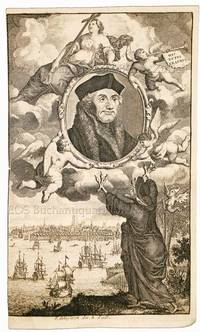
1600686CG1600. Um 1600. Kupferstich Brustbild mit der Ansicht der Stadt Rotterdam von Bleujwyk . Blattgrösse: 14 x 85 cm. Knapp beschnitten. unknown
160015652Small 4to. Bound with orig. wrappers in a fine hmorocco. No 93 of 1600 "sur velin teinte". Fine wood-engravings by Pauw. unknown
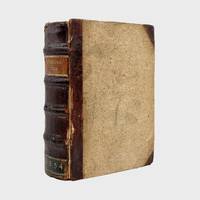
1554500039293Lugduni: Apud S. Gryphium 1554. First Edition. . Hardcover. Good. 648pp and index 12mo leather some marginalia. Nme on title page. First volume of four. <br/> <br/> Apud S. Gryphium hardcover
15791306270053Parisiis: Sumptibus Herculis Francois 1579-01-01. Hardcover. Acceptable. Early black pigskin raised bands. 12mo. 1296 25 pp. Later part of index bound in front. Title page in facsimile. Lacking first 24 pages of preface. Minor foxing marginal dampstaining affecting text. Restoration to final leaves. 1095-1296 is Parabolae sive similitudines: Des. Erasmi Roterodami. <br><br> The Alsatian humanist Conrad Lycosthenes Conrad Wolffhart compiled this collection of classical anecdotes. Lycosthenes was a noted populizer of classical science and medicine. Parisiis: Sumptibus Herculis Francois hardcover
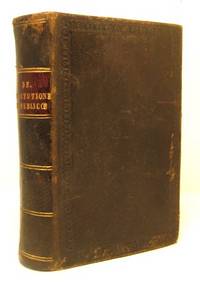
15741304040108Paris : Hieronymum de Marnef Gulielmum Cauellat Cavellat 1574-01-01. Hardcover. Good. 16mo 12 cm. Bound in 19th-century sheepskin. Scuff to rear board. Printer's device on title-page. 382 28 p.; Title soiled remounted. <br><br> Francesco Patrizi of Siena Franciscus Patricius Senensis 1413-1494 was an Italian political writer and humanist. In De Institutione reipublicae Patrizi discusses how public speaking may influence the civil discussion and the ability to manipulate people through eloquence and rhetoric to the ends of the state rather than simply by force alone. Patrizi served as governor of Foligno in the Papal States and bishop of Gaeta. His political writings on had influence on the ideas of civic Humanism and is considered a predecessor of Machiavelli. Paris : Hieronymum de Marnef Gulielmum Cauellat (Cavellat) hardcover
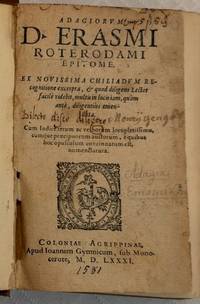
159080905Cologne Coloniae Agrippinae: Ioannem Gymnicum sub Monocerote 1590. Cloth bound in good condition; Title page partially separating appears to be partially reglued; Top trim severe but running titles still present. EX NOVISSIMA CHILIADUM recognitione"; 5 1/2" x 3 5/8"; pp. 2 ff. 658 79 index; Leaf A2 wanting; two modern binder's leaves inserted after A1; Matches VD16 E 3102 & USTC 626708; Contemprary Latin manuscript notes on title page. Ioannem Gymnicum sub Monocerote unknown
1556LLV2641Lugduni Lyon:: Seb. Gryphium 1556. 1556. Small 8vo. Pagination: 473 23 pp. Signatures: a-z8 A-H8. Printer's device on the title page woodcut initials printed marginalia; editor's name on title and p. 2 are lined out in ink three small worm holes from title-page. Nineteenth century quarter gilt-ruled calf red paper board boards. Early ink name on title of "Carolus . . ." and occasional marginalia pp. 58 61 62 80-83 heavy notes - in the same hand. Very good. Beautifully printed early pocket edition printed by Sebastianus Gryphius 1493-1556 of Suetonius' most famous work and one of the few of his texts that survive with excellent annotations by Desiderius Erasmus of Rotterdam. Commonly known as The Twelve Caesars the work contains a set of twelve biographies of Julius Caesar and the first eleven emperors of the Roman Empire Augustus Tiberius Caligula Claudius Nero Galba Otho Vitellius Vespasian Titus Domitian. It is a primary source for the study of Roman history. <br /><br /> The first edition of Suetonius with Erasmus' annotation was issued in 1533. <br /><br /> Baudrier Henri L. Bibliographie lyonnaise VIII p. 284; Gultlingen V p. 215: I369; French Books III & IV: Books published in France before 1601 . . . edited by Andrew Pettegree Malcolm Walsby Leiden: Brill 2012 87100. <br /><br /> Locations: BYU lacks everything after p. 340 and title is damaged; NYPL. Seb. Gryphium, 1556. hardcover
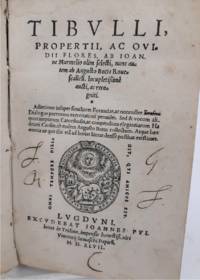
15471328082Lugdunum: Ioannes Pul Ioannes Pullonus 1547. Other. Tibulli propertii ac Ovidii flores ab Ioanne Murmelio olim selecti nunc autem ab Augusto Botta Rouescallen. Iocupletissimè aucti ac recogniti. Edited by Ioannes Murmellius and Augustus Botta Rouescallen. Lugdunum: Ioannes Pullonus 1547. 117 pp. Text in Latin. Duodecimo in early vellum boards. A partial title has been written on the spine in faded ink. The initials F.R.G.F.C. appear in ink on the title page and the name Erasmus has been crossed out in two instances. A book stamp likely placing this volume in a library or collection in Bologna in the 19th century appears on the final page of text. Condition: Very Good. The boards are very thin and have become cockled. The vellum is somewhat darkened with age and light staining and shows minor insect damage. There is evidence of a closure device now absent on both boards. Both paste downs are partially detached but the binding is overall very solid. The pages are somewhat age-toned with occasional foxing. There are a handful of small ink marks to the textblock. Dimensions 4.25 x 6.375 x 0.625 inches<br /> <br> <br /> <br> <br /> shelved case 3. 1328082. Shelved Dupont Bookstore. Ioannes Pul [Ioannes Pullonus] unknown
154865831Lugduni:: Seb. Gryphium 1548. old mottled sheep; gilt spine. . Old small bookplate and faint old ownership signature; faint old dampstain affects lower margin; a few old ms. excisions to text leaving it entirely legible. The binding is a little rubbed; but tight and sound. . 12mo. Seb. Gryphium, unknown
1571D10980Basel: Eusebius Episcopius & heirs of his brother Nicolaus 1571. Hardcover. Very Good. 8vo 165 x 104mm. 36 621 63 pages including final leaf with printers device of the word EPISCOP. Episcopus separated by stork surmounting bishops crozier on verso. Edited by Desiderius Erasmus; revised by Johann Jacob Grynaeus. Contemporary calf over wooden boards with blind-stamped arabesque centerpiece on covers brass catches lacking clasps rebacked spine gilt labeled IRENAEI HAERESES 1571; front joint cracked but cords intact; dark stain on opening leaves paper cracks and small holes in title not affecting text some light dampstaining in hinge toward end. 17th-century signature of Robert Baillie to title the famous Covenanter according to pencil note on front endpaper. 19th-century Chiesa Libera stamp on title; and pictorial bookplate of Douglas and Mildred Horton dated 1962 to front pastedown. Reverend Dr. Douglas Horton married Mildred née McAfee in 1945 who was a prominent female captain in the United States Naval Reserve and later the president of Wellesley College. <br/><br/>Irenaeus theological treatise written c. 180 attacked contemporary Christian heresies particularly Gnosticism and the system devised by Valentinus c. 100-c. 160. Irenaeus treatise also supported the idea that bishops maintained apostolic ties to the era of Christ and that a bishop was the best guide to understanding scripture. Given the very bishop-centric message of this work perhaps it is not curious at all that the Episcopius press expressed interest in printing it In Latin Episcopus is bishop. It was not until the 16th century that Irenaeus Opus eruditissimum was widely disseminated first published in Latin by Froben of Basel in 1526 and in the original Greek in 1570. Erasmus famously edited this Latin edition which appeared a year after the first Greek. In it he removed two annotations which referred to baptism and purgatory and also corrected a passage concerning the fault of Adam. The text itself is a new translation of the first book with an extensive dedication to the Basel Mayor Bernhard Brand and the founder of the Basel Reformed Orthodoxy Church Johann Jacob Grynaeus. Irenaeus Opus appears in 10 editions before this one published in both Basel 1528 1534 1548 1554 1560 and Paris 1541 1545 1563 1567 1570. This volume once belonged to Robert Baillie 1602-1662 a Glaswegian and Presbyterian minister and writer known for his Letters which faithfully recorded public events and his participation via correspondence. Baillie was a leader in the 17th century movement that rejected the Church of Englands Book of Common Prayer. From a reformative point of view Baillie would have found interest in Irenaeus work which recognized the canonical character of the gospels. For a work against the Gnostics it is said to contain valuable historical information and a great many New Testament quotations which are a witness to the New Testament text long prior to any extant manuscript; it is the first systematic exposition of Christian theology--Sarton I 294. Hoffmann II 466. Eusebius Episcopius & heirs of his brother Nicolaus hardcover
15489932Colonia 1548. Handbeschriebener Einband in gotischer Schrift.Alterungsspuren Martinus Gymnicus Kl.-8°. Pgt. Alte Drucke unknown
156374559latin version of Erasmus's new translation of the Bible 4 320 16 leaves woodcuts in text throughout "Argumenta Capitvm Capitum in Omnes Novi Testamenti libros" to rear in elegiac verse Published in Officina Froschouiana hardcover
1562508219Petrus Horst 1562. Leather. GOOD. 8vo 3.75 x 6' 784pp. Later mottled sheep with ornate floral spine panels and burgundy morocco title label half perished. Tips worn joints rubbed and starting at tail ends but cords still intact title page repaired and some lettering restored by hand; occasional pen markings in multiple early hands one contemporary; with engraved portrait of Erasmus d. 1802 inlaid to flyleaf; owner's inscription 'Conrady . 1841' to FFEP. Petrus Horst unknown
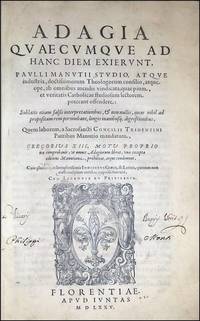
1575214172Florence: Apud Iuntas 1575. Half Bound. VG. 9 1/2 x 13. Adagia of Erasmus. His name for some reason does not appear on the title page. Ex-library copy with minimal stamps and labels. Greek and Latin text. 1453 pages plus Index of the Proverbs. Pages are in very good condition; very readable. Light foxing throughout especially on the edges. Half bound with brown leather over marbled boards. Gilt titles and decoration on the spine. Corners a little bumped and frayed. Boards and leather a little scuffed. Binding very secure. VG heavy - may require extra postage <br/> <br/> Apud Iuntas unknown
157572<p><b>FINE AND IMPORTANT ALDINE EDITION OF ERASMUS ADAGES</b>Erasmus Roterodamus. <b><i>Adagia</i></b><i> quaecumque ad hanc diem exierunt Paulli Manutii studio atque industria . ab omnibus mendis vindicata quae pium et veritatis Catholicae studiosum lectorem poterant offendere: sublatis etiam falsis interpretationibus & nonnullis . digressionibus. Quem laborem a sacrosanti Concilii Tridentini patribus Manutio mandatum Gregorius 13. motu proprio ita comprobauit vt omnes Adagiorum libros vna excepta editione Manutiana prohibeat atque condemnet. </i><i>Cum plurimis ac locupletissimis indicibus Graecis & Latinis quorum nonnulli nusquam antheac impressi fuerunt</i>. Florentiae apud Iuntas MDLXXV Florence Giunti for the Aldine Press <b>1575</b>.2° later limp <i>cartonnage</i> handwritten title and library label at spine ff. 4 columns 1454 i.e.1440 ff. 36.Giunti device at title and final leaves. Woodcut headletters. Text in Latin on two columns with some passages in Greek.Aldus Manutius' dedicatory to pope Gregory XIII.<b>Fine and important edition revised by Aldus Manutius the Younger of the renowned collection of Latin and Greek adages sayings proverbs mottos epygrams compiled by Erasmus</b>.Paul Manutius was commissioned by the Fathers of the Council of Trent to correct the work reorder purge by false interpretations and doctrinal errors in order to make this edition the only one approved by the Church the bull of Gregory XIII as stated in the title prohibits and condemns the other editions.<b>Desiderius Erasmus Roterodamus</b> 1466 – 1536 known as Erasmus of Rotterdam or simply Erasmus was a Dutch Renaissance humanist Catholic priest social critic teacher and theologian.Amongst humanists he enjoyed the sobriquet "Prince of the Humanists"; he has been called "the crowning glory of the Christian humanists". Using humanist techniques for working on texts he prepared important new Latin and Greek editions of the New Testament. These raised questions that would be influential in the Protestant Reformation and Catholic Counter-Reformation.<b>Provenance</b>: Ownership signature <i>Philippi Monti</i> at title-page beside the printer device.<b>References</b>: Renouard 220. 14. STC <i>Italian</i> 236; Adams E-443. BMC 236. CNCE 18245 & 18247.</p> Giunti for the Aldine Press paperback
1557097858Paris: Robert Estienne 1557. Vellum. pp. 112 8; 128 16; 192 36 of 40: 2 leaves missing. 12mo. Vellum with hand-lettered spine and yapped edges with the ties missing. Each title shows the famous Estienne olive tree vignette on the title page first and last titles include a colophon. Very good. In "de Magistratibus" Fiocci lists and explains the offices of Roman priests and magistrates. This work was reprinted many times in the 15th-17th centuries. The second title which translates to "The Beauties of the Latin Language" was written in 1431 to praise the Latin language and advocate for its proper usage. The third is a reprint of Erasmus' Biblical paraphrases. All three titles were popular in the 16th century and these reprints are published by famous Parisien printer Robert Estienne who inherited the press from his father Henri in 1526: Francis I later made him the King's Printer. Robert Estienne unknown
15411903140038Basel: Westhemerus 1541. Hardcover. Good. 2nd ed. First published in 1538. Contemporary vellum-backed pasteboard binding. Solid binding some wear to cover extremities. All edges red. Printer's snake device verso colophon. Internally clean and unmarked. Early signature of Robert Guyard Roberti Guyardi and "Carmelus Cadomensis". A collection of Erasmus letters for the use in Latin schools. Refs: Index Aurel. 163.109 9. VD-16 E-2958. Vanderhaeghen I 101. Bezzel 1043. Cat. Rotterdam 121. De Reuck 220. Not in Adams. "Adiecimus in Calcem proverbiorum & graecarum vocum interpretationem floresq ; in elocutione latina selectissimos que omnia commentarii vice esse possunt ; opus novum et recens natum. Basel: Westhemerus hardcover
15591807040010Basel: Frobenium et Nicol. Episcopium Froben 1559. Hardcover. Good. Bound in contemporary 1/2 vellum. Worn cover edges. Collated: 10 of 12 preliminary pages 886 pages blank 16 leaves. Lacking 2nd preliminary leaf and top half of 3rd. Handsome Froben printer's device on title and final leaf. Internally clean. Larger figurative initials at the start of each section and smaller historiated initials throughout. All edges red. Not in Adams See Adams J 360 for first edition of 1534 De bello Judaico; Contra Apionem; De imperio rationis Later Latin edition of one of the main works of the ancient historian Flavius Josephus 38-100 on Roman-Jewish history. Basel: Frobenium et Nicol. Episcopium (Froben) hardcover
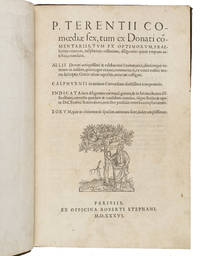
1536ABC_49923Paris: Robert Estienne 1536. Late 17th-century calf sewn on five supports with corresponding raised bands richly gold-tooled spine with the author title and year lettered in gold and red and-brown sprinkled edges. Small folio 20.2 x 30.3 cm. With Estiennes small woodcut device ona small woodcut the title page. Second edition of Terences Comoediae published by the French humanist and printer Robert Estienne 1503-1599. Publius Terentius Afer also known as Terence ca. 195-ca. 159 BCE was a Roman playwright of North African origin and one of the foremost authors of Latin comedy. The present work includes the commentary of Aelius Donatus 4th century CE based on a manuscript provided by Estiennes father-in-law Josse Bade 1462-1535. Donatus was a Roman grammarian and teacher of rhetoric best known for his grammatical works Ars Minor and Ars Maior. Building on Estiennes earlier 1529 folio edition this one was printed in the new Roman types and divided into acts and scenes a notable innovation. In addition Estienne incorporated Erasmus treatise on comedic metres which provided a scholarly analysis of the rhythmic and metric structures of classical comedies enhancing readers understanding of Terences original cadence and comedic effect.The boards are severely rubbed light foxing and staining throughout the title page is very slightly browned the head margin is cut slightly short. Otherwise in good condition.l Adams T 326; BM STC French p. 416; De Reuck 512; Inventaire chronologique des editions Parisiennes du XVIe siecle V 314; Renouard Estienne I 43 no. 15; Schreiber 52; USTC 147028 9 copies; Vander Haeghen II 55. Robert Estienne, hardcover
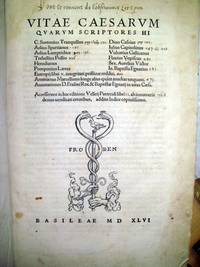
154613096Basilae Basel Bâle Basel: Froben 1546. Fine. Froben Basilae Basel Bâle Basel 1546 33 x 22.50 cm relié Colophon: Basileae per Hieronymvm Frobenivm et Nic. Episcopvm mense Septembri M.D.XLVI. First edition. Decorated with numerous historiated initials. Printer's device on the title page and verso of the final leaf. Absent from French catalogues but present in English catalogues 2 copies in Germany at the GBV union catalogue of northern Germany and one at the University of Munich. The 1544 edition published in Paris does not include Erasmus's notes and the complete assembly of authors gathered in this edition; the Parisian edition was reissued in 1551 in Lyon by Gryphium but not this Froben edition which reproduces only Egnazio's edition. The first edition of Suetonius dates from 1479. Full sheep binding 17th century decorated raised spine red morocco title label. Overall rubbed and worn on boards numerous scratches upper headcap missing 2 upper corners broken and missing. Fine interior condition with pale dampstaining running through about twenty pages at top center pp. 29 to 45. Several pagination errors same number repeated leaf skipped without lack. The evident interest of this edition was to gather together all the writers of antiquity who wrote about the Roman empire not only Suetonius but also rarer writers such as Dio Cassius translated by Merula Herodian translated by Angelo Ambrogini Poliziano Spartianus or Lampidius Velleius Paterculus Vulcatius Gallicanus Ammianus Marcellinus. Two commentators: Erasmus died in 1536 and Giovanni Battista Egnazio 1478-1553. Froben 1501-1563 is one of the great publishers of the Renaissance and the worthy successor of Johann Froben the first of the dynasty who established his printing house in Basel in 1491; it was with him that Erasmus was linked and worked and Jerome Froben merely reaped the fruits. This edition is the alliance of Froben and Nikolaus Episcopius his brother-in-law. Gothic manuscript note: ""pour le couvent de l'observance des Lyon"" and manuscript pagination of the authors. Froben hardcover
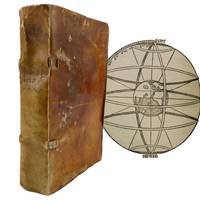
1558800Wittenberg: Krafft 1558. Softcover. Fair. Misc. A remarkable survivor clearly a student's copy of Sacrobosco's Libellus de Sphaera printed in 1558 with the student's inscription at the bottom of the title page and a question and answer styled study guide bound at the rear 1560 by Hartmann Beyer. The shared shelfmark from the title page to the binding indicates the wallet-style binding may be contemporary to the book. Also this copy still retaining its broadside with the locations of the sun updated since the 365.25 days per calendar year causes yearly drift in the location of the sun by day since the true day is slightly shorter. Sacrobosco's work was first produced around 1230 a text book dedicated to spherical astronomy. Although Sacrobosco did use the Earth as central to all rotation his methods of finding the locations of stars the sun and moon based on elliptical patterns was fairly reliable and became the standard of students for centuries to come. He also correctly identified the world as a sphere. By 1558 the idea of the Earth as the center of the universe was largely dispelled but Sacrobosco's calculations and tables were so good that they were yet to be replaced so academies were updating to accommodate the new science. This copy has the commentary and editing of several 16th century scholars Philip Melanchthon and Erasmus Reinhold as well as a second book with commentary of Hartmann Beyer. The university usage of this copy is clear and to be noted. The scholar one Wolfgang notes at the bottom of the title page that he is studying physics. The 17th century date of study denotes that an older book was still acceptable in studies. Yet despite the later date the binding contains both the 1558 Sacrobosco and essentially a 1560 study guide posing the question ""Has this book been used for study before Wolfgang wrote in it"" A mystery is the Cistercian monastery also holding the work. Did they possess the book before or after Wolfgang Or was it from a different Cistercian monastery that was dissolved during the protestant reformation years leading up to Wolfgang's study Bibliographic Details - 1558 Sacrobosco - Universal Short Title Catalogue USTC number 668014 6 copies recorded in the world's libraries. 1560 Quaestiones. - Universal Short Title Catalogue USTC number 689026 5 copies recorded in the world's libraries and USTC 689025 recording four more copies. Physical Attributes - Measures approx. 15 x 9 x 3 cm. Vellum wallet-style wrapper. Spine with two bands. Spine with author/title in old hand. Sacrobosco's work is illustrated throughout some with diagrams that could be used as the base for moving parts. Sacrobosco - Pages - Not paginated Collation - A-R8 with last two blank leaves present. Collates complete. Beyer - Pages - xxxii 302 2 blank pages last leaf blank Collation - aa8 a8 b-u8 collates complete. Condition - See pictures. Wallet-style vellum binding with wear and cockling waviness. Bottom of flap corner chipped away. Top front strap missing from binding to text block causing looseness still connected in back. No pastedowns used. Matching library number to title page written on front board inner as well as bookseller notes of date/publication and ex libris of Gingerich. 1st gathering almost loose chipping to top edge. Title page heavily annotated with two ex libris. One is the library of a Cistercian monastery and the other is of an early 16th century student. The title page has heavy toning and some chipping along edges. Bottom corner of front of text block dog eared. Throughout text block there is use consistent with student usage. Occasional thumbing dog-eared corners annotations page-edge chips/tears fox spots candle ember marks etc. Occasional moisture mark from edge second half from upper corner worst at last page. Occasional faded page E gathering ink light. Krafft
15542212260023Basel: Froben 1554. First Edition. Hardcover. Acceptable. Opera of Josephus: Containing Sigmund Gelen and Erasmus's translations Folio. Bound in modern vellum with leather ties. Woodcut printer's device on title. 8 886 blank 24 of 32 pages. Lacking last 8 pages of the appendix. Some contemporary marginalia but generally sound. "De imperio rationis" is from Erasmus's 1517 translation. Hoffmann II:593. Not in Adams. Contents: 1. Antiquities of the Jews with Flavius's autobiography translated by the Czech philologist Sigmund Gelen 1497-1554; 2. the Jewish war; 3. Against Apion both in the late antique translation by Ruffinus of Aquilea 340-410 revised by Gelen; 4. a treatise on the martyrdom of the Maccabees edited by Erasmus. Froben hardcover
1534372192Basel: Froben 1534. Froben's printer's device on first and last leaf of each work. 415 1; 191 1pp. 8vo. Early half calf and pastepaper boards. Spine ends rubbed front joint cracked but cords holding. Very good. Froben's printer's device on first and last leaf of each work. 415 1; 191 1pp. 8vo. Early Froben edition of a pedagogical work by Erasmus "On the Writing of letters" first published in 1522 with a collection of aphorisms or "Parallels" gathered out of Plutarch's Moralia Seneca Lucian Xenophon Demosthenes Aristotle Pliny and Theophrastus. An edition was published in Cologne in the same year and the work was a standard throughout the sixteenth century. VD16 E2515 E3257. Provenance: Princes of Liechtenstein armorial bookplate; General Theological Seminary bookplate Froben unknown
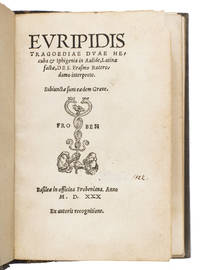
1530ABC_49914Basel 1530. 8vo 10.4 x 15.4 cm. Froben Office heirs of Johann Froben 19th-century half brown calf and grey paper sides. With a woodcut printer's device on the title page and final page and 7 decorated woodcut initials. 293 1 1 blank 1 pp. This volume brings together Erasmus renditions in Latin of two of Euripides most enduring tragedies titled Hecuba and Iphigenia in Aulis presented alongside the original Greek texts beginning on page 169. Euripides ca. 480-ca. 406 BCE was a Greek tragedian of classical Athens. He is one of only three Greek tragedians whose plays have survived in full the others being Aeschylus and Sophocles.Both plays in the present work explore the devastating costs of war through the eyes of women caught in its aftermath. In Hecuba the former queen of Troy endures unspeakable losses the sacrifice of her daughter Polyxena the murder of her son Polydorus and ultimately a brutal act of revenge that leads to her mythical transformation into a howling dog symbolising her complete descent into grief and rage.Iphigenia in Aulis is set on the eve of the Trojan War focusing on Agamemnons impossible decision to sacrifice his daughter Iphigenia to appease the goddess Artemis and allow the Greek fleet to sail. The play confronts themes of duty honour and the personal costs of collective ambition. These themes echo tragically in Hecuba which portrays the wars bitter consequences. Together these tragedies form a poignant narrative arc from the sacrifices made to start a war to the wreckage and human suffering left in its wake.With a partially erased manuscript note on the title page 1822. Some water staining in the margins and a few small holes in the inner margin not affecting the text. Otherwise in good condition.l Adams E 1042; BM STC German p. 289; De Reuck 425; Erasmus Online 4215; Vander Haeghen II 25; VD 16 E 4231; USTC 654881; not in Kossmann. unknown
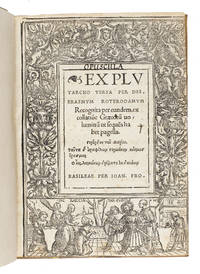
1520ABC_49876Basel: Johann Froben 1520. Modern gold-tooled half calf and marbled paper sides with the author title and year of publication lettered in gold on the spine red sprinkled edges. 4to. With the title set within an elaborate woodcut frame a smaller woodcut frame on the verso of the title page and the first page of the first text. Further with 9 woodcut decorated initials woodcut headpieces and a small woodcut illustration incorporating Frobens device on the last page. This finely printed 1520 Basel edition presents a collection of Erasmus earliest translations from the works of the Greek moral philosopher Plutarch. The volume presents eight of Plutarch's shorter treatises addressing themes such as friendship health and the nature of the human soul.One of the most notable inclusions is De discrimine adulatoris et amici How to tell a flatterer from a friend a treatise Erasmus translated during his time in Cambridge and dedicated to King Henry VIII. The text which explores the subtle art of distinguishing true friendship from sycophancy resonated in an era when rulers were often surrounded by flattering courtiers. With characteristic tact Erasmus hoped the work might serve both as philosophical instruction and as a gentle warning to the young English king particularly in light of those who had encouraged Henrys war with France.Furthermore the present work includes two of Plutarchs important medical treatises in Erasmus translation: De tuenda bona valetudine Advice on keeping well and Utrum graviores sint animi morbi quam corporis Are diseases of the soul more serious than those of the body. The latter contains strikingly early and thoughtful reflections on what we now recognise as mental illness. Other works included in this volume are: Quo pacto quis efficere possit ut capiat utilitatem ab inimico reflections on transforming enmity into wisdom and personal growth. In principe requiri doctrinam on the necessity of wisdom and education in a prince. Cum principibus maxime philosophum debere disputare a meditation on the philosophers role in advising those in power. Num recte dictum sit e ßsa on the meaning of the maxim lathe biosas: to live quietly and modestly. De cupiditate divitiarum a discourse on avarice and the moral corruption born of greed.With a small manuscript note added above the title opuscula and a 17th- or 18th-century owners inscription by an otherwise unidentified Johannes below the colophon on the final page. Slightly foxed and browned throughout the fore-edge and lower margins are cut slightly short barely affecting the printed marginalia. Otherwise in good condition.l Adams p. 654; Ledo pp. 260-66; USTC 655014 6 copies; Vander Haeghen II 46; VD 16 P 3718; not in BM STC German; De Reuck. Johann Froben, unknown