Darwin, Erasmus [MD FRS] M D F R SBiblio.com

107 résultats
1800142097London: Printed for J. Johnson 1800. viii 612pp. Quarto 220 x 270mm. Contemporary calf with gold gilt decorations to the spine and gilt lettering stamped to a black moroccoo spine label. Illustrated with 12 engraved plates 2 folding 9 with an accompanying non-paginated text leaf. Some rubbing and wear to the boards with the top corners a bit bumped. Previous owner's inscription: "REVD. WILLIAM. RUSH. CHURCHILL 1775-1847 of Colliton Dorchester". Ex-libris of Darwin bibliographer Richard Freeman. Some offsetting and light foxing to the plates otherwise a tight and clean copy. A very good copy of this work by the grandfather of Charles Darwin with an interesting provenance. Erasmus Darwin was a well known English physician having turned down the opportunity to be a physician to the King at one point as well as a natural philosopher physiologist slave-trade abolitionist inventor and poet. 1800 Printed for J. Johnson hardcover
17971978Derby: J. Drewry 1797. First edition. Contemporary quarter calf over marbled boards; spine ruled in gilt with red morocco label; all edges dyed yellow. Boards and spine rubbed; some chipping along edges. Original stab holes visible in gutter margins. Previous owner's bookplate on front pastedown; ink signature of Mary Wolley to front free endpaper; light foxing. Quarto collates complete with half title and engraved frontispiece: viii 9-128. Bound with: Fosbrooke T.D. The Economy of Monastic Life. Glocester: Printed by R. Raikes 1792. First edition dedicated to Edward Jenner who is also listed as a subscriber. Internally a copy in excellent condition.<br /> <br /> The grandfather of the illustrious Charles Darwin Erasmus Darwin wrote this treatise on the education of young women to support his own daughters' school at Ashbourne. Darwin's treatise takes a comprehensive view of women's education suggesting that it should reach beyond social skills such as the "perpetual appearance of attention" polite dancing and flattering dress and into formal intellectual pursuits including literature history mathematics and the natural sciences. While he promoted women's education in part to improve the likelihood of companionate marriages Darwin's text tentatively acknowledges that a marital partnership can only function happily when both parties have an intelligent understanding of the world and the ability to participate in it. "A radical campaigner for equality he condemned slavery supported female education and opposed conventional Christian ideas on creation" Farra. With a bookplate from the library of the Wolley family this particular copy has the ownership signature of female reader Mary Wolley. J. Drewry unknown
1797D19679DERBY: J. Drewry for J. Johnson 1797. First Edition. Paperback. Near Fine. 4to. 128 pp. including half-title. With engraved frontispiece of the grounds of Ashbourne School. ORIGINAL WRAPPERS. Housed in attractive custom box. Written for his two illegitimate daughters who were known as the Misses Parker Darwin covers a number of topics in this treatise on female education. "Education should draw the outline and teach the use of the pencil; but the exertions of the individual must afterwards introduce the various gradations of shade and colour must illuminate the landscape and fill it with the beautiful figures of the Graces and Virtues" preface. He recommends science subjects for girls as well as visits to factories and foundries. Also included is a fifteen-page list of recommended books for studying further one of the many subjects touched upon here. Darwin 1731-1802 grandfather of Charles Darwin was a poet naturalist as well as a prominent physician. He assisted in setting up the Ashbourne School and in furtherance of his belief in the importance of intellectual pursuit for all. He had this work published by Johnson an important radical bookseller of the period who was responsible for among many other works Wollstonecraft's Vindication of the Rights of Women. <br/><br/> J. Drewry for J. Johnson paperback
17951262351795. London: Johnson 1795-94. <br /> <br /> 2 vols. in one 4to xx 218 124 2 directions to binder and advertisement; 2 viii 200 2 directions to the binder lacking the errata and ads pp. With a frontispiece to each volume ten plates in vol. I and 8 in vol. II. Early half calf marbled boards newly rebacked in calf with gilt-lettered label. A very good copy if a little aged -- early manuscript note loosely inserted about the Portland Vase copied from the Morning Chronicle c. 1796.<br /> <br /> § Best edition. 6 plates are engraved by Blake the best known being Fertilization of Egypt and Tornado both after Fuseli. The third edition of part one is the only edition to include the striking Tornado plate. At page 87 appears the enigmatic circular image of an African man in chains titled "Am I not a man and a brother." Bentley 450B and C. Essick William Blake's Commercial Book Illustrations XXI.<br /> The Morning Chronicle was a newspaper founded in 1769 in London. It was notable for having been the first steady employer of essayist William Hazlitt as a political reporter and the first steady employer of Charles Dickens as a journalist. unknown
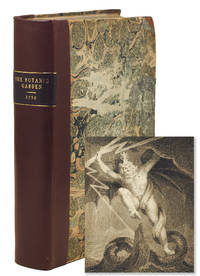
17911277661791. First Edition. BLAKE William engraver DARWIN Erasmus. The Botanic Garden; A Poem in Two Parts. London: J. Johnson 1791 1791. Two volumes in one. Quarto contemporary full brown mottled calf rebacked burgundy morocco spine label. $3300.First edition of Part I third edition of Part II of Erasmus Darwin's chief poetical work illustrated with two engraved frontispieces and 18 plates one from a painting by Henry Fuseli five engraved by William Blake.""The chief source of Erasmus Darwin's literary fame during his lifetime The Botanic Garden contains a great deal of important and frequently advanced scientific information in the nearly 300 footnotes and the 115 pages of appendices to its verses. Part I 'The Economy of Vegetation' involves a far-reaching survey of science and technology with significant sections on evolutionary theories and numerous footnotes on electrical phenomena. Part II 'The Love of the Plants' is a 'single-minded catalogue of vegetable sex-life"" Norman. Darwin describes plant reproduction according to the Linnaean system ""by means of a most ingenious and amusing personification of each plant and often even of the parts of the plant. It is significant that botanical notes are added to the poem and that its eulogies of scientific men are frequent"" Britannica. Darwin's Garden is also important for the five plates in Part I engraved by William Blake: ""The Fertilization of Egypt"" engraved after the painting by Henry Fuseli and four engravings of the Portland Vase. Darwin the grandfather of Charles is notable for his ""exposition of the form of evolutionism afterwards expounded by Lamarck"" DNB. Inexplicably Part II was published first in 1789 here present in the 1791 third edition; Part I followed in 1791 present in the first edition. Wilson 343. Hunt II lxvii. Nissen 451. Bentley 450A. Keynes 103. Bookplate; early ink shelf markings to front flyleaf.Occasional spotting or offsetting from plates to text. Some wear to corners and board edges. A very good copy. unknown
179143999London: J. Johnson 1791. <p>Darwin Erasmus 1731-1802. The botanic garden: A poem in two parts . . . 4to. xii 214 126 2; 2 ix 197 1pp. General title-leaf misbound before title-leaf to Part II. 20 engraved plates including 5 by William Blake 1757-1827; 2 of the plates are after drawings by John Henry Fuseli 1741-1825. London: J. Johnson 1791. 275 x 207 mm. Half calf gilt marbled boards in period style. Minor foxing and offsetting small marginal stains on two or three plates not affecting the images marginal tears in signature S and one plate repaired but very good. </p> <p> First Edition of Part I; third edition of Part II containing two more plates than the first edition of 1789. Darwin's first major literary work and the chief source of his fame during his lifetime. "The Botanic Garden an annotated scientific poem in Augustan couplets appeared in two parts of which the second The Loves of the Plants 1789 was published before the first The Economy of Vegetation 1791. Darwin decided to publish the second part of the work first because it was better suited 'to entertain and charm.' The first part of the work is more ambitious than the second covering all natural philosophy and embodying many of the researches and inventions of Wedgwood Watt Boulton and others. The design of the totality was Darwin wrote 'To enlist Imagination under the banner of Science . . . to induce the ingenious to cultivate the knowledge of botany . . . and recommending to their attention the immortal works of the celebrated Swedish naturalist-Linnaeus'" Dictionary of Scientific Biography. The Botanic Garden is also important for the five plates in Vol. I engraved by William Blake: four engravings of the Portland vase and the "Fertilization of Egypt" after a design by Fuseli. Keynes Blake 103. King-Hele Erasmus Darwin pp. 97-119. </p> . J. Johnson unknown
17912091202133203778J. Johnson 1791. Soft Cover. Fine. Volume: 1 J. Johnson paperback