96 résultats
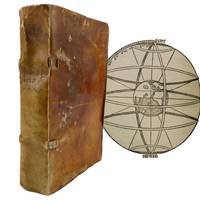
1558800Wittenberg: Krafft 1558. Softcover. Fair. Misc. A remarkable survivor clearly a student's copy of Sacrobosco's Libellus de Sphaera printed in 1558 with the student's inscription at the bottom of the title page and a question and answer styled study guide bound at the rear 1560 by Hartmann Beyer. The shared shelfmark from the title page to the binding indicates the wallet-style binding may be contemporary to the book. Also this copy still retaining its broadside with the locations of the sun updated since the 365.25 days per calendar year causes yearly drift in the location of the sun by day since the true day is slightly shorter. Sacrobosco's work was first produced around 1230 a text book dedicated to spherical astronomy. Although Sacrobosco did use the Earth as central to all rotation his methods of finding the locations of stars the sun and moon based on elliptical patterns was fairly reliable and became the standard of students for centuries to come. He also correctly identified the world as a sphere. By 1558 the idea of the Earth as the center of the universe was largely dispelled but Sacrobosco's calculations and tables were so good that they were yet to be replaced so academies were updating to accommodate the new science. This copy has the commentary and editing of several 16th century scholars Philip Melanchthon and Erasmus Reinhold as well as a second book with commentary of Hartmann Beyer. The university usage of this copy is clear and to be noted. The scholar one Wolfgang notes at the bottom of the title page that he is studying physics. The 17th century date of study denotes that an older book was still acceptable in studies. Yet despite the later date the binding contains both the 1558 Sacrobosco and essentially a 1560 study guide posing the question ""Has this book been used for study before Wolfgang wrote in it"" A mystery is the Cistercian monastery also holding the work. Did they possess the book before or after Wolfgang Or was it from a different Cistercian monastery that was dissolved during the protestant reformation years leading up to Wolfgang's study Bibliographic Details - 1558 Sacrobosco - Universal Short Title Catalogue USTC number 668014 6 copies recorded in the world's libraries. 1560 Quaestiones. - Universal Short Title Catalogue USTC number 689026 5 copies recorded in the world's libraries and USTC 689025 recording four more copies. Physical Attributes - Measures approx. 15 x 9 x 3 cm. Vellum wallet-style wrapper. Spine with two bands. Spine with author/title in old hand. Sacrobosco's work is illustrated throughout some with diagrams that could be used as the base for moving parts. Sacrobosco - Pages - Not paginated Collation - A-R8 with last two blank leaves present. Collates complete. Beyer - Pages - xxxii 302 2 blank pages last leaf blank Collation - aa8 a8 b-u8 collates complete. Condition - See pictures. Wallet-style vellum binding with wear and cockling waviness. Bottom of flap corner chipped away. Top front strap missing from binding to text block causing looseness still connected in back. No pastedowns used. Matching library number to title page written on front board inner as well as bookseller notes of date/publication and ex libris of Gingerich. 1st gathering almost loose chipping to top edge. Title page heavily annotated with two ex libris. One is the library of a Cistercian monastery and the other is of an early 16th century student. The title page has heavy toning and some chipping along edges. Bottom corner of front of text block dog eared. Throughout text block there is use consistent with student usage. Occasional thumbing dog-eared corners annotations page-edge chips/tears fox spots candle ember marks etc. Occasional moisture mark from edge second half from upper corner worst at last page. Occasional faded page E gathering ink light. Krafft
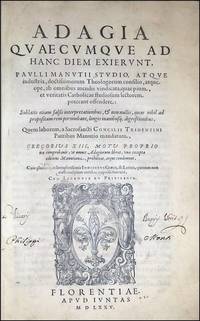
157572<p><b>FINE AND IMPORTANT ALDINE EDITION OF ERASMUS ADAGES</b>Erasmus Roterodamus. <b><i>Adagia</i></b><i> quaecumque ad hanc diem exierunt Paulli Manutii studio atque industria . ab omnibus mendis vindicata quae pium et veritatis Catholicae studiosum lectorem poterant offendere: sublatis etiam falsis interpretationibus & nonnullis . digressionibus. Quem laborem a sacrosanti Concilii Tridentini patribus Manutio mandatum Gregorius 13. motu proprio ita comprobauit vt omnes Adagiorum libros vna excepta editione Manutiana prohibeat atque condemnet. </i><i>Cum plurimis ac locupletissimis indicibus Graecis & Latinis quorum nonnulli nusquam antheac impressi fuerunt</i>. Florentiae apud Iuntas MDLXXV Florence Giunti for the Aldine Press <b>1575</b>.2° later limp <i>cartonnage</i> handwritten title and library label at spine ff. 4 columns 1454 i.e.1440 ff. 36.Giunti device at title and final leaves. Woodcut headletters. Text in Latin on two columns with some passages in Greek.Aldus Manutius' dedicatory to pope Gregory XIII.<b>Fine and important edition revised by Aldus Manutius the Younger of the renowned collection of Latin and Greek adages sayings proverbs mottos epygrams compiled by Erasmus</b>.Paul Manutius was commissioned by the Fathers of the Council of Trent to correct the work reorder purge by false interpretations and doctrinal errors in order to make this edition the only one approved by the Church the bull of Gregory XIII as stated in the title prohibits and condemns the other editions.<b>Desiderius Erasmus Roterodamus</b> 1466 – 1536 known as Erasmus of Rotterdam or simply Erasmus was a Dutch Renaissance humanist Catholic priest social critic teacher and theologian.Amongst humanists he enjoyed the sobriquet "Prince of the Humanists"; he has been called "the crowning glory of the Christian humanists". Using humanist techniques for working on texts he prepared important new Latin and Greek editions of the New Testament. These raised questions that would be influential in the Protestant Reformation and Catholic Counter-Reformation.<b>Provenance</b>: Ownership signature <i>Philippi Monti</i> at title-page beside the printer device.<b>References</b>: Renouard 220. 14. STC <i>Italian</i> 236; Adams E-443. BMC 236. CNCE 18245 & 18247.</p> Giunti for the Aldine Press paperback
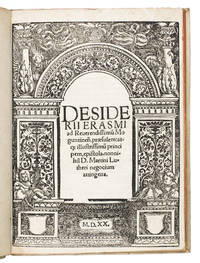
1520ABC_49889Augsburg 1520. 4to. Sigmund Grimm and Marcus Wirsung 19th-century gold-tooled vellum with a black morocco title label and a black morocco label with the year of publication on the spine lettered in gold a double fillet border on both boards red edges marbled endpapers. With an elaborate woodcut title border by Hans Weiditz. 4 ll. Early print of the letter Erasmus wrote to Cardinal Albrecht of Brandenburg Archbishop of Mainz in October 1519 with statements about Luther. In it Erasmus recommends to hear Luther whom he defends in several instances and suggests to help him where he errs. The letter was delivered by Ulrich von Hutten 1488-1523 and likely published without Erasmus's consent. The present edition is one of seven unauthorised editions published in the same year. It was printed by Marcus Wirsung ca. 1460-ca.1520 and Sigmund Grimm ca. 1480-1530 whose printing office was the most important publication centre for humanist literature in pre-Reformation Augsburg. Their edition includes a beautiful title border by Hans Weiditz 1495-ca.1537 and is among the rarest of the seven with only five copies recorded by the Universal Short Title Catalogue USTC. The present copy was auctioned at Sotheby's in 1955 and 1980 and is one of only two copies that we have been able to trace in sales records.The boards are somewhat warped. The work has been bound with 25 blank leaves. Otherwise in good condition.l Adams E 871; Allen Opus epistolarum Erasmi IV 1033; Bezzel 28; BM STC German p. 276; Erasmus Online 1957; Proctor 10920; USTC 635546 5 copies; Vander Haeghen I 93; VD16 E 1887; not in De Reuck. hardcover
1575214172Florence: Apud Iuntas 1575. Half Bound. VG. 9 1/2 x 13. Adagia of Erasmus. His name for some reason does not appear on the title page. Ex-library copy with minimal stamps and labels. Greek and Latin text. 1453 pages plus Index of the Proverbs. Pages are in very good condition; very readable. Light foxing throughout especially on the edges. Half bound with brown leather over marbled boards. Gilt titles and decoration on the spine. Corners a little bumped and frayed. Boards and leather a little scuffed. Binding very secure. VG heavy - may require extra postage <br/> <br/> Apud Iuntas unknown
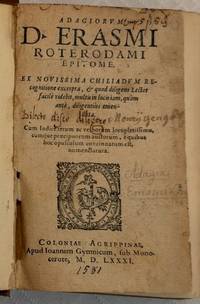
159080905Cologne Coloniae Agrippinae: Ioannem Gymnicum sub Monocerote 1590. Cloth bound in good condition; Title page partially separating appears to be partially reglued; Top trim severe but running titles still present. EX NOVISSIMA CHILIADUM recognitione"; 5 1/2" x 3 5/8"; pp. 2 ff. 658 79 index; Leaf A2 wanting; two modern binder's leaves inserted after A1; Matches VD16 E 3102 & USTC 626708; Contemprary Latin manuscript notes on title page. Ioannem Gymnicum sub Monocerote unknown
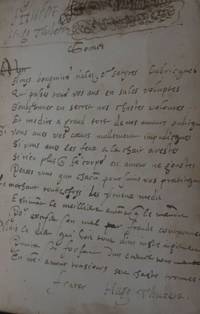
15233722Paris: apud Simon de Colines 1523. First edition. Contemporary French blind-stamped calf over wooden boards panelled with intersecting fillets and lozenge tools; remains of clasps present metal attachments preserved; spine with raised bands. Wide-margined and notably clean throughout. Early manuscript moral sonnet signed "Frater Hugo Thubert" on the front flyleaf and a biblical motto "Si quis vult post me venire." in a seemingly different sixteenth-century hand on the rear flyleaf. With a few early marginal annotations in a sixteenth-century hand on ff. 39 and 253 and f. 9 ruled with brown-ink frames. Leather somewhat worn including a damaged area on the front panel and some loss at the lower corners with surface abrasions and light cracking along the joints; spine rubbed at head and foot. A complete unsophisticated copy in its original binding retaining notable early reader's marks; overall in very good condition. First edition. Contemporary French blind-stamped calf over wooden boards panelled with intersecting fillets and lozenge tools; remains of clasps present metal attachments preserved; spine with raised bands. ff. 373 22. <p><br /> A rare example of early educational use of Erasmus's Adagia in its contemporary French leather binding and preserved with a handwritten French moral sonnet by its sixteenth-century owner Hugues Thubert.<br /> <p><p><br /> First edition of Jean Brouchier's pedagogical epitome of Erasmus's Adagia printed by Simon de Colines in the early years of his Paris press. Though derived entirely from Erasmus's celebrated Chiliades the structure and didactic programme are Brouchier's: an abridged sequence of selected adages arranged for the studiosa iuventus intended to make the moral historical and rhetorical substance of the Adagia usable in the Latin classroom at an elementary stage.<br /> <p><p><br /> Brouchier's dedicatory epistle explains the rationale behind the epitome: while the Adagia had become essential reading for humanist education their full scope far exceeded what younger students could manage. His selection extracts the most serviceable sententiae supplying a compact repertory suited to memorization written exercises and introductory rhetorical training. The epitome reflects early humanist classroom practice when teachers adopted shorter selections to provide beginners with a practical corpus for variation and elementary composition while still introducing Erasmus's ethical and stylistic programme.<br /> <p><p><br /> A dedicatory letter to the magistrates of Florence precedes the text outlining Brouchier's aims and directing readers to Erasmus for fuller commentary. The work aligns with Colines's broader programme of humanist educational printing which equipped collèges and monastic schools with clear reliable editions of classical and contemporary authors. Colines's architectural title border clean roman types and spacious mise-en-page underscore the book's intended function as a school text designed for legibility and daily use. As an adaptation of one of Erasmus's most influential works Brouchier's Epitome documents an early stage in the mediation condensation and classroom transmission of the Adagia illustrating the practical needs of humanist teaching in early sixteenth-century France.<br /> <p><p><br /> Brouchier's biography is largely undocumented; he is known only through a small group of humanist pedagogical editions issued in Paris between 1511 and 1534. Three of these-the present Epitome and the two editions of the Commentarii in Septem Sapientum Graeciae Apophthegmata-were printed by Simon de Colines placing Brouchier within the circle of authors associated with Colines's early humanist programme.<br /> <p><p><br /> This copy preserves an unpublished French moral sonnet in the hand of Hugues Thubert written on the front flyleaf and signed "Frater Hugo Thubert." The poem belongs to the broad and often fragmentary vernacular literary production of the sixteenth century when humanist education and the widespread use of printed and manuscript verse encouraged even non-professional writers to adopt classical forms for ethical reflection. Autograph poems of this type-especially those entered into the flyleaves of school and humanist books-are relatively uncommon and they offer intimate evidence of personal reading practices. Thubert's sonnet in fluent but regionally inflected French adapts the sonnet structure to a concise moral argument setting impurity and chastity in rhetorical opposition a mode familiar from contemporary humanist and devotional writing.<br /> <p><p><br /> An early owner of the present volume Hugues Hugo Thubert was a Benedictine of the Congregation of Chezal-Benoît listed in the 1529 matricule as a monk of Saint-Germain-des-Prés and later recorded as having left the order TELMA IRHT. He signs himself in this volume and appears again as owner of another book-Jean Grolier's former copy of Gaspar Bracellus's Ortus delitiarum Milan Minutianus 1515; Austin 357; Michon 24A-which he inscribed with his name and the date 1580 and which subsequently entered the abbey library of Saint-Germain-des-Prés. These traces collectively document a Paris-based sixteenth-century reader whose surviving books display consistent humanistic engagement.<br /> Rare; USTC lists 14 copies only six outside France and RBH records a single sale 2024.<br /> <p><p><br /> References: USTC 180884; IRHT-CNRS. n.d. Matricule de la Congrégation de Chezal-Benoît 1529. In TELMA - Traitement électronique des manuscrits.<br /> <p>. apud Simon de Colines unknown
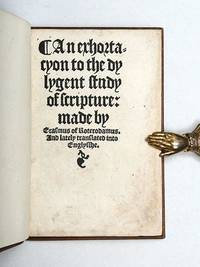
1534150904London: Robert Wyer c.1534. Erasmus on reading the Bible in the vernacular Rare English translation of Erasmus's Paraclesis "a cogently argued text in support of the Bible in the vernacular and it is this particular thrust of the work that must have drawn the early English reformers to it since they too like Erasmus spoke eloquently and at length. in support of the Bible in English" Douglas H. Parker. Based on a translation variously attributed to either William Joy or George Joye which was first printed at Antwerp in 1529 this is one of two editions printed for the first time in England in 1534. While the 1529 Antwerp edition had included a translation of Martin Luther's commentary on 1 Corinthians 7 both 1534 editions replace Luther's text with another Erasmus text "An exhortacyon to the study of the Gospell". This is the only copy to have appeared in commerce in the past 45 years. Octavo 135 x 94 mm in two parts. Woodcut opening initials printer's devices McKerrow 67c and 68 69 "dieu et mon droit" woodcut on I8r. Twentieth-century brown pigskin spine lettered in gilt marbled endpapers. Fore-margins restored throughout affecting woodcuts on final leaf and occasional shoulder notes numerous short wormtracks filled some just into text some mostly marginal staining washed still a presentable copy carefully restored of a notably rare book. STC 10494 four copies only: British Library Oxford Huntington and the present copy. unknown
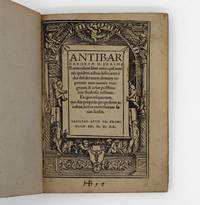
1520375736Basel: Froben 1520. First edition printed in May. Woodcut borders to title leaf and dedication by Hans Holbein printer's device on last page. 150 2 imprint pp. 4to. Eighteenth-century marbled boards ink label. Some toning to spine. Very good fresh copy. First edition printed in May. Woodcut borders to title leaf and dedication by Hans Holbein printer's device on last page. 150 2 imprint pp. 4to. Ignorantiam esse superbiae matrem. Eruditionem contra modestiam parere.<br /> Ignorance is the mother of pride; it is from learning on the contrary that modesty is born.<br /> <br /> First edition of Antibarbari Erasmus' manifesto "defending the arts against the scruples of the barbarians" Tracy. Erasmus argues for the primacy of poetry among the liberal arts for the importance of critical understanding of the writers of classical antiquity and for appropriating what is good in their work. He is also scornful of rote learning and blind repetition of earlier scholarship where "cuckoo calls to cuckoo".<br /> <br /> In Petro summus erat ardor fidei in Hieronymino summa doctrina: alterius animum alterius studia imitar. In Peter there was the ardour of faith at its highest; in Jeronme there was learning at its best. It is for you to imitate the spirit if the one and the scholarship of the other.<br /> <br /> This was a work of very long ripening. Erasmus began the earliest version circa 1490 when he was a newly ordained monk but that manuscript was left behind in his wanderings. Decades later when he came across his earlier work he was at the center of intellectual controversy following publication of of his edition of the New Testament. He revised his Antibarbari to assert the humanist position and Froben published it in May 1520. There were six editions of the work in the early 1520s Froben himself published another edition later the same year and ten editions in his lifetime.<br /> <br /> "it is ignorance rather than erudtion which makes men insolent"<br /> <br /> FIRST EDITION OF A KEY WORK BY ERASMUS. VD16 E1997; Valentina Sebastiani Johann Froben Printer of Basel 170; Bibliotheca Erasmiana p. 9; Adams E-463; Bezzel 157. The standard modern text iwith translation by Margaret Mann Phillips˜The Antibarbarians" is in the Toronto Collected Works vol. 23 1978 Froben unknown
15591807040010Basel: Frobenium et Nicol. Episcopium Froben 1559. Hardcover. Good. Bound in contemporary 1/2 vellum. Worn cover edges. Collated: 10 of 12 preliminary pages 886 pages blank 16 leaves. Lacking 2nd preliminary leaf and top half of 3rd. Handsome Froben printer's device on title and final leaf. Internally clean. Larger figurative initials at the start of each section and smaller historiated initials throughout. All edges red. Not in Adams See Adams J 360 for first edition of 1534 De bello Judaico; Contra Apionem; De imperio rationis Later Latin edition of one of the main works of the ancient historian Flavius Josephus 38-100 on Roman-Jewish history. Basel: Frobenium et Nicol. Episcopium (Froben) hardcover
15791306270053Parisiis: Sumptibus Herculis Francois 1579-01-01. Hardcover. Acceptable. Early black pigskin raised bands. 12mo. 1296 25 pp. Later part of index bound in front. Title page in facsimile. Lacking first 24 pages of preface. Minor foxing marginal dampstaining affecting text. Restoration to final leaves. 1095-1296 is Parabolae sive similitudines: Des. Erasmi Roterodami. <br><br> The Alsatian humanist Conrad Lycosthenes Conrad Wolffhart compiled this collection of classical anecdotes. Lycosthenes was a noted populizer of classical science and medicine. Parisiis: Sumptibus Herculis Francois hardcover
154865831Lugduni:: Seb. Gryphium 1548. old mottled sheep; gilt spine. . Old small bookplate and faint old ownership signature; faint old dampstain affects lower margin; a few old ms. excisions to text leaving it entirely legible. The binding is a little rubbed; but tight and sound. . 12mo. Seb. Gryphium, unknown
1522ABC_49903Cologne: Eucharius Cervicornus 1522. Contemporary blind-tooled calf with armorial panel-stamps. Sewn on 4 supports with corresponding raised bands on the spine with remnants of 4 pairs of green closing ties re-backed. 4to. With an elaborate woodcut frame on the title page and 2 smaller woodcut frames on the first pages of the texts and 5 woodcut decorated initials. 2 parts in 1 volume. Including: ERASMUS Desiderius. Commentarius in psalmum quare fremuerunt gentes. Second edition printed in the same year as the first of Erasmus version of the Commentaries on the psalms attributed to Arnobius the Younger a Christian priest active in 5th-century Gaul. Arnobius interprets the psalms allegorically relating their content to Christ and the Church. First printed in folio by Froben in Basel in September 1522 the present 4to edition was published shortly after that same year in Cologne by Eucharius Cervicornus. It contains Erasmus preface addressed to Pope Adrian VI the commentary of Arnobius on the psalms and Erasmus own extensive commentary on psalm 2 Quare fremuerunt gentes. The present copy is bound in a contemporary Cologne binding attributed to an anonymous binder active circa 1510. Both boards feature a panel-stamped frame including three armorial shields of the city arms of Cologne ermine field with three open crowns the arms of the Archbishopric of Cologne a black cross on a silver field and a diagonally banded shield likely the binders own mark. Inside there are two identical rectangular panels made up of a stamp with bird motifs and the motto Clamo ad te Domine "I call to you Lord".With two book plates mounted on the front pastedown Thomas Brooke F.S.A. Armitage Bridge and one with the motto Pro viribus summis contendo a small manuscript cypher CP on the title page and Erasmus commentary contains manuscript annotations in the margins and on the final blank page by a near-contemporary hand. The binding has been re-backed the head of the spine is slightly damaged the corners of the boards are slightly damaged the original blind-tooled leather on the boards is somewhat dry and cracked affecting the clarity of the stamps and with some small scratched in the leather on the front board. Some occasional browning and water- staining in the margins. Otherwise in good condition.l Bezzel 554; Goldschmidt 57; Jenkins 2.1; USTC 613135; Vander Haeghen II 10; VD 16 B 3132 and VD 16 E 2460; not in: BM STC German De Reuck. Eucharius Cervicornus, hardcover
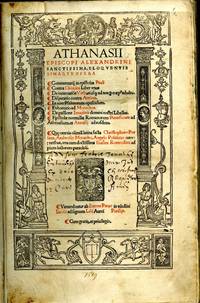
1519048644Paris: Ioanne Paruo Jean Petit 1519. First Edition. Hardcover Vellum. Very Good Condition. First part dated 1518 second 1519. Later overlapping parchment. browned new endpapers. Some soiling to title page top edge excised likely for a signature page numbers added to upper right in pencil slight scattered browning light dampstain to upper edge of final leaves. A nice wide margined copy two parts in one with the integral blank between them. Rubricated throughout. 6 255 1 bl. 64 ff.<br /> <br /> Scarce edition with the important commentary on Paul's Epistles here attributed to Athanasius but actually by Theophylact of Ohrid. They were a "profound influence" on Erasmus' new testament and his In Praise of Folly Obolensky Six Byzantine Portraits 1988. 22 copies in OCLC but only 3 in the US. Rare in commerce.<br /> <br /> <br /> contains: Commentari in Epistolas Pauli Contra gentiles liber unus : De incarnatione Verbi eiusque ad nos per corpus aduentum : Disputatio contra Arrium : In uim Psalmorum opusculum : Exhortatio ad Monachos : De passione imaginis domini nostri libellus : Epistolæ nonnullæ Romanorum pontificum ad Athanasium et Athanasii ad eosdem Size: Folio. Quantity Available: 1. Shipped Weight: Under 1 kilo. Category: Religion & Theology; Antiquarian & Rare. Inventory No: 048644. Ioanne Paruo (Jean Petit) hardcover
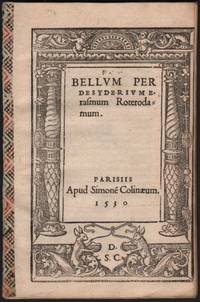
1530329Parisiis Paris: Apud Simonem Colinaeum Simon de Colines 1530. Reprint of the printer's edition of 1525. First printed by Johann Froben in 1517. Papered spine. In fine condition. Title within elaborate woodcut border with initials S.D.C. and Geoffroy Tory’s Lorraine cross. Title within elaborate woodcut border with initials S.D.C. and Geoffroy Tory’s Lorraine cross. Reprint of the printer's edition of 1525. First printed by Johann Froben in 1517. Papered spine. 8º a–c8 c8 blank; 23 1 blank leaves. <p><br /> Erasmus’ famous pacifist text on the adage “dulce bellum inexpertis" war is sweet to those who have not tried it. It was first published in the revised and enlarged edition of “Adages†called “Proverbiorum chiliades" 1515 Basel; Froben and published separately in 1517 also by Froben. <br /> <p><p><br /> “Bellum" is the first essay where Erasmus speaks of Jews contemporary to him praises them along with the Turks and the pagans as well as various peoples of Europe Asia and Africa for their virtuous living. He writes: “When has the sword murder arson plundering turned conquered people into good Christians! Openly to be a Turk or a Jew is lesser evil than to pretend to be a Christian. I prefer a real Turk to a false Christian.†<br /> <p><p><br /> The printer Simon de Colines 1480–1546 is most notable for his 1525 “Grandes Heures de Simon de Colines†the illustrator was the same Geoffroy Tory 1480–1533 who made the design of the woodcut border of this book.<br /> <p><p><br /> Bibl.: Markish Shimon: Erasmus and the Jews. Chicago. University of Chicago Press 1986.; Johnson Carina L.: Cultural hierarchy in sixteenth-century Europe. The Ottomans and Mexicans. Cambridge; New York. Cambridge University Press 2011.; Olin John C.: Six essays on Erasmus and a Translation of Erasmus' Letter to Carondelet 1523. New York. Fordham University Press 1979.<br /> <p><p><br /> Moreau III 2074. <br /> <p>. Apud Simonem Colinaeum (Simon de Colines) unknown
1556LLV2641Lugduni Lyon:: Seb. Gryphium 1556. 1556. Small 8vo. Pagination: 473 23 pp. Signatures: a-z8 A-H8. Printer's device on the title page woodcut initials printed marginalia; editor's name on title and p. 2 are lined out in ink three small worm holes from title-page. Nineteenth century quarter gilt-ruled calf red paper board boards. Early ink name on title of "Carolus . . ." and occasional marginalia pp. 58 61 62 80-83 heavy notes - in the same hand. Very good. Beautifully printed early pocket edition printed by Sebastianus Gryphius 1493-1556 of Suetonius' most famous work and one of the few of his texts that survive with excellent annotations by Desiderius Erasmus of Rotterdam. Commonly known as The Twelve Caesars the work contains a set of twelve biographies of Julius Caesar and the first eleven emperors of the Roman Empire Augustus Tiberius Caligula Claudius Nero Galba Otho Vitellius Vespasian Titus Domitian. It is a primary source for the study of Roman history. <br /><br /> The first edition of Suetonius with Erasmus' annotation was issued in 1533. <br /><br /> Baudrier Henri L. Bibliographie lyonnaise VIII p. 284; Gultlingen V p. 215: I369; French Books III & IV: Books published in France before 1601 . . . edited by Andrew Pettegree Malcolm Walsby Leiden: Brill 2012 87100. <br /><br /> Locations: BYU lacks everything after p. 340 and title is damaged; NYPL. Seb. Gryphium, 1556. hardcover
15106221Hardcover. Fine. 4to. Bound in 20th-century 1/4-vellum over marbled boards. Strasbourg: Matthias Schürer <b>Jul</b><b>y 1510. Second Strasbourg</b> edition of Erasmus heavily annotated collection of Greek and Latin proverbs. Printed in Roman and Greek types. <br /><br />This is the original version containing 818 adages which is considerably shorter than the later expanded versions published under the title Adagiorum chiliades. Adams E-420; Bezzel Erasmusdrucke 50; Van der Haeghen Bibliotheca Erasmiana p.25-6; Bibl. Belgica II 276: no. E.61; Muller Strasbourg II p. 179 no. 45. <br /><br />The Adagia could only have been possible in the new world of European education in which careful attention to a broader range of classical texts produced a much fuller picture of the literature of antiquity. Its impact has been long lasting. Such popular expressions such as <i>one step at a time</i> <i>between a rock and a hard place</i> <i>break the ice</i> <i>an iron in the fire</i> l<i>ooking a gift horse in the mouth</i> and many other sayings can trace their origin to the Adagia. <br /><br />The printer Matthias Schürer published 15 works by Erasmus in over 70 editions. It is interesting to note that his relationship with Erasmus began with a rather rough start. In 1509 the year Schürer completed his apprenticeship and opened his own print shop he struck an unauthorized edition of Erasmuss Adagia purloined from the first edition of 1500. In spite of this commercial indiscretion Erasmus favored Schürer with a warm supportive and lasting friendship. The dedicatee of this celebrated work William Blount 4th Baron Mountjoy of Barton Blount Derbyshire was a wealthy English courtier and scholar. A pupil of Erasmus he called him inter nobiles doctissimus The most learned amongst the nobles. Having served since 1512 as Chamberlain to Queen Catherine of Aragon it fell to him to announce to her the intention of Henry VIII to divorce her. Boards slightly rubbed; signatures D-K with a small wormhole to outer margin without loss of text; some slight browning and soiling to some pages; a few leaves with faded manuscript marginalia in a neat 16th-century hand; index leaves with light water staining to upper portion; o/w a very nice unrestored wide-margined example of this rare early edition. Matthias Schürer hardcover
1562508219Petrus Horst 1562. Leather. GOOD. 8vo 3.75 x 6' 784pp. Later mottled sheep with ornate floral spine panels and burgundy morocco title label half perished. Tips worn joints rubbed and starting at tail ends but cords still intact title page repaired and some lettering restored by hand; occasional pen markings in multiple early hands one contemporary; with engraved portrait of Erasmus d. 1802 inlaid to flyleaf; owner's inscription 'Conrady . 1841' to FFEP. Petrus Horst unknown
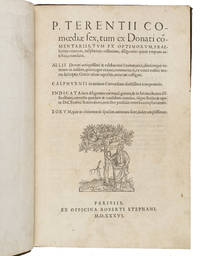
1536ABC_49923Paris: Robert Estienne 1536. Late 17th-century calf sewn on five supports with corresponding raised bands richly gold-tooled spine with the author title and year lettered in gold and red and-brown sprinkled edges. Small folio 20.2 x 30.3 cm. With Estiennes small woodcut device ona small woodcut the title page. Second edition of Terences Comoediae published by the French humanist and printer Robert Estienne 1503-1599. Publius Terentius Afer also known as Terence ca. 195-ca. 159 BCE was a Roman playwright of North African origin and one of the foremost authors of Latin comedy. The present work includes the commentary of Aelius Donatus 4th century CE based on a manuscript provided by Estiennes father-in-law Josse Bade 1462-1535. Donatus was a Roman grammarian and teacher of rhetoric best known for his grammatical works Ars Minor and Ars Maior. Building on Estiennes earlier 1529 folio edition this one was printed in the new Roman types and divided into acts and scenes a notable innovation. In addition Estienne incorporated Erasmus treatise on comedic metres which provided a scholarly analysis of the rhythmic and metric structures of classical comedies enhancing readers understanding of Terences original cadence and comedic effect.The boards are severely rubbed light foxing and staining throughout the title page is very slightly browned the head margin is cut slightly short. Otherwise in good condition.l Adams T 326; BM STC French p. 416; De Reuck 512; Inventaire chronologique des editions Parisiennes du XVIe siecle V 314; Renouard Estienne I 43 no. 15; Schreiber 52; USTC 147028 9 copies; Vander Haeghen II 55. Robert Estienne, hardcover
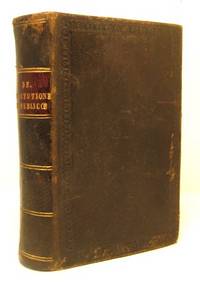
15741304040108Paris : Hieronymum de Marnef Gulielmum Cauellat Cavellat 1574-01-01. Hardcover. Good. 16mo 12 cm. Bound in 19th-century sheepskin. Scuff to rear board. Printer's device on title-page. 382 28 p.; Title soiled remounted. <br><br> Francesco Patrizi of Siena Franciscus Patricius Senensis 1413-1494 was an Italian political writer and humanist. In De Institutione reipublicae Patrizi discusses how public speaking may influence the civil discussion and the ability to manipulate people through eloquence and rhetoric to the ends of the state rather than simply by force alone. Patrizi served as governor of Foligno in the Papal States and bishop of Gaeta. His political writings on had influence on the ideas of civic Humanism and is considered a predecessor of Machiavelli. Paris : Hieronymum de Marnef Gulielmum Cauellat (Cavellat) hardcover
153672393Parissiis: Simonem Colinaeum 1536. Simonem Colinaeum unknown
1532V75865Cologne: Joannes Gymnicus Gymnich 1532 1533 1532. Hardcover. Good. Woodcut pictorial titlepages with borders of female deities etc to each of 3 works fine illustrated colophon to 2nd work. . Sammelband of 3 Works in one Volume. Small octavo pigskin on wooden boards front cover with floral marginal rolls central holy figures SS Peter & John and ownership stamp SVM IACOBI BVECSEN MDXXXIII. Back cover with border of dancing figures one dated 1528. Spine on 3 raised bands brass clasps missing but catches present. Some damage to head & foot of spine edges worn but stamped pigskin covers in excellent condition. Front & back endpapers present but pastedowns removed showing at gutters vellum strips with black & red MS lettering used to attach wooden boards to spine. Work I 16pp woodcut emblematic bordered titlepage Erasmus dedication to Beraldo dated Basel 8 June 1522 Index 385pp 1p blank collated complete except Lacks one leaf of text at Fii pp83-4. Titlepage has early ink ownership name Zielenski repeated at Aii verso of Work II in centre and partly erased MS library notes at foot. Some neat red ink underlining & marginal notes throughout light brown marks of former damp at top margins from start affecting up to 5 lines by end but all clearly readable. Small tears neatly repaired at top of last 2 sections without loss of text except on last leaf. Work II 2nd woodcut titlepage with Adam & Eve on either side nudity partly inked out 80 leaves unpaginated but collated complete with signatures A-K8 last page has full-page colophon of seahorse Gymnich's printer's mark Latin motto and Greek text round all 4 sides. Work III has 3rd woodcut titlepage with same Adam & Eve surround but no ink nudity defacement 127pp 1p blank collated complete but with tears at top margin some with minor paper loss neatly repaired. At end 12 marginally damaged blank leaves are bound in. Nice woodcut titlepages and very interesting early binding. Rare K lner Gymnich imprint Sammelband of 3 Works referenced I. Adams E558 VD 16 E 2514 Bezzel 609; II. VD 16 & van der Haeghen not in Adams; III. VD 16 not in Adams. Joannes Gymnicus (Gymnich) hardcover
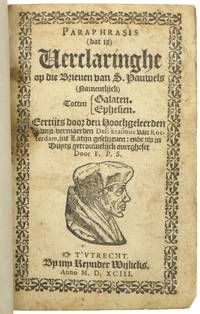
159312512Amsterdam Pieter la Burgh / T'Utrecht Reynder Wijlicks 1658/1593. 2 werken in 1 band 124 142 p. Origineel Perkament 8°. Twee werken van Erasmus in het Nederlands vertaald waarvan het tweede in deze uitgave uiterst zeldzaam is. Amsterdam, Pieter la Burgh / T'Utrecht Reynder Wijlicks unknown
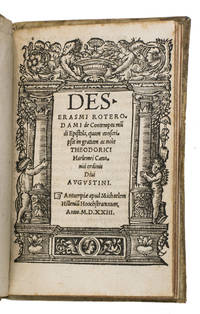
1523ABC_50124Antwerp: Michiel Hillen van Hoogstraten 1523. Later vellum with the manuscript title and year of publication on the spine red sprinkled edges. 8vo. With a decorative woodcut border on the title page and 2 decorated woodcut initials. Very rare early edition of Erasmus first written work a letter in praise of monastic life which was only published later in his career. Erasmus wrote it in 1488 or 1489 when he was 20 years old at the request of Theodoricus of Haarlem a fellow canon at the Augustine monastery at Steyn in order to persuade his nephew to join the order. It circulated in manuscript form for many years and was likely used to entice prospective candidates to enter the order of Canons Regular of St. Augustine.The work is divided into three parts: the first seven chapters focus on the evils of this world; chapter eight through eleven on the pleasures of the religious life; and chapter twelve on the ultimate choice between the material world or the religious state. This final chapter appears to counteract the rest of the work as it advises Theodoricus' nephew to carefully consider whether he truly wanted to enter a religious order since being a Christian is enough in itself. As such it has been suggested that Erasmus rewrote the text before its publication adding the 12th chapter but as he apologises for his adolescent writing style in the preface the work was likely mostly unedited.The first edition was published in Louvain in 1521 more than 30 years after it was written. The present edition is the first by Michiel Hillen van Hoogstraten and one of four printed in 1523. It is exceptionally rare on both the market and in institutions as only four copies have been recorded in libraries and we have not been able to find any others in sales records of the past century.The vellum is slightly soiled. The work is slightly browned throughout. Otherwise in good condition.l Adams E-569; Erasmus Online 1383; Nijhoff & Kronenberg 804; USTC 403708 4 copies; Vander Haeghen p. 64; WorldCat 71746606 2 copies; cf. De Molen R. "First fruits. The place of Antibarbarorum Liber and De contemptu mundi in the formulation of Erasmus Philosophia Christi" in: Colloque érasmien de Liège 1986 pp. 177-196; not in Bezzel; De Reuck; STCV. Michiel Hillen van Hoogstraten, hardcover
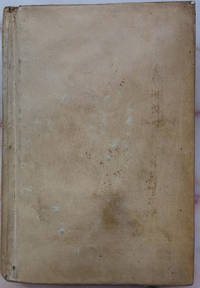
15489932Colonia 1548. Handbeschriebener Einband in gotischer Schrift.Alterungsspuren Martinus Gymnicus Kl.-8°. Pgt. Alte Drucke unknown
152116988Colophon: Mainz: Johannes Schoeffer 1521. German contemporary blind-tooled calf sewn on 3 double cords in a panel design each board with a 15 mm-wide border roll with fillets on either side containing 4 different heads in medaillions separated by quatrefoils. The central panel on each board is filled with dozens of impressions of 3 floral stamps 1 on the front board and 2 on the back. Titles in ink written on the spine partly upside down and the fore-edge; later paper spine label; 2 holes near the fore-edge of each board from fastenings now lost. 8vo. Ad 1: with the title in woodcut architectural border with 3 coats of arms the Isenburg bars and Mainz wagon wheel above left and right and Schoeffer's device here with 2 stars above and a rosette below rather than 3 stars at the foot under his IS-monogram; 6 large beautiful woodcut initials the largest 45 mm with 2 human figures. Both works set throughout in italic types still with upright capitals as always at this date. With 1 initial coloured by hand. Ad 2: with the title in an elaborate woodcut border dated "MDXX" at the head first page of the dedicatory letter by Erasmus to Petrus Aegidius dated Basle 5 October 1514 on back of the title page with a border made of woodcut strips Froben's large woodcut device on the last page and 2 decorative woodcut initials 2 series the 30 mm Q with a scorpion. 2 works in 1 volume. With: 2 ERASMUS Desiderius. Parabolae sive similia.Colophon: Basel Johannes Froben July 1521. Ad 1: Good scholarly edition of Erasmus's famous guide to writing and speaking style in Latin designed to provide the student of Latin with a wide range of words and expressions. Ad 2: A collection of similes or comparisons composed along the same lines and with the same intentions as those that had brought Erasmus much success in his Adagia. In a sense the Parabolae are an addition to and continuation of the Adagia. With some contemporary annotations. In very good condition with only a few minor marginal smudges or chips. Binding lacking fastenings and with damage to the spine and edges but still in good condition with most of the tooling very clear.l Ad 1: VD 16 E 2656; Allen I 260; II 305 311; Bezzel 748; Vander Haeghen Bibl. Erasm. p. 66; Reedijk 95 97; De Reuck Bibl. Erasm. Bruxel. 135 with illus. of the title; ad 2: VD 16 E 3246 2 copies; Bezzel 1371; Vander Haeghen Bibl. Erasm. p. 138; for the binding: cf. K. von Rabenau Deutsche Einbände der Renaissance von Jakob Krause Berlin 1994 7 & 8 similar bindings using stamps with the same motifs. Johannes Schoeffer, unknown