Thomas Prior; George BerkeleyBiblio.com

41 résultats
174638412London: in Paternoster-Row; and C. Davis in Holborn. Near Fine with no dust jacket. 1746. Leather. 88 pages; . .to which are subjoined letters from the author of SIRIS showing the medicinal properties of tar-water and the best manner of making it. A new edition complete." Later binding with calf leather over marbled boards. Fine binding. . in Paternoster-Row; and C. Davis, in Holborn hardcover
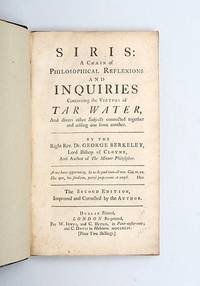
17461203210002London : Dublin printed London re-printed for W. Innys C. Hitch and M. Cooper in Paternoster-Row; and C. Davis in Holborn 1746. Hardcover. Very Good. Octavo. 192 pp. Modern brown leather gilt raised bands black leather spine label. Fine binding. Minor toning scattered spotting. <br><br> George Berkeley published Siris Philosophical Reflexions and inquiries concerning the virtues of tar-water and divers other subjects connected together and arising from one another. The early 1740's were a period of famine and epidemic in Ireland and there were no physicians in Berkeley's diocese. Berkeley took it upon himself to do what he could for the sick and settled upon tar-water as the best malady for the various ailments that he treated. Berkeley prepared tar-water by mixing pine tar with water allowing it to settle and then draining off the clear fluid for medicinal use. Siris which starts with a discussion of the virtues of tar-water for curing most diseases was the most popular of his books during his lifetime. It was widely read on the continent and in America and quickly went through several editions. Most of its readers however read it for its medical discussions and ignored the main subject of the book a chain of philosophical reflections that start with tar and end with the Trinity. In Siris Berkeley restated many of the tenets of the immaterialism of his youth but mixed them with even more speculative ideas drawing heavily on classical works. The end result is the most difficult of Berkeley's works to read although one with significant philosophical content. Subject; Hydrotherapy. [London] : Dublin printed, London re-printed, for W. Innys, C. Hitch, and M. Cooper, in Paternoster-Row; and C. Davis, in Holbor hardcover
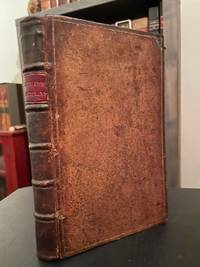
17161277391716. First Edition. LORD GREY OF WERK BERKELEY Henrietta. The Trial of Ford Lord Grey of Werk et al. For Unlawful Tempting and Inciting the Lady Henrietta Berkeley to Unlawful Love with an Intent to Cause Her to Live in a Scandalous Manner. London: J. Morphew 1716. Slim octavo period-style full paneled calf raised bands red morocco spine label. $2000.First edition of the verbatim transcript of this sensational 17th-century trial in which Lord Grey was charged with seducing the under-18-year-old sister of his wife ""with an intent to cause her to live in a scandalous manner with the said Lord Grey."" Handsomely bound.The prosecution of this scandalous case was ably handled by George Jeffreys; the defense was equally capable and the verbatim transcript of the proceedings vividly portrays the case's high emotional charge. ""In 1682 Lady Henrietta became a well-known figure of scandal when still a minor and under 18 following the revelation of her love affair with Ford Grey Lord Grey of Warke 1655-1701 the husband of her elder sister Mary. The intrigue seems to have begun in 1681 and continued for about 14 months before it was discovered by Lady Henrietta's mother Eventually the earl of Berkeley launched a lawsuit for unlawful seduction against Grey and his accomplices which was brought before the court of king's bench on 23 November 1682. Henrietta herself appeared at the trial but with her evidence the lord chief justice told her 'You have injured your own reputation and prostituted both your body and your honour and are not to be believed' State trials 9.176. As the court was breaking up the earl attempted to take his daughter away with him whereupon Henrietta announced that she was married to William Turner Grey's servant. A scuffle broke out in the courtroom as she refused to return home and her father tried to seize her by force The trial attracted a great deal of publicity and the story of Lady Henrietta's affair with her brother-in-law became the inspiration for Aphra Behn's Love Letters between a Nobleman and his Sister the first part of which was published in 1684"" ODNB. Bound with half title. Old ink annotations to verso of half title; small duplicate stamp to final text leaf.Only occasional faint foxing to text. Fine condition handsomely bound. hardcover
1789919P1London: C. Elliot; T. Kay; C. Elliot 1789. First edition. Leather. Very Good. 8.5" by 5.5". None. A very scarce volume of biographical pieces and edited correspondence by eminent historical figures the first edition of this work by George Monck Berkeley. The first edition of this very scarce work.The 'Literary Relics' of George Monck Berkeley an interesting selection of research and correspondence of royal figures edited and collected here into one volume.Berkeley's work contains his 'Inquiry into the Life of Dean Swift' a biographical work for which he is best known as well as an edited selection of letters from Kings Charles II and James II Elizabeth of Bohemia Jonathan Swift and more.George Monck Berkeley was a playwright an author who only published a few works before his death at the age of 29. Half-title is present.Bookplate of Edward Winnington to the front paste down. Winnington was a baronet and politician an MP Droitwich Worcestershire for almost thirty years. In a full marbled calf binding. Externally generally smart a little rubbed to the leather. Minor bumping to the extremities. A few light marks to the boards. Very small crack to the head of the front joint. Bookplate to the front paste down. Internally firmly bound. Pages are bright and clean with a few scattered spots. Very Good C. Elliot; T. Kay; C. Elliot hardcover
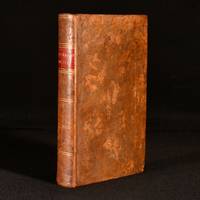
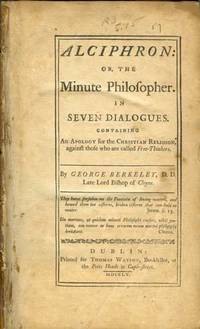
1732BTETM0001889London: J. Tonson 1732. 2nd Edition. Hardcover. Very Good/No Jacket. Octavo Standard 8vo 6 נ9 in 152 נ229 mm . Please email for Photographs or further information. Very Good - Boards rubbed and bumped; text block and binding firm and strong. A lovely copy. Collation: pp. 707 Please see Photos as part of condition report. 1732 2nd Edition With Provenance ALCIPHRON Or The Minute Philosopher in Seven Dialogues By George Berkeley Author Bio: George Berkeley 12 March 1685 14 January 1753 known as Bishop Berkeley Bishop of Cloyne of the Anglican Church of Ireland was an Anglo-Irish philosopher whose primary achievement was the advancement of a theory he called "immaterialism" later referred to as "subjective idealism" by others. This theory denies the existence of material substance and instead contends that familiar objects like tables and chairs are ideas perceived by the mind and as a result cannot exist without being perceived. Berkeley is also known for his critique of abstraction an important premise in his argument for immaterialism. Synopsis: 1732 ALICIPHRON: OR THE MINUTE PHILOSOPHER in Seven Dialogues containing an Apology for the Christian Religion against those who are called free-thinkers Two volumes - complete set 356 pp & 351 pp - Title pages with engravings various ornamental engravings at end of chapters and end of volume. Printed for J. Tonson in the strand 1732 By George Berkeley Book plate for The Right Honourable The Earl of Portsmouth in FEP Earl of Portsmouth is a title in the Peerage of Great Britain. It was created in 1743 for John Wallop 1st Viscount Lymington who had previously represented Hampshire in the House of Commons.Previous owner inscription on FEP. Format: Hardcover Octavo Standard 8vo 6 × 9 in 152 × 229 mm Note: Binding/size selection follows standard bibliographic conventions and is approximate; exact measurements may vary. Language: English Published By: J. Tonson London Condition Report: Dust Jacket: No Jacket Dust Jacket Condition: No Jacket Very Good - Boards rubbed and bumped; text block and binding firm and strong. A lovely copy. Collation: pp. 707 Please see Photos as part of condition report. SKU: BTETM0001889 Shipping Info: Approximate Package Dimensions H: 12.5 L: 30 W: 25 Units: cm W: 2Kg Tracked Shipping Insurance Coverage as per Customer Request J. Tonson hardcover
175515970Dublin: Thomas Watson 1755. Hard Cover. Fair/No Jacket. Thomas Watson1755. Leather binding. Front board missing back board partially detached 1/3 loss on spine. 370 pages 2 pages of advertisement 7 page table of contents. Pages are clean and unmarked moderately foxed throughout. Good reading/research copy. Thomas Watson hardcover
174752088à Amsterdam: Chez Pierre Mortier 1747. Fine. Chez Pierre Mortier à Amsterdam 1747 10 x 17 cm relié First edition. The French edition was expanded with additions and corrections communicated by Berkeley to Bouillier before he began his translation. Title page in red and black. Contemporary brown speckled sheep binding. Raised-band spine richly decorated roulette at foot. Red morocco title-label. Headcap torn away. Tailcap worn. Joints cracked at head and foot. 2 wormholes on spine. Small nibbling to last leaf in upper margin on less than one cm. Fairly good copy. Tar water was a medicine used since the Middle Ages composed of pine or birch tar. Its use spread in 18th-century England. Berkeley describes for the first time its use in a wide variety of cases and wonders whether it might not be the universal panacea. He extrapolates as to its efficacy from a study of mind and soul of which ether would be the divine instrument and the thing that binds beings together. Tar water would be used in various forms until the end of the 19th century. Bergson particularly appreciated the philosophical qualities of the treatise. Chez Pierre Mortier unknown
174844380Chez Henri-Albert Gosse & Comp. Good. 1748. Softcover. Good softcover. Taped spine. Heavily used but in good reading condition and intact. Text is in French. Translates to "Research on the Virtues of Tar Water." ; 4 1/2" x 6 3/4"; 331 pages . Chez Henri-Albert Gosse & Comp. paperback
1752268<b>J. & </b><b>R. Tonson and S. Draper 1752. Title page iii-vi 2 9-268 all collated. Full calf. Spine with raised bands. Covers have gold frames. All joints and hinges slightly worn and/or cracked but covers holding well by strings. Some brown stains to edges of endpapers and first and last few leaves. The spine is darkened but a nice uncomplicated copy overall with a refreshed label. </b> J. & R. Tonson hardcover
17449733London: C. Hitch 1744. First Edition . Full Leather. Fair/No Jacket. FIRST EDITION/LONDON PRINTING of this philosophical work by Berkeley here spelled Berkley DOES NOT FEATURE SIRIS IN TITLE PREDATES IT. Extremely rare scarce. Title page: "By the Right Rev. Dr. George Berkley lord Bishop of Cloyne and Author of The Minute Philosopher. "As we have opportunity let us do good unto all men. Gal. vi. 10. Hoc opus hoc studium parvi properemus et ampli. Hor." LONDON printed for C. Hitch in Pater-noster-row; and C. Davis against Gray's Inn Holboutn MDCCXLIV price two shillings. CONDITION: Front board is COMPLETELY MISSING. obvious shelf-wear for a book almost 300 years old all pages present a few pencil markings on title page back board/spine still bound in leather marbled back board. Formerly from Harvard library though with no library markings info paper included with book Please email for any information. <br/> <br/> C. Hitch hardcover
1750175832London: for J. and R. Tonson and S. Draper 1750. Presented to and initialled by the Enlightenment thinker George Berkeley First edition presentation copy to the idealist philosopher George Berkeley inscribed by the Countess of Burlington on the initial binder's blank "To the Bishop of Cloyne from his most humble servant D. Burlington" and with Berkeley's ownership initials George Cloyne to the title page. Dorothy Countess of Burlington 1699-1758 was the granddaughter of Halifax a leading statesman of Charles II's time. She owned several manuscripts from Halifax which were edited here for publication by Alexander Pope. She was one of Queen Caroline's Ladies of the Bedchamber a patron of artists including David Garrick and Handel and a portrait painter. Berkeley was first introduced to her husband by Alexander Pope and he became close friends with them. Berkeley wrote to the Countess to thank her for the volume: "Madam Permit me to thank your Ladyship for a present very valuable in it self and much more so on account of the giver who is so good as to remember an humble servant in this remote corner; where to my sorrow I am haunted with a taste for good company and fine arts that I got at Burlington house the worst preparative in the world for a retreat at Cloyne" 2 April 1750. The volume came into the possession of the bookseller and bibliographer John Stephens 1948-2006 and has his bookplate. Stephens identified the letter and sourced a photocopy from Chatsworth House which had the original the photocopy is included as is a letter from Chatsworth sending it. He published an article on the volume and its presentation "Berkeley and Lady Burlington: A Footnote" in Berkeley Newsletter Number 12 1992 pp. 16-17. He quoted the letter and commented: "It is a rather sad letter: he may then have been depressed but worse was to happen. In February 1751 his son William died and the following October his friend Thomas Prior followed. The next year he sailed for England never to return to Ireland. Berkeley shared Burlington's interest in architecture but he had certainly not been in Burlington House since he had last been in London in 1734. It has very much the tone of someone pleasantly surprised that he should be remembered after so long an absence". Octavo 199 x 120 mm pp. 8 183 1. Contemporary mottled calf rebacked with black morocco label later double gilt rule to covers marbled endpapers red speckled edges. Bookplate to front pastedown of British modernist architect Marshall Sisson 1897-1978 alongside his pencilled signature and notes on the book on the front free endpaper verso. Covers a little worn with patches of calf infill superficial split to front inner hinge some light foxing to contents still a very good copy. ESTC T130907. unknown
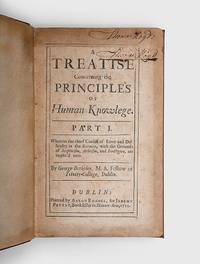
1710171378Dublin: printed by Aaron Rhames for Jeremy Pepyat 1710. A cornerstone of 18th-century philosophy First edition of the author's major work "the classic exposition of Berkeley's philosophy of immaterialism as an antidote to infidelity" ODNB in which he famously puts forward the idea that "no object can exist without a mind to conceive it". Part Two of the work was lost while still in manuscript form. Although Berkeley's works did not initially prompt much reaction they came to have a profound effect on the intellectual life of the later 18th century. The Treatise "set out his idealistic philosophy in detail arguing that the concept of 'material substance' is at once absurd and explanatorily useless. He pointed out that even philosophers who posit the existence of material bodies cannot explain how matter can produce ideas in the mind or how purely mental phenomena like ideas could resemble or correspond to non-mental material substances. Perhaps his most shocking claim in favour of his metaphysics was his oft-repeated contention that his principles were in strict accord with common sense and inimical to skepticism" Grattan-Guinness p. 122. Octavo 205 x 128 mm. Complete with the final blank 2E4. Rebound to style in full panelled calf red morocco spine label raised bands and spine ends ruled and tooled in blind. Ink ownership signature of one Thomas Lloyd on title page and p. i upper margin of the former excised not affecting lettering but shaving the printed rules. Contents browned and occasionally spotted title leaf chipped at lower outer corner a few ink marginal marks crosses lines small tear at upper outer corner of 2B4. Overall a very good copy. Keynes Berkeley 5; Norman 196; Printing and the Mind of Man 176. Ivor Grattan-Guinness Landmark Writings in Western Mathematics 1640-1940 2005. hardcover
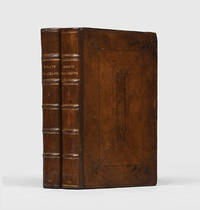
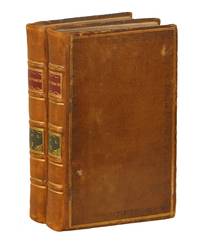
1732170650London: Printed by J. Tonson 1732. The idealist philosopher's most substantial work First edition of Berkeley's defence of traditional Anglicanism against the nascent secularism of the early Enlightenment: a major work of 18th-century Christian apologetics. Alciphron is a critical source for Berkeley's wider philosophy of language. Berkeley 1685-1753 defends the Theist position that the world is dependent on an interventionist God providing religious knowledge through miracles and divine revelation. Enlightenment thinkers increasingly argued that a non-interventionist deity had created the universe to operate autonomously on machine-like principles and laws. In such a scenario the miracles and revelations of an interventionist God were of little use as a source of religious knowledge which was possible only through rational reflection. In challenging these ideas Berkeley collectively represents their chief exponents Locke Mandeville and the third Earl of Shaftesbury as the conceited free thinkers Alciphron and Lysicles. Volume II includes a revised edition of Berkeley's An Essay towards a New Theory of Vision first published in 1709 with a new title page and continuous register. In the Advertisement Berkeley notes that his earlier work is included as an addendum to the fourth dialogue which concerns the function of the senses in deriving knowledge of God. 2 vols octavo 194 x 120 mm. Wood engraving to title pages of both vols. Contemporary panelled calf neatly rebacked and recornered spines ruled and lettered in gilt raised bands edges sprinkled red. 18th-century signature of "William McGuire" to title page of vol. II. Light rubbing cosmetic splits to inner hinges minor browning and foxing to endpapers and edges loss to upper outer corner of title page vol. I small hole in F8 vol. I: a very good copy. Jessop 121a; Keynes 15. hardcover
173255973London: J. Tonson. Very Good. 1732. First Edition. Hardcover. Two volume set. Contemporary paneled calf rebacked with new labels repaired corners reinforced hinges new endsheets. Bookplates of Richard Clark Esq. Chamberlain of London. The Chamberlain of the City of London is an ancient office dating back to at least 1237 Wikipedia. . Volume 1 retains original front blank with Richard Clark's signature. Pp. 12 350; 8 358. Volume II also contains "An essay towards a new theory of vision first published in the year MDCCIX" with separate title page pp. 211-358. Engraved title-page vignettes. ; 8vo 8" - 9" tall . J. Tonson hardcover
1732000010926London: J. Tonson 1732. First edition. Hardcover. Very Good. 2 vol. 8vo. 13 2-350 2; 9 2-358 2 pp. Full sheep ca. 1800 with twin gold borders on each board spines in six compartments with later red and green morocco labels lettered and bordered in gold on each spine; all edges decoratively sprinkled. Bound with a later edition of Berkeley's Theory of Vision. Illustrated with two small woodcuts on the title pages and several wood-cut initials head and tailpieces. The Theory of Vision contains a few in-text diagrams. Contains one of the mispaginations in volume II but not the other. Honderich 89. Jessop 16a. Keynes 15. Mead 10. Written in colonial America Berkeley's Alciphron is a vigorous defense of Christianity against the atheists deists and skeptics of his day. It elicited several responses from other theologians and would help Berkeley shape his later views concerning philosophy of language. According to Honderich "Berkeley is a most striking and even unique phenomenon in the history of philosophy. There have been many philosophers who have constructed bold and sweeping . metaphysical systems . have been devoted to the clarification and defence of 'common sense' . some have made it their chief concern to defend religious faith and doctrine against their perceived enemies. It is the peculiar achievement of Berkeley that with high virtuosity and skill he contrived to present himself in all these roles at once" Honderich 89. The volumes rebacked in later sheep the reverse of the front flyleaf of volume one has a pre-20th century inscription citing a 1746 publication each title page has a pre-20th century name in its margin. J. Tonson hardcover
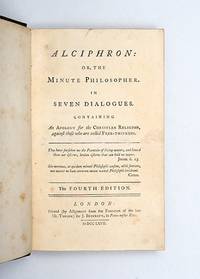
1767158145London: Printed by assignment from the executors of the late Mr. Tonson for J. Beecroft 1767. Stated fourth edition though in fact a re-issue of the third edition sheets of 1752 with a cancel title page. In Alciphron first published in 1732 Berkeley rebuts the insurgent secular intellectual trends of the early Enlightenment. Countering the views of Locke Mandeville and the third Earl of Shaftesbury who collectively manifest as the conceited free thinkers Lysicles and Alciphron Berkeley defends traditional Christianity and his own idealist epistemology. Octavo 206 x 129 mm. Nineteenth-century half calf green calf label marbled sides sprinkled edges. 19th-century bookplate of one Daniel Frazer to front pastedown. A little rubbed small chip at foot of rear joint binding firm scattered light foxing else clean slight paper fault to A8 not affecting text; a very good copy. ESTC N15774; Keynes 25; Jessop 169. unknown
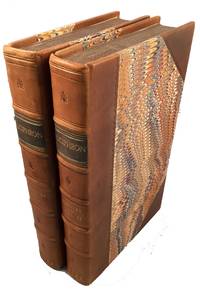
173200008013London: J. Tonson 1732. Second edition. Hardcover. Near Fine. 2 vol. 8vo. 15 2-356 4; 9 2-351 3 pp. Recent half brown calf over marbled paper boards spine in six compartments with gold lettering and gold rules; brown topstain and red speckled fore-edge and bottom edge. Recent endpapers and pastedowns. Volume 1 missing the A4 blank the blank leaf called for between the errata and the contents has been excised otherwise both volumes collate complete. Keynes A17. A handsome set of two of Berkeley's principal works. Bindings are about Fine contents Very Good or better leaves very clean with occasional light wear Volume 1: bottom corner of L1 missing; Volume 2: the first three or so gatherings show minor loss at the front gutter. J. Tonson hardcover
173226337London: J. Tonson 1732. 2 vols. 8vo pp. 14 356; 8 218; engraved vignette title-pp.; bound with as issued An Essay towards a New Theory of Vision pp. 12 215-351; several woodcuts in the text; full contemporary calf double gilt rules on covers unlettered spines in 6 compartments volume designations in 1; some moderate chipping and cracking of the spines but all in all a good and reasonably sound set. Rothschild 372 citing the first edition of the same year: "Alciphron was written in America where Berkeley had gone to await funds which never came for his projected College in the Bermudas. J. Tonson unknown
174511457AB1745. Amsterdam P. Mortier 1745. Kl.-8°. XXIV 343 S. Lederband der Zeit mit Rückenvergoldung und farbigem Rückenschild geringfügig bestoßen und berieben Gelenke mit minimalem Wurmfraß. Umlaufend roter Sprenkelschnitt. Erste Vakatseite und Schmutztitel verso mit kleiner Anhaftung am Unterrand. Titelei geringfügig lädiert am Kopfschnitt. Sonst äußerst schönes und nahezu fleckenfreies Exemplar. Blake 43; Wellcome II 149; Neu 423; Osler 1072: 'Perhaps the most remarkable work on Philosophy ever published as a chain of reflections was linked with a discussion on the virtues of tar-water.This french edition published in Amsterdam was 'quite unobtainable''Zitat des französ. Philosophen Henri Bergson. - Teer als Hausmittel lange angewandt kam als Teerwasser durch die Empfehlung des Bischofs Berkeley stark in Aufnahme s. Schelenz 590. Vgl. Ferchl 38 Poggendorff I 153 und DSB II 16. - George Berkeley 1685-1753 Bishop of Cloyne 'was a critic of the 17th- and 18th-century philosophical scientific mathematical moral political and theological ideas and an important link in the development of general philosophy between a period of Descartes and Locke and that of Hume and Kant.B.'s last major work Siris 1744 .begins as an investigation of the medicinal virtues of tar water and ends with a disquisition of Platonic philosophy' DSB; s. a. Ziegenfuß I 113 ff. unknown
174543324HB1745. Amsterdam P. Mortier 1745. Kl.-8°. XXIV 343 S. Lederband der Zeit mit Rücken- und Kantenvergoldung leicht bestoßen und berieben oberes Kapital mit kleiner Fehlstelle unterer Rücken mit montierter Bibl.-Sign. Umlaufender Rotschnitt. Schmutztitel und Titel beidseitig gestempelt oder mit handschriftlichen Anmerkungen. Sonst sehr schönes und nahezu fleckenfreies Exemplar. Blake 43; Wellcome II 149; Neu 423; Osler 1072: 'Perhaps the most remarkable work on Philosophy ever published as a chain of reflections was linked with a discussion on the virtues of tar-water.This french edition published in Amsterdam was 'quite unobtainable''Zitat des französ. Philosophen Henri Bergson. - Teer als Hausmittel lange angewandt kam als Teerwasser durch die Empfehlung des Bischofs Berkeley stark in Aufnahme s. Schelenz 590. Vgl. Ferchl 38 Poggendorff I 153 und DSB II 16. - George Berkeley 1685-1753 Bishop of Cloyne 'was a critic of the 17th- and 18th-century philosophical scientific mathematical moral political and theological ideas and an important link in the development of general philosophy between a period of Descartes and Locke and that of Hume and Kant.B.'s last major work Siris 1744 .begins as an investigation of the medicinal virtues of tar water and ends with a disquisition of Platonic philosophy' DSB; s. a. Ziegenfuß I 113 ff. unknown
174527379Amsterdam: Pierre Mortier 1745. perfect. Gut. XXIV 343 S. 1 Bl. Schmucklose Broschur der Zeit mit handschriftl. Rückenschild bestossen Bezug des Rückens mit Fehlstellen etwas angestaubt wenige Lagen mit Bräunungen und Wasserrand in einer Ecke teilweise nicht aufgeschnitten insgesamt aber ordentliches und breitrandiges Exemplar. Erste französische Übersetzung des Textes der zuerst 1744 in London unter dem Titel 'Siris a chain of philosophical reflexions and inquiries concerning the virtues of tar-water' erschienen war. Laut Vorwort des Übersetzers Boullier wurden für vorl. Ausgabe Ergänzungen und Korrekturen verwendet die er direkt von Berkeley aus dem Manuskript erhalten hatte. Eine vollständige deutsche Ausgabe erschien erst 1913. Berkeley 1684-1753 Theologe und als solcher seit 1734 Bischof von Cloyne Irland begründete von John Locke ausgehend 'den neueren erkenntnistheoretischen Idealismus als Immaterialismus' Eisler a.a.O. Er beeinflusste so unterschiedliche Denker wie David Hume John Stuart Mill und Ernst Mach. - Eisler Philosophen-Lexikon p. 60ff. - Ueberweg III 12. Aufl. 1924 p. 394 - Barbier IV Sp. 37 zur Identifizierung des Übersetzers. Wegen Urlaub kann Ihre Bestellung / Anfrage erst nach dem 21.06.2026 bearbeitet werden. - Because of holidays your order / question can be handled only after 06/21/2026. Pierre Mortier unknown
1744158069London: For W. Innys and C. Hitch and C. Davis 1744. Second London edition first published in Dublin and London earlier the same year. The work was in his lifetime by far Berkeley's most popular book. Berkeley was interested in the therapeutic properties of an infusion of tar in water and the first part of the book is indeed on the subject but he then "passes by imperceptible stages from physical to metaphysical arguments until he is fairly launched upon a general discussion of Aristotelian and Platonic philosophy. The book is written with compelling lucidity and charm and is one of Berkeley's major works though his last substantial treatise. Siris was by far his most popular work by reason of its containing a supposed remedy for most human ills the efficacy and cheapness of which was so convincingly urged by the author confidence in it being strengthened by the fact that he had experimented first upon himself. Berkeley confessed that this work caused him more thought and research than any other he had ever been engaged in" Keynes p. 116 & vi. The popularity of the work led to a series of Dublin and London editions in quick succession. This edition includes the corrections made by the author to the second Dublin edition. Octavo 196 x 116 mm. Twentieth-century quarter calf spine lettered in gilt marbled sides. Light toning to contents with a couple of ink splashes; a very good copy. ESTC T9521; Keynes Bibliography of George Berkeley 67. unknown
1744AQ18715London: Re-printed For W. Innys and C. Hitch.and C. Davis 1744. 174pp 2. Recent sheep-backed marbled paper boards contrasting red morocco lettering-piece. Lightly rubbed spine sunned. Recent book-label of John Stephens to FEP inked ownership inscription of 'Danvers Osborm 1744' to head of title-page with very occasional annotations in his hand slight loss to upper corner of leaf O1. The revised edition of George Berkeley's 1685-1753 penultimate publication an exploration of the medicinal virtues of tar-water with instructions for its use. Berkeley considered tar-water to be a cure for a plethora of ailments ranging from fevers and apoplexies to cancers and scurvy. He cites Isaac Newton in regards to his study of the solubility of salts and acids. Sir Danvers Osborn 3rd Baronet 1715-1753 politician notable for serving the cause of the House of Stuart in the Jacobite rising of 1745 and for serving as colonial governor of New York Province in 1753. ESTC T9521. Second edition improved and correct by the author. 8vo. Re-printed For W. Innys, and C. Hitch...and C. Davis hardcover
1744elala486Dublin Printed London Reprinted: For W.Innys and C.Hitch and C.Davis 1744. 1744. 8vo. pp. 174 2. contemporary mottled calf rebacked corners worn several small library rubberstamps. Second London Edition of Berkeleys most popular work an exposition of the medicinal virtues of tar-water and instructions for its use. Berkeley regarded it as a cure for virtually every ailment including fevers cancers apoplexies small-pox and scurvy and he even set up an apparatus for manufacturing it himself. It was equally beneficial he maintained for cattle and was strongly recommended to improve and sharpen the general health and intellect of infants and young children. Blake 43. Jessop 21e. Keynes 67. Kress 4685. Bib. Osleriana 1071. Wellcome II 149. Dublin Printed, London Reprinted: For W.Innys, and C.Hitch, and C.Davis, 1744. unknown
1747206028Dublin/London: W. Innys and C. Hitch in Pater-noster-row and C. Davis in Holbourn 1747. Wear to a small portion of the upper corners of the first fifty-four pages as if nibbled by a small rodent less offensive than it sounds; a short marginal tear and library stamp to title page; small neat marginal notations; small abrasion to the front endpaper; joints and edges rubbed. 8vo 174 2pp; later morocco and marbled boards. De-accessioned from the American Antiquarian Society with the AAS stamp on the title page and initials on the spine. Among Bishop Berkeley's last works this series of "reflexions" touts the medieval remedy of tar-water made from pine tar steeped in cold water for prevention of all manner of ailments from digestive disorders and kidney stones to scurvy distemper smallpox and other illnesses. W. Innys, and C. Hitch, in Pater-noster-row, and C. Davis in Holbourn unknown