43 résultats
1676650788London: C. Smith for Sampson Evans 1676. 1st Edition . Hardcover. Very Good. 507 pages in very good condition. Pages are aged and worn. Some pages are re-margined to repair significant edge-wear many are darkened creased lightly stained. Pen markings on the title page. Previous owner's signature on the first page of the preface. Page edges are darkened. Rebound in half-leather with marbled paper on the boards. 5 raised bands and gilt titles on the spine. Worn and scuffed around the edges and spine. Very good for its age. 1ST EDITION VG <br/> <br/> C. Smith, for Sampson Evans hardcover
1699117837Amsterdam : Chez Jaques Menassion 1699. 150x90mm. 9 ff. Avertissement - PrÂŽface du traducteur - Indice du Contenu des Sections - 484 pages bandeaux reliure plein veau avec titre fleurons fleurs de lys et caissons ornÂŽs dorÂŽs au dos ˆ quatre faux-nerfs. Coiffe infÂŽrieure abimÂŽe. CharniÂre supÂŽrieure fendue. IntÂŽrieur propre. Barbier III-574. TroisiÂme traduction franÂaise de Coste.Revue Dix-septiÂme siÂcle 2011/4 n.¡ 253 article LÕoeuvre des premiers traducteurs franÂais de John Locke : Jean Le Clerc Pierre Coste et David Mazel : Ã’Locke ne semble pas avoir trouvÂŽ que les commentaires ajoutÂŽs par Coste dans la prÂŽface de la traduction de ses Thoughts concerning Education ÂŽtaient dÂŽplacÂŽs ; au contraire il trouva son conseil ˆ propos de la nÂŽcessitÂŽ de bien ma”triser sa langue maternelle si perspicace quÕil dÂŽcida de lÕinsÂŽrer non pas dans le paratexte mais dans le texte mÂme de lՎdition anglaise revue et augmentÂŽe qui suivit ce dont Coste ne fut pas peu fier. Le transfert culturel eut donc un effet boomerang. En dÕautres termes lÕadaptation culturelle ˆ laquelle Coste fut contraint de procÂŽder pour traduire Some Thoughts concerning Education en franÂais fut ensuite adoptÂŽe par lÕauteur anglais pour son texte source qui fut ainsi enrichi de lÕidÂŽe du traducteur franÂaisÓ. Ã’dans lÕavertissement ˆ la deuxiÂme ÂŽdition franÂaise de De lÕeducation des enfans Coste signala quÕau rang des Ã’articles tout nouveauxÓ dont Locke avait grossi la version originale de lÕÃuvre figurait le sien sur lÕimportance dÕune bonne ma”trise de sa langue maternelle il prÂŽcisa ÂŽgalement que le texte original avait gagnÂŽ en exactitude. . Ë en croire Coste cÕest gr‰ce ˆ lui et ˆ son travail de traduction que Locke en vint ˆ Ã’exprimer en Anglois quantitÂŽ dÕendroits dÕune maniÂre plus prÂŽcise & plus distincte quÕil nÕavoit fait dans les trois premiÂres ƒditions de son LivreÓÓ. 235 Chez Jaques Menassion unknown
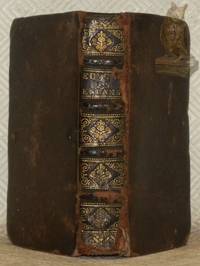
1697AQ12749London: Printed by Edw. Jones for Awnsham and John Churchill 1697. 16 310 10. With a terminal advertisement leaf. Contemporary blind-panelled speckled calf neatly rebacked and recornered in brown morocco contrasting red morocco lettering-piece gilt. Binding a trifle rubbed and a little marked new endpapers. Small rust hole to G3 without loss of sense else a crisp and clean copy. The third edition but first appearance with this title of a collection of scriptural excerpts collected together thematically which was first published as Graphautarkeia London 1676. The authorship is unknown but it is commonly misattributed to John Locke presumably because his own system of common-placing was outlined in an appendix to Humane understanding - despite this work not being organised in his fashion - to the extent that several nineteenth-century editions featured the philosopher's name in their titles. Wing L2737. Third edition. Quarto. Printed by Edw. Jones, for Awnsham and John Churchill unknown
169944075Leipzig Grosse & Gleditsch 1699. 4to. In: "Acta Eruditorum Anno MDCIC". The entire volume offered in contemporary full vellum. Hand written title on spine. A yellow label pasted on to top of spine. Two small stamps to title-page and free front end-paper. Library label to pasted down front free end-paper. As usual with various browning to leaves and plates. Pp. 12-20. Entire volume: 2 582 pp. ten engraved plates. <br/><br/><em>First Latin edition and second overall printing of a selection of Locke's responses to Edward Stillingfleet Bishop of Worcester. These are not only an important source in understanding Locke's late and mature view on religion but are probably the most famous and indebt discussions related to his seminal work "An Essay concerning Humane Understanding" Locke engaged in. The topic is of special interest since: "Religion and Christianity in particular is perhaps the most important influence on the shape of Locke's philosophy". SEP: John Locke. The debate was essentially about Locke's definition of substance in "An Essay.". Stillingfleet argued that Locke advocated against dualism mind - body and thereby opening a door to Unitarianism. Locke did not support this view he however did not clearly reject the notion of Unitarianism and Socinianism. The volume contains the following:1. Bernoulli Jakob. Circinus proportionum nauticus scala loxodromica instructus. Pp. 91-3.2. Bernoulli Johann. Cycloidis primariae segmenta innumera quadraturam recipienta. Pp. 316-20 one engraved plate. 3. Bernoulli Jakob. Quadratura zonarum cycloidalium demonstrata. Pp. 427-28.4. Bernoulli Johann. Excerpta ex literis. Groningae 7 Augusti 1699 datis. Pp. 513-16.And many other papers by influential contemporary mathematicians philosophers and historians. </em> hardcover
1684721072London: Samson Evans H. Sawbridge 1684. Full leather. Quarto full leather. Worn and chipped leather with professional restoration along spine and to corners and hinges. Imprimatur page is creased and torn light chipping to title page edges. Early owners' names on end papers and title page. Lacks bfep. Heavy foxing some stains. Otherwise sound. London: Samson Evans, H. Sawbridge hardcover
1695JC14328London: A. and J. Churchill 1695. Third edition enlarged. Hardcover. Very Good. Early panelled calf joints and spine tips rather shabbily renewed; 12mo; pp. 8 374 2 TOC. Binding scuffed. Previous owner's bookplate on FFEP; a little foxing here and there; but text block is overall clean and unmarked. <br/><br/>The third edition -- following two substantially identical editions from 1693 -- has a number of changes including the author's name added to the end of the Preface as well as textual expansion and new sections. A. and J. Churchill hardcover
1693POCme[LO61London: Printed for A. and J.Churchill 1693. 1693. 8vo. pp. 4 p.l. 262 2. contemporary mottled calf front joint cracked short split in upper rear joint spine ends bit chipped lacking front flyleaf discolouration to outer margin in some gatherings outer margin of last few leaves with slight fraying. a few old manuscript marginal notes. First Edition First Issue with with slightly skewed woodcut ornament on title catchword I my on A2v and misprint Patronnge on A3v Yolton reversing priority given in Wing. Lockes treatise grew out of a correspondence dating from 1684 between himself and his friend Edward Clarke whom he was advising on the education of his son. Locke was in Holland at the time. "His thought was marked by a ready understanding of and sympathy with children. Three main thoughts dominate the work. First the individual aptitudes capacities and idiosyncrasies of the child should govern learning not arbitrary curricular or rote learning taught by the rod. Second Locke placed the health of the body and the development of a sound character ahead of intellectual learning. In the third place he saw that play high spirits and the "gamesome humor" natural to children should govern the business of learning wherever possible. Compulsory learning is irksome; where there is play in learning there is also joy in it. Throughout he placed emphasis on good example practice and use rather than on precepts rules and punishment. The work was an implicit criticism of his own education at Westminster and Oxford which he found unpleasant and largely useless." James Gordon Clapp Encyc. of Philosophy p. 500 Wing 2762A. Yolton 165. Christophersen p. 57. Pforzheimer 612. 1st Edition. London: Printed for A. and J.Churchill, 1693. unknown
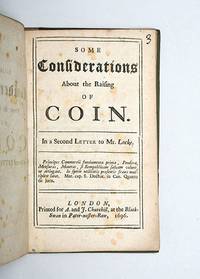
1696151077London: A. and J. Churchill 1696. Responding to Locke on coinage First edition of an anonymous reply to John Locke's Further Considerations Concerning Raising the Value of Money both part of the considerable output of publications surrounding the Great Recoinage of 1696 where the shortage and drawbacks of metal currency was engendering much debate. The terminal page is known in two settings this dated 3 October 1696 with advertisements the other dated 23 September 1696 and without advertisements. Octavo 173 x 106 mm. Nineteenth century white quarter cloth spine lettered in gilt green paper-covered sides. Early notation to title page stamp of Assay Office Library Birmingham to front free endpaper. Spine and extremities darkened contents foxed half-title lightly soiled. A very good copy. ESTC R16348; Pforzheimer 615; Wing S4481; Yolton C1696-5. hardcover
170011172Amsterdam: Chez Henri Schelete 1700. French translated Edition Fourth. Full Calf. Very Good. French translated Edition Fourth. Full Calf. Translation to English: Philosophical Essay Concerning Human Understanding or We Show What is the Extent of our Certain Knowledge and the Way in which We Achieve it. Translated from the English of Mr. Locke by Pierre Coste. On the Fourth Edition revised corrected and enlarged by the Author. Original 18th Century Edition. First French translation by Pierre Coste 1668-1747 of Locke's 1632-1704 philosophical work first published in 1690. Pierre Coste was a French theologian translator and writer. Born in Uzès France to Protestant parents he moved to England via Switzerland and Holland after the Revocation of the Edict of Nantes in 1685. Acknowledgments from Simon von Beaumont statesman. Complete detachment on front board starting rear; minimal head and tail wear chipping rubbing to boards minor foxing evidence of dampstaining else very good. Full calf gilt titling/edging/decorations tall 8vo 936 pp. table ornaments marbled edge. In French. Chez Henri Schelete unknown
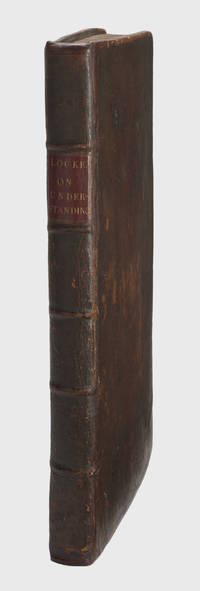
1700B5207London: Awnsham and John Churchil c. 1700. A fine example of this desirable work. Edition: 4th edition with large additions. Binding: Contemporary brown speckled calf boards with blind tooled decorative borders on top and bottom cover rebacked skillfully. Spine in six compartments with gilt text on 2 and 6. Tooled decorations on 1 3 4 5 and 6. <br> Notes: The essay is divided into 4 books within the one volume. John Locke FRS 1632 –v1704 was an English philosopher and physician regarded as one of the most influential of Enlightenment thinkers and known as the "Father of Classical Liberalism". Considered one of the first of the British empiricists following the tradition of Sir Francis Bacon he is equally important to social contract theory. His work greatly affected the development of epistemology and political philosophy. His writings influenced Voltaire and Rousseau many Scottish Enlightenment thinkers as well as the American revolutionaries. His contributions to classical republicanism and liberal theory are reflected in the United States Declaration of Independence. Locke was the first to take up the challenge of Bacon and to attempt to estimate critically the certainty and the adequacy of human knowledge when confronted with God and the universe. In the past similar enquiries had been vitiated by the human propensity to extend them beyond the range of human understanding and to invent causes for what it cannot explain. Therefore Locke’s first task was to ascertain ‘the original certainty and extent of human knowledge’ and excluding ‘the physical consideration of the mind to show how far it can comprehend the universe’. His conclusion is that though knowledge must necessarily fall short of complete comprehension it can at least be ‘sufficient’; enough to convince us that we are not at the mercy of pure chance and can to some extent control our own destiny" Printing and the Mind of Man Size: Small Folio 317x205mm. Illustration: Illustrated with a frontispiece engraving of John Locke. Volume: 4 books in 1 volume Provenance: of William Bell from Ulcombe Kent. References: Attig 228. Grolier 100 English 36. Grolier Wither to Prior 527. Pforzheimer 600. Printing and the Mind of Man 164. Wing L2739. HBS 64538. Pages: P. Blank. Frontis. Title. Dedication 1-4. Epistle to the Reader 1-10. Contents 1-23. 1-438. Index 1-11. Errata. Blank. 91-94 mispag as 93-96 226 jumps to 233 371 mispag as 317 380-381 mispag as 390-391. This is an augmented edition with two new chapters that were not in the previous editions. Category: Book Philosophy; Book Social Sciences; Book Europe United Kingdom; Awnsham and John Churchil hardcover
1690fivelettersJohn Locke 1690. First English Edition. Hardcover. Pages generally clean with notat. Five Letters Concerning the Inspiration of the Holy Scriptures translated from the French written originally by Jean Le Clerc. This edition translated and published by John Locke. Rare first English edition from 1690. Previously owned by Gleason L Archer famous American biblical scholar and theologian with his notation to front space and final page. Book complete and tightly bound in contemporary linen titled boards.Pages generally clean with notation to front space and end page by prior owner contemporary binding tight and clean linen boards with one small stain. John Locke hardcover
1696BBO47<p><b>LOCKE</b> John:<br /></p><p><b><i>Some Thoughts Concerning Education</i></b></p><p>London: A and J Churchill 1695.</p><p>8vo. 3742 pp.; brown spotted calf</p><p>Third edition Newly Expanded First edition thus</p><p><br /></p> A and J Churchill hardcover
169031842London: by Eliz. Holt for Thomas Basset 1690. First edition first issue with the Undated Dedication with the title-page listing Eliz. Holt the Properly Positioned “SS†the first imprint and all points called for typographical ornaments line 3 has them upside down in columns 2 through 6 while in line 4 all ornaments are upside down with five of the six possible misnumbered pages for this issue: "85" as "83" "287" as "269" "296" as "294" "303" as "230" and "319" as "327" page 55 with "Underwandings" as called for with the incorrect Roman numerals to pp. 57 and 263 and the deleted 24 paragraph indicator at page 90. With contemporaneous signature “J Locke†on the title page and three handwritten corrections "in" “extremely†and the insert “some†which may be in Locke's hand in the preliminaries. Folio 320 x 195 mm. full polished calf to style handsomely and discreetly double lined in gilt on the covers and the spine with raised bands ruled in gilt with red morocco lettering label gilt in best style on the spine. In beautiful condition. title 10 1-362 22 Contents pp. A handsome and pleasing and crisp copy in lovely condition some quite unobtrusive evidence of age mellowing or toning to the lower edges of the leaves probably from old damp. FIRST EDITION FIRST ISSUE OF THIS SINGULARLY IMPORTANT WORK IN THE HISTORY OF PHILOSOPHY AND EPISTEMOLOGY. Locke's ESSAY was the "first attempt on a great scale and in the Baconian spirit to estimate critically the certainty and the adequacy of human knowledge when confronted with God and the universe" EB. It served as the most concrete manifestation of a new empiricist spirit in contrast to the metaphysical philosophies of Descartes Spinoza and Leibniz. Locke was inspired to write the ESSAY in 1671 after a philosophical discussion with friends in which he realized that no progress could be made before they had examined the mind's capacities and seen "what objects our understandings were or were not fitted to deal with" from the "Epistle to the Reader".<br> "Other philosophers had reflected on and written about human knowledge.But Locke was the first philosopher to devote his main work to an inquiry into human understanding its scope and its limits. And we can say that the prominent place occupied in modern philosophy by the theory of knowledge is in large measure due to him." Copleston A HISTORY OF PHILOSOPHY.<br> Locke's influence was widespread and was not strictly limited to pure philosophical enquiry. In America his emphasis on rational thought versus "enthusiasm" provided ammunition and philosophical grounding to opponents of the revivalist and itinerant preachers of the Great Awakening and in the nineteenth century the "nature versus nurture" thesis was employed by Unitarians and other anti-Calvinist factions to argue that human nature was improvable through nurture and self-culture rather than corrupt beyond hope without conversion through a special act of divine grace. In England Locke had a strong influence on the literature of the Augustan Age Sterne Addison and the members of the Scriblerus Club all acknowledging the currency of his ideas. "The art of education political thought theology and philosophy especially in Britain France and America long bore the stamp of the ESSAY or of reaction against it" Fraser quoted in Grolier. Locke's ESSAY has passed through more editions than any classic in modern philosophical literature and remains a cornerstone in the history of human thought. by Eliz. Holt for Thomas Basset hardcover
169711458<p>London: Printed by H. Clark for A. and J. Churchill. 1697 First edition. Rebound in quarter calf over marbled boards. Octavo. Very good.</p> Printed by H. Clark, for A. and J. Churchill.. hardcover
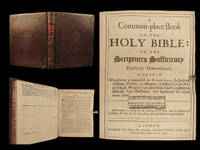
169724368<p><strong>1697 John LOCKE Commonplace Book BIBLE Interpretation Miracles Demons Angels </strong></p><p><em>"I have always thought the actions of men the best interpreters of their thoughts." </em></p><p><em>– John Locke </em></p><p>John Locke was without question one of the world's most important philosophical thinkers. He published books on human understanding and was the first to describe the idea of 'blank state' of the mind. However in 1685 Locke published the first of his 'commonplace books' in which he described the formulas for understanding ideas quotations and sayings. This style of writing proved effective for learners so many other writers began publishing common-place books to build on the popularity established by Locke.</p><p>One such work was "<em>A Commonplace Book to the Holy Bible</em>" – an anonymously published supplement to scripture reading and interpretation. It provides extensive descriptions on the character of God the relationship between Christ and the church on saints and the roles and duties believers. This book has long been attributed to John Locke but this attribution has been contested in modern scholarship.</p><p>Item number: #24368</p><p>Price: $995</p><p>LOCKE John attributed</p><p><strong><em>A common-place book to the Holy Bible or The scriptures sufficiency practically demonstrated wherein whatsoever is contain'd in scripture</em></strong></p><p>London: printed by Jones for Awnsham and Churchil 1697.</p><p><u>Details</u>: </p><p><!-- if !supportLists-->· <!--endif-->Collation: Complete</p><p><!-- if !supportLists-->o <!--endif-->16 310 10</p><p><!-- if !supportLists-->· <!--endif-->References: Wing L 2737</p><p><!-- if !supportLists-->· <!--endif-->Language: English</p><p><!-- if !supportLists-->· <!--endif-->Binding: Leather; tight and secure</p><p><!-- if !supportLists-->· <!--endif-->Size: ~8in X 6.5in 20.5cm x 16.5cm</p><p>Our Guarantee:</p><p>Very Fast. Very Safe. Free Shipping Worldwide.</p><p>Customer satisfaction is our priority! Notify us with 7 days of receiving and we will offer a full refund without reservation!</p><p>24368</p><p>Photos available upon request. </p> Jones for Awnsham and Churchil hardcover
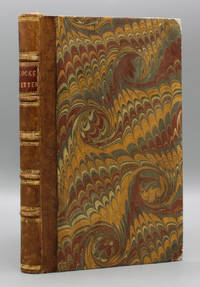
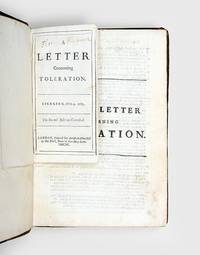
1690187184London: first: Printed for Awnsham Churchill 1690; second & third: Printed for Awnsham and John Churchill 1690 & 1692. Locke's three letters on toleration in a single volume with a probable connection to Locke's Somerset friends First editions of the Second and Third Letters second edition in English of the First collecting in a single volume all the works on toleration published by Locke in his lifetime. Following Louis XIV's revocation of the Edict of Nantes in 1685 Locke was moved to publish views he had previously circulated only in manuscript. Although intended primarily for Christians and particularly for dissenting Protestants the three Letters outline a hugely influential conception of the proper relationship between government and religion. For Locke the state cannot and should not compel individuals to adopt particular faiths. Churches are re-conceived as voluntary societies which can be joined or left without incurring civil penalties - subject to the concerns of civil society and foreign influence. Locke's original Epistola de tolerantia 1689 was swiftly translated into English by his friend William Popple who was responsible for the phrase often attributed to Locke himself "Absolute Liberty Just and True Liberty Equal and Impartial Liberty is the thing that we stand in need of" p. iv. In April 1690 an Oxford clergyman disputed the Letter's rejection of force which prompted Locke to reply that summer under an assumed identity with the Second Letter and then under his own identity with the much longer Third Letter of 1692. A fourth was left in manuscript at Locke's death in 1702; it was first published in the Posthumous Works 1706. The first and second Letters bear the contemporary ink signature of Thomas Musgrave on their title pages. This is probably a member of the Musgrave family of Nettlecombe Somerset whom Locke knew well. William Musgrave 1655-1721 was a fellow member of the Royal Society while Dr George Musgrave d. 1721 a country physician married the daughter of Edward Clarke one of Locke's closest friends. Locke himself a trained physician knew George Musgrave well enough to write letters praising his medical skills: the latter returned the compliment by providing some of the first admiring reviews of Locke's Essay Concerning Human Understanding 1694. The Somerset archives contain the 1723 will of one Thomas Musgrave of Nettlecombe. A similar hand possibly that of Musgrave has made a further annotation on the rear free endpaper verso. 3 works bound in 1 vol. the first duodecimo 139 x 70 mm the others quarto 205 x 142 mm; pp. iv 87 5; pp. iv 68; pp. iv 350 2. Contemporary panelled calf edges sprinkled red. Joints and extremities restored spot of wear to corners light bumping faint offsetting to several leaves Third Letter with minor loss to upper outer corner of half-title and short closed tears to outer margins of Gg4 & Yy1 each just touching text: still a very good volume indeed. ESTC R21477; R5484; R5673; Printing and the Mind of Man 163; Wing L2748 L2755 L2765; Yolton 4; 25; 27. See Sowerby 1338. unknown
1697PCKLeLOC34London: Printed by H.Clark for A. and J.Churchill and Edw. Castle 1697. 1697. 8vo. pp. 2 p.l. 227 1ad. complete with half-title. paneled calf antique narrow strip from blank upper margin of title cut away; some light foxing. First Edition Second Issue. BOUND WITH: LOCKE John. Mr. Locke's Reply to the Right Reverend the Lord Bishop of Worcester's Answer to his Letter Concerning some Passages Relating To Mr. Locke's Essay Of Humane Understanding: In A Late Discourse of his Lordships In Vindication of the Trinity. 8vo. pp. 2 p.l. 174 1 leaf 7 1errata 2ads. complete with half-title. upper portion of last leaf of ads cut away; some light foxing. London: Printed by H.Clark for A. and J.Churchill and E.Castle 1697. First Edition. In 1696 deist John Toland published his Christianity not Mysterious a work professing to be a strict theological application of Lockean philosophy. It drew immediate response from Edward Stillingfleet Bishop of Worcester who in his Vindication of the Doctrine of the Trinity attacked Toland and Locke alike and charged Locke with disallowing mystery in human knowledge. A heated controversy ensued Locke responding with a Letter and two Replies the second of which appeared in 1699. Wing L2749 & L2754. NCBEL II 1837. Christophersen pp. 37-41. Rand I 342. 1st Edition. Hardcover. Very Good. London: Printed by H.Clark, for A. and J.Churchill and Edw. Castle, 1697. Hardcover
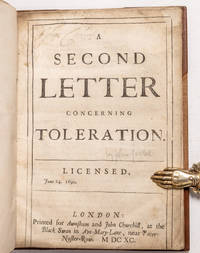
1690151201London: Printed for Awnsham and John Churchill at the Black Swan in Ave-Mary Lane 1690. First edition of John Locke's landmark second Letter of Toleration a profound influence on Jefferson Madison and the architecture of the American Constitution on freedom of religion. Octavo bound in three quarter calf with gilt titles to the spine marbled endpapers. In very good condition paper repair to lower corner D1 faint early ink ownership inscription to title page. Rare. John Locke’s Letters on Toleration 1689–1692 articulate one of the most influential defenses of religious toleration in Western political thought. Written in the aftermath of the religious conflicts that followed the Reformation and England’s own civil strife Locke’s argument became foundational for modern liberal constitutionalism—especially principles later reflected in First Amendment doctrines such as free exercise of religion and the separation of church and state. Locke's idea of toleration has been described as "one of the defining topics of political philosophy… a way of thinking about First Amendment rights such as the free exercise of religion and the wall of separation between church and state" Williams and Waldron Toleration 1. Jefferson and Madison in particular "grounded their commitment to freedom of conscience on the foundation laid by Locke in his Letter Concerning Toleration" which Locke wrote in Latin Epistola de Tolerantia in 1685 while in exile in Holland Ravitch & Witeritti Making Good Citizens 245. Soon after publication of Locke's first Letter in the virtually unobtainable 1689 English edition he was anonymously caught up in a heated debate with Jonas Proast whose 1690 Argument of the Letter Concerning Toleration quickly prompted Locke to reply the same year with A Second Letter Concerning Toleration. Locke continued developing his philosophy with "the largest work in the exchange A Third Letter for Toleration almost ten times the lengthy of his original Letter… In recent years… the Locke-Proast controversy has attracted more attention than ever before"—marking a seminal "divide between two conceptions of politics" Vernon Career of Toleration 3-6. Printed for Awnsham and John Churchill, at the Black Swan in Ave-Mary Lane unknown
1700AQ17273London: Printed for A. and J. Churchil 1700. 8 308pp 4. Contemporary panelled calf recently rebacked to style recent contrasting green morocco lettering-piece. Boards rubbed. Later armorial bookplate of Waldegrave Pelham Clay to FEP minute worm-trail to margins of first half of text-block lightly spotted. The second edition a significant abridgement of John Locke's 1632-1704 An Essay Concerning Humane Understanding; the foremost modern attempt at an analysis of human knowledge greeted with as much opposition as applause upon it's appearance in 1690. The abridgement by John Wynne of Jesus College Oxford was first printed in 1696; such was it's popularity among students seeking clarification of Locke's philosophy that a further 17 editions appeared the following century. ESTC R20235 Wing L2736. Second edition corrected and enlarged. 8vo. Printed for A. and J. Churchil hardcover
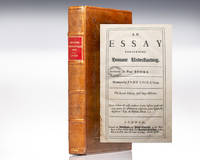
1690168757London: by Eliz. Holt for Thomas Basset 1690. One of the principal sources of empiricism in modern philosophy First edition first issue with the Holt imprint. Locke worked for nearly two decades on his investigation of "the certainty and the adequacy of human knowledge" PMM and the resulting landmark work influenced many Enlightenment philosophers. Locke argued that all our knowledge comes from experience and through our senses rather than innate ideas. The mind is at birth a clean sheet a tabula rasa; since only material things can affect our sense we can know nothing but matter and must accept a materialistic philosophy. Locke concluded that "though knowledge must necessarily fall short of complete comprehension it can at least be 'sufficient'; enough to convince us that we are not at the mercy of pure chance and can to some extent control our own destiny" ODNB. Locke's Essay quickly ran to several editions and was popularized on the continent through French translations. "Few books in the literature of philosophy have so widely represented the spirit of the age and country in which they appeared or have so influenced opinion afterwards. The art of education political thought theology and philosophy especially in Britain France and America long bore the stamp of the Essay or of reaction against it" Grolier. Voltaire and Diderot accepted Locke with little question Hume and Kant continued the investigation and Bishop Berkeley rejected it with his own immaterialism. The edition was reissued with a cancel title bearing an Edward Mory imprint. Provenance: inscription to front free endpaper "Robert Kirktowne London: 1698" a Robert Kirktowne is recorded as a naval surgeon in the period 18th-century inscription to the front pastedown "Ex libris Gulielmi Byrd MTS". This is possibly William Byrd II 1674-1744 a large landowner in Virginia who studied at Middle Temple in London explaining the MTS Middle Temple School initials. Folio 318 x 192 mm pp. xii 362 22. Contemporary speckled calf red morocco label covers bordered in blind edges speckled red. Housed in a dark blue quarter morocco solander box by the Chelsea Bindery. Ninteenth-century shelf label at head of spine. Skilful restoration at extremities leaf D2 with defective inner margin resulting in a number of missing words supplied in manuscript in early hand. A few splashes and scratches to covers else well-preserved contents a little toned else clean: a very good copy. Attig 228; ESTC R22993; Garrison-Morton 4967; Grolier English 100 72; Pforzheimer 599; Printing and the Mind of Man 164; Hook & Norman 1380; Wing L-2738; Yolton 61A. unknown
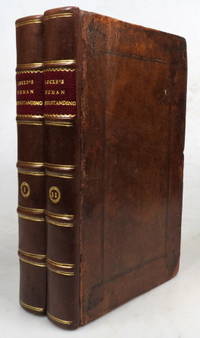
161545061London: J. Churchill and Samuel Manship 1716 15. Seventh edition two volumes 8vo. Portrait frontispiece. Brief contemporary inscription to the fly leaf in volume II booklabel of Professor J.D.M. Derrett to the fly leaf in volume I with his inscription in both volumes. Contemporary panelled calf old repair to the corners recently rebacked with maroon morocco labels. "Locke's design. covers a remarkably wide field of investigation into human knowledge: it is the first modern attempt to analyse it." Printing and the Mind of Man 164. London: J. Churchill and Samuel Manship unknown
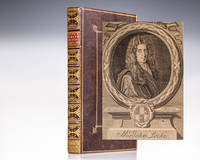
1700150333London: Printed for Awnsham and John Churchil at the Black-Swan in Pater-Noster Row and Samuel Manship at the Ship in Cornhill near the Royal-Exchange 1700. Rare fourth edition of this fundamental work in the history of Western thought the first to name Locke as the author and include the frontispiece portrait of him. Folio bound in in full speckled calf with gilt titles and tooling to the spine in six compartments within raised gilt bands gilt turn-ins engraved frontispiece portrait of Locke. An exceptional example. The second edition of Locke's essay contains a number of important changes and additions to the text. It was the first to name Locke as the author and include the frontispiece portrait of him. "It is Locke's second edition of the 'Essay on Human Understanding' that is the masterpiece we remember; the first 1690 edition did not bear Locke's name nor did it include a number of emendations that finished the work as Locke wanted it" Matthews Collecting Rare Books 97. "Locke was the first to take up the challenge of Bacon and to attempt to estimate critically the certainty and the adequacy of human knowledge when confronted with God and the universe" PMM 164. Printed for Awnsham and John Churchil, at the Black-Swan in Pater-Noster Row, and Samuel Manship, at the Ship in Cornhill, near unknown
1694149739London: Printed for Awnsham and John Churchil at the Black-Swan in Pater-Noster Row and Samuel Manship at the Ship in Cornhill near the Royal-Exchange 1694. Rare second edition of this fundamental work in the history of Western thought the first to name Locke as the author and to include the frontispiece portrait of him. Folio bound full paneled calf morocco spine label lettered in gilt elaborated diced stamping to the spine in five compartments within raised bands engraved frontispiece portrait of Locke by P. Vanderbanck after Sylvester Brounower. In very good condition. From the library of the Isle of Wight Institution with stamps to the title page page 175 and verso of final leaf; ownership signature of British missionary Daniel Tyerman 1773-1828 of Newport Isle of Wight dated 1804 to the title page. The second edition of Locke's essay contains a number of important changes and additions to the text. It was the first to name Locke as the author and include the frontispiece portrait of him indicative of the celebrity Locke acquired with the publication of the first edition in 1690. "When Thomas Basset was running out of copies of the first edition in February 1693 he signed a contract with Locke to pay him ten shillings per sheet for additional materials for a new printing. These additions included an expansion of Book I Chap. IV; the chapter on power was almost entirely new; a new chapter 'Of Identity and Diversity' was inserted as 2.27 making chapters 27-31 to be renumbered as 2.28-32; and a discussion was added to 2.9.8. Other numerous additions were made throughout sectional summaries added in the margins and an analytical index supplied" Yolton. "It is Locke's second edition of the 'Essay on Human Understanding' that is the masterpiece we remember; the first 1690 edition did not bear Locke's name nor did it include a number of emendations that finished the work as Locke wanted it" Matthews Collecting Rare Books 97. "Locke was the first to take up the challenge of Bacon and to attempt to estimate critically the certainty and the adequacy of human knowledge when confronted with God and the universe" PMM 164. It is in this work that Locke 1632-1704 lays the foundations of British empiricism and the concept of the mind as a tabula rasa. "Locke summed up the Enlightenment in his belief in the middle class and its right to freedom of conscience and right to property in his faith in science and in his confidence in the goodness of humanity. His influence upon philosophy and political theory has been incalculable" Columbia Encyclopedia. Printed for Awnsham and John Churchil, at the Black-Swan in Pater-Noster Row, and Samuel Manship, at the Ship in Cornhill, near hardcover
169032820531<p>FIRST EDITION FIRST ISSUE with the integral Eliz. Holt title-page. An excellent fresh copy of this classic of philosophy the first modern attempt to analyze knowledge. "Few books in the literature of philosophy have so widely represented the spirit of the age and country in which they have appeared or have so influenced opinion afterwards" Fraser.</p><p>"<b>The Essay has long been recognized as one of the great works of English literature of the 17th century and one of the epoch-making works in the history of philosophy. It has been one of the most repeatedly reprinted widely disseminated and read and profoundly influential books of the past three centuries</b>" Nidditch.</p><p>"Locke is often classified as the first of the great English empiricists ignoring the claims of Bacon and Hobbes. This reputation rests on Locke's greatest work the monumental An <i>Essay Concerning Human Understanding</i>" Stanford Encyclopedia of Philosophy.</p><p>Locke sold the copyright to the publisher Thomas Basset for thirty pounds plus six bound copies of every later edition and ten shillings for every sheet of additions to later printings. By 1800 twenty editions had appeared indicating work's great influence. Locke's intellectual heirs include Berkeley Hume and Bentham and the Radicals.</p><p>"Locke was the first to take up the challenge of Bacon and to attempt to estimate critically the certainty and the adequacy of human knowledge when confronted with God and the universe. In the past similar enquiries had been vitiated by the human propensity to extend them beyond the range of human understanding and to invent causes for what it cannot explain. Therefore Locke's first task was to ascertain 'the original certainty and extent of human knowledge' and excluding 'the physical consideration of the mind to show how far it can comprehend the universe.' His conclusion is that though knowledge must necessarily fall short of complete comprehension it can at least be 'sufficient'; enough to convince us that we are not at the mercy of pure chance and can to some extent control our own destiny" Printing and the Mind of Man 164.</p>Folio. Contemporary paneled calf red leather label. Rebacked preserving spine old endpapers. Manuscript correction on A3v. A very good fresh copy. Liz Holt
170005904AN ESSAY CONCERNING HUMANE UNDERSTANDING IN FOUR BOOKS Printed for Awnsham and John Churchil at the Black-Swan in Pater-Noster Row; and Samuel Manship at the Ship in Cornhill near the Royal-Exchange 1700 Fourth Edition Revised and Enlarged the last edition to be published in Locke's lifetime four books in one volume complete folio 438 pp plus 12 pp index and errata full leather covers detached and worn base of leather spine chipped lower fore edge corner of front free end-paper and title page chipped and worn however with no loss of text to the title page much less chipping and fore edge damage to the next seven leaves again with no loss to the text some staining to the bottom section and center gutters of the last 31 leaves entering the text but never defacing it faint narrow and unobtrusive stain to the lower fore edge section of most pages some staining to the first 20 leaves again entering the text but never defacing it. A decent candidate for rebinding as a majority of the text block is without significant damage. Printed for Awnsham and John Churchil, at the Black-Swan in Pater-Noster Row; and Samuel Manship, at the Ship in Cornhill, near hardcover