John LockeBiblio.com
105 résultats
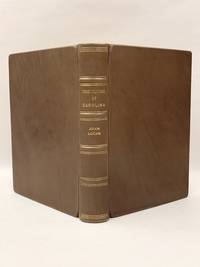
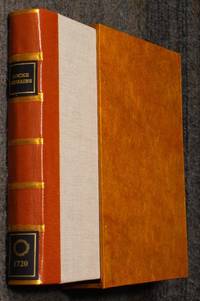
172040126London: J Betttenham for R. Franklin. Very Good with no dust jacket. 1720. First Edition; First Printing. Leather. 62 362 Index and Errata pages; Sabin states " Contains the fundamental Constitutions of Carolina" the first instrument ever digested and written out for the entire and perfect government of a political body. The plan was laid out by Lord Shaftesbury but the labor of it's composition was accomplished by Mr Locke. Though impracticable in many particulars it undoubtedly suggested to the colonists many hints which were beneficial in their civil and political organization." Rebound in 3/4 leather. The copper plate of the Solar System is there in facsimile. Otherwise VG complete contents an appealing binding ensconced in a matching slip case covered with handmade paper. A thoroughly attractive copy. . J Betttenham for R. Franklin hardcover
17391609070041London Printed for R. Francklin 1739-01-01. Hardcover. Very Good. Second edition issued without frontis and plate. Folio. 10 x 118 pp. 2. Modern blue paper covered boards paper spine label. Library stamps to several pages. Table of contents bound at end of volume. <br> Contents: The character of Mr. Locke. By Mr. Peter Coste.--The fundamental constitutions of Carolina.--A letter from a person of quality to his friend in the country.--Remarks upon some of Mr. Norris's books.--Elements of natural philosophy.--Some thoughts concerning reading and study.--Several letters to Anth. Collins esq; and other persons.--Rules of a society. Attig 787; Sabin 41726; Yolton 316B 316A. ref. to 1720 edition London, Printed for R. Francklin hardcover
172049627London: Printed by J Bettenham for R Francklin 1720. First Edition. Full calf. Very good. 362p index errata. old stain through some of the middle portion otherwise a very good copy rebound in modern calf with new end papers and fly leaves gilt title. Cherub cartouche on the title page. "Contains the Fundamental Constitutions of Carolina" Sabin 41726 <br/><br/> Printed by J Bettenham for R Francklin unknown
1739BOOKS099458ILondon: R. Francklin. Very good copy. 1739. 2nd ed. 1/4 leather. 4to 119 pp. Edited by Pierre Desmaizeaux under the direction of Anthony Collins. The second edition. Probably rebound in the 19th century; spine darkened and chipped at the top; front board rubbed; contents very good. . R. Francklin hardcover
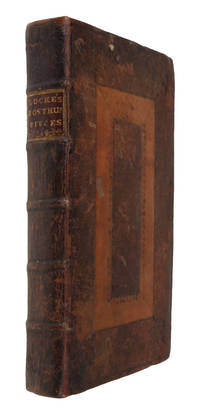
172041467London J. Bettenham 1720. 8vo. Nice contemporary English Cambridge-style full calf binding with five raised bands and gilt title-label to spine. Neat minor repair to extremities. A bit of overall wear but a nice and tight copy. Internally nice and clean with only some occasional soiling that is very light. Engraved title-vignette 36 - i.e. title-page dedication XXIV i.e. "The Character of Mr. Locke" by Peter Coste 2 - i.e. contents 362 18 - i.e. index 4 - i.e. errata advertisements pp. one plate "The Solar System". <br/><br/><em>First edition of this important collection of hitherto unpublished works by Locke containing the first printing of his unique work on Natural philosophy "The Elements of Natural Philosophy" as well as first printings of other important works. Assisted by Anthony Collins in 1720 the journalist Pierre Desmaizeaux brought out a new collection of Works and pieces by John Locke that had not previously been published. This collection "A Collection of Several Pieces" came to play a great role in the Locke scholarship not least in recent times and not least because it contains the first printing of his "Elements of Natural Philosophy"The "Elements of Natural Philosophy" constitutes Locke's main work in natural philosophy and it is a work that pas puzzled Locke scholars and readers ever since its appearance. The work seems to need some further explanation; at a firsthand glance it doesn't look very much like Locke - the greatest of the English philosophers who has so frequently been accused of not understanding the exact sciences and who even encouraged the youth not to learn these but to educate themselves in superficial and useful party-conversation. Thus numerous attempts have been made to establish the influence that resulted in this educational work of natural science. The two dominating answers to the question of influence are now: Newton and Descartes. It now seems to be fairly commonly recognized that Newton a personal friend of Locke even contributed directly to the work. "When Locke himself at the end of his life came to compose a treatise on natural philosophy for a pupil we have reason to believe that he obtained the advice and help of the most brilliant scientist of the century his close friend Isaac Newton. As we shall see this unique educational work itself "The Elements of Natural Philosophy" belies the myth of Locke the scientific smatterer." Axtell Locke Newton and the Elements of Natural Philosophy p. 244. However Descartes influence also seems to be obvious; "The influence of the "Principles" by Descartes is also obvious in Locke's posthumously published "Elements of Natural Philosophy". There is a striking similarity in the order of exposition although there are also considerable differences: Locke carefully eschewed Descartes' "a priori" metahpysics of nature. We find him rather emphasizing the essential role of experience. For example Locke introduced Newtonian universal gravitation as follows:. Thus according to Locke empirical support was necessary to establish the law of nature. Although the exposition looks quite similar to Descartes' "Principles" the "Elements" in fact contain several anti-Cartesian remarks in favour of the experimental philosophy." Aoki Descartes and Locke on the Nature of Matter. In: Hutton and Schuurmann edt. Studies on Locke p. 77."Elements of Natural Philosophy" was printed in no less than nine times during the 1th century and appeared in both Russian and French during the 18th century as well.The present "Collection of several Pieces" furthermore included a collection of letters from Locke to Anthony Collins "Remarks upon some of Mr. Norris's Books." "Some Thoughts concerning Reading and Study for a Gentleman." and "Rules of a society." all printed here for the first time as well as an English translation of Coste's Eulogy "The Character of Mr. Locke" originally published in French in 1705 and reprints of "The fundamental Constitutions of Carolina" and "A Letter from a person of Quality."."Remarks upon some of Mr. Norris's books." is the third of Locke's replies to Norris. "Some thoughts concerning reading and study for a gentleman" constitutes Locke's reply to Samuel Bold's question on behalf of a parishioner on how to create a course of reading and study. "Rules of a Society" constitutes the rules that Locke set up for a small group of friends who met once a week to discuss "useful Knowledge" and to promote "Truth and Christian Charity". Throughout his life Locke created several of these "societies" one of which led to his "An Essay Concerning Human Understanding" another one being "The College" in London after the Revolution. </em> hardcover