6 résultats
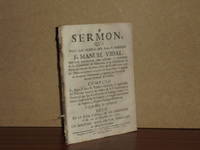
1769023027Salamanca: Oficina de la Santa Cruz por Domingo Casero 1769. No consta edición. Tapa blanda. Good. 40 pp. 14 x 195 cm. SERMÓN QUE PARA LAS HONRAS DEL Rmo. P. MAESTRO Fr. MANUEL VIDAL COMPUSO el Rmo. P. Mro. Fr. PEDRO OTERO Y MALLON Y QUE POR SU MUERTE DIXO en la Real Capilla de San Geronymo el día 19 de diciembre de 1769 un discípulo suyo. Papel limpio. Oficina de la Santa Cruz por Domingo Casero unknown
179738275T. Heptinstall. Good with no dust jacket. 1797. 1. Leather. b/w; 2xi12751 pages; Engraved title showing a rather devilish looking cherubic brother portrait frontis and six plates by Thomas Stothard. Front cover detached. Mild spotting to first two leaves otherwise VG throughout. . T. Heptinstall, hardcover
1750323461750. unknown
1737100960<p>Borgo San Donnino December 1737. 1737. Good. - Over 104 words penned in a secretarial hand on 12 inch high by 8-1/8 inch wide laid paper with an attached integral address leaf. Enrichetta the Duchess of Parma offers her thanks for Count Antonio Berni Canan's expressions of kindness following the death of her father Rinaldo d'Este 1655-Oct. 26 1737. Loosely translated from the Italian Enrichetta writes: "Recognizing very clearly your customary politeness and kindness in the courteous office that you were pleased to share with me on the occasion of the very heavy loss I suffered through the death of the Most Serene Lord Duke my Father of illustrious memory I attest to you my singular gratitude in the act of thanking you for it as I do most vividly. -- And also responding to the happy announcement of good tidings which on the same occasion you wished to put forward to me for the recurrence of Holy Christmas I pray the Lord to fill you with all the most desirable contentments." Signed "Enrichetta D__ di Parma Nata Psa. di Mod.a" Enrichetta Duchess of Parma born Princess of Modena. Addressed in ink with a paper over wax seal on the verso of the attached address leaf. There is worming in the upper half of the letter barely touching on a couple of letters and some additional worming below the text which though it does not affect the text runs through the seal. Folded several times with a couple of tiny holes at the intersection of the folds. Good.</p><p>Duchess of Parma by marriage to her cousin Antonio Farnese Duke of Parma Princess Enrichetta d'Este 1702-1777 served as Regent of Parma during her alleged pregnancy in the period after the death of her husband in 1731. A Princess of Modena she had been among those seriously considered as a possible bride for Louis XV the king of France though the French Prime Minister the Duke of Bourbon regarded her inferior rank as an impediment. Her marriage to Antonio Farnese was arranged by Count Anvidi his secretary of state. The day prior to his death Antonio announced that Enrichetta was pregnant and a Regency council for the potential heir consisting of Enrichetta a bishop the first Secretary of State and two gentlemen of the Court was formed following Antonio's death. The Queen of Spain and the Pope supporting the 12 year old Don Carlos claim to the Duchy questioned her pregnancy. Though initially supported by the Emperor who opposed Spanish influence the Second Treaty of Vienna officially recognized the Infante Don Charles as the Duke of Vienna and Piacenza and the Emperor was forced to retract his support. Enrichetta discontinued her original plan to arrange a simulated birth. She later married Prince Leopold of Hesse-Darmstadt.</p> Borgo San Donnino, December, 1737.
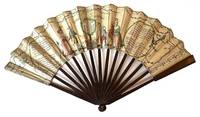
17864439France 1786. Hand-colored etched folding paper fan printed on the recto of two joined sheets backed in plain paper mounted on 15 later plain wooden sticks the open leaf measuring approx. 112 x 460 mm. total fan height 260 mm. The etching shows two couples and a small dog and table with wine carafe and glass flanking a female figure in white Grecian robes and a green wreath holding in one hand a heart at her breast and with the other hand ceremoniously setting alight a bundle of wood a fagot on a small pedestal or altar above which is the wreathed inscription Institution des fagotiers a auteuil le 2 avril 1786 / On prete serment sur un fagot de pratiquer toute sa vie cinq vertus : cordial franchise amitié générosité obeisance sic et tendresse; at top a star with the initials T L A and a banner lettered Vertus des fagotiers surmounted by the caption Ronde joyeuse des fagotiers/ Air: c’est la petite Theresse sic; on either side of this scene are four verses within two green-outlined oval cartouches within stenciled blue and yellow decorative border. Some wear and slight splitting along a few folds a couple of small tears at mounts.<br /> <br /> A mildly licentious pre-Revolutionary printed fan possibly commemorating a real event a “festival of the wood-gatherers†fagotiers held in Auteuil on April 2 1786 but of which there appears to be no historical record. Rather than a guild the fagotiers may have been a local association or club. <br /> <br /> The symbolism of the image and verses seems to be along the lines of Carpe diem carnally for death is around the corner — heavy sentiments for a feather-light fan. One of the men is gesturing toward his partner’s crotch and the verses on either side of the central scene are dotted with sexual innuendo. The first stanza “Let us sing of the burning fagot a bundle of small wood lit by friendship / he who backs away from it knows her i.e. friendship only half-way / without her life is nothing / with her one is deified†could be understood as innocuous but the second stanza celebrates the joys of Déduit an archaic term for the pleasures of love or coïtus. Stanza three brings in Death in the form of Charon: “amiable fellow let us sing his good humor his boat may lead to the devil but his spirit leads to happiness / with his worthy ardor the fire burns in our hearts.†The last stanza declares that the “august fagotine law†allows us to include women we need not hide everyone kiss your partner etc. <br /> <br /> I locate one other example of this fan held by the Musée Carnavelet in Paris. It is digitized on their website with the description “The Genie of Friendship lights the pyre on which the couples will take the oath of friendship.†The stenciled border of our copy differs from that of the Carnavelet example which is in pink; here it is in two colors and includes two birds perched on branches. unknown
17843603426London: Sold in Spur Street Leicester Square 1784. Small crease in lower corner in good condition. Oval engraving 350 x 265 mm. image size; mounted. <p><p>Rare variant of the famous engraving of Cook's death showing as the caption notes "Part of the Original Plate after Webber" and presumably quite literally printed from an oval cut from the fuller engraved copper. This is only very rarely seen: the single example noted by Joppien and Smith was in the British Museum. </p> <p>The full-size engraving was first issued early in 1784. Based on the oil painting executed by Webber soon after he returned to London in 1780 the figures were engraved by Francesco Bartolozzi and the landscape by William Byrne. Quickly becoming the most famous of all eighteenth-century depictions of the massacre the view appeared at about the same time as the official third voyage account was published. This was no coincidence: although lavishly illustrated by Webber the official account did not include any depiction of the most famous scene of the entire voyage the death of Captain Cook. As a result the iconic engraving is often seen bound into extra-illustrated editions of the third voyage account.</p> <p>Reflecting the general opinion prevailing in published accounts of the voyage the original image as Joppien and Smith argue appeared to show Cook as 'an innocent victim killed in the act of pleading for peace'. This is here heightened by the changed composition as the oval shape dictates a radically different impact to that of the original engraving omitting the dramatic conflict between the British sailors and the Hawaiians and thus implying a scene in which Cook his arm raised in supplication to his men offstage stands alone and is overwhelmed by a seething crowd.</p> <p>The only copy noted among Australian holdings appears to be the heavily clipped copy in the National Library of Australia part of the Nan Kivell collection.</p> </p> . Sold in Spur Street, Leicester Square unknown