35 résultats
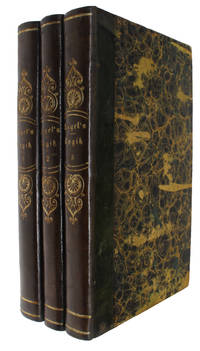
1812COLLECTI014466INURNBERG: JOHANN LEONHARD SCHRAG. VERY GOOD. PUB 1812. FIRST EDITION. HARDCOVER. HALF-BOUND DECORATED PAPER BOARDS WITH LEATHER SPINE AND CORNERS SPINE TITLES IN GILT AND ALL EDGES STAINED RED. OTHER THAN SOME WORMING TO THE FIRST 15 AND LAST 11 LEAVES VERY MARGINAL EFFECT TO TEXT AND SOME FUGITIVE LIGHT PENCIL UNDERLININGS AND MARGINAL LINES RUBBING AND LIGHT WEAR TO THE CORNERS AND EDGES A VERY NICE COPY OF THE RAREST OF THE 3 VOLUMES OF THE LOGIC. . JOHANN LEONHARD SCHRAG hardcover
184018245Paris & Nancy: AndréHachetteJoubert et GrimblotRaybois 1840. Fine. André Hachette Joubert et Grimblot Raybois Paris & Nancy 1840-1852 14.50 x 23 cm 5 volumes brochés First edition in French. Spine of second volume missing one tear with lack to lower cover of this volume a few small lacks to head and foot of spine of other volumes small lacks to upper cover of third volume. Internally very fresh despite a little spotting. This edition was published only two years after the original in Berlin. This first edition in French translated by Charles Bénard at first had very little impact before becoming one of the foundations of the modern philosophy of art. Very rare in its original covers. AndréHachetteJoubert et GrimblotRaybois unknown

182757047Stuttgart und Tübingen Cotta 1827. 4to. In the original patterned paper boards with contemporary handwritten paper-title to spine and old handwritten library paper-label to lower spine. Wear to extremities and lacking some paper at spine. Stamp to first title-page general title-page for the wntire year and stamp to verso of title-page for the front wrapper of the January-issue. A damp stain to the first two leaves otherwise internally quite good. Bound with the general title-page for the entire year and with some of the original wrappers for the individual months among these that of January. 1856 colomns i.e 928 pp. <br/><br/><em>The extremely rare first printing of all twelve issues constituting the entire first year of the seminal organ for the philosophical school that developed around Hegel namely the "Yearbooks for Scientific Critique" issued by Hegel himself constituting the starting-point of this greatly influential journal of the Hegelian right. This entire first year with its 12 issues contains a wealth of highly important contributions one being Hegel's own highly important review of Humboldt's lectures on the Bhagavad-Gita delivered in June 1825 and 1826 "On The Episode of the Mahabharata Known by the Name Bhagavad-Gita" in which Hegel puts this Indian work in his large context of world history. Hegel's review which appeared in two parts in the present publication for the first time Jan. nos. 7-8 pp. 51-63 Oct. nos. 181-88 pp. 1441-92 is now considered an extremely important document dealing with India. Humboldt's lectures had praised the Gita as the greatest most beautiful and presumably the only real philosophical poem of all known literatures; Hegel's review was meant as a critical assessment of the Hindu world-view in toto in a comparison with European Weltanschauung.In 1818 Hegel took over Fichte's chair at the University of Berlin. With his great lectures on the different fields of philosophy he soon became widely famous and an important school formed around him. This Hegelian school grew to be extremely influential from the 1820'ies and onwards. From 1827 "the Jahrbücher" founded by Hegel himself began appearing working as the official organ for this seminal school. </em> hardcover
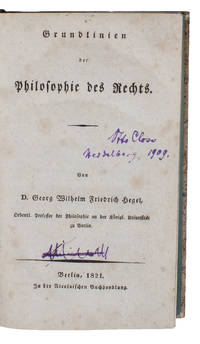
182150543Berlin 1821. 8vo. A beautiful and excellently made pastiche binding in brown half calf with richly gilt spine and red gilt leather title-label. Previous owner's name to title-page dated 1909 and a few light pencil-marginalia otherwise internally very nice and clean with only occasional minor brownspotting. XXVI 355 1 pp. A very fine copy. <br/><br/><em>The scarce first edition of Hegel's seminal "The Outline or later Elements of the Philosophy of Right" the last of Hegel's major works which represents the culmination of a life-long interest in politics and political phenomena. Hegel was perhaps more than any other German philosopher influenced by the French Revolution and this masterpiece of philosophy constitutes a grandiose attempt to make freedom the foundation of human society. "Taken apart from the rest of his system Hegel's political philosophy has been much misrepresented by totalitarian propagandists. He was however one of the most profound and influential thinkers of the nineteenth century. Theology philosophy political theory all have been radically influenced by his system; Strauss 300 Baur 322 Bradley Kierkegaard 314 Marx 326 359 Lenin 392 all came under his spell and his indirect influence has been limitless." PMM 283. </em> hardcover
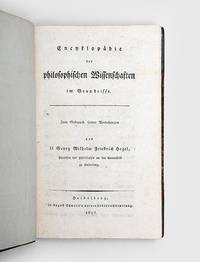
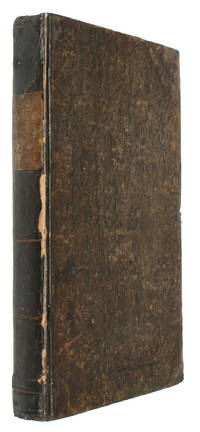
1817163719Heidelberg: In August Oswald's Universitätsbuchhandlung 1817. The only form in which Hegel published his entire mature philosophical system First edition of the Encyclopedia of the Philosophical Sciences the only complete compendium of Hegel's philosophical system and a masterwork of absolute idealism. The Encyclopedia is the critical text for understanding Hegel's overarching conception of philosophy as a system. The tripartite treatise begins with a condensed version of the Science of Logic 1812-16 Hegel's comprehensive account of logical enquiry before applying its principles to the philosophy of nature and of spirit. In the Encyclopedia Hegel methodically derives each concept from its predecessor to provide a comprehensive logically rigorous account of the ideal structures underlying all reality. The work was written for Hegel's lectures as professor of philosophy at Heidelberg 1816-18. Following its publication he was offered the chair of philosophy at Berlin "the most prestigious position in the German philosophical world" Stanford Encyclopedia of Philosophy. Octavo 200 x 118 mm. Recent half calf spine with raised bands and black calf label earlier marbled paper sides edges sprinkled red. Short contemporary ink annotation to p. 14 not touching text loss to upper outer corner of initial blank minor foxing to contents: a very good copy. Croce I 3; Steinhauer 0341. hardcover
181734668Heidelberg Druck und Papier von Brede in Offenbach 1817. 8vo. Nice cont. cardboardbdg. w. title-label to back. Corners and capitals professionally restored. Hinges w. a bit of paper-loss. Occational brownspotting. Front free end-paper w. vast cont. annotations by former owner Fr. Selasinski. <br/><br/><em>The rare first edition of Hegel's immensely important work the "Encyclopaedia of the Philosophical Sciences" by himself and his contemporaries considered his main work and likewise an absolute main work of philosophy in general. Hegel is considered one of the four greatest philosophers of all times and his contributions to philosophy are incomparable to other than perhaps those of Aristotle Plato and Kant. In 1816 Hegel chose the professorship of philosophy at the University of Heidelberg and here he taught his courses with great enthusiasm. He lectured no less than 16 hours a week mostly over his own system which is the object of this chronologically speaking third main work generally just called the "Encyclopaedia".Hegel himself considered his "Encyclopedia" to be the most important of his works and his contemporaries likewise judged it his actual main work. Hegel was considered the epitome of the great systematic thinker of the 19th century and his "Encyclopaedia" forms the epitome of his work at the same time as it to his own mind constitutes his greatest achievement. Hegel's main aim was to systematically comprise all spiritual and natural knowledge and thus his philosophy peaks with his all-comprising Encyclopaedia which remained of the greatest importance to himself throughout his life-time. He kept working on the book and no less than three different altered editions appeared within his lifetime the last in 1830 the year before he died confirming his lasting devotion to this work.The book has belonged to one Friedrich Selasinski perhaps a midshipman from the aristocracy who has annotated the entire front free end-paper ab. 1830. </em> unknown
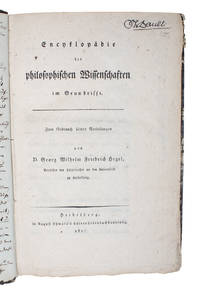
181746416Heidelberg 1817. 8vo. COMPLETELY UNCUT in contemporary original interim marbled paper-binding with handwritten paper title-label to spine. Boards rubbed and corners a bit worn. Internally unusually clean. Last ten leaves with a small marginal worm-tract not affecting lettering. Extensive contemporary hand-written scholarly notes seemingly in three different hands to all end-papers in all 6 closely-written pages in French and German. Contemporary owner's name to title-page Th. Daulli . A fabulous copy with very varying sizes of pages. XVI 288 pp. <br/><br/><em>The rare first edition extremely scarce in original uncut condition of Hegel's immensely important work the "Encyclopaedia of the Philosophical Sciences" by himself and his contemporaries considered his main work and likewise an absolute main work of philosophy in general. Hegel is considered one of the four greatest philosophers of all times and his contributions to philosophy are incomparable to other than perhaps those of Aristotle Plato and Kant. In 1816 Hegel chose the professorship of philosophy at the University of Heidelberg and here he taught his courses with great enthusiasm. He lectured no less than 16 hours a week mostly over his own system which is the object of this chronologically speaking third main work generally just called the "Encyclopaedia".Hegel himself considered his "Encyclopedia" to be the most important of his works and his contemporaries likewise judged it his actual main work. Hegel was considered the epitome of the great systematic thinker of the 19th century and his "Encyclopaedia" forms the epitome of his work at the same time as it to his own mind constitutes his greatest achievement. Hegel's main aim was to systematically comprise all spiritual and natural knowledge and thus his philosophy peaks with his all-comprising Encyclopaedia which remained of the greatest importance to himself throughout his life-time. He kept working on the book and no less than three different altered editions appeared within his lifetime the last in 1830 the year before he died confirming his lasting devotion to this work. </em> hardcover
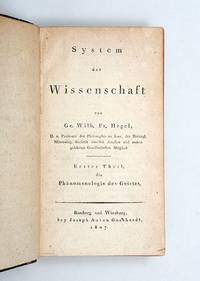
1807144735Bamberg and Würzburg: Joseph Anton Goebhardt 1807. The phenomenology of spirit First edition first issue of Hegel's best-known and first major work. Known in English as "The Phenomenology of Spirit" this was the only part published. He develops the idea of Geist realizing itself in the intellectual development of mankind. "It begins with a dialectical discussion of sense perception in which it is argued that knowledge of physical things presupposes the view that the physical world consists of forces interacting according to laws. Hegel maintained that knowledge of such a world is really a type of self-knowledge since in penetrating to the forces behind phenomena we become aware of what we ourselves have devised and put there. 'Behind the so-called curtain which is to hide the internal constitution of things there is nothing to be seen unless we ourselves go behind'. The physical world of scientific theory presupposes self-conscious beings. When he analyzed self-consciousness Hegel argued that it presupposes a plurality of living and desiring beings each of whom seeks to subdue the world to his own wishes to make it part of himself" Edwards. This copy in the first issue with leaf A1 the sub-title reading "Erster Theil. Wissenschaft der Erfahrung des Bewusstseyns". At Hegel's request this leaf was substituted with a cancel reading "I. Wissenschaft der Phänomenologie des Geistes." Octavo 202 x 114 mm. Complete with the final advertisement leaf. Contemporary interim marbled boards rebacked and corners consolidated red edges. Printed ex-libris of Karl Engel to front pastedown. Library stamp removed from title verso leaving a very small hole small wormtrack to lower outer corner of first 8 leaves occasional marginalia in pencil with one or two in ink ink notes to rear free endpaper; a good copy. Croce I 1. Edwards: Encyclopedia of Philosophy 1972. hardcover
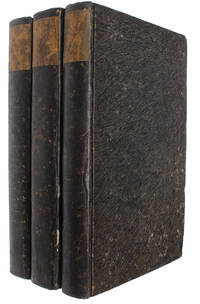
181248133Nürnberg Johann Leonhard Schrag 1812-1813-1816. 3 vols. 8vo. 3 contemporary uniform ! marbled paper bindings with hand-written paper title-labels to spines hand-writing not legible. Very minor excellently executed and barely noticeable professional restorations to a couple of hinges and corners. An excellent set also internally very nice clean and fresh wih only very minor occasional brownspotting. Old owner's inscription in the form of a poem and an old vague owner's stamp Giulini to front free end-paper of volume one. Same stamp to title-page and verso of title-page respectively of volumes 2 and 3. Old owner's name neatly removed from title-page of volume 3.XIV = title-page Vorrede Inhalt XXVIII = Einleitung 334; VI = title-page Inhalt 282; 2 = general title-page stating second volume of Wissenschaft der Logik X = title-page Vorbericht Inhalt 403 1 pp. <br/><br/><em>The scarce first editions of all three volumes that together constitute Hegel's second main work his "Science of Logic" also called his "Greater Logic" as opposed to the Logic section of the Encyclopaedia in which logic is seen as the science of pure thought concerning the principles by which concepts are formed and therefore also as that which reveals to us the principles of pure knowing. THIS IS THE RAREST OF ANY OF HEGEL'S MAJOR WORKS TO FIND COMPLETE - IT IS A TRUE SCARCITY TO FIND A SET IN UNIFORM CONTEMPORARY BINDINGS. Hegel's "Logic" is begun five years after his first major work the "Phänomenologie des Geistes" and the five years which Hegel has had to develop his philosophy in the meantime are clearly reflected in his monumental second masterpiece. The "Logic" can be regarded as a more systematic and well organized epistemological and ontological work. It is in this groundbreaking work of German Idealism that Hegel develops his famous dialectic which comes to determinate all later reading of his philosophy. It is Hegel's dialectic theory later condensed as "thesis-antithesis-synthesis" that is developed in this main work of 19th century philosophy. The dialectical process constitutes the movement of thought and consciousness from basic to complex ideas and thus demonstrates how the categorical infrastructure of thought can be laid bare by thought itself alone. With this work Hegel is considered as having created a revolution in the understanding of Logic because he widens it from being merely concerned with formal rules of propositions to including all of humanity. He elaborates the laws that govern the development of human practice and as a consequence he also uncovers the objective laws that govern the entire objective material world. Throughout the 20th century Hegel's logical philosophy was largely neglected but the last 40-50 years have shown a revived interest in this most fundamental of works which is of the greatest importance for the understanding of his systematic thought.Hegel himself considered his "Logic" to be of the utmost importance and he kept revising it throughout the years. It is very difficult to find a set of all three volumes in first editions. </em> unknown
181255245Nürnberg Johann Leonhard Schrag 1812-1813-1816. 3 vols. 8vo. Bound in three lovely contemporary uniform ! green half calf bindings with gilt spines. Very minor excellently executed and barely noticeable professional restorations to small pieces of spines and boards. A magnificent set in lovely contemporary uniform bindings. Some brownspotting as usual. Housed in a custom-made marbled paper cassette. XIV = title-page Vorrede Inhalt XXVIII = Einleitung 334; VI = title-page Inhalt 282; 2 = general title-page stating second volume of Wissenschaft der Logik X = title-page Vorbericht Inhalt 403 1 pp. <br/><br/><em>The scarce first editions of all three volumes that together constitute Hegel's second main work his "Science of Logic" also called his "Greater Logic" as opposed to the Logic section of the Encyclopaedia in which logic is seen as the science of pure thought concerning the principles by which concepts are formed and therefore also as that which reveals to us the principles of pure knowing. THIS IS THE RAREST OF ANY OF HEGEL'S MAJOR WORKS TO FIND COMPLETE - IT IS A TRUE SCARCITY TO FIND A SET IN UNIFORM CONTEMPORARY BINDINGS. Hegel's "Logic" is begun five years after his first major work the "Phänomenologie des Geistes" and the five years which Hegel has had to develop his philosophy in the meantime are clearly reflected in his monumental second masterpiece. The "Logic" can be regarded as a more systematic and well organized epistemological and ontological work. It is in this groundbreaking work of German Idealism that Hegel develops his famous dialectic which comes to determinate all later reading of his philosophy. It is Hegel's dialectic theory later condensed as "thesis-antithesis-synthesis" that is developed in this main work of 19th century philosophy. The dialectical process constitutes the movement of thought and consciousness from basic to complex ideas and thus demonstrates how the categorical infrastructure of thought can be laid bare by thought itself alone. With this work Hegel is considered as having created a revolution in the understanding of Logic because he widens it from being merely concerned with formal rules of propositions to including all of humanity. He elaborates the laws that govern the development of human practice and as a consequence he also uncovers the objective laws that govern the entire objective material world. Throughout the 20th century Hegel's logical philosophy was largely neglected but the last 40-50 years have shown a revived interest in this most fundamental of works which is of the greatest importance for the understanding of his systematic thought.Hegel himself considered his "Logic" to be of the utmost importance and he kept revising it throughout the years. It is very difficult to find a set of all three volumes in first editions. </em> hardcover