Marquis de CONDORCETBiblio.com
40 résultats
1789102441Sans lieu : Imprimerie de la SociÂŽtÂŽ LittÂŽraire-Typographique 1789. 205x125mm. reliure veau marbrÂŽ de lՎpoque. PiÂce de titre dorÂŽ ornementations et fleurons dorÂŽ au dos. Encadrements dorÂŽs sur les deux plats. Bordures fleuries. Bel exemplaire. 421 Imprimerie de la Socit Littraire-Typographique unknown
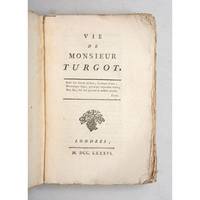
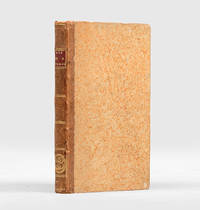
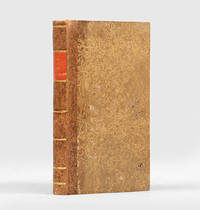
178683882London: no publisher 1786. One of four printings of 1786 Gerits's edition D with no Avis de l'éditeur and no errata and the misprints corrected: "Contrary to what is suggested by the title this book was not a biography but rather an exposé of Turgot's educational political and economic ideas" Gerits. This work together with Dupont de Nemours's biography is the chief contemporary account of the renowned financial reformer and friend of the physiocrats. It contains in a footnote Condorcet's early attempt to apply mathematics to economics. On pp. 178-184 he discusses the various mathematical ways "in which indirect taxation could be replaced by direct taxation and the effects of such a change" Theocharis Early developments in mathematical economics p. 65. Condorcet 1743-1794 was secretary to the Académie and was a prolific author. Although more celebrated for his studies in philosophy literature and politics "his mathematical treatment of probabilities and his discussion of differential equations and finite differences show an ability which might have put him in the first rank had he concentrated his attention on mathematics" W.W. Rouse Ball A Short Account of the History of Mathematics p. 388. Octavo 214 x 135 mm. Contemporary papier dominoté wrappers paper spine label hand-written in black ink. Short closed tear to pages 245-246 neatly repaired without loss occasional light spotting; a very good uncut copy in an attractive decorated paper wrapper. Kress B.1033. Gerits: "Condorcet's Vie de Monsieur Turgot" in Harvard Library Bulletin. unknown
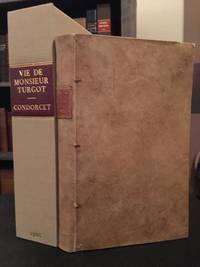
1786003<b>London s.e. 1786; 8vo. 299 pp. 1 pp.n.ch. d'errata full vellum with flaps from the 19th century smooth spine tan title piece speckled edges. The true first edition of Condorcet's life of Turgot Gertis's edition A the first of four editions published with a London imprint in 1786. one of four published under the date 1786; this print corresponds to Einaudi's collation 2 ff. 299 pp. 1 p. d'errata which presents it as the first and therefore differs from the 287 pp. edition. with portrait reported by INED under n ° 1186. Condorcet was a strong supporter of Turgot who had attempted to implement physiocratic ideas as the French finance minister from 1774 to 1776. His biography seeks to vindicate Turgot's thought and work and is a powerful defence of Enlightenment economic ideas. Seven editions appeared within two years making it one of the best-selling works of economics of its day. From the Thomas Carnegy of Craigo library armorial ex-libris. A beautiful copy well preserved. Housed in a cloth clamshell box with leather label.</b> Published by London: [no publisher stated] hardcover
1786126469London: no publisher 1786. From the library of Empress Joséphine True first edition of Condorcet's life of Turgot Gerits's Edition A; a superb copy from the library of Empress Joséphine de Beauharnais with her Bibliothèque de la Malmaison stamp on the title page and her initials to the spine. This work together with Dupont de Nemours's biography is the chief contemporary account of the renowned financial reformer and friend of the physiocrats. It contains in a footnote Condorcet's early attempt to apply mathematics to economics. On pp. 178-184 he discusses the various mathematical ways "in which indirect taxation could be replaced by direct taxation and the effects of such a change" Theocharis p. 65. Condorcet 1743-1794 secretary to the Académie and a prolific author was a strong supporter of Turgot who had attempted to implement physiocratic ideas as the French finance minister from 1774 to 1776. The present work seeks to vindicate Turgot's thought and work and is a powerful defence of Enlightenment economic ideas. "Contrary to what is suggested by the title this book was not a biography but rather an exposé of Turgot's educational political and economic ideas. In fact Stanley Jevons has called it one of the earliest works on 'économie pure'" Gerits. Seven editions of Condorcet's Vie de Monsieur Turgot appeared within two years making it one of the best-selling works of economics of its day. The first four editions all bear a London imprint dated 1786 though Gerits notes that it seems that all but Edition A were printed in France. Octavo 202 x 125 mm. Contemporary speckled quarter calf smooth spine ruled in gilt with red morocco label monogram "JB" gilt-tooled to penultimate compartment paste paper sides red silk bookmarker. Bibliothèque de la Malmaison stamp to title page. Spine ends and corners a touch worn a few light spots to title leaf scattered marginal pencil marks; a notably fresh and crisp copy beautifully bound. Einaudi 1217; Goldsmiths' 13128; Kress B.1032; Sraffa 1062 "first edition first issue". Anton Gerits "Condorcet's Vie de Monsieur Turgot" Harvard Library Bulletin 3 4 Winter 1992-93 pp. 35-37; Reghinos D. Theocharis Early Developments in Mathematical Economics 1961. unknown
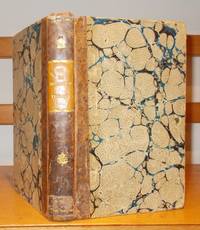
1786013838London: no publisher 1786. Book measures 19.5x12.5.cm. 42991pp. Bound in period or early quarter calf marble boards gilt tooling leather title label. Binding rubbed worn chipped on head of spine. Internally library cancellation stamp on free endpaper no other library marks staining to title and about 10 pages. Some occasional minor spotting pencil underlining or minor annotations. Pages in good clean condition. ~A good copy. Quarter Calf. Good Plus. 8vo. [no publisher], Hardcover
178629371No publisher London Paris 1786. First Edition. Softcover. Very Good Condition/No Dust Jacket. Gerits Edition C listing four editions published in 1786 in "Londres" but more likely Paris. "Contrary to what is suggested by the title this book was not a biography but rather an expose of Turgot's educational political and economic ideas. In fact Stanley Jevons has called it one of the earliest works on 'economie pure' He also included it in his famous list of 'mathematico-economic' works for Condorcet expressed his ideas on fiscal reform and on freedom of commerce and trade in mathematical terms" from Anton Gerits' 'Condorcet's Vie de Monsieur Turgot'. An 'unsophisticated' copy bound in original publisher's wrappers the wrappers rather worn particularly on the spine and some staining to rear wrapper the contents clean with printed pastedown leaf from an earlier work; engraved portrait frontispiece iv 5-287 pages untrimmed a very small single wormhole to last two leaves of text. Approx. 8.5" x 5.4". Quantity Available: 1. Category: Economics; Pictures of this item not already displayed here available upon request. Inventory No: 29371. . No publisher paperback
1786EONe[CON89London ie. Paris: 1786. 1786. 8vo. pp. 3 p.l. 246. old half calf rebacked. One of several issues with identical imprint this one being Gerits' issue 'B'. The present work and Dupont de Nemours' earlier memoir 1782 are the two major contemporary biographies of the great French statesman economist and financial reformer. The Life is also important for containing an early contribution to mathematical economics in a passage where Condorcet discusses the various mathematical ways "in which indirect taxation could be replaced by direct taxation and the effects of such a change". Theocharis Early Development in Maathematical Economics p. 65 A.Gerits in Harvard Library Bulletin 1992-93 Vol. III No. 4. cfCioranescu 20417. cfEinaudi 1217. cfGoldsmiths' 13128. cfKress B.1031-33. Palgrave III p. 594. London [ie. Paris]: 1786. unknown
1786124115London i.e France: no publisher 1786. One of four editions of Condorcet's life of Turgot printed in 1786 this being Gerits's edition C. All four editions have London imprints but the latter three were printed in France. Condorcet was a strong supporter of Turgot who had attempted to implement physiocratic ideas as the French finance minister from 1774 to 1776. His biography seeks to vindicate Turgot's thought and work and is a powerful defence of Enlightenment economic ideas. Seven editions appeared within two years meaning that it was one of the best-selling works of economics of its day. "Contrary to what is suggested by the title this book was not a biography but rather an exposé of Turgot's educational political and economic ideas" Gerits. This work together with Dupont de Nemours's biography is the chief contemporary account of the renowned financial reformer and friend of the physiocrats. It contains in a footnote Condorcet's early attempt to apply mathematics to economics. On pp. 178-184 he discusses the various mathematical ways "in which indirect taxation could be replaced by direct taxation and the effects of such a change" Theocharis Early developments in mathematical economics p. 65. Condorcet 1743-1794 was secretary to the Académie and was a prolific author. Although more celebrated for his studies in philosophy literature and politics "his mathematical treatment of probabilities and his discussion of differential equations and finite differences show an ability which might have put him in the first rank had he concentrated his attention on mathematics" W.W. Rouse Ball A Short Account of the History of Mathematics p. 388. Octavo 205 x 122 mm. Portrait frontispiece of Turgot. Early 19th-century quarter marbled calf red label to smooth spine with compartments ruled in gilt marbled sides speckled edges. Condorcet's name added to title page in contemporary hand. Front cover lightly marked tiny chip at base of title page a few small blemishes to contents. An excellent copy. ESTC T177159; Anton Gertis Condorcet's Vie de Monsieur Turgot Harvard University Bulletin. unknown
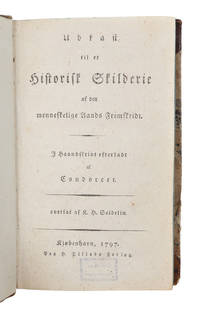
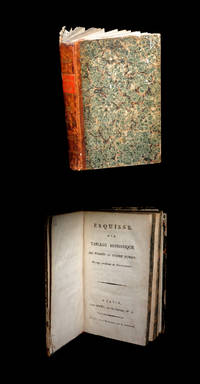
179761971København Tikiøbs Forlag 1797. 8vo. Bound in a contemporary half calf binding with gilt spine and gilt title label. Minor cracks to spine. Insignificant wear to capitals. Edges of boards worn. Corners bumped. Bibliographical notes to front free endpaper. Small ownership stamp to verso of title page. Evenly browned. XII23681: errata pp. <br/><br/><em>The extremely rare first Danish edition of Condorcet's main work "Esquisse d'un tableau historique des progrès de l'esprit humain.1795" "the most fully developed exposition of the progress of man" Printing and the Mind of Man p. 149 and a main work of the Enlightenment as well as of historical thought in general. The author was the creator of what came to found the basis for the modern French system. The great French philosopher political thinker and mathematician M.J.A. Condorcet 1743 - 1794 played a seminal role in 18th century France. He was friends with the likes of d'Alembert Voltaire Turgot etc. and he greatly contributed to the social and political debates of politically turbulent France. As one of the few he advocated a liberal economy equality in public education as well as in gender and race etc. He preached constitutionalism and his thoughts that are still influential today embody those of the Enlightenment and rationalism."A belief in the ultimate perfectibility of man lies at the root of all progressive thinking about the human condition. The "philosophes" and Godwin had familiarized the reading public with this notion; it was left to Condorcet to give it its finest and most durable expression. It was the gospel of nineteenth century that mankind is destined for indefinite future progress. Condorcet looking back and then forward saw proof of this in the growing equality between classes and nations the intellectual physical and moral improvement of man; and he prophesied that popular education on correct principles would strengthen and assure this progress." PMM 246.During the French Revolution Condorcet came to play a dominating role advocating a rationalist reconstruction of society and he championed many liberal causes. In 1791 he became secretary of the Legislation Assembly and the institution adopted his scheme for comprehensive state education which later became the basis of the modern French system. In the struggle between the two political parties the Girondists and the Montagnards Condorcet occupied an independent role but when he opposed the death penalty under the trial of King Louis XVI still supporting the actual trial and the radical Montagnards gained more power Condorcet was branded a traitor and in October 1793 a warrant was issued for his arrest. He now went into hiding for several months almost a year and it is during these months that he writes the work that was to become his most important the main work "Esquisse." "Sketch for a Historical Picture of the Progress of the Human Mind" which was published posthumously the year after his death. In 1794 Condorcet was arrested and two days later he was found dead in his cell -it is unknown whether he committed suicide or was murdered because of fear of fierce reactions that would definitely have occurred had the beloved man been officially sentenced to the death penalty."In the Esquisse" published after his death Condorcet traces the history of man through epochs the first three covering his progress from savagery to pastoral community and thence to the agricultural state. The next five span the growth of civilizations and knowledge down to Descartes and the ninth describes the revolution of Condorcet's own lifetime from Newton to Rousseau. The prophetic view of the tenth epoch shows Condorcet at his most original. He forecasts the destruction of inequality between nation and classes and the improvement intellectual moral and physical of human nature. it exercised considerable influence on Comte. But it is as the most fully developed exposition of the progress of man that Condorcet's work is now remembered and it is this which has given it its lasting appeal." PMM 246. </em> hardcover
1790127340Paris: Imprimeur de l'Assemblee Nationale 1790. First edition of Condorcet's critique of the assignats. Condorcet was Inspector of the Coins from 1775 to 1790 and had consequently participated in the great monetary debates of the reign of Louis XVI. Partly invigorated by these debates he was a fierce opponents of the assignats an opposition which would be vindicated as their value plummeted. Octavo 189 x 121 mm. Recent marbled boards red morocco label to spine. A few foxing marks but generally clean. A very nice copy. hardcover
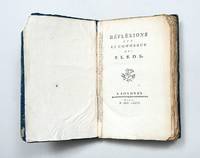
177683886London: No Printer 1776. Uncommon first edition of Condorcet's Thoughts on the corn trade. Appointed secretary to the Académie des Sciences in 1773 for his work in mathematics Condorcet "soon won the friendship of Turgot by whom his attention was turned towards political economy. Under the inspiration of Turgot he wrote various articles or works among others Les Réflexions d'un laboureur de Picardie à M. N. auteur prohibitif à Paris 1775; and Les Réflexions sur le commerce des bleds 1776 two writings directed against M. Necker that auteur prohibitif who had brought out May 1775 his work Sur la législation et le commerce des grains." Palgrave. Octavo 212 x 134 mm pages 2 title xvi 2 errata 221. Contemporary blue marbled paper boards paper spine label lettered by hand. Front board and upper outer corner of the first 100 pages gnawed title page with closed tear to the gutter partly repaired with tape to verso; a very good copy uncut with generous margins. INED 1178. Not in Goldsmiths' Kress Mattioli or Sraffa. See Palgrave's Dictionary of Political Economy 1925 I p. 386. hardcover
1788264649Paris: Chez Froullé libraire quai des Augustins 1788. First edition. 4 xvi 383 1; 4 259 1; 4 292; 4 366 pp. 4 vols. 8vo. Contemporary quarter leather pastepaper boards french tips flat spines with red leather title and volume labels. Spines rubbed some minor starting of joints to two volumes small loss to head of vol. I a very good contemporary set. First edition. 4 xvi 383 1; 4 259 1; 4 292; 4 366 pp. 4 vols. 8vo. Mazzei emigrated to America from Italy in 1773 and introduced the cultivation of grapes and olives to the United States. He became a neighbor of Jefferson in Virginia settling near Monticello at Jefferson's request and this association led to their long friendship and the author's acquaintance with Franklin and Adams. A staunch Republican Mazzei took an active role in the Independence movement. In this work he outlines the history of the American colonies the causes of the Revolution and the economy and government of the United States. Also discussed are Indians slavery emigration and the Society of the Cincinnati. The book was a contemporary success and remains an important work which Malone characterizes as "probably the most reliable of all the works of the period on the United States" Thomas Jefferson 2:109-110. Jefferson aided Mazzei in the compilation of the work while acting as American minister in Paris. Sabin 47206; Leclerc 957; Howes M456; Monaghan 1052; Muller 1612; Fay 24; Einaudi 3807; Reese Revolutionary 87 Chez Froullé, libraire, quai des Augustins unknown
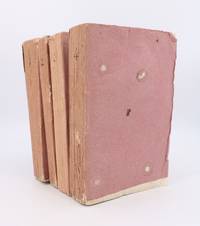
178889325Paris Colle: Froullé 1788. Fine. Froullé Paris Colle 1788 13.5 x 21 cm 4 volumes Brochés First edition cf. Sabin 47206. Leclerc 952.Some joints cracked at head and tail minor marginal losses of no consequence to the temporary wrappers.The author Italian by birth emigrated to America before the Revolution and settled in Virginia near Monticello.His book written in collaboration with Condorcet is of particular interest with regard to the history of independence and the government of the United States cf. Fay pages 24-25: ""Compilation très exacte qui réfute les théories de Mably et de Raynal et constitue un répertoire précieux de renseignements de tous ordres sur les États-Unis.""Rare and appealing copy preserved in its original stitching and in plain pink temporary wrappers. Froullé unknown
1796054673Philadelphia: Lang and Ustick 1796. No Statement of Printing. . Hardcover. Good/No Dust Jacket. A Good copy in rubbed/scuffed full brown leather with red leather spine label. Lacks the blank front endpaper. Some listings show a frontispiece but this copy does not have one. The first sheet is a half title page with title only followed by the title page and Contents pages.There are two blank endpapers at the rear. The binding is sound and the text is clean/unmarked. Not ex-library. <br/> <br/> Lang and Ustick hardcover
179651690Philadelphia: M. Carey-et al. 1796. Hardcover. Good. 1796 printing. Lacking frontispiece. Original full brown leather binding shows wear and rubbing to the spine edges and corners with the corners rubbed through an slightly bumped. The binding is tight. The text shows scattered foxing and there is a spill stained to some the pages near the end of the book affecting the upper right corners.; 293 pages . M. Carey-et al hardcover
179655398Philadelphia:: Printed by Lang and Ustick 1796. old full sheep. Some scattered inoffensive foxing; light use to binding; tight and sound. 12mo. Engraved frontispiece portrait. Being a Posthumous Work of the Late M. de Condorcet. Translated from the French. Printed by Lang and Ustick, unknown
178486383Kehl Baden: Imprimerie de la Société Littéraire-Typographique 1784. Leather Bound. Very Good. L 8vo 7.75 - 9.75'' tall. Leather Bound. Condition: Very Good. Imprimerie de la Société Littéraire-Typographique Kehl Baden 1784. In French. Famous first posthumous collected edition of Voltaire's 1694-1778 works known as the 'Kehl Voltaire' produced by Beaumarchais who created a print foundry at Kehl to carry out this great work. Set contains 69 of the 70 Volume 8vo edition smaller 12mo 90 volume edition was also produced. Volume 23 Histoire de Charles XII missing. Volumes 10 and 27 printed 1784 summary volume 70 printed 1789 all other volumes printed 1785. Uniform 18th century calf full brown leather. Spines decorated in gold floral designs titles volume numbers within 6 boxed compartments. Boards have a natural brown mottled leather finish slanted gold lines on the narrow board edges. All page ends stained a very light yellow finely bespeckled with green. Green silk reading ribbons. Moderate wear of leather at spine tops light stress wear along exterior leather hinges some boards show minor leather loss at edges. All interior hinges firm untorn. Volume 20 upper rear board tip charred. Otherwise no volume damaged or repaired uniform light general wear. Only endpapers show browned bands along margins from pasted endpaper glue chemistry. Volumes 1 to 69 containing all the works and massive correspondences of Voltaire. Volume 70 contains Condorcet's Life of Voltaire and Condorcet's 'Memoires' of Voltaire index and 'Additions et Corrections' to the 70 volumes. Volume 1 frontispiece engraving of Voltaire by Moreau.; Volume 10 frontispiece engraving of Henry IV; Volume 16 frontispiece portrait of Voltaire; Volume 24 frontispiece engraving military map camp plan; Volume 31 14 engraved plates of scientific diagrams. Provenance: Each volume has the small ink stamp 'William H. Floyd Collection No.' on the rear of the title page. Floyd was a late 19th century American antiquarian collector. The numbering sequence 5098-5166 shows that volume 23 was missing even when cataloged by Floyd. Size: L 8vo 7.75 - 9.75'' tall. A major cultural event of the last decade of the ancien regime a beautiful monument to Voltaire the greatest man that literature had produced. Pierre-Augustin Caron de Beaumarchais led a controversial life. Playwright The Marriage of Figaro politician publisher entrepreneur spy supplier of munitions for the American Revolution and an early champion of the rights of artists and intellectual property. Shortly after the death of Voltaire in 1778 Beaumarchais set out to publish Voltaire's complete works many of which were banned in France and vehemently condemned by the Church. Royal letters would be censored by Frederick II of Germany Catharine II of Russia and others. He bought the rights to most of Voltaire's many manuscripts from publisher Charles-Joseph Panckoucke in 1779. To evade censorship printing presses were set up in the small neutral independant state of Baden at Kehl. Beaumarchais bought with exclusivity the complete foundry of the famous English type designer John Baskerville for the Societe Litteraire Typographique an organization he established to produce editions in which he was interested. Three paper mills were purchased. Seventy volumes were published between 1783 to 1790. While the venture proved a financial failure Beaumarchais was instrumental in preserving many of Voltaire's later works which otherwise might have been lost. The Kehl edition was banned on French territory until 1789. Baskerville font was revived by Americans in the 20th century. Voltaire Kehl Condorcet Pierre Beaumarchais Charles-Joseph Panckoucke RBR4 RBR4 Imprimerie de la Société Littéraire-Typographique hardcover
1777SZEPEBKS007360IParis: Claude-Antoine Jombert 1777. First edition . Hardcover. Good. 12mo. - 4232 pp. plus plates. - Jombert Paris 1777. - Recent full dark-blue cloth with title stamped in gilt on spine. - Ex-library university with small bookplate embossed stamp and with stamped release; else fine no markings on the plates. - First Edition. - Bibliotheca mechanica p. 9. - With 5 fine quadruple-folding plates with altogether 4612 engraved illustrations as well as with engraved title- page vignette head and tail pieces. - These pioneering fluid mechanics experiments on the resistance of various solid bodies to flow were sponsored by the government of France in connection with inland navigation. - Detailed description of the experimental apparatus of the preparations for the experiments and of the experiments themselves. Tabulated are the data of altogether 293 experiments followed by mathematical modeling and analysis. <br/> <br/> Claude-Antoine Jombert hardcover
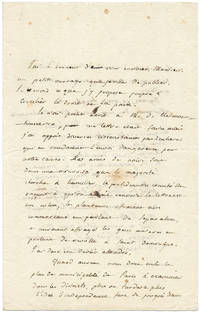
1789Condorcet2<p><strong>CONDORCET de Nicolas 1743-1794</strong></p><p>Autograph letter to Jacques Pierre Brissot<br />N.p.n.d. 25 June 1789 2 p. in-12° on laid bi-folio<br />Watermark cropped: Cornet à courroie double sur écu coiffé d'une couronne / pendentif petite fleur de lis renversée / "D & C BLAUW"<br />An ink blot on the first page evidence of a fold by Condorcet while the ink was still wet.<br />Five redactions and an interlinear insertion in his hand with very browning</p><p><strong>Nice letter on his fight against slavery in the early days of the Revolution</strong></p><p><em>" J'ai l'honneur de vous envoier Monsieur <strong>un petit ouvrage que je viens de publier</strong></em> <em>Sur l'admission des députés des planteurs de Saint Domingue dans l'Assemblée nationale</em>. <strong><em>Je</em></strong><em> <strong>crois ce que j'y propose propre á concilier le droit et la paix</strong>. Je n'ai point ecrit a M. de Clermont-Tonnerre ma lettre etait faite mais j'ai appris diverses circonstances particulieres qui en rendaient l'envoi dangereux pour notre cause. <strong>Les amis des noirs sont dans une minorité que la majorité cherche à humilier</strong> le president du comité rapport à qui on aurait renvoie la lettre est un colon les planteurs effraient nos commercans en parlant de separation et auraient effrayé les gens moderés en parlant de revolte á Saint Domingue. J'ai donc cru devoir attendre.</em><br /><em>Quand aurons-nous donc enfin le plan de municipalité de Paris á examiner dans les districts plus on tardera plus l'idée d'independance fera de progrès dans les districts. <strong>On prend aisement l'habitude de gouverner et on a peine à le quitter.</strong></em><br /><strong><em>Agreez je vous supplie les assurances de mon inviolable attachement.</em></strong><br /><em>Comme je vais à Versailles et que j'y reste quelques jours je vous prie de vouloir bien vous charger de ces deux billets pour M. de Gramagnac en le priant de passer chez M. Mazzei chargé d'affaires du Roi de Pologne hotel des colonies rue des Prouvaires afin de terminer avec lui. Il manque encore un nom mais comme le Roi connait M. l'abbé Piatoli qui demeure dans le même hotel que M. Mazzei je crois qu'il faut preferer sa signature á une autre "</em></p><p>Condorcet and Brissot jointly carried out during the Revolution a decisive action against slavery within the <em>Société des Amis des Noirs</em>. The parliamentary debate crystallized in June 1789 around the question of admitting a deputation of colonists from Saint-Domingue to the <em>Assemblée nationale constituante</em>. By sending Brissot <em>" un petit ouvrage "</em> of his own writing on this subject <em>Sur l'admission des députés des planteurs de Saint Domingue dans l'Assemblée nationale</em> Condorcet nevertheless explains that he had to give up sending a memorandum in the name of the <em>Société des Amis des Noirs</em> to Deputy Clermont-Tonnerre who was then presiding over the Assembly to oppose this admission. As the majority of the Assembly was in favor he rightly considered that such a claim would be <em>à contre-emploi</em>.<br />Later he also asks Brissot for news of the <em>" plan de municipalité "</em> then under discussion which aimed to allow the <em>" patriote "</em> municipality—created on June 25 1789 and in which Brissot sat—not to remain hostage to the sixty Parisian districts which were showing <em>" indépendance "</em> tendencies that Condorcet deemed harmful.<br />Finally Condorcet asks his correspondent to deliver <em>" deux billets "</em> to M. de Gramagnac secretary of the <em>Société des Amis des Noirs</em>. He recommends that Gramagnac visit the Florentine merchant Filippo Mazzei 1730–1816 also a fervent abolitionist and member of the <em>Société des Amis des Noirs</em> to obtain the <em>" signature "</em> of Abbé Scipione Piattoli 1749–1809. Piattoli's membership in the <em>Société des Amis des Noirs</em> was all the more valuable because he was <em>" connu "</em> to the king for having been a member of the court of the King of Poland Stanislas-Auguste Poniatowski for whom Mazzei was then acting as agent in Paris.</p><p><u>Provenance:</u><br />Drouot 2 Apr. 2003 n°19<br />M.L.M. N°40234<br />Bertrand Loevenbruck's estate</p><p><u>Reference:</u><br /><em>Inventaire Condorcet</em> dir. Nicolas Rieucau n°1661</p>
1780136971No place no publisher 1780. First edition of Condorcet's attack on the corps of engineers responsible for France's major canal building projects. Turgot looking to finish the large and ambitious Picardy and Burgundy canal systems placed Condorcet in charge of experimental research on canals. "Condorcet's research was instrumental in demonstrating the flaws in existing proposals for the tunnels for the new canals whose design would have made it impossible for boats to pass through. In the course of the demonstration a whole new branch of physics was invented. Apart from technical issues Condorcet also soon found himself immersed in research of a more sociological nature in Flanders and Picardy on the impact of the new canals on local communities. This resulted in an angry report to Turgot published in 1780 as the Mémoire sur le canal de Picardie in which the corps of engineers and the inadequacies of their professional training were strongly criticised" Williams p. 21. Octavo 194 x 120 mm. Disbound. Contemporary note of Condorcet's authorship to title page. Slight loss at bottom fore corner of pp. 11-14 not near text contents clean; very good. David Williams Condorcet and Modernity 2004. unknown
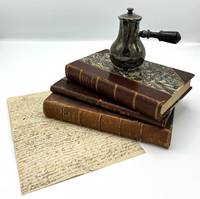
17801756c.1780-1800. French silver coffee pot with turned ebony side-handle 12.5cm in height with engraved inscription to the front: "Cafetière de la Marquise de Condorcet / donnée à Claude Fauriel / léguée à Madame Mary de Mohl / 120 Rue du Bac Paris" "Coffee pot belonging to the Marquise de Condorcet / given to Claude Fauriel / bequeathed to Madame Mary de Mohl / 120 rue du Bac Paris". Stamped maker's mark and hallmarks to the base and lid. The coffee pot's ebony handle has an old somewhat crude glue repair where it joins the silver pot there are possible old repairs to the silver base of the handle and to the base of the spout as well as a few minor dents to the body otherwise it is in good condition and presents well. </p><p>With: A closely-written 2pp. manuscript letter in French from Mary Clarke to Claude Furiel dated August 1829 with a later typed English translation. The letter with a 1cm tear to the foot some splitting along the folds and scattered foxing.</p><p>And three books comprising: </p><p>1 Mohl Ottmar de: Correspondance de Fauriel et Mary Clarke. Paris: Plon-Nourrit et Cie. 1911. Author's own copy with his armorial bookplate to the front pastedown. First edition. Octavo. Contemporary binding by Victor Wächter of Cairo Egypt of half brown sheep over marbled boards ruled in gilt the spine ruled and with titles in gilt. Marbled endpapers. Original blue paper upper wrapper with printed titles bound-in. Illustrated with a photogravure frontispiece of Clarke with tissue guard and two further portraits of Fauriel and Julius Mohl. pp. 6 iii 1 403. A very good copy the binding firm with a little rubbing to the joints. The contents with some minor spots of worming to the front hinge and occasional light foxing are otherwise in good order. The book is accompanied by a group of contemporary press cuttings reviewing the work.</p><p>2 Galley J. B.: Claude Fauriel Membre de l'Institut 1772-1843. Saint-Étienne: Loire Républicaine. 1909. Ottmar von Mohl's copy with his armorial bookplate to the front pastedown. First edition. Octavo. Contemporary binding by Victor Wächter of Cairo Egypt of half brown sheep over green cloth boards the spine with five raised bands ruled and titled in gilt. Marbled endpapers. pp. xxiv 512. A good copy the binding firm with heavy rubbing to the joints and fading and a few scuffs to the spine. The contents with the occasional spot minor mark or spot of foxing are otherwise in good order.</p><p>3 ROD. Ed.: Le Roman de Claude Fauriel et de Mary Clarke. Lettres d'Amour de 1822 a 1844. Three instalments excerpted from an unidentified journal "La Revue". 1909. Ottmar von Mohl's copy with his armorial bookplate to the front pastedown. Octavo. Contemporary binding by Victor Wächter of Cairo Egypt of half brown sheep over marbled boards ruled in gilt the spine with titles in gilt. Marbled endpapers. pp. 551-587; 832-862; 131-161. A very good copy the binding firm with rubbing to the joints and few scuffs to the spine. The contents with toning light scattered foxing and the occasional finger-mark are otherwise in good order. An evocative artefact in the form of a silver coffee pot connecting two of most significant female-intellectual salon hostesses of the late eighteenth and early nineteenth centuries. Originally owned by the philosopher author and influential public figure Sophie Madame de Condorcet 1764-1822 the coffee pot was subsequently bequeathed to her lover the historian philologist and critic Claude Charles Fauriel 1772-1844 who then gifted it to his intimate friend the feminist intellectual Mary Clarke 1793-1883.</p><p>Following her marriage to the French Enlightenment philosopher political economist politician and mathematician the Marquis de Condorcet 1743-1794 in 1786 Sophie de Grouchy now Madame de Condorcet began hosting what would become one of the most significant salons of the revolutionary period. Commencing in 1789 the salon ran until 1793 when it was halted by the reign of terror and the proscription and death of the Marquis resuming again uninterrupted from 1799 to 1822. More egalitarian than her fellow-Girondist hostess Madame Roland Condorcet did not discriminate on the basis of class or social origins and always welcomed other women into her salon along with a host of notable visitors including Thomas Jefferson Adam Smith and Germaine de Staël. The salon also played a particularly notable role in the promotion of women's rights with Condorcet allowing the Cercle Social - an association with the goal of equal political and legal rights for women - to meet in her home; Olympe de Gouges author of the "Declaration of the Rights of Woman and of the Female Citizen" 1791 being prominent amongst its members. Scholars have also argued that Sophie de Condorcet's own concern with female emancipation was responsible for her husband's arguments for greater rights for women most famously expressed in his essay "Sur l'admission des femmes au droit de cité" 1790. Beyond her role as a salon hostess Condorcet also penned the philosophical work "Lettres sur la Sympathie" which she appended to her 1798 translation of Adam Smith's "Theory of Moral Sentiments".</p><p>Claude Charles Fauriel a dedicated republican was a regular attendee at Condorcet's salon having been introduced to such intellectual circles by Madame de Staël particularly the group centred around Antoine Destutt de Tracy and the "idéologues". He began a relationship with Condorcet in 1801 living openly with her until her death in 1822. Fauriel met Mary Clarke that same year with the pair quickly developing a romantic attachment although this ultimately developed instead into an intimate friendship.</p><p>Born into a family of progressive intellectual women Mary Clarke moved from Westminster to Paris with her mother and grandmother at the age of eight. By her twenties initially via her friend the French socialite Juliette Récamier she had become a well-known figure at the heart of Parisian intellectual and literary life and was acquainted with writers including Stendhal Victor Hugo Prosper Merimee Chateaubriand and Alessandro Manzoni. In 1838 she established her salon in rooms that she rented above the home of Chateaubriand in a third floor apartment at 120 Rue du Bac in the Saint-Germain district. Here for more than forty years her home became an intellectual centre in Paris where she hosted all manner of writers thinkers aristocrats diplomats and politicians additionally offering a home-from-home for Anglophone foreigners such as William Thackeray the Brownings and the Trollopes. It was here that Clarke also cultivated a number of friendships with other distinguished female authors thinkers and activists including George Eliot Lady Augusta Stanley Elizabeth Gaskell and most intensely Florence Nightingale with whom she shared a close lifelong friendship. In her mid-fifties she married the German orientalist Julius von Mohl 1800-1876 whose nephew Ottmar von Mohl 1846-1922 a German diplomat and government adviser in Meiji period Japan ultimately published Clarke and Fauriel's correspondence and via whom the present collection descended. Between 1897 and 1917 von Mohl served as a German delegate to the Egyptian National Debt Commission in Cairo hence the Egyptian binder's labels in the three books.</p><p>In the present typically full letter by Clarke - which she notes with pleasing detail was written whilst her beloved cat sits upon her lap - she makes reference to her travels between Paris Brussels and England as well as politics religion her current reading and the pair's own intellectual and literary endeavours as well as mentioning the activities of various friends and associates including the physicist and mathematician André-Marie Ampère 1775-1836 statesman and later Prime Minister of France François Guizot 1787-1874 and historian Augustin Thierry 1795-1856. Writing in a forthright style she is unafraid to commence the letter with a rebuke to Fauriel for apparently requiring encouragement from another friend to reply promptly to her letters: "Madam Arconati is very kind and has more capacity for affection in her little finger than the entire male race has in their whole bodies".</p><p>The present coffee pot was left by Sophie de Condorcet to Fauriel in her will as part of a larger generous inheritance which is reproduced in one of the accompanying books noted in a more intimate line: "I bequeath and give to Mr. Claude Fauriel named above my small silver coffee pot the few pieces of furniture and books that will be found at the time of my death mixed with his in Paris and Meulan". Galley p.275. It was likely engraved with its present inscription later in Clarke's own lifetime following her marriage bearing her final address of 120 Rue du Bac.</p><p>Coffee of course formed part of the life-blood of convivial salon culture as it similarly did in the English coffeehouse; the present coffee pot which passed through the hands of two prominent public female intellectuals who served as leading salon hostesses of the period thus carries a strong symbolism which as the proud inscription attests was likely not lost on Mary Clarke. Considering the varied and illustrious nature of those who passed through Condorcet's and Clarke's salons it is tempting to imagine who may have poured their coffee from this distinguished little pot.</p><p>Provenance: Sophie Marquise de Condorcet; bequeathed to Claude Charles Fauriel 1822; bequeathed to Mary Elizabeth Clarke 1844; the collection of Clarke's nephew and the editor of her correspondence Ottmar von Mohl 1846-1922. hardcover
1774127684Paris: Chez Couturier père 1774 but 1775. First edition of Condorcet's defence of the free trade of grain. Turgot's liberalisation of the grain trade in 1774 coinciding with bad harvests and rocketing prices led to a fierce pamphlet war between proponents of the mercantilist and free trade schools of thought. Condorcet had written the present tract prior to Turgot's enactment of the policy perhaps to anticipate it but the work was not published until April 1775 in the midst of the troubles and the month before the outbreak of bread riots in Paris. Condorcet would elaborate his ideas further in his 1776 treatise Réflexions sur le commerce des bleds the year in which Turgot was dismissed and liberalisation of the grain trade scaled back. Octavo 181 x 118 mm. Recent marbled boards black calf label. Half-title present. Some offsetting from type a few minor creases discreet repair to tear on p. 8 else a very good copy. INED 1171 bis; Kress 7003. Williams Condorcet and Modernity p. 19. hardcover
178851530No place: no publisher 1788. The abolition of taxes First edition the first four numbers of Le Moniteur a political journal edited by Brissot de Warville Clavière and Condorcet all published. Issues two and four consider taxation proposing the abolition of all existing taxes and their replacement by equally distributed voluntary subsidies. In this volume the fourth number is the 50-page edition. Garrett notes: "The Bibliothèque nationale has the only complete collection of Le Moniteur. The British Museum has a 38-page edition of the fourth number and Cornell University has versions of the same pamphlet in 48- and 50-page editions. Among the other major collections of French revolutionary pamphlets in this country i.e. USA Le Moniteur is to be found only at Harvard University 48-page edition of the fourth number Princeton University 50-page edition of the fourth number and the New York Public Library an edition of the third number differing slightly from that in the Bibliothèque nationale" Garrett. 4 parts in one vol. octavo 188 x 119 mm pp. 14 2 bl.; 20; 32; 50. Ownership stamp of Thomas Valletau de Chabresy to title verso of the fourth part. Modern dark red quarter morocco spine lettered in gilt patterned paper boards old red edges to first 3 parts. Boards rubbed at lower outer edges some dampstaining to part 4 very good copies. Hatin 92; INED 815. Clarke W. Garrett "The Moniteur of 1788" in French Historical Studies vol. 5 no. 3 Spring 1968 pp. 263-73. hardcover
178566958Paris: De k'Imprimerie Royale 1785. The First Large-Scale Attempt to Apply Mathematics to Knowledge of Human Phenomena"<br> <br> CONDORCET Marie Jean Antoine Nicolas Caritat Marquis de. Essai sur l'application de l'analyse à la probabilité des décisions rendues à la pluralité des voix. Paris: De l'Imprimerie Royale 1785.<br> <br> First edition. Quarto. 2 cxci 1 blank 304 pp. Decorative woodcut head- and tail-pieces.<br> <br> Contemporary French mottled calf spine decorated in gilt with five raised bands. Marbled endpapers all edges red. First and last few pages browned at edges . gathering K is browned a Q and 2G is toned. Otherwise very good and very scarce.<br> <br> "Condorcet's most significant and fruitful endeavor was in a field entirely new at the time. The subject was one that departed from the natural sciences and mathematics but nevertheless showed the way toward a scientific comprehension of human phenomena taking the empirical approach of natural science as its inspiration and employing mathematics as its tool. Condorcet called this new science 'social mathematics.' It was apparently intended to comprise.a statistical description of society a theory of political economy inspired by the Physiocrats and a combinatorial theory of intellectual processes. The great work on the voting process published in 1785 is related to the latter. Condorcet there sought to construct a scheme for an electoral body the purpose of which would be to determine the truth about a given subject by the process of voting and in which each elector would have the same chance of voicing the truth.No doubt the results obtained in the Essai d'application de l'analyse were modest ones. 'In almost all cases' Condorcet said 'the results are in conformity with what simple reason would have dictated; but it is so easy to obscure reason by sophistry and vain subtleties that I should feel rewarded if I had only founded a single useful truth on a mathematical demonstration' Essai p. ii. One must nevertheless recognize in this work.the first large-scale attempt to apply mathematics to knowledge of human phenomena" D.S.B.<br> <br> Brunet VI col. 472.<br> <br> HBS 66958.<br> <br> $7500. De k'Imprimerie Royale unknown
1794245971794. A Paris chez Agasse l'an III de la RÂŽpublique 1794 / 1795. Un vol. au format in-8 198 x 128 mm de viii - 389 pp. Reliure lÂŽgÂrement postÂŽrieure de demi-basane brune dos lisse ornÂŽ de doubles filets dorÂŽs fleurons dorÂŽs piÂce de titre de maroquin cerise titre dorÂŽ tranches marbrÂŽes. Edition originale. ''Texte capital emblÂŽmatique du projet des LumiÂre de son idÂŽologie du progrÂs comme de sa conception de la perfectibilitÂŽ continue de l'esprit humain''. Alde. ''Aussit™t ÂŽlevÂŽe lors de sa publication en l'an III par Mme de Condorcet et Daunou au rang des Ãuvres nationales l'Esquisse est souvent considÂŽrÂŽe pour le contexte tragique qui a entourÂŽ sa composition comme une Ãuvre de circonstance ÂŽcrite quelques mois avant le dÂŽcÂs de son auteur. S'appuyant sur le rationalisme cartÂŽsien l'empirisme de Locke et le sensualisme de Condillac qui fournissent une caution philosophique ˆ la thÂse de la perfectibilitÂŽ humaine l'Esquisse synthÂŽtise la philosophie des LumiÂres et tÂŽmoigne de l'influence exercÂŽe sur Condorcet par le Tableau philosophique des progrÂs successifs de l'esprit humain et le Plan des deux discours sur l'histoire universelle de son ma”tre et ami Turgot.'' Eric Letonturier. ''Les conclusions de Condorcet ressemblent beaucoup ˆ celles des anciens alchimistes ; en ce qu'il admet comme une certitude que l'homme parviendra t™t ou tard ˆ prolonger son existence ˆ des limites invraisemblables''. in Caillet. Brunet II Manuel du libraire et de l'amateur de livres 3650 - Varet II Manuel de bibliographie philosophique p. 502 - Cioranescu I Bibliographie de la littÂŽrature franÂaise du XVIIIÂme 20528 - QuÂŽrard II La France littÂŽraire p. 269 - Caillet I manuel bibliographique des sciences psychiques et occultes 2545 - Dorbon-A”nÂŽ Bibliotheca esoterica 56 pour une ÂŽdition de 1822 - En FranÂais dans le texte 196 - Martin & Walter n¡8083. Coiffes et coupes ÂŽlimÂŽs. Petit manque angulaire au second plat. Dos prÂŽsentant des frottements. Petit dÂŽfaut angulaire affectant le faux-titre. InÂŽgales mais claires rousseurs dans le texte. PrÂŽsence de passages surlignÂŽs accolÂŽs ou annotÂŽs. b42961 unknown