115 résultats
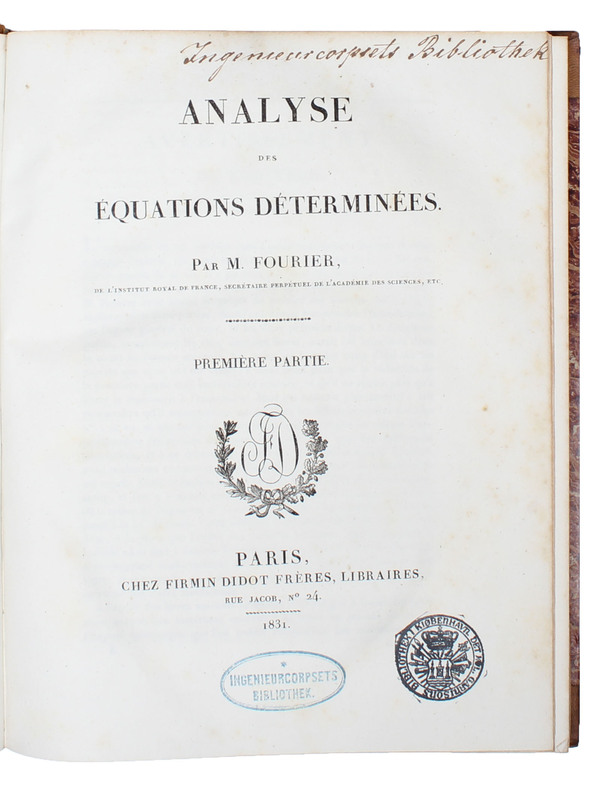
183042087Paris, Firmin Didot Frères, (1830) 1831. 4to. Orig. clothbacked boards. Red titlelabel in paper with gilt lettering on spine. Spine faded and with small nicks to titlelabel and spine. Light wear to spine ends. (4),XXIV,258 pp. and 1 folded engraved plate. Htitle a bit browned. A few scattred brownspots. A wide-margined copy.
183051179Paris, Firmin Didot Frères, (1830) 1831. 4to. Contemp. hcalf. Richly gilt spine. A paperlabel pasted on top of spine. (4),XXIV,258 pp. and 1 folded engraved plate. A few minor brownspots. A fine, wide-margined copy.
187142210Paris, A. Le Chevalier, Guillaumin et Cie. ; Bruxelles, Office de publicité, 1871. In-8 de (4)-III-663-(1) pp., demi-veau blond à coins, dos à nerfs, tranches rouges (reliure de l'époque).
182916403Paris, Bossange père, P. Mongie ainé, 1829. In-8 de XVI-576 pp., demi-basane blonde, dos lisse orné, pièce de titre en veau noir (reliure de l'époque).Le Nouveau Monde Industriel, ou Invention du Procédé d'Industrie attrayante et combinée, distribuée en séries passionnées. Livret d'annonce. Paris, Bossange Père et les Marchands de Nouveautés, 1830. In-8 broché de 88 pp., couverture imprimée.
183062395Paris, Firmin Didot, 1830, in-4, de (4), XXIV, 258 pages et 1 planche, demi-chagrin marron postérieur, tête dorée, Très rare premier état à la date de 1830. Edition originale de la première, et seule partie parue, de l'ultime oeuvre mathématiques de Fourier publiée posthume par son ami Navier. "In constrast with the famous work on heat diffusion, Fourier's interest in the theory of equations is remarkably little know. Yet it has a much longer personal history, for it began in his sixteenth year when he discovered a new proof of Descarte's rule of sign and was just as much in progress at the time of his death [...]. Fourier's proof was based on multiplying f(x) by (x + p), thus creating a new polynomial which contained one more sign in its sequence and one more positive (or negative) root, according as p was less (or greater) than zero, and showing that the number of preservations (or variations) in the new sequence was not inscreased relative to the old sequence. Hence the number of variations (or preservations) is increased by at least one, and the theorem follows. The details of the proof may be seen in any textbook dealing with the rule, for Fourier's youthful achievement quickly became the standard proof, even if its authorship appears to be viertually unknown[...]". "Fourier appears to have proved his own theorem while in his teens and he sent a paper to the Academy in 1789. However, it disappeared in the thrumoil of the year in Paris, and the pressure of administrative and other scientific work delayed publication of the resultats untiel the late 1810's. Then he became involved in a priority row with Ferdinand Budan de Bois-Laurent, a part-time mathematician who had previously published similar but inferior result. At the time of his death, Fourier was trying to prepare thse and many other result for a book to be called Analyse des équations déterminées ; he had almost finished only the first two of its seven "livres". His friend Navier edited it for publication in 1831 [sic], inserting an introduction to establish from attested documents (including the delayed 1789 paper) Fourier's priority on results which had by then become famous. Perhaps Fourier was aware that he would not live to finish the work, for he wrote a synopsis of the complete book which also appeared in this edition. The synopsis indicated his wide interests in the subject, of which the most important not yet mentioned were various means of distinguishing between real and imaginary roots, refinements of the Newton-Raphson method of approximating to the root of an equation, extensions to Daniel Bernoulli's rule for the limiting value of the ratio of successive terms of a recurrent series, and the method of solution and applications of linear inequalities. Fourier's remarkable understanding of the last subject makes him the great anticipator of linear programming." On trouve à la suite, deux extraits d'articles de Fourier tirés des Mémoires de l'Académie des Sciences portant sur le sujet de la théorie des équations : -Sur la distinction des racines imaginaires, et sur l'application des théorèmes d'analyse algébrique aux équations transcendantes qui dépendent de la théorie de la chaleur (Mémoires de l'Académie royale des sciences de l'Institut de France, tome VII, Paris, Didot, 1827, pages 605 à 624) ; -Remarques générales sur l'application des principes de l'analyse algébrique (lues à l'Académie des Sciences le 9 mars 1829 et publiées dans les Mémoires de l'Académie Royale des Sciences de l'Institut de France, tome X, Paris, Didot, 1831 ; pages 119 à 146). Bel exemplaire, à toute marge, portant l'ex-libris imprimé du bibliophile Henri Viellard et l'estampille, annulée, de l'Institut Catholique de Paris. DSB, V, p. 93-99. Couverture rigide
18452872Paris, aux bureaux de la Phalange, 1845-1849. 10 vol. in-8, demi-veau vert, dos lisse orné de fers romantiques (reliure de l'époque).
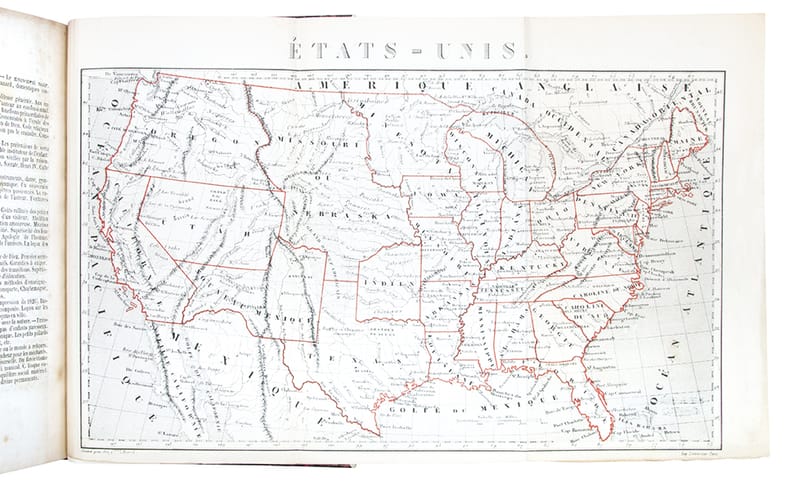
1854384461854 In-8 (209 x 134 mm), demi-maroquin rouge à grain long, dos orné de filets à froid, auteur et titre dorés (rel. moderne signée Laurenchet), (4), 194 p., 4 p. de catalogue éditeur, 2 grandes cartes dépliantes. Paris, Librairie Phalanstérienne, 1854.
183743291A Paris, Au Bureau de la Phalange, 1837-1844. 3 vol. in-8 de IX-(3)-558 pp. 1 planche ; IX-(3)-LXXXVI-(2)-351 pp. ; VIII-(2) 355 à 595 pp., demi-veau prune, dos lisse orné, tranches marbrées (reliure de l'époque).
184443292Paris, Librairie de l'École sociétaire (Besançon, Imprimerie de Sainte-Agathe), 1844. In-8 de XVI-194 pp., demi-chagrin chocolat, dos lisse orné en long (reliure de l'époque).
18365782Paris, aux bureaux de la Phalange, 1836-1840. 3 tomes de 36, 45 et 16 livraisons reliées en 1 vol. in-4, demi-basane fauve, dos lisse orné de fers romantiques (reliure de l'époque).
181644516Paris, Crochard, 1816-25. Bound in 2 fine recent hmorocco. In: ""Annales de Chimie et de Physique, Redigées par MM. Gay-Lussac et Arago"", Tome I, IV, IX, X, XI, XV, XVII, XX, XXI, XXIII, XXVIII and XXIX. Some memoirs with scattered brownspots. All but volume 15 with the orig. titlepages to the volumes. Vol. XV having instead of the titlepage, a sample of the orig. printed wrappers, December issue 1820. Bound at end of volume 2. The memoir, no. 25a below is inserted at the end of volume 2. Some of the memoirs having textillustrations. Some versos of titlepages with stamps.
180892131808 A Leipzig [Lyon], s. n. e. [Pelzin], [7 avril] 1808. Un volume in-8° (132 x 205 mm) de [4]+425+[3] pages, très grand tableau dépliant en page 56. Reliure de lépoque en demi-basane marron à coins, dos lisse orné de filets, pièce de titre rouge, tranches jaunes.
1808AMO-4498A Leipzig [i.e. Lyon], 1808 1 volume in-8 (20 x 12,5 cm) de (4)-425-(3) pages et un grand tableau dépliant (replié relié entre les pages 56 et 57). Reliure strictement de l'époque demi-basane fauve, dos lisse orné de plattes dorées en guise de faux-nerfs, fleurons dorés, pièce de titre de maroquin rouge, plats de papier marron. Quelques usures (coins, plats, coupes, légères fentes en tête des mors, légères marques et éraflures au dos, le tout sans gravité), intérieur frais. Quelques rousseurs peu pregnantes aux premiers et aux derniers feuillets. Quelques annotations manuscrites, corrections et rajouts, notamment sur le grand tableau dépliant. Collationné complet. Edition originale rare du premier livre de Fourier.
182248285Paris, Bossange père"" Londres, Martin Bossange et Comp., 1822 & 1823. 8vo. [Traité:] Two lovely contemporary, uniform half calf bindings with gilding and blindstamped ornamentations to spines. ""E. C."" in gilt lettering to top of spine on both volumes + [Sommaire:] a bit later red half cloth with marbled paper over boards. Gilt title to spine. [Traité]: signed by the author on verso of half-title in vol. 1: ""Ch Fourier"". Title-page of vol. 1 with a small light brown stain (probably candle-starin), far from affecting lettering. Both volumes in lovely condition, with only very light occassional brownspoting. LXXX, 592 pp."" VIII, 648 pp. [Sommaire:] Title-page slightly browned, evenly. Otherwise very nice, clean, and fresh. 16 pp, pp. (1329) -1448 + 4 ff. (= (A8 (unnumbered) - on two leaves, first recto and second verso blank) + B8, C8, D8, E8).A lovely set.
182251212Paris, Firmin-Didot, 1822. 4to. Contemporary half calf with gilt spine. Old paper label to top of spine. Two old stamps to foot of title-page and old inscription to top of title-page. Half-title browned, otherwise just a bit of mild scattered brownspotting. A mild damp stain to lower blank margin of ab. 20 leaves, far from affecting text. A nice copy. Plates with light brownspotting. (4), XII, 639 pp. + 2 plates.