91 résultats
183852570Kjøbenhavn Copenhagen 1838. Lille 8vo. Pænt samtidigt halvlæderbind med enkelte diskrete stregforgyldninger på ryg. False slidte ellers ren og frisk. X 79pp. Small 8vo. Nice contemporary half calf with discreet gilt lines to spine. Hinges with wear but fine and tight. A large and unusually clean copy. X 79pp. <br/><br/><em>Originaludgaven af Kierkegaards debut -værket i hvilket han skarpt kritiserer H.C. Andersen og i hvilket inspirationen fra Poul Martin Møller til hvem han dedikerede værket "Begrebet Angest" - den eneste uden for familien der er blevet beæret med en trykt dedikation af Kierkegaard formenlig er tydeligst at spore. Den specielle titel kan med en vis rimelighed siges at hentyde til en villet videreførelse af den beundrede og på tidspunktet for udgivelsen netop afdøde Poul Martin Møllers nærmest upublicerede produktion. Den "endnu Levende" skulle således være "Danmarks Gæde i Glæden over Danmark" "Mindet i den danske Sommer" Poul Martin Møller den mand der ved sin person har inspireret Kierkegaard mere end nogen anden. Himmelstrup 6.First edition of Kierkegaard's first work; -the work in which he sharply critisizes Hans Christian Andersen and ridicules the genre of fairy tales in general. </em> unknown
183813886Kjøbenhavn 1838. Ubeskåret i et senere blankt omslag. Gennemgående skjold i øverste venstre hjørne overvejende ganske svagt. Første og sidste blade mest påvirkede. X 79pp. <br/><br/><em>Originaludgaven af Kierkegaards debut -værket i hvilket han skarpt kritiserer H.C. Andersen og i hvilket inspirationen fra Poul Martin Møller til hvem han dedikerede værket "Begrebet Angest" - den eneste uden for familien der er blevet beæret med en trykt dedikation af Kierkegaard formenlig er tydeligst at spore. Den specielle titel kan med en vis rimelighed siges at hentyde til en villet videreførelse af den beundrede og på tidspunktet for udgivelsen netop afdøde Poul Martin Møllers nærmest upublicerede produktion. Den "endnu Levende" skulle således være "Danmarks Gæde i Glæden over Danmark" "Mindet i den danske Sommer" Poul Martin Møller den mand der ved sin person har inspireret Kierkegaard mere end nogen anden. Himmelstrup 6.Uncut in a very nice later halfleatherbdg. of dark red morocco w. green marbled paper and dark red gilt leather-title-label on front board. Gilt lines to back. Oscar Jacobsen. Some brownspotting. X 79pp.First edition of Kierkegaard's first work; -the work in which he sharply critisizes Hans Christian Andersen and ridicules the genre of fairy tales in general. </em> hardcover
183813867Kjøbenhavn 1838-49. Alle indbundet i ét lidt senere halvlæderbind m. rig rygforgyldn. False nænsomt restaureret. "Af en endnu Levendes Papirer" er kun en smule plettet; "Gjentagelsen" også ganske pæn de første par blade dog lidt brunplettede og de sidste sider m. skjold; "Smaa = Afhandlinger" er en del brunplettet. <br/><br/><em>Et nydeligt sæt af tre af Kierkegaards væsentligste værker heriblandt hans første bog indbundet næsten samtidigt. Alle tre originaludgaver. Himmelstrup 653116. </em> unknown
186956681Kbh. 1869. 8vo. Samtidig skinnryggbind. LV 506 s. Med en foldet faksimile av Kierkegaards håndskrift. C. A. Reitzels Forlag Dansk. unknown
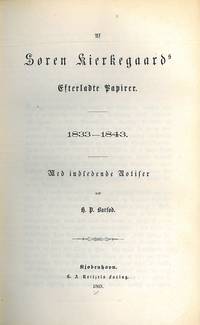
184613879Ubeskåret i med den original hollanderede forperm bevaret. Ryg restaureret m. papir som det originale samt ny bagperm. <br/><br/><em>Originaludgave. Himmelstrup 90. </em> unknown
184634479Kjøbenhavn 1846. Samt. hldrbd. m. rig tidstypisk rygforgyldn. False slidte og indre false lidt svage. Hjørner slidte. Brunet og med understregninger primært i blyant. <br/><br/><em>Originaludgave. Himmelstrup 90. </em> unknown
184613905K. 1846. Samt. hldrbd. m. rygforgyldn. Øvre fals restaureret. Skjold i øvre højre hjørne. X4804pp. <br/><br/><em>Originaludgave. Himmelstrup 90. "Jakob Knudsen" på smudstitilbl. </em> unknown
184358133Kjøbenhavn 1843-45. 8vo. Samtidig helshirtingbind med ryggforgylling i tidens stil. 52 62 84 59 70 111 s. . <br/><br/><em>Himmelstrup 85.Mangler fellestittelbladet. Bindet slitt ved kapitélene og hjørnene støtt. </em> unknown
1843152258Copenhagen: P. G. Philipsen 1843-1845. Building the reader's faith First editions collective issue comprising the unsold sheets of six publications of Kierkegaard's Edifying Discourses originally published in 1843 and 1844 here issued together with a collective title page as Eighteen Edifying Discourses. Between 1843 and 1850 Kierkegaard published numerous works under the title of "Edifying Discourses" inviting 'that single individual my reader' to dwell with a biblical passage for the sake of building up faith. 6 parts in 1 vol. as issued octavo 199 x 125 mm. Recent black half sheep spine lettered in gilt mottled paper sides. Binding fine; contents lightly toned and occasionally spotted 2.5 cm closed tear to fifth part pp. 55/6. A very good copy. Himmelstrup 85; original parts 45 57 58 60 61 and 73 respectively. unknown
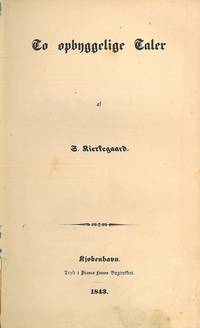
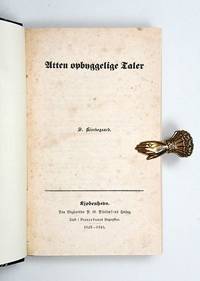
184357279Kjøbenhavn Copenhagen P. G. Philipsens Forlag 1843-1845. 8vo. Bound uncut in a recent pastiche cardboardbinding imitating the original brown cardboard binding in which it was issued. Printed pastice paper label to spine. Some brownspotting as always due to the paper quality. 4 52 62 84 59 recte 57 pp. i.e. without the blank leaf between the title-page and the preface 70 111 pp. Complete with all the titles and the joint title-page without the blank leaf after the preface of "To opbyggelige Taler 1844" - which is not called for and hardly ever present. <br/><br/><em>First edition of Kierkegaard's important eighteen upbuilding discourses which comprise his two three and four upbuilding discourses from the years 1843-45 with the joint title-page of all eighteen. The work constitutes Kierkegaard's religious works which supplement his theological and philosophical ones.The first upbuilding discourses were published the same year as Either-Or and it is interesting to note that in opposition to his major philosophical works the religious upbuilding discourses actually bear the name of the author on the title-page a fact that was by no means incidental. While the pseudonymous works could make one doubt the religiousness of the author the parallelly written religious discourses stress the fact that we are dealing with an author who was religious from the very beginning a fact that Kierkegaard also wished to establish himself; in his journals he clearly states that the religious discourses bear as much significance for his work as a whole as do the larger pseudonymous works "I began with "Either-Or" and two upbuilding discourses." he says and explains that he intended the upbuilding the religious to advance and that he wanted to show "that the writer was not an esthetic author who in the course of time grew older and for that reason became religious" Journals IX A 227.The importance of the upbuilding discourses and the close relationship they have with the major works and Kierkegaard's philosophical development also becomes evident with the fact that every pseudonymous work was accompanied by a little collection of "upbuilding discourses" until "Concluding Postscript" appeared.Himmelstrup 85. </em> unknown
184353093Kjøbenhavn Copenhagen 1843-1845. 8vo. Near contemporary half calf with richly gilt spine. Binding with very light wear. Front free end-paper with the ownership-inscription of Michael Bentzon and his acquisition date of 1855 the same year that Kierkegaard died. Some brownspotting here and there and the first couple of leaves of "To opbyggelige Taler 1844" with a damp stain. Neat underlinings in the text as well as several marginalia mostly in pencil. A very good copy indeed. IV 52 62 84 59 70 111pp. Complete with all the half-titles and the joint title-page without the blank leaf after the preface of "To opbyggelige Taler 1844" - which is not called for and hardly ever present. <br/><br/><em>First edition of Kierkegaard's important Eighteen Upbuilding Discourses which comprise his two three and four upbuilding discourses from the years 1843-45 with the joint title-page of all eighteen. The work constitutes Kierkegaard's religious works which supplement his theological and philosophical ones.The first upbuilding discourses were published the same year as Either-Or and it is interesting to note that in opposition to his major philosophical works the religious upbuilding discourses actually bear the name of the author on the title-page -a fact that was by no means incidental. While the pseudonymous works could make one doubt the religiousness of the author the parallelly written religious discourses stress the fact that we are dealing with an author who was religious from the very beginning -a fact that Kierkegaard also wished to underline himself; in his journals he clearly states that the religious discourses bear as much significance for his work as a whole as do the larger pseudonymous works "I began with "Either-Or" and two upbuilding discourses." he says and explains that he intended the upbuilding the religious to advance and that he wanted to show "that the writer was not an esthetic author who in the course of time grew older and for that reason became religious" Journals IX A 227.The importance of the upbuilding discourses and the close relationship they have with the major works and Kierkegaard's philosophical development is also stressed by the fact that every pseudonymous work was accompanied by a little collection of "upbuilding discourses" until "Concluding Postscript" appeared.Himmelstrup 85. </em> unknown
184326192Kbh. 1843-45. Et nydeligt samtidigt hshirtbd. m. stregforgyldn. på ryg. Brunplettet. M. alle deltitelblade samt det fælles titelbl. 4 52 62 84 59 70 111 pp.Nice contemporary half cloth with single gilt lines to spine. Fully complete with all half titles and the joint title-page. <br/><br/><em>Originaludgave. Himmelstrup 85.First edition of Kierkegaard's important eighteen upbuilding discourses which comprise his two three and four upbuilding discourses from the years 1843-45 with the joint title-page of all eighteen. The work constitutes Kierkegaard's religious works which supplement his theological and philosophical ones.The first upbuilding discourses were published the same year as Either-Or and it is interesting to note that in opposition to his major philosophical works the religious upbuilding discourses actually bear the name of the author on the title-page - a fact that was by no means incidental. While the pseudonymous works could make one doubt the religiousness of the author the parallelly written religious discourses stress the fact that we are dealing with an author who was religious from the very beginning -a fact that Kierkegaard also wished to establish himself; in his journals he clearly states that the religious discourses bear as much significance for his work as a whole as do the larger pseudonymous works "I began with "Either-Or" and two upbuilding discourses." he says and explains that he intended the upbuilding the religious to advance and that he wanted to show "that the writer was not an esthetic author who in the course of time grew older and for that reason became religious" Journals IX A 227.The importance of the upbuilding discourses and the close relationship they have with the major works and Kierkegaard's philosophical development also becomes evident with the fact that every pseudonymous work was accompanied by a little collection of "upbuilding discourses" until "Concluding Postscript" appeared.Himmelstrup 85. </em> hardcover
186220375Kbhvn. 1862. Samt. hldrbd. Rig rygforgyldning. Ryg lidt slidt. 6378 pp. unknown
184863351Kjøbenhavn. 1848. 8vo. Noe nyere skinnryggbind med svakt ommhøyde ryggbnd og enkel ryggforgylling. 103 1 74 96 77 1 s. Forlagt af Universitetsboghandler C. A. Reitzel Dansk. <br/><br/><em>Inneholder : “Første - Fjerde Afdelingâ€. Materien noe gulnet et par fuktskjolder. Ryggen med bruksspor. </em> unknown
184866825Kjøbenhavn 1848. 8vo. 1800-talls granitolbind med skinn rygg og hjørner opphøyde ryggbånd og enkel ryggforgylling. 103 1 blank 75 96 77 1 blank s. Forlagt af Universitetsboghandler C. A. Reitzel Dansk. <br/><br/><em>Himmesltrup 110. Med Arnoldus Marius Hilles navnetrekk på forsatsbladet. Inneholder fire deler : Hedningenes Bekymringer. Stemninger i Lidelsers Tid. Tanker som saare bagfra - til Opbyggelse. Taler ved Altergang om Fredagen. </em> unknown
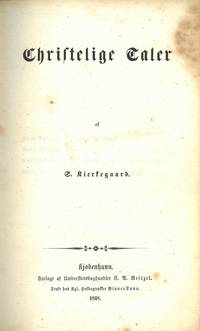
1848152265Copenhagen: C. A. Reitzel 1848. First edition of the Christian Discourses the four parts comprising "The Anxiety of the Heathen" "Exultant Notes in the Conflict of Suffering" "Thoughts Which Wound from Behind - for Edification" and "Discourses at the Communion on Fridays". The work is notable as an early example of the polemics against self-satisfied and complacent Christianity which would dominate Kierkegaard's later writings. 4 parts in 1 vol. as issued octavo 199 x 126 mm. Recent black half sheep spine lettered in gilt mottled sides. Binding fine contents with some very light foxing but generally clean and bright. A very good copy. Himmelstrup 110; McGill p. 50. unknown
1840915Kjøbenhavn: Corsaren 1840. First Edition. Hardcover. Very good. KIERKEGAARD Soren & GOLDSCHMIDT Meir Aaron ed. Corsaren. DANISH SATIRE - CARICATURING KIERKEGAARD complete Corsaren Affair Kjøbenhavn Vol I: 1840 - 41 Vol II: 1843 Vol III: 1846. Octavo. First Edition. <br />$ 2500 <br /> <br />The complete Corsaren Affair all issues related to Soren Kierkegaards conflict with Aaron Goldschmidt editor of the famous Danish satirical journal Corsaren with the iconic caricatures of Kierkegaard that now stand as the most famous "portraits" of the founder of existentialism. <br /> <br />This satirical weekly typically was issued with 8 pages with numbered columns 2-per page. Filled with short polemics and dozens of caricatures of various public figures in Denmark. A wonderful snapshot of literary and political life in mid-19th century Denmark often the target of political and police censure due to its scathing depictions of powerful figures. <br /> <br />Mention and review of Kierkegaards Concept of Irony in issues 49 & 51; <br />Review of Either-Or in issue 129 <br />Polemics against Kierkegaard began in issues 276 & 277 <br />Continued polemical ridicule and caricatures in issues 278 279 & 280 <br />Review of Concluding Unscientific Postscript in issue 284 <br />Famous depiction of Kierkegaard as center of the world in issue 285 <br />Further devastating polemicizing in issues 297 299 300 & 304 <br /> <br />CONDITION: Good 3 matching volumes in contemporary quarter leather with marbled boards. Leather along front hinge slightly starting. Staining and moderate wear to leather with light to moderate foxing to pages. <br /> <br/><br/> Corsaren hardcover
188040966AB1880. First Edition. Kjobenhavn G.A. Reitzels Forlag 1880. 20.6cm x 13cm. XII 4 398 pages. Private hardcover of the early 20th century in protective Mylar. Very good condition with only minor signs of wear. Titlepage privately inscribed. hardcover
185929383K. 1859. Orig. bogtrykt omsl. Ubesk. Foromsl. løsgået. Rent ekspl. M. to sider avertissement. 14 2 pp. <br/><br/><em>Originaludgave. Himmelstrup 287. </em> unknown
1859236Kjøbenhavn: C. A. Reitzels 1859. First edition. Wraps. Very Good . KIERKEGAARD Søren. En Bladartikel A Newspaper Article C. A. Reitzels Kjøbenhavn 1859. Original front wrap TP 3-16 original rear wrap small Octavo. First Edition Himmelstrup 287. Original Wrappers. "A brief work reprinting Kierkegaard's article "A Passing Comment on a Detail in Don Juan" which originally appeared in Fatherland. and had been omitted from Bladartikel in 1857. An afterthought on Mozart's great opera sublimely treated at length by Kierkegaard in Either/Or." Wronoski p. 30 CONDITION: Very good in original wrappers. Minor edgewear. <br/><br/>CONDITION: Very good in original wrappers. Minor edgewear. PHOTOS AVAILABLE UPON REQUEST C. A. Reitzels, paperback
1846PARSkieELC. A. Reitzel 1846. Hardcover. Very Good/No dustjacket as issued. Quarter bound brown leather with stiff black leather backed sides gilt lettering on the spine. The binding is tight corners rubbed. Wear and rubbing on the spine. Text Danish unmarked. Previous owner name written on the first flyleaf. Small damp stain on the top edge of the text block. Endpapers show some small patches of discoloring. 12mo. 114pp. C. A. Reitzel hardcover
1846902Kjøbenhavn: C. A. Reitzel 1846. First Edition. original boards. Very good. One of Keirkegaards Intensest and Most Brilliant Pieces of Writing <br />En literair Anmeldelse A Literary Review. C. A. Reitzel Kjøbenhavn 1846. TP 3 = Forord 5-114 Octavo. First Edition <br />Himmelstrup 100. <br /> <br />This book begins with a review of Two Ages the last novel by Thomasine Gyllembourg who was the mother of Johan Ludvig Heiberg one of Kierkegaards regular targets for ridicule. The second part of this work has been translated as The Present Age and represents one of Keirkegaards intensest and most brilliant pieces of writing and the transitional work between the Authorship and Kierkegaards later religio-political works. Wronoski p. 20 <br /> <br />CONDITION: Very good in original blue cardboard covers with spine label still intact. Chpping along spine edges and wear to boards. Light brownspotting/foxing internally and very small inked initials to top corner of title page else a very good or better copy all in original condition. <br/><br/>PHOTOS AVAILABLE UPON REQUEST C. A. Reitzel hardcover
184613947K. 1846. Ubeskåret i senere blankt omsl. Første og sidste blade noget brunplettet. 114pp. <br/><br/><em>Originaludgave. Himmelstrup 100. </em> unknown
189440965AB1894. Kjobenhavn George C. Gron 1894. 20.7cm x 13.2cm. XVIII 414 pages. Frontispiece portrait of Søren Kierkegaard. Original Hardcover Halfleather with gilt lettering on spine in protective Mylar. Very good condition with only minor signs of wear. Minor traces of foxing to endpapers. Text itself in excellent condition. Published in two volumes in 1843 Either/Or original Danish title: Enten - Eller is an influential book written by the Danish philosopher Søren Kierkegaard exploring the aesthetic and ethical "phases" or "stages" of existence. Either/Or was Kierkegaard's first published book; it was released under the pseudonym Victor Eremita Latin for "the victorious hermit". Either/Or portrays two life views one consciously hedonistic the other based on ethical duty and responsibility. Each life view is written and represented by a fictional pseudonymous author with the prose of the work reflecting and depending on the life view being discussed. For example the aesthetic life view is written in short essay form with poetic imagery and allusions discussing aesthetic topics such as music seduction drama and beauty. The ethical life view is written as two long letters with a more argumentative and restrained prose discussing moral responsibility critical reflection and marriage. The views of the book are not neatly summarized but are expressed as lived experiences embodied by the pseudonymous authors. The book's central concern is the primal question asked by Aristotle "How should we live" His motto comes from Plutarch "The deceived is wiser than one not deceived. The aesthetic is the personal subjective realm of existence where an individual lives and extracts pleasure from life only for his or her own sake. In this realm one has the possibility of the highest as well as the lowest. The ethical on the other hand is the civic realm of existence where one's value and identity are judged and at times superseded by the objective world. In simple terms one can choose either to remain oblivious to all that goes on in the world or to become involved. More specifically the ethic realm starts with a conscious effort to choose one's life with a choice to choose. Either way however an individual can go too far in these realms and lose sight of his or her true self. Only faith can rescue the individual from these two opposing realms. Either/Or concludes with a brief sermon hinting at the nature of the religious sphere of existence which Kierkegaard spent most of his publishing career expounding upon. Ultimately Kierkegaard's challenge is for the reader to "discover a second face hidden behind the one you see" in him/herself first and then in others: "The Middle Ages are altogether impregnated with the idea of representation partly conscious partly unconscious; the total is represented by the single individual yet in such a way that it is only a single aspect which is determined as totality and which now appears in a single individual who is because of this both more and less than an individual. By the side of this individual there stands another individual who likewise totally represents another aspect of lifes content such as the knight and the scholastic the ecclesiastic and the layman." Either/Or Part I p. 86-87 Swenson. Wikipedia hardcover
184963142Kjøbenhavn Reitzel 1849. 8vo. In contemporary half calf. Spine with wear and scratches. Back hinge partly split. Previous owner's name "P. O. Bugge / 1852". First and last leaves slightly browned otherwise internally nice and clean. XIV 2 320; 4 250 pp final blank. <br/><br/><em>Second edition of Kierkegaard’s Either-Or his magnum opus widely regarded as a foundational work of existentialism and among the most celebrated writings of the greatest Scandinavian philosopher. Kierkegaard is “now generally considered to be however eccentric one of the most important Christian philosophers†PMM 314. Kierkegaard's monumental magnum opus seminally influenced later as well as contemporary philosophy and ranks as one of the most important works of philosophy of modern times. Either-Or is the earliest of Kierkegaard’s major works and the work with which he begins his pseudonymous authorship. Kierkegaard’s pseudonymity is an entire subject unto its own. The various cover names he uses play a significant role in his way of communicating and are essential to the understanding of his philosophical and religious messages. And it all properly begins here with his groundbreaking magnum opus. Conjuring up two distinctive figures with diverging beliefs and modes of life – the aesthetic “A†of Part One and the ethical B note that this is the first “pseudonym†that Kierkegaard uses in his earliest articles – no. I above/Judge Vilhelm of Part Two Kierkegaard presents us with the most basic reflections on the search for a meaningful existence seen from two completely different philosophical views. This masterpiece of duality explores the foundational conflict between the ethical and the aesthetical providing us along the way with the now so famous contemplations on music Mozart drama boredom pleasures virtues and probably most famously seduction and rejection – The Seducer’s Diary. It is primarily Judge Vilhelm from Part Two of Either-Or that has bestowed upon Kierkegaard the reputation as the Father of Existentialism. His emphasis on taking ownership of oneself and the importance of making choices has made him the first personification of Existentialism and the idea that one does not passively develop into the self that he or she should be or ought to become. Kierkegaard went to great lengths to ensure that the public would not know the identity of the author was of Either-Or. He even had the draft of the work done by several hands so that employees at the printer’s would also be deceived. Despite his efforts however it did not take long for the public to guess that Kierkegaard had written this astounding work. But Kierkegaard himself kept up the façade and did not accept authorship until several years later. Nothing Kierkegaard did was left to chance which his carefully chosen pseudonyms also reflect. This also spills over in his presentation-inscriptions which follow as strict a pattern as the pseudonyms themselves – he never signed himself the author if his Christian name was not listed as the author on the title-page. And seeing that he had not accepted authorship of Either-Or and is not mentioned by name anywhere on the title-page also not as the editor nor publisher as with the other pseudonymous works he was not able to give away copies of his magnum opus which is why no presentation-copy of the first edition exists. The appearance of the second edition of this monumental work was naturally carefully planned. Either-Or first appeared in 1843 and due to the great demand for the work which had originally only been printed in ca 525 copies it had quickly been sold out; but Kierkegaard refused to have it reprinted. In 1849 finally he decided to let it appear again in a textually unchanged version. When the second edition appeared recte second issue Kierkegaard had meanwhile owned up to the authorship of Either-Or. He had done so in 1846 in his Concluding Unscientific Postscript to The Philosophical Fragments own translation: “For the sake of manners and etiquette I hereby acknowledge what can hardly in reality be of interest to anybody to know that I am as one says the author of Either-Or Victor Eremita Copenhagen in February 1843.â€. Now finally Kierkegaard could give away his magnum opus! In his Papers from 1849 Kierkegaard states own translation: “The poets here at home each received a copy of Either-Or. I thought it my duty; and now I was able to do it; because now one cannot reasonably claim that a conspiracy is made concerning the book. -because the book is now old and its crisis over. Of course they were given the copy from Victor Eremita.†Pap. X1A 402. Naturally because “as little as I in Either-Or is the Seductor or the Assessor as little am I the publisher Victor Eremita exactly as little; he is a poetically-real subjective thinker as he is also found in “in vino veritas.†“ the postscript to the Postscript 1846 Either-Or is now not only the title of Kierkegaard’s most famous and widely read work it is also a phrase that summarizes much of the thinking for which he is best known and a cornerstone of what we now characterize as Existentialism. The first edition caused a sensation. The second issue termed “edition†although it is textually unaltered is not only the first edition of the work to appear after Kierkegaard had acknowledged authorship of it and thus also confirmed being one and the same with his most famous pseudonym it is also the first of Kierkegaard’s works to appear in a second edition or issue. The second edition of the work is thus also of the utmost importance and is one of the only important second editions of any of Kierkegaard’s works. PMM: 314 Himmelstrup 21 </em> unknown