Pagnol, Marcel [1895-1974]Biblio.com
98 résultats
1949165806Monte-Carlo: Editions du Livre 1949. Softcover. Schmuckschuber ertwas angestaubt und berieben die Bücher tadellos. 8°. jeder Band mit zahlreichen lithographierten Illustrationen farbig auf Tafeln und schwarz/weiss im Text. französische Broschur in Schmuckschuber Nummerierte Ausgabe Exemplar 386 von 3000 auf velin blanc. Die farbigen Lithographien wurden bei Frères Mourlot abgezogen. Bücher mit mit braunem blauen und Himbeer-Umschlag in transparentem Pergamin-Umschlag. Saint-Martin Frankreich; 20. Jahrhundert; Editions du Livre, paperback
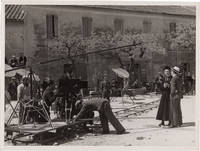
1937150439N.p.: N.p. 1937. Vintage double weight photograph from the 1938 film. A candid on-the-set photograph by the film's credited still photographer Roger Corbeau capturing a scene in the town square between the town priest Robert Vattier and schoolteacher Robert Bassac with the camera crew just to the left director Marcel Pagnol looking on in the center background and several members of the cast waiting just outside the frame to the far right. With Roger Corbeau's photo credit "PHOTO ROGER CORBEAU" at the bottom left of the frame. With a stamp for the Cinemonde Archives on the verso.<br /> <br /> An extraordinary "fourth wall" shot demonstrating at once the method and the magic of Pagnol's filmmaking as well as his relentless interest in provincial life in France. <br /> <br /> Loosely based on Jean Giono's 1932 novel "Blue Boy" the film follows a small-town baker's wife who runs away with a handsome younger shepherd leaving the baker heartbroken and unable to work. The villagers who initially laugh at his cuckoldry soon take the matter very seriously and organize a plan to find the wife and to bring her back to her husband. <br /> <br /> 9.25 x 7 inches. About Fine. N.p. unknown
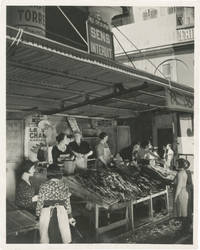
1932149934N.p.: N.p. 1932. Vintage oversize double weight reference photograph from the 1932 film showing the fish stand in the Marseille harbor. With a manuscript pencil annotation on the verso noting the number 8. <br /> <br /> A young fishmonger's daughter discovers she's pregnant with little chance of marriage to the father who has departed overseas for a sailor's life. The second film in director Marc Allegret's delicate lyrical Marseillaise trilogy preceded by "Marius" 1931 and followed by "Cesar" 1936. <br /> <br /> Set and shot on location in Marseille. <br /> <br /> 9 x 11.25 inches. Very Good plus slightly wavy at the bottom edge with some soil on the bottom half of the recto only.<br /> <br /> Criterion Collection 883. Godard Histoires du cinema. N.p. unknown
193239213Paris: Fasquelle 1932. A LARGE-PAPER COPY OF THE FIRST EDITION. 215 pp. ONE OF ONLY 100 COPIES PRINTED ON FINE DUTCH LAID PAPER WITH LARGE MARGINS. 8vo. Original printed wraps. Entirely uncut. FINE AND BRIGHT. <br/><br/> Fasquelle paperback
1990Q-2877061000Editions de Fallois 1990-08-01. Paperback. New. New. In shrink wrap. Looks like an interesting title! Editions de Fallois paperback
196855123DAS BESTE 1968. 1. hardcover. Reader's Digest Auswahlbücher Sirmkovrilo! DAS BESTE hardcover
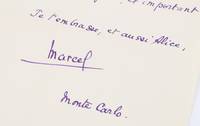
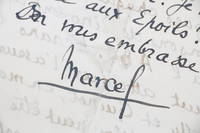
195983040Paris 1959. Fine. Paris 19 mai 1959 21 x 27 cm une feuille Touching autograph letter signed by Marcel Pagnol addressed from Monte Carlo to his great friend Carlo Rim 9 lines in blue ink : ""Petit Carlo Où es-tu Donne-moi ton adresse car il faut que je t'écrive sérieusement à propos du droit d'auteur au cinéma. C'est urgent et important pour tous. Je t'embrasse et aussi Alice Marcel. Monte Carlo"" ""Little Carlo Where are you Give me your address as I need to write to you seriously about film copyright. It's urgent and important for everyone. I embrace you and also Alice Marcel. Monte Carlo"" Central folds inherent to postal handling Carlo Rim having inscribed a date in pencil probably that of receiving the letter. He also indicated below still in pencil: 27 mai ass.ger. SACD à Pleyel. Carlo Rim was a Provençal writer author notably of ""Ma belle Marseille"" a caricaturist a filmmaker: ""Justin de Marseille"" ""L'armoire volante"" ""La maison Bonnadieu"" and was notably the friend of Fernandel Raimu and Marcel Pagnol but also of Max Jacob and André Salmon whom he met in Sanary. Tutor to the aspiring baccalaureate candidate Jean Marius future Carlo Rim the very young graduate Marcel Pagnol preferred to teach him cup-and-ball mocking the uselessness of the baccalaureate. This was the beginning of an unshakeable friendship between the two artists whose literature theater and films contributed to the fame of the land of cicadas. unknown
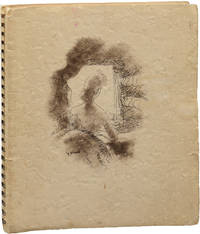
194441308Paris: Oeuvres Sociales du Cinéma 1944. First edition. Softcover. g- to vg. Octavo 8 1/2 x 7 1/4". Unpaginated. Original spiral bound illustrated wrappers by Gilberte Vigué. Laid in the first two pages of a four-page program for the 1944 edition of "La Nuit du Cinéma" a French event whose primary purpose was the raising of funds to help the unemployed of the movie industry. Bound in at rear is a tombola-ticket for the above mentioned event.<br /> <br /> This elegant brochure was published to comemorate the fourth year of the "Comité d'Organisation de l'Industrie Cinématographique" COIC: Committee for the Organization of the Cinema Industry an organization created by the Nazis in the first months of the occupation. The COIC was to oversee and manage film production in occupied France. <br /> <br /> "Cinéma 1944" is profusely illustrated throughout with 22 pages of b/w photographic reproductions five original lithographs by Jean Colin Grau Sala Touchagues Ray Bret Koch Jean Effel and features a series of delightful b/w and color sketched portraits of some of the most celebrated French actors of the period such as:<br /> <br /> - Raimu; Pierre-Richard Willm; actor and singer Tino Rossi; Claude Genia; actor and director Sacha Guitry; Noel Roquevert; Raymond Rouleau; Michèle Alfa; Jeanne Fusier-Gir; Fernandel; Michel Simon; Charles Vanel; Jean Tissier; Fernand Ledoux; Fernand Gravey; Mila Parely; Suzy Carrier and Jacques Dumesnil.<br /> <br /> The brochure contains also a preface and a photo-illustrated article on the fiftieth anniversary of the French movie industry as well as advertisement pages for the following movie companies: <br /> <br /> - Gaumont Pathé Cinéma France-Actualités Minerva Tobis ACE Consortium du Film Continental Films UFA Continental Films Francinex Films Roger Richebé Regina Scalera Film Sirius Eclair Les Films Raoul Ploquin and Les Productions Camille Tramichel.<br /> <br /> Includes advertisements for the following movies:<br /> <br /> - Les Visiteurs du Soir; L'Eternel Retour; Paméla; Le Merle Blanc; Le Ciel est à Vous La Nuit Fantastique Les Visiteurs du Soir Pontcarral Les Anges du Péché Goupi Mains Rouges Le Corbeau Paméla: l'Enigme du Temple etc.<br /> <br /> Also includes advertisements for the following magazines and newspapers:<br /> <br /> - "Sensations" "Actu" "Le Film Complet" "Vedettes" "Ciné-Mondial" "Le Petit Parisien" "Le Miroir des Sports" "Ciné-Miroir" Paris-Soir" and "Le Matin."<br /> <br /> The last section contains advertisements for high end Parisian fashion jewelry and fragrance companies Lucien Lelong Rolex Paquin Phebel Worth Marin Jeanne Lanvin Cherigan A la Ville du Puy Kriegck L. Larsen & Co. Renoir Chanel Robel Armand Gabriel La Samaritaine de Luxe Heyraud etc. as well as restaurants cabarets and French mineral water wines and spirits Chateau Bagatelle Bar François Ier Champagne de Saint-Marceaux Calvados Blanchard Perrier Cognac Rouyer Kressmann Chateau Cheval Blanc St. Emilion Cognac Larsen St. Emilion Jean-Jacques Galhaud Chateau d'Yquem St. Emilion Chateau Ausone St. Emilion Chateau Belair and Cognac Camus.<br /> <br /> Wrappers partly foxed and age-toned. Fore-edge of front cover partly and slightly water-stained. Text in French. Wrappers in overall good- interior in good to very good condition. Oeuvres Sociales du Cinéma unknown
1937133241N.p.: N.p. 1937. Vintage double weight photograph from the 1938 film. A candid on-the-set photograph by the film's credited still photographer Roger Corbeau of a cafe scene featuring the film's principal character actor Raimu with the camera crew just to the left in the shadows the borders of the studio set clearly visible. With Roger Corbeau's photo credit "PHOTO ROGER CORBEAU" at the bottom left of the frame. On the verso is a rubber stamp for the Cinemonde Archives. <br /> <br /> An extraordinary "fourth wall" shot demonstrating at once the method and the magic of Pagnol's filmmaking as well as his relentless interest in provincial life in France. In this film a new baker Aimable Raimu settles down in a small French village. His wife Aurelie is beautiful and much younger than he. She departs with a shepherd the night after Aimable produces his first breads. Aimable is so afflicted that he cannot work anymore. The villagers who initially laugh at his cuckoldry soon take the matter very seriously they want the bread and organize a plan to find Aurelie and to bring her back to the bakery and her husband. <br /> <br /> In a custom museum-quality frame archivally mounted with UV glass. 9.25 by 7 inches. Four tiny single pinholes at the corners within the white marginal border. Near Fine overall. N.p. unknown
193039324Paris: Fasquelle 1930. First edition. A SPECTACULAR LARGE-PAPER COPY ON JAPON IMPERIAL OF PAGNOL'S MASTERPIECE. 287 pp. From a total edition of 1000 numbered copies this is ONE OF ONLY 75 ON IMPERIAL JAPANESE PAPER. 4to. Beautifully bound in quarter morocco and decorated boards. Wrappers and backstrip preserved. Top edge gilt other edges uncut. FINE AND BRIGHT WITH NO DEFECTS. <br/><br/> Fasquelle hardcover
1922H2901Marseille: Editions de 1922. First printing. Wraps. Good. Inscribed by Pagnol to Eugene Silvain doyen of the Comédie Francaise and a very well known actor and author in 1923. Pagnol notes that this is the last copy he has of the original printing. Small quarto wraps good plus copy some shelfwear and soil to wraps and what looks like old streaks of glue to rear wrap contents tanning. Possibly Pagnol's first book he also published a novel “Pirouettes†in 1922 from his earliest time in Paris when he was still teaching English. Although he first started working on this play in 1913 completing it in 1920 it was not published until 1922. In 1928 Pagnol proposed staging it at the Theatre Silvain with Eugene Silvain playing the title role but although Silvain was friendly with the Pagnol he declared that Pagnol had "no sense of theater." Pagnol was at that time an overnight success because of his play Topaze so it might have been professional jealousy on Silvain's part as he came from an older generation and tradition. In any case a superb association copy between a young playwright and an older and established actor and author. Pagnol went on to become France’s first “auteur†filmmaker and the first filmmaker elected to the Academie Francaise. There was a brief revival of interest in Pagnol in the late 1980s when two of his books were made into critically and commercially successful films by director Claude Berri: “Jean de Florette†and “Manon des Sources.â€. Editions de unknown
1938539870Paris: Les Éditions Marcel Pagnol 1938. Hardcover. Very Good. First photoplay edition. Small octavo. 148pp. Illustrated with several black and white plates of film stills. Text in French. Bound with wrappers including the spine still connected to the lower wrap in cloth and papercovered boards. Binding with a lightly toned spine and modest edgewear a bit of interior toning very good. Inscribed by the director on the half-title: "To Howard Barnes Sincerely Marcel Pagnol. 1950." Collection "Les Films Qu'on Peut Lire." Based on the 1932 novel Jean le Bleu by Jean Giono; the text of the film version is published here. Les Éditions Marcel Pagnol hardcover
1944154872Paris: Oeuvres Sociales du Cinema 1944. First Edition. First Edition. <br /> <br /> Deluxe brochure published in commemoration of the fourth year of the Comite d'Organisation de l'Industrie Cinematographique Committee for the Organization of the Cinema Industry an organization created by the Nazis during the first month of French occupation. The brochure contains a preface by director Marcel Pagnol as well as five original lithographs by Jean Colin Grau Sala Touchagues Ray Bret Koch and Jean Effel as well as several portrait sketches of contemporary French actors including Tino Rossi Raimu Claude Genia Fernandel Charles Vanel Mila Parely Suzy Carier Fernand Ledoux and others. <br /> <br /> Very Good plus in spiral bound illustrated wrappers with light edgewear and age toning overall and a few splashes on the front wrapper. Oeuvres Sociales du Cinema unknown
195846407Paris: Grasset 1958. Fine. Grasset Paris 1958 14.50 x 19.50 cm broché First edition of the French translation by Marcel Pagnol one of 32 numbered copies on pur fil paper the only grand papier deluxe copies. Cover illustrated with a woodcut by Aristide Maillol. Slight traces of sunning to head and to foot of spine nice copy. Grasset unknown
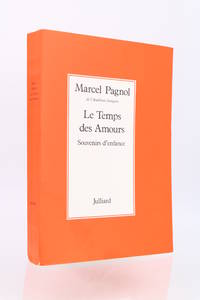
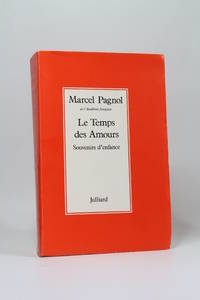
197789548Paris: Julliard 1977. Fine. Julliard Paris 1977 15 x 22 cm broché First edition one of 100 copies on pure wove paper ours being one of 20 hors commerce copies the only deluxe papers after 25 on Hollande. A very fine copy. Julliard unknown
1929007262Les Nouvelles Editions Fournier 1929. Book. Fine. Cloth in Box. Limited. 8vo - over 7¾" - 9¾" tall. Fine copy.Loose Signatures in a cloth Box 1/999 copies.This is #266. Beautiful Rare Edition.Gorgeousl Illustrations. Les Nouvelles Editions Fournier Hardcover
194886570Paris 1948. Fine. Paris s. d. ca 1948 21 x 26.50 cm une page recto verso Autograph letter signed by Marcel Pagnol sent from Monte Carlo 40 lines in black ink concerning the distribution and success of his new film ""La belle meunière"" freely adapted from the life of Franz Schubert with Tino Rossi Jacqueline Bouvier and Raoul Marco in the leading roles. Central folds inherent to postal delivery. Marcel Pagnol shows enthusiasm and is even somewhat overwhelmed with cinemas clamoring for ""La belle meunière"": ""Guinot must have told you about the great success in Marseille. If I had prints the 3 best theaters in Nice are offering to stop their programs to show La Belle Meunière. It's actually foolish since one theater is enough for us."" He is pleased with the public's enthusiasm: ""The lesson from the Rex is that the film is popular. There are nearly a hundred effects. Marco creates immense comic effects every time he speaks and Tino's songs are applauded as at the ABC. Blank screens."" even though he considers that he must make some improvements to the film: ""With Willy and Guinot in less than two days the film can be greatly improved. With about thirty shots the film will be transformed. . they will only have to bring Jacqueline and Tino's costumes - and if Marco can come spend two days here it will be perfect."" ""La belle meunière"" comes at just the right time to replenish Marcel Pagnol's coffers: ""The money troubles continue but I think they will be quickly resolved thanks to the film. But it is essential to hassle Armand."" unknown
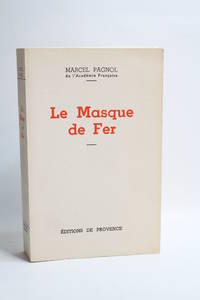
196573243Paris: Editions de Provence 1965. Fine. Editions de Provence Paris 1965 12 x 19 cm broché First edition one of 100 copies on Dame Blanche wove paper deluxe issue. A fine copy. Editions de Provence unknown
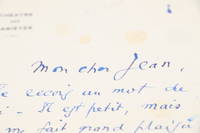
193080538s. l.: S. n. 1930. Fine. S. n. s. l. s. d. 1930 14 x 21.50 cm trois feuilles Signed autograph letter of three pages by Marcel Pagnol addressed to his great friend the Provençal writer caricaturist and filmmaker Carlo Rim pseudonym of Jean Marius Richard one of his oldest accomplices. 33 lines in blue ink on Théâtre des Variétés letterhead. Folding traces inherent to being placed in an envelope a date inscribed in pencil by Carlo Rim probably that of the receipt of this letter. In this very fine letter of indulgent and touching tenderness for his old friend Carlo Rim with whom he is slightly at odds Marcel Pagnol shows less clemency for the theatrical criticisms of Roger Martin du Gard: ""Mon cher Jean Je reçois un mot de toi - Il est petit mais il me fait grand plaisir. Il y a eu entre nous quelque pique imbécile. Partageons en la responsabilité et embrassons nous Folleville ! J'ai d'ailleurs des nouvelles de toi par les littéraires - où je regarde tes dessins chaque semaine. Je t'avoue d'ailleurs que c'est la seule raison pour laquelle j'achète ce journal dont la page des théâtres est en général absolument hilarante par l'incompréhension absolue de M. Martin du Gard. Il a d'ailleurs été très gentil pour moi mais il s'y connait autant que moi en peinture. Quand déjeune-t-on ensemble Téléphone donc à Gras qui est aux Variétés tous les jours de 3 à 7. Tous mes respects chez toi. Ton vieux Marcel."" ""My dear Jean I receive a note from you - It is small but it gives me great pleasure. There has been some foolish quarrel between us. Let us share the responsibility and embrace each other Folleville! I have news of you moreover through the literary papers - where I look at your drawings each week. I confess to you moreover that it is the only reason for which I buy this journal whose theatre page is generally absolutely hilarious by the absolute incomprehension of M. Martin du Gard. He has moreover been very kind to me but he knows as much about it as I do about painting. When shall we lunch together Do telephone Gras who is at the Variétés every day from 3 to 7. All my respects to your household. Your old Marcel."" Tutor to the aspiring bachelor Jean Marius the very young graduate Marcel Pagnol preferred to teach him bilboquet mocking the uselessness of the baccalauréat. This was the beginning of an unbreakable friendship between the two artists whose literature theatre and films contributed to the fame of the land of cicadas. S. n. unknown
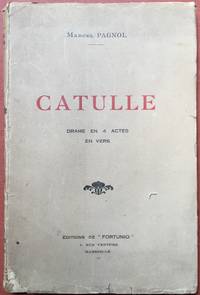
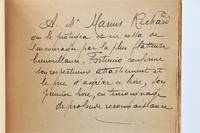
192280544Marseille: Editions de ""Fortunio"" 1922. Fine. Editions de ""Fortunio"" Marseille 1922 16.50 x 25.50 cm relié First edition with no mention of deluxe copies. Bradel binding in full decorative paper smooth spine decorated with a black morocco title-label underlined with gilt fillets covers and spine preserved binding signed P. Goy & C. Vilaine. Autograph inscription from Marcel Pagnol to Marius Richard: ""A Mr Marius Richard qui le protégea et ne cessa de l'encourager par la plus flatteuse bienveillance Fortunio confirme son respectueux attachement et le prie d'agréer ce livre son premier livre en témoignage de profonde reconnaissance."" ""To Mr Marius Richard who protected him and never ceased to encourage him with the most flattering benevolence Fortunio confirms his respectful attachment and asks him to accept this book his first book as a testimony of profound gratitude."" Rare and important autograph inscription from Marcel Pagnol then assistant professor of English at the Lycée Condorcet in Paris to one of his first supporters the politician and journalist Marius Richard the father of his close friend and collaborator Carlo Rim. Editions de ""Fortunio"" unknown
194151622Paris: Fasquelle 1941. Fine. Fasquelle Paris 1941 13.50 x 20.50 cm relié First edition one of 50 numbered copies on Hollande the deluxe issue. Bradel binding in full chartreuse-green floral and vegetal patterned paper smooth spine green olive box leather label original wrappers preserved binding signed by Thomas Boichot. Minor foxing to the lower cover and the final three leaves. A fine untrimmed copy handsomely bound. Fasquelle hardcover
197771183Paris: Julliard 1977. Fine. Julliard Paris 1977 14.50 x 22.50 cm broché First edition one of 25 numbered copies on Hollande paper deluxe issue. A very handsome copy. Julliard unknown
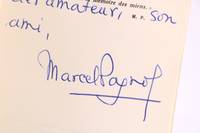
195792080Monte-Carlo Monte Carlo: Editions Pastorelly 1957. Fine. A double presentation copy to Druon fervent admirer of Pagnol's work Editions Pastorelly Monte-Carlo Monte Carlo 1957-1958 12 x 19 cm 2 volumes brochés sous chemise et étui First edition on ordinary paper for the second volume; statement of 1000th edition on the first volume. Minor foxing to the top edges. A handsome set housed in a white paper covered chemise and slipcase. Exceptional presentation copies signed by Marcel Pagnol to Maurice Druon on each volume: ""à Maurice Druon écrivain véritable hommage du romancier amateur son ami MarcelPagnol. 1958"" to Maurice Druon true writer homage from an amateur novelist his friend Marcel Pagnol and ""Cher Maurice puisque ça te plaît voilà la suite. Mais rassure-toi il n'y en a plus qu'un ! affectueusement Marcel."" Dear Maurice since you liked it here is the continuation. But not to worry there is only one left after this! tenderly Marcel ""It was through Joseph Kessel that Marcel and Maurice first met. . Unlike certain representatives of the Parisian intelligentsia Maurice Druon fully recognised the universal and timeless quality of Marcel Pagnol's writings: 'To communicate and to endure: the two aims of the art of writing' he reminded him."" Nicolas Pagnol Thierry Dehayes ed. Je te souhaite beaucoup d'ennemis comme moi. Correspondances intimes et littéraires 2017 p. 252 L'écrivain véritable as Pagnol humorously styled him in this first inscription was overwhelmed by La Gloire de mon père: ""Dear great Marcel It is a marvel! Rich delightful tender French because Provençal and Provençal because Latin! The warmth of the sun and the scent of the 'herbettes' the taste of olive oil and the nostalgic drift of time. One reads it with an southern accent and with a small tear at the corner of a smile. Memories in the great tradition. How human you are beneath such pleasant appearances! I feel now as though reading you has made me one of your childhood friends. And I await the sequel to La Gloire de mon père as one awaits a reward. I admire you and embrace you. Maurice P.S.: I shall never forget the testing of the hunting rifles against the lavatory door. I was howling with laughter alone at two in the morning in the silence of the rue de Grenelle."" 29 March 1958 ibid. Pagnol would refer back to this enthusiastic letter in the second inscription ""puisque ça te plaît voilà la suite"" and Druon equally praised the second volume of memoirs in a letter reading: ""If I say less about Le Château de ma mère it is only because I can do no more than repeat everything I wrote to you about the first volume. How glad I am that there is to be a third! These are the Bucolics of Aubagne. 'You alone know how to sing shepherds of Provence!'"" ibid. 1 June 1958 Editions Pastorelly unknown