George SANDBiblio.com
219 résultats
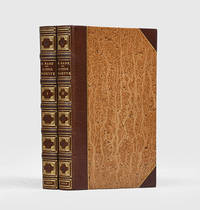
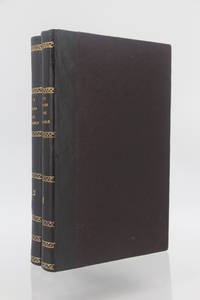
184688172Paris: Desessart 1846. Fine. Desessart Paris 1846 12.80 x 20.80 cm 2 volumes reliés Rare and highly sought-after first edition. Contemporary binding in black half shagreen flat spines richly decorated with gilt ornamental rolls discreet and skilful restoration to the foot of one joint black paper-covered boards marbled endpapers and pastedowns sprinkled edges. Discreet restoration to the lower hinge of the first volume. Exceptionally clean copy virtually free of foxing a rarity according to Clouzot who notes that most copies are usually heavily spotted. Provenance: from the libraries of Saint-Germain with printed crowned bookplate beneath the titles on the half-titles; Count de Bonvouloir with his printed bookplate Château de Magny in Calvados above the title on the half-title of the second volume and above the next bookplate on an endpaper of the first volume; Charles-Albert Gigault de Crisonoy de Lyonne with his bookplate mounted on a pastedown and endpaper; and more recently Max Brun with his bookplate mounted on the front pastedown of the first volume. Shelving labels mounted at the top of the rear pastedowns minor losses to white paper and some corner stains on the endpapers. A rare copy preserved in a strictly contemporary binding. Desessart hardcover
1849178642Paris: Michel Lévy Frères Libraires-Éditeurs 1849. Beautifully preserved in a fine Parisian binding First edition fine paper issue of the author's major novel one of her best known today. Together with La Mare au diable 1846 and François le Champi 1848 La Petite Fadette is one of Sand's pastoral "rustic novels" which drew inspiration from the author's love of the countryside and sympathy for the rural poor. In these works "the familiar theme of Sand's work - love transcending the obstacles of convention and class - regained pride of place" Ency. Brit. The fine bindings were executed by the Parisian master bookbinder Émile Mercier 1855-1910 the apprentice and successor to Francisque Cuzin 1836-1890. Mercier worked for Cuzin for eight years during which they established the elegant "Cuzin style" characterized by fine gilding and finishing. Following his mentor's death Mercier took over his workshop and sustained the firm's reputation for two decades signing bindings "Mercier Successeur de Cuzin". Mercier's bindings are "noted for the excellence of their tooling" and the binder himself was celebrated in Paris as "l'artiste impeccable" Coutts & Stephen p. 182. Provenance: Paul Villeboeuf b. c. 1856 with his bookplate. Villeboeuf was a distinguished collector of Romantic literature and fine bindings mostly by Cuzin and Mercier. He was the father of the artist André Villeboeuf. 2 vols octavo 227 x 150 mm. Late 19th- or early 20th-century straight-grain half morocco by Mercier spines lettered and decorated in gilt covers ruled in gilt marbled sides and endpapers edges untrimmed original wrappers bound in. Binding and contents exceptionally well-preserved a fine copy. Henry T. Coutts & George A. Stephen Manual of Library Bookbinding: Practical and Historical 1911. unknown
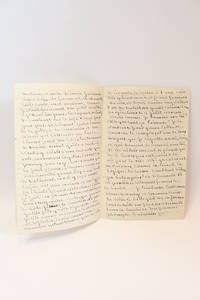
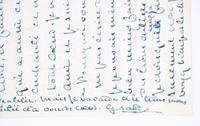
186771232Nohant Nohant-Vic 1867. Fine. Nohant Nohant-Vic 21 décembre 1867 13.40 x 20.70 cm deux feuillets sous chemise et étui Autograph letter from George Sand to Gustave Flaubert dated December 21 1867 8 pages on two lined leaves. Published in Sand's Correspondance XX pp. 642-645. From one of the finest literary correspondences of the century this letter written on Christmas Eve 1867 is a sublime testament to the frank friendship between George Sand the old troubadour and Gustave Flaubert christened cul de plomb leaden ass after declining his invitation to Nohant to complete L'Éducation sentimentale. Despite their seventeen year-age gap opposing temperaments and divergent outlooks on life the reader is gripped by the tenderness and astonishing verve of George Sand's long confession to Flaubert. At the height of her literary fame and enjoying her theater in Nohant Sand talks at length about politics their separation their conception of the writer's work and life itself. In this stream-of-consciousness letter Sand naturally and freely sets down on paper eight pages of conversations with Flaubert who made only too rare and brief appearances in Nohant: But how I chat with you! Do you find all this amusing I'd like a letter to replace one of our suppers which I too miss and which would be so good here with you if you weren't a cul de plomb leaden ass who won't let yourself be dragged along to life for life's sake whereas Flaubert's motto then busy writing L'Éducation sentimentale was rather art for art's sake. In the end of 1867 Sand grieved the death of an almost brother François Rollinat which Sand appeased with letters to Flaubert and lively evenings at Nohant: This is how I've been living for the last 15 days since I stopped working . Ah'! . Ah! when you're on vacation work logic and reason seem like strange swings. Sand was quick to criticize him for working tirelessly in his robe the enemy of freedom while she was running up and down mountains and valleys from Cannes to Normandy even to Flaubert's own home which she had visited in September. On this occasion Sand had happily reread Salammbô where she picked up a few lines for her latest novel Mademoiselle Merquem. Their literary and virile friendship similar to Rollinat's defied the old guard of literati who declared the existence of a sincere affair between man and woman utterly impossible. Sand who has been described in turn as a lesbian a nymphomaniac and made famous for her resounding and varied love affairs began a long and intense correspondence with Flaubert for whom she was a mother and an old friend. She called herself in their letters old troubadour or old horse and no longer even considered herself a woman but a quasi-man recalling her youthful cross-dressing and formidable contempt for gender norms. To Flaubert had compared the female writers as Amazons denying their femininity: To better shoot with the bow they crushed their nipples Sand replied in this letter: I don't share your idea that you have to do away with the breast to shoot with the bow. I have a completely opposite belief for my own use which I think is good for many others probably for the majority. A warrior yes but a peaceful warrior Sand willingly adopted the customs of a world of misogynistic intellectuals while remaining true to herself: I believe that the artist should live in one's nature as much as possible. To the man who loves struggle war; to the man who loves women love; to the old man who like me loves nature travel and flowers rocks great landscapes children too family everything that moves everything that fights moral anemia she then adds. A fine evocation of her green period this passage marks the time of Sand's country novels when mellowed by the years she gave herself over entirely to contemplation to write François le Champi La Mare au diable and La Petite Fadette. But her love of nature didn't stop unknown
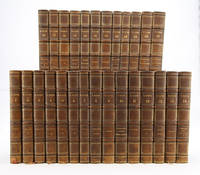
183777301Paris: Félix BonnaireVictor MagenComonHippolyte Souverain 1837. Fine. Félix Bonnaire Victor Magen Comon Hippolyte Souverain Paris 1837-1841 13 x 20.50 cm longueur totale de la série 72 cm 27 volumes reliés Extremely important edition comprising a large number of works appearing here in their first edition. The complete set of these 27 volumes is rare Clouzot. The titles present in first edition are: Mattea Lettres dun Voyageur La Dernière Aldini Les Maîtres mosaïstes LUscoque Spiridion Les Sept Cordes de la lyre Gabriel Pauline and Un hiver à Majorque.Illustrated with a portrait of the author at the head of the first volume. Bound in contemporary half brown sheep spines uniformly faded with four raised bands decorated with double gilt panels double gilt fillets at head and foot marbled-paper boards marbled endpapers and pastedowns marbled edges a few very lightly rubbed corners contemporary bindings. Some occasional foxing a light dampstain affecting the final leaves of the twenty-first volume. A very rare complete set in contemporary bindings. Félix BonnaireVictor MagenComonHippolyte Souverain hardcover
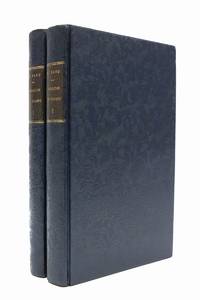
185074490Paris: Alexandre Cadot 1850. Fine. Alexandre Cadot Paris 1850 13.50 x 21 cm 2 volumes reliés Rare and much sought-after first edition cf. Clouzot published at the correct date of 1850 with some unsold copies later reissued by the same publisher in 1852. Bradel bindings in full bottle-green boards decorated with blind-stamped floral motifs brown morocco title labels bookplates pasted on the pastedowns. A small paper loss at the foot of the final page of the second volume without any loss of text a few occasional spots of foxing. A very rare and handsome copy elegantly bound strictly contemporaneous with the publication. Alexandre Cadot hardcover
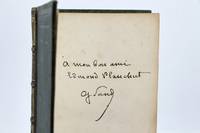
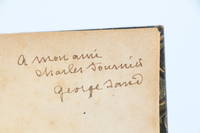
186780208Paris: Michel Lévy frères 1867. Fine. Michel Lévy frères Paris 1867 11.50 x 18.50 cm relié New edition. Contemporary binding in half green shagreen spine in four compartments set with gilt stippling gilt fillets and gilt fleurons in the corner pieces multiple blind tooled frames on the boards white iridescent paper endpapers all edges gilt. Some leaves shorter in the bottom margin. Handwritten inscription signed by George Sand on the first endpaper: à mon bon ami Edmond Plauchut. G. Sand"". Today the only outsider to the family buried in the cemetery of the Nohant house is Lucien-Joseph-Edmond Plau chut 1824-1909 who began an epistolary relationship with George Sand in the autumn of 1848 when he was a voluntary expatriate after the fall of the Republic. Leaving for Singapore he was shipwrecked off the coast of the Cape Verde Islands and was able to save only one cassette containing Sand's letters that he had preciously bound. These missives were his salvation: they allowed him to be collected fed and laundered by a rich Portuguese admirer of the Lady of Nohant Francisco Cardozzo de Mello. After several journeys toward the Far East and several exotic presents sent to his distant and yet so close friend Plauchut finally met George Sand in 1861. In 1870 she paid a vibrant tribute to him in the preface of her novel Malgrétout. Despite everything she recounts the shipwreck of which he was a victim and expresses with emotion her friendship for this courageous friend. Plauchut much loved by the Sand family and particularly George's granddaughters who nicknamed him Uncle Plauchemar was an integral part until his death in January 1909. The handwritten signed inscriptions on La Mare au Diable are very rare this one is from a superb provenance. Michel Lévy frères hardcover
185976839Nohant Nohant-Vic 1859. Fine. Nohant Nohant-Vic 16 août 1859 13.50 x 20.90 cm 4 pages sur un double feuillet Autograph letter signed by George Sand addressed to Ernest Feydeau. Four pages written in blue ink on a double sheet bearing at the head of the first page the sender's blind stamp. This letter was published in the complete correspondence of George Sand established by Georges Lubin. Fine and lengthy letter discussing literature and friendship between writers. Initially a stockbroker and specialist in Antiquity Ernest Feydeau launched himself late into fiction. Anxious to occupy a literary space in which he did not feel justly appreciated he used his connections and maintained a regular epistolary relationship with illustrious correspondents such as Gustave Flaubert Sainte-Beuve and George Sand to whom he sent drafts of his novels and whose opinions he sought. This letter forms Sand's response after having just finished reading Daniel Feydeau's second novel. George Sand then at the height of her literary career describes herself thus: ""I am quite old enough to be your mother for I am 55 years old and I have good hands quite skillful but not beautiful at all. I have earned the right to no longer be coquettish I have been quite reproached for never having been so. I will tell you anything about myself that you wish."" As was her habit much solicited by her peers she delivers a very detailed critique of the text her colleague submits to her: ""I am not against sentences that jar where they need to jar but I am not for harmony being sacrificed to rhythm. Nor am I for the contrary. Understand me well I only blame what is too noticeable what reveals the technique. Do not touch the passages you speak of they are excellent. And in sum I will not insist furiously on the question of form in style seeing that if the qualities of yours should disappear with what sometimes seems to me a flaw I would be in despair at having pointed out the flaw."" Herself very close to Flaubert whom she nicknamed her ""leaden bottom"" Sand seems delighted that the two men know each other: ""I do not have time. But I will have time to receive you when you are free you must come with Flaubert who also has in me an enchanted reader and a wholehearted literary friend. I did not know he was your friend and I am pleased that he is."" The friendship goes so far that Sand soon brings the two writers together placing them on complete equal footing: ""It is no misfortune for you any more than for Flaubert to belong to the race of seers."" A form of solidarity then establishes itself in the face of critical adversity: ""All this is felt better than it can be said and that is why criticism loses its reason three-quarters of the time."" For criticism has had the misfortune of labeling Feydeau as it did with Flaubert a realist: ""People have taken it upon themselves to baptize your manner and his as realism. I do not know why; unless realism is something entirely different from what the first adherents attempted to explain to us. I suspect indeed that there is a way of envisaging the reality of things and beings which is great progress and you bring triumphant proof of it. But the name realism does not suit because art is a multiple infinite interpretation. It is the artist who creates reality within himself his own reality and not that of another. Two painters paint the portrait of the same person. Both create a work that represents the person if they are both masters. And yet the two paintings do not resemble each other. What has become of reality"" This long diatribe - a true manifesto - forms a powerful testimony to the repulsion of George Sand and Flaubert for theorists obsessed with the idea of classifying literature according to a ""system that . blinds"". unknown
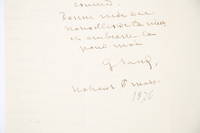
187676872Nohant Nohant-Vic 1876. Fine. Nohant Nohant-Vic 6 mars 1876 13.20 x 20.70 cm deux pages sur un feuillet remplié Autograph letter signed by George Sand addressed to Gustave Flaubert. Two pages written in black ink on a double sheet bearing at the head of the first page the sender's dry stamp. This letter was published in the complete correspondence of George Sand established by Georges Lubin. Fine letter written by George Sand a few months before her death and addressed to her lifelong friend Gustave Flaubert. The writer wishes to offer her friend a seat so he may attend the revival of her play Le Mariage de Victorine : ""Je t'écris en courant ce matin parce que je viens de recevoir de Mr Perrin avis de la 1ère représentation de la reprise du Mariage de Victorine une pièce de moi au théâtre français. Je n'ai ni le temps d'y aller ni l'envie de partir comme cela au pied levé mais j'aurais voulu y envoyer quelques amis et il ne m'offre pas une seule place. Je lui écris une lettre qu'il recevra demain et je le prie de t'envoyer au moins un orchestre."" ""I'm writing to you hurriedly this morning because I've just received notice from Mr Perrin of the first performance of the revival of Le Mariage de Victorine a play of mine at the Théâtre Français. I have neither the time to go nor the desire to leave like that at a moment's notice but I would have liked to send some friends and he doesn't offer me a single seat. I'm writing him a letter which he will receive tomorrow and I ask him to send you at least an orchestra seat."" Letters from the correspondence between George Sand and Gustave Flaubert are renowned and highly sought after. unknown
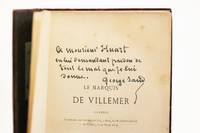
186471862Paris: Michel Lévy frères 1864. Fine. Michel Lévy frères Paris 1864 14.50 x 23 cm relié First edition of the theatrical adaptation. Bound in half red shagreen spine in four compartments set with gilt stipples adorned with double gilt spine panels marbled paper plates marbled endpapers contemporary binding. Precious handwritten presentation signed by George Sand: à monsieur Huart en lui demandant pardon de tout le mal que je lui donne. To Mr Huart asking for his forgiveness for all the harm I am causing him. Provenance: from the Grandsire library with its ex-libris. Le 1er mars 1864 en effet se déroule l'événement théâtral de l'année: la première du Marquis de Villemer. L'Odéon gardé par des cordons de police est pris d'assaut par les étudiants qui campent sur la place depuis dix heures du matin. Dans la salle les trépignements les hurlements les applaudissement interrompent les acteurs. La claque est débordée. On a refusé 3 000 à 4 000 personnes faute de place. La famille impériale applaudit l'empereur pleure ouvertement Flaubert est en larmes le Prince Napoléon hurle son enthousiasme. C'est un triomphe. Deux cents personnes entourent George et l'embrassent au foyer. Les étudiants l'escortent jusqu'à son domicile aux cris de Vive George Sand! Vive Mademoiselle La Quintinie! à bas les cléricaux! La police disperse la manifestation dans la nuit. Ces démonstrations anticléricales sont d'autant plus étonnantes que rien dans la pièce n'y fait allusion. Il s'agit d'un mélodrame très réussi dans lequel l'amour triomphe des préjugés sociaux. Le premier acte qui a bénéficié de l'esprit de Dumas fils est brillant. La pièce met en scène deux frères dont l'un très proche de sa mère introverti et sérieux refuse de se marier. Il finira par épouser la dame de compagnie une jeune femme vertueuse et droite. L'autre un libertin sympathique et spirituel de quarante ans se mariera avec une héritière tout juste sortie du couvent. Le rythme est enlevé les caractères bien dessinés. La pièce jouit de l'aura de George Sand. Le succès se reproduit tous les jours. Les recettes sont fabuleuses. Le Quartier latin est méconnaissable. Les ruelles autour de l'Odéon bien éloigné des grands boulevards élégants sont obstruées par les équipages de luxe. Les belles dames font la queue dès le matin à la location. L'Odéon ce théâtre sale froid loin de tout désert misérable Lettre à Maurice et Lina Dudevant-Sand 5 mars 1864 est illuminé tous les soirs. On 1 March 1864 the theatrical event of the year took place: the premiere of Le Marquis de Villemer. The Odeon guarded by a police cordon is stormed by students who have been camping on-site since ten o'clock in the morning. In the hall the feet stamping the yelling and the clapping interrupts the actors. The claque is overshadowed. Between 3000 and 4000 people were refused for lack of space. The Imperial family applauds the Emperor weeps openly Flaubert is in tears Prince Napoleon howls with enthusiasm. It is a triumph. Two hundred people surround George and kiss him in the foyer. The students escort him home with shouts of Long live George Sand! Long live Mademoiselle La Quintinie! Down with the clerical! The police break up the demonstration throughout the night. These anticlerical demonstrations are all the more surprising since nothing in the play alludes to them. It is a very successful melodrama in which love triumphs over social prejudices. The first act which has benefited from Dumas fils' mind is superb. The play features two brothers one of whom who is very close to his mother introverted and serious refuses to be married. He will end up marrying the lady in wating a young virtuous and upright woman. The other a forty year old sympathetic and spiritual libertine will marry an heiress who has just left the convent. The rhythm is lively the characters well drawn. The play has the aura of George Sand. The success is repeated every day. The takings are fabulous. Th Michel Lévy frères unknown
187578260Paris: Michel Lévy frères 1875. Fine. Michel Lévy frères Paris 1875 11.50 x 18.50 cm relié First edition published in the authorÂ’s collected works. Some occasional foxing. Half black morocco shagreen binding smooth spine decorated with triple blind fillets and gilt fleurons marbled paper boards marbled endpapers and pastedowns contemporary binding. Signed autograph inscription by George Sand : ""to my friend Charles Fournier."" Handwritten note by George Sand beneath the title on the title page: ""suite de Flamarande"" published the same year and by the same publisher as ""Les deux Frères"".  Michel Lévy frères hardcover
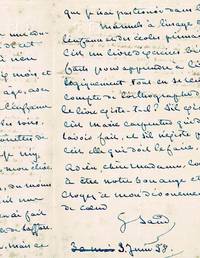
185876111Nohant Nohant-Vic 1858. Fine. Nohant Nohant-Vic 3 juin 1858 13.40 x 20.90 cm 4 pages sur un feuillet remplié Autograph letter signed by George Sand addressed to her friend Stéphanie Bourjot daughter of Étienne Geoffroy-Saint-Hilaire. Four pages written in blue ink on a folded bifolium bearing George Sands monogram. Fold marks as usual. This letter was partially published in Correspondance vol. XIV no. 7846. A beautiful and partly unpublished letter in which George Sand discusses Marie Pape-Carpantiers book and the education of her young maid Marie Caillaud: «It is an excellent book which I use to teach my young maid to read. She is extraordinarily intelligent and this book opens her mind to all sorts of sound ideas. Educating this 18-year-old childwho six months ago was only two in terms of knowledgehas been a unique experience. She now seems her age yet retains all the innocence of childhood. So every evening we read Marie Carpentiers little stories and I enjoy them just as much as my pupil does.» Marie Caillaud was only eleven years old when George Sand hired her to wash dishes and tend to the chicken coop a task that earned her the nickname Marie des poules. But the writer soon recognized the young peasant girls intelligence appointed her as housekeeper and by 1856 included her in the performances of the Nohant theatre. Her education is first mentioned in early 1858 notably in a letter from George Sand to her friend Charles Duvernet: «During my winter evenings I took on the education of little Marie the one who acted with us. From a dish washer I immediately raised her to the rank of housekeeper a role for which her excellent mind makes her perfectly suited. The greatest obstacle was that she couldn't read. That obstacle no longer exists. In thirty half-hour lessonsfifteen hours in a monthshe mastered all the difficulties of the language slowly but perfectly. This miracle is due to the admirable Laffore method which I applied with the utmost gentleness to a perfectly lucid mind.» 16 February 1858 Marie Caillaud would go on to become a notable actress at Nohant and move in the circles of George Sands illustrious guests: Delacroix Gautier Dumas Prince Jérôme Bonaparte But Marie was not George Sands first pupil. All her life Sand was deeply interested in pedagogy and taught not only her children and grandchildren but also members of her household staff and local peasants. This letter is a remarkable testament to her hands-on approach as a teacher always seeking new and effective ways to impart knowledge: «What is lackingor at least what I havent foundis a true reading method. Ive devised one for my own use never written down based on Laffores and adapted to my own ideas. But what I havent found in primers for children or public school manuals is a well-crafted exercise book that teaches reading logically while also making sense of spelling. Does such a book exist» Far from a casual activity education was central to George Sands worldview. As Georges Lubin noted her aim was not merely to teach literacy. Taught to write by her own mother at the age of five Sand understood from an early age that the only path to equality lay through intellectual emancipation: «She understood very early on that the only road to equality was intellectual emancipation. The ignorance imposed upon women was the root of their servitude. The ignorance imposed upon the working classes underpinned class inequality. Education was the key to opening locked doors.» «George Sand et l'éducation» in Nineteenth-Century French Studies 1976 A beautiful and important testimony to George Sands tireless struggle for the emancipation of women through education. unknown
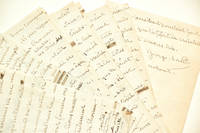
187275733Nohant Nohant-Vic 1872. Fine. Nohant Nohant-Vic 19 semptembre 1872 13.20 x 20.60 cm 20 pages 1/2 sur 21 feuillets Autograph manuscript signed by George Sand written in black ink on 21 leaves of white paper. Deletions and corrections. One page of the manuscript appears to have been lost. The final version of this chronicle whose text conforms to the manuscript we offer was published in Impressions et souvenirs Paris M. Lévy 1873. George Sand would devote another article to her son's novel in Questions d'art et de littérature in 1878. The first edition of Maurice Sand's Coq aux cheveux d'or was published by Lacroix and Verboeckhoven in 1867. unknown
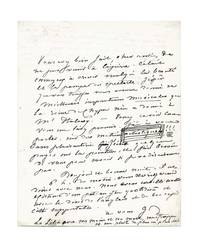
1841Sand14<p><strong>DELACROIX SAND George 1804-1876</strong></p><p>Autograph letter signed " G.S. " to Eugène Delacroix<br />Paris Postal mark 23rd December 1841 1 p. 1/2 in-8°<br />Autograph address on fourth folio wax seal : " Monsieur Delacroix rue des Marais Saint Germain 17 "</p><p><strong>Superb letter to her friend Delacroix about her desire to write "a few pages on painting" the <em>Femmes d'Alger</em> her contempt for the <em>Ingresque</em> school and other artistic news</strong></p><p><em>" Vous avez bien fait cher ami de ne pas venir à l'Opéra. <strong>C'était ennuyeux à crever malgré la beauté et la pompe du spectacle.</strong> J'espère que vos truffes vous auront donné de meilleures inspirations musicales que la reine de Chypre n'en a donné à Mr Halevy.1</em><br /><strong><em>Venez ce soir comme vous me l'avez promis. J'ai à vous parler sur des matières artistiques !!!</em></strong> le mot est entouré par Sand d'un triple trait de plume.<strong><em> Sans plaisanterie j'écris quelques pages sur la peinture et j'ai besoin de vous pour savoir si je ne déraisonne pas. </em></strong><em>2</em><br /><em>Bonjour et bonne nuit. Il est 6h du matin. Vous devriez venir dîner avec nous. Nous avons embelli notre existence d'un pot-au-feu quotidien et avec le dîner de l'anglais3 et du bon café c'est supportable.</em><br /><em>G.S.</em><br /><strong><em>La Lélia</em></strong><em>4<strong>avec son moine et son mort me frappe et me plaît de plus en plus c'est ce qui m'a mise en veine d'écrire sur la couleur et ce qu'il faut entendre par la forme. Avec ça j'ai vu vos femmes d'Alger</strong>5 ce matin. Si vous m'encouragez je suis capable de faire le prochain salon dans notre revue</em> La Revue indépendante<em> et <strong>vous savez que je ne caponnerai pas</strong></em> ne se montrera pas lâche <strong><em>avec tout cette école silhouettiste</em></strong><em>6<strong> qui se dit en possession du dessin</strong> ".</em></p><p>1 <em>La Reine de Chypre</em> an opera in five acts by Halévy to a libretto by St. George took place the day before December 22 1841. Unlike George Sand Richard Wagner who was also present at the premiere considered the music "noble moved and even new and exhilarating" although he criticized Halévy's failings in simple orchestration.<br />2 In Horace which George Sand was then writing she staged a rapin a pupil of Delacroix but there were no "few pages on painting". Is this an article intended for the Independent Review – which it has just created – but which it has renounced The word written in postscript confirms that it is an aesthetic reflection that focuses on "color" and "form".<br />3 Possible reference to an English restaurateur or caterer frequented by George Sand.<br />4 <em>Lélia avec son moine et son mort</em> is the third work offered by Delacroix to George Sand for the gifts of 1842. It is a pastel depicting Lélia kneeling near Stenio's corpse while the monk Magnus "in the shadows leaning stiffly against the wall of the cave darted on her his sparkling eyes". The subject was treated several times by Delacroix.<br />5 This is the <em>Femmes d'Alger dans leur appartement</em> a painting presented at the Salon of 1834 where it caused a sensation. A synthesis of orientalism and romanticism this painting expresses a deep "melancholy" for the poet and art critic Baudelaire.<br />6 George Sand refers to the school of Ingres as a "Silhouettist school". We know the adversity between the two painters that animated the artistic scene of the nineteenth century. The writer had resolutely taken Delacroix's side that of "form" and "color".</p><p><u>Bibliography:</u><br /><em>George Sand</em> – Correspondance t. V Lubin Garnier p. 529-531 lettre n°2369<br /><em>Correspondance</em> éd. Françoise Alexandre Les éditions de l'Amateur p. 117-118 n°50</p><p><u>Provenance:</u><br />Achille Piron Delacroix's universal legatee<br />Bibliothèque Marc Loliée</p>
1842Sand29<p><strong>DELACROIX SAND George 1804-1876</strong></p><p><u>Two autograph letters</u> signed " GS " to Eugène Delacroix<br />Nohant 6 & 7 July 1842 3 p. in-8° in total in black ink<br />Autograph addresses on verso<br />Stamp marks previous trace of mounting</p><p><strong>Saddened by the departure of her "good little" Delacroix after the latter's stay in Nohant in the company of Chopin and the rest of the Sand family the writer found herself immersed in her reading of <em>Les Mystères de Paris</em></strong></p><p><strong><u>From the Marc Loliée library</u></strong></p><p><em>" <strong>Cher bon petit</strong> J'espère que vous êtes arrivé à bon port sans trop souffrir de la chaleur qui a été modérée le jour de votre départ. Vous avez oublié ici quelques effets dont Maurice a fait une caisse laquelle part aujourd'hui. Comme le port en est payé accusez-en réception afin qu'elle ne s'égare pas sans que nous la fassions réclamer. J'ai encore retrouvé dans mes mouchoirs un mouchoir à vous. Je vous le mets à part ainsi que ceux qui pourraient se retrouver au prochain blanchissage. <strong>Que Jenny</strong></em> la gouvernante de Delacroix <strong><em>ne nous accuse donc pas de vous avoir grinché vos zardes</em></strong>¹<em>. – <strong>Je lis le Chourineur et je vous assure que malgré l'horreur du sujet et des détails</strong></em>²<strong><em> c'est jusqu'à présent fort intéressant et fabriqué avec beaucoup de talent</em></strong><em>. – <strong>Nous sommes restés tout tristes et tout déconfits de votre départ</strong>. Nous tâchons de jouer au billard mais je crois que vous avez emporté le carambouillage</em>³<em> dans votre poche et que vous ne nous avez laissé que le manque de touche. J'attends avec impatience un petit mot de vous. <strong>Nous sommes encore trop chagrins pour vous en dire long aujourd'hui</strong>. Et puis l'heure me presse. À présent cher soyez bien portant. Si vous nous regrettez autant que nous vous regrettons faites un effort pour nous oublier jusqu'à notre retour </em>Sand et Chopin rentreront à Paris le 31 juillet<em> alors vous nous raimerez de nouveau. <strong>Adieu moi et tous vous embrassons et vous aimons</strong>.<br />GS. "</em></p><p><em>" Cher ami mon dadet </em>sic <em>de Thomas </em>peut-être Thomas Aucante autrefois vacher<em> a commencé le cours de bêtises auxquelles je dois m'attendre en ne payant pas le port de la caisse que je vous ai envoyée hier. Si bien qu'il faut que vous le sachiez afin de n'avoir pas de contestation avec l'administration. Accusez-moi réception car tout ceci a été fort mal fait malgré mes précautions.<br />Nous nous portons bien. <strong>Nous vous aimons. J'ai rêvé de vous toute la nuit</strong> ; j'espère que c'est bon signe et que vous êtes bien portant.<br />À vous<br />GS. "</em></p><p>In response to his friend's repeated invitations Delacroix spent nearly two weeks in Nohant in June 1842. He wanted above all to rest "vegetate" as he put it and enjoy the pleasures of the countryside. Back in Paris he replied on the 8th stating that he had received the crate and calling the person who had brought it to him a cheat and an imposter demanding postage. He asked his friend for a small purse left in Nohant a purse that Solange had given him and a small cord from Algiers. He concluded: "The weather is awful for the nerves. When you dreamed that you saw me did you dream that you were the Duchess of Berry I send you all my sincere embraces but I am very sad" Corr. gén. de Delacroix t. II p. 116.</p><p>Using the slang present in Eugène Sue's work we understand that Sand is here in the middle of reading The Mysteries of Paris. The serial novel published in the Journal des débats from June 19 1842 to October 15 1843 inaugurated mass literature in the 19th century and earned its author immense fame in all social classes.</p><p><u>Provenance:<br /></u>Bibliothèque Marc Loliée<br /><u><br />Bibliography:<br /></u><em>Correspondance</em> t. V éd. G. Lubin Garnier n°2477 & 2478</p>
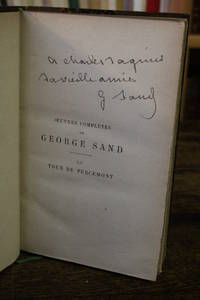
187648387Paris: Calmann Lévy 1876. Fine. Calmann Lévy Paris 1876 12.50 x 19.50 cm relié First edition published as part of the complete works Half light brown morocco by Petit successeur de Simier spine in six compartments marbled pastedowns and endpapers top edge gilt Handsome autograph inscription from George Sand to his friend Charles Sagnier a frequent visitor of the house at Nohant during the final years of Sand's life Provenance: from the library of Charles Sagnier with his ex libris. Calmann Lévy unknown
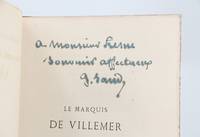
186487349Paris: Michel Lévy frères 1864. Fine. Michel Lévy frères Paris 1864 14.50 x 23 cm relié First edition of the theatrical adaptation.  Contemporary binding in red half morocco with corners spine with five raised bands framed by gilt fillets adorned with double gilt panels and decorative tooling gilt fillets framing the marbled paper boards combed paper endpapers and pastedowns combed edges. A few stains to the covers a crisp and clean copy free of foxing.  Signed autograph inscription by George Sand to the actor Fresne : « à monsieur Fresne souvenirs affectueux. G. Sand. » Fresne had performed in her play Molière at its premiere at the Théâtre de la Gaîté in 1851. « On 1st March 1864 the theatrical event of the year took place: the premiere of Le Marquis de Villemer. The Odéon Theatre cordoned off by police lines was stormed by students who had been camping out in the square since ten in the morning. Inside the actors were interrupted by stomping shouting and thunderous applause. The hired claque was overwhelmed. Between 3000 and 4000 people were turned away at the door. The imperial family applauded the emperor wept openly Flaubert was in tears Prince Napoléon shouted his enthusiasm. It was a triumph. Two hundred people surrounded George and embraced her in the theatre foyer. Students escorted her back to her home to the cries of « Vive George Sand! Vive Mademoiselle La Quintinie! à bas les cléricaux! » The police dispersed the crowd later that night. These anticlerical demonstrations were all the more surprising given that the play contained no such allusions. It was a melodrama—highly accomplished—in which love triumphs over social prejudice. The first act infused with the spirit of Dumas fils is dazzling. The play tells the story of two brothers: one deeply attached to his mother introverted and serious initially refuses to marry. but ends up wedding the virtuous and upright ladyÂ’s companion. The other a charming and witty libertine in his forties marries a wealthy heiress just out of the convent. The pace is brisk the characters well drawn. The play benefited from George SandÂ’s aura. Its success was repeated night after night. The box office receipts were extraordinary. The Latin Quarter was unrecognizable. The narrow streets around the Odéon far removed from the elegant grands boulevards were clogged with luxury carriages. Elegant ladies queued at the box office from early morning. The Odéon—once described as a theatre that was “dirty cold remote deserted wretched” Letter to Maurice and Lina Dudevant-Sand 5 March 1864—was lit up every evening. » Evelyne Bloch-Dano Le Dernier Amour de George Sand 2010  Michel Lévy frères hardcover
18432030Paris: Imprimerie de Schneider et Langrand 1843. First edition. Contemporary 19th century quarter calf binding with green boards; gentle wear to edges. Internally an excellent copy with original wraps bound in; occasional light foxing and small paper loss to margins of last two leaves neither affecting text. Octavo collates complete with 31 pages. An exceptionally rare copy of Sand's first work on social justice of which only 500 were printed. This copy is the only one known to have come onto the market with none in the modern auction records and the only other held at La Bibliotheque Nationale de France.<br /> <br /> Having dedicated the first decade of her career toward writing novels about women's internal and social struggles George Sand made her first move into activism with Fanchette. Shocked by the story of a young girl with mental illness who had been refused refuge in a convent and was soon after discovered pregnant and arrested for begging Sand opted to expose the events in a set of letters printed in the Revue Independente. Following a wave of public outcry "Sand decided to have the letters printed in brochure form with the plan that half the copies would be distributed free to the workers of La Chatre the others sold for the benefit of Fanchette. Five hundred copies of this brochure of thirty-one pages were printed and circulated. The Fanchette case therefore revealing as it did an appalling lack of sympathy for the poor and misfortunate convinced George Sand that an effort should be made to awaken the citizens of La Chatre to their duties as members of a community" Bowes. This publication marked a new phase of Sand's writing career which more directly emphasized social justice particularly for vulnerable women. A rare and important work. [Imprimerie de Schneider et Langrand] unknown
186376837Nohant Nohant-Vic 1863. Fine. Nohant Nohant-Vic 14 mars 1863 13.40 x 20.60 cm 3 pages sur un double feuillet Autograph letter signed by George Sand addressed to René Biémont. Three pages written in blue ink on a double sheet bearing at the head of the first page the blind stamp of Sand's initials. Envelope included. Folds inherent to mailing. This letter was published in the complete correspondence of George Sand established by Georges Lubin. Fine letter of congratulations addressed to René Biémont after sending his work Le Petit Fils d'Obermann: ""Your little book is very original and you show qualities of talent that will develop if you look ahead."" As an attentive reader much solicited by her young peers Sand develops her literary criticism: ""Obermann and his grandson the monk belong to the past. They are true and the timid Jean is well drawn. There is grandeur and truth in this exceptional type. But Constant d'Heurs is too passive to events. He should react against this powerless man and cure him or pity him more ."" Sententiously she thus concludes her letter: ""Do not complain of thankless work and accept it as a good thing three-quarters of life sacrificed to some duty makes the last quarter very strong and very alive. It is very good to be attached to poetry and thwarted in the possession of a beautiful dream. As soon as one can savor it without respite it fades or becomes troubled. I speak to you from experience. One is never happier and more inspired than when one believes one does not have time to be so."" Very fine testimony to the leading role that George Sand played on the literary scene of the Second Empire. unknown
1866L006.789FRANCE: Michel Levy Freres 1866. Original printed pink wrappers. Halftitle title page 1-26 blank. At rear os a 36 page catalogue of Michel Levy dated Juillet 1866. Book is in very good condition with minor signs of wear and/or age. . Paperback. VG. Michel Levy Freres Paperback
1862006327Paris: A. Lévy Fils 1862. Half Morocco. Very Good. Sand Maurice. All the plates are here rendered in three states -- full hand-colored black and white and sepia and white! 2 volumes 4to. 28 by 20 cm. viii 356 2 384 pp. 50 hand-colored plates and 100 additional in the two other formats featuring the stock characters of the improvisational Theatre Italienne such as Harlequino Arlechino Pulcinella Colombine Pagliaccio Pierrot Pantalon L'Apothicaire Le Notaire Scaramuccia Pasquariello etc. Nowadays these characters are most familiar to opera-goers thanks to the comical works of Donizetti Mascagni Busoni Mozart etc. Most of these characters grew out of the roaming theatrical troupes that originated in Italy of the sixteenth and seventeenth centuries. The costume and basic personality of the character remained stable from one performance to the next but within those parameters the characters in a troupe usually following the broad contours of a story line would improvise bringing in buffonery perhaps relating to the events of the day the specific venue where they were appearing or whatever else might spring into their mind on the spur of the moment. In the eighteenth century the free form went into decline replaced by more scripted plays but its influence is very evident in the plays of Goldoni Moliere who worked well before the form vanished and besides the opera buffa early twentieth century Vaudeville ballet and more current comedy. Also the costume from the Theatre Italienne has never failed to excite enthusiasm and thus it is often celebrated in the decorative arts as perhaps most magnificently in porcelain beginning in the eighteenth century with Meissen Nymphenburg and many other makes. Today the style of Harlequin or Arlecchino continue to be emulated in clothes design with some regularity. This two volume celebration of the costume and characters of this theater was written by Maurice Sand who was the son of the novelist George Sand who wrote the preface. Maurice Sand 1823 -1889 was an accomplished illustrator and writer in his own right. Provenance: this copy comes from the heirs of John James Audobon. The initials "V.A." are stamped on both front boards; these initials probably refer to Victor Gifford Audubon Jr. 1847-1915 the artist's grandson. Condition: some minor scuffs and abrasions on the leather spine shelfwear on the edges. A few some light soil spots here and there but overall quite clean and bright. A. Lévy Fils unknown
1848293976Paris 1848. framed. very good. Important A.L.S. as Sand had recently began writing for the soon-to-be-banned Le Vrai Republique with integral address page personal stationary with blind stamped monogrammed initials: "G.S." 8vo. 1 page Paris March 16th 1848 to radical journalist and fellow supporter of the French Revolution Theophile Thore in French with translation explaining that she has not yet met with Louis and Charles Blanc and apologizes for not having responded to his letters because all of her time has been consumed writing material for the Republique. In closing she signs herself "a vous de tout Coeur / George Sand". Evenly toned and set into a white matte gatefold whereby both the letter and the integral address page are both visible then placed into a simple gold-stained wooden frame to 13" x 11.5". Louis Blanc 1811-1882 was a staunch French Socialist and reformer who only three months after this letter was written was exiled to England where he would remain until 1870. Also two weeks prior to this letter being sent George Sand had agreed to provide the Republique with no less than 13 original articles for publication. An exceptional letter written during the heart of the French Revolution of 1848.<br/> <br/> French novelist and socialist whose works were immensely popular in Europe during her lifetime and whose fame eclipsed both that of Victor Hugo and Honore de Balzac in the 1840's and 1850's.<br/> <br/> unknown
1862003597Paris: A. Levy Fils 1862. Quarter Morocco pebbled cloth boards. Very Good. Sand Maurice. 2 volumes 4to. 28 by 19 cm. viii 356 2 384 pp. 50 hand-colored plates featuring the stock characters of the improvisational Theatre Italienne such as Harlequino Arlechino Pulcinella Colombine Pagliaccio Pierrot Pantalon L'Apothicaire Le Notaire Scaramuccia Pasquariello etc. Nowadays these characters are most familiar to opera-goers thanks to the comical works of Donizetti Mascagni Busoni Mozart etc. Most of these characters grew out of the roaming theatrical troupes that originated in Italy of the sixteenth and seventeenth centuries. The costume and basic personality of the character remained stable from one performance to the next but within those parameters the characters in a troupe usually following the broad contours of a story line would improvise bringing in buffonery perhaps relating to the events of the day the specific venue where they were appearing or whatever else might spring into their mind on the spur of the moment. In the eighteenth century the free form went into decline replaced by more scripted plays but its influence is very evident in the plays of Goldoni Moliere who worked well before the form vanished and besides the opera buffa early twentieth century Vaudeville ballet and more current comedy. Also the costume from the Theatre Italienne has never failed to excite enthusiasm and thus it is often celebrated in the decorative arts as perhaps most magnificently in porcelain beginning in the eighteenth century with Meissen Nymphenburg and many other makes. Today the style of Harlequin or Arlecchino continue to be emulated in clothes design with some regularity. This two volume celebration of the costume and characters of this theater was written by Maurice Sand who was the son of the novelist George Sand who wrote the preface. Maurice Sand 1823 -1889 was an accomplished illustrator and writer in his own right. Occasional soiling sometimes toning around perimeter outside of tissue guards which have survived remarkably well. Rubbing along joints and moderate wear of boards. Very handsome marbled painting of edges. A. Levy Fils unknown
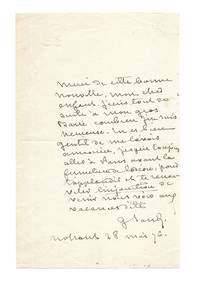
1876Sand2<p><strong>SAND George 1804-1876</strong></p><p>Autograph letter signed "GSand" to Paul Porel Dry monogrammed G S initial on letterhead Nohant May 28 1876 1 page in-8 in black ink</p><p><strong>A moving letter one of the very last less than 10 days before her death</strong></p><p><em>"Merci de cette bonne nouvelle mon cher enfant. J'écris tout de suite à mon gros</em> Léopold<em> Barré combien je suis heureuse. Tu es bien gentil de me l'avoir annoncée. J'espère toujours aller à Paris avant la fermeture de l'Odéon pour t'applaudir et te renouveler l'injonction de venir nous voir aux vacances d'été. </em> <em>GSand</em> <em>Nohant 28 mai 76″</em></p><p>This moving letter is one of George Sand's last. After the three letters written on 28 May one to Miss Marguerite Thuillier the other to her doctor Henri Favre and finally this one and a note in the Agenda on 29 May she will take up the pen one last time on the 30th to write to her nephew Oscar Cazamajou Corr. XXIV p. 638</p><p>George Sand who died on 8 June 1876 of an intestinal obstruction was already suffering of stomach pain on 28 May as evidenced by her letter to Dr. Henri Favre: "<em>I wonder where I am going and whether to expect a sudden departure one of these mornings. I'd rather know right away than by surprise.</em>" Her condition will deteriorate on May 30 before the symptoms worsen significantly on June 3. On June 7 in agony she whispers to her daughter Solange who is caring for her and to her daughter-in-law Lina Calamatta: "<em>Goodbye farewell I am dying.</em>" She died on June 8 at 10:00 a.m. in her 72nd year.</p><p>Paul Porel 1843-1917 is a French actor director and theater director. He was married to the actress Réjane and was close to literary and musical circles notably attending Alphonse Daudet Emile Zola Léon Hennique George Sand Gabriel Fauré etc.</p><p>This letter unpublished in the correspondence edited by Lubin will appear in the next volume of <em>Nouvelles lettres retrouvées</em>.</p><p>Provenance: René Vallet Archives</p>
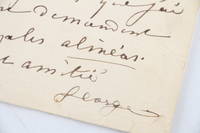
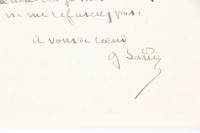
1838866321838. Fine. Sand publishes her response to Lerminier s. d. 23 février 1838 11 x 20.40 cm 1 page sur feuillet Autograph letter signed by George Sand addressed to François Buloz. One page in black ink on a single sheet. Fold marks sheet reinforced with paper on verso. Published in her correspondence ed. Georges Lubin vol. IV pp. 331-332. Exasperated by the attitude of the Revue des deux mondes of her friend Buloz George Sand decides to defend the progressive thinker Félicité Lammenais targeted by a scathing critique published in the review. She takes up her pen here and orders Buloz to publish her response article without changing a single line. Mon cher Buloz voici la lettre à M. Lerminier n'y changez rien. Relisez-en vous même et vous seul l'épreuve. Corrigez les fautes de typographie. Veuillez à la ponctuation et aux guillemets. Il va sans dire que les blancs de mon manuscrits sont le résultat de coupures et de transcriptions que j'ai faites et ne demandent que de simples alinéas. Bonjour et amitié George ""My dear Buloz here is the letter to M. Lerminier change nothing. Proofread it yourself and yourself alone. Correct the typographical errors. Mind the punctuation and quotation marks. It goes without saying that the blanks in my manuscript are the result of cuts and transcriptions I have made and require only simple paragraphs. Good day and friendship George"" This letter perfectly illustrates the stormy yet fruitful collaboration that united François Buloz and George Sand. The latter gave Sand for many years a platform and a means to live by her pen. She published in the Review a great number of masterpieces including Lettres d'un voyageur 1834-1836 Mauprat 1837 Spiridion 1839 Gabriel 1839 Mademoiselle La Quintinie 1863 Césanne Dietrich 1870. Through his mediation she also actively participated in the political debates of her time. In 1838 Buloz was the great orchestrator of an ideological duel when Sand ""decided to take on the critic Lerminier who had just made a very critical analysis of the Livre du peuple in the review. Buloz out of desire for publicity allowed his two collaborators to publicly exchange blows in the review. Through Lerminier and his superior tone the review then revealed its rather misogynistic vision of literature and philosophy: 'the time has come for you to give your philosophical opinions more consistency and scope because you are entering a new phase of life and talent. Inspiration and fantasy have raised you to a height where they would not suffice to maintain you. Draw now madam new strength from reflection and science'"" Marie-Eve Thérenty George Sand François Buloz et la Revue des Deux Mondes. Sand reacted immediately and sent her response article accompanied by this peremptory missive ordering Buloz to publish her text as it stood. Lamennais was very touched by her gesture: ""I shall always count among the happy circumstances of my life where I don't count many to have been defended by you. In publishing my last book I knew well that it would shock almost everyone legitimists juste-milieu Catholics even republicans those at least who want neither God nor liberty and their number is great and they have a terrible faith in themselves. I have hoped only in the people who do not make systems and who under the influence of primitive and imperishable human instincts judge by the heart and judge alone infallibly. Without them I don't know what would become of liberty on earth. M. Lerminier and many others imagine that I speak at random according to whatever idea of the moment occurs to me. They are mistaken"" Yves Chastagnaret George Sand Lerminier et le Livre du Peuple de Félicité Lamennais. Flying to the rescue of a defender of the people Sand writes this scathing missive at a key moment in her tumultuous relationship with Buloz. unknown
1868784821868. Fine. s. d. mai 1868 13.50 x 20.70 cm 2 pages sur un double feuillet Autograph letter signed by George Sand addressed to Alphonse Peyrat two pages written in black ink on a double sheet. Transverse folds inherent to mailing. Interesting letter evoking one of her faithful friends: Jean Patureau-Francoeur. George Sand had published a long obituary article in tribute to this close friend in L'Avenir national on May 2 1868. She described her late friend with great tenderness: ""C'était un simple paysan un vigneron des faubourgs de Châteauroux. Il avait appris tout seul à écrire et il écrivait très remarquablement avec ces naïves incorrections qui sont presque des grâces dans un style rustique et spontané. . Ce petit homme robuste à grosse tête ronde au teint coloré à l'il bleu étincelant et doux était doué d'une façon supérieure. Il voyait la nature il l'observait il l'aimait et il la savait. . Son existence parmi nous fut pénible agitée méritante. Naturellement un esprit aussi complet que le sien devait se passionner pour les idées de progrès et de civilisation. Il fut avant la Révolution le représentant populaire des aspirations de son milieu et il travailla à les diriger vers un idéal de justice et d'humanité. ."" ""He was a simple peasant a wine-grower from the suburbs of Châteauroux. He had taught himself to write and he wrote remarkably well with those naive incorrections that are almost graces in a rustic and spontaneous style. . This sturdy little man with his large round head his ruddy complexion his sparkling and gentle blue eyes was gifted in a superior way. He saw nature observed it loved it and understood it. . His existence among us was painful agitated meritorious. Naturally a mind as complete as his had to be passionate about ideas of progress and civilization. He was before the Revolution the popular representative of his milieu's aspirations and he worked to direct them toward an ideal of justice and humanity. ."" In 1848 Patureau was elected mayor of Châteauroux and became the spokesman for the workers of his commune. ""Au moment du coup d'État il fut poursuivi mais il se cacha dans des familles amies et échappa à la police. George Sand obtint difficilement sa grâce ce qui lui permit de regagner Châteauroux. Il fut arrêté en janvier 1858 à la suite de la loi de sûreté générale."" ""At the time of the coup d'état he was pursued but he hid with friendly families and escaped the police. George Sand obtained with difficulty his pardon which allowed him to return to Châteauroux. He was arrested in January 1858 following the general security law."" ""Il resta un mois au cachot sur la paille en plein hiver. Quand on le mit dans la voiture cellulaire qui le dirigeait vers l'Afrique il était presque aveugle et depuis il a toujours souffert cruellement des yeux"" ""He remained a month in the dungeon on straw in the middle of winter. When they put him in the prison van that was taking him to Africa he was almost blind and since then he has always suffered cruelly with his eyes"" George Sand. In September 1858 following an intervention by George Sand with her friend Jérôme-Napoléon Napoleon III's cousin he was released but remained under surveillance. He settled in Algeria after obtaining permission to come to Châteauroux to sell his house and vineyard and to fetch his family. In Algeria he lived by his trade as a wine-grower was part of the Agricultural Society of Philippeville and wrote a treatise on viticulture."" Maintron ""À présent je viens vous demander de me payer ce petit article le plus cher que vous pouvez et d'envoyer le prix directement à Joseph Patureau rue de cluis n°7 à Châteauroux. Indre. Et cela le plus tôt possible."" ""Now I come to ask you to pay me for this little article as dearly as you can and to send the payment directly to Joseph Patureau rue de cluis n°7 à Châteauroux. Indre. And this as soon as possible."" Jos unknown