George SANDBiblio.com
219 résultats
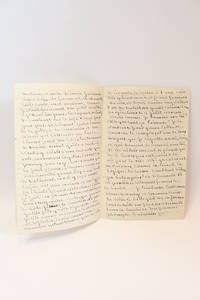
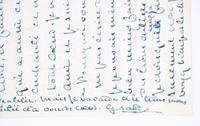
185976839Nohant Nohant-Vic 1859. Fine. Nohant Nohant-Vic 16 août 1859 13.50 x 20.90 cm 4 pages sur un double feuillet Autograph letter signed by George Sand addressed to Ernest Feydeau. Four pages written in blue ink on a double sheet bearing at the head of the first page the sender's blind stamp. This letter was published in the complete correspondence of George Sand established by Georges Lubin. Fine and lengthy letter discussing literature and friendship between writers. Initially a stockbroker and specialist in Antiquity Ernest Feydeau launched himself late into fiction. Anxious to occupy a literary space in which he did not feel justly appreciated he used his connections and maintained a regular epistolary relationship with illustrious correspondents such as Gustave Flaubert Sainte-Beuve and George Sand to whom he sent drafts of his novels and whose opinions he sought. This letter forms Sand's response after having just finished reading Daniel Feydeau's second novel. George Sand then at the height of her literary career describes herself thus: ""I am quite old enough to be your mother for I am 55 years old and I have good hands quite skillful but not beautiful at all. I have earned the right to no longer be coquettish I have been quite reproached for never having been so. I will tell you anything about myself that you wish."" As was her habit much solicited by her peers she delivers a very detailed critique of the text her colleague submits to her: ""I am not against sentences that jar where they need to jar but I am not for harmony being sacrificed to rhythm. Nor am I for the contrary. Understand me well I only blame what is too noticeable what reveals the technique. Do not touch the passages you speak of they are excellent. And in sum I will not insist furiously on the question of form in style seeing that if the qualities of yours should disappear with what sometimes seems to me a flaw I would be in despair at having pointed out the flaw."" Herself very close to Flaubert whom she nicknamed her ""leaden bottom"" Sand seems delighted that the two men know each other: ""I do not have time. But I will have time to receive you when you are free you must come with Flaubert who also has in me an enchanted reader and a wholehearted literary friend. I did not know he was your friend and I am pleased that he is."" The friendship goes so far that Sand soon brings the two writers together placing them on complete equal footing: ""It is no misfortune for you any more than for Flaubert to belong to the race of seers."" A form of solidarity then establishes itself in the face of critical adversity: ""All this is felt better than it can be said and that is why criticism loses its reason three-quarters of the time."" For criticism has had the misfortune of labeling Feydeau as it did with Flaubert a realist: ""People have taken it upon themselves to baptize your manner and his as realism. I do not know why; unless realism is something entirely different from what the first adherents attempted to explain to us. I suspect indeed that there is a way of envisaging the reality of things and beings which is great progress and you bring triumphant proof of it. But the name realism does not suit because art is a multiple infinite interpretation. It is the artist who creates reality within himself his own reality and not that of another. Two painters paint the portrait of the same person. Both create a work that represents the person if they are both masters. And yet the two paintings do not resemble each other. What has become of reality"" This long diatribe - a true manifesto - forms a powerful testimony to the repulsion of George Sand and Flaubert for theorists obsessed with the idea of classifying literature according to a ""system that . blinds"". unknown
184077244Paris 1840. Fine. Paris jeudi 7 mai 1840 13.60 x 20.90 cm une page sur un double feuillet Autograph letter signed by George Sand addressed to publisher Léon Curmer. One page written in black ink on a double sheet. This letter was published in the complete correspondence compiled by Georges Lubin. ""Monsieur J'ai parcouru votre recueil avec beaucoup d'intérêt et j'accepte la collaboration que vous m'avez offerte mais je ne pourrais m'occuper de vous satisfaire que dans six semaines ou deux mois. Si cette époque vous convient veuillez bien me le faire savoir ainsi que les conditions de la rédaction."" ""Sir I have perused your collection with great interest and I accept the collaboration you have offered me but I could not undertake to satisfy you for six weeks or two months. If this timing suits you please let me know as well as the conditions of the writing."" The ""recueil"" ""collection"" in question here is none other than Les Français peints par eux-mêmes. Sand would not however collaborate on this monumental compendium of types preferring instead several years later Le Diable à Paris published under the direction of her close friend publisher Hetzel. unknown
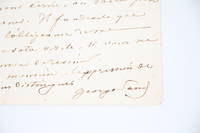
187676872Nohant Nohant-Vic 1876. Fine. Nohant Nohant-Vic 6 mars 1876 13.20 x 20.70 cm deux pages sur un feuillet remplié Autograph letter signed by George Sand addressed to Gustave Flaubert. Two pages written in black ink on a double sheet bearing at the head of the first page the sender's dry stamp. This letter was published in the complete correspondence of George Sand established by Georges Lubin. Fine letter written by George Sand a few months before her death and addressed to her lifelong friend Gustave Flaubert. The writer wishes to offer her friend a seat so he may attend the revival of her play Le Mariage de Victorine : ""Je t'écris en courant ce matin parce que je viens de recevoir de Mr Perrin avis de la 1ère représentation de la reprise du Mariage de Victorine une pièce de moi au théâtre français. Je n'ai ni le temps d'y aller ni l'envie de partir comme cela au pied levé mais j'aurais voulu y envoyer quelques amis et il ne m'offre pas une seule place. Je lui écris une lettre qu'il recevra demain et je le prie de t'envoyer au moins un orchestre."" ""I'm writing to you hurriedly this morning because I've just received notice from Mr Perrin of the first performance of the revival of Le Mariage de Victorine a play of mine at the Théâtre Français. I have neither the time to go nor the desire to leave like that at a moment's notice but I would have liked to send some friends and he doesn't offer me a single seat. I'm writing him a letter which he will receive tomorrow and I ask him to send you at least an orchestra seat."" Letters from the correspondence between George Sand and Gustave Flaubert are renowned and highly sought after. unknown
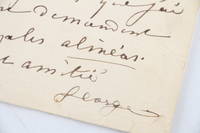
1838866321838. Fine. Sand publishes her response to Lerminier s. d. 23 février 1838 11 x 20.40 cm 1 page sur feuillet Autograph letter signed by George Sand addressed to François Buloz. One page in black ink on a single sheet. Fold marks sheet reinforced with paper on verso. Published in her correspondence ed. Georges Lubin vol. IV pp. 331-332. Exasperated by the attitude of the Revue des deux mondes of her friend Buloz George Sand decides to defend the progressive thinker Félicité Lammenais targeted by a scathing critique published in the review. She takes up her pen here and orders Buloz to publish her response article without changing a single line. Mon cher Buloz voici la lettre à M. Lerminier n'y changez rien. Relisez-en vous même et vous seul l'épreuve. Corrigez les fautes de typographie. Veuillez à la ponctuation et aux guillemets. Il va sans dire que les blancs de mon manuscrits sont le résultat de coupures et de transcriptions que j'ai faites et ne demandent que de simples alinéas. Bonjour et amitié George ""My dear Buloz here is the letter to M. Lerminier change nothing. Proofread it yourself and yourself alone. Correct the typographical errors. Mind the punctuation and quotation marks. It goes without saying that the blanks in my manuscript are the result of cuts and transcriptions I have made and require only simple paragraphs. Good day and friendship George"" This letter perfectly illustrates the stormy yet fruitful collaboration that united François Buloz and George Sand. The latter gave Sand for many years a platform and a means to live by her pen. She published in the Review a great number of masterpieces including Lettres d'un voyageur 1834-1836 Mauprat 1837 Spiridion 1839 Gabriel 1839 Mademoiselle La Quintinie 1863 Césanne Dietrich 1870. Through his mediation she also actively participated in the political debates of her time. In 1838 Buloz was the great orchestrator of an ideological duel when Sand ""decided to take on the critic Lerminier who had just made a very critical analysis of the Livre du peuple in the review. Buloz out of desire for publicity allowed his two collaborators to publicly exchange blows in the review. Through Lerminier and his superior tone the review then revealed its rather misogynistic vision of literature and philosophy: 'the time has come for you to give your philosophical opinions more consistency and scope because you are entering a new phase of life and talent. Inspiration and fantasy have raised you to a height where they would not suffice to maintain you. Draw now madam new strength from reflection and science'"" Marie-Eve Thérenty George Sand François Buloz et la Revue des Deux Mondes. Sand reacted immediately and sent her response article accompanied by this peremptory missive ordering Buloz to publish her text as it stood. Lamennais was very touched by her gesture: ""I shall always count among the happy circumstances of my life where I don't count many to have been defended by you. In publishing my last book I knew well that it would shock almost everyone legitimists juste-milieu Catholics even republicans those at least who want neither God nor liberty and their number is great and they have a terrible faith in themselves. I have hoped only in the people who do not make systems and who under the influence of primitive and imperishable human instincts judge by the heart and judge alone infallibly. Without them I don't know what would become of liberty on earth. M. Lerminier and many others imagine that I speak at random according to whatever idea of the moment occurs to me. They are mistaken"" Yves Chastagnaret George Sand Lerminier et le Livre du Peuple de Félicité Lamennais. Flying to the rescue of a defender of the people Sand writes this scathing missive at a key moment in her tumultuous relationship with Buloz. unknown
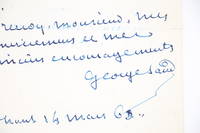
186376837Nohant Nohant-Vic 1863. Fine. Nohant Nohant-Vic 14 mars 1863 13.40 x 20.60 cm 3 pages sur un double feuillet Autograph letter signed by George Sand addressed to René Biémont. Three pages written in blue ink on a double sheet bearing at the head of the first page the blind stamp of Sand's initials. Envelope included. Folds inherent to mailing. This letter was published in the complete correspondence of George Sand established by Georges Lubin. Fine letter of congratulations addressed to René Biémont after sending his work Le Petit Fils d'Obermann: ""Your little book is very original and you show qualities of talent that will develop if you look ahead."" As an attentive reader much solicited by her young peers Sand develops her literary criticism: ""Obermann and his grandson the monk belong to the past. They are true and the timid Jean is well drawn. There is grandeur and truth in this exceptional type. But Constant d'Heurs is too passive to events. He should react against this powerless man and cure him or pity him more ."" Sententiously she thus concludes her letter: ""Do not complain of thankless work and accept it as a good thing three-quarters of life sacrificed to some duty makes the last quarter very strong and very alive. It is very good to be attached to poetry and thwarted in the possession of a beautiful dream. As soon as one can savor it without respite it fades or becomes troubled. I speak to you from experience. One is never happier and more inspired than when one believes one does not have time to be so."" Very fine testimony to the leading role that George Sand played on the literary scene of the Second Empire. unknown
186771232Nohant Nohant-Vic 1867. Fine. Nohant Nohant-Vic 21 décembre 1867 13.40 x 20.70 cm deux feuillets sous chemise et étui Autograph letter from George Sand to Gustave Flaubert dated December 21 1867 8 pages on two lined leaves. Published in Sand's Correspondance XX pp. 642-645. From one of the finest literary correspondences of the century this letter written on Christmas Eve 1867 is a sublime testament to the frank friendship between George Sand the old troubadour and Gustave Flaubert christened cul de plomb leaden ass after declining his invitation to Nohant to complete L'Éducation sentimentale. Despite their seventeen year-age gap opposing temperaments and divergent outlooks on life the reader is gripped by the tenderness and astonishing verve of George Sand's long confession to Flaubert. At the height of her literary fame and enjoying her theater in Nohant Sand talks at length about politics their separation their conception of the writer's work and life itself. In this stream-of-consciousness letter Sand naturally and freely sets down on paper eight pages of conversations with Flaubert who made only too rare and brief appearances in Nohant: But how I chat with you! Do you find all this amusing I'd like a letter to replace one of our suppers which I too miss and which would be so good here with you if you weren't a cul de plomb leaden ass who won't let yourself be dragged along to life for life's sake whereas Flaubert's motto then busy writing L'Éducation sentimentale was rather art for art's sake. In the end of 1867 Sand grieved the death of an almost brother François Rollinat which Sand appeased with letters to Flaubert and lively evenings at Nohant: This is how I've been living for the last 15 days since I stopped working . Ah'! . Ah! when you're on vacation work logic and reason seem like strange swings. Sand was quick to criticize him for working tirelessly in his robe the enemy of freedom while she was running up and down mountains and valleys from Cannes to Normandy even to Flaubert's own home which she had visited in September. On this occasion Sand had happily reread Salammbô where she picked up a few lines for her latest novel Mademoiselle Merquem. Their literary and virile friendship similar to Rollinat's defied the old guard of literati who declared the existence of a sincere affair between man and woman utterly impossible. Sand who has been described in turn as a lesbian a nymphomaniac and made famous for her resounding and varied love affairs began a long and intense correspondence with Flaubert for whom she was a mother and an old friend. She called herself in their letters old troubadour or old horse and no longer even considered herself a woman but a quasi-man recalling her youthful cross-dressing and formidable contempt for gender norms. To Flaubert had compared the female writers as Amazons denying their femininity: To better shoot with the bow they crushed their nipples Sand replied in this letter: I don't share your idea that you have to do away with the breast to shoot with the bow. I have a completely opposite belief for my own use which I think is good for many others probably for the majority. A warrior yes but a peaceful warrior Sand willingly adopted the customs of a world of misogynistic intellectuals while remaining true to herself: I believe that the artist should live in one's nature as much as possible. To the man who loves struggle war; to the man who loves women love; to the old man who like me loves nature travel and flowers rocks great landscapes children too family everything that moves everything that fights moral anemia she then adds. A fine evocation of her green period this passage marks the time of Sand's country novels when mellowed by the years she gave herself over entirely to contemplation to write François le Champi La Mare au diable and La Petite Fadette. But her love of nature didn't stop unknown
185755056Paris: Michel Lévy & Calmann Lévy 1857-1923. 13 vols. 18mo 18x115 cm. Uniformly bound about 1950. Lightbrown halfcalf some parts of the leather darkened; spines with ribbons; gilt titles on spines; marbled paper on covers. Little by little paper more and more age-toned and browned due to the paper but a nice spotless set of the most important novels 15 with additions and 1 play bound in 13 volumes. Michel Lévy & Calmann Lévy hardcover
1880180270New York: R. Worthington 1880. Hardcover. Very Good in boards. Front hinge cracked. Chipping at spine crown. Top rear end page corner creased. R. Worthington hardcover
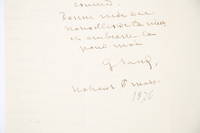
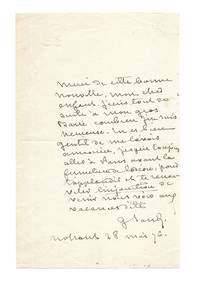
1876Sand2<p><strong>SAND George 1804-1876</strong></p><p>Autograph letter signed "GSand" to Paul Porel Dry monogrammed G S initial on letterhead Nohant May 28 1876 1 page in-8 in black ink</p><p><strong>A moving letter one of the very last less than 10 days before her death</strong></p><p><em>"Merci de cette bonne nouvelle mon cher enfant. J'écris tout de suite à mon gros</em> Léopold<em> Barré combien je suis heureuse. Tu es bien gentil de me l'avoir annoncée. J'espère toujours aller à Paris avant la fermeture de l'Odéon pour t'applaudir et te renouveler l'injonction de venir nous voir aux vacances d'été. </em> <em>GSand</em> <em>Nohant 28 mai 76″</em></p><p>This moving letter is one of George Sand's last. After the three letters written on 28 May one to Miss Marguerite Thuillier the other to her doctor Henri Favre and finally this one and a note in the Agenda on 29 May she will take up the pen one last time on the 30th to write to her nephew Oscar Cazamajou Corr. XXIV p. 638</p><p>George Sand who died on 8 June 1876 of an intestinal obstruction was already suffering of stomach pain on 28 May as evidenced by her letter to Dr. Henri Favre: "<em>I wonder where I am going and whether to expect a sudden departure one of these mornings. I'd rather know right away than by surprise.</em>" Her condition will deteriorate on May 30 before the symptoms worsen significantly on June 3. On June 7 in agony she whispers to her daughter Solange who is caring for her and to her daughter-in-law Lina Calamatta: "<em>Goodbye farewell I am dying.</em>" She died on June 8 at 10:00 a.m. in her 72nd year.</p><p>Paul Porel 1843-1917 is a French actor director and theater director. He was married to the actress Réjane and was close to literary and musical circles notably attending Alphonse Daudet Emile Zola Léon Hennique George Sand Gabriel Fauré etc.</p><p>This letter unpublished in the correspondence edited by Lubin will appear in the next volume of <em>Nouvelles lettres retrouvées</em>.</p><p>Provenance: René Vallet Archives</p>
1871008609James R. Osgood and Company 1871. Book. Fine. Decorative Cloth. First Edition. 8vo - over 7¾" - 9¾" tall. Fine copy in Decorative Cloth.First Edition Excellent Copy. James R. Osgood and Company Hardcover
187124337Boston: James R. Osgood and Company. Very Good. 1871. First US Edition. Hardcover. Green cloth binding with gilt lettering rubbed at extremities; owner's name pencilled on front endpaper; leaf edges endpapers a few margins lightly foxed else a very nice tight & clean book.; Translated from French by Carroll Owen. ; 8vo; 113 pages . James R. Osgood and Company hardcover
189357116East Hampton North Adams & Boston MA; Bethlehem PA & New York: Caulkins & Post Co.; Harry S. Millard; Henry Lindenmeyr & Sons; Stewart & Sparry; Pettinos Brothers Atha V. Hughes; Barber Leather Co.; N.N. Hill Brass Co. 1893-1918. 4to. 72 letters some mimeographed others typed carbon copies and a few ALS sized 5.75 x 9.25 in. up to 8.5 x 11 in. many on steel-engraved letterhead a couple on ruled paper and many featuring the offsetting from the leather dyes with over 40 attached samples of papers White coated sign muslin foundry sand and assorted leathers. All preserved in archival mylar sleeves in recent full calf 3-ring binder w/ stamping. An exceptional archive of original TLS many with original samples of paper leather and even sand which were used in ever increasing quantities by the noted manufacturer of sleigh bells bells pull toys and many other toys for children from the Gilded Age through World War I. The earliest letter dated Feb. 10 1899 includes two paper samples from the Henry Lindenmeyr & Sons Paper Warehouse in New York on Bleeker Street noting that “we can furnish in the shade of your sample at $ 8.00 per hundred sheets basis 25 x 36. We could not make less than a thousand yards.†Sixty or the majority of the letters and samples were sent by the Barber Co. beginning in 1902 and continuing into World War I. Their letters and samples describe the colour grain and general finish of the included samples as well as their perfect applications in “baby carriage straps shawl straps small cases i.e. for toys small tool boxes†and of course sleigh bells and bell hangers and bell flappers as well as handle grips. Leathers encompass Red Straight Grain Cowhide Pigskin straps Black Bell Leather Walnut Strap Leather and specialized leathers for tumbling purposes for brasswork. Barber 1836-1909 was the longtime owner and operator of the Barber Leather Co. in North Adams until his death when his son Archer Barber took over the business. Many of the samples offered to the Hill Brass Co. are mounted on TLS and TLS copy letters from Harry S. Millard who later was brought into the Barber Co. in 1914 as Treasurer of the Company. The samples here include splits black pig leather as well as embossed strips in assorted coloured leather Caulkins & Post whose building at 484-494 Main Street in Middletown was considered one of the first “modern†stores and specialized in drapes window shades furniture and bicycles before opening up their successful card dealership in 1903. The Hill Brass Co. required products beyond leathers & papers as shown by the reply to their request for a quote for White Sign Muslin waterproof textile intended for use on children’s carriages and go-carts. For their manufacturing processes they required foundry sands and the Pettinos Brothers based in Columbia Ceylon Bethlehem PA and Mexico sent them a sample of their plumbago “high grade Ceylon stock.†There is even a May 29 1905 solicitation letter from F. von Bardeleben after seeing the Hill Brass Co. exhibit at the 1904 St. Louis World’s Fair mentioning that his company can supply a “very fine grade of non-poisonous unchangeable paints to be used for painting toys.†The N.N. Hill Brass Co. founded by Norman Newton Hill 1863-1950 in 1889 operated until the early 1960’s was one of the largest factory’s in the World producing bells & toys and by the 1930’s produced Walt Disney merchandise. Along with the Bevin Brothers and other local Massachusetts foundries they manufactured Salvation Army bells sleight bells bicycle bells alarm bells and more. See: N.N. Hill Brass Company Business Correspondence Jay T. Last Collection of Transportation Huntington Library; Edward T. Howe Small Bells of Connecticut: One Town Made Sounds that Rang in Millions of Ears New England Historical Society 2019; Norman N. Hill Brass Company Connecticut Historical Society 2020. Caulkins & Post Co.; Harry S. Millard; Henry Lindenmeyr & Sons; Stewart & Sparry; Pettinos Brothers, Atha V. Hughes; Barber Leat hardcover
185691013Paris: Librairie De L. Hachette 1856. Hardcover. Very Good with no dust jacket. 282 pages. Text in French. Colorful marbled paper covers 3/4 front and back portions of the boards. Some very faint foxing on pages. Cover edges a little rubbed. ; 4 1/2 x 7 1/4 Librairie De L. Hachette hardcover
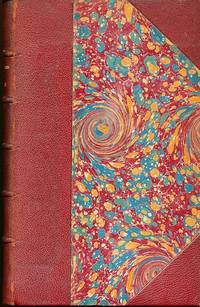
18641780Paris: Michel Levy Freres. Near Fine. 1864. 9th. Hardcover. Some foxing on the initial pages but little or none in the text. ; Text in French. One of six volumes we have in "Complete Works of Geroge Sand" in a matching set. Each volume bound in 3/4 red leather with marbled boards; five raised bands bright gilt title on spines. Marbled endpapers. Previous owner's small circular gilt and red personal label on inside front endpaper and name stamped on second free endpaper and title page. Top edge gilt. Binding is tight. Inquire about details of the other volumes in the set. Text is clean and unmarked. Nouvelle edition. ; Oeuvres De George Sand Series; Small 8vo 7½" - 8" tall; 271 pages . Michel Levy Freres hardcover
183560346Paris: Félix BonnaireVictor Magen 1835. Fine. Félix Bonnaire Victor Magen Paris 1835 13 x 20.50 cm relié First edition. Half shagreen two corners slightly bumped contemporary binding. A little light spotting library label to pastedown. Félix BonnaireVictor Magen unknown
1892055555Boston MA: Robert Brothers 1892. Not Indicated . Half-Leather. Very Good. Some rubbing on the leather edges otherwise in very nice condition. <br/> <br/> Robert Brothers hardcover
186215359Paris: La Revue des deux mondes 1862. Fine. La Revue des deux mondes Paris 15 octobre au Ier décembre 1862 15.50 x 25 cm 4 volumes brochés Published before the first edition. Softcover as issued. La Revue des deux mondes paperback
1875300002131Charpentier 1875. 1875. 326 pages. Charpentier unknown
1848293976Paris 1848. framed. very good. Important A.L.S. as Sand had recently began writing for the soon-to-be-banned Le Vrai Republique with integral address page personal stationary with blind stamped monogrammed initials: "G.S." 8vo. 1 page Paris March 16th 1848 to radical journalist and fellow supporter of the French Revolution Theophile Thore in French with translation explaining that she has not yet met with Louis and Charles Blanc and apologizes for not having responded to his letters because all of her time has been consumed writing material for the Republique. In closing she signs herself "a vous de tout Coeur / George Sand". Evenly toned and set into a white matte gatefold whereby both the letter and the integral address page are both visible then placed into a simple gold-stained wooden frame to 13" x 11.5". Louis Blanc 1811-1882 was a staunch French Socialist and reformer who only three months after this letter was written was exiled to England where he would remain until 1870. Also two weeks prior to this letter being sent George Sand had agreed to provide the Republique with no less than 13 original articles for publication. An exceptional letter written during the heart of the French Revolution of 1848.<br/> <br/> French novelist and socialist whose works were immensely popular in Europe during her lifetime and whose fame eclipsed both that of Victor Hugo and Honore de Balzac in the 1840's and 1850's.<br/> <br/> unknown
186255066Paris: E. Dentu Libraire au Palais-Royal 1862. 8vo 185x12 cm. Orig. green wrappers frontcover title within ornamental border; backcover with list "en vente ou en preparation" within ornamental border and mention "Paris - Typ. J. Claye Rue Saint-Benoit 7". Small tear in frontcover and in first hinge; spine dustsoiled iv354 pp. P.216-217 brown spot due to a paper left between the pages; lightbrown spots in places. - According to Vicaire 269: date of imprint 1862 and "Édition originale". - Blindstamped on first cover E. O. E. Dentu, Libraire au Palais-Royal unknown
18681507Paris: Michel Levy Freres. Very Good. 1868. 2nd. Hardcover. Dampstained initial and final pages. ; Text in French. 3/4 maroon leather and marbled covers. Marbled endpapers. Five raised bands and bright gilt lettering on maroon leather spine. Small bookowner's monographed tag on front inside cover. Tight binding and clean unmarked text. T. E. G. Part of the six volume "Oeuvres de George Sand." Deuxieme edition. ; Oeuvres de George Sand Series; 12mo 7" - 7½" tall; 389 pages . Michel Levy Freres hardcover
186855000Paris: Michel Lévy Frères Éditeurs 1868. 8vo 19x13 cm. Original printed wrappers discoloured; small tear in frontcover. ivviii 129 iii:blank pp. Uncut edges dust-soiled. small tear of frontcover continued in half title and title; light waterstain in upper outer corner. - Despite of the minor defects mentioned above a good copy of the first edition very rare. Michel Lévy Frères, Éditeurs unknown
1871014119London: Claton Remsen and Haffelfinger 1871. First edition. . Hardcover. Very Good/No Jacket. first edition in English. Bit of damage with loss to corner of front brown endpapers else very good. <br/> <br/> Claton, Remsen and Haffelfinger hardcover
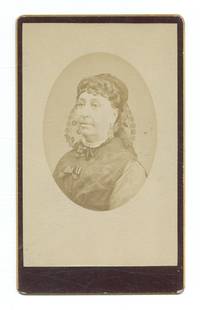
1870517626London: No Photographer 1870. Unbound. Fine. Albumen print. Oval image measures approximately 1.75" x 2.25" on unprinted cardstock mount with gilt beveled edge measuring 2.5" x 4". An albumen print professional studio portrait of an elderly George Sand in three-quarter profile shown from the shoulders up. Extremities of unprinted mount lightly rubbed at tips of corners the image is in fine condition. Possibly issued upon the death of George Sand in 1876. No Photographer unknown
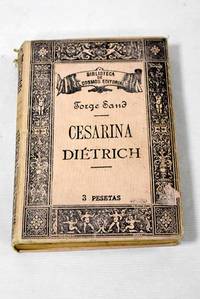
18883392722Madrid.: El Cosmos. 1888. Hardcover. Cubierta deslucida. Good. 18 cm. 334 p. Encuadernación en tapa dura de editorial ilustrada. Colección 'Biblioteca de "El Cosmos Editorial"'. Sand George 1804-1876. Versión castellana de Joaquina García Balmaseda. Título original: Césarine Dietrich. García Balmaseda Joaquina. 1837-1911 . Cubierta deslucida. Literatura francesa 821.133.1-31"18" Literatura francesa 821.133.1 El Cosmos. hardcover