Rousseau, Jean-Jacques (1712-1778)Biblio.com
194 résultats
1772402288Amsterdam : Chez Jean Neaulme 1772. 1st edition in this form. Hardcover. Poor copies in the original full tree calf leather with gilt borders. All edges marbled. Spines worn. Spine bands and panel edges rubbed and bumped as with age. Text remains clear and without blemish. Physical description; 2 v. Subjects; Education ; Early works to 1800. Rousseau Jean-Jacques. Émile ou de l'Éducation. Philosophy. Amsterdam : Chez Jean Neaulme hardcover
176254730A la Haye Chez Jean Néaulme Recte: Paris Duchesne 1762. 8vo. Bound in four beautiful uniform contemporary full mottled calf bindings with gilt title-and tome-lables to richly gilt spines. Gilt line-border to edges of bords. Lovely patterned edges. Spines and some corners lightly and expertly restored barely noteable. Occasional very light brownspotting or dusting but overall very nice and clean. Printed on good heavy paper with wide margins. An excellent copy. 2 VIII 2 466 6 pp. 4 407 1 pp. 4 384 pp.; 4 455 1 pp. 5 engraved plates used as frontispieces and facing p. 141 of vol. 1 respectively. The first plate "Thétis" in the variant state without title as described in MacEachern. Fully complete exactly as described in MacEachern. With all the misprints: Vol. 1: 88 as S8 443 as 433 465 as 46; vol. 2: 356 as 256 357 as 257; vol. 3: 383 as 363; vol. 4: 336 with first 3 broken according to McEachern this is just the case in some copies. With the usual cancelled leaves: Vol 1: Av B4; vol. 2: H3 N6 called I6. The final leaf ends with "FIN" and has no grapes MacEachern: "The grapes appear in three different forms.". <br/><br/><em>The very scarce actual first edition being the rarer more sought-after nicer 8vo-edition as opposed to the much more common 12mo edition which was printed about simultaneously but which seems to have appeared later the 8vo format also being the one preferred by Rousseau himself and the format in which he wanted his great work to appear.This magnificent work constitutes the climax of Rousseau's genius as well as the most important work on education since Plato. In Émile Rousseau poses an entirely new approach to education and the upbringing of children. His thoughts were exceedingly controversial the work was burnt by the executioner immediately after its first appearance and Rousseau had to flee the country due to a warrant for his arrest. The printing history of "Émile" is extremely complicated and has been a matter of intense dispute for many decades. Until Maceachern's bibliography from 1989 the edition that has now been established as the "Second Paris octavo" MacEachern 4A was generally considered the first printing of the work but there is no longer any dispute about the fact that the present edition is in fact the actual first 1A. The first edition appeared in both 8vo1A and 12mo1B and it seems to be generally accepted that the 8vo-edition was distributed first but that parts of the 12mo-edition may have been in printing a bit earlier. Rousseau himself seems to have preferred the 8vo-edition and wished for his great work to appear as this form first "The question of the format gave rise to some dissension for while Rousseau felt that the work was more suited to the octavo format Duchesne preferred to print a duodecimo and only a limited number of the more expensive octavo. Rousseau finally agreed to Duchesne's plan with reluctance declaring that in his opinion Duchesne was committing an error of judgment and that the octavo would certainly be the more sought after of the two formats." - MacEachern pp. 18-19. Rousseau himself was more involved in the coming-to-be of "Émile" than perhaps any other author has been in any other book. Throughout the entire process there were a large number of misunderstandings between himself and Duchene which more than once endangered the printing and publishing of this seminal work and which has contributed greatly to the extremely complicated bibliographical data of it. In fact up until very late in the process Rousseau did not believe that the work was actually going to be finished and it took several instances of mediation between the two to keep the work on tracks. Finally however the work was a reality and with it one of the greatest works of Western culture had been born.Rousseau's "Émile" constitutes the most significant modern treatise on the education of man surpassed only by Plato's "Republic". The comparison with Plato is all the more apt seeing that both works grow out of and are meant to remedy lacunae in the political philosophy of their authors.The conclusion to Rousseau's work on the social contract also written during Rousseau's stay in Montmorency had pointed to a predicament of political thought: that only if man were himself naturally inclined to freedom could he make use of political freedom. "Émile" is the analysis of the conditions under which a child can develop into a free human being. As such it presents the conclusion to Rousseau's earlier works on inequality political freedom and servitude.The paradox of Émile is that while the development of human nature must be natural if the child is to develop into a free human being steering that development in the right - that is free - direction requires constant intervention which moreover must be hidden from the child. Rousseau details this intervention in his analysis of the five stages in the education of the child covering the period from birth to the age of 25.Being one of the most influential thinkers of the 18th century Rousseau is considered one of the indirect causes of the French Revolution. In Rousseau one certainly finds one of the most influential spokesmen for 18th century thought and it is primarily the thoughts of him and Voltaire that are put into action with the Revolution."The first and last of these i.e. Héloise and Émile with their sentimental expression of deism gave much offence and Rousseau like Voltaire was forced to flee to Prussia. Restless and locally unpopular he fled again to England where he had a great welcome. Hume who had offered him asylum looked after him patiently." PMM 207 Printing and the Mind of Man.The totalitarian tendency of Rousseau's philosophy of education has been noted by a number of philosophers in recent times most famously Karl Popper.McEachern: 1A </em> unknown
1762PUSilROU64Amsterdam: Jean Néaulme 1762. 1762. 4 Volumes. 12mo. pp. 2 p.l. 442; 2 p.l. 383; 2 p.l. 328; 2 p.l. 463. with half-titles. 5 engraved plates after Eisen. woodcut ornaments. contemporary half calf extremities bit rubbed some light foxing. The Second Lyon Edition with false Amsterdam address of Néaulme. A classic in educational theory Émile is also as Rousseau himself points out a philosophical treatise on the goodness of human nature. The work seeks to follow the natural unfolding of a young man raised in rural isolation unsubjected to the corrupting influences of society. Rousseau's radical ideas especially his proposal to substitute sentimental deism for the dogma of revealed religion aroused the wrath of ecclesiastical and civil authorities; the book was condemned and Rousseau threatened with arrest fled the country. McEachern II 5. cfGagnebin 5. cfRand I 448. cfTchemerzine X p. 45. Amsterdam: Jean Néaulme, 1762. unknown
1792266209Anonymous 1792. Nouvelle Édition. Hardcover. Worn copy bound in full aniline calf. Some wear and tear to the spine and panel edges as with age. Provenance; from the library of William Tarun Fehsenfeld with the owner's bookplate. Physical description; vol. II only: 460 pages. Subjects; Music. French Music. Anonymous hardcover
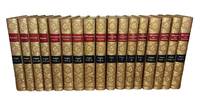
1767274London: T. Becket and P. A. de Hondt 1767. Mixed Editions. Riviere Fine Full Polished Calf. VERY GOOD to NEAR FINE. A beautifully preserved curated collection of Rousseau's works bound in uniform fine polished full calf by the prestigious Riviere and Son.<br /> <br /> Condition: VG to NF. Exterior and binding - FINE. All volumes collated and complete including half-titles plates as called for and publisher ads.<br /> <br /> BOOK INFO<br /> <br /> A 17-volume set put together from various editions published between 1767 - 1819. Mixed editions. Text in English. Duodecimos 12mo 6 5/8" x 4 1/4". Collated and complete. Uniformly bound by Riviere circa late 19th to early 20th century in exceptionally preserved fine binding: polished full calf with double fillet gilt paneling with corner fleurons; spine with gilt-lettered black and burgundy morocco spine labels and compartments richly tooled and ruled in gilt; all cover edges with gilt rolls; gilt dentelles; marbled endpapers; all page edges stained yellow. Verso of FFEP in each volume stamped "Bound by Riviere and Son". A gorgeous set!<br /> <br /> Emilius and Sophia Or A New System of Education four volumes published by T. Becket and P.A. de Hondt in London in 1767. First published in English in 1762-1763 this is an early edition. Six copperplate engravings. Ads at back of volume IV.<br /> <br /> Miscellaneous Works five volumes published by T. Becket and P.A. de Hondt in London in 1767. First collected edition of Rousseau's essays letters and miscellaneous works in English. Includes famous essays such as "Dissertation on the Effects of Cultivating the Arts and Sciences" "A Dissertation on the Origin and Foundation of the Inequality of Mankind" and letters to contemporaries and vocal critics such as Voltaire. Ads at back of volume IV.<br /> <br /> Eloisa: Or a Series of Original Letters four volumes published by T. Becket and P.A. de Hondt in London in 1769. Fourth edition in English. Frontispiece in each volume. Ads at back of volume IV.<br /> <br /> Confessions of J.J. Rousseau with Reveries of a Solitary Walker added four volumes published by Longman Hurst Rees Orme and Browne in 1819. New edition. Ads at back of volume II.<br /> <br /> CONDITION REPORT<br /> <br /> Exterior and binding: FINE. Firmly bound tight pages sharp corners. Minimal rubbing or wear. Leather is colorful bright and supple. A few of the volumes' exteriors could be considered Near Fine if being picky due to some shallow scratches on the boards. Exceptional overall for a 19th century full calf fine binding. <br /> <br /> Interior: VG to VG Offsetting from gilt scroll turn-ins in each volume per usual. Pages with varying degrees of toning by set with the Confessions of Rousseau more heavily toned to light browning due to the poor paper quality used by the printer. Foxing varies from light and scattered to more moderate and frequent the latter in Confessions in particular. Confessions of Rousseau has multiple areas of marginal insect nibbling. A few pages of insect nibble or marginal wear in the other titles' volumes. Professionally closed tear on page 105 of volume 3 in Miscellaneous Works. Other usual signs of handling over the centuries - some stray marks thumbing small ink blots or infrequent smudge or crease. No writing ex libris marks or bookplates.<br /> <br /> All in all a beautiful uniformly bound collection of mixed edition sets of Rousseau's most important works with bindings in a superior state of preservation.<br /> <br /> ABOUT THE AUTHOR & HIS INFLUENCE<br /> <br /> Jean-Jacques Rousseau 1712 – 1778 was a Genevan philosopher philosophe writer and composer. His political philosophy influenced the progress of the Age of Enlightenment throughout Europe as well as aspects of the French Revolution and the development of modern political economic and educational thought.<br /> <br /> Rousseau's Discourse on Inequality which argues that private property is the source of inequality and The Social Contract which outlines the basis for a legitimate political order are cornerstones in modern political and social thought. Rousseau's sentimental novel Julie or the New Heloise 1761 was important to the development of preromanticism and romanticism in fiction. His Émile or On Education 1762 is an educational treatise on the place of the individual in society. Rousseau's autobiographical writings—the posthumously published Confessions completed in 1770 which initiated the modern autobiography and the unfinished Reveries of the Solitary Walker composed 1776–1778—exemplified the late 18th-century "Age of Sensibility" and featured an increased focus on subjectivity and introspection that later characterized modern writing. T. Becket and P. A. de Hondt unknown
1767008104London: T. Becket and P.A. DeHondt 1767. Very rubbed boards and spine grubby pages.detached front board.POSTED AT OUR STANDARD RATES AND FULLY INSURED! UK ONLY .Please e-mail for further details. John Jardine Nottingham Stamps. 1767 Edition . Full-Leather Brown. Good BELOW AVERAGE/No Jacket. Illus. by Not Illustrated. 12mo - over 6¾" - 7¾". HARDBACK. T. Becket and P.A. DeHondt hardcover
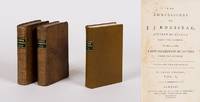
17910040961Dublin: P. Byrne et al 1791. Hardcover. Good. 3 Volumes of 3 complete half leather edition. This is Part II of Rousseau's Confessions which was first published in French in 1789. This is a very early edition of the English translation. The volumes are small 8vo 6 3/4 X 4 1/2 inches hardcover; 19th century 1/2 calf on light brown cloth boards; calf spine with raised bands & gilt titles & decorations; spine edges worn; marble end-papers; previous owner's name inscribed in ink on top edge of title pages; title page & 1st page o text stamped "Property of 2042 Arch Street Philadelphia"; aside from minor scattered foxing spots contents clean; text-blocks tight; 344 274 ii; 246 xlii pages. This is indeed a lovely set that fits neatly in your hands Dublin: P. Byrne et al, hardcover
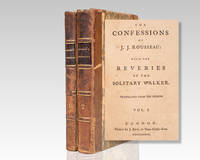
1783149924London: Printed for J. Bew 1783. Rare first edition in English of the author's classic work. Duodecimo 2 volumes bound in three-quarters contemporary calfskin over marbled boards with gilt titles and ruling to the spine in five compartments within raised bands morocco spine labels. In very good condition signatures to the front pastedowns. First published in 1783 four years after Rousseau's death his Confessions is notable as one of the first major autobiographies. Prior to the Confessions the two great autobiographies were Augustine's own Confessions and Saint Teresa's Life of Herself. Providing an account of the experiences that shaped Rousseau's personality and ideas the work was also noted for its detailed account of Rousseau's more humiliating and shameful moments. Founded in 1922 in London by Francis Meynell his second wife Vera Mendel and their mutual friend David Garnett The Nonesuch Press was established in the basement of Garnett's bookshop in Soho. Nonesuch was unusual among private presses in that it used a small hand press to design books and then had them printed by commercial printers. Among the press's best-known editions were the collected works of William Congreve and William Wycherley and translations of Cervantes and Dante. Printed for J. Bew hardcover
1790200530AB1790. First Edition in the English Language. Volume I-III of the Second Part complete. London G.G.J. and J.Robinson and J.Bew Paternoster-Row 1790. 10.5 cm x 17.7 cm. Volume I: VII 442 pages / Volume II: 397 5 pages / Volume III: 418 5 pages. Hardcover / Volumes II and III in original full leather with new spine-label. Volume I recently rebound by a mster-binder in modern leather matching the style of the 18th century bindings. All three Volumes with new spine-labels. Very good condition with only minor signs of external wear. The Confessions is an autobiographical book by Jean-Jacques Rousseau 28 June 1712 2 July 1778 a Genevan philosopher writer and composer. Covering the first fifty-three years of Rousseau's life up to 1765 it was completed in 1769 but not published until 1782 four years after Rousseau's death even though Rousseau did read excerpts of his manuscript publicly at various salons and other meeting places. The Confessions was two distinct works each part consisting of six books. Books I to VI were written between 1765 and 1767 and published in 1782 while books VII to XII were written in 17691770 and published in 1789. Rousseau alludes to a planned third part but this was never completed. Wikipedia hardcover
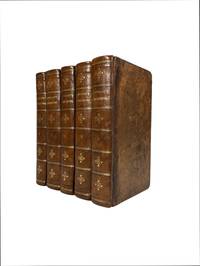
17902576London: Printed for G.G. J. and J. Robinson and J. Bew Paternoster-Row 1790. Second Edition. Tree calf. Very good. Five volumes : twelvemo : pp 4 318 2 blank; viii 442; 2 380 2 blank; 4 397 398 6 Key to the Abbreviations; 2 blank iv 418 6 Table 2 blank :uniformly bound in contemproary tree calf : recently rebacked with gilt lettering and roman numerals double lines separating the panels and decorative stamps : bookplate of Frederick William Cosens in each. Corners rounded; occasional foxmark. Rousseau's Confessions first appeared in English translation in 1783. Lowndes vol 3 p 2134 Bookplate: Frederick William Cosens 1819-89 was a book and art collector and port wine importer. His library was sold by Sotheby's in 1890 with several volumes bought by the British Library. Printed for G.G. J. and J. Robinson and J. Bew, Paternoster-Row unknown
177941679Amsterdam et Lausanne resp. Neuchatel: F. Grasset & Cie resp. Société Typographique 1779. 3 works in 1 vol. 8vo 20x135 cm. Contemporary marbled boards with green title-label on spine sl. rubbed mainly the corners. Anecdotes. 80 pp.; Supplement. 208 pp. With woodcut-vignette on titles. Both works edited at Amsterdam Grasset; Relation. 46 pp. With woodcut-vignette at last page.Edited at Neuchatel Société Typogaphique. - First editions for the 'Supplément' first separate edition. - Rare collection in good condition F. Grasset & Cie, resp. Société Typographique hardcover
1784gf69Changuion 1784. Hardcover. Very Good/No Jacket. 'Sixieme' appears on title page; dix-septieme on spine and half-title. The boards are worn - not excessively so considering age. Some annotating tape residue foxing and rippling. Soundly bound. Condition in terms of age. French. Our orders are shipped using tracked courier delivery services. Changuion hardcover
1789844071789. a Geneve. 1789. Lovely full tree calf binding gilt bands and contrasting label to spine slightly rubbed to head of spine. 399pp. Silk book mark. In French. Unfortunately only Volume III available. unknown
1790003204Neuchatel: Fauche - Borel 1790. Cloth. Very Good. Contemporary original paper covered boards hard cover deckle edge laid-paper. 447 pages containing Relative A M. Vernes Vision de Pierre de La Montagne and Lettres Diverses . Hinges starting chipping to spine w/ 2' loss at head and expected wear internally exceptionally clean and bright. Size: Octavo <br/> <br/> Fauche - Borel hardcover
1790003205Neuchatel: Fauche - Borel 1790. Cloth. Very Good. Contemporary original paper covered boards hard cover deckle edge laid-paper. 448 pages containing Lettres Diverses . An exceptionally clean and bright copy in period binding Size: Octavo <br/> <br/> Fauche - Borel hardcover
1790003206Neuchatel: Fauche - Borel 1790. Cloth. Very Good. Contemporary original paper covered boards hard cover deckle edge laid-paper. 472 pages containing Lettres Diverses . An exceptionally clean and bright copy in period binding Size: Octavo <br/> <br/> Fauche - Borel hardcover
1790003203Neuchatel: Fauche - Borel 1790. Cloth. Very Good. Contemporary original paper covered boards hard cover deckle edge laid-paper. 447 pages containing Livre IX - XII. Hinges starting chipping to spine and expected wear internally exceptionally clean and bright. Size: Octavo <br/> <br/> Fauche - Borel hardcover
1790199795A Neuchatel: l'imprimerie de L. Fauche-Borel imprimeur du Roi 1790. Hardcover. Good - Boards are heavily worn/scuffed/smudged; front boards is loosely attached; hinges are cracked; textblock edges are toned/scuffed/smudged/foxed; interior is toned with some foxing; textblock appears solid. Brown leather boards with mounted red title card with gilt lettering; 447 pp. Text in French. l'imprimerie de L. Fauche-Borel, imprimeur du Roi hardcover
175448404Valladolid: El la Imprenta de Alfonso del Riego 1754.- 11 h. 126 p.; 8º minúsculo 14 x 105 cm; Enc. en Pleno Pergamino época. Tapas algo deslucidas con una pequeña falta en el lomo. Interior con las señales habituales del tiempo en general bien. Esta obra es considerada relevante en la historia de la enseñanza del francés en España especialmente por ser una de las primeras en citar Las Aventuras de Telémaco como base para ejercicios de traducción. LINGÃœÃSTICA GRAMÃTICA PALEOGRAFÃA EN GENERAL Y LENGUAS EXTRANJERAS Libro en español Imprenta de Alfonso del Riego paperback
17753431<p>Paris 1775 1775. Soft cover. Fair. Drouet. iv 18pp. Illustrated with engravings. 'La Texte Grave par Drouet'. Remains of paper covers. Title page and last page very soiled other pages little soiled. Page edges creased. Light stain to upper edge of half the pages. Ownership stamp on title page. 23x14cms. <br /><br /></p> Paris, 1775 paperback
17814873CB1781. Geneve 1781. 12°. 448 2 S. Lederband der Zeit mit verblasster Rückenvergoldung und dreis. Goldschnitt. Enhält zudem folgende Texte: II: Dissertation sur la musique moderne. - III: Essai sur l'origine des langues. - IV: Lettre à M. l'Abbé Raynal au sujet d'un nouveau mode de musique inventé par M. Blainville. - V: Examen de deux principes avancés par M. Rameau dans sa brochure intitulée: Erreurs sur la musique dans l'encyclopédie. - VI: Lettre à M. Burney sur la musique avec fragmens d' observations sur l'Alceste italien de M. Le Chevalier Gluck. - VII: Extr. d'une réponse du petit faiseur à son prête-nom sur un morceau de l'Orphée de M. le Chevalier Gluck . - Zu Beginn etwas stockfleckig. Mit handschr. Besitzereintrag auf dem ersten weissen Blatt. unknown
1800964P45Paris: Sallior; Poignee et Vollard c1800. Paperback. Good. 5.5" by 3.5". Not Stated. A very scarce extract from Rousseau's important work 'Emile' in which he discusses religion and evil. A very scarce work being an extract from Rousseau's 'Emile' which was very popular and famous and was often published separately. In the original French.This volume sees a philosopher as he critiques the ecclesiastical institution dogmatism and heteronomy. An interesting piece of moral philosophy in which Rousseau uses a young Savoyard vicar to speak after than himself. He questions evil and its source and criticises established religion. Illustrated with a frontispiece.'Emile' is one of the best and most important of Rousseau's writings a fictionalised treatise on education and the nature of man. In the original paper wraps. Externally generally smart a little rubbed and edge worn. Light marks to the wraps. A small amount of loss to the spine. Front joint is torn and starting. Prior owner's ink to the rear paste down. Internally generally firmly bound. Pages are generally bright and clean with a few scattered spots. Good Sallior; Poignee et Vollard paperback
1762149605Amsterdam: Marc Michel Rey 1762. Rare first edition type B of Rousseau's greatest work. Octavo bound in full contemporary sheepskin gilt tooling to the spine in eight compartments within raised bands burgundy morocco spine label lettered in gilt stamped turn-ins marbled endpapers engraved vignette of Liberty to the title page by Boily after Bolomey all edges red ribbon bound in. Provenance: Perrotin-Grandville notary in Le Mans ownership inscription to the title page. In very good condition with scuffing to the boards splitting to the rear lower hinge. Exceptionally rare in a contemporary binding. "The Contrat Social remains Rousseau's greatest work. Rousseau believed passionately in what he wrote and when in 1789 a similar emotion was released on a national scale the Contract Social came into its own as the bible of the revolutionaries in building their ideal state. Still in print translated into every language in cheap editions and paperbacks it remains a crucial document of egalitarian government" Printing and the Mind of Man 270 discussing the 1762 first edition. Written in 1762 Rousseau's seminal work provided a philosophical justification for revolutionary change by promoting the principles of popular sovereignty the general will equality liberty and political participation. Rousseau argued that legitimate political authority comes from the consent of the governed rather than from divine right or hereditary monarchy. This idea inspired French revolutionaries to demand a government that represented the will of the people. Upon publication the distribution of The Social Contract in France was prohibited and Rousseau fled the country to avoid imprisonment. It was primarily Rousseau's chapter on civil religion rather than his ideas on liberty and sovereignty that caused the controversy. Immanuel Kant one of the most influential moral philosophers in Western philosophy acknowledged his debt to Rousseau's work in political philosophy of which The Social Contract is perhaps the closest to a complete statement. Kant wrote “I myself am a researcher by inclination. I feel the entire thirst for cognition and the eager restlessness to proceed further in it as well as the satisfaction at every acquisition. There was a time when I believed this alone could constitute the honour of humankind and I despised the rabble who knows nothing. Rousseau has set me right. This blinding prejudice vanishes I learn to honour human beings and I would feel by far less useful than the common labourer if I did not believe that this consideration could impart a value to all others in order to establish the rights of humanity†Refl. 20:44. Marc Michel Rey paperback
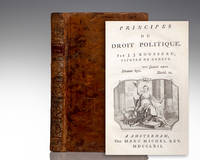
1762187978Amsterdam: Marc Michel Rey 1762. Developing the social contract First edition of the definitive version of Rousseau's greatest work a potent influence on liberal republican and French revolutionary thinking. Where Rousseau's Second Discourse 1755 explained how people had lost their liberty in the past the Principes considered how they might recover it in the future. The work develops the model of a government made legitimate by following the general will of its subjects. In so doing it tackles the problem of securing political co-operation among people with separate wills. The concept of the general will followed as an artificially constructed pledge to dissolve individual natural rights. Shortly after the printing had begun Rousseau requested that the title page vignette of Justice be replaced by one of Liberty and that the 24-line note on civil marriage on page 324 be excised completely for fear of French censors. He also judged the title page too crowded hence the transposition of the first part of the title "Du Contract Social" to a separate half-title. Bound after Rousseau's work is the Profession de foi du vicaire Chrétien Berlin: Chez Jean Neaulme 1764 by Johann Heinrich Samuel Formey 1711-1797 a key figure in the German Enlightenment and a committed opponent of Rousseau 2 works bound in 1 vol. octavo 199 x 119 mm pp. iv viii 324; pp. viii 144 14. Engraved title vignette of Liberty by Boily after Bolomey in Principes engraved initials head- and tailpieces. Profession bound without ten engraved plates. Contemporary calf spine ruled and decorated in gilt and with red morocco label marbled endpapers edges red red silk book marker. Light rubbing several marks to boards minor foxing to outer leaves contents crisp and clean small loss to lower outer corner of final leaf of Profession: a very good copy indeed. Dufour 133; En français dans le texte 162; Printing and the Mind of Man 207; Tchemerzine V p. 543. hardcover
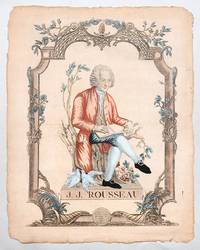
1789138603Paris: Basset c. 1789. Rousseau as revolutionary icon A striking full-length portrait of the philosopher seated on a tree stump and hard at work on the Contrat Social. At his feet two doves presumably evicted from their stump discuss matters. The print is by the Parisian firm of Basset which was a leading source of popular prints during the Revolution. Rousseau was claimed as a foundational influence by many revolutionary leaders and in 1794 they arranged for his remains to be transferred to the Panthéon in Paris. Hand-coloured copperplate engraving. Image size: 70 x 52 cm. Framed size: 85 x 66.5 cm. Presented in a handmade gilt frame with conservation acrylic glazing. Light toning and chipping to extremities not touching impression: in very good condition. Bachelin 185; Girardin p. 35. unknown