Richardson, JohnBiblio.com

464 résultats
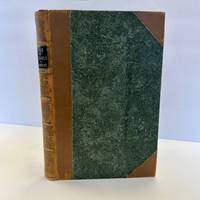
183632452London : Richard Bentley 1836 . First Edition . Very Good . 4TO . Containing Descriptions of the Objects of Natural History Collected on the Late Northern Land Expeditions Under Command of Sir John Franklin R.N. John Richardson 1787-1865 was the physician-naturalist on Franklin's two Arctic overland expeditions 1819-1822 & 1825-1826. He was instrumental in ensuring the survival of the remnants of the crew during the very difficult first expedition. His journal from this expedition was published as Arctic Ordeal published by McGill-Queen University Press in 1984. The Fauna Boreali-Americana was his major work and was published in four volumes - The Quadrupeds Birds Fish and Insects - from 1829-1837 the Fish being published in 1836 with Richardson as the sole author. It describes 133 species of fish. With 2 wood-cuts in the text and 24 full page illustrations at the rear 14 hand coloured all by Waterhouse Hawkins and numbered from 74 to 97. Eighty nine and 90 are etched on copper 94 to 97 are drawn on zinc and the remainder lithographed. This copy originally in the Royal Society library and latterly in the library of a Marine Research Institute. The plates have been stamped on the rear with a now undecipherable small circular stamp which in some cases has transferred to the following plates. Very faint on most of them more noticeable on the last several black and white plates. Bound in blue cloth with two gilt stamped black leather spine labels. Sabin 71028. AB 14492. Richard Bentley hardcover
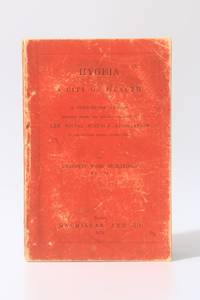
187610946London: Macmillan and Co. London Macmillan and Co. 1876. Firist.First Impression. Paperback. A very good copy. Written to help illustrate how sanitation could improve lives the book nowadays can be seen as equally a work of Utopian fiction. Including certain novel ideas such as a balance between cremation and burial wherein the dead are interred in shrouds in articifical soil to aid decomposition. Uncommon in general certainly in the original wraps and not having come from libraries. The orange wraps are rubbed and worn but fairly tight overall. 47pp. 10946 Hyraxia Books. . Very Good. Paperback. Firist Edition. 1876. Macmillan and Co. paperback
186442489London: Richardson Brothers 1864. Renowned as a story-teller of the sea Marryat was elected to the Royal Society in 1819 mainly on the strength of this adaptation of Sir Home Popham's system of signaling first published 1817. "This earned him a large and regular income." ODNB He later received the Légion d'Honneur from the king of France "for services rendered to science and navigation". "The copyright of this Code of Signals by which the Mercantile Marine of the whole world has so greatly benefited became from a very early period the property of the late Mr. J. M. Richardson. The Edition of 1841 was the last edited by the original inventor. but since then five large Editions has been issued each greatly extended and improved." Preface. Front endpapers with request that "Owners and Captains of Vessels desirous" of having their official number or names included to apply to the publishers and advertising the publication of French Spanish and Italian translations and imminent issue of German and Norwegian editions and the availability of the "Flags used in this Code of Signals". Bound in at the rear is a leaf with the "Royal Humane Society's Directions for the Recovery of the Apparently Drowned." Marryat had been awarded "the Society's honorary medallion in 1821 for his design for a lifeboat and for his gallantry in saving life at sea." None of the editions of the Code are common: two copies only on Library Hub Oxford and NLS WorldCat records just three copies in the US. NMM has a copy. Octavo. 244 x 154mm With 8 chromolithographic plates of plates one of them double-page of "Maritime Merchant Flags of all Nations." Original blue embossed cloth rebacked with the original spine laid down title gilt to the front board. Contemporary armorial bookplate of Col. Charles A. W. Troyte to the front pastedown together with his pencilled initials. Lightly browned one plate a little torn now repaired no loss cloth a little rubbed sunned at the spine. hardcover
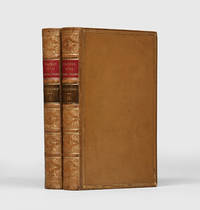
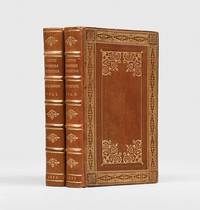
1848168912London: Richard Bentley 1848. Richardson's explorations in the nineteenth century have been most unjustifiably neglected First edition of this detailed travelogue by an English explorer and abolitionist. Richardson 1806-1851 joined a Sahara-bound expedition leaving Tripoli in 1845 hoping to "gather information on the legitimate and slave trades in the interior and in the unfulfilled expectation that he would be made vice-consul at Ghadames a strategically important market town. From Ghadames he travelled to Ghat a very important slave market but there was forced by ill health and lack of equipment to turn back travelling via Fezzan and reaching England in 1846" ODNB. His account includes descriptions of the major cities in the Fezzan region trade routes and oases as well as the culture religion and traditions of the Tuaregs. Richardson also frequently refers to the trans-Saharan slave trade and the position of slaves in local Tuareg communities. The Royal Geographical Society reviewed Richardson's Travels favourably upon publication: "These volumes are useful contributions to our knowledge of the interior of the imperfectly known regions of Northern Africa; and they describe some hundreds of miles of desert routes over which no Europeans had previously passed as well as several of the cities of the Desert of which we had not before received accounts from European visitors" p. lix. 2 vols octavo 215 x 130 mm. Engraved frontispieces similar plate engraved folding map wood-engravings in the text. Contemporary pale polished calf spines with raised bands red and brown morocco spine labels richly gilt in compartments double-gilt fillet borders on covers marbled edges and endpapers. Gift inscription on front flyleaf. Slightly rubbed and scuffed occasional foxing gilt bright. A very good copy. Gay 1530; Howgego II R13. Journal of the Royal Geographical Society vol. 18 1848. hardcover
184891137London: Richard Bentley 1848. First edition of this account of James Richardson's 1806-1851 first expedition to Africa. Richardson was an English explorer and ardent anti-slavery campaigner; he considered the slave trade to be "the most gigantic system of wickedness that world has ever seen" Wright Libya Chad and the Central Sahara p. 68. In 1845 Richardson joined a Sahara-bound expedition leaving Tripoli. With it he travelled to "Ghadames became the first European to visit Ghat and after a nine-month long and arduous journey through Fezzan arrived safely back in Tripoli" Embacher cataloguer's translation. His account includes descriptions of the major cities in the Fezzan region trade routes and oases as well as the culture religion and traditions of the Tuaregs. Richardson also frequently refers to the trans-Saharan slave trade and the position of slaves in local Tuareg communities a subject he had already discussed in his "Report on the Slave-Trade of the Great Desert" written for the Anti-Slavery Reporter and Aborigines' Friend upon his return to London in 1846. Upon publication the Journal of the Royal Geographical Society wrote of Richardson's Travels: "These volumes are useful contributions to our knowledge of the interior of the imperfectly known regions of Northern Africa; and they describe some hundreds of miles of desert routes over which no Europeans had previously passed as well as several of the cities of the Desert of which we had not before received accounts from European visitors" JRGS vol. 18 p. lix. 2 vols octavo 221 x 137 mm. Engraved frontispieces 24 woodcuts in text and one engraved folding map. Original green morocco-grain cloth titles to spines gilt decorative frames to boards in blind Glasgow coat of arms gilt-stamped to front boards pale yellow endpapers. Glasgow High School prize copy with bookplates to front pastedowns. Spines sunned corners and spine ends bumped inner hinges of Volume II cracked but holding firm short closed tear to folding map stub. A very good set. Embacher p. 247; Gay 1530; Hess & Coger 5679; Howgego II R13. hardcover
1851E0879a<p>2 volumes. viii1-414 pages with frontispiece plates and folding map. vii1 blank1-426 pages with frontispiece. Octavo 8 ¼ x 5 bound in contemporary half blue morocco over blue pebbled cloth spines ruled in gilt 2 green gilt morocco lettering labels. Arctic Bibliography 14489. Sabin 71025. First edition.</p><p>John Richardson studied medicine at Edinburgh University and became a surgeon in the navy in 1807. He traveled with John Franklin in search of the Northwest Passage on the Coppermine Expedition of 1819 1822. Richardson wrote the sections on geology botany and ichthyology for the official account of the expedition.</p><p>Franklin and Richardson returned to Canada in 1825 and went overland by fur trade routes to the mouth of the Mackenzie River. Franklin was to go as far west as possible and Richardson was to go east to the mouth of the Coppermine River. These were the only known points on the central coast and had been reached in 1793 and 1771 respectively. He had with him two specially-built boats which were more ocean-worthy than the voyageur canoes used by Franklin on his previous expedition. They gave their names to the Dolphin and Union Strait near the end of his route.</p><p>Richardson's journey was successful and he reached his furthest east the same day that Franklin reached his furthest west 16 August 1826. He abandoned his boats at Bloody Falls and trekked overland to Fort Franklin which he reached three weeks before Franklin. Together they had surveyed 1878 mi 3022 km of previously unmapped coast. The natural history discoveries of this expedition were so great that they had to be recorded in two separate works the <em>Flora Boreali-Americana</em> 1833-40 written by William Jackson Hooker and the <em>Fauna Boreali-Americana</em> 1829-37 written by Richardson William Swainson John Edward Gray and William Kirby.</p><p><strong>Condition:</strong> Bindings heavily worn at spines and extremities some color restoration to boards board edges worn fps. with bookplate removal residue endleaves offset text and plates a bit toned folding map toned repaired and backed with paper else good.</p> Longman, Brown, Green, and Longmans hardcover
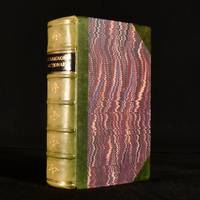
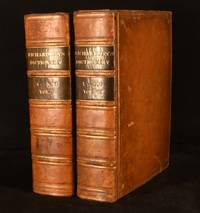
1844817D10London: William Pickering 1844. Leather. Very Good Indeed. 9" by 5.5". None. A scarce leather-bound copy of Charles Richardson's 'New Dictionary of the English Language' bound in a half-calf binding on marbled boards. Scarce Second Edition. Two volumes in one bound in a later half-calf binding with marbled boards. This is a nicely bound copy of Charles Richardson's 'New Dictionary of the English Language' first published from 1836 to 1837. This reference work was the first general dictionary which offered readers a 'full conspectus' of historical evidence paving the way for the popular Oxford English Dictionary. Interestingly Richardson believed in etymological meaning but with little or no historical basis. He would use many quotations in place of definitions and nodded to different aspects of English cultures and traditions. Contents of this work include the prefaces to Parts I and II supplementary notes as well as an errata page and 'additions and corrections' to the rear of text.Charles Richardson 1775-1865 was an English teacher lexicographer and linguist. Undated due to lack of title page dated using an identical copy with the same pagination from the Hathi Digital Trust Library. This particular edition's text is also displayed in double columns unlike the triple columns of the earlier editions. Collated bound without a title page. Bound in a later half-morocco binding with marbled boards. Externally excellent with fading to spine and minimal wear to head and tail of spine. Internally firmly bound. Pages are very clean with age-toning to pages and the odd spot and handling mark. Prior owner's pencil inscription to top of preface page. Very Good Indeed William Pickering hardcover
1829BIBLIO-42087Printed by J.L. Cox for Parbury Allen & Co. and others London new edition considerably enlarged 1829. Later library buckram gilt spine-title 8vo 32 cm. 3-9 lxxxvi 1714 2 pp. This vast Persian Arabic and English Dictionary was originally published as a two-volume work by John Richardson in 1777-1780 intended principally for employees of the Hon. East India Company. John Wilkins substantially enlarged the work in 1806 and 1810 and Johnson's "new edition" of 1829 included the "addition of more than 38000 words Arabic and Persian" from the Preface as well as incorporating Willmet's Arabic Lexicon. Ownership inscription "Fred R. Pollock Lahore 1848"l on front free endpaper; lacking the half-title a mildly ex-library copy with a library bookplate and library marks on the front free endpaper and a gilt shelfnumber on the spine; title-page and a few others with old neat repairs to short tears some age-toning and occasional mild foxing about 20 pages with some heavier foxing or staining otherwise contents generally clean with occasional minor marks and one or two small edge-chips a Good copy in a sturdy binding. Printed by J.L. Cox, for Parbury, Allen & Co. and others, London, new edition, considerably enlarged, 1829 hardcover
18940015942<p>Ticknor & Company 1894 Issued in conjunction with the American Architect and Building News. Large folder 13.25" x 16.25" with 30 black and white heliotype plates of the Town Hall Library Gate-Lodge and Railway Station. the beige folder is very worn scuffed with traces of old water damage and is missing the ribbons that once secured the plates. The plates themselves are in very good condition some show slight wear on the edges. No markings. Requires extra postage.</p> Ticknor & Company hardcover
183631189London: William Pickering 1836. First edition 2 volumes 4to pp. 4 1183 1; 4 1185-2222 1; contemporary and probably original full calf double gilt-ruled borders gilt-decorated spine in 5 compartments gilt-lettered in 2; rebacked original spines laid down; spines a little rubbed else very good and sound. "First published as part of the Encyclopaedia Metropolitana 1818-37 it consisted of a great many illustrative quotations drawn from literature but with relatively few and brief definitions . Richardson's approach was based on the notion that quotations alone if sufficient in number could serve to elucidate 'true etymological meaning.' He went far beyond Johnson in collecting quotations beginning at the fourteenth century Johnson went back only to the end of the 16th century . Richardson sought by his vast collection of quotations to justify the preposterous theory of John Horne Tooke that each word had a single immutable meaning. In his own work each word and its derivatives were given one etymology and one meaning. His etymologies were as preposterous as his theories but his dictionary was of great interest to lexicographers because it foreshadowed the historical collections of quotations that were later to form the basis of the Oxford English Dictionary" Landau Dictionaries p. 66. "Richardson was an ardent philologist of the school of Horne Tooke . His principle was to arrive at the original and proper meaning which was inherent in a word from its etymology" see DNB. Based on the "historical principle" of lexicography this work formed the most substantial link between Johnson and the O.E.D. William Pickering unknown
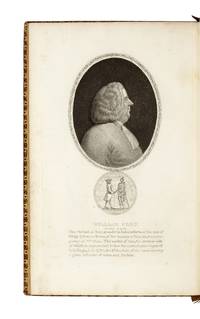
182210708Printed by W. Nicol late Bulmer & Co. London. 1822. FIRST EDITION. 8vo. 9.3 x 6.1 inches. Illustrated title 56pp 7 full page engravings each with a plain tissue guard. Aside from some light spotting to the tissue guards this is a bright and clean copy throughout. Finely bound in nineteenth century full burgundy morocco. Spine with four wide raised bands each with gilt box ruling. Compartments triple ruled and lettered in gilt. Boards with five ruled line gilt borders. Board edges and turn-ins with gilt decorative roll. All edges gilt. Yellow coated endpapers. Some minor wear to the edges of the binding but overall a very good and attractive copy of this rare work both inside and out. Contains a lithographed title page illustrating both sides of the medal of the Outinian Societ and seven full page plates; portrait frontispiece of William Penn the founder of Pennsylvania; Lady Juliana Penn; Vice-Admiral Sir William Penn; Thomas Penn; a memorial urn dedicated to the memory of Lady Juliana; the remnant of the Great tree at Stoke Park under which the treaty was held between William Penn and the Original Natives of America; and another different portrait of Penn. --- Sabin lists the author as John Penn 1760 - 1834 Grandson of William Penn the founder of Pennsylvania and also incorrectly only calls for 6 plates. The anonymous publication of a poem titled "Marriage" in a Monthly Magazine issue during the summer of 1815 inspired Penn to organise The Matrimonial Society which he established in early 1817 and which had for its object an improvement in the domestic life of married persons. It later extended its aims to include other schemes of domestic utility and the society re-named itself the Outinian Society. During the summer of 1818 meetings of the society took place at Penn's house in London's Spring Gardens and later at Stoke Park Buckinghamshire the family home purchased by his father in 1760. Penn who acted as president edited the works of the society for publication. The Second Lecture appeared in 1819 the General Address of the Outinian Lecturer in 1822 Records of the Origin and Proceedings of the Outinian Society in 1822 A Proposal of the Outinian Society in 1823 written by Penn and the Seventh Outinian Lecture in 1823. The society was still existing in 1825. Sabin 26864. Printed by W. Nicol, late Bulmer & Co. London. 1822 hardcover
18112091202133212995James Carpenter 1811. Soft Cover. Fine. Number of books: 19 books in total James Carpenter paperback
1822E4804<p><b>First edition very rare. </b> The <i>Address</i> is a revised version of the valedictory lecture given on 31 December 1818 to mark the centenary of the death of William Penn. It gives an explanation of the origins of the Society and then is entirely directed to the career and particularly the principles of William Penn based on 'traditional information' and 'publicly and privately attested facts'. The private information was doubtless supplied by John Penn 1760-1834 founder of the Society who as a surviving grandson of William Penn succeeded his father to the moiety of the last proprietorship of Pennsylvania.<br /></p><p>The Outinian Society was originally founded in 1817 as the Matrimonial Society in response to an anonymous poem called 'Marriage' in the <i>Monthly Magazine</i>. It had the object of promoting marriage and improving the domestic life of married couples. Extending its aims to other schemes of human happiness – to 'the more perfect knowledge of certain less obvious truths and principles of human action' – it soon changed its name to the Outinian Society apparently inspired by a line in Homer. John Penn was its president and editor Jonathan Richardson its secretary and lecturer. The lectures were very popular: <i>Records of the Origin and Proceedings of the Outinian Society</i> 1822 lists well over 1000 names of Auditors who had attended.</p><p>COPAC and OCLC list copies at the British Library Society of Friends and Harvard only. J. Smith<i>Friends' Books</i> 2.326 attributing it to John Penn.</p><p>8vo pp. 2 56 with a lithographed title-page illustrating the medal of the Outinian Society an engraved portrait frontispiece of William Penn the founder of Pennsylvania and six other plates Lady Juliana Penn Vice-Admiral Sir William Penn Thomas Penn a memorial urn to Lady Juliana the remains of the tree at Stoke Park under which the treaty between Penn and the Indians was signed and a second portrait of Penn tissue guards foxed; contemporary hard grain morocco rubbed; note on endleaf identifying the founder of the Outinian Society as John Penn; signature of the educationist and author Madame de Genlis dated 1829 'a friend of the family' bookplate of Major Claud Alexander.</p> W. Nicol, late Bulmer & Co hardcover
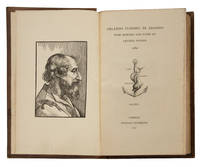
18341003797London: William Pickering 1834. First Panizzi edition of Ariosto's Orlando Furioso issued in four volumes by William Pickering in 1834 from the celebrated library of Frances Mary Richardson Currer. Set during the Saracen invasion of France Orlando Furioso 1516-1532 follows the adventures of Charlemagne's high-strung knight Orlando who goes mad for love. Ariosto's comic epic was hugely influential going on to inspire works as various as The Faerie Queene Much Ado About Nothing Don Quixote and Don Juan. Pickering issued this set as a companion to Panizzi's 1830 edition of Boiardo's Orlando Innamorato. It was Pickering's practice to keep his books in sheets and bind them over time: the morocco-grain cloth used on this set likely dates from slightly later in the nineteenth century. This copy of Orlando Furioso contains the bookplates and purchaser's note of Yorkshire coal heiress Frances Mary Richardson Currer 1785-1861 who built a celebrated library of some 20000 volumes. Contemporaries praised Currer's scholarship and taste as well as the rigorous organization and "choice condition" of her books. The bibliographer Thomas Frognall Dibdin called her a "book-genius" and remarked of her library: "The 'Collections' are nearly perfect." In 1820 and again in 1833 Currer issued a catalogue of her holdings widely viewed as "the model catalogue of a private library" DNB and sent copies to book collectors across England and Europe including members of the newly formed Roxburghe Club quietly asserting her place among them. Also known for her commitment to charitable causes Currer is obliquely noted as a "wealthy lady in the West Riding of Yorkshire" who paid off the debts of a new widower Patrick Brontë; scholars speculate that Charlotte Brontë's unusual pen name Currer Bell is a tribute to Frances Currer. Text in Italian. See Keynes William Pickering Publisher. A near-fine copy in the publisher's cloth with excellent bibliophilic provenance. Four octavo volumes measuring 7.5 x 4.5 inches: vii-viii clxxvi 198; 4 436; 4 424; 4 330 79 1. Original publisher's morocco-grain plum cloth printed paper spine labels text uncut and partially unopened. Woodcut frontispiece portrait after Titian; woodcut publisher's device to title pages. Bookplates of Frances Mary Richardson Currer and John Porter; Porter's Pickering collection label to rear pastedown of Volume I. Ink note in Currer's hand to verso of front free endpaper of Volume I: "Russell Smith - 13s: 6d." Spines sunned and slightly bubbled light scattered foxing. Housed in later green card slipcases. William Pickering unknown
185144838London: Longmans Green and Co 1851. First Edition. Hardcover. Very Good/No Jacket. 8vo. 2 volumes. 8vo. Pp. viii 413 32p. catalogue frontis ills. folding col. map with 5 inch tear 8 col. plates. Pp. vii 426 frontis col. In the original brown cloth with gilt lettering. Armorial bookplate to each publisher's ads. for "Lardner's Cabinet Cyclopaedia" on front and rear endpapers. Heavy wear to the cloth at spine head both vols. with light wear at foot. Bindings a little cocked but overall remarkably clean and tight Volumes. Nice set in the original cloth boards. Longmans, Green, and Co hardcover
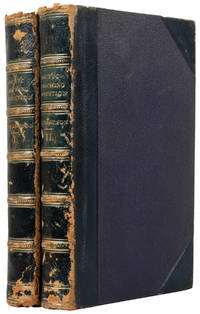
18361006J6London: William Pickering 1836. First edition. Leather. Very Good. 11" by 9" . None. An impressive first edition of Charles Richardson's dictionary with a signed letter from the author to Lord Viscount Strangford. An excellent first edition of lexicographer Charles Richardson's New Dictionary. Bound in contemporary full calf. Richardson first published a critical examination of Johnson's dictionary in 1815. He followed this with his own dictionary the early part of which appeared in the Encyclopaedia Metropolitana a collaborative project overseen by Samuel Taylor Coleridge. The prospectus for A New Dictionary appeared in 1834 followed by the book in parts published by subscription by William Pickering over a two year period.This copy with a tipped-in hand-written letter addressed to Percy Smythe 6th Viscount Strangford from the author dated March 16th 1836.In his letter Richardson thanks the Lord Viscount for his patronage; both for subscribing to the book personally and reccomending the New Dictionary to the libraries of the Carlton Club and House of Lords. He politely requests the Viscount's permission to mention his endorsement in further letters to the Duke of Wellington the Marquess of Cambden and Chancellors of the Universities of Oxford and Cambridge.Viscount Strangford was known for his literary tastes as well as for his decorated career as a diplomat and ambassador to multiple major European courts. Two volumes bound in full contemporary calf. Externally smart. With notable marks to all boards. Rubbing to extremities resulting in loss of leather at corners. Joints strained; front joint of second volume significantly so. Internally firmly bound. Pages bright and clean. The odd handling mark throughout. Mild age toning. Dusting to fore edge. A signed letter by the author tipped-in after the title page of volume one. Very Good William Pickering hardcover
180712513London: Published by W. Richardson York House 31 Strand 1807. Image: 335 by 1090mm 13.25 by 43 inches. Sheet: 449 by 616mm 17.75 by 24.25 inches. Copper engraving printed on two sheets. A view of Southwark from the north bank of the River Thames reaching from Somerset House to St Mary Newington Church. Various buildings of interest are labeled along the lower edge including the Leverian Museum a now defunct natural history museum. BM 18801113.1205. Published by W. Richardson, York House, 31, Strand, unknown
181126106London: Printed for William Miller and James Carpenter 1811. The father of the modern novel of the serious or pathetic kind First collected edition of this major 18th-century author whose works Jane Austen "knew. by heart" ODNB. Anna Laetitia Barbauld called Richardson "the father of the modern novel of the serious or pathetic kind". The editor was Dublin-born Edward Mangin 1772-1852 of Huguenot origins a contemporary of Southey at Oxford ordained into the Irish church; he published several volumes of essays and translations and a three-decker novel George the Third 1807. After a spell as a naval chaplain he spent most of his life at Bath and having a substantial income was able to study and write full-time. The delicately engraved portrait of Richardson is the work of Edward Scriven who "became eminent in his profession" ODNB. 19 vols octavo 179 x 117 mm. Fine stipple engraved portrait frontispiece of Richardson by Edward Scriven after Mason Chamberlin. Attractively bound to style in half speckled calf red morocco labels marbled sides and edges endpapers renewed. Neat early ownership inscription to head of each title page "Hilder Sandhurst". Portrait offset to title page of vol. I. A nice clean set in a handsome period-style binding which has the virtue of opening easily at the printed page. NCBEL II 917. unknown
1852D59641852. Hardcover. Very Good. Original full red morocco ornately stamped in blind and gilt; 8vo; 31 manuscript pages including an illustrated short story landscapes in pencil Havana the Hudson River harbor of St. Thomas Martinique and 3 colored-pencil cartoons of American Indians these seemingly contributed by a child. Just a little scuffed along joints and edges of boards else fine. Likely the work of Horace Richardson the title-page and "publication information" see above states that this unique item was "copied" by him and one of the drawings most of which are clearly by the same artist is initialed "H. R." The book does indeed seem to correspond at least in part with a journey on the Winfield Scott a sidewheel steamer that transported cargo and passengers from San Francisco and Panama during the California Gold Rush -- then sank in December of 1853. The landscapes are nicely accomplished: "Yosemite Falls from Black's Hotel" signed "H.R." "Highland Park Hotel Aiken S.C." "Vineyard Haven" "View from the Window in our Parlor in the Hotel El Telegrafo Havana 1872" "View from my Window at the West Point Hotel Looking up the Hudson 1872" and "Fort de France Martinique from the Sea." Opens with a weird little short story in which the malefactor Joseph Shed spends his entire life stealing stockings even dirty ones punishment be damned. <br/><br/> hardcover
18541369650London: Richardson Brothers 1854. Twelfth Edition. Hardcover. Octavo unpaginated. In Very Good minus condition. Bound in later half brown leather with green cloth boards. Paneled spine with black label and gilt lettering. Slight cracking to upper edge of front hinge and weakening beginning. Discoloration to entirety of front cloth and part of rear cloth.<br /> <br> <br /> <br> <br /> With all six chromolithographic plates. Plates 1-4 bound before the title page with the first three as one folding page plate 5 as a double-page "Maritime Merchant Flags of all Nations" with tissue guard between them.<br /> <br> <br /> <br> <br /> Despite its popularity none of the editions of the Code are common.<br /> <br> <br /> <br> <br /> shelved case 9. The first general system of signalling for merchant vessels was Captain Frederick Marryat's A Code of Signals for the Merchant Service published in 1817. Marryat's code was an immediate success and was translated into several other languages and the 1854 edition was renamed The Universal Code of Signals for the Mercantile Marine of All Nations because of its widespread usage. The last edition was published in 1879 two decades after the publication of the code that supplanted it; there are reports that it was still being used as late as 1890. The replacement was the Commercial Code of Signals published by the British Board of Trade in 1857 which eventually became the International Code of Signals ICS. wikipedia;<br /> <br> <br /> <br> <br /> Previously published under title: A Code of Signals for the Use of Vessels Employed in the Merchant Service.<br /> <br> <br /> <br> <br /> "The copyright of this Code of Signals by which the Mercantile Marine of the whole world has so greatly benefited became from a very early period the property of the late Mr. J. M. Richardson. The Edition of 1841 was the last edited by the original inventor the late Captain Marryat but since then four large Editions has been issued each greatly extended and improved." from the Preface. 1369650. Shelved Dupont Bookstore. Richardson Brothers hardcover
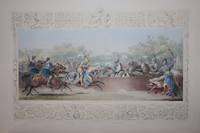
1843008069London: Colnaghi and Puckle. Printed by Cook & Co. Lithography by Day & Haghe 1843. First Edition. Half Morocco. Pebbled cloth on boards. Very Good. A magnificent souvenir of a Romantic era joust basically a re-enactment of the Medieval combat sport in keeping with the resurgent interest in the Middle Ages at the time. This tournament was sponsored by Lord Eglinton at his Scottish castle in 1839. That this massive book took four years to put together attests to its grandeur as well as the ardor of Medievalism among the aristocratic elite. Elephantine Folio 61 by 43 cm. Blank title leaf dedication leaf six paginated pages then 21 hand-colored plates each with a tissue guard and a one or two page Description of the particular plate on a single leaf until the last or 21st numbered plate which has a four page or two leaf Description after which there are two unpaginated pages of "Concluding Remarks". The lettering of text on these pages is done mostly with blue type with occasional red. The title and the plate leaves are of a card stock. The other leaves are of a more standard but not light paper weight and the tissue guards are of a similar minimally less paper weight but a glossier stock. The plates capture and probably improve upon the spirit of the event as they idealize the whole proceeding with nary a misstep all the costuming just right not a speck of dust or dirt to mar the beauty of the sport. However true these "reenactors' -- for that was what they were -- are faithful to the Medieval sport our image of jousting tournaments is probably more influenced by the prettified imitation than the original since books like this directly influenced Hollywood and the historic fiction genre more than the more esoteric surviving documents from the Middle Ages. The tournament reportedly drew an estimated 100000 spectators but it also was mocked and satirized in its day especially by members of the Whig Party. Notwithstanding that this pageant inspired others in its wake. In addition to the 21 numbered plates the title page has a large hand-colored illustrated oval centerpiece 26 cm tall surrounded by monotone decoration comprised of figures of men in armor and seraphs. All the descriptions begin with a decorated letter that is in itself an esquisite vignette. And not to be slighted each of the color plates has surrounding its primary richly colored illustration a highly decorative frame that is populated with seraphs human figures foliate ornaments escutcheons weaponry etc. etc. These frames in contrast to the central illustration are mostly black line drawings with a tinted background but there are occasional bits of fuller color -- the coat-of-arms are generally rendered so -- and in a few of the frames these full color pieces are quite numerous. Regarding the Dedication leaf the dedication is to Archibald William Montgomerie who was the Earl of Eglinton as well as the holder of other titles and was made by Edward Puckle. The gallery he headed at the time goes back to 1760 and remains to this day now known simply as Colnaghi with headquarters in Mayfair but branches in New York and other cities. Nixon 1802 - 1857 illustrated the novels of Sir Walter Scott and not coincidentally "Ivanhoe" apparently was the inspiration to stage this particular pageant. He is best known though as a designer of stained glass and his work in this medium done through a partnership of Ward and Nixon can be seen most famously in Lincoln Cathedral. As to Eglinton himself the tournament cost him dearly as he depleted his coffers of almost everything to cover the massive losses incurred by the event. All edges gilt. Gilt lettering and decoration on cover bright. Two decorative bookplates mounted onto FEP. The book besides being extra-large is also extra-heavy -- 13 lbs. 8 ou. -- and thus expect a substantial amount of extra postage will be required to ship especially internationally. Condition: Binding shows some wear with bumped edge a moderate level of spotting and other soiling most pronounced on the pebbled cloth of front board and small areas with rubbing. Hinge crack by title page. Other than occasional light stains the book is clean tight and we would say a highly attractive copy of the work. Colnaghi and Puckle. Printed by Cook & Co. Lithography by Day & Haghe unknown
1811141429London: William Miller 1811. hardcover. very good. With a sketch of his Life & Writings by Edward Mangin. Engraved frontispieces. 19 volumes. Small 8vo full polished calf marbled edges. London: William Miller 1811. Covers a bit bowed still a very good set.<br/> <br/> William Miller unknown
1851184706London: Longman Brown Green and Longmans 1851. These 'barren grounds' are very thinly peopled First edition of this important account of Richardson's 1848-9 journey in search of Franklin. His account was also published in the United States in 1852 but without the plates and map present in this edition. Richardson's "descriptions are particularly valuable for their treatment of his personal experiences with Indians and Eskimo" Hill. With no word from the Franklin expedition the Admiralty commissioned Sir John Richardson 1787-1865 to lead a search expedition - a task that he readily accepted. On the trail of Franklin Richardson's party travelled down the Mackenzie River and proceeded east by boat following the Arctic shore to the mouth of the Coppermine River. While Richardson's voyage failed to clear up the Franklin mystery it nonetheless represented "a model of careful planning and good execution with no loss of life no injuries no shortages of food and no lack of shelter" ODNB. Following the publication of his account in 1851 Richardson devoted himself to the study of medicine and natural history eventually authoring or co-authoring over 100 publications. 2 vols octavo 215 x 134 mm. Colour frontispieces 8 colour plates folding map wood engravings in text. Bound without adverts. Late 19th-century calf rebacked to style spines lettered in gilt raised bands divided by gilt fillet compartments with gilt device wide elaborate gilt and blind frames to boards milled board edges gilt roll to turn-ins marbled endpapers free endpapers renewed edges sprinkled red and black. Marginal pen annotations to p. 89 vol. 1; contemporary bookplate of Ann Curtis. Extremities mildly rubbed with spots of wear folding map with a couple of tears and paper repairs marginal ink stains to a few pages of vol. 1. A very good copy. Arctic Bibliography 14489; Hill 1452; Sabin 71025. hardcover
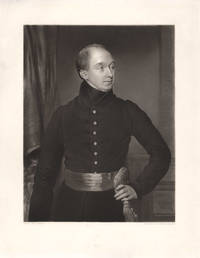
184516281845. Mezzotint. 310mm by 235mm image 420mm by 330mm sheet. India-laid proof. After an oil dated 1825.<br /> Sir Ralph Darling 1772 - 1858 was appointed in 1824 as Governor of New South Wales. He was the Governor of NSW from 1825 - 1831.A couple of very minor marks in margins. unknown
181346621Paris: A. Belin 1813. Very good. Beautifully bound set of the works of the French playwright from the library of Frances Mary Richardson Currer who was among the most celebrated book collectors of her era. This set was once owned by Yorkshire coal heiress Frances Mary Richardson Currer 1785-1861 who built a celebrated library of some 20000 volumes. Contemporaries praised Currer's scholarship and taste as well as the rigorous organization and "choice condition" of her books. The bibliographer Thomas Frognall Dibdin called her a "book-genius" and remarked of her library: "I may fairly and honestly say that with the exception of Althorpe Chatsworth and Stowe I know of NO such collection of books situated in the country that can pretend to break a lance with it . The 'Collections' are nearly perfect." In 1820 and again in 1833 Currer issued a catalogue of her holdings widely viewed as "the model catalogue of a private library" DNB and sent copies to book collectors across England and Europe including members of the newly formed Roxburghe Club quietly asserting her place among them. This set is documented in the 1833 catalogue. Also known for her commitment to charitable causes Currer is obliquely noted as a "wealthy lady in the West Riding of Yorkshire" who paid off the debts of a new widower Patrick Brontë; scholars speculate that Charlotte Brontë's unusual pen name Currer Bell is a tribute to Frances Currer. A choice set once held by one of the great English book collectors of the Regency and early Victorian periods when the field of book collecting as practiced in the UK and US today began to cohere. 5 octavo volumes 8.25'' x 5'' each. Contemporary full blue calf raised bands elaborately gilt-stamped spines red goatskin spine labels triple-ruled gilt boards. All edges marbled marbled endpapers. Text in French. clxxii 297 1; 488; 486; 392; 310 pages. Engraved bookplate of Currer on front pastedown of each volume; ink gift inscription dated 1966 on fly leaf of each volume. Bindings with a bit of dryness and trace wear around joints; vol. I with ink stain at top joint of front board; some gatherings foxed and a few areas of marginal staining or spotting. Joints firm. Gilt bright. A. Belin unknown