[Joseph Ritson, or Richardson]Biblio.com
87 résultats
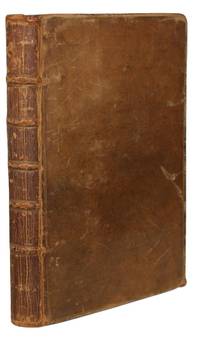
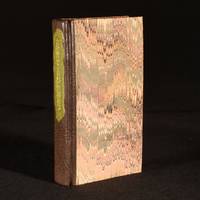
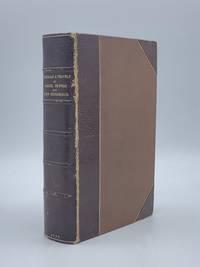
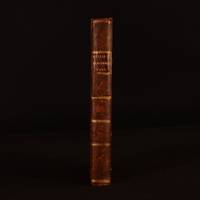
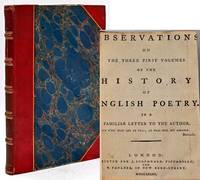
1782298728London: J. Stockdale; R. Faulder 1782. First Edition. Half Leather. Very Good binding. 8vo.; in an attractive later binding of red half-goat over marbled boards with raised bands with morocco label lettered vertically; with marbled endpapers; 2 49 1 pages.~~A note on this rather interesting binding: we assume that the binder was charged with binding a group of different books to a uniform size -- the title page is trimmed and mounted and all the other leaves are folded neatly to fit the bottom edge and then the leading edge over it. Rather astonishing actually.~~This is Ritson’s first book in which he attacks Thomas Warton’s History of English Poetry in such vitriolic tones -- Warton is a pretender a cheater and a liar -- as to cause quite a contretemps in late 18th century English literary circles. One assumes this actually pleased Ritson as he went on the next year to attack Samuel Johnson and George Steevens. Eventually Ritson went complete mad barricading himself in his rooms at Gray’s Inn and setting fire to a pile of manuscripts. Very Good binding. J. Stockdale; R. Faulder unknown
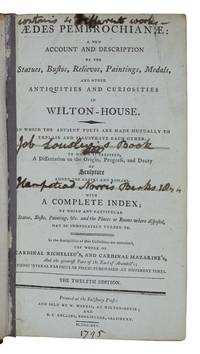
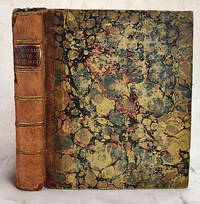
1795AQ28838Salisbury: Printed at the Salisbury Press: and sold by W. Morris.and B. C. Collins 1795. 6 xvi 133pp 15. Without half-title. ESTC T193594. Bound with: The weymouth guide: exhibiting the ancient and present state of weymouth and melcombe regis. Weymouth. Printed for P. Delamotte 1792. Third edition. 128pp. With an engraved folding frontispiece and one further engraved folding plate. ESTC T66352. And: MOREAU Simeon. A tour to the Royal Spa at Cheltenham; or Gloucestershire Displayed. Bath. Printed for the Author by R. Cruttwell 1793. Seventh edition. 3 vi-viii 210pp. Without half-title. With an engraved plate. ESTC T60577. And: COOKE John. A concise description of the royal hospital for seamen at greenwich. Extracted from the historical account published by the chaplains. London. Sold only at the Hospital 1791. 2 40pp. Without half-title. With a folding table. ESTC T149218. 12mo and 8vo. Contemporary half-calf marbled board recently rebacked. Boards worn. Marbled endpapers bookplate of A. M. Broadley and ticket of Maud booksellers of Andover to FEP scattered spotting margins of second mentioned work trimmed close. Job Lousley's copy: 'Job Lousley's Book Hampstead Norris Berks 1844' to title of first mentioned work and gutter of p.38 of final mentioned work and a manuscript list of contents in his hand to verso of FFEP. A sammelband of four works tentatively connected by a vague architectural interest including architectural draughtsman and decorative designer George Richardson's 1737/8-c. 1813 popular survey of the contents of Wilton House seat of the Earls of Pembroke; and the third and final eighteenth century edition of a provincially published guide to Weymouth and environs that reveals the origins of the town as a resort including all seven 'Rules and Orders' of the public rooms with 'IV. That no Lady or Gentleman be permitted to dance in coloured gloves' and 'VIII. That Gentlemen will be pleased to leave their swords at the door' particularly anachronistic highlights. Job Lousley 1790-1855 English landowner farmer antiquarian and bibliophile. He lived at Blewbury and Hampstead Norris near Newbury; an avid and idiosyncratic book-collector with an eye for the curious and unusual the books from his library with the present being a curious exception often bear forthright inscriptions relating his opinions of the contents or his other encounters with the work. . Twelfth edition. Printed at the Salisbury Press: and sold by W. Morris...and B. C. Collins hardcover
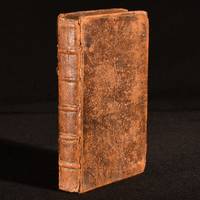
1757AQ16791London: Printed and Sold by Luke Hinde 1757. vi 236pp 4. With two terminal advertisement leaves. Contemporary calf gilt. Extremities rubbed some loss to head of spine splitting to upper joint. Book-label of Henry Birkbeck and faded ink ownership inscription to FEP loss to FFEP slight loss to lower corner of leaf H5 very occasional marginal chipping lightly foxed. The first edition of an account of the ministry of Quaker John Richardson 1667-1753 a respected member of the Society of Friends notable for his preaching tours of Britain and latterly America where he would befriend William Penn and on one occasion accompany the state founder to treat with Native Americans. ESTC T133591. First edition. 8vo. Printed and Sold by Luke Hinde unknown
1784RICec[RI37London: Printed For W.Strahan And T.Cadell 1784. 1784. 8vo. pp. xvi 478 1 leaferrata. with half-title. contemporary sprinkled calf extremities & spine very worn covers & first 2 leaves detached occasional light foxing. First Edition. The author was tutor to Lord Cathcart's two sons and accompanied them to St. Petersburg in 1768 following Lord Cathcart's appointment as ambassador-extraordinary to the Russian empress. During the course of his four years there he also acted as secretary to Lord Cathcart. His letters touch on the causes and progress of the Turkish War the state of agriculture in Russia the slavery of the Russian peasants life at court the situation of the Jews in Russia &c. Crowther 2053. Nerhood 96. F. Hardcover. London: Printed For W.Strahan, And T.Cadell, 1784. Hardcover
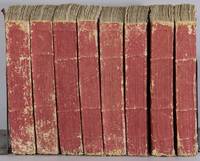
178566986London: printed for J. F. and C. Rivington. T. Davies B. Law T. Cadell G. Robinson J. Johnson W. Goldsmith W. Lowndes. J. Knox W. Fox C. and T. Wilkie P. Maqueen and E. Newberry 1785. 8 volumes 12mo original pink pastepaper wrappers; engraved frontispieces in each volume folding plate of engraved music in volume II; overall wear wrappers rubbed especially on volume VIII and worn but the binding is sound. Volumes II and V partially unopened the remainder unopened save volume I. Leaf of ads at the back of volume III and a 9-page catalogue at the back of volume VIII. First published in 1748 this remains one of the greatest English novels. printed for J. F. and C. Rivington. T. Davies, B. Law, T. Cadell, G. Robinson, J. Johnson, W. Goldsmith, W. Lowndes. J. Knox, W. unknown
1791370724London: James Ridgway 1791. Hardcover. Near Fine. Four works in one volume: 1. Criticisms on the Rolliad. Part the First Ninth edition 1791; 2. Criticisms on the Rolliad. Part the Second Fourth edition 1790; 3. Probationary Odes for the Laureatship: with a Preliminary Discourse by Sir John Hawkins Knt. Ninth edition 1791; 4. Political Miscellanies by the authors of the Rolliad and Probationary Odes First edition 1790. Octavo. Engraved frontispiece plate and title vignette. Contemporary full tree calf with morocco spine label: "Rolliad Compleat." Rubbing to the spine and joints else near fine. A scarce complete set of this pioneering collection of satires on the administration of William Pitt the Younger written in the form of mock reviews of a mock epic. Originally published in the Morning Herald in 1784-85 it became an instant sensation. Its anonymous authors also contributed ancillary satires which were published together with it. When collected in book-form they ran through twenty-two editions. Armorial bookplate of Henry Merrick Hoare and bookseller's ticket on the front pastedown. A handsome copy. ESTC T133733 T133732 N11967 and T173343. James Ridgway hardcover
1754695181754. 1754 Richardson Samuel THE HISTORY OF SIR CHARLES GRANDISON IN A SERIES OF LETTERS In Six Volumes London 1754 Volume 6 states Second Edition on tpage 8vo Bookplate of Sir George Shiffner Bar on front pastedown on all volumes Contemporary half-leather/marbled paper-covered boards/leather spine labels/gilt Leather on spines has cracked due to dryness with minor chips volume 56 Hinges are tender volumes 1 6 epages offset in all volumes minor shelf-rubbing on edges Overall this is a Very Nice set. unknown
1750292361London: Henry Lintot 1750. Third Edition. Full Leather. Good binding. The set in two volumes in worn period calf with morocco labels. With loss to the leather and wear at the extremities. Volume I is lacking at least the last leaf of the Index with significant damping to the Index as well. Lacking the front endpaper as well. Volume II appears to be complete. ESTC T97037. Good binding. Henry Lintot unknown
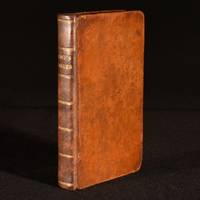
1752965P22London: T. Longman and C. Hitch 1752. Leather. Good. 6.5" by 4". None. A very scarce guide to letter writing by the master of the epistolary novel Samuel Richardson. A very scarce work.The fifth edition.A guide to letter writing by Samuel Richardson in which he presents examples for letters to be written in various circumstances. Containing a total of one hundred and seventy three letters with situations including "from an uncle to a nephew on his keeping bad company bad hours &c. in his apprenticeship" "an elder to a younger brother who is in love with a young lady of great gaiety" "from a brother to his sister in the country upbraiding her for being negligent in writing" "to a friend on his recovery from a dangerous illness" "from a gentleman to his mistress resenting her supposed coquetry" and more. The letters Richardson offers here are often comical and offer a unique insight into society during the Georgian era in England. Richardson is best known for his three epistolary novels: 'Pamela' 'Clarissa' and 'The History of Sir Charles Grandison'. Bound without endpapers. In a contemporary calf binding. Externally a little rubbed. Bumping to the extremities resulting in a small amount of loss of leather. A small amount of loss to the head and tail of the spine. Lacking the spine label. Joints are starting. Hinges are strained. Lacking the endpapers. Internally generally firmly bound. Pages are lightly age-toned and generally clean with scattered spots. Small chip to the tail of the title page. Torn printers label to the verso of the title page. Good T. Longman and C. Hitch hardcover
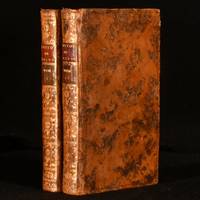
1770860N63Amsterdam: - 1770. Leather. Very Good Indeed. 6.5" by 4". None. A leather bound French translation of Samuel Richardson's epistolary novel. The first four volumes of Samuel Richardson's epistolary novel are bound into two leather bound books. Published in French. First published in 1753 the novel was a response to Henry Fielding's The History of Tom Jones which parodied the morals presented in Richardson's previous novels. After rejecting the advances of Sir Hargrave Pollexfen Harriet Byron is kidnapped by the him until Sir Charles Grandison comes to her rescue. Grandison then becomes the central figure and focuses on his life and history. Prior owner's bookplate to both volumes. No author given. In a full mottled calf binding. Externally generally smart. Lightly rubbed to the boards a little more so to the joints and the spine. Volume II is missing a tiny bit of calf to the head of the spine. The front and rear hinges of volume I are starting but firm. Internally firmly bound. Pages are bright and generally clean with the occasional spot to the front and rear of the volume. Very Good Indeed - hardcover
176073880London:: Printed for J. Rivington R. Baldwin and 12 others 1760. Early edition. 19th c. dark blue straight-grain morocco. Lacking one engraved plate as noted. Tiny old ink name partially effaced from title; old signature practiced on the verso of one plate not visible on recto and ink calculations at the bottom margin of one page of text; neat repair to one torn leaf; some light spots and inoffensive soiling. Joints partially cracked; edges and corners quite rubbed; still sound. . 12mo. Engraved illustrated title page. Containing Two Hundred and Forty i.e. 230 Fables with a Cut Engrav'd on Copper to each Fable. The engravings were printed ten to a page and this copy is unfortunately lacking one of the 24 plates Plate XIII. . And the Life of Aesop prefixed by Mr. Richardson. Printed for J. Rivington, R. Baldwin [and 12 others], unknown
1775962P1London: J. F. and C. Rivington; et al 1775. Leather. Very Good. 7" by 4"; 8" by 5". Not Stated. Aesop's enduring fables an illustrated edition with ten scenes to each plate including a life of Aesop. In a custom cloth clamshell bound by Eric Sweet in 1998 clamshell is in a near fine condition.The important fables of Aesop.Illustrated with an engraved title and twenty-five plates each of which portrays ten scenes. Collated complete.Aesop's Fables is a selection of fables generally attributed to the Ancient Greek storyteller Aesop who lived around 620 BCE-564 BCE. The fables are moral tales that guide in religious and secular aspects of life following adventures of many different creatures.Including a life of Aesop by Mr. Richardson.Undated dated from Jisc from a copy held at the British Library.Bound by Eric Sweet a keen collector of private press and fables. He studied at the Brighton College of Art before moving to London to work as a lettering artist and typographer for advertising agencies later becoming the head of Birmingham School of Printing. Sweet's bindings are unique and striking reflecting the topics of the volumes in distinctive style. In a full calf binding rebacked in a custom cloth clamshell. Externally smart. Light discolouration and marks to the boards. Minor bumping to the extremities. Internally firmly bound. Pages are age-toned and generally clean. Small chip to the margin of the plate facing page 142 no loss to image. Publisher's label over the imprint to the title page. Ink to the title page. Clamshell is in a near fine condition with only a few light marks. Very Good J. F. and C. Rivington; et al hardcover
1760962Z5London: J. Rivington et al 1760. Leather. Fine. 7" by 4". None stated. A beautifully bound eighteenth century engraved collection of Aesop's renowned fables bound in half calf and housed in a cloth chemise and uniform slipcase. The Samuel Richardson edited edition. Bound by Eric Sweet a keen collector of private press and fables. He studied at the Brighton College of Art before moving to London to work as a lettering artist and typographer for advertising agencies later becoming the head of Birmingham School of Printing. Sweet's bindings are unique and striking reflecting the topics of the volumes in distinctive style.Illustrated with a monochrome copper engraved frontispiece and twenty-four monochrome cooper engraved plates each depicting ten engravings. Collated complete. Frontispiece incorrectly bound facing pp. xv. A charming collection of fables credited to Aesop a Greek storyteller and fabulist whose tales were characterised by the anthropomorphic animal characters. This collection includes two hundred and forty fables with an account of the life of Aesop by Samuel Richardson. Bound in modern quarter calf with marbled paper to the boards and a cloth chemise and slipcase. Endpapers and blanks renewed. Undated dated by copies held institutionally. Bound in modern quarter calf with marbled paper to the boards and with a cloth chemise and matching slipcase. Endpapers and blanks renewed. Externally lovely. Frontispiece bound before pp.xv. Bookplate of 'Eric Sweet' to the front pastedown. Internally firmly bound with washed bright pages and generally clean with only the odd spot. The slipcase has spotting. Fine J. Rivington et al hardcover
1751h038.clarGB: S Richardson 1751. Old full leather with twin title labels. Old bookplate of "R S MILLER J C" with mootoes and heraldic devices. on front pastedown of each book. Fairly clean tight texts but Some spotting mostly to early and late leaves and text edges. A few covers only just holding by strings. in need of attention. Set is in good double plus condition with noticeable signs of wear and/or age. SPECIAL POSTAGE RATES APPLY 2026 GB £9. Packed weight 4500g. NOT AVAILABLE OVERSEAS . 4th Edition. Hardback. G/No DW. S Richardson Hardcover
1750L014.005GB: T. Woodward Etc 1750. Contemporary old full leather with raised bands but no title label. Book is in very good condition with minor signs of wear and/or age. . Hardback. VG/No DW. T. Woodward Etc Hardcover
17662408070028Edinburgh: publisher not identified 1766. Hardcover. Good. Douglas Peerage Case Quarto. Leather backed. Gilt ruled. Marbled boards. Spine join cracked. Binding sound. Shelf wear rubbing to board. Hardcover. Clean unmarked pages. 549 pages. <br> Relating to the claim of Archibald Douglas formerly Stewart to be heir of his uncle Archibald Duke of Douglas which was disputed by the Duke of Hamilton on the ground that Archibald was not the son of Lady Jane Douglas in trials before the Scottish courts 1761-1767 and before the House of Lords 1769. Douglas's mother Lady Jane Douglas reportedly birthed Archibald at age 50 in Paris her husband was 63. Lady Jane Douglas d.1753 was the sister of the extremely wealthy Duke of Douglas who died childless. The inheritance would have passed to the Duke of Hamilton if not for the birth of Archibald. The circumstances of Archibald's birth were in question with reports that Archibald was actually the son of a French glassblower. The peerage case was quite a scandal and was eventually overturned by the House of Lords who ruled in favor of Archibald in 1769. [publisher not identified] hardcover
1759404954Philadelphia: William Dunlap 1759. Crudely mistrimmed with occasional loss of a few letters of text G8 with marginal loss extending into text a bit browned light wear to joints. 8vo. viii 242; iv 220 pages. 20th-century brown half morocco. Provenance: John Martin early inscripttion on front flyleaf. FIRST AMERICAN EDITION. "Richardson visited America in 1701 and traveled through Virginia Carolina Pennsylvania New Jersey New York and New England. He spent some time with William Penn at his country house and had several conversations with him as to the Indians’ belief. His book also contains some account of George Keith’s disputes with the Quakers" Sabin. Evans 8308; Howes B-668; Sabin 71024. William Dunlap unknown
1759033598Philadelphia PA: William Dunlap "at the Newest Printing-Office in Market-Street" 1759. Book. Good. Full-Leather. First American Edition. 8vo - over 7¾" - 9¾" tall. Full calf five raised bands. Leather shows surface rubbing rounded and exposed corners both covers reinforced/reattached by stitching along joints. Main title detached but present all other leaves firmly anchored. viii242vi220 pp. Interior shows typical signs of use including light to moderate foxing occasional light dampstaining some creased corners. Some fascinating period inscriptions: 1 main title: "John Gardiner's / Book / Given by His Mother / to Him Catharine Tomlinson / 178"; 2 front pastedown: partially decipherable undated Gloucester County New Jersey; 3 manuscript notes on blank verso of second title concerning the passing of two friends Bowman and Buchan on the same day month and year "2nd of the 4th mo. 1753" dated 2nd mo 18th 1818; 4 name of Elizabeth Easttaugh and date of 23 of 8th mo 1738 on blank recto of rear flyleaf; signature of John Gardiner on rear flyleaf. Howes B 668 combined edition. Quaker. William Dunlap, "at the Newest Printing-Office, in Market-Street" Hardcover
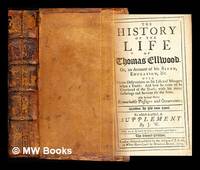
1714287468London : Printed and sold by the assigns of J. Sowle 1714. Second Edition. Softcover. Poor copy in the original stiff-card wrappers; wear and tear as with age. Text remains in fine condition and without blemish. Physical description; 32 478 2 32 pages ; 20 cm. Subjects; Ellwood Thomas 1639-1713. Society of Friends Great Britain. Society of Friends. Society of Friends ; Biography. Quakers ; Biography. Society of Friends ; Early works to 1800. Tithes ; Early works to 1800. London : Printed and sold by the assigns of J. Sowle paperback
17955274London: J. Ridgway 1795. Fourth Edition. Fourth edition. Measuring approximately 8.75" x 5.5" with 153 numbered pages. <br /> <br /> This book is in poor condition. Heavy chipping to entire spine. Heavy scuffing to both boards. Front board completely detached. Previous owner's handwriting on front pastedown and endpaper. Interior pages are moderately foxed. <br /> <br /> "The Rolliad" in full "Criticisms on the Rolliad" is a work of British satire directed principally at the administration of William Pitt the Younger the British statesman and Prime Minister. It was written and originally published in serial form in the Morning Herald in 1784–85.<br /> <br /> Please view the many other rare titles available for purchase at our store. We are always interested in purchasing individual or collections of fine books.<br /> <br /> Inventory number N11-11. J. Ridgway unknown
175244635Stockholm Lars Salvius 1752-53 Folio. 33x22 cm Stor helt ubeskåret eksemplar i orig. blødt blankt papbind. rester af titelskrift på ryg. Kobberstukket frontispiece = planche I. 121008101-260. Med ialt 30 kobberstukne plancher Nummererede II-XXIX komplet og med det lille stik indsat ved p. 6 de fleste store dobbeltsidede. 2 kort hvor det sidste er kobberstukket gengivelse af 2 Ptolemaeus-kort fra 1513-udgaven planche XXIX. 33 x 43 cm. Indvendig aldeles frisk eksemplar uden pletter trykt på skrivepapir. <br/><br/><em>Blandt planchernme kan nævnes Kungsbacka Varberg Falkenberg Halmstad Laholm Vinbergs Holms og Getinge Kirker Skottorp etc.Warmholtz 610: ""Lycka var at Döden ryckte pennan ur handen på Författaren eljest hade Kronan blifvit belastad med ännu mera Maculatur" ! </em> unknown
1762ANT70251762. Law William Leather bound first edition of the complete works; each work is separately paginated there are 19 works in all. The volumes are bound in rubbed and crudely but soundly respined full tree calf. The endpapers and title leaves have General Theological Seminary Library New York bookplates. There is some light foxing in places and the last 60 leaves of the volume eight have marginal creases and tears without loss. hardcover
1792777P34London: T. and J. Egerton 1792. Cloth. Very Good. 9.5" by 7.5". Jonathan Richardsom. An illustrated collection of the works of Jonathan Richardson containing his best known and most influential works such as 'An Essay on the Theory of Painting'. A collection of the influential works of Jonathan Richardson including 'The Theory of Painting' 'Essay on the Art of Criticism' and 'The Science of a Connoisseur'.Richardson was an English artist known for his work as a portrait painter. His work 'An Essay on the Theory of Painting' inspired Joshua Reynolds.Illustrated with twelve plates.Collated complete.Half-title is present. Rebound in a cloth binding with new endpapers. Externally generally smart with some marks to the boards and spine. Fading to the spine and boards. Internally firmly bound. Pages are lightly age-toned with some odd spots. Light tidemark to the head of the plates. Very Good T. and J. Egerton hardcover
1787619L3London: James Ridgway 1787-1788. Leather. Good. 8.5" by 5.5". None. Two collections of satirical poetry bound as one being an early edition of the satirical poem directed at William Pitt's the younger's administration. The eighth edition of this satirical poem directed at the administration of William Pitt the Younger. A collaborative effort this work takes the form of a piece of literary criticism of the epic poem 'The Rolliad'. With an engraved frontispiece and engraved title page. This work was originally published in a serial form for the early daily newspaper the 'Morning Herald' from 1784-1785. This work is a very early if not first edition in book form. The main victim of this satire is John Rolle MP for Devon but further individuals mentioned include William Pitt Henry Dundas and Charles Jenkinson. This poem was written by Joseph Richardson George Ellis Richard Tickell French Laurence and Richard FitzPatrick. The second work to this volume is Sir John Hawkins' Probationary Odes. The seventh edition of this work. With publisher's adverts for Ridgway to the start of the work. Being an anthology of satires and parodies by Richard Tickell and others purporting to be the competitive essays of Thomas Warton's rivals for the laureatship. ESTC Richard Tickell was an English playwright and satirist. With the bookplate of one Alexander Adair to the front pastedown. This is likely to be the Adairs of Flixton Hall. Alexander Adair was the great grandson of Sir robert Adair of Ballymena and Custos Rotulorum of County Antrim. In a full calf binding. Externally generally smart. Patches of light rubbing to the extremities and to the spine. Front joint and hinge are tender with cords showing. Rear hinge and joint are tender with cords showing. Lacking portions of spine label. Prior owner's bookplate to the front pastedown Alexander Adair. Internally firmly bound. Pages are generally bright with just the odd spots. Good James Ridgway hardcover
1764FB367 (1 to 6) /4C<p>Leather binding with black and red title plates.</p><p>Volumes I. to VII. but <strong>volume III. is missing.</strong></p><p><strong>A noteworthy collection.</strong> <strong><em>Clarissa; or The History of a Young Lady: Comprehending the Most Important Concerns of Private Life. And Particularly Shewing the Distresses that May Attend the Misconduct Both of Parents and Children In Relation to Marriage</em></strong> is an epistolary novel by English writer Samuel Richardson published in 1748. It tells the tragic story of a young woman Clarissa Harlowe whose quest for virtue is continually thwarted by her family. The Harlowes are a recently wealthy family whose preoccupation with increasing their standing in society leads to obsessive control of their daughter Clarissa. It is considered one of the longest novels in the English language based on estimated word count. It is generally regarded as Richardson's masterpiece. In 2015 the BBC ranked <em>Clarissa</em> 14th on its list of the 100 greatest British novels. In 2013 <em>The Guardian</em> included <em>Clarissa</em> among the 100 best novels written in English.</p><p><strong>PLOT SUMMARY </strong> Robert Lovelace a wealthy "libertine" and heir to a substantial estate begins to court Arabella Clarissa's older sister. However she rejects him because she felt slighted by his more ardent interest in her parents approval than in her. Lovelace quickly moves on from Arabella to Clarissa much to the displeasure of Arabella and their brother James. Clarissa insists that she dislikes Lovelace but Arabella grows jealous of Lovelace's interest in the younger girl. James also dislikes Lovelace greatly because of a duel which had occurred between the two of them. These feelings combine with resentment that their grandfather had left Clarissa a piece of land and lead the siblings to be aggressive to Clarissa. The entire Harlowe family is in favour of her marrying Roger Solmes however Clarissa finds Solmes to be unpleasant company and does not wish to marry him either. This makes her family suspicious of her supposed dislike of Lovelace and they begin to disbelieve her. The Harlowes begin restricting Clarissa's contact with the outside world by forbidding her to see Lovelace. Eventually they forbid her to either leave her room or send letters to her friend Anna Howe until Clarissa apologises and agrees to marry Solmes. Trapped and desperate to regain her freedom Clarissa continues to communicate with Anna secretly and begins a correspondence with Lovelace while trying to convince her parents not to force her to marry Solmes. Neither Clarissa nor her parents will concede. They see her protests as stubborn disobedience and communication between parents and daughter breaks down. Lovelace convinces Clarissa to elope with him to avoid the conflict with her parents. Joseph Leman a servant of the Harlowes shouts and makes noise so it may seem like the family has awoken and discovered that Clarissa and Lovelace are about to run away. Frightened of the possible aftermath Clarissa leaves with Lovelace but becomes his prisoner for many months. Her family now will not listen to or forgive Clarissa because of this perceived betrayal despite her continued attempts to reconcile with them. She is kept at many lodgings including unknowingly a brothel where the women are disguised as high-class ladies by Lovelace so as to deceive Clarissa. Despite all of this she continues to refuse Lovelace longing to live by herself in peace. Lovelace is too cynical to believe that virtuous women exist and he is desperately trying to seduce Clarissa despite declaring that he loves her. Although he puts her under increasing pressure to submit Clarissa does not waver. Under the pretence of saving her from a fire Lovelace at last gains entry to Clarissa's bedroom but she thwarts his attempted assault with vigorous resistance. She promises under threat of rape to forgive and marry him. However she considers this promise made under duress as void; soon after she makes her first successful escape from Lovelace concealing herself in lodgings in Hampstead. Enraged by Clarissa's flight Lovelace vows to seek revenge. He hunts her down to the lodgings where she is hiding and rents all the rooms around her effectively trapping her. He hires people to impersonate respectable family members of his in order to gain her trust. During this time he intercepts a letter to Clarissa from Anna Howe warning her of true extent of his deception and roguery. He commits forgery to put an end to the communication between them. Eventually he persuades Clarissa to accompany his imposter-relatives out in a carriage and thus carries her back to the disguised brothel. There with the assistance of the prostitutes and brothel madam he first drugs and then rapes her. After the rape Clarissa suffers a loss of sanity for several days presumably brought on by her extreme distress as well as the dose of opiates administered to her. This temporary insanity is represented in her "mad letters" by the use of scattered typography. When Clarissa recovers her senses Lovelace soon realises that he has failed to "subdue" or corrupt her; instead she is utterly repulsed by him repeatedly refusing his offers of marriage despite her precarious situation as a fallen woman. She accuses him of deceiving and unlawfully detaining her and insists that he set her free. He continues to claim that the impersonators really were his family members and that his crime was simply one of desperate passion. He tries to convince her to marry him alternating between threats and professions of love. She steadfastly resists and attempts several more escapes. Lovelace is forced to concede that Clarissa's virtue remains untarnished but he begins to convince himself that the "trial" was not properly conducted. Since Clarissa was drugged at the time she could consent nor refuse. He decides to orchestrate a second rape but without drugs. Pretending to be angered by the discovery that she has bribed a servant to help her escape Lovelace begins to menace Clarissa intending to escalate the confrontation to physical violence but she majestically condemns his premeditated villainy and threatens to kill herself with a penknife should he proceed. Utterly confounded by her righteous indignation and terrified by her willingness to die for her virtue Lovelace retreats. More intent than ever to make Clarissa his wife Lovelace is called away to attend his dying uncle from whom he is expecting to inherit an Earldom. He orders the prostitutes to keep Clarissa confined but well-treated until he returns. Clarissa escapes however. The brothel madam is able to have her jailed for a few days for unpaid bills and Clarissa finds sanctuary with a shopkeeper and his wife when she is released. Corresponding with Lovelace's real family she discovers for herself the true extent of his deception. She lives in constant fear of again being found by him who continues to send her marriage offers through his disreputable friend John Belford as well as through his own family members. Clarissa is determined not to accept. She becomes dangerously ill from the stress rarely eating convinced that she will die soon. Her illness and probable anorexia progress. She and Belford become correspondents she appointing him executor of her will as she puts all of her affairs in order to the alarm of the people around her. Belford is amazed at the way Clarissa handles her death and laments what Lovelace has done. In one of the many letters sent to Lovelace he writes "if the divine Clarissa asks me to slit thy throat Lovelace I shall do it in an instance." Eventually surrounded by strangers and her cousin Col. Morden Clarissa dies in the full consciousness of her virtue and trusting in a better life after death. Belford manages Clarissa's will and ensures that all her articles and money go into the hands of the individuals she desires should receive them. Lovelace departs for Europe and continues to correspond with Belford. Lovelace learns that Col. Morden has suggested he might seek Lovelace and demand satisfaction on behalf of his cousin. He responds that he is not able to accept threats against himself and arranges an encounter with Col. Morden. They meet in Munich and arrange a duel. Morden is slightly injured in the duel but Lovelace dies of his injuries the following day. Before dying he says "let this expiate!" Clarissa's relatives finally realise they have been wrong but it comes too late. They discover Clarissa has already died. The story ends with an account of the fate of the other characters.</p><p><strong>Samuel Richardson</strong> baptised 19 August 1689 – 4 July 1761 was an English writer and printer best known for three epistolary novels: <em>Pamela; or Virtue Rewarded</em> 1740 <em>Clarissa: Or the History of a Young Lady</em> 1748 and <em>The History of Sir Charles Grandison</em> 1753. He printed almost 500 works in his life including journals and magazines working periodically with the London bookseller Andrew Millar. Richardson had been apprenticed to a printer whose daughter he eventually married. He lost her along with five sons but remarried and had four daughters who reached adulthood but no male heirs to continue the print shop. As it ran down he wrote his first novel at the age of 51 and immediately joined the admired writers of his day. Leading figures he knew included Samuel Johnson and Sarah Fielding the physicians Behmenist and George Cheyne and the theologian and writer William Law whose books he printed. At Law's request Richardson printed some poems by John Byrom. In literature he rivalled Henry Fielding; the two responded to each other's literary styles.</p> J Rivington.