AnonymousABAA
1 résultat
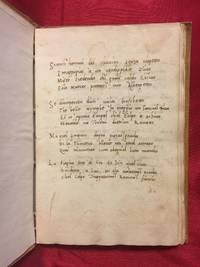
15102973Venice 1510. 8vo. in fours. Collation: A-Q4 COMPLETE. 64 ff. some signatures written in contemporary MS several erroneously neat modern foliation in pencil. Paper size: 155 x 105. Watermarks: Northern Italy ca. 1480-1520 see below. Bound in late 18th century Italian sprinkled ochre boards upper cover with title in MS. Text in Italian and with the titles of several poems in Latin. Several types of Italian humanistic literae cursivae all apparently by the same person see images below numerous corrections throughout. Fascinating Unknown Venetian Manuscript of Unpublished Sonnets and Love Letters ca. 1510.<br/><br/>An important discovery. Unknown manuscripts of unpublished Italian poetry written in Venice during the age of Aldus Manutius are rare in private ownership. The present manuscript contains 100 poetical compositions sic and merits considerable scholarly inquiry: certain sonnets and poems were extensively revised showing authorial development; the handwriting is perfectly clear in some instances modeled after contemporary Italian writing masters; and finally the codex is preserved in remarkably fresh condition and is perfectly suitable for exhibition and intensive study. <br/><br/>The manuscript consists mainly of sonnets in the style of Petrarch several capitoli and strambotti and includes many revisions variants and even cancellations to which two intriguing love letters were added. The name of the author is unknown but his identity may yet be discovered as he left a number of intriguing clues in the text the most obvious one being the family name Colonna famous in Venice and Rome and the names of several of his muses. <br/><br/>Certain sonnets exhibit handwriting reminiscent of Giovanni Antonio Tagliente ca. 1460s - ca. 1528 who worked for the Venetian Chancery and whose "Lo presente libro" Venice 1524 continues to inspire modern-day calligraphers and typographers. We may also reference the work of writing master Ludovico Vicentino degli Arrighi 1475-1527 who seems to have started his career in Venice before becoming a Papal scribe and type designer. <br/><br/>That the MS was written over a long period in some instances interpolated on formerly blank leaves is attested by the changes in handwriting and ink. To illustrate the development of the codex itself we propose an artificial division of four sections: <br/><br/>¶ Section A contains 42 sonnets written in the litera cursiva styles A and B. The neat humanistic handwriting is comparable with that used by contemporary Venetian scribes. If the text had been copied from previous drafts it is clear that the author remained unsatisfied as there are a number of substantive revisions in the text. In the upper margin of eleven sonnets were written the title of the poem - in Latin - at some point in the life of the MS. Two sonnets in this section were cancelled by the author. ¶ Section B contains 32 poems written in the litera cursiva styles C-G. These were presumably written in the same period except for some interpolated sonnets that were written slightly afterwards. ¶ Section C contains 16 poems one of which bears the date 27 Ianuarij 1510 fol. 46v. This section surely contains poems written in a different period including two sonnets fol. 49r-v that were written in the humanistic litera cursiva style A which begins the MS. ¶ Section D contains two Love Letters plus an Addenda of 10 "new" poems and capitoli hastily written. <br/><br/>That the author may have had thoughts on publishing his work is suggested by the "printer's signatures" that were written by him in ink in the lower margins of the first 16 leaves. If such a book was ever printed it has not been located; indeed not even a single poem has been traced see below for a complete Index Poematum. <br/><br/>The fact that the author never signed his work may be due to the private and very personal contents of this Canzoniere. The work was probably begun by the author as a young man and for years it served as a vehicle of consolation for unrequited love. <br/><br/>Faustina Helena Colonna Laura Arianna<br/><br/>In the first sonnet Stanch'ormai dal cacciar senza rispetto fol. 1r the author claims to have met "three beautiful nymphs" during a break from hunting. A possible connection to the Colonna family is first suggested in Sonnet II A una colonna d'alabastro fina 1v in which the poet declares his eternal lover for Faustina "ni altra Dea adorerò ch'a Faustina." The word colonna is found in other compositions throughout the Canzoniere suggesting that at least one of the author's muses was a member of the famous Colonna family. Sonnet XVIII Ardo piango sospiro et a tutt'hore 9v ends with the verse chiedendo sempre a un cor di marmo a una colonna viva "always begging a marble heart a living column" again suggesting by means of a well-crafted literary image the Colonna family. Most importantly the actual name "Helena Colonna" appears as the caption heading to Sonnet LXXXII Da una marmorina Alta colonna 48v. Lady Colonna may be referenced in the first Love Letter 53v in which the author describes her as alta colonna di mia vita "high column of my life". No longer is the Colonna surname obscured behind imagery. <br/><br/>The promise of endless love to Faustina was not kept unless the author cleverly utilized more than one name for the same woman a not-uncommon practice in this particular genre. Two other names appear herein namely Laura and Arianna. That the author may have had changes of heart might be due to the fact that he seems to have written the poems over an extended period of time see images of the handwriting development A-G and is therefore a record of failed love years in the making. The sonnets reflect perpetual desperate longing almost always to the point of death. How could it be otherwise<br/><br/>The Philosopher and His "Poetessa" Muse<br/><br/>In Sonnet LI I' solea ben la penna et l'intelletto 28v the author states quite clearly that the object of his desire was also a poet declaring that a mortal blow has pierced his side because he has lost the paper the ink and each amorous rhyme of his Lady's verse persi la carta l'inchiostro e ogni amoroso detto. The author claims that he is much better at writing about philosophy:<br/><br/>Smaritha quella strada. altro sentiero<br/>Hora mi è scorta mi governa et regge<br/>Qual va fina Avicenna e agli aphorismi<br/>Ove Signor si vostre rime egregge<br/>Non han da me risposta: a dirvi 'l vero<br/>Mi torna meglio scriver Syllogismi.<br/><br/>"The road is lost. A different path is now taking me to Avicenna the philosopher and to Aphorisms where Lady your excellent rhymes have no answer; to tell you the truth I'm better in writing Syllogisms." Thus the identity of the author a "reluctant poet" may be found among contemporary Venetian philosophers. <br/><br/>Index Poematum<br/><br/>Section A litera cursiva styles A and B:<br/><br/>I. Stanch'ormai dal cacciar senza rispetto "Stanch' hormai dal chacciar senza rispetto" fol. 1r<br/>II. A una colonna d'alabastro fina 1v<br/>III. Deponni l'archo la pharetra Amore 2r: textual corrections<br/>IV. Deh! Potess'io canggiar tecco mia sorte 2v: caption title in Latin<br/>V. Non posso più celar la fiamma ardente 3r: caption title in Latin<br/>VI. Era tutto coperto d'adamante 3v: caption title in Latin textual correction<br/>VII. Vedendo de gli fior le Vite corte 4r: caption title in Latin textual correction<br/>VIII. Vaten felice Aventurata Rosa 4v: caption title in Latin<br/>IX. L'esca gli stral et l'amorosa Rete 5r: caption title in Latin<br/>X. Quando sera quel giorno che chi m'have 5v: the entire sonnet cancelled<br/>XI. Dolce m'e 'l giogo et la pregion men grave 6r: caption title in Latin<br/>XII. La singular mia fede che vi porto 6v: entire sonnet cancelled<br/>XIII. Ardo d'Amor et ho la fiama viva 7r: caption title in Latin textual corrections<br/>XIV. Donna gentil fin hor son sta patiente 7v: caption title in Latin<br/>XV. Se mai per tempo alchun mi vedrò sciolto 8r: caption title in Latin<br/>XVI. Amor un dolce viso teso havea 8v: caption title in Latin<br/>XVII. Madonna ogni mio ben da dolci Rai 9r<br/>XVIII. Ardo piango sospiro et a tutt'hore 9v<br/>XIX. Qual vero Pregionier al sacro Tempio 10r<br/>XX. Sono doi animali un de si altera 10v<br/>XXI. Un scoglio d'una Pietra è tanto ardita 11r<br/>XXII. Amor in guisa d'huom che guerra aspetta 11v<br/>XXIII. Il mie Adversario a cui in tutte l'hore 12r<br/>XXIV. Amor nel volto mio ben più di mille 12v<br/>XXV. Sapete che ben solo me nutrisco 13r<br/>XXVI. Una che qui tra noi excider suole 13v<br/>XXVII. Si questo e ver Amor como se dice 14r<br/>XXVIII. Donna gentil mi sento 14v<br/>XXIX. Deh! Perché non vi è noto il mio dolore 15r<br/>XXX. Se gli è pur mio destin ch'amando i' rompa 15v<br/>XXXI. Sempre vidi Iustìa star accorta 16r<br/>XXXII. Come voi ho et d'enverno et d'estate 16v: textual corrections<br/>XXXIII. D'un verdeggiante Lauro un giorno Amore 17r: textual corrections<br/>XXXIV. Gli occhi leggiadri ove ch'alberga Amore 17v: final line verse rewritten in an 18th century hand<br/>XXXV. S'io fusse di sospir Et pianto privo 18r: extensively revised then completely cancelled<br/>XXXVI. Gratie che a pocche donne Amor concede 18v<br/>XXXVII. Occhi miei lassi ho ben mirare Fiso 19r: textual corrections<br/>XXXVIII. Il Pellegrin avintto dal disio 19v: textual corrections<br/>XXXIX. Il Chacciator che nel bosco la Ferra 20r<br/>XL. Smarite piaggie ov'hor piangendo torno 20v<br/>XLI. Mille fiate al di m'assale Amore 21r<br/>XLII. Ogni luocho mi spiace ov'io non trovo 21v<br/><br/>fol. 22r: S'io fusse de sospir et pianto privo: variant of Sonnet XXXV hastily written as a draft<br/>22v-23r: two pages of verse extensively revised and then apparently abandoned<br/>23v: blank<br/><br/>Section B litera cursiva styles C-G<br/><br/>XLIII. Amor Fortuna a sì'nfelice Sorte 24r<br/>Fol. 24v: blank<br/>XLIV. Lasso credendo haver pur qualche pace 25r: textual corrections<br/>XLV. Scoprir non posso l'amorosa fiama 25v<br/>XLVI. Miser vo pur scorgendo a passo: a passo 26r: textual corrections<br/>XLVII. Miser tutto ardo Et piango a tutte l'hore 26v<br/>XLVIII. Io viverei con la Phenice a prova 27r<br/>XLIX. Per la merce dil mio si longo affanno 27v<br/>L. Gli occhi beati intorno han l'esca e'l visco 28r: textual corrections<br/>LI. I' solea ben la penna et l'intelletto 28v<br/>LII. Sotto rara beltà nascosto è l'hamo 29r: textual corrections including one stanza cancelled<br/>LIII. Piango cantando 'n rime il mio lamento 29v: textual corrections<br/>LIV. Qual dolce mana qual esca qual visco 30r: introduction of "Laura"<br/>LV. Quando Madonna con dolci parole 30v<br/>LVI. In fronte meco i' porto l' ben e il male 31r: textual corrections<br/>LVII. Occhi ove ch'Amor sovente tresca 31v: textual corrections LVII and LVIII are written on the same page but in different handwriting styles<br/>LVIII. Che il tempo si consuma ogni fier cosa 31v: textual corrections<br/>LIX. Sol per farmi gustar mana in veneno 32r<br/>LX. Baso ogni giorno mille et mille volte 32v<br/>LXI. N'anti ch'entrasse un'hora me ritrovo 33r<br/>Fols. 33v-34r: blank<br/>LXII. Lauda le ver ch'ogni fidel amante 34v<br/>LXIII. Laura soave che si dolcemente 35r: reintroduction of "Laura"<br/>LXIV. Deh! Vi fusse si noto quanto ch'io ardo 35v<br/>Fol. 36r: blank<br/>LXV. Si come è vagho un vivido colore 36v: a capitolo written for "Arianna" <br/>LXVI. Maraveglia non è si ho mesto il volto 37r<br/>LXVII. Chi non vedrà quanto è mia bella 37v<br/>LXVIII. Dovran per mostrar gran maraviglia 38r<br/>LXIX. Si come è bello un vivido colore 38v: preliminary verses corrected cancelled and apparently abandoned<br/>LXX. Se mai per altra donna i' rompo fede 39r<br/>Fols. 39v-40r: blank<br/>LXXI. Et copre donna quel candido seno 40v: caption heading: "Laura S. C." <br/>LXXII. Amor da cui mai fu troppo lontano 41r<br/>LXXIII. Quella ch'un tempo la ti piacque tanto 41v-42r<br/>LXXIV. S'el primo di che mi piacesti tanto 42r-43r: ending with "Telos" in Greek<br/>Fol. 43v: blank<br/><br/>Section C:<br/><br/>LXXV. Vaga et smarita va Phylosophia 44r<br/>LXXVI. Spirto gentil in cui valor si trova 44v<br/>LXXVII. Occhi che nel mio cor fate il bel nido 45r<br/>LXXVIII. Gli occhi ove scherzar si vede amore 45v: textual corrections<br/>LXXIX. S'el vivo Sol et le doi chiare Stelle 46r: dated 27 January 1510 at Venice "M.E."<br/>LXXX. La meggia notte facea meggio giorno 46v: textual corrections <br/>LXXXI. Gratie da gli occhi uscian sante et si nove 47r: textual corrections <br/>Fols. 47v-48r: blank<br/>LXXXII. Da una marmorina Alta colonna 48v: textual corrections; caption title: "Helena Colonna" <br/>LXXXIII. Istarò sempre come scoglio al onde 49r<br/>LXXXIV. Ogni supplitio dammi ogni martoro 49v <br/>LXXXV. Questo già non pensai superba Altera 50r<br/>LXXXVI. Deh! Pensa un poco a la mia Iniqua sorte 50v <br/>LXXXVII. Da poi che per amar son gionto a morte 51r<br/>LXXXVIII. Non è cosa mortal benchè in fra sphera 51v<br/>LXXXIX. Ben è infelice chi in fra mondo ingrato 52r<br/>XC. Se dil mio amor volevi esser felice 52v: textual corrections<br/><br/>Section D Sigs. O-Q4:<br/><br/>NB: These three gatherings have a waterstain which does not appear in any of the preceding gatherings or individual leaves. <br/><br/>First Letter: Honoranda et singular mia Diva la cui imagime como richo thesoro explicit: Vale o et praesidium et dulce decus meus 53r-54v<br/>Second Letter: Suolsi communemente dire almo mio Sole explicit: Vale. 54v-55v<br/>XCI. Così come un sasso accorto et destro 55r<br/>XCII. Né illegible word d'haver più pena vale 55r<br/>XCIII. A che mostrarmi pace nel aspetto 56v<br/>XCIV. Io son contento poi che m'hai nel Iocho 57r-57v<br/>XCV. Sacro santo mio nome Alma mia stella 58r-59r: caption heading: "Capitolo" / Finis<br/>XCVI. Rotto e carcho d'amor spreciato e l'arco 59r-60v: caption heading: "Capitolo" / Finis<br/>XCVII. Un dolce laccio ha fatto amore 61r-61v: textual corrections; caption heading: "Capitolo" / "Telos" in Greek<br/>Fols. 62r-63r: blank<br/>XCVIII. Mai rosa fu si vagha nel mattino 63v: caption heading: "Strambotti"<br/>XCIX. De' Lumi da begli occhi discendea 63v: caption heading: "Strambotti"<br/>C. Doi occhi da far arder 64r: caption heading: "Sonetto"<br/>Fol. 64r: blank<br/><br/>WATERMARKS: As the book is an octavo the watermarks appear in the upper gutter margins and thus only one half appears at one time; however it has been possible to identify them especially with the aid of the countermarks "angle" and "lettre B". Chapeau: type of Briquet 3456 Venice 1499 and Briquet 3461 Udine 1521. Balance: type of Briquet 2575 Venice 1478 Briquet 2587 Verona et al. 1525. unknown books