"TB" (anonymous) T BBiblio.com
125 résultats
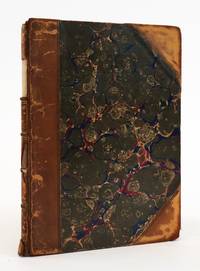
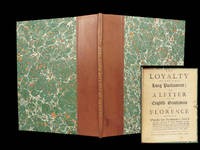
168129368<p>The Loyalty of the Last Long Parliament or A Letter to an English Gentleman at Florence by T.B. is a Restoration political pamphlet published in London in 1681 for Francis Smith Senior. This scarce tract engages with the heated debates over Parliament's conduct and the scope of royal prerogative during Charles II's reign specifically addressing the "late Parliaments" and contrasting them against the long-continuing Parliament of earlier decades. The text notably cites the king's remarks of 20 February 1663 situating its arguments within the broader context of Stuart governance. Such ephemeral political works rarely survive making this copy an important witness to the polemical press of the late seventeenth century. Condition: Very Good with secure leather spine and marbled boards showing only light external wear; the binding remains firm and sound. The text block is tight pages are complete and the paper exhibits only mild age toning without major blemishes. Book format: Octavo 8vo single volume. Collation: 20 pp. Illustrations: None. Edition: First edition 1681. References: Not cited in standard bibliographies but relevant to works on Restoration parliamentary history. Item Number SKU: #29368. PHOTOS AVAILABLE UPON REQUEST.</p> for Francis Smith, Senior hardcover
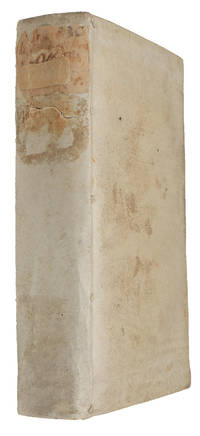
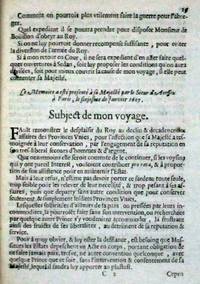
165061357Paris 1650. 12mo. In contemporary limp vellum. Paper-label pasted on to top of spine. Small tear to spine otherwise a nice and clean copy. 2 333 3 96 pp. <br/><br/><em>The uncommon first edition of the account of the trial of Louis de Marillac who was decapitated on 10 May 1632 at the Place de Grève in Paris. The present work function as part two of “Memoires du cardinal de Richelieu†but is a separate work in itself. </em> hardcover
16181001771618. In 's Graven-Haghe By Hillebrandt Iacobsz woonende aende Marckt. Anno 1618. 37pp. Unbound. unknown
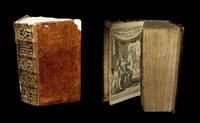
1695206221695. A Cologne chez Jean de La VÂŽritÂŽ 1695 puis : A Paris chez Anthoine sic Antoine Palmier 1696. 2 ouvrages reliÂŽs en 1 fort vol. au format in-16 142 x 78 mm de 1 frontispice gravÂŽ n.fol. 1 f. n.fol. et 323 pp. ; 1 frontispice gravÂŽ n.fol. et 437 pp. Reliure de l'ÂŽpoque de plein veau mouchetÂŽ brun plats jansÂŽnistes dos ˆ nerfs ornÂŽ de filets gras ˆ froid filets dorÂŽs caissons d'encadrement dorÂŽ large dÂŽcor fleuronnÂŽ dorÂŽ roulettes verticales et semis de pointillÂŽs dorÂŽs palette dorÂŽ en tÂte et queue dentelle dorÂŽe sur les coupes toutes tranches mouchetÂŽes. Edition originale pour chacun de ces textes ; s'ouvrant tous deux sur un joli frontispice gravÂŽ. Seule une notice localisÂŽe au CCfr pour l'ouvrage consacrÂŽ ˆ Boufflers. Cioranescu I Bibliographie de la littÂŽrature franÂaise du 17e siÂcle17067 pour le premier texte - Gay II Bibliographie des ouvrages relatifs ˆ l'amour . 537 pour le second. Angles ÂŽlimÂŽs ; l'un a ÂŽtÂŽ renforcÂŽ ˆ l'aide d'un petit morceau de papier blanc. Coiffes arasÂŽes. Dos prÂŽsentant un ÂŽclat lÂŽgÂrement altÂŽrÂŽ ainsi qu'un petit manque marginal. Deux t‰ches en tÂte du second plat. Infime perforation affectant le frontispice du premier ouvrage. Bonne condition intÂŽrieure n'excluant toutefois pas quelques lÂŽgÂres marques d'usage. Rare. b42961 unknown
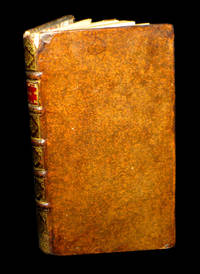
1691132901691. A Cologne chez Jean Sambix le Jeune 1691. Un vol. au format pt in-12 ÂŽtroit 153 x 88 mm de 2 ff. bl. 159 pp. et 2 ff. bl. Reliure de l'ÂŽpoque de plein veau mouchetÂŽ havane plats jansÂŽnistes dos ˆ nerfs ornÂŽ de filets gras ˆ froid roulette dorÂŽe sur les nerfs caissons d'encadrement dorÂŽs larges fleurons dorÂŽs semis de pointillÂŽs dorÂŽs piÂce de titre de maroquin vieux-rouge titre dorÂŽ palette dorÂŽe en tÂte et queue dentelle dorÂŽe sur les coupes toutes tranches mouchetÂŽes. ''Ouvrage dont l'ÂŽdition originale est de 1690 a aussi ÂŽtÂŽ imprimÂŽ sous le titre d'Esprit de Gerson. Quelques auteurs l'ont attribuÂŽ ˆ Claude de Saint-Georges''. in Barbier. ''Cet ouvrage fut fait pour la dÂŽfense des immunitÂŽs privilÂges libertÂŽs des ambassadeurs de France ˆ Rome o elles leur ÂŽtaient contestÂŽs par le gouvernement pontifical. Jean Charlier docteur de Sorbonne connu sous le nom de Gerson village du diocÂse de Reims o il naquit en 1363 fit ses ÂŽtudes ˆ Paris. Il assista aux conciles de Pise et de Constance et y eut une grande influence. Il mourut ˆ Lyon en 1429. Quelques auteurs l'ont regardÂŽ comme le vÂŽritable auteur de l'Imitation de JÂŽsus-Christ.'' in Gay. Favorable ˆ la voie de cession puis avocat de la cause conciliaire Gerson fut l'un des principaux thÂŽologiens du Concile de Constance procÂs de Jan Hus de 1415 et un acteur important de la fin du schisme. Il est notamment connu pour son projet de Çretour ˆ la foi pureÈ son engagement au service d'une vulgarisation du dogme et sa thÂŽorisation de la thÂŽologie mystique dans la lignÂŽe du Pseudo-Denys l'ArÂŽopagite et de saint Bonaventure. Son travail intellectuel sera marquÂŽ notamment par le combat contre le nÂŽo-platonisme et la logique de Duns Scot. Sa postÂŽritÂŽ se mesure aussi bien chez des penseurs rÂŽformÂŽs Luther Calvin que chez des penseurs catholiques tels que saint FranÂois de Salles. LettrÂŽ de premier ordre il appartient au groupe du premier humanisme franÂais aux c™tÂŽs de Nicolas de Clamanges Jean de Montreuil Gontier et Pierre Col. Il est un des tÂŽmoins du renouveau de la rhÂŽtorique et de l'ouverture aux conceptions littÂŽraires en provenance de l'Italie tel PÂŽtrarque. Barbier I Dictionnaire des ouvrages anonymes 451-d - QuÂŽrard V La France littÂŽraire p. 161 - Gay Saisie des livres prohibÂŽs faite au couvent des Jacobins et des Cordeliers ˆ Lyon en 1694. Infime dÂŽfaut en tÂte du dos. Quelques feuillets trÂs lÂŽgÂrement brunis. Nonobstant trÂs belle condition. b42961 unknown
1652121571652. A Paris s.ÂŽ. 1652. Un fort vol. in-4 262 x 178 mm de 2 ff. bl. 15 pp. 12 ff. n.fol. 168 pp. 218 pp. 424 pp. et 3 ff. bl. Reliure de l'ÂŽpoque de plein veau marbrÂŽ havane double filet dorÂŽ portÂŽ sur les plats dos ˆ nerfs ornÂŽ de filets gras ˆ froid doubles caissons d'encadrement dorÂŽs fleurons dorÂŽs titre dorÂŽ roulette dorÂŽe en tÂte et queue toutes tranches mouchetÂŽes. Edition originale rare. ''Bourzeis a ÂŽtÂŽ formÂŽ par les JÂŽsuites et devient jansÂŽniste ˆ son retour ˆ Paris sous l'influence du duc de Liancourt par opportunisme diront ses ennemis Camusat p. 155 et suiv. Camusat qui accorde une large place aux controverses dans lesquelles Bourzeis a ÂŽtÂŽ engagÂŽ p. 137-160 le dÂŽcrit comme Çun des plus francs et dÂŽterminÂŽs jansÂŽnistesÈ p. 136. De la soutenance de sa thÂse ÇPropositiones de gratiaÈ juin 1649 jusqu'ˆ la condamnation des cinq propositions de Jansenius par le pape Innocent X mai 1653 B. attaque sans rel‰che les JÂŽsuites en particulier le P. Petau en 1649. Il se rÂŽtracte en 1653 signe le formulaire et publie le 4 novembre 1661 une dÂŽclaration circonstanciÂŽe Camusat p. 155. A l'AcadÂŽmie il est le porte-parole des Anciens contre Charpentier lors de la querelle des Inscriptions en 1671. Ses adversaires ont rendu hommage ˆ son ÂŽrudition et ˆ son exquise courtoisie en particulier Charpentier dans sa DÂŽfense de la langue franÂaise pour l'inscription de l'Arc de Triomphe publiÂŽe en 1672 aprÂs la mort de B. Camusat p. 164-168.'' in Dictionnaire des journalistes. Desgraves I RÂŽpertoire des ouvrages de controverse . 4958 - Richard BibliothÂque sacrÂŽe p. 233. Angles ÂŽmoussÂŽs. LÂŽgers frottements affectant les plats. Coiffes arasÂŽes. Petit dÂŽfaut affectant le mors supÂŽrieur sans cependant nuire ˆ la soliditÂŽ de l'ensemble. Petite aurÂŽole en marge des premiers feuillets. Quelques rares rousseurs dans le texte et feuillets lÂŽgÂrement brunis. Du reste belle condition. Rare. b42961 unknown
1698280401698. A Paris Nicolas Le Gras 1695. Un vol. au format in-12 163 x 93 mm de 6 ff. n.fol. 1 carte dÂŽpliante gravÂŽe n.fol. et 316 pp. Reliure de l'ÂŽpoque de plein veau mouchetÂŽ acajou plats jansÂŽnistes dos ˆ nerfs ornÂŽ de filets gras ˆ froid caissons d'encadrement dorÂŽs larges fleurons dorÂŽs piÂce de titre de maroquin brune titre dorÂŽ palette dorÂŽe en queue dentelle dorÂŽe sur les coupes. Rare relation ; complÂte de sa jolie carte dÂŽpliante gravÂŽe laquelle est dÂŽsolidarisÂŽe et prÂŽsente en outre dÂŽchirures et plissures. Exemplaire complet en tant que tel. Angles ÂŽlimÂŽs. Petit manque superficiel en marge du premier plat. Coiffe de tÂte accidentÂŽe. Frottements affectant le dos. Cerne claire affectant les fonds de cahiers de plusieurs feuillets. Quelques claires rousseurs et plissures angulaires. b42961 unknown
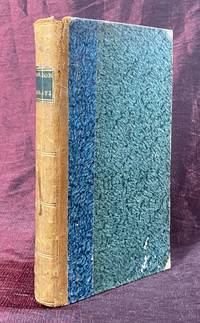
16873835Lugduni imprint false: likely printed in Germany 1687. First Edition. Very good. 8vo 180 x 100 mm. 8 295 pp. Later German quarter calf over decorated blue paper boards actually two different sheets were utilized printed waste utilized as spine lining the text is in Latin and French vellum corner tips black spine label gilt binding a bit worn all edges stained red. Paper defect on fol. H3 pp. 101/2 affecting five lines of text with loss paper stock foxed and somewhat browned as is common with Germany medical books at this date but a good unsophisticated copy with a few leaves unopened. UNKNOWN PHYSICIAN ARGUES AGAINST HEAVY SMOKING IN 1687. <br /> <br /> This curious medical book discusses in 65 chapters an uncharacteristically broad array of afflictions: vertigo vomiting stomach complaints "hypochondria" "melancholia hypochondriaca" ailments of the liver and spleen arthritis fever coughing grief scurvy bloody urine epilepsy asthma and much more. <br /> <br /> To these discussions are added a series of bewildering letters to various unknown recipients including an argument addressed to a young student AGAINST SMOKING TOBACCO "Ad juvenem quendam studiosum cui Nicotianae fumum dissuaseram" pp. 231-236. Here the anonymous author argues against the "noxious" smoke of tobacco "Nicotiana" which is an "enemy to human nature." But the author conceeds that "No one of a sound mind will deny that this plant has been endowed with amazing strength by God the greatest Creator." Also: "All other plants were created in vain and the earth was crushed by the useless weight of millions of plants in vain because the faculties of all other plants were in this one plant . that can by itself remove and quench both cold and hot disease." However the conclusion is that even "Moderate smoking is harmful but much more harmful to those who sin in excess." We learn that the tobacco plant "not only has the power of subverting the stomach but also has a certain narcotic capacity and if we are to believe the writers of Indian affairs it often produces wonderful visions." Such however should very rarely be put to use. Furthermore tobacco is harmful to the skin and flesh; if smoked frequently the brain is weakened by the narcotic power; nor does it help the eyes. Finally the author implores his young recipient to "abstain from daily smoking."<br /> <br /> No copy in the U.S. The BL copy lacks the title-page. <br /> <br /> BnF Catalogue des sciences médicales II p. 258. unknown
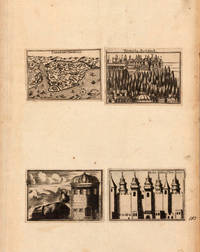
170021774Germany 1700-20. Other. Still in very good to excellent condition. The four small engravings each ca. 78 x 115cm pasted down on an atlas page. 78 by 115mm 3 by 4½ inches. 78 by 115mm 3 by 4½ inches. Copper engraving uncolored as published. Shown are Constantinoples Turkish residence Sieben Thürmen and the Patriarchen Kirche. unknown
1695097759La Haye: Etienne Foulque 1695. Leather Bound. pp. 259-556. Leatherbound. Five raised bands to spine title label chipped. Title page in red and black. Edges worn with some loss esp. to corner of rear board and head of spine contents complete and unmarked; very good. Volume two only of two. Etienne Foulque unknown
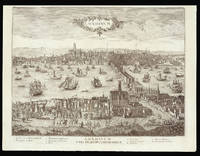
168712426Italy c1687-1730. Image: 395 by 510mm 15.5 by 20 inches. Sheet: 430 by 555mm 17 by 21.75 inches. Copper engraving. A Latin version of Pierre Aveline's view of London. Although the title cartouche has been changed the engraver has not changed the tower of St Paul's Cathedral to its post-Fire state. Although it is intended to represent contemporary eighteenth century London it still shows the Elizabethan theatres in Bankside. Scouloudi records this as a variant of the view published by Antoine Aveline 1691-1743 in the early eighteenth century but she does not record the copy published by his father Pierre Aveline. The present example could therefore be a variant on either the father's or the son's. Scouloudi pp.59-60. unknown
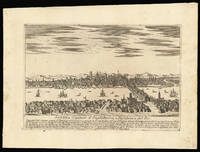
169012422Italy c. 1690. Image: 212 by 316mm 8.25 by 12.5 inches. Sheet: 288 by 391mm 11.25 by 15.5 inches. Copper engraving. An Italian view of the River Thames and the London skyline from a viewpoint above Southwark. The image is one of a number of derivatives of Pierre Aveline's prospect. The text underneath gives the reader information about London and England in general. The English have beautiful women "le donne sono bellissime" and the aristocracy is interested in science "inclinata alle Scienze" but the lower classes are insolent and volatile "insolenti e volubili" and the country is full of heretical sects. unknown
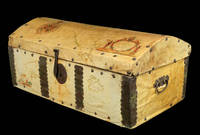
16902196Spain c1690. 320 by 740mm. 12.5 by 29.25 inches. Wooden chest clad in vellum manuscript maps with wrought iron handles rivets lock and clasp. A very unusual piece of cartographic history. It was common for seafarers to have sturdy wooden chests for storage whilst on a voyage but the owner of this chest chose to have it covered it with manuscript maps drawn on vellum possibly by their own hand with the decorative ironwork fitted on top. The lid is covered with a map of North and Central America with the Darien Isthmus labelled to the south and decorated with an elaborate compass rose and title cartouche supported by figures of Native Americans. The map on the front is decorated with a title cartouche showing a sea god. The sides are covered with maps of the East and West Indies decorated with ships. It is remarkable that the maps have survived given the treatment they would have encountered at sea. hardcover
16881577212024827<p><strong>Author:</strong> Anonymous.<br /><strong>Title:</strong> Nouveaux Interêts des Princes de l'Europe selon l'état que les affaires font aujourd'hui. Troisième édition.<br /><strong>Publisher:</strong> A Cologne Chez Pierre Marteau 1688. Third Edition.<br /><strong>Language:</strong> Text in French.<br /><strong>Size:</strong> 6 x 4 inches.<br /><strong>Pages:</strong> 355 pages.<br /><strong>Binding:</strong> Good contemporary full mottled calf binding spine with raised bands and richly gilt compartments red morocco lettering piece hinges fine overall worn and scuffed - as shown noticeable wear and rubbing to boards with chips and losses to the rear cover - as shown under a protective removable mylar cover. <br /><strong>Content: </strong>Good content tight some foxing or staining - as shown. Early ink ownership signature to front blank.<br /><br /><strong> </strong></p><p><strong>The book: </strong>A rare late-seventeenth-century political treatise examining the shifting balance of power among the principal states of Europe during a period marked by dynastic rivalry and the emergence of modern diplomacy. The work surveys the interests and strategic maxims of the leading monarchies and republics—including France Spain England the Empire and the Dutch Republic—offering insight into contemporary perceptions of international relations at the close of the age of Louis XIV. Issued under the imprint "Pierre Marteau" a well-known pseudonymous Cologne address often used for politically sensitive works the book reflects the vibrant clandestine publishing culture of the period. Despite the wear to the rear cover this copy retains a pleasing contemporary binding and a complete readable text making it an appealing survival of an important genre of early modern political literature.</p> A Cologne, Chez Pierre Marteau, 1688. Third Edition. hardcover
166617940s. l. Bruxelles Brussels: S. n. F. Foppens 1666. Fine. S. n. F. Foppens s. l. Bruxelles Brussels 1666 8 x 13.50 cm relié Anonymous first edition. The work bears number 2023 in the catalogue of Elzevirian editions Willems Vol. II. For the author see Barbier Dictionnaire des ouvrages anonymes. Contemporary full vellum binding with flaps. Smooth spine. Title in faded red ink. Rolland Le Vayer de Boutigny 1627-1685 was Master of Requests to Louis XIV and one of his influential advisors. Author of novels plays and short stories as well as political and legal treatises this book reveals that Boutigny was trained as a jurist. Peculatus designates the theft of public funds by those who administer them; it was punished by death under Roman law but not under French law. ""Under the Ancien Régime how many ministers were condemned for peculatus and extortion! How many chambers of justice were instituted to make the financiers who pillaged the treasury disgorge their gains in complicity with the superintendents of finance!"" Dictionnaire de droit criminel Doucet. The treatise on peculatus caused scandal; Boutigny was accused of defending Fouquet who a few years earlier had been arrested and accused of embezzlement which is why he wrote these Observations in dialogue form where he discusses the validity of the death penalty banishment and the history of French law regarding peculatus. S. n.[ F. Foppens] hardcover
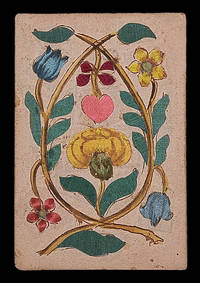
168021834Germany c1680. 93 by 65mm. 3.75 by 2.5 inches. A luxury silk and brocade deck 36 playing cards coloured silk and brocade laid between paper. The Maker There is no information on the present deck of cards about its maker but the nature of the materials used demonstrate that he or she must have been working for some extremely wealthy clients. The Cards The present cards are uniquely luxurious each one being comprised of layers of coloured silk and brocade laid between two sheets of paper. The different layers of fabric give the images added depth which reinforces the sense of meticulous craftsmanship. The janiform eagle which had been a symbol of the German emperors since the fifteenth century points towards a German origin for these cards. Indeed Hargrave records another deck of silk trappola cards from the seventeenth century which appear to have been made in Germany. It has been tentatively suggested that hearts represent France with Louis XIV as King; spades Russia with Peter the Great as Tsar - the jack bears the double headed-eagle of the Russian Empire; clubs the Holy Roman Empire with Leopold I as Emperor - he holds a shield bearing the imperial eagle; and diamonds the Ottoman Empire with - possibly - Mehmed IV as Sultan; the jack holds a falcon: falconry was one of the most popular pastimes in the Ottoman court. unknown
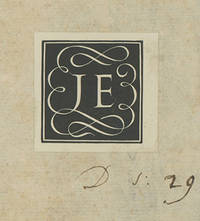
168928493London: Printed in the Year 1689 1689. First edition. ESTC R10117; Wing S5329; NCBEL I 1223 A. Marvell. Edges rubbed with some loss at the end and foot of the spine; hinges starting but sound; some spotting and small stains; very good copy. Folio contemporary sprinkled calf blind rules and decorations red morocco spine label gilt lettering "State / Tracts / Vol. / I" 28 tracts on English affairs during the reign of Charles II written mostly as anonymous pamphlets during the decade 1671-1681 and compiled here as an act of preservation "for the sole use of some particular Gentlemen who set an extraordinary value and estimate upon them." Politics and life under Charles II are the primary subjects with an emphasis on anti-Catholicism including poet Andrew Marvell's An Account of the Growth of Popery first published in Amsterdam in 1677. There was a second volume in 1692 and both volumes were reprinted together in 1693. See ESTC R17906 and R28848. From the library of prominent Englishman of the era John Evelyn 1620-1706 with the later JE bookplate on the front paste-down and contemporary ink manuscript shelf mark. Evelyn Library Part III Christie Manson & Woods March 16 1978 lot 1414; sold again at Sotheby's London December 3 1979 lot 35. A foolish modern owner has clumsily written in ink on the front free endpaper "Sotheby-London December 3 1979 Lot 35 - 1 of 4 all for . . . " The amount paid has been excised. London: Printed in the Year, 1689 unknown
16621381629London: s.n. 1662. First Edition. Hardcover. Small Quarto 2 pp. 5 - 134 2. In Good condition. Later three-quarter calf and marbled paper boards with significant wear to leather on spine lacking spine label. Boards are detached. Moderate wear to leather on boards light wear to edges and significant wear and chipping to leather along spine. Text block has moderate plus age toning to speckled edges significant age toning to front and back free end pages along edges moderate age toning to pages throughout interiorly and occasional ink marginalia in a seventeenth century hand. The bottom inch of page 131/132 has been torn away impacting the last four lines of text on both pages. An eight-line ink inscription appearing to be in an 18th century hand appear on the errata page "From the Printer to the Reader." listing errors found in the text. Text complete despite pagination. <br> <br> Shelved in Room G. EH Consignment.<br> <br> References: ESTC R21850; Sabin 98500. Henry Vane 1613-1662 emigrated from England to New England in 1635. A member of the most radical wing of the Puritans he was elected governor of Massachusetts in 1636 but returned to join the Long Parliament in 1637. Vane's stay in Massachusetts was tempestuous and he returned to England in 1637 to become a member of the Long Parliament though his interest in New England continued. After the Restoration he was imprisoned for two years convicted of treason and executed. The present text authored by a partisan in favor of Vane includes the speech Vane intended to give from the scaffold but was barred by the court. The speech argues for parliamentary sovereignty and other radical political ideas that proved influential among American colonists. 1381629. Special Collections. [s.n.] hardcover
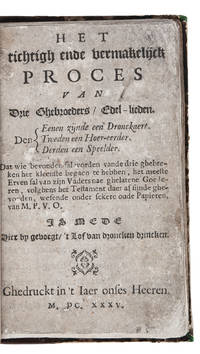
16351616Amsterdam 1635. Small 8vo 14.5 x 9 cm. Jacob Aertsz. Colom Half calf ca. 1830s with the binder's stamp on an endleaf F. DUQUESNE À GAND chemical marbled sides 2 black spine labels marbled endpapers. With 2 decorative initial letters castings made from woodcuts and a decoration made from cast fleurons on the title-page. The main text is set in roman type with long passages in italic and textura. 136 1 1 blank; 30 pp. Second known copy of the third edition 1635 of a rare satirical Dutch adaptation first and second editions 1634 of a moralistic story in Latin by Filippo Beroaldo 1453-1505 possibly intended in this adaptation to satirize the Princes of Orange. The quotations from classical sources are given in Latin each followed by a Dutch verse translation that takes some liberties with the text. Pieter Nootmans active 1627-1635 contributed a verse about the book printed on the back of the title-page. Following the main text is a drinking song by H. Rulant active 1632-1634 with its own part-title which had been published separately in 1632. We have located only one other copy of the present edition in the library of Tresoar in Leeuwarden.The British Library database of bindings includes one binding by this Ghent binder. The title-page is worn and dirty with a small abrasion obliterating the letter S in "Stichtigh" and the upper outside corner of the last leaf has been restored with the loss of a few words of the text of the added drinking song. The binding is good with some cracks in the hinges and minor damage along the edges.l KVK & WorldCat 1 copy; cf. Kruyskamp Jan Mommaert en het "Stichtelyck Proces" in: Het Boek XXX pp. 306-312 1640 ed. unknown
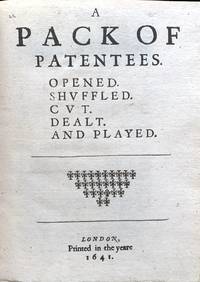
164117940London: n.p. 1641. FIRST EDITION. Type ornament device on title and woodcut headpiece. Polished calf signed “F. Bedford triple gilt fillet round sides spine gilt a.e.g. From the library of Lord Fairfax of Cameron with his armorial bookplate and the Huth bookplate lot 5630 Sotheby’s sale of July 17 1917. First edition of the very rare satire on the granting of monopolies. The anonymous author piles on the criticism of monopolies and patents granted on goods such as coal soap starch leather wine salt tobacco and butter. By the reign of James I patents had become so numerous and unfairly granted that they were considered oppressive and unjust to certain classes of people especially tradesmen and manufacturers. Except for “novel inventions†the King was finally forced to revoke all existing monopolies and declare that henceforth patents were only to be used for “projects of new invention.†This “Statute of monopolies†enacted in 1624 became the foundation for all later developments in patent law in England and elsewhere. It was a fundamental landmark in the transition of Britain’s economy from the feudal to the capitalist.<br /> <br /> Unfortunately James’s successor Charles I continued to abuse the patent system and it was only during the Restoration that the abuse was finally curtailed. The present work written during the reign of Charles I bitterly describes the injustices within certain trades and industries.<br /> <br /> Wing P156; ESTC locates 4 copies in North America Harvard Huntington NYPL McGill. n.p. unknown
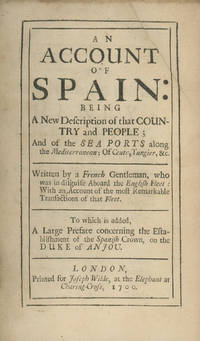
170028857London: Printed for Joseph Wilde at the Elephant at Charing Cross 1700 1700. First edition one of two variants. In this one the dedication is signed "E. L. ESTC R223814 records nine copies Durham Oxford Bodleian National Trust Folger UCLA Illinois Kansas Tennessee Beinecke; Wing A226C. Edges neatly repaired; a little browning and slight smudges in the text; very good copy. 8vo contemporary panelled sheep neatly rebacked with the original spine laid on brown leather spine label gilt decorations and lettering. Informed and lively observations on Spain at the end of the 17th century the political intrigues of the monarchy Spanish culture - including bull fighting and theater - and one allegorical tale entitled "The Story" about the "Monarchy of Philippia" all written in a series of letters to a Mr. Brunet from "His Devoted Friend R.--" who apparently visited Spain and northern Africa between 1694 and 1696. The "Epistle Dedicatory" signed "E. L." in this variant is signed "E. Lewis" in the other equally scarce variant. See ESTC R13796. London: Printed for Joseph Wilde, at the Elephant at Charing Cross, 1700 unknown
163027072à Paris: De l'imprimerie de Jean Martinet de Jean de Bordeaux 1630. Fine. De l'imprimerie de Jean Martin et de Jean de Bordeaux à Paris 1630 7.50 x 15 cm relié First edition rare of this collection of witticisms and funny stories published as a ""supplement"" to a reprint of the famous Les Délices ou Discours joyeux et récréatifs by Verboquet and since reprinted in its wake ""although it is probably not by the same author"" according to Paul Lacroix PL. Jacob Enigmes et découvertes bibliographiques. Full cream parchment-covered cardboard Bradel binding modern. Black sheep title-label. Foxing. A pale dampstain in the upper margin. A black stain in the lower margin of leaf 2. Very rare and amusing testimony to popular humor and the art of facetious anecdote. De l'imprimerie de Jean Martinet de Jean de Bordeaux unknown
1696106407Padova dalla Tip. del Seminario 1696. In 8° piena pergamena con titoletto calligrafico al dorso. Pp. 216 ex libris applicato buon esemplare di questo compendio in seguito rielaborato per lo stesso seminario da J. Facciolati Padova, dalla Tip. del Seminario unknown
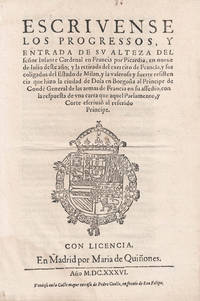
163614466Madrid: María de Quiñones 1636. 283x190mm. 11¼x7½". Madrid María de Quiñones 1636. En folio 283 x 190mm. 8 pp. Escudo grabado en la portada. Hojas sueltas. Primera edición. Relación de los sucesos del ejército español al mando del Cardinal Infante don Fernando de Austria en el norte de Italia y Francia en el contexto de la Guerra Franco-Española 1635-1659 durante la llamada "campaña de Francia" de 1636 un conjunto de operaciones militares desarrolladas por el ejército español tras la entrada de Francia en la Guerra de los Treinta Años; en concreto del sitio de Dôle ciudad francesa del departamento de Jura que resistió un asedio francés de más de dos meses. Dôle fue la capital del Franco Condado español hasta que Luis XIV conquistó la región el 6 de junio de 1674 y trasladó el parlamento de Dôle a Besanzón. A pesar de las dificultades económicas y logísticas a las que se tuvo que enfrentar para mantener la guerra con Francia y las Provincias Unidas 1636 fue un año de importantes victorias del ejército español derrotando sucesivamente a las tropas francesas en La Capelle Le Catelet Vervins y Corbie llegando hasta las puertas de París. Toda la familia real a excepción del monarca Luis XIII huyó de la ciudad ante la amenaza de las tropas españolas. OCLC registra solo 3 ejemplares BNE RAH y Universidad Complutense localizamos además ejemplar en la Colombina de Sevilla. OCLC registra 1 ejemplar en USA Universidades de Chicago. CBDRS registra ejemplar en el Palacio da Ajuda Lisboa. Se publicó una segunda edición en Valencia el mismo año. Papel ligeramente amarronado ligera mancha antigua en la esquina inferior. María de Quiñones unknown
16647286Bruxelles: Fopens 1664. Hardcover — Tapa dura. 128x74mm. 5x3". Ratisbona Mathias Kerner pero Bruxelles Fopens 1664. En 12º 128 x 74mm. 8 336 pp. 1 lámina plegada. Encuadernación de finales del siglo dieciocho o principios del diecinueve en tafilete rojo lomera cuajada de adornos dorados cabeza y cortes también dorados. Sátira contra la Liga Católica publicada originalmente en 1593. Dice Palau: "Contribuyó al fracaso de las aspiraciones de Felipe II al trono de Francia en oposición a Enrique de Borbón. No obstante el catolicismo francés se salvó sin duda por la intervención filipista que indujo al axioma "ParÃs bien vale una Misa". Los autores son Pierre Le Roy del Catholicon Gillot Passerat Rapia Florent-Chretien y Pithon". La Liga Católica fue un movimiento polÃtico armado de carácter católico de las guerras de religión de Francia cuyo objetivo era imponer el catolicismo como única religión y eliminar el protestantismo de Francia. Contaba con el apoyo del papa Sixto V los jesuitas la reina Catalina de Médicis y el rey Felipe II de España. Este partido católico se formó con el fin de contraponerse al Edicto de Saint-Germain 1570 y al Edicto de Beaulieu 1576 considerados ambos demasiado favorables a los protestantes. MagnÃfico ejemplar muy bien encuadernado. Fopens hardcover