848 résultats
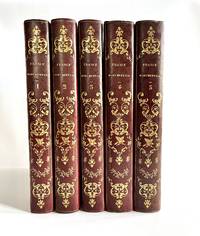
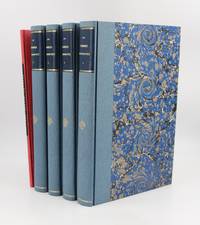
187883249Paris: Léon Vanier 1878. Fine. Léon Vanier Paris s. d. 1878-1899 & 1886-1892 19.50 x 28.50 cm 5 volumes reliés First edition of Les Hommes d'aujourd'hui 33 issues lacking out of 469. Five volumes bound in light blue half-cloth smooth spines blue morocco title labels decorated with double filets marbled paper boards 4 volumes. The color title pages have been preserved and bound in. Marginal tears without damage to the text no. 163; no. 165; no. 184 p. 2. Marginal restorations without damage to text on 8 leaves between nos. 214 and 223. Two leaves of no. 224 backed. Marginal tear with some paper missing no. 345 p.1. Format of quires in the first volume varies; some are trimmed more than others. First edition of Les Femmes du jour very rare complete collection in 11 issues published between 1886 and 1892 the last very rare Réjane issue appeared in 1892 six years after the other 10. Bound in half red cloth smooth spine midnight-blue morocco title labels framed in gilt gilt title lengthwise marbled paper boards. An impressive gallery of prominent 19th century women and men caricatured and described by the foremost avant-garde artists and writers of the time. Created by writer Félicien Champsaur and illustrator André Gill in 1878 this exceptional literary and satirical review was later directed by Léon Vanier the publisher of the Parnassiens poets from 1885 to 1899. Each issue is a portrait of a contemporary figure in the world of arts and letters politics science or technology. The full set includes 469 monographs written by some of the most provocative voices of the time: Jules Laforgue Gustave Kahn Joris-Karl Huysmans Jean Moréas Félix Fénéon. The only contributor Vanier ever paid for those written portraits was Paul Verlaine famously always short of money. Each issue includes on the front page a large and fine color lithographed caricature by artists such as Manuel Luque André Gill and Félix Régamey but also world-renowned painters: Toulouse-Lautrec Steinlen Pissarro Seurat Signac to name a few. The actress Sarah Bernhardt was so famous she appeared both in the men-issue Hommes d'aujourd'hui as well as one of the very rare women-issues Femmes du jour! The literary issues cover every school and movement of the second half of the 19th century including Buveurs d'eau Vilains bonshommes Hydropathes Parnassiens Naturalists Decadents Symbolists and Incohérents. There is also a number of avant-garde painters belonging to the Pont Aven school Schuffenecker Pissarro Emile Bernard Maximilien Luce the circle of the Montmartre Affichistes Chéret Willette Caran d'Ache Georges Auriol Job Steinlen as well as Post-Impressionnists Cézanne Toulouse-Lautrec Anquetin Pointillists Signac Seurat and Symbolists Redon. Musicians are also featured with fine portraits of Gounot Massenet Verdi Camille Saint-Saëns Rubinstein and Reyer. An exceptional and rare set bearing witness to the free spirit of 19th century French intellectuals and artists. Léon Vanier hardcover
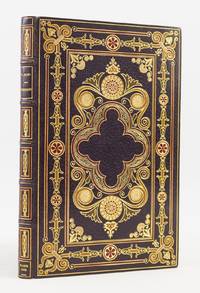
1830ST19754Paris: Mame et Delaunay-Valleé 1830. FIRST EDITION. 225 x 143 mm. 8 3/4 x 5 3/4". 2 p.l. vii 1 154 pp. 7 leaves ads. <br/> DAZZLING AUBERGINE CRUSHED MOROCCO ELABORATELY INLAID AND GILT BY GRUEL stamp-signed at foot of spine and on front turn-in covers inlaid to an Art Nouveau design of curving lines and botanical elements in red citron tobacco ivory and teal morocco raised bands spine compartments with tan morocco and gilt centerpiece BEAUTIFUL MOSAIC DOUBLURES with a complex Moorish lattice design in turquoise red and dark brown morocco and much gilt dark brown jacquard silk endleaves all edges gilt on the rough. In the matching suede-lined morocco-backed chemise and morocco-trimmed slipcase. Original paper wrappers bound in. Bibliotheque de M. René Descamps-Scrive II 423 this copy; Carteret II 399. A FLAWLESS COPY.<br/> <br/> This is the superb Descamps-Scrive copy of Hugo's revolutionary play in a binding by one of the great French masters—a bibliopegic achievement that reflects the play with its memorably exuberant and flamboyant style as seen particularly in the intricacy of its highly decorative doublures. When "Hernani" debuted on 25 February 1830 it caused a fierce argument among the audience--between the young Romantics led by Hugo's friend Théophile Gautier and the fans of classical theatrical styles--that became known as the Battle of Hernani. According to the Library of Congress "The clashes lasted several days and marked the triumph of romantic drama which dominated the stages of French theaters for years to come." Gautier would later reminisce: "February 25 1830! This date remains written in the depths of our past in flamboyant characters: the very first performance of Hernani! That evening decided our lives! It was there that we received the impetus which still drives us on after so many years and which will see us through to the end of our career." The binding here is as uninhibited by tradition and as over-the-top dramatic as the play with arresting design motifs inspired by Art Nouveau and Orientalism and with richly colored leathers that both contrast with and complement each other. In her "Bookbinders and their Craft" Prideaux says that the Gruel firm founded in 1811 "has always had the highest reputation . . . for initiative in artistic matters as well as for irreproachable execution in the detail of its many-sided achievements." Our binding stands as testament to the truth of this statement. The Gruel bindery was managed by several family members over the years most famously by Léon Gruel 1841-1923 and the list of binders who trained at the Gruel atelier is the most distinguished in Europe. Our binding was very probably done by Léon in the late 19th century for the famed French bibliophile René Descamps-Scrive 1853-1924 whose collection was as prestigious as Henri Beraldi's. Descamps-Scrive owned the volume in any case as it was auctioned after his death as part of his library at the Parisian gallery Georges Petit in May 1925 where it was lot no. 423 with full-page illustration. Like Beraldi Descamps-Scrive collected beautiful bindings that typified major styles and periods and was known for his insistence on acquiring only volumes in perfect condition. We have sold many fine bindings with elaborately decorated doublures but nothing quite like the ones seen here: they resemble a kind of fiery thicket although formed with rigorous control by a masterly binder. Mame et Delaunay-Valleé unknown
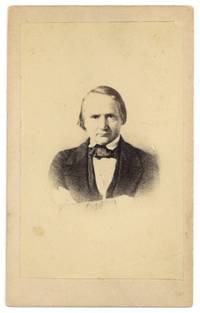
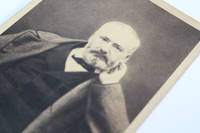
1860602666No place: no photographer 1860. Unbound. Near Fine. Albumen carte-de-visite photographic portrait of Victor Hugo. Image size 2.25" x 3.5" mounted on a slightly larger card No photographer identified. Small barely noticeable crease in bottom right corner of image else near fine. Subject noted on verso in pencil "V. Hugo" in unknown hand. The photograph depicts Hugo from mid-chest up looking forward. no photographer unknown
1889596042London: E. Ascherberg & Co 1889. Softcover. Very Good. Unknown edition. Folio. Three nested bifolia making 12 pages. Outer bifolium separated along the fold but both leaves are present middle bifolium with some separation at the top and bottom of the fold light edgewear some bumping to the corners and a name stamp on the front cover a complete and very good copy with the cover illustration bold and bright. An instrumental piece for piano. Plate imprint "E.A. & Co. 420." The music in this piece is from the production Ruy Blas and The Blasé Roué which was based off of Victor Hugo's play Ruy Blas. The musical opened in Birmingham and London in 1889 and was written by A.C. Toor and H.F. Clarke with music by Meyer Lutz. This piece has notes that correspond to scenes in the musical such as "Ladies Chorus 'Who ordered the sweeps'" and "Chorus 'Here's a jolly lark.'" OCLC locates only a single holding of this piece and it appears to be equally scarce in the trade. E. Ascherberg & Co unknown
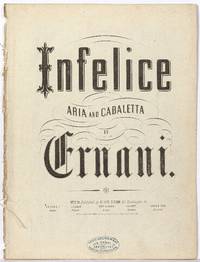
1855620621Boston: Oliver Ditson 1855. Softcover. Very Good. Sheet music. Folio. Two nested bifolia with a single-sheet-insert making ten pages. Notched and worn along the fold from once being bound within an album as a result the bifolia and insert remain bound together with page numbers stamped in the top right corners light offsetting and light soiling throughout and music shop stamp on the front cover still a complete and very good copy. For voice and piano. Plate number 7807. OCLC locates only a single holding of this 1855 edition. From the operetta Ernani based on the 1830 play by Victor Hugo Hernani. Oliver Ditson unknown
1896383053Portland Maine: Thomas B. Mosher 1896. Softcover. Fine/Very Good. First American edition. One of 925 copies printed on Van Gelder paper. Octavo. Printed wrappers with yapp edges glassine wrapper and slipcase. An unopened copy with the publisher's 1896 catalog: "Autumn List of Books" laid in. A fine copy in very good toned glassine wrapper with opened fleur-de-lis seal and fair only slipcase splitting at the edges. Bishop 15. Thomas B. Mosher unknown
1896383052Portland Maine: Thomas B. Mosher 1896. Softcover. Near Fine/Good. First American edition. One of 925 copies printed on Van Gelder paper. Octavo. Printed wrappers with yapp edges glassine wrapper and slipcase. An unopened copy with the publisher's 1896 catalog: "Autumn List of Books" laid in. Near fine in good moderately foxed glassine wrapper with opened fleur-de-lis seal and fair only slipcase lacking the lower flap. Bishop 15. Thomas B. Mosher unknown
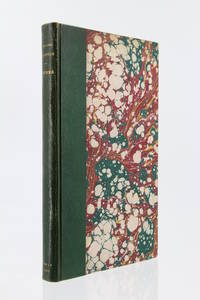
183578159Paris: Georges Decaux 1835. Fine. Georges Decaux Paris 1835 12.50 x 20 cm relié First edition printed in 100 copies. Bradel binding in half green Russian morocco smooth spine date and place gilt at foot pebbled paper boards marbled paper endpapers and pastedowns. One restoration to the margin of the title page using an adhesive piece. Rare and precious signed autograph inscription from Antoine de Latour ""A monsieur Victor Hugo hommage de tendre dévouement"" ""To Monsieur Victor Hugo tribute of tender devotion"" The inscription has been slightly trimmed missing the last letter of the word dévouement. Georges Decaux hardcover
186171163Paris: Pierre Petit 1861. Fine. Pierre Petit Paris s. d. 1861 6.20 x 10.20 cm une photographie contrecollée sur carton Medallion photographic portrait of Victor Hugo Paris 1861 62x102cm photograph mounted on card Original contemporary albumen print mounted on card. Notes on the back. The very first photograph of Victor Hugo with a beard. It was in January 1861 after a terrible sore throat that the writer decided to grow a beard: «I am growing a beard to see if it will protect me against throat-ache.» There are several references to the famous beard in Hugo's correspondence. «Conclusion: a man's head must be handsome well-touched with intelligence and illumined by thought in order to look well without a beard; a human face has to be very ugly indeed irredeemably deformed and degraded by the extreme thoughts of the vulgar life in order to be unattractive with a beard. Therefore let your beards grow you who are ugly and would be handsome instead!» Letter to an unknown correspondent 1845. As well as the aesthetic impact of this transformation there was a real thumbing of the nose at the Imperial state which had banned beards for teachers and professors. Pierre Petit unknown
186392149Paris & Leipzig & Bruxelles Brussels: Lib. internationale A. Lacroix & Verboeckhoven & Cie 1863. Fine. Lib. internationale A. Lacroix & Verboeckhoven & Cie Paris & Leipzig & Bruxelles Brussels 1863 14 x 21.50 cm 2 volumes reliés First edition. Contemporary half brown shagreen bindings spines with four raised bands framed by blind fillets gilt floral tools at head and tail marbled paper boards marbled endpapers and pastedowns bookplates mounted at the head of the pastedowns sprinkled edges. A few minor spots of foxing with press cuttings loosely inserted and leaving offsetting to the front endpapers of the first volume. Signed autograph presentation inscription by Jules Claye the printer of this work to Ferdinand Taillefer on the front of the first volume: "". souvenir typographique à mon ancien et excellent collaborateur."" Lib. internationale A. Lacroix & Verboeckhoven & Cie hardcover
188638317London: Dulau and Co. 1886. Illustrated Third Edition. Three titles bound together as one. PRESENTATION COPY inscribed and signed by this rather eccentric author. Thick octavo in original gilt decorated green cloth over bevelled edge boards. Front cover ruled in black with elaborate gilt emblem spine lettered in gilt gilt top edge. Illustrated with numerous engravings photographs and folding plates. Fraying at spine ends two inch tear in spine cloth. Front hinge starting. In need of some minor restoration. Internally very good. "Charles Ottley Groom Napier also known as C. O. G Napier FGS FLS 1839 - 1894 was a natural historian geologist mineral collector as well a writer on vegetarianism ornithology and an early proponent of British Israelism. He was most well known for his eccentric claims of ancestry."--Wikipedia . Signed. Hard Cover. Good. Dulau and Co. Hardcover
1885ABC_48556Paris 1885. 4to ca. 27 x 24.5 cm. J. Lemmonyer G. Richard and Cie E. Testard Contemporary gold-tooled red morocco with the title and author lettered in gold on the spine gold-tooled board edges and turn ins marbled end papers. Bound by the French bookbinder Louis Guétant 1848-1936 signed in the bottom turn in of the front board. With 30 full-page engravings on silk. 30 silk ll. Remarkable suite of plates for the plays of Victor Hugo 1802-1885 printed on silk and luxuriously bound. The engravings are beautifully drawn and capture the light in an entrancing way because of the sheen of the silk. The work starts with a portrait of Hugo by Achille Devéria 1800-1875 a painter and lithographer known for his portraits of famous authors. The other plates illustrate all 13 of Hugo's plays including his unfinished Les jumeaux and were made by various different artists.The plates were engraved for the "Edition nationale" a 43 volume work containing Hugo's complete oeuvre printed between 1885-1895. Five of the volumes were dedicated to his plays. This national edition was illustrated by some of the most important French artists of the time including Maurice Leloir 1853-1940 Adrien Moreau 1843-1906 and Georges Antoine Rochegrosse 1859-1938. The work was limited to a 1000 copies only available to subscribers. This included a luxury edition printed on Japanese paper which was limited to just 250 copies and came with an extra suite of plates printed on silk. The present work is most likely this extra suite of plates from the theatre volumes of the luxury edition.Victor Hugo was a French poet novelist and dramatist of the Romantic movement. He is considered one of the greatest and best-known French writers. His most well-known works are the novels Les Misérables 1862 and Notre-Dame de Paris 1831. He also earned respect as a campaigner for social causes such as the abolition of capital punishment.The present work comes from the library of Henry Baudet 1891-1921 a Dutch mathematician and chess player.With the bookplate of Henry Baudet mounted at the head of the front pastedown. The corners of the boards are very lightly scuffed the leather on the front and back is lightly scratched. The silk leaves are frayed at the head and foot margin not affecting the images the first engraving of the play Hernani has somewhat browned some engravings are slightly creased mostly in the margins. Otherwise in very good condition. ABE CAT Art History hardcover
187297606Adelaide: 'published by Superintendent of Club' 1872. First Edition. Hardcover. Very Good. Adelaide 'published by Superintendent of Club' 1872. Octavo viii 9-408 pages the last 8 being advertisements plus 2 frontispiece lithographs 'Present Bushmen's Home' and 'Proposed Bushmen's Home'. Flush-cut dark blue cloth over thin boards with the short title in gilt on the front cover; cloth lightly marked and rubbed at the extremities; spine a little sunned; inner hinges cracked but firm; very occasional foxing slightly heavier on the edges and endpapers; small light stain in the front gutter; an excellent copy. The name of the anonymous author a cousin of the somewhat more famous Victor is added in pencil on the title page. Ferguson 10643 recording only 'blue morocco cloth boards'. 'By 1866 a ravaging northern drought accelerated the need to succour bush workers who were often victims of their own excesses and were preyed upon between jobs. Hugo pressed for a "bushmen's home" like a seamen's home as a quiet sober refuge. Opposition came from those who saw it as a squatters' movement but his canvassing bushmen's subscriptions and philanthropic support enabled the home to open in Whitmore Square Adelaide in May 1870' 'Australian Dictionary of Biography'. 'published by Superintendent of Club' hardcover
187280725Adelaide: 'published by Superintendent of Club' 1872. First Edition. Hardcover. Very Good. Adelaide 'published by Superintendent of Club' 1872. Octavo viii 9-408 pages the last 8 being advertisements plus 2 frontispiece lithographs 'Present Bushmen's Home' and 'Proposed Bushmen's Home'. Original flush-cut dark green cloth with the short title in gilt on the front cover; cloth lightly marked and rubbed at the extremities with slight wear in a couple of places; spine a little sunned; inner hinges cracked but firm; endpapers a little marked with some scuffing and silverfish damage to the front flyleaf; small stain to the bottom edge bleeding very slightly into some bottom margins; very occasional foxing; three smallish areas on pages 167-70 lost to silverfish with two patches affecting some 25 words of text now supplied on an insert; a very good copy. A note dated January 1879 in pencil on the flyleaf gives some details of the anonymous author a cousin of the somewhat more famous Victor. Ferguson 10643 recording only 'blue morocco cloth boards'. 'By 1866 a ravaging northern drought accelerated the need to succour bush workers who were often victims of their own excesses and were preyed upon between jobs. Hugo pressed for a "bushmen's home" like a seamen's home as a quiet sober refuge. Opposition came from those who saw it as a squatters' movement but his canvassing bushmen's subscriptions and philanthropic support enabled the home to open in Whitmore Square Adelaide in May 1870' 'Australian Dictionary of Biography'. Provenance: P. Curzon Clement with his armorial bookplate on the pastedown. Peake 'Australian Personal Bookplates' 983 recording John Shirlow as the artist. 'published by Superintendent of Club' hardcover
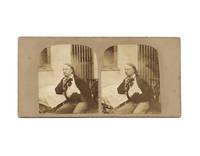
1853Hugo-Vacquerie<p><strong>HUGO VACQUERIE Auguste 1819-1895</strong></p><p>Period albumen prints in stereoscopic view<br />Jersey c. 1853-1855 75 x 65 cm on thick cardboard 85 x 175 cm<br />Nice contrasts despite some stains and flaws on prints see scans<br />Some flaw on cardboard<br />Pencil annotations on verso</p><p><strong>Nice portraits of the poet in a seated position leaning on a table in Marine Terrace</strong></p><p>These two prints show Victor Hugo seated leaning on a table on which a few scattered sheets can be seen. Behind him the wall of his house in Marine Terrace in Jersey where the exiled poet lived with his family from August 1852 to October 1855. We observe a slightly different pose of the subject on each of the two prints. Hugo seems more questioning on the first while he gives the impression of a more determined look on the second.</p><p>Attributed to Auguste Vacquerie these photographs could just as well have been taken by the poet's son Charles Hugo 1826-1871.</p><p>Two similar prints are kept in the collections of the Maison de Victor Hugo.</p><p>Nice contrasts. Rather uncommon for this era.</p><p>These prints do not appear in any of the works devoted to the poet's iconography.</p><p><u>Provenance:</u><br />Private collection</p> hardcover
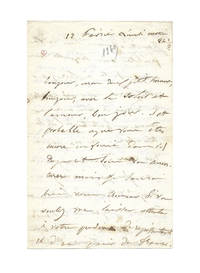
1849Juliette1<p><b>HUGO Juliette DROUET 1806-1883</b></p><p>Autograph letter signed " Juliette " to Victor HugoN.p 12 February 1849 4 pp. in-8°Collection stamp on first page</p><p><b>Fiery love letter to Victor Hugo with numerous erotic allusions</b></p><p><b><br /></b></p><p><i>"</i><i> Bonjour mon doux petit homme bonjour bonjour avec le soleil et l'amour bonjour.</i><b><i>Il est probable que vous êtes encore enfoui dans vos draps et sous vos couvertures mais je saurai bien vous trouver si vous voulez me laisser attenter à votre pudeur de représentant et d'ex pair de France.</i></b><i> J'ai été étonnée hier de la facilité avec laquelle vous avez consenti à sacrifier votre soirée pour une gueulardise au risque de vous ennuier comme un spectateur de l'ile de tohu-bohu. Ceci m'a prouvé que vous vous apparteniez un peu plus que je ne croyais et qu'il suffisait seulement de vous payer de la viande pour avoir vos faveurs <b>qu'à cela ne tienne je vous en fournirai de la viande et des chaires fraiches même si vous en usez</b>.</i><i>Puisque vous ne rougissez pas de mettre en action sur vous-même et par vous-même cette inf</i><i>â</i><i>me devise : <b>Exploitation de l'homme par l'homme… pour l'homme. Je demande à être votre complice. Je vous achète toutes vos soirées</b> à raison d'une b</i><i>â</i><i>frerie tragaldabesque pour chaque. Je m'y ruinerai mais </i><i>ç</i><i>a m'est égal. <b>D'ailleurs un peu plus t</b></i><b><i>ô</i></b><b><i>t un peu plus tard j'aime mieux que ce soit tout de suite. En tout j'aime le genre violent et expéditif</i></b><i>. <u>Courte</u>et bonne voilà comme j'entends la vie. Maintenant que je connais votre tarif je ne m'en priverai pas puisque mes moyens me le permettent. Je ne vous demanderai même pas de vous livrer au dessous du cours. <b>Je veux au contraire tout à la hausse rien à la baisse.</b>Juliette </i><i>"</i></p><p>Juliette Drouet is a French actress who was the companion of Victor Hugo for nearly fifty years. In 1833 while she was rehearsing the role of Princess Negroni in <i>Lucrèce Borgia</i> Victor Hugo noticed her. She abandoned her theatrical career to devote herself for the rest of her days to her lover. He will demand from her a cloistered monastic life and her outings will be made only in his company.</p><p><u>References:</u>This letter does not appear in <i>Lettres de Juliette Drouet à Victor Hugo</i>Digitally published in CÉRÉdI Université de Rouen-Normandie.</p><p><u>Provenance:</u>Henri Ledoux Collection</p>
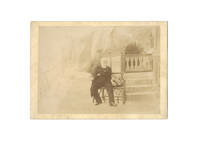
1882Hugo15<p><strong>HUGO QUINET Alexandre 1836-1900</strong></p><p>Original photography of Victor Hugo by Alexandre Quinet<br />Veules-les-Roses c. 1882 118 x 164 cm<br />Period albumen print mounted on yellow carton<br />Some light stains low contrasts</p><p><strong><u>From the Paul Meurice archives</u></strong></p><p><strong>Victor Hugo's only period print portrait at Veules-les-Roses at his friend's Paul Meurice</strong></p><p>This portrait can be dated to the year 1882 when the poet was 80 years old. Despite the great age the pose is both full of energy and derision. Hugo with his white beard and crossed arms appears more than ever as an unshakable patriarch.</p><p>Paul Meurice's house was located on the coast of Veules-les-Roses in Normandy. During his stays at his friend's house Victor Hugo stayed below the house in a small pavilion directly adjacent to the beach. This photo is taken on the promenade along the staircase of that same pavilion.</p><p>French novelist and playwright Paul Meurice 1818-1905 was one of Victor Hugo's loyal friends. When the latter died Meurice and the other great friend Auguste Vacquerie were named as his executors. In 1902 he set about building up a collection around his friend drawings manuscripts photographs in preparation for the opening to the public of his house on the Place des Vosges in Paris which was inaugurated on 30 June 1903.</p><p>Photographer's stamp on the back: Adre Quinet / Photographe / 42 rue Cadet Paris</p><p><u>Provenance:</u><br />Archives Paul Meurice</p><p><u>Iconography:<br /></u><em>Victor Hugo devant l'objectif </em>éd. Jean-Marc Gomis L'Harmattan 2018 p. 349 n°249</p>
1846DrouetHugo1<p><strong>HUGO DROUET Juliette 1806-1883</strong></p><p>Autograph letter signed " Juliette " to<u> Victor Hugo</u><br />N.p Paris 9th December 1846 " Wednesday morning " 10 h ½ " 4 p. in-4°<br />Central fold reinforced with Japan paper two letters affected two words crossed off by Juliette Drouet<br />Dry stamp "BR" on top left corner</p><p><strong>Superb unpublished letter to her lover Victor Hugo passionately evoking the reading that the latter gave her the previous evening of a chapter of his novel <em>Les Misères</em> which fifteen years later would become <em>Les Misérables</em></strong></p><p><em>" Bonjour mon cher bien aimé bonjour mon adoré petit Toto bonjour mon amour comment vas-tu ce matin as-tu eu bien froid cette nuit en rentrant chez toi j'ai bien regretté d'avoir éteint mon feu hier par distraction et dans un but d'économie. Si j'avais pu penser que tu rentrerais avec tes pauvres pieds mouillés j'aurais fait tout le contraire au risque de mettre le feu à la maison. Je te promets que la nuit prochaine tu auras du bon feu. <strong>Mon</strong> <strong>Dieu que c'est beau ce que tu m'as lu hier soir. J'en ai encore le cœur tout ému. Tu n'as jamais rien fait de plus grand de plus vrai de plus douloureux de plus doux de plus généreux et de plus consolant que ces premières pages de ton Jean Trejean. Tout y est</strong>. Depuis les plus grandes choses de la nature jusqu'aux plus petits détails de la toilette empire de Mlle Sylvanie depuis la dureté de cœur des bourgeois jusqu'à l'ineffable bonté du vieil évêque </em>M. Myriel<em> depuis les féroces préjugés du monde jusqu'à la morale si généreuse et si douce de Jésus-Christ</em>1<em>. <strong>Tu n'as rien omis rien oublié rien dédaigné. Et tout cela dans ton plus beau style et</strong> de ta <strong>plus sublime poésie</strong>… pardon mon Victor adoré pardon pour la ridicule page d'admiration que je viens de t'écrire. Il est permis au ciron</em> espèce d'acarien. Pascal dans sa pensée sur " Les deux infinis " le prend comme exemple de l'infiniment petit <em>d'admirer Dieu dans sa petite âme de ciron mais il n'est donné qu'aux aigles de s'en approcher parce qu'ils ont des ailes. J'aurais dû me borner ce matin à t'exprimer ma reconnaissance pour le bonheur immense que tu m'as donné cette nuit sans chercher à te traduire tout ce que j'ai éprouvé en t'écoutant </em>…<em>. Il y a une sorte d'ivresse du cœur qui fait que l'âme et l'esprit ont leur vertige comme le corps. C'est ce qui m'arrive dans ce moment-ci. </em>…<em> Laissez-moi donc vous dire en toute hâte que vous êtes mon cher petit toto que j'aime et que j'adore. Que je baise sur toutes les coutures que je désire et que j'attends de toutes mes forces et à qui je recommande de m'être bien fidèle de venir tout de suite et de m'aimer toujours.<br />Juliette. "</em></p><p>This letter allows us to fully appreciate the emotion experienced by Juliette following the visit the previous evening of her lover Victor who came to give her a reading of what was still only <em>Jean Tréjean</em> the novel that she has been recopying since the previous year. We can also guess at certain characters whose names were later changed. Thus without the final version of the novel Mademoiselle Sylvanie sister of Monseigneur Myriel here the "old bishop" becomes Mademoiselle Baptistine: "Mademoiselle Sylvanie sweet thin frail a little taller than her brother dressed in a puce silk dress a fashionable color in 1806 which she had bought at the time in Paris and which still lasted her …. Mademoiselle Sylvanie's dress was cut according to the 1806 patterns short waist narrow sheath sleeves with epaulettes with tabs and buttons."<br />As for Juliette if the analogies between her own youth and the character of Fantine are speculative we know with more certainty that she sensitized the writer to the question of poverty. She also contributed to collating the manuscripts copying them and participated in documenting Hugo particularly on life in convents. It was also Juliette who on December 13 1851 just a few days after Napoleon III's coup d'état joined Victor in Brussels with the famous "manuscript trunk" which contained all of the writer's works including the future <em>Les Misérables</em> two-thirds of which were completed.</p><p>The development of <em>Les Misérables</em> is well documented. Victor Hugo began the first drafts a year earlier in November 1845. The first title considered by the writer was then <em>Jean Tréjean</em> taken from the name of the main character who later became Jean Vlajean then Jean Valjean. In December 1847 the novel already largely written became <em>Les Misères</em>. The events of 1848 Hugo's activity as a politician during the Second Republic and the tribulations of exile were all obstacles to the completion of the work. Hugo was at the same time in the middle of writing<em> Les Contemplations</em>. Twelve years later in 1860 while he was in exile in Guernsey Hugo took up his pen again to complete his novel. Moreover there are no two different versions between the manuscript before the Revolution of 1848 and that of exile. The manuscript of <em>Les Misérables</em> is in this respect a manuscript of<em> Les Misères</em> corrected and expanded. The first volume was published on March 30 1862 by Albert Lacroix Verboeckhoven et Cie and four days later in Paris. Parts two and three were published on May 15 parts four and five on June 30. Although reactions were mixed success was immediate.</p><p>1 The bourgeois of Senez mock Monseigneur Myriel who rides a donkey. "Mr. Mayor" said the bishop "and gentlemen bourgeois I see what scandalizes you you find that it is indeed pride for a poor priest to ride a mount that was that of Jesus Christ." Monseigneur Myriel invents examples and "parables going straight to the point with few sentences and many images which was the very eloquence of Jesus Christ convinced and persuasive." <em>Les Misères</em></p><p><u>Provenance:<br /></u>Private collection</p><p><u>Sources:<br /></u><em>Les Misérables </em>éd. Maurice Allem Pléiade 1951 VIII-XVII<br /><em>Les Misères</em> éd. de Guy Rosa consultée sur son site à <em>groupugo.div.jussieu.fr</em></p><p>We thank Florence Naugrette for the information she kindly provided to us.</p>
18332052726Paris: Chez Delloye 1833. Hardcover. Good/No Jacket. Five volumes half leather over marbled boards. Front board of fist volume is detached but present. French military history up to 1833 illustrated with hundreds of steel engravings illustrations and charts written by Victor Hugo's brother. Moderate foxing. Chez Delloye hardcover
18353435Paris: Chez Delloye Editeur de la France Militaire 1835. Hardcover. Good. viii 320 pages. 7 x 11 in. high. Quarter calf over mottled boards with gilt titles on spine. Condition of book is GOOD; Leather ripped at edges at top & bottom of spine heavy wear to edges of covers one corner missing all maps & illustrations are present some with light foxing but most are very clean & bright. Chez Delloye, Editeur de la France Militaire hardcover
183412139Paris: Perrotin 1834. Relié. Etat satisfaisant. in-8. Charlet. 479 pp. Reliure carton avec couverture montée accrocs. La page de garde indique 1833 et le 1er plat 1834. Auteur et titre manuscrits sur le dos. Quelques rousseurs. Perrotin unknown
183684668A Paris: Chez Delloye 1836. Fine. Chez Delloye A Paris 1836 - 1843 18 x 27.50 cm 5 volumes reliés First edition illustrated with 424 plates and more than 700 figures of monuments costumes historical scenes maps. The last volume on contemporary history added later ends in 1842. Contemporary half cherry red glazed calf. Smooth spine decorated with rococo tools and a central bird tool. Some rubbing. Overall relatively clean and fresh with occasional light foxing on the first 3 volumes the last two with scattered foxing and yellowed signatures with some browning at the end of volume 5. In volume 3 from p.91 to 96 brown dampstain at lower corner. Handsome copy rare in this condition. Armorial bookplate heightened in colors of Paul-Emile Cadilhac man of letters editor at L'Illustration notably for ""Demeures et sites romanesques"". While this history of France remains interesting to read it is full of curious anecdotes and erudition and Hugo was a skillful compiler it is much more interesting from a geographical point of view human and physical and gives a proper panorama of France in 1834 with numerous statistics. The work possesses above all very rich iconography notably of all the monuments of France even those that have disappeared such as the château de Richelieu or the abbey of Cluny. Chez Delloye unknown
183586155Paris: Chez Delloye 1835. Fine. Chez Delloye Paris 1835 18 x 28 cm reliés First edition 470 engraved plates including 363 views and portraits 94 departmental maps 8 city plans one table as well as 3 folding maps of France. and most importantly the 1834 Paris map by Monin almost always missing in volume 3. Contemporary half-blonde calf bindings. Smooth spine decorated with series of fillets tail roll. Black calf title and volume labels. Surface abrasions on the spines. Head caps of volumes 2 and 3 partially slightly worn. A few rare and pale scattered foxing marks on an otherwise clean and fresh set. While this history of France remains interesting to read it teems with curious anecdotes and erudition and Hugo was a skillful compiler it is much more interesting from a geographical standpoint human and physical and provides a proper panorama of France in 1834 with numerous statistics. The work possesses above all a rich iconography notably of all the monuments of France even those that have disappeared such as the château de Richelieu. Furthermore the last volume concludes with the description of the state of Algiers Senegal Île Bourbon the French colonies in India the French Antilles Guyana Madagascar. Chez Delloye unknown
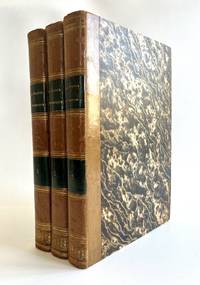
1835848B32Paris: Chez Delloye 1835-1838. Leather. Good. 11" by 7". Not Stated . A complete three volume set of France Pittoresque richly illustrated and with folding maps. A complete three volume set. In the original French. These three volumes contain picturesque topographic and statistical descriptions of the colonies and departments of France. Exploring the history antiquities topography natural history politics of each area. With additional notes on languages idioms and local biography accompanied by the general statistics of France by Abel Hugo. The first volume is dated 1838 and the other two are dated 1835. The volumes are extensively illustrated. The first volume has three folding maps and the third volume has one folding map and other illustrations throughout the volumes. Collated complete. In quarter calf with marbled boards. Externally smart with rubbing to the spines and some marks to the boards. Previous owner pencil inscription to the page before the half title page. Internally all are firmly bound with bright pages with just some scattered spots to some of the pages as usual. Good Chez Delloye hardcover
183563886Paris: Chez Delloye 1835. Fine. Chez Delloye Paris 1835 18.50 x 27.50 cm 3 volumes reliés First edition illustrated with 471 engravings including 4 folding plates. Binding signed by Desloge. Contemporary half blue calf bindings smooth spines decorated with gilt dentelle roulettes and fillets publisher's signature at foot of first volume marbled paper boards. Some corners slightly bumped headcaps rubbed occasional foxing. Chez Delloye hardcover