STENDHALBiblio.com
54 résultats
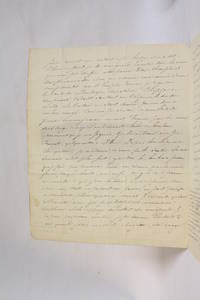
1808689671808. Fine. 26 mars 1808 20 x 24.80 cm 3 pages 1/2 sur un double feuillet Long autograph letter by Stendhal addressed to his sister Pauline written in fine handwriting with black ink. Address of Stendhal's father where his sister resides in Grenoble with the stamp ""n°51 Grande Armée."" Red wax seal bearing Stendhal's coat of arms. Several original folds inherent to postal delivery. A paper loss due to the unsealing of the letter has been skillfully restored. Published in his Correspondance ed. Henri Martineau Paris Le Divan 1933 vol. 3 no. 262 A pp. 26-29. A very beautiful letter filled with romantic passion blending childhood nostalgia with sentimental tales and foreshadowing The Red and the Black. This letter is part of the correspondence between twenty-five years old Henri Beyle and his sister Pauline three years his junior. This epistolary relationship which quickly took the form of a ""journal"" as Pauline's responses were rare. It is deemed a crucial milestone in the intellectual development of the future Stendhal: ""Here are my dreams my dear friend; I am almost ashamed of them; but after all you are the only person in the world to whom I dare confess them."" In this letter which attests to the strong bond between brother and sister Stendhal then in Germany expresses his deep nostalgia: ""I revisited in my memory all the time we spent together: how I did not love you in our childhood; how I once hit you at Claix in the kitchen. I hid in the little book cabinet; my father came back a moment later furious and said to me: 'Wicked child! I would eat you!' Then all the woes inflicted upon us by poor Aunt Séraphie; our walks along those paths surrounded by stagnant water towards Saint-Joseph."" These regrets about the past are accompanied by a typically Stendhalian melancholy: ""Alas! That delightful happiness I once imagined I glimpsed it once at Frascati and a few other times in Milan. Since then it has not returned; I marvel at my inability to feel it. The mere memory of it is more powerful than all the present joys I can procure."" This evocation of the Italy he longs for is intertwined with memories of the women he loved: ""I told you that while in Frascati at a charming fireworks display at the moment of the explosion Adèle leaned on my shoulder for an instant; I cannot express how happy I was. For two years whenever I was overwhelmed with sorrow this image gave me courage and made me forget all my troubles. I had long forgotten it; I tried to recall it today. Against my will I see Adèle as she is; but as I am now there is no longer the slightest joy in this memory."" This lengthy account of Adèle Rebuffet his cousin with whom he had a profound romantic relationship before forming a closer bond with her mother reflects Stendhal's sentimentality. He also mentions another of his great passions Angelina Pietragrua the ideal Italian woman and embodiment of his Milanese memories: ""Madame Pietragrua is different: her memory is linked to that of the Italian language; whenever something pleases me in a role for a woman in a work I involuntarily put it into her mouth."" This ""role for a woman"" that Stendhal refers to echoes the central theme of this letter the work Il Matrimonio segreto by composer Cimarosa: ""Do you sometimes play the Matrimonio Its the passage Cara sposa at the beginning between Carolina and Paolino. . But play the Matrimonio for my sake especially Signor deh permettette and the finale Io rival de mia sorella."" This opera by Cimarosa remained a constant throughout the writer's life and work. In his Memoirs of an Egotist 1832 he explains: ""In Milan in 1820 I wanted to have this written on my tomb . I wanted a marble tablet in the shape of a playing card: ""Errico Beyle - Milanese - Visse scrisse amò - Quest'anima adorava Cimarosa Mozart e Shakspeare - Morì di anni. il . 18."" ""Henri Beyle - Milanese - He lived wrote loved - This soul adored Cimarosa Mozar unknown
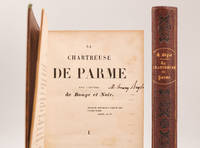
183989931Paris: Ambroise Dupont 1839. Fine. Ambroise Dupont Paris 1839 13 x 21.7 cm 2 volumes reliés sous étui First edition printed on thick wove paper. Bound in contemporary half brown shagreen smooth spines decorated with black typographic motifs marbled paper boards hand-marbled endpapers and pastedowns modern slipcase edged in brown morocco with matching marbled paper sides and olive-green felt lining. Some occasional foxing the note ""Henri Beyle"" in black ink at the upper corner of the title page of the first volume without the final catalogue leaf at the end of the second volume small corner restorations to four leaves of the first volume. ""Very rare and extremely sought after. Usually quite simply bound at the time. Often foxed"" Clouzot. ""This work is of great rarity in fine condition"" Carteret. A handsome and very rare copy large-margined and attractively bound at the time of this masterpiece by Stendhalrarer still than Le Rouge et le Noir. Ambroise Dupont hardcover
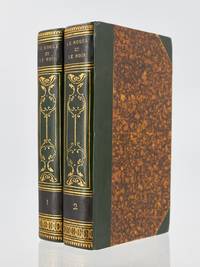
183187102Paris: A. Levavasseur 1831. Fine. A rare copy with no foxing A. Levavasseur Paris 1831 13.10 x 20.80 cm 2 volumes reliés First edition ""very rare and extremely sought-after"" Clouzot one of 750 copies on laid paper with title vignettes engraved by Henri Porret after Henry Monnier. Skilful restoration of a tear at the foot of a page with slight damage to a letter. A rare copy with no foxing. Green half calf binding smooth spines with arabesques stamped in gilt black title labels and volume labels; marbled paper boards spine boards and endpapers speckled edges later bindings in the Romantic style. Stendhal began writing 'Le Rouge et le Noir' under the Restoration and completed it just four months after the July Revolution of 1830. The seminal novel was published in the last weeks of 1830. All critics immediately praised the novel's exceptional qualities although even its most enthusiastic supporters were shocked by the hero's harsh judgment of society and Jacobinism. A handsome first-edition copy of this great classic of French literature. A. Levavasseur hardcover
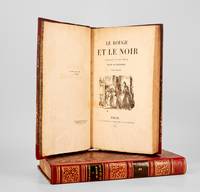
183188395Paris Paris: A. Levavasseur 1831. Fine. First edition in contemporary binding of one of the rarest and most sought-after Romantic novels A. Levavasseur Paris Paris 1831 14 x 22 cm 2 volumes reliés First edition untrimmed with wide margins very rare and highly sought-after see Clouzot. Some occasional foxing. Illustrated on the title pages of both volumes with two engraved vignettes by Porrêt. This copy contains the publishers notice leaf in the first volume and the authors note leaf in the second volume. Contemporary red half calf over marbled boards calf corners spines ruled in gilt with double gilt panels decorated with typographic gilt tooling black calf title and volume labels some minor rubbing to joints marbled endpapers and pastedowns lower corners a bit worn bookplate pasted on the front pastedown of volume one contemporary bindings. A very rare and desirable copy entirely untrimmed and preserved in a handsome contemporary binding an even rarer feature. As noted by Clouzot: Contemporary bindings are most often rather plain; one should not be overly particular regarding their quality. A. Levavasseur hardcover